Table of Contents
- Dawn in Philadelphia: A City on Edge in 1787
- From War to Fracture: The Confederation’s Unraveling
- Calling the Convention: Mandate and Misgivings
- The Hall and Its Heat: Summer in Independence Hall
- Opening Gambits: The Virginia Plan and Its Challengers
- Voices that Carved the Frame: Madison, Wilson, Hamilton
- The Great Compromise: Seats, States, and Survival
- Three-Fifths and Shadows: Bargains with a Troubled Conscience
- Executive Enigma: Forging the Presidency
- Judicial Architecture: Courts for a New Republic
- Federalism Defined: The Division of Sovereignty
- Pen, Quill, and Clause: Drafting the Final Text
- Signing Day: September 17, 1787 — Hands and Hesitations
- The Dissenters: Voices That Withheld Their Names
- Spreading the Parchment: Ratification Wars in the States
- Federalist Firepower: Essays That Won the Argument
- From Promise to Protection: Crafting the Bill of Rights
- Consequences at Home and Abroad: Model, Mirror, and Warning
- Memory, Myth, and the Scene We Cannot Photograph
- A Living Echo: Crises, Amendments, and the Unfinished Work
- Conclusion
- FAQs
- External Resource
- Internal Link
Article Summary: On September 17, 1787, a parchment on a wooden table transformed from draft to destiny in a moment known as the signing of the united states constitution. This article traces the journey to that day—through the failures of the Articles of Confederation, the blistering debates of the Constitutional Convention, and the fragile compromises that created a new federal framework. We move room by room through the summer heat of Philadelphia, pausing over the unquiet bargains on representation, slavery, and the shape of the presidency. The narrative follows the signatures and the silences—the hands that wrote their names and the voices that refused—and the long battle that followed in the newspapers and town halls of a restless nation. We consider how the signing of the united states constitution launched a global conversation about rights, sovereignty, and the rule of law, while leaving unresolved contradictions that would echo for generations. Along the way, we hear from the delegates themselves in their own words, tracing the anxiety, ambition, and idealism that swirled over the green baize table. Finally, we weigh the legacy of that September day and explore how the document they forged continues to be amended, contested, and renewed in our time.
Dawn in Philadelphia: A City on Edge in 1787
Morning light slid across Philadelphia’s brick facades and cobbled streets, stirring the city to a summer rhythm that had grown heavy with anticipation. Carriages clattered toward Chestnut Street where Independence Hall, squatting in red brick gravity, kept its secrets behind shuttered windows. For four months the city had played reluctant host to arguments that seemed to topple the air itself—questions so basic that they pried under the floorboards of daily life: Who truly governs? What is liberty worth in the marketplace of power? As the delegates threaded through the narrow streets in their powdered wigs and rumpled linen, people wondered if they were witnessing a birth or a burial. Even before the signing of the united states constitution, the mood was like that of a sickroom at dawn, when the patient either turns toward life or slips away. They arrived in small knots—Washington, stoic and towering; Franklin, leaning on a sedan chair borne by convicts in livery; Madison, with folded papers and a relentless gaze, ready to record. The city pressed in: smithies and tannery smells, the river’s brackish breeze, coffeehouses that turned rumor into thunder. Philadelphia had once been the empire’s brightest provincial star; it now became a forge where a new alloy of government might just find its shape. Yet behind the calm faces, tremors ran. The Articles of Confederation were failing, creditors were knocking, and the ghost of anarchy had begun to whisper through farm fields and countinghouses alike. In this early hour, the hall’s bell seemed poised over history’s anvil.
From War to Fracture: The Confederation’s Unraveling
The American Revolution had delivered independence, but not coherence. Under the Articles of Confederation, the states were bound by a threadbare rope—too weak to pull the common load, too knotted to untangle. Congress could request funds but not compel them; it could sign treaties yet could not ensure obedience to their terms. Merchants watched their ledgers bleed as states raised rival tariffs and minted competing currencies. Western lands promised opportunity but also chaos, as settlement outran governance. Shays’s Rebellion in Massachusetts—farmers taking up arms against debts and seizures—rattled the eastern cities and gave new resonance to fears of a republic coming apart at the seams. Washington, the reluctant Cincinnatus, wrote of “anarchy and confusion” stalking the land. Across the Atlantic, European observers smirked that the new nation had learned to fight but not to rule. It is astonishing, isn’t it, how a confederation crafted to protect liberty threatened to smother it beneath parochial self-interest? The path toward the future would be neither quick nor gentle, but by 1787 enough had agreed on a first principle: they needed something stronger, a framework that could tax, regulate, defend, and speak with a single voice. The journey to the signing of the united states constitution began, paradoxically, in the confessions of failure.
Calling the Convention: Mandate and Misgivings
The call for a convention came wrapped in ambiguity. Officially, the delegates were to revise the Articles; unofficially, many arrived determined to replace them. Alexander Hamilton dreamed in systems; James Madison dreamed in structures and safeguards; George Washington, his war-worn caution intact, agreed to preside, lending the enterprise a legitimacy mere words could not. States selected delegates with varying enthusiasm: some sent their brightest political anatomists; others sent placeholders; Rhode Island, suspicious of central power, declined entirely. The mandate’s vagueness provided both camouflage and courage. As they gathered in May, the plot of reform thickened into the possibility of reinvention. Would they dare to go beyond instructions? Could a single room claim the right to redraw sovereignty itself? The stakes were mortal—if they chose too boldly, the union might splinter; if too timidly, it might decay. Madison arrived armed with research on ancient confederacies and modern parliaments, carrying a quiet conviction that only a compound republic could secure liberty without dissolving into faction. These opening days laid the rails for a train that would, in September, thunder into the moment of the signing of the united states constitution, a moment still unthinkable to many as the summer began.
The Hall and Its Heat: Summer in Independence Hall
Independence Hall was both stage and crucible. Heavy curtains sealed the windows to prevent eavesdropping; the air grew thick with candle smoke and perspiration. Delegates dabbed at their brows, fanned themselves with papers, and drank bowls of punch in the evenings to unknot the day’s rancor. The green baize table at the front, where Washington sat, took on the aura of an altar. Even the furniture acquired personalities: chairs creaked their disapproval; quills scratched a percussive counterpoint to human voices. Privacy bred frankness. Fears and ambitions that might have gone half-spoken in public now erupted. Franklin deployed wit as a tincture against bitterness, reminding them that “we must all hang together, or most assuredly we shall all hang separately.” Outside, Philadelphia hummed with speculation. Sarah Bache, Franklin’s daughter, heard whispers in the market: Are they building a king? Are they carving up the states? In this furnace of secrecy and breath, time ripened toward decision. The signing of the united states constitution would one day give the room a famous silhouette, but in the summer of 1787, the shape of the future was still being blown, glass-like, in the heat of unresolved questions.
Opening Gambits: The Virginia Plan and Its Challengers
On May 29, Edmund Randolph, lanky and earnest, rose to present the Virginia Plan, the opening move in a game of constitutional chess. It proposed a national government with three branches, a bicameral legislature based on population, and a broad grant of power. It was radical and, to some, threatening. Smaller states bristled at a scheme that would erase their equal voice; skeptics warned of a new tyranny. The New Jersey Plan emerged in rebuttal, defending state equality and a more modest revision of the Articles. For weeks, the room became a seesaw: on one side, the urgency of effective national power; on the other, the dignity of state sovereignty. Gouverneur Morris’s eloquence flashed like steel; Roger Sherman, sturdy and practical, sought middle paths. Madison argued that republican government required the large republic’s filtering effects, while opponents countered that a consolidated national power invited corruption. These debates sculpted the battle lines that would, months later, still haunt the signing of the united states constitution. Even as tempers flared, a realization crept in: no single plan would survive intact; compromise wasn’t surrender but the only currency that bought legitimacy.
Voices that Carved the Frame: Madison, Wilson, Hamilton
Some men shaped the debates with honey; others with hammerblows. James Madison, slight and soft-spoken, possessed an architect’s patience. He recorded and reasoned in equal measure, speaking not to dazzle but to build. His fear was faction—those combustible combinations of interest and passion. In his notes and later in Federalist No. 10, he argued that a large republic could balance factions the way a vast sea disperses storms (Madison, Notes, June 1787). James Wilson of Pennsylvania, Scottish by birth and intensely learned, advanced a bold vision of popular sovereignty, insisting that “We the People” were not a flourish but a foundation. Alexander Hamilton, with volcanic energy, pushed for a muscular national government and a strong executive, sometimes startling his colleagues with proposals that felt monarchical. He lost many battles inside the hall but would later win them on paper. Behind these luminaries stood dozens whose labor was less heralded but essential—George Mason’s principled independence, John Rutledge’s legal acumen, and Elbridge Gerry’s skeptical eye for excess. In their friction and fellowship, the architecture of agreement began to emerge, pressing toward the day of the signing of the united states constitution like a ship finding its current.
The Great Compromise: Seats, States, and Survival
Representation was the quicksand on which the whole edifice threatened to sink. Large states demanded seats in proportion to people; small states insisted on equal votes to protect their sovereignty. The debates dragged and darkened. Threats of walking out fluttered around the hall like trapped birds. Then, in July, came the compromise: a bicameral legislature with a House of Representatives apportioned by population and a Senate that would grant equal seats to each state. Roger Sherman and Oliver Ellsworth acted as midwives to the idea, dressing principle in the clothes of practicality. It was not elegant; it was essential. With this, the ship moved off the sandbar. The agreement did more than solve arithmetic; it taught the convention how to bargain under the stigma of failure. Without it, there would have been no document to sign, no moment in September when ink would fix ambition to parchment. The Great Compromise gave bones to a body that otherwise might have remained vapor, and it set a pattern: when interests collide, seek a structure that allows them to coexist rather than to conquer. The eventual signing of the united states constitution would bear this compromise like a spine.
Three-Fifths and Shadows: Bargains with a Troubled Conscience
But if the Great Compromise formed a spine, the question of slavery revealed a heart disease. Delegates circled the issue with anguish, calculation, and evasion. Southern states wanted enslaved people counted for representation; northern delegates recoiled at the hypocrisy. Out of this moral fog came the three-fifths compromise: enslaved persons would count as three-fifths for apportionment. It was a formula both arithmetical and abhorrent, an equation that stained the new charter from its birth. The convention also permitted the slave trade to continue until 1808 and established a fugitive slave clause. Some, like George Mason, thundered against the trade; others warned that without these concessions, the southern states would not join. Franklin, nearing the end of his life, watched in grave silence as the hall bartered with its ideals. The signing of the united states constitution would seal these bargains into law, preserving a union but entrenching an injustice that future generations would pay for in blood. The delegates did not resolve the contradiction; they institutionalized it. And yet, even in this darkness, some hoped the framework might contain mechanisms for reform. The Constitution, to be signed in September, would be both a promise and a postponement.
Executive Enigma: Forging the Presidency
What sort of executive could command respect without devouring liberty? The shadow of monarchy hung over every suggestion. Some wanted a plural executive, a committee to dilute the temptations of power; others argued that decisiveness required a singular figure. Tenure, powers, selection—each question tugged the room in different directions. If Congress chose the president, would he become its captive? If the people chose, could demagoguery prevail? The Electoral College, a contrivance of federalism and fear, emerged as a compromise: states would appoint electors, and a candidate would need a majority from them to win. The president would have a qualified veto, a role as commander-in-chief, and the duty to “take Care that the Laws be faithfully executed.” Hamilton pressed for vigor; Madison sought balance; Wilson demanded accountability. Their synthesis would give the new government a heartbeat and a face. The signing of the united states constitution would imprint these answers in ink, leaving to future centuries the task of testing the office against crises unknown. They could not foresee all: civil war, industrial expansion, world wars, or the nuclear age. But they understood that constitutional design is a wager—on character, on caution, and on the patient friction of separated powers.
Judicial Architecture: Courts for a New Republic
The judiciary received less heat than the legislature or the executive, but its quiet power was no less revolutionary. A Supreme Court would crown the system, with Congress authorized to create inferior courts. Life tenure during good behavior was meant to insulate judges from political storms, while jurisdiction over federal questions promised uniformity across a sprawling union. The specter of judicial review—courts striking down unconstitutional laws—hovered but was not explicitly inscribed. Yet the logic was there, embedded in the supremacy of the Constitution and the duty of judges to apply it. James Wilson and others laid the intellectual tracks; years later, Chief Justice John Marshall’s opinion in Marbury v. Madison would drive the train. In September 1787, however, the contours were enough: a court strong enough to guard the boundaries of power but not so strong as to govern outright. The signing of the united states constitution would set this architecture under seal, handing to jurists the delicate tools of interpretation. The founders left us not a code but a conversation, expecting future justices to join the debate and, sometimes, to prune the overgrowth of transient majorities.
Federalism Defined: The Division of Sovereignty
Between the national and the state governments, power would be divided, not layered; shared, not swallowed. The Constitution assigned enumerated powers to the federal level—taxation, regulation of commerce, war and peace—while reserving others to the states and the people. It was an experiment in dual sovereignty, the constitutional equivalent of a delicate ecosystem. To critics, it looked like a riddle: who decides when lines blur? Proponents argued that competition between governments would safeguard liberty by offering multiple avenues of redress. The Necessary and Proper Clause became a focal point—broad enough to empower, vague enough to terrify. The Supremacy Clause, clear and stern, announced that this new charter would be the highest law of the land. Such ideas demanded more than parchment; they needed fidelity. That fidelity would be publicly pledged at the signing of the united states constitution and later tested in the crucible of ratification. Federalism, like a well-tempered instrument, would produce harmony only if tuned and played with restraint. History would compose the rest.
Pen, Quill, and Clause: Drafting the Final Text
As August shaded into September, the Committee of Style took up its work, with Gouverneur Morris acting as lead stylist. He recast clauses into a cadence that still rings: “We the People of the United States, in Order to form a more perfect Union…” It was not merely grammar; it was a declaration of authorship. “We the People” replaced a listing of states, proclaiming that sovereignty flowed upward from citizens, not downward from governments. Ellipses of meaning were tightened; loose threads were tied. Compromises reached in hot debate were translated into cool prose. The Preamble, brief and majestic, became the Constitution’s overture. Elsewhere, mechanics ruled: dates for elections, rules for impeachment, the process for amendments. Franklin listening, smiled at the sun carved on the back of Washington’s chair; he later said he had long wondered if it were a rising or a setting sun. By the end, he concluded it was rising. The draft, taller now, lay on the table like an invitation. The signing of the united states constitution was no longer a hypothesis. It was a ceremony drawing near, with all its gravity and grace.
Signing Day: September 17, 1787 — Hands and Hesitations
The morning of Monday, September 17, turned cool under a pale sky. Delegates filed into the chamber, more solemn than triumphant. Washington, steady at the front, presided over final touches. Then came the moment. One by one, they approached the table to write their names beneath a text that would claim to speak for millions. There were only thirty-nine signers out of the fifty-five who had attended at some point. Some had left early; some withheld assent in principle. Franklin, now eighty-one, produced a speech asking that dissent be set aside for the sake of union; too frail to deliver it, he enlisted James Wilson to read. “I consent, Sir, to this Constitution because I expect no better,” it declared, “and because I am not sure that it is not the best.” The room absorbed the words like a balm. Then the quills scratched. It was the signing of the united states constitution—ink blotting into parchment, titles shrinking into signatures, disagreements preserved beneath a common pledge. The parchment did not glow; trumpets didn’t sound. Yet something changed in the room’s gravity, the way air feels when a storm passes. Washington, careful as always, recorded little emotion, but a witness later recalled tears in Franklin’s eyes. As the door opened to let in Philadelphia’s noise, the Constitution moved from secret debate to public fate.
The Dissenters: Voices That Withheld Their Names
Absence can be as eloquent as presence. Three men who remained at the end refused to sign: Edmund Randolph, George Mason, and Elbridge Gerry. Mason objected to the lack of a bill of rights; he also feared the blending of powers and the risk of a standing army. Gerry distrusted the potential for corruption; Randolph, despite having introduced the Virginia Plan, balked at the final form. Their dissent reminds us that unity did not erase principle. Outside the hall, larger-than-life critics sharpened their pens. Patrick Henry smelled danger in every clause; in Virginia’s ratifying convention he thundered against the possibility of consolidated despotism. The Constitution’s friends would have to win not merely votes but hearts, persuading a skeptical public that imperfect architecture could still house liberty. The signing of the united states constitution did not end the argument; it began it anew, transferring the debate from a closed chamber to the open theater of the states. Dissent would prove catalytic, extracting promises and shaping amendments. In a republic, even refusal can plant seeds.
Spreading the Parchment: Ratification Wars in the States
With signatures drying, the document embarked on a second voyage—through newspapers, taverns, and packed halls. Ratification required nine states, and the early returns were mixed. In Pennsylvania, the federalist majority pushed proceedings quickly, prompting charges of steamrolling. In Massachusetts, the painful memory of Shays’s Rebellion was fresh, but so too was the fear of central power. There, a grand bargain emerged: ratify the Constitution now, and press later for a bill of rights. The solution became a template, carrying New Hampshire, Virginia, and eventually New York. Debates cut to the bone of human concern: Would the new taxes crush farmers? Would distant courts strip away local justice? Could a president become a king in all but name? Preachers thundered from pulpits; printers hurried to keep pace with polemics. The signing of the united states constitution became a rallying symbol for supporters and a red flag for opponents. Each state brought its own geography of fear and hope, yet a pattern formed: where commerce demanded order and safety from foreign humiliation, federalism found friends; where frontier independence and local identity ran strongest, suspicion rose like a wall. By summer 1788, the ninth state, New Hampshire, tipped the balance. The Union had its charter.
Federalist Firepower: Essays That Won the Argument
The fiercest weapons of the ratification struggle were words. In New York, where opposition was stiff, three authors—Alexander Hamilton, James Madison, and John Jay—launched a campaign of essays under the pseudonym Publius. The Federalist Papers dissected republican theory with surgical intelligence and relentless energy. Federalist No. 10 mapped the peril of faction; No. 51 explained checks and balances; others defended the new powers enumerated under the Constitution and calmed fears of overreach. Hamilton wrote like a cavalry officer—charging, persuasive, at times audacious; Madison wrote as a calm scholar, forging logical chains; Jay, when illness permitted, offered the foreign-policy wisdom of a seasoned diplomat (Hamilton, Federalist No. 78). The essays spread beyond New York, becoming a kind of national seminar in constitutional mechanics. They did not merely defend; they educated, knitting a vocabulary for citizenship. For many, the signing of the united states constitution was the start of the argument; The Federalist was its most sophisticated reply. These papers would echo across centuries, offering future generations a lens through which to read the Preamble’s promise and the articles’ machinery.
From Promise to Protection: Crafting the Bill of Rights
Victory in ratification carried a debt: to enshrine protections that would calm Anti-Federalist dread. James Madison, once skeptical of enumerating rights, became their chief steward in the First Congress. Drawing from state declarations and public petitions, he distilled a list that shielded speech, religion, assembly, and press; secured due process; and protected against unreasonable searches and cruel punishments. The amendments would also speak to federalism, reserving undelegated powers to the states and the people. In 1791, ten amendments were ratified—the Bill of Rights transforming abstract liberty into enforceable claims. It was a promise kept and a horizon extended. In retrospect, the bill reads like a dialogue with the anxieties of 1787, an implicit commentary on the debates that preceded the signing of the united states constitution. By adding these guarantees, the new nation affirmed that strength without rights is only a new form of weakness. The parchment grew a margin that the people could write in, generation after generation, turning an elite debate into a more democratic possession.
Consequences at Home and Abroad: Model, Mirror, and Warning
The consequences of that September day spilled far beyond Philadelphia’s streets. At home, the new government gained the sinews to collect revenue, fund debt, regulate commerce, and project authority. Federal taxes sparked new friction, as in the Whiskey Rebellion, but the response—firm, limited, constitutional—confirmed that order could be restored without abandoning liberty. Abroad, the Constitution impressed and puzzled European observers. Some saw a durable compromise between monarchy’s stability and republican virtue; others predicted a swift collapse. The French Revolution, with all its hopes and terrors, watched and, at moments, sought lessons. Latin American patriot-leaders read the document like a map, marking where its rivers might run in their own lands. Yet the Constitution also mirrored the nation’s unresolved sins: its compromises over slavery left a moral sinkhole that deepened as cotton and expansion tied profit to bondage. The signing of the united states constitution had launched a ship with a crack in the keel; it would sail far, but the flaw would threaten catastrophe. When civil war came, the document bent but did not break—amendments after the war tried to suture the original wound. The Constitution proved less a monument than a workshop, a place of ongoing labor where Americans hammered at the meaning of “We the People.”
Memory, Myth, and the Scene We Cannot Photograph
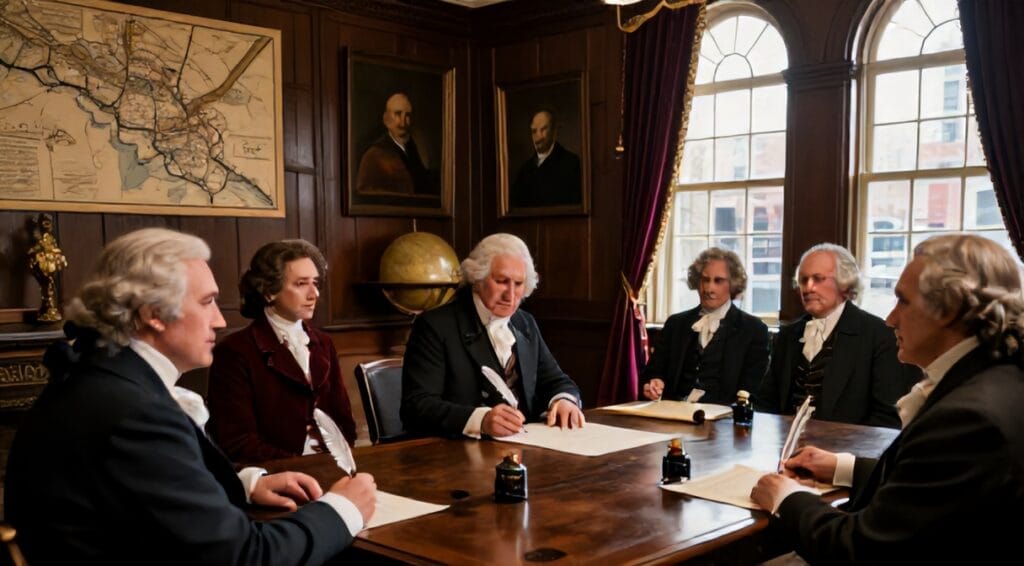
No image exists of the actual moment of signing—no flash of magnesium powder, no photographer’s command to hold still. Our memory is a composite: paintings rendered years later, stitched from recollections and ideals. Howard Chandler Christy’s famous canvas shows a bright room and well-ordered dignity, as if progress itself had donned a powdered wig. Reality was sweatier, more hesitant. We rely on Madison’s notes—the closest thing to a camera in the room—meticulously recorded and later revised, a mixture of transcript and crafted memory. “If men were angels, no government would be necessary,” Madison wrote elsewhere; the line has become a distilled wisdom for a hard lesson learned (Madison, Federalist No. 51). Washington’s diary gives us thumbnail silhouettes of days spent, dinners shared, visitors received—glimpses of a quieter man steering a louder room. Myth fills gaps, sometimes to inspire, sometimes to forget. But the absence of a photograph is a blessing of sorts: it forces us to hear, not just see; to sense the pause of a pen before a name; to feel the weight of uncertainty in the small bones of a hand. The signing of the united states constitution becomes, in this way, perpetually present—reimagined by each generation that confronts the same questions in new light.
A Living Echo: Crises, Amendments, and the Unfinished Work
After 1787, the Constitution did not rest; it traveled. It passed through Supreme Court opinions, through congressional battles, through streets filled with protesters demanding inclusion. Its text is short, but its life is long, stretched by the elastic of interpretation. The Thirteenth, Fourteenth, and Fifteenth Amendments tried to complete what the founders evaded—abolishing slavery, guaranteeing equal protection, and securing voting rights. Later amendments recalibrated elections and governance: direct election of senators, presidential term limits, voting at eighteen. Each crisis tested whether the framework would hold. In the Great Depression, a reimagining of commerce powers helped build a social safety net; in the civil rights era, the Equal Protection Clause caught fire, illuminating the distance between promise and practice. The signing of the united states constitution still resonates when courts weigh privacy, when Congress debates war powers, when citizens march for equality. Every generation inherits the responsibility to read the parchment against its own horizon: who counts as “We”? How shall we balance liberty and security, equality and tradition, local control and national purpose? The Constitution answers not with a single voice but with a chorus of structures—federalism, separation of powers, checks and balances—inviting a people to govern themselves by argument. The work is unfinished, and that is by design.
Conclusion
On that September afternoon in 1787, the room emptied and the city resumed its ordinary noises—wheelwrights hammered, children shouted, dogs nosed the gutters. Yet the world had shifted. The signing of the united states constitution condensed a summer’s thunder into the steady pulse of a new government. It was not a miracle; it was a mortal achievement, written by men who argued, doubted, and compromised under mortal limits. There were noble insights and grievous failures, soaring ideals and dark bargains. But the architecture they crafted has endured because it acknowledges imperfection and builds mechanisms to correct course—elections to overthrow rulers without bloodshed, amendments to rewrite inherited injustices, courts to reconcile the command of law with the claims of rights. To remember the signing is to accept the invitation it offers: to argue in good faith, to recognize complexity, and to shape a future truer to the principles so carefully inscribed. The parchment lives because a people keep reading it—aloud, critically, passionately. The door of Independence Hall opens again each time we take that task seriously, and the quills are never quite dry.
FAQs
- What was the purpose of the 1787 Convention in Philadelphia?
The convention was called to address the failures of the Articles of Confederation. While officially tasked with revising the Articles, many delegates intended to design a stronger national framework, which culminated in the signing of the united states constitution. - Who presided over the convention?
George Washington presided, offering credibility and calm leadership that helped keep fractious debates from collapsing into chaos. - How many delegates signed the Constitution?
Thirty-nine delegates signed on September 17, 1787. Notably, Edmund Randolph, George Mason, and Elbridge Gerry refused, largely due to concerns over the lack of a bill of rights and potential centralization. - Why is the three-fifths compromise significant?
It counted enslaved persons as three-fifths for representation and taxation, embedding a moral contradiction in the new charter and shaping political power in ways that deepened sectional tensions for decades. - How was the president chosen under the new system?
The Electoral College balanced state and popular interests. States appointed electors who cast votes for the presidency, a compromise emerging from fears of legislative capture and direct-democracy demagoguery. - Did the Constitution include a bill of rights at the time of signing?
No. The absence fueled Anti-Federalist opposition. The first ten amendments, known as the Bill of Rights, were proposed by James Madison and ratified in 1791. - What made ratification possible in skeptical states?
Strategic compromises, persuasive writing like The Federalist Papers, and promises to add a bill of rights helped secure crucial votes in states such as Massachusetts, Virginia, and New York. - Is there an authentic image of the signing moment?
No. We rely on Madison’s notes, Washington’s diary, and later artistic interpretations. The absence of a photograph invites a richer engagement with the words and debates themselves. - How has the Constitution adapted over time?
Through amendments and judicial interpretation. Landmark changes include Reconstruction amendments, direct election of senators, and expansions of civil rights and liberties through the Fourteenth Amendment’s guarantees. - Why does the signing of the united states constitution still matter today?
Because it launched a framework that allows peaceful self-correction. Modern debates—from voting rights to privacy and federal power—continue to unfold within the structures set in 1787.
External Resource
Internal Link
Other Resources
- Encyclopaedia Britannica – general search for the exact subject
- Google Scholar – academic search for the exact subject
- Internet Archive – digital library search for the exact subject

