Table of Contents
- The Night Fires of Alexandria: A City Waits for Its Bishop
- From Deacon to Defender: The Young Athanasius and Nicaea
- Tyre and Trier: First Exile and the Anatomy of a Fall
- Between Two Empires: Politics of Constantius and Constans
- Rome, Sardica, and Vindication: The West Embraces Athanasius
- Gregory of Cappadocia’s Interlude: A City Under Strain
- Letters Across the Desert: Monks, Merchants, and Messengers
- The Decision in the East: A Reluctant Green Light
- Sailing Home: Autumn 346 and the Living Sea
- Procession Through the Canopic Way: A Triumphal Return
- Pastoral Repairs: Rebuilding Altars, Rebinding Wounds
- The Arian-Labeled Minority: Fears, Negotiations, and Compromises
- The Pen and the Pulpit: Festal Letters and Catechesis
- The Desert Alliance: Anthony’s Legacy and Monastic Networks
- Economics of Orthodoxy: Grain, Guilds, and the Harbor
- Ripple Effects: Antioch, Constantinople, and the Latin West
- Theology in the Streets: Explaining Homoousios to Artisans
- Storm Signs on the Horizon: Seeds of the 356 Exile
- Memory and Myth: How 346 Shaped Christian Imagination
- Conclusion
- FAQs
- External Resource
- Internal Link
Article Summary: In 346, Alexandria became a stage for reconciliation and drama as the long-contested bishop Athanasius returned to his city, and athanasius restored as patriarch signaled a turning point in a struggle that had divided churches and courtyards alike. This article follows the road to that triumph—from the decrees of Nicaea to the pressures of emperors, from the dusty sessions of councils to the hush of desert monasteries. We enter the teeming harbor and walk the Canopic Way with cheering crowds, but we also sit in candlelit rooms where letters were drafted and fears confessed. Through triumph and tension, the story shows how theology and politics braided together, shaping the fate of a Mediterranean metropolis. The phrase athanasius restored as patriarch passed from rumor to reality, yet behind the joyful processions lay wounded relationships and fragile alliances. We explore the immediate reforms, the pastoral care that mended a bruised flock, and the social and economic rhythms reshaped by stability. We trace how this return echoed through Rome and Constantinople, spoke to artisans and monks, and planted seeds for both unity and future exile. In the end, athanasius restored as patriarch became more than an event; it became a symbol of steadfast conviction, a mirror for the courage and the cost of defending what one believes to be the truth.
The Night Fires of Alexandria: A City Waits for Its Bishop
They lit the braziers along the quay as if coaxing the sea itself to speak. Sailors leaned over the rails of moored ships, their palms salted and patient, while along the Canopic Way shopkeepers did a strange thing for solemn Alexandrians: they kept their doors open after dusk. Children were hushed not by bedtime but by expectation, and old women who remembered the last return told the newest wives how the sky had shone when their shepherd came home. Word had flown ahead like a swift over the marshes—athanasius restored as patriarch, they whispered, the phrase too audacious to say loudly until the lamps were many. Men gathering outside the Serapeum and women carrying oil to martyrs’ shrines both knew the name that rode the wind: Athanasius, the bishop who had faced councils and emperors, was on the water somewhere to the north. But this was only the beginning; the return would be a rare moment where a city’s soul, bruised by years of schism, turned audible in its roaring relief.
What Alexandria awaited was not simply a man but a verdict on a decade. The words athanasius restored as patriarch meant that the debates sealed at Nicaea and rehearsed in council after council would find flesh again in a pastor whose hard edges were known to friend and foe. For those who held the creed that confessed the Son “of one substance with the Father,” his coming was the stiffening of a spine; for those who had benefited under his rival, it was a tightening in the gut, a reckoning. Ships in harbor carried cargoes of papyrus and grain, yes, but also rumors carried by traders and monks: letters from Rome and Sardica, signs of imperial tilt, the mention of a death—Gregory of Cappadocia gone, the bishop installed against Alexandrian will. As bowls of lentils cooled beside shuttered balconies, the narrative of the city stretched taut to the point of snap. It’s astonishing, isn’t it, how a single phrase, athanasius restored as patriarch, can bear so much weight that entire neighborhoods breathe with it as if it were weather.
From Deacon to Defender: The Young Athanasius and Nicaea
Years before the lamps awaited his return, he was a deacon with quick eyes and a sharper pen. At Nicaea in 325, Athanasius was not yet the commanding figure history would know, but even then he moved with a conviction that made older bishops glance twice. He would later write lines heavy with personal knowledge, defending a creed more than a man. The air of the council was thick with old friendships, new alliances, and the smell of wet wool as men from across the empire thawed from travel. There, where the term “homoousios”—of one substance—rose into the contested light, Athanasius began to understand himself as something more than a clergyman: he was to be a witness whose life would be braided to a doctrine.
Alexandria had taught him to love argument the way other cities love theater. In the lecture halls of the Mouseion and the alleys of the artisan quarters, Athanasius had learned that words could heal or riot. So when he later wrote his On the Incarnation, he did not deliver abstractions to placid ears; he hammered sentences that could survive a marketplace. After the council, as bishop Alexander of Alexandria neared his death, he recognized in Athanasius a peculiar sternness: not cruelty, but an insistence that the church be more than an echo of imperial moods. In 328, the cleric was elected bishop, some say reluctantly, though reluctance evaporated before purpose. The seeds of “athanasius restored as patriarch” were planted the day he first told the city that truth would cost them sleep.
Tyre and Trier: First Exile and the Anatomy of a Fall
Vindication is a melody that takes time to resolve. In 335, at the Council of Tyre, accusations spiraled like gulls in storm-winds. His enemies—men aligned with the theological circle of Eusebius—pressed charges: violence, sacrilege, even blocking grain shipments to force Rome’s hand. The spectacle felt like a courtroom drama staged for an emperor’s gallery. Athanasius saw the trap close. He wrote later, with the clipped intensity of the wrongly accused, that he would not concede to a council stacked against him. Consternation followed, then exile—first to Trier, so far to the northwest that the Nile might have been a fable. In the Rhineland chill, he learned to carry faith as a cloak against more than weather.
Yet even there the story bent strangely. Constantine, the emperor who first gathered bishops at Nicaea, found the tide shifting beneath his own feet. Those who had lost the argument at Nicaea were busy perfecting the art of survival. Athanasius’ exile was a warning, but it was also an education: in how ecclesial accusations travel, in how imperial favor veers. The report that reached Alexandria was blunt: the bishop was gone. But Alexandria, too, learned to wait. The refrain athanasius restored as patriarch had not yet been born, but the city’s memory began knitting together a hope that would survive winters and councils.
Between Two Empires: Politics of Constantius and Constans
The empire of the 340s was less a single mind than a dialogue conducted with clenched jaws. After Constantine’s death, his sons divided the world like an inheritance: Constans in the West, Constantius II in the East. Their temperaments diverged. Constans, influenced by Western bishops and the steadying counsel of men like Julius of Rome, tilted toward Nicaea; Constantius, no crude partisan but a calculating leader, learned to navigate the complex currents of Eastern episcopacy where anti-Nicene theologies offered him both advisors and leverage. Theology was no mere ornament to their rule; it was the fabric of alliances, a grammar in which one could speak obedience or defiance.
At times an emperor’s letter was sharper than a soldier’s spear. So when Western synods defended Athanasius, the stakes grew. The cause of “athanasius restored as patriarch” was not only about a bishop’s honor—it hinted at a possible reconciliation between feuding halves of the Christian oikoumene. Each new council—their names now floating like archipelagos: Antioch, Sardica—became an attempt to write theology into law. Behind the curt phrases, the human texture remained: bishops fearing banishment, deacons ferrying notes under cloaks, civic leaders counting whether it was safer to cheer or to keep the shutters drawn. In this tension, the East’s reluctance and the West’s insistence prepared the theatre into which a single man would step in 346.
Rome, Sardica, and Vindication: The West Embraces Athanasius
When Athanasius reached Rome after his second expulsion in 339, he found not a city indifferent but a companion in Julius, the bishop of that church. Julius listened and then wrote with an episcopal calm that must have felt like balm: Alexandria has a rightful bishop. The West, sometimes caricatured as provincial in Eastern minds, suddenly mattered as ally. In 343, at Sardica—now Sofia—bishops convened under imperial consent, but the gathering fractured as Eastern delegates walked out. Even so, the Western participants issued letters that read like a verdict: Athanasius acquitted, the creed reaffirmed.
In his “Apologia contra Arianos,” Athanasius later quoted documents from Sardica as if they were affidavits in a case ongoing even after judgment. “They demanded our presence,” he recorded of his opponents, “and then fled the contest” (Athanasius, Apologia contra Arianos, paraphrase). Sardica’s paperwork traveled on parchment, but it rushed like weather. It gave the hope of athanasius restored as patriarch not merely rhetoric but stamps and signatures. Constans, sensing both political and spiritual advantage, leaned into this newfound Western consensus. Pressure filtered through envoys, across mountain passes, down the arteries of the empire. The West had not only spoken; it had learned to insist.
Gregory of Cappadocia’s Interlude: A City Under Strain
While Athanasius pleaded his case under Roman rooftops, Alexandria lived through the years of Gregory of Cappadocia, seated under imperial protection. His tenure was not simply an office; it was a weather system. His supporters, many sincere, saw in him a reprieve from a conflict that seemed to drag the city into constant turmoil. But others, fiercely loyal to the exiled bishop, treated Gregory’s liturgies like intrusions. There were scuffles spilling out of churches into courtyards, a contest of choirs as much as of doctrines. The city learned the scars of two simultaneous calendars, two lists of clergy, two groups claiming continuity.
Sozomen wrote of factional strife that gnawed at Alexandria during those years; the details vary with the teller, but the result was unchanged: a city hungry for one voice (Sozomen, Ecclesiastical History, Book III). Some speak of arrests, of threats, of that gnawing attrition when friends avoid greeting for fear of being marked. Gregory’s death in 345 came like the sudden lift of a storm. Without a sitting rival, the path cleared—not simply for political negotiation but for a psychological reorientation. The cry athanasius restored as patriarch now sounded less like defiance and more like the ordinary ache of a house waiting for its door to open.
Letters Across the Desert: Monks, Merchants, and Messengers
Between 343 and 346, letters did the work of armies. Papyrus rolls crisscrossed coasts; wax tablets carried notes across sand. The desert, far from empty, was alive with traffic: monks who belonged to Anthony’s lineage, merchants moving along the caravan routes, deacons trained to travel light and speak carefully. They ferried not only tidings but tone: the difference between a command and a promise, between a request and a warning. News of Sardica’s rulings met the more delicate realities of Eastern court politics, and in this meshwork of words the hope hardening into certainty could be read.
Some of these letters survive in Athanasius’ own collections, where he practiced the art of the dossier, assembling proofs of innocence and tokens of favor. “I have received your letter,” one begins, cool and formal, “and marvel how these things are said to be done who were not present when they were done” (Socrates Scholasticus, Ecclesiastical History, paraphrase). The monks, meanwhile, preferred other speech. They told stories, remembered faces, repeated sentences until they became community property. In those circles, the phrase athanasius restored as patriarch became almost a chant, a hope braced by calloused hands and honeyed bread shared at dusk.
The Decision in the East: A Reluctant Green Light
Constantius II did not simply bend; he calculated. The death of Gregory, the paper barrage from Sardica, the pressure of Constans—all weighed on him. There are letters—some preserved, some merely inferred—suggesting an imperial willingness to let the matter cool. Allowing Athanasius to return cost him less than sustaining a stalemate that made him appear the emperor of a church divided for want of a signature. He granted passage, a cautious assent fretted with misgivings. It was not a trumpet blast but the lifting of a gate.
In Alexandria, the news arrived neither with fanfare nor drums. A messenger dismounted near the Gate of the Moon, found the right door, whispered the name, and let the city do the rest. The rumor mulled itself into confidence by the time it crossed the market. You could see it in the way scribes slowed their copying mid-line, how shipwrights stood from their benches. The imperial seal meant that athanasius restored as patriarch was no longer a risky toast or a whispered deacon’s promise; it was an order drawn in the clear ink of governance. But if the East had made peace with a name, the city still had to make peace with itself.
Sailing Home: Autumn 346 and the Living Sea
Imagine the sea. The grain ships that usually rode low in the water now seemed to lift, as if the Mediterranean itself adjoined in the business of reunion. Athanasius boarded in the company of clergy and a few chosen lay supporters, men who had learned to read a face for likelihood, who knew which sailors to pay for a swift passage along the coast. The route was coastal, because coastal was safer; storms gather slower where harbors break the line of sight. Somewhere near Pelusium, the mast shivered with wind and the bishop, weathered by exile, must have thought of the first time he entered his city as shepherd—what he knew then and what he knew now.
He prayed, but not as if performing for chroniclers. He prayed with the inwardness of one who has folded and unfolded the same letter until its edges fray, asking that the city he loved might be whole and the friends who had sworn by him might be safe. Those on deck did not speak of councils. They ate fish and stale bread, laughed softly at sea stories, and then fell into contemplative quiet. The phrase athanasius restored as patriarch had now crossed water; it was in the gulls’ cry, in the slap of waves against the hull, in the expectation that something long delayed had come at last to its day.
Procession Through the Canopic Way: A Triumphal Return
If it had been a coronation, there might have been less noise. The Canopic Way—Alexandria’s grand artery—filled until the city seemed to press itself forward in a single motion. Women threw linens dyed with saffron from balconies; men scrambled up steps and olive trees to see over shoulders; children learned, in an hour, the communal memory that would be their inheritance. It was an eruption and a relief. Some said there were hymns. Others say it was just shouting that became music because it endured. Athanasius came not on a chariot but on his feet for the final strides, as if to close the distance at a human pace.
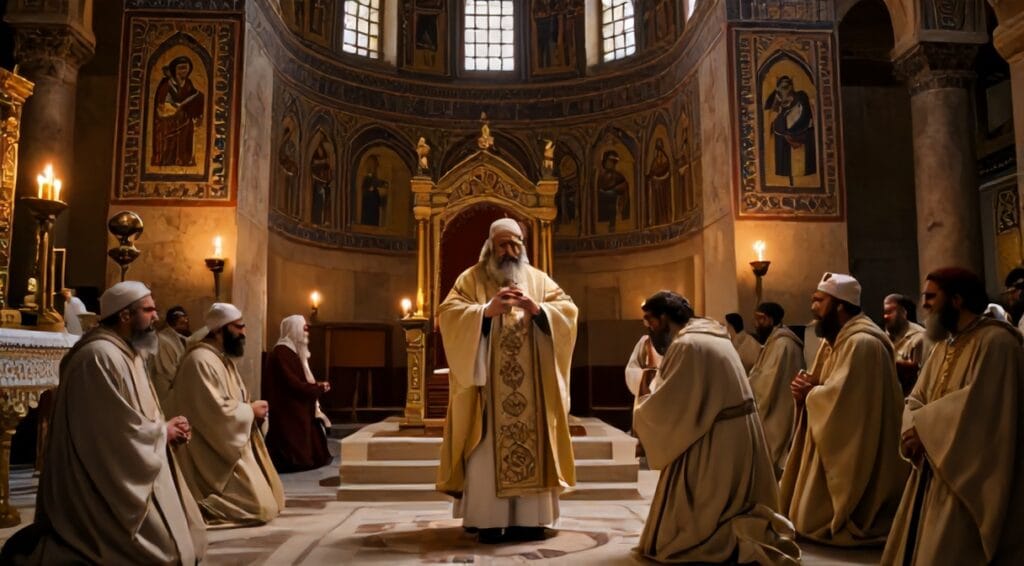
At the church gates, a threshold moment. The bishop lifted his hands, and the roar subsided into that honest hush in which a city listens. He thanked God for the mercy of return and thanked those—Western bishops, Eastern moderates, tireless monks—who had made it possible. And then, like a craftsman counting his tools, he named the tasks ahead: reconciliation, order, teaching. The clerks took note, erecting a ledger of the day as eyewitnesses would carry the story outward to all who had not seen it. The words athanasius restored as patriarch were no longer a gauntlet thrown in political alleys; they were a blessing uttered on steps worn smooth by genuflections and tears.
Pastoral Repairs: Rebuilding Altars, Rebinding Wounds
Nothing breaks a city like divided worship. Over the years, altars had been consecrated by rival hands; scrolls had been copied by scribes who declined to speak each other’s names. Athanasius did not start by purging but by counting. Which deacons were ordained in unsteady conditions? Which parishes could be united by a cautious, compassionate reappointment? He convened clergy not in committees but in conversations, tea steaming in cups, bread on platters—small gestures of common life. He preferred to bind wounds, even as he defended the creed with iron clarity.
He wrote letters naming feast days, cataloging martyrs, weaving time itself back into a common calendar. In his pastoral counsel, you hear the shepherd under the polemicist: “Let the peace of Christ dwell among you; the enemies of the truth are not those you greeted in the marketplace yesterday, but the falsehood which stalks our speech.” Athanasius’ method was not softness but sequencing: offer welcome, teach truth, reform practice. The phrase athanasius restored as patriarch did not stop at the city gate; it reached into the sacristy, across baptisteries, into the bellies of lamps trimmed late so that priests could reconcile parish books in a single ink again.
The Arian-Labeled Minority: Fears, Negotiations, and Compromises
Triumph is public; fear is private. In small courtyards where those who had supported Gregory sat in anxious circles, the night after the procession felt chillier. Some shivered at the thought of retribution—loss of stipend, removal from posts, the pinprick humiliations by which victors announce their reign. Athanasius had a choice: to rule on the pulse of celebration or on a longer view that saw more than victory. He chose the latter, though he never compromised on the creed he defended. He met with representatives of the faction often labeled “Arian”—a name that smoothed over many shades of belief—and asked for two things: honesty about doctrine and willingness to live peaceably under the bishops he would appoint.
There were negotiations. Some clerics agreed to sign formulas closer to Nicaea than they might have earlier accepted; others appealed for time and were granted it. The record is not tidy. But what emerges is this: the practical business of “athanasius restored as patriarch” meant holding space for those who could be persuaded and naming boundaries that would not be crossed. He was no sentimentalist; men who sought to subvert would find him steel. Yet the city noticed that punishments were fewer than feared, and that in many parishes the liturgy the following Sunday sounded like something familiar enough to sing.
The Pen and the Pulpit: Festal Letters and Catechesis
The restored bishop took up the pen as eagerly as the pulpit. His Festal Letters, sent to announce the date of Easter and to frame the spiritual life of the year, became the heartbeat of his leadership. He wrote in a style both sinewy and warm, urging the faithful to fast, to give, to expect Christ’s victory as a seasonal certainty. These letters stitched Alexandria’s neighborhoods to one another and joined the city to far-off congregations who awaited the rhythm that defined their springs and summers. Where a city’s rumor had once carried the phrase athanasius restored as patriarch, now a city’s discipline carried it, in how they spent the forty days, where they lodged the foreign poor, how they taught children the psalms.
His catechesis did not retreat into slogans. He explained why “of one substance” mattered, not for scholastic pride but for salvation: if the Son were not truly God, then God had not truly descended to raise us; if the Savior were only like God, then our hope was only like salvation. In homilies he paired doctrine with pictures: the physician who must share the patient’s nature to heal; the sun and its radiance as unseparated yet distinguishable. He elevated the city’s intellect, expecting artisans and sailors to learn with the seriousness of scholars. The day’s cheers congealed into a season’s instruction.
The Desert Alliance: Anthony’s Legacy and Monastic Networks
Though Anthony the Great would not die until a decade later, his figure already loomed like a rugged mountain on the city’s horizon. Athanasius had known him well enough to later write his Life, a book that would travel farther than any imperial decree. The alliance between city and desert was a hallmark of this period. Monks arrived in cloaks the color of sand, speaking little and praying long; they brought favor not only from heaven but from the countryside, where peasants trusted these ascetics more quickly than they trusted magistrates. They stood with Athanasius in the years of trial, and they stood with him now, a living guarantee that the restoration was not merely urban politics but spiritual continuity.
In those months after the return, monks helped settle disputes, carried letters, guarded churches at night when whispers of sabotage rose. Their presence made athanasius restored as patriarch feel like a covenant with the country beyond Alexandria’s gates. They were living footnotes to his homilies: the world could indeed be renounced for a better citizenship. And they were pragmatists, too. They knew which villages were restless, which roads were safe, which grain stores were honest. The desert alliance turned theology into a social map.
Economics of Orthodoxy: Grain, Guilds, and the Harbor
Religion is not practiced in the air. The return of a recognized bishop restored predictable rhythms to the city’s economy. Grain shipments found fewer excuses to stall; contracts that had wavered under uncertainty stiffened into obligation. Guilds—the dyers, the carpenters, the shipwrights—adjusted their schedules to a liturgical calendar once more unified. Fewer rival feast days meant fewer disruptions; fewer disruptions meant steadier wages. Pious benefactors loosened their purses when they trusted the stewards over the alms tables. In the harbor magistrate’s log, you could read the restoration in the language of tonnage and dates.
There were, of course, losers. Those who had enjoyed the favor of Gregory’s circle faced a narrowing of opportunity. Still, Athanasius appears to have preferred adaptation over annihilation. He reminded the wealthy that almsgiving was no optional glory but a duty; he persuaded guild leaders to take apprentices from families who had suffered under factionalism. Justice became a lived form of doctrine. And when the phrase athanasius restored as patriarch appeared in merchants’ letters, it was not pious exaggeration; it was a signal that business could proceed without the potholes of ecclesial uncertainty.
Ripple Effects: Antioch, Constantinople, and the Latin West
What happens in Alexandria rarely stays there. News traveled like electricity along the empire’s nerve endings. Antioch watched closely; Constantinople, still young and flexing, measured consequences; the Latin West, encouraged, felt its own convictions straighter under the cloak. Bishops elsewhere who had hesitated to be counted now saw that the man with a history of exile could be named, without flinching, as bishop in good standing. It signaled that the era defined by imperial maneuver could not wholly write doctrine; it could, at its best, receive and ratify what had already taken root in the life of churches.
Letters from the West to the East—copies preserved in fragments and summaries—warmed in their tone. Some dared to think that a durable peace might be possible if patience were cultivated and extreme partisans tamed. Others, more sober, remembered how quickly weather changes on the theological sea. Yet for a season, athanasius restored as patriarch was a cipher for common purpose: that faith confessed in one tongue could be sung in another, that a city on the Nile might, in the mercy of God and the maneuvering of rulers, teach the whole empire how to welcome back a battered father.
Theology in the Streets: Explaining Homoousios to Artisans
Athens had its academies; Alexandria had its porticos and workshops. If doctrine mattered, it had to pass the street test. The bishop took his arguments into the dust, making them legible to hands thick with dye and fingers nicked by blades. “If a craftsman sends an apprentice,” he would say, “the apprentice may be skilled, but he is still a hired hand. The son, by contrast, bears his father’s trade in his blood.” This was homoousios without syllables: the Son does what the Father does because He is who the Father is. Artisans nodded; they understood succession and substance in the language of families and guilds.
People spoke of church again without fear of spark. Mothers told their children why they crossed themselves at certain corners where a martyr had once refused to bow. Fishermen asked whether God could truly suffer; Athanasius answered that God in the flesh had truly died and truly risen, without the Godhead suffering diminution. The return was being catechized into the city’s hours. The line athanasius restored as patriarch did not live only in parchments; it lived in the apprenticeship of belief, where understanding deepens at the speed of friendship and repetition.
Storm Signs on the Horizon: Seeds of the 356 Exile
Even in celebration, those with weather-sense see clouds. Constans, the Western patron whose pressure had pried open the door for Athanasius’ return, would not live forever; politics, like the sea, keeps its own secrets. In Constantinople and Antioch, theological factions continued to refine their positions, sometimes out of conviction, sometimes out of the arithmetic of power. Athanasius, navigating his restored city, could also read the distant scripts. Some Eastern bishops, uneasy under his renewed influence, prepared dossiers. The emperor in the East weighed how to manage a figure whose stature made him both necessary and inconvenient.
And yet the knowledge of coming trouble did not dissolve the good of the present day. The fruit of athanasius restored as patriarch would have to be harvested quickly and stored well for leaner seasons. He ordained men of substance and humility; he invested in monastic alliances that would endure a decade of absence; he wrote with an eye to readers who had yet to be born. The next exile would come in 356, under darker circumstances, but this one, in 346, was a high summer—warm enough to ripen what would later keep many hearts from withering.
Memory and Myth: How 346 Shaped Christian Imagination
Memory is not a mirror; it is a loom. Over time, the story of the return stitched itself into a fabric denser than the bare facts. Mothers would tell daughters, “I was there when the bishop came home,” and the tale would grow brighter at each retelling. Chroniclers in later centuries, like Socrates Scholasticus, would frame Athanasius as the man who stood almost alone. The city’s love for him acquired the shimmer of myth. But myths often carry truth better than chronologies alone. The truth here is that the church learned something essential: that conviction can survive court intrigue, that theology can inhabit alleys and harbors, that a shepherd can be loved not merely for victory but for vigil.
In later ages, when bishops calculated the cost of defiance, this story was their currency. Monastics read the Life of Anthony and heard beneath its desert winds the quieter surf of Alexandria’s harbor greeting its bishop. In Western homilies, preachers gestured toward far Egypt when they spoke of fidelity outlasting fashion. The phrase athanasius restored as patriarch became not only an entry in a chronicle but a proverb whispered in sacristies: that restoration, when it comes, must be spent for others, not hoarded for triumph. And always, there were the documents—council canons and imperial rescripts—bearing witness that even empires, for a season, can serve a larger constancy.
Conclusion
On a map, the year 346 can look like a dot on a timeline—a point between earlier trials and later tumults. But in the life of a city and a church, it was a room filled by a returning presence, a square pulsing with song, a ledger of reconciliations and reforms written in practical ink. To say athanasius restored as patriarch is to say that doctrine found an anchor again in the pastoral craft of a leader who knew both how to fight and how to feed. It is to admit that imperial policy bent, if briefly, toward the persistent testimony of communities that refused to be schooled by fear. It is to remember that theology, when it is true, can walk down the Canopic Way as easily as it sits in a council chamber, that it can be sung by dockworkers and parsed by monks.
The restoration did not erase all shadows; a later exile would teach that courage must be renewed in each generation. Yet the months and years that followed the return reorganized the city’s conscience, stilled some fevers, and produced a literature and a way of life that would feed souls far beyond Egypt. Athanasius’ letters, the alliances with the desert, the humility with which he folded opponents back into the fold when it could be done—all this made the phrase more than a headline. It became a school. And the lesson still stands: that the church lives by the patience of truth, and when its shepherds return from winter seas, their feet must carry not vindication alone but the bread and oil of healing.
FAQs
- Who was Athanasius and why was he significant?
Athanasius of Alexandria (c. 296–373) was a bishop and theologian whose defense of the Nicene doctrine—that the Son is “of one substance” with the Father—shaped the trajectory of Christian orthodoxy. His resilience through multiple exiles and his prolific writings made him a figure of enduring influence. - What does the phrase “athanasius restored as patriarch” refer to?
It refers to Athanasius’ return to his episcopal seat in Alexandria in 346 after years of exile and contestation. The event marked both a theological affirmation and a political accommodation that briefly united Alexandria under his leadership. - What led to his restoration in 346?
A combination of factors: the Western church’s support after the Council of Sardica, the diplomatic pressure of the Western emperor Constans, the death of his rival Gregory of Cappadocia, and a pragmatic decision by the Eastern emperor Constantius II to allow his return. - How did the people of Alexandria react to his return?
Contemporary and near-contemporary accounts describe a jubilant popular welcome—public processions, hymns, and widespread relief. The return soothed years of factional bitterness and restored predictable rhythms to worship and civic life. - Did Athanasius seek revenge upon his opponents?
No. Though unyielding on doctrine, he often pursued reconciliation, meeting opponents, allowing time for persuasion, and integrating clergy willing to accept Nicene formulations. His strategy emphasized pastoral healing alongside doctrinal clarity. - How did the restoration affect the wider Roman Empire?
It encouraged pro-Nicene bishops elsewhere, influenced ecclesiastical politics in Antioch and Constantinople, and strengthened Western resolve. The event demonstrated that imperial policy could accommodate a strong, principled episcopate. - What writings emerged around this period?
Athanasius’ Festal Letters structured the liturgical year and shaped catechesis. He also produced apologetic works defending his actions and clarifying doctrine, and later wrote the Life of Anthony, which amplified monastic ideals. - Was the peace in Alexandria lasting?
It was real but not permanent. Political shifts and renewed pressures led to Athanasius’ third exile in 356. Yet the reforms and teachings from 346 onward fortified the community for hardships to come. - What role did monastic communities play?
Monks formed an essential support network—carrying letters, safeguarding churches, advising laity, and embodying the spiritual seriousness that undergirded Athanasius’ leadership. Their alliance tied urban faith to the desert’s quiet strength. - Why is the 346 restoration remembered as more than a local event?
Because it crystallized a broader contest over the nature of Christ and the authority of councils. It showed that conviction, anchored in communal life, could prevail long enough to reshape an empire’s religious imagination.
External Resource
Internal Link
Other Resources
- Encyclopaedia Britannica – general search for the exact subject
- Google Scholar – academic search for the exact subject
- Internet Archive – digital library search for the exact subject