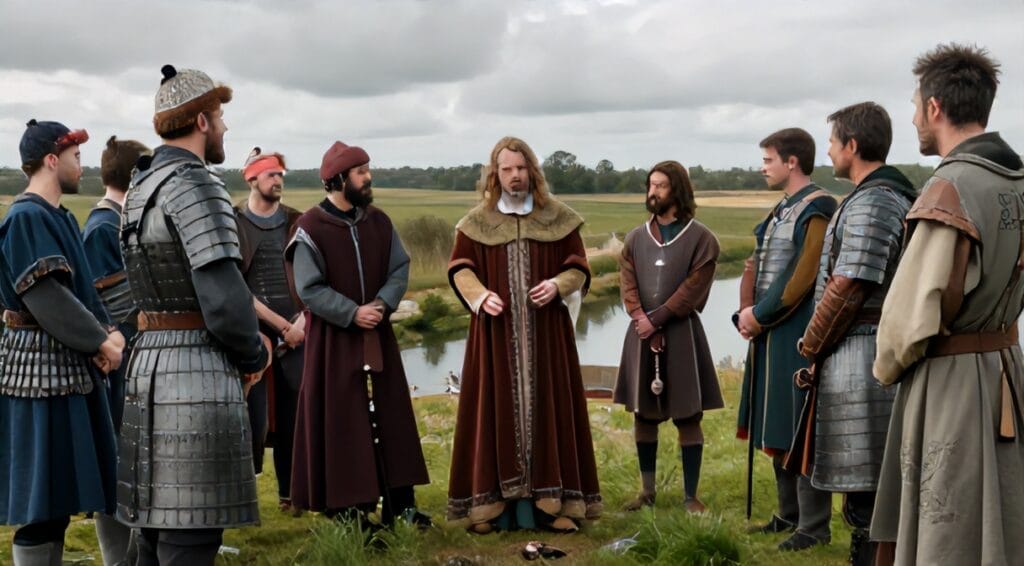
Table of Contents
- A Dawn of Smoke over the Reeds: East Anglia on the Eve of 865
- The Boy Raised to Rule: Edmund’s Early Crown and Conscience
- Sails on the Gray Horizon: The Great Heathen Army Arrives
- The First Bargain: Horses, Winter Quarters, and a Shaken Peace
- Councils in Shadow: Abbots, Ealdormen, and the Perilous Calculus
- The Weight of the Ringed Crown: Prudence Against Pride
- Where Words Held Swords at Bay: The Parley by the Icy Roads
- Terms Inked in Frost: Tribute, Hostages, and Sanctuaries Spared
- A Kingdom Holding Its Breath: Winter of 865–866
- Horses and Hearths: The People Who Bore the Cost
- The Economics of Fear: Why the Army Took Gold Instead of Blood
- Cross and Raven: Piety, Pagans, and the Tense Truce
- News from the North: The Army Turns Toward Northumbria
- Edmund’s Renewed Coinage and Quiet Preparations
- Rumors, Omens, and the Uneasy Year
- A Negotiated Mercy: Chronicle Lines and Living Memories
- The Long Shadow of Peace: Toward Martyrdom and Memory
- Historians at the Palimpsest: Sources, Silences, and Disputes
- Conclusion
- FAQs
- External Resource
- Internal Link
Article Summary: In the winter of 865, East Anglia faced the unanswerable might of the Great Heathen Army and chose to survive by making peace rather than perish in glorious defeat. This article reconstructs that pivotal season when the young ruler, king edmund of east anglia, granted horses, tribute, and winter quarters to avert devastation. We follow the councils in which abbots and ealdormen wrestled with fear and duty, the negotiations perhaps held along frosted roads near Thetford, and the binding of terms that kept churches standing and granaries unburned. We move with the army as it turned north in 866, leaving a tense relief in its wake while Edmund quietly strengthened his kingdom. The narrative blends chronicle fragments, later hagiography, and material evidence to trace the political, economic, and spiritual impact of that truce. It also asks what it means for a Christian king to protect his people through compromise rather than combat. Along the way, voices from the Anglo-Saxon Chronicle and Abbo of Fleury sound across the centuries. The peace did not save Edmund forever, but it shaped the legend that would transform a living ruler into a sainted sovereign.
A Dawn of Smoke over the Reeds: East Anglia on the Eve of 865
The waterlogged light over the fens could feel like a prophecy. Before the first frost had glazed the sedge, fishermen and crofters along the Waveney and the Yare had already heard rumors—fleets seen farther north, halls put to the torch, and new bands of warriors who did not come simply to plunder and leave, but to stay, to winter, to rule. In that uneasy dawn, with gulls crying over reedbeds and black cattle steaming in the cold, the young ruler looked across a kingdom built on barley and prayer and wondered how to outlast a storm no sword could easily turn. He had known raids before, but this felt different, organized, a convergence of jarls and sea-kings gathering strength like a weather system. The chronicles would later write the name of this force as if it carried the rumor of doom inside it: the Great Heathen Army.
Amid these thickening reports, the king’s court carried on with its winter duties—audiences, the collection of renders, adjudication of disputes over grazing rights and marriage gifts. Yet every report from the coast and ford whispered a narrowing of options. There must have been a sense, even in the hush of monasteries, that choices made that season would not quickly be undone. To some, the answer seemed as simple as courage: muster the fyrd, trust to God, and fight. But the season’s short daylight enforced other thoughts. Food would be scarce; horses would tire. The raiders were expert at drawing out defenders and slipping blades between their ribs in marsh or forest. And in the midst of this tightening net stood a young man in a ringed crown—king edmund of east anglia—tasked to protect a people more than to burnish his renown.
The Boy Raised to Rule: Edmund’s Early Crown and Conscience
He had been set upon the throne young, trained not only in arms but in Scripture, his mind sharpened less by riddles than by the Psalms. In the telling that would later grow in monastic circles, he learned to rule by kneeling: a prince whose day began with a doxology and ended with petitions for wisdom. A boy-king’s education in East Anglia was pragmatic as well—he learned the measure of a bushel, the law of oath-helpers, the weight of honey and salt in dues. Yet his sensibility traced a gentler contour. He is said to have memorized whole passages of the Gospels. Whether all this is history or holy embroidery, his contemporaries saw in him the promise of a ruler intent on right rather than on vaunt. That temperament would be tested against a new arithmetic of survival.
In those first years, he had quietly strengthened ties with monastic houses, giving privileges to royal vills and reaffirming the immunities of churches whose towers stood like sentinels across the flatlands. He learned the names of abbots and ealdormen, memorized their genealogies, drank carefully at their tables, and listened. It is plausible that by the time word came of the massing fleets, he already understood the political geography of his realm as a living map: where loyalties were thick or thin, where the harvests had failed, where the shoreline coves made for easy landings. All this counsel came to a point in the winter of 865, when the news sickened into certainty and the watchers on the beaches stopped counting ships.
Sails on the Gray Horizon: The Great Heathen Army Arrives
When the fleet came, it came with method. The ships rode low in the water with men and arms, each vessel a glossy animal of oar and sail. Villagers watched from willow breaks as the first waves drew up their keels, warriors leaping into cold surf. Here, in the eastern counties, the attackers did not begin with the reckless burning of outbuildings but with a studied display of presence: they were here to winter. The Anglo-Saxon Chronicle would later be succinct, almost dry, in a way that makes the blood chill: it records that in this year a great army came into England and first went to East Anglia, where they found horses and made peace for themselves. The casual cadence of that line feels like a bell tolling. Horses. Peace. The two words held a kingdom in their quiet jaws.
Men of the fen and forest heard accents strange to their ears—Danish, Norse, shifting to the needs of trade and threat. Messengers fled inland with what they had seen: numbers, banners, unfamiliar helmets, a warlike poise that came from many campaigns. In that breathless movement of reports, the court gauged the strength of the invaders by negative space—how much of the coast was not aflame, how many barns still stood, how measured the newcomers seemed to be. Calculated menace promised negotiation. It also promised that refusal would come at a high price. In council, king edmund of east anglia sat at the head of a board where the fate of winter wheat and unborn lambs was weighed against the honor of refusal. The king listened; the king prayed; the king prepared to parley.
The First Bargain: Horses, Winter Quarters, and a Shaken Peace
The first bargain was bone-simple: horses for peace. And yet the terms ran like roots beneath the sod, complicated and far-reaching. Horses were war. To give them was to arm the enemy with mobility, to enrich their ability to raid beyond the marsh-tangle into the open heaths and fields. But to refuse was to invite a raid now, upon a populace not yet summoned into full array, in a season when the fields could not feed an army encamped for defense. The idea of winter quarters—”to winter” as a verb with teeth—meant that the intruders would not be swept away by a rally and a countercharge. They would settle in, dig, demand, survey. Behind the blunt exchange of animals for safety was a more delicate choreography of status, honor, and the sacredness of oath. Peace is as much performance as parchment.
And so the talks began. Perhaps in the liminal spaces where river and road met, a neutral ground to signal that both sides had swallowed enough pride to speak. The air would taste of iron. Edmund’s emissaries stood with their cloaks heavy with frost, while the captains of the arriving host measured the lay of land and temper with quick eyes. A bargain would be struck that, on its face, preserved East Anglia from immediate ravage. In later telling, the choice would loom either prudent or perilous. But in that present hour, the calculation was tender, human, and urgent. Bread mattered more than bravado. Churches could yet ring bells in the evening. The king, king edmund of east anglia, chose the protection of his people first, knowing the ledger of honor would be tallied by men not yet born.
Councils in Shadow: Abbots, Ealdormen, and the Perilous Calculus
We can imagine the council fires in the early darkness when decisions were courted. Abbots with the smoke of incense in their robes stood beside ealdormen with the smoke of hearths in their hair. Together they laid out not only the threat, but the custom of response. There were precedents, though not perfect ones: gifts to raiders to buy time, truces negotiated to allow for harvest, oaths sworn on arm-rings and gospel-books alike. A Christian polity instinctively reached for covenant, for mutual obligation. A war-band that worshiped under the raven standard might understand surety in a different register. The risk was not just betrayal but misunderstanding across cultures of oath.
Some urged rallying the fyrd. Others, whose sons had seen the North Sea glint with too many sails, pressed for a compact. Monks whispered that a spared monastery could become a city on a hill, a witness to the power of forbearance. Warriors muttered that tribute now would become tribute forever. And in the midst of such cross-purposes, the king spoke sparingly, asked many questions, and dismissed none. The habit of listening was not timidity but a craft of rule. The counsel struck him as a poem written in frost—beautiful, fragile, and vanishing as the sun moved. Still, he would press quill to vellum if it meant saving his people. And he would trust that time, God, and prudence might yet sharpen the sword if swords must one day be drawn.
The Weight of the Ringed Crown: Prudence Against Pride
A king’s pride is an old animal. It does not sleep easily. It prowls the corridors of the mind long after the torches are quenched. Edmund felt its heat. Yet the weight of his ringed crown was the weight of families and fields, of the white faces of children at vespers, of the mosaic of dues and duties that kept a realm from slipping into famine and fear. If a sovereign cannot protect the baker’s oven and the shepherd’s fold, titles are bright ribbons pinned to nothing. So he set his pride against prudence and found prudence heavier. He would face the envoys of the intruders with the calm dignity of a king who believed that God sometimes saves through a closed fist, and sometimes through an open hand.
In his tent or hall, he may have unrolled a map made of memory: fordable rivers, defensible ridges, the treacherous fen tracks. He knew that a pitched fight against an army seasoned in winter campaigns might end with East Anglia unpeopled where it had once been bright with hearths. The choice to treat was not a renunciation of courage but a discipline of it. King edmund of east anglia could lead a charge, and perhaps he itched to do so. But the season and the odds argued for another kind of bravery—the bravery to be called cautious, to wear whispers like thorns, so that the kingdom might yet see spring.
Where Words Held Swords at Bay: The Parley by the Icy Roads
Where, exactly, did they meet? Tradition points to places like Thetford, or to royal sites near Rendlesham or Hoxne, places dense with memory. The ground was likely chosen for its symbolic and practical neutrality: easy approach, hedged by watercourses, near enough to provisions that a long morning of talk would not collapse into hunger. Witnesses would be present—interpreters, men of law, priests to bless the attempt at peace, shield-bearers to assert that words were not weakness. The frost on the grass would crunch, and breath would smoke in the air. A pair of ravens might have carved loops over the scene, or perhaps only a schoolboy, wide-eyed, thought so and told his grandchildren later.
The invaders would have sought clarity: horses, food, coin. The defenders would have pressed for promises: no burning of towns and halls, safety for churches, restraint upon the winter guests. Hostages—either word or bodies—would have been floated as a guarantee. There is a scene one longs to paint more surely: the moment when king edmund of east anglia lifted his hand to seal the bargain, when a murmur passed through his retinue, when the blades on both sides were sheathed with an audible sequence of clicks. In that shy music lay a reprieve. It was not victory. It was not surrender. It was the ragged edge between them, and for that one season it would hold.
Terms Inked in Frost: Tribute, Hostages, and Sanctuaries Spared
The shape of the terms survives in outline more than in fine detail, yet the outline is legible. The army received horses. That much is braced in the Chronicle. Horses meant a leap in capability: raiding distance, scouting, tactical feints. In return, East Anglia received something like a promise of restraint—“made peace for themselves,” as the Chronicle has it. Tribute in silver and goods is plausible, for the extraction of wealth was the economic engine of such forces. Hostages could have stood as living bonds, exchanged like living oaths. Sanctuaries spared would have been both a mercy and a message; the white walls of a monastery untouched by fire were a proclamation that the pact, however uneasy, had meaning.
These arrangements carried layered significance. By entering a peace, the invaders acknowledged the king’s authority to grant it, an oblique and temporary recognition of his standing. By provisioning their enemies, the East Anglians made themselves complicit in their own vulnerability—an irony not wasted on the grumbling fyrdmen who led the best mares and geldings across winter fields. Yet it kept the barns standing and the altars intact. One can nearly hear the scrape of a stylus as some scribe noted the accord, storing the memory against slander that might come later: that king edmund of east anglia had not faltered in courage but had risen to wisdom when the times demanded it.
A Kingdom Holding Its Breath: Winter of 865–866
Peace does not erase fear; it redirects it. The winter that followed was taut as a bowstring. Markets reopened, cautiously. Village bells sounded the hours again. Men drilled in small companies on the edges of fields, their shields catching the watery sun, though now such exercises could be disguised as simple readiness rather than provocation. Monks returned to copying, though with ears pricked at every horn blast. Children played again by the ditches, casting pebbles into the water, while their mothers watched with a glance always toward the road. The presence of the wintering host was felt, if not seen every day: supply trains, campfires smoky at dusk, the sudden appearance of foreign traders with gleaming arm-rings and foreign words for the same bread and beer.
For Edmund, this was the meticulous work of governance under a pact: balancing stores, negotiating prices, admonishing his own men to keep tempers cool at the sight of strangers in their land. Political rivalries did not sleep simply because a foreign power was near; indeed, they sharpened. Some local magnates would have seized the chance to intrigue, to whisper that the king’s policy humbled the realm. Others would have been steadied by the simple fact that their barns were not smoldering. The health of a kingdom is rarely measured by its loudest voices. It is measured in whether life can proceed at all: the plough drawn, the altar dressed, the winter ale brewed. By that measure, the peace held.
Horses and Hearths: The People Who Bore the Cost
Every peace built from tribute is paid for twice—once in the coins or goods that change hands, and again in the mute ache of what those goods would have become. A horse given in winter is a horse not breeding in spring; a sack of grain tithed is a bowl not filled. So we should honor the anonymous majority who bore the cost of this policy. The shepherd who fetched back a ewe taken by a camp-follower; the smith who mended a bit for a foreign mouth; the tanner who bartered hides for news and safety. Their ledger was measured in sore backs and quiet meals. Yet they also bore the intelligence of a people who understand the geometry of survival: give something now so that something greater remains. That is not cowardice; it is the mathematics of staying alive together.
Coinage in Edmund’s time spoke its own language. Later pennies bearing his name—EADMUND REX—attest to a stable authority that could inspire minting and trade. Even if the exact patterns of 865 are debated, the economic life of the kingdom is glimpsed in these small, bright witnesses. The policy of peace sustained that life. One cannot mint silver in a field of ash. In smoky hearths, where families warmed their feet and told the same stories they had told the winter before, there would be gratitude for this ordinary continuity. It was here, not in council chambers, that the depth of Edmund’s choice became a living thing: bread set upon a board in a house not burned.
The Economics of Fear: Why the Army Took Gold Instead of Blood
Why did the great army accept horses and peace? There is a temptation to render them as mere plunderers, incapable of calculation beyond the swing of an axe. But their leaders were hard-headed strategists. An army newly arrived in foreign country needs winter quarters and provisions to consolidate strength. A negotiated peace buys rest, reconnaissance, and time to assess rival kingdoms. Horses solve problems of mobility and surprise. Gold, silver, and food solve the perishable problem of now. Moreover, making peace in one shire can unsettle the politics of another: it suggests to the next king that accommodation is both possible and prudent, sowing doubt and division ahead of a campaign. In this sense, Edmund’s peace was also their opening gambit.
Fear has an economy. It prices loyalty, risk, and betrayal. The army understood that by avoiding a brutal winter of combat in one corner of England, they could bring spring violence elsewhere with momentum. It is chilling and unavoidable to note that the calculus worked. In 866, they moved north toward Northumbria, preying upon a kingdom lacerated by internal strife. The pause they had purchased—or been granted—had fattened their horses and sharpened their plans. And yet, to say this is not to blame the peace. It is to trace the cold logic that made it utile to both sides. For king edmund of east anglia, the exchange was a bridge to a future he meant to fortify. For his antagonists, it was a staging ground for the wars to come.
Cross and Raven: Piety, Pagans, and the Tense Truce
Religion bent close to every word of that settlement. East Anglia had been shaped by Christianity for generations; churches stood as nodes in a network of grace and law that threaded the countryside. The invaders carried different pieties, their oaths sworn upon gods the English had learned to fear in story and in smoke. Yet there is a stubborn reciprocity in the act of parley. To make peace is to tacitly admit that your opponent is a moral agent with whom binding promises can be made. Priests would have blessed the talks. Warriors would have frowned. But the language of sanctity, read aloud under a dull sky, cannot help but change the air.
Here the sources lean forward to instruct us. Though written a century later, Abbo of Fleury’s Passio Sancti Eadmundi preserves a memory of Edmund as a ruler whose holiness infused his politics. He writes of a king who would “imitate the patience of Christ in power,” a line that glances back toward 865 as much as toward the events of 869 (Abbo of Fleury, c. 985). The Chronicle’s later entry for 865—“and made peace for themselves”—retains its minimalism, yet the churches that were not burned are the footnotes to that line. In this tension of cross and raven, East Anglia found a way to breathe through one hard winter without choking on smoke.
News from the North: The Army Turns Toward Northumbria
In the new year, footsteps oriented north. Messengers returned with the rumor made fact: the great host had shifted its appetite. Perhaps the terms of Edmund’s peace had been fulfilled; perhaps new opportunities beckoned. Northumbria was riven by factions; the lure of a divided crown was too bright. The relief in East Anglia would have been low and physical, a slackening of shoulders at the market, a farmer humming to himself as he checked the thatch. But the relief was not clean. It came braided with dread of what might follow next year or the year after. Peace bought time; time might prove a creditor with a cold face.
We should imagine Edmund scrutinizing the same maps, counting the same distances, now feeling the texture of respite and responsibility. He had not fought a set battle, but he had kept the kingdom’s arteries clear. Trade with the continent might resume its normal pulse. The winter herds could calve with fewer alarms. The young king could plan. Yet each plan had a shadow, the shape of returning sails. It is here that the man behind the later martyr would have deepened: king edmund of east anglia, learning to be unafraid of rumor without becoming blind to risk, learning that a sovereign must prepare not only to command, but to endure.
Edmund’s Renewed Coinage and Quiet Preparations
Coins are small speeches. When minted with a king’s name, they utter a claim that circulates hand to hand: I am lawful; I keep order; I make trade possible. Edmund’s pennies—those that numismatists find stamped with EADMUND REX—are flashes of sovereignty found in hoards and fields. If not all belong precisely to 865–866, they witness to a reign intent on normalcy and authority, and those aims are inseparable from the peace. The mint speaks because the barns did not burn. The barns did not burn because the king made a winter bargain. Meanwhile, drills of the local levy would have continued, quietly. Blacksmiths would have learned the shape of foreign blades to better defend against them. Warehouses near river landings could have been stocked with eyes on the horizon.
The court also would have tended to law and mercy. Cases postponed for fear of raids now came forward. Disputes over boundaries or bride-gifts could be settled with royal arbitration. Each judgment returned a sense of rhythm to civic life, a rhythm without which a polity corrodes. Here again, king edmund of east anglia chose the slow strength over a quick display. It is astonishing, isn’t it?—how the act of not fighting that winter permitted a thousand small fights of law to be resolved, stitching the torn fabric tighter. Edmund’s counselors, many of them seasoned, must have recognized the opportunity and urged the king to plant thick hedges of order against whatever storm would next appear.
Rumors, Omens, and the Uneasy Year
The price of a negotiated winter is rumor. Some said the invaders had left spies in the marsh villages. Some said a band had sworn to take a famous shrine by stealth. Others swore that the spirits of the fens had warned fishermen of a darker year to come. Omens multiply when men fear; geese flying low over a river become a message; a wolf’s cry becomes a cipher. The court, needing to govern by truth, could not afford to be ruled by superstition. Yet rumor is not always false. Scouts doubled their sweeps. Beacon hills were checked and re-checked. Messengers trotted the roads with careful packets of information that would make or break spring plans. Far off, beyond rivers and wood, the army in Northumbria prepared its own storms.
In Edmund’s evenings, the psalms that once coached a boy’s heart now anchored a king’s. Piety is not theatre here. It is sustenance. The peace made in 865 had not taken his sword from him; it had blessed his hand until he must draw it with necessity rather than with fury. There is a line in the Chronicle—“and they made peace for themselves”—that can sound selfish, as if the invaders simply purchased relief. But the mirror phrase is this: king edmund of east anglia made peace for his people. Within that reflection lies the distinction between tyranny and care. The uneasy year taught him the cost of care and the inescapable risk threaded through any decision worth the making.
A Negotiated Mercy: Chronicle Lines and Living Memories
Historians love the Chronicle for its concision. It leaves us hungry so that we will cook our own meals from archaeology, numismatics, and later prose. In the entry for 865, the Anglo-Saxon Chronicle notes the peace without sermon: “and they took horses there and made peace for themselves” (Anglo-Saxon Chronicle, s.a. 865). What is dry in a manuscript can be wet with tears in a farmhouse. The living memory of that winter—if we could have collected it—would have brimmed with the small graces of an unburnt life. A mother lit candles; a clerk finished a page of Jerome; a shepherd’s dog had puppies; the earth turned; the spring came. All because a young man in a ringed crown stretched his courage across a new kind of decision.
To call it mercy is not sentimental. A negotiated peace is mercy structured into politics. Edmund’s refusal to sacrifice his people upon the altar of an unwinnable winter raid was a kind of covenantal care. To be sure, there were voices to say that the mercy had been bought with humiliation—that to provision one’s enemy is to rehearse defeat. But a deeper tradition, woven of Scripture and custom, weighs a ruler’s heart not by the shine of victory but by the fruit of justice and protection. In that light, king edmund of east anglia stands not only as a later martyr, but as a governor of one painfully lucid winter who chose to keep his people alive.
The Long Shadow of Peace: Toward Martyrdom and Memory
History composes its ironies with a steady hand. Four years after the peace, Edmund would face the blade. The stories of his end in 869, shot with arrows and beheaded after refusing to renounce Christ or rule as a client of pagan war-lords, form the matrix of his sainthood. The peace of 865 cannot be blamed for this fate, nor can it be baptized as prophetic. It was a decision for a particular hour. But the long shadow it cast touched that later scene in subtle ways. The king who had once pledged horses in exchange for mercy became the king who, when no mercy was possible without treachery, chose instead a sufferance imaged upon the Crucified. Both decisions are forms of fidelity—the first to his people; the second to his God. Read together, they make of king edmund of east anglia a complex figure, not a cardboard saint but a breathing sovereign who learned that duty arrives under many disguises.
Abbo of Fleury, writing more than a century later, shaped Edmund’s end into a shining legend. Yet under his golden sentences we can still hear the plainer rhythms of the earlier winter: the murmur of cattle in byres, the clink of bridles delivered as part of the bargain, the quiet relief of a hamlet spared. The cult of Edmund would grow potent—pilgrims, relics, the great abbey at Bury that would anchor power for generations. The memory of the peace belongs in that same story, for it prepared the ground on which his sanctity could later be sown. If sainthood requires not only death but a life whose curve can be traced through decisions made in fear and faith, then the winter accord of 865 is one of its essential arcs.
Historians at the Palimpsest: Sources, Silences, and Disputes
We are working at a palimpsest, scraping at old ink to read the earlier text beneath. The evidence for Edmund’s peace in 865 comes most directly from the Anglo-Saxon Chronicle, terse and faithful as a lighthouse note. Later hagiography, especially Abbo’s Passio, supplies character and color but must be handled with the tongs of criticism. Coins recovered by metal detectorists and curated in museums whisper of governance and trade. Place-names, with their layers of Old English and Norse, chart patterns of settlement and influence after the storms had moved on. From these materials, historians have reconstructed the scene with fair confidence: an army arrived; it acquired horses; it wintered; and it moved on after a peace of some sort had been made.
There remain disputes. Some argue over the exact location of negotiations or the scale of tribute, whether silver flowed heavily or the army mainly leaned upon local provisioning. Others debate the extent to which Edmund’s policy strengthened his hand for future resistance or, conversely, undermined morale. A few even question whether the very minimalism of the Chronicle masks a more complex treaty with clauses lost to time. Such debates do not diminish the scene; they animate it. What is sure is that the winter of 865–866 offered East Anglia a breathing space, purchased at cost, stewarded with care. In that clarity, the name of king edmund of east anglia survives not only as a martyr’s gloss, but as a ruler’s signature upon a fragile, precious season of peace.
Conclusion
On a morning when the fenlight bruised the sky purple, a young ruler chose words instead of lances. In that stark calculus of winter, he gave horses and perhaps silver, and in return received time—the most underrated commodity of all. That time allowed fields to rest uncharred, granaries to be counted, laws to be spoken, and babies to be named by candlelight. It permitted a kingdom to listen to its own heartbeat rather than the drum of onrushing boots. The Great Heathen Army accepted the bargain for reasons as clear-eyed as Edmund’s, and when the snows melted, it turned north, already plotting the next chapter of conquest. But the winter of 865–866 had been held without a massacre.
We have learned to see beyond the seductions of a single glorious stand to the quieter heroism of preservation. King edmund of east anglia appears here not as a figure sketched only by his end, but as a sovereign whose prudence was as sharp as any spear. The later legend of his martyrdom glows with the gold of sanctity, and rightly so. Yet the earlier episode, the decision to make peace, reveals the same soul in another key: a man who understood that the first task of a crown is to keep the realm breathing until the next dawn. History is not kind to such choices; it prefers thunder. But those who lived through that winter, those who kept their homes and their altars, their cattle and their songs, knew what had been done for them. For their sake, and for the sake of truth, the peace of 865 deserves remembrance as an act of courageous governance—one more shining thread in the tapestry of a king who would, in time, be called a saint.
FAQs
- Who was the Great Heathen Army?
The Great Heathen Army was a large coalition of Viking forces—mainly Danish, with Norwegian elements—that invaded England in 865. They moved strategically across kingdoms, wintering where needed, and waging concerted campaigns for plunder, tribute, and, increasingly, rule. - What exactly did the Anglo-Saxon Chronicle say about the 865 peace?
The Chronicle’s entry for 865 is brief, noting that the great army came into England, first went to East Anglia, “took horses there,” and “made peace for themselves.” The succinctness hides a complex reality of negotiation, tribute, and winter provisioning. - Why did king edmund of east anglia agree to make peace?
He faced a seasoned army in winter, with limited prospects for a decisive defensive victory without catastrophic losses. Peace preserved lives, churches, and the kingdom’s economic core, allowing time to prepare for the future rather than perish in an unwinnable fight. - Did the peace mean Edmund was weak?
No. Making peace in 865 was a strategic decision balancing survival with sovereignty. It demanded moral and political courage, as it invited criticism while safeguarding the people. Later, Edmund’s martyrdom in 869 would display a different kind of courage when compromise equated to betrayal of faith. - What were the terms of the peace?
While not fully recorded, the core included the provision of horses and likely tribute or supplies. In return, the army refrained from devastating East Anglia that winter, sparing churches and settlements and moving onward the next year. - How do we know about these events?
Primary evidence comes from the Anglo-Saxon Chronicle (s.a. 865). Later accounts, such as Abbo of Fleury’s Passio Sancti Eadmundi, add character but require careful reading. Archaeology and coin finds provide context about the kingdom’s resilience and administration. - Did this peace directly lead to Edmund’s martyrdom?
No. The peace addressed an immediate threat in 865–866. Edmund’s martyrdom occurred in 869 under different circumstances, when refusal to accept pagan overlordship led to his death. The two episodes reflect different responses to different pressures across time.
External Resource
Internal Link
Other Resources
- Encyclopaedia Britannica – general search for the exact subject
- Google Scholar – academic search for the exact subject
- Internet Archive – digital library search for the exact subject

