Table of Contents
- A Winter of Emperors: The Brothers Who Inherited a Restless World
- Rome Divided at the Core: An Experiment in Co-Rule
- The Road Back to Rome: Processions, Promises, and Tension
- Julia Domna Between Two Sons: A Mother in the Furnace of Power
- An Empire Suspicious of Itself: Spies, Barracks, and the Frontiers
- An Audience on the Palatine: Setting the Stage for Betrayal
- Blood in the Imperial Apartments: The Moment of the Killing
- The Aftermath of Fratricide: Purges, Fear, and the Erasure of a Name
- Law as Perfume Over Blood: The Edict That Made the Empire Citizens
- Coins, Marble, and Memory: How Rome Rewrote the Brothers
- Steel and Oath: The Legions Choose Their Emperor
- In the Streets and Markets: Rome’s People Under a Single Ruler
- The Price of Conscience: Jurists, Philosophers, and the Execution of Papinian
- The Haunted March: Caracalla’s Restless Travels and the Shadow of Alexander
- Warfare and Vengeance: From Parthia to Alexandria’s Bitter Laughter
- Chroniclers and Blame: Dio, Herodian, and the Shaping of a Crime
- Threads of Time: A Chronology from Eboracum to Antioch
- Echoes of a Decree: Citizenship, Identity, and the Long Roman Century
- Conclusion
- FAQs
- External Resource
- Internal Link
Article Summary: In the winter of 211–212, two imperial brothers inherited the Roman world and promptly found there was not room enough for both. Behind ceremonies and careful proclamations, jealousies metastasized, culminating in a scene of palace horror as caracalla murders geta and orders his sibling’s memory shorn from marble and law. This article unfolds the build-up to that killing, the claustrophobic rooms in which it happened, and the sweeping aftermath in the army, the courts, and among Rome’s citizens. It follows a republic-turned-empire that learned, yet again, that succession is a battlefield. We track the edict that changed citizenship forever, the execution of a jurist who refused to perfume blood with argument, and a ruler haunted by his own deed. With the voices of Cassius Dio and Herodian, and with the testimony of coins and erased inscriptions, the story passes from Eboracum to the Palatine and on to the desert. It shows how a single, intimate murder could ripple outward across continents and centuries. And it asks what it means, in the Roman sense, to rule when one has killed a brother.
A Winter of Emperors: The Brothers Who Inherited a Restless World
They were born into the purple and raised in the camp-beds of a soldier-emperor who liked to pitch his tent at the world’s edges. When Septimius Severus died at Eboracum—York to modern maps—in the early months of 211, he left his empire to his two sons with a gravelly admonition: “Be harmonious, enrich the soldiers, and scorn all others.” It sounded simple, even generous. But in the Roman imperial language, harmony was a razor. One brother, Marcus Aurelius Antoninus, known to history as Caracalla, was fierce and taciturn, his temper anchored not by law but by resentment. The other, Publius Septimius Geta, cultivated, bookish at times, and courting the Senate’s favor, dreamed of a gentler ascendancy. The empire had two rulers, two courts, two entourages, and one destiny. In those first months, chroniclers already heard the gears grinding: you could feel the inevitability in the air, and you can hear its echo in the refrain that will travel with us through this story—caracalla murders geta—words that compress a continent’s anxiety into a single, sallow act.
It is astonishing, isn’t it? The Roman world had so often balanced on familial edges—Antony and Octavian, Tiberius and Germanicus, Domitian and Titus—and each time, the façade of concord cracked beneath the weight of ambition. The stage was set in the mist and rain of northern Britain where the father died, and the curtain lifted on a divided succession. Nearby, legionaries warmed their hands over trench fires, loyal to the wages they were paid and the iron charisma of a commander who stood among them. The brothers’ faces loomed on signa and coins with a contrived amity, but already their rooms had become rival courts. This was not just personality drama; the empire itself, as a machine, could not be shared easily. Diarchies require patience; the Roman camp required command.
What followed was the journey south, over the churning gray sea lanes and the broad stone roads that led to the capital. In its temples and baths, Rome rehearsed the ceremonies of joint rule. Yet behind the wreaths and figural reliefs, ordinary voices traded rumors, and the capital’s heartbeat thudded with expectation tinged with dread. From that first breathless interval, our story moves forward with a stark sentence beating like a drum: caracalla murders geta. But this was only the beginning…
Rome Divided at the Core: An Experiment in Co-Rule
Upon their return, the brothers engineered a compromise that looked tidy on parchment and fatal in practice: two Augusti sharing the palaces, the audiences, the decrees. They split the calendar of appearances, divided the administrative staff, and placed their own men in sensitive offices. It was a blueprint for civil war drawn in gold leaf. Every petition to one emperor was a slight to the other. Every nod in Senate felt like a strategic alignment. Julia Domna, their mother, a Syrian-born empress of formidable intellect, wove between them like a practiced diplomat, yet her presence only emphasized the cold distance the brothers kept from each other. The palace corridors became borderlands.
Later writers, peering back through the smoke of time, described partitions within the imperial residence—different dining rooms, different guards and schedules—and even proposed an idea so chilling it reads as prophecy: the brothers, according to rumor, discussed dividing the empire itself, with one ruling the West and the other the East. It may be a flourish, yet it expresses a deep truth—co-rule inside a single urban hill was untenable. The Senate watched and pretended belief in concord, while the city’s rumor-machine manufactured outcomes by the hour. Some predicted exile for Geta, others a sudden death for Caracalla. In every whispered version, the refrain resurfaced, prophetic and inevitable: caracalla murders geta.
The Road Back to Rome: Processions, Promises, and Tension
The first months in the city offered the public vocabulary of unity. Triumphs and sacrifices sought to bind the brothers into one image: two laurelled heads pressed together on a coin die, clementia and concordia invoked as if words could anchor a political weather vane. Their joint audiences were a theatre in which courtiers discovered where to stand and when to bow. Even the plebs, giddy with bread and spectacles, tested the edges—chanting favors toward one, then the other, sensing which way the wind turned.
But such pageantry cloaked a dripping blade. The imperial system, heavy with correspondence and frontier pressures, demanded decisiveness. The heavy iron of the Danube and the sand-stung Syrian provinces required a single signature at the bottom of the military dispatch. The praetorian guard, posted at the heart of government, felt the rivalry in their bones; they knew their paymasters’ moods, and they calculated their futures accordingly. On the Palatine, private dinners turned tense, and Julia Domna’s salons—once brilliant with philosophers, jurists, and poets—grew careful, even stilted. Not for nothing did contemporaries mutter: caracalla murders geta. The phrase was not merely a prophecy; it became an atmosphere.
Julia Domna Between Two Sons: A Mother in the Furnace of Power
Amid this tightening coil stood Julia Domna, the empress who had walked with her husband through sieges and parades of triumph. She had helped convert the Severan household into an imperial brand, with her portraits carved on distant altars, her name etched onto the lips of merchants and magistrates. Now she moved between sons whose bond had curdled. She convened conferences, sent messages, and arranged meetings in neutral rooms where the furniture itself was chosen to avoid the slightest symbolism.
Accounts describe her intervening again and again, nurturing the hope of peace long past the point where hope could stand unaided. Her bitterest hour would come later, when she would be forced into a role no mother should endure—witness and instrument of a fratricide. That day had not yet arrived, but it showed in the lines at the corners of her eyes. The palace slaves learned to read her pace in the corridors: when she moved faster, they whispered to each other in doorways, knowing that a meeting between the brothers had been called. The stagecraft of unity always ended the same way—two men exiting through different doors, with different sets of guards, and that thick taste of copper in the air, as if the city itself had bit its tongue. And among the palace’s lower orders, the talk turned ever more fatalistic: caracalla murders geta, they would say in the kitchens, lowering their eyes.
An Empire Suspicious of Itself: Spies, Barracks, and the Frontiers
Politics is never merely an urban act in Rome; it is a provincial wind. Along the Rhine, along the Euphrates, in the hills of Numidia, the empire’s administrators watched the Roman newspapers of rumor and adjusted their calculations. The more informed among them cultivated agents in both courts. The letter that arrived stamped with one imperial seal inspired one course of action; the rumor that followed about the same policy sent them in a different direction. The empire shuddered under such dual energies. Every centurion watched his cohort for signs of disloyalty. Every provincial council wondered which emperor would reward a loyal oath and which would avenge a perceived slight.
The Severan machine had thrived on militarized confidence—it had elevated a soldier to the purple and carried him through civil wars toward a dynamic, if costly, peace. Now that machine sputtered. The praetorians, with their habit of negotiating imperial fates, understood at once that their decision might tip the balance. Caracalla had the soldiers’ scent—he had, after all, marched with them and shared their rough, muddy lives. Geta had the Senate’s half-hearted hope—a fantasy of restoration, of a philosopher prince reconciled with republican dignity. Between them, suspicion widened. And ghosting over all this was that accumulating whisper, low at first and then loud enough to unsettle provincial governors: caracalla murders geta.
An Audience on the Palatine: Setting the Stage for Betrayal
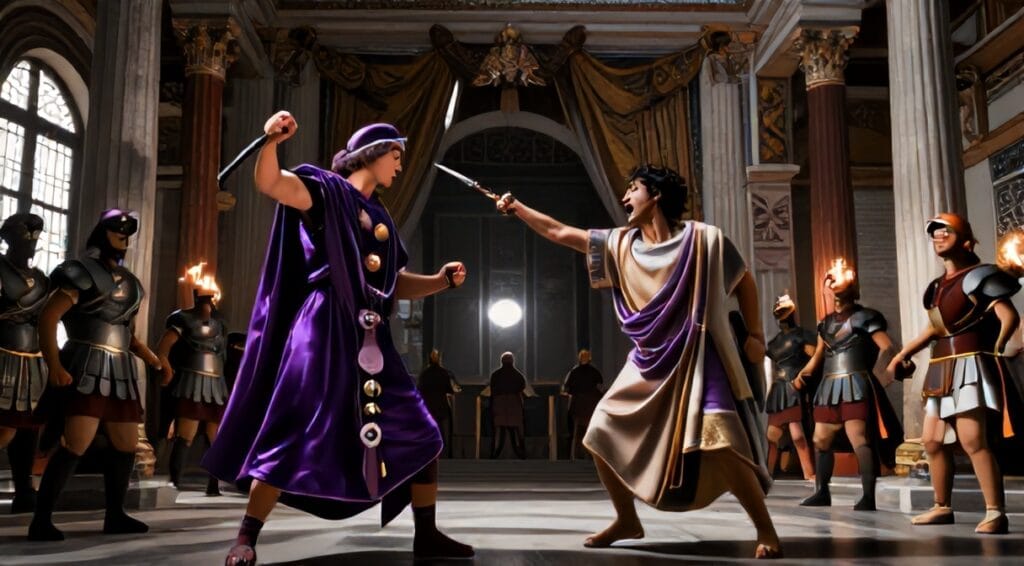
There are moments in history that feel choreographed by an impatient fate. As the year 211 sagged into its last frosty weeks, the palace prepared for an audience that, on paper, aimed at a reconciliation. It was to be held in Julia Domna’s apartments—either as a sign of maternal mediation or as camouflage for the steel to come. Cassius Dio, a senator and witness to the times, reports that Caracalla plotted the deed under the guise of a meeting for peace, summoning Geta to his mother’s presence on the pretext of harmony (Roman History 78.4). Herodian, another historian, tells a similar story with different scenery—everything is fog and menace and the clasping of a mother’s arms as shield. What the sources agree upon is atmosphere: the softness of a carpet underfoot, the heavy drapes shutting out the Roman afternoon, the smell of resin, the thick pacing of guards outside the threshold.
Here the Roman language of power—audiences, petitions, the whisper of imperial secretaries—was about to be replaced by the language of knives. The rooms themselves seemed to sense it; a draft might have moved the curtain just before the footfalls grew louder. Julia Domna, perhaps, stood between them, her hands out. Caracalla may have murmured conciliatory phrases. The doors opened wider, and the guards flowed in. It took fewer heartbeats than one would think. The words not yet uttered in that chamber would fill centuries with their absence. And with this, the prediction sealed itself into fact: caracalla murders geta, not as rumor or allegory, but as the hot impact of steel and the collapse of a young man’s body into the one embrace in the world that should have kept him safe.
Blood in the Imperial Apartments: The Moment of the Killing
The killing itself is one of those moments ancient writers return to with shivering fascination, carving a still-life of cruelty. Geta, unsuspecting or at least unguarded in the sanctuary of his mother’s rooms, was set upon by soldiers. He tried to shelter in Julia Domna’s arms, and some say her clothing was soaked with his blood as he staggered; others say he cried out to the household gods. Either way, the doorposts remember the force of the push as men in armor crowded into a private space. The emperor’s brother fell in a room perfumed for diplomacy. He was cut down not in a battlefield blaze but in a silenced court where whispers had been louder than swords—until the swords came.
We can almost hear the silence that followed, that longest Roman pause—after the gasp, before the orders. Caracalla, according to Dio, ran out into the praetorian camp proclaiming that he had saved himself from a plot and needed their protection. The murder, in an immediate posterior spin, became a pre-emptive defense. Soldiers, trained to interpret power the way mariners read waves, accepted the story they had been given and then accepted the rewards that followed. And so the deed instantly expanded, from a confined, private scene to a public narrative. That is how caracalla murders geta enters history: first a scream and a stain, then a proclamation and a payment.
The Aftermath of Fratricide: Purges, Fear, and the Erasure of a Name
Violence in Rome, once unleashed, travels with bureaucratic elegance. The orders went out: allies of Geta were to be found, questioned, neutralized. “Neutralized” soon became “eliminated.” Cassius Dio numbers the victims in the tens of thousands; whether that exact figure is exaggeration or bitter poetry, the reality is terror made systemic. Houses were searched, dowries rescinded, statues toppled. The Senate, which had dared to hope that Geta might prove a counterweight to his brother’s iron, now moved like a school of fish in a harbor full of nets. Public records were revised. Names became blank spaces. Here the Roman practice of damnatio memoriae—condemnation of memory—reached its cruel zenith.
Walls that had held the likenesses of two young emperors were scraped until the paint turned to a fog of dust. Inscriptions were chiselled, slicing away the syllables of a murdered man. Sculptors reworked reliefs to remove Geta’s face as if removing a tumor from stone. A chest of coins bearing both brothers was recalled or quietly melted; single heads replaced the double. The city learned again how the state can punish not only the living body but the very idea of a person. And over the work’s noise—hammer on marble, chisel against bronze—you could still hear the murmuring of the phrase that now named a reality the stones were being forced to deny: caracalla murders geta.
Law as Perfume Over Blood: The Edict That Made the Empire Citizens
As the blades did their grim editing, a very different document took shape—one that would outlast every smear of blood and outlive the frenzies of the palace. In 212, Caracalla issued the Constitutio Antoniniana, extending Roman citizenship to nearly all free inhabitants of the empire. It was, on paper, a magnanimous gesture of inclusion, the longest reach of Rome’s civic hand into its provinces. Cynics, then and now, point to the fiscal motives—the wider tax base, the expanded pool of jurors, the administrative conveniences that citizenship bestowed on state machinery. Ideologues hailed it as an act of unity from a ruler eager to gather the world under one law. Both things can be true.
And yet the timing was eloquent. In the wake of a fratricide, a decree of inclusion could act as counterpoint and cover, perfume over blood. Jurists would argue its meanings for a century; provincial notables would re-inscribe their identities in its wake. But under the fine Latin phrases, readers could still hear the muffled drums of what had made such a move necessary: caracalla murders geta. In a political sense, the edict was a genius’s response to crisis. In a human sense, it was a curtain drawn neatly across a ravaged stage, behind which the bodies had not quite cooled.
Coins, Marble, and Memory: How Rome Rewrote the Brothers
Archaeology is sometimes the study of Roman politics after the shouting stops. Take the coins: before the murder, mints struck pieces flaunting concordia between the brothers—two laureled heads facing each other, interlaced victories, clasped hands. After, a new monotony sets in: the singular bust of Caracalla with a soldier’s scowl and an emperor’s diadem. Take the statues: those with two figures were either replaced or underwent sculptural surgery. Tools bit the marble where Geta’s profile once arced; sometimes the incision cut deep enough to leave a ghost shape that any child can see—an outline of absence.
Inscriptions did their own cruel arithmetic. Where once the titles of both Augusti filled the stone, now only one name marched across the lines. Households that had proudly displayed imperial gifts kept them wrapped away; some scraped names from the bases in nervous obedience, others hid the pieces in courtyards and cellars. The city’s material language told the same story that papers and edicts told, and yet the stones occasionally betrayed the anxiety of their patrons. A clumsy chisel stroke or an unevenly re-carved numeral whispers the hurry, the shaking hand. The process reveals something raw: that power can command erasure, but cannot erase the knowledge of erasure. And through it all, the event that gave orders to chisels remains: caracalla murders geta, the sentence that explains the absence in the stone.
Steel and Oath: The Legions Choose Their Emperor
Every Roman emperor lives or dies by the quality of his understanding of soldiers. Caracalla, for all his faults, understood their appetite for honor, pay, and clarity. Immediately after the deed, he ran to the praetorians, swore that he had escaped a conspiracy, and promised gold. He solidified his control with the legions by re-raising their pay—a costly policy with violent consequences for the treasury, but a shrewd one for a man who knew that iron speaks louder than senatorial rhetoric. Geta’s death thus became legible to the army as a necessity, or at least as an irreversible fact accompanied by tangible rewards.
In the northern camps, centurions looked to Rome and read the message: an emperor who does not hesitate. On the eastern frontiers, where the uneasy peace with Parthia required a steady hand, the news traveled and found a grim sort of welcome—clarity, even bought with blood, is a commodity on the fringes of empire. When a regime cements itself, language follows, and the phrase caracalla murders geta began to shift from scandal to slogan, from rumor to regime fact, adopted into the soldier’s gruff historiography as the moment the empire regained a single will. It is cruel to note, but the legions often made their peace with murder if the pay-chest arrived on time.
Meanwhile, the Senate, deprived of its favored counterweight, fell obediently into line, passing decrees that made virtue of necessity. Some senators scrawled private laments in their diaries, which do not survive. Others rehearsed stoic commonplaces about fate. None could change the new arithmetic of power. When the eagles have chosen, marble follows.
In the Streets and Markets: Rome’s People Under a Single Ruler
What did the shoemaker think, or the fishmonger, or the woman carrying a lattice of figs? To them, the palace had always been a distant theatre with lethal plots and larger-than-life actors. Bread was bread, and the goddess of Fortune was more often felt than seen. In the weeks after Geta’s death, patrols grew more visible, courtiers appeared more cautious in public, and rumors wore out their footwear. Parents told their children not to say Geta’s name except in a whisper. The baths echoed with coded conversations and the kind of laughter that ends too abruptly.
Economic rhythms continued; grain ships still creaked into Ostia’s harbors, coin still changed hands on the Esquiline, and the calendar still moved from market-day to market-day. Yet something had shifted: a city knows when it is ruled by a man who has killed his brother. Some found a twisted comfort in the new clarity—at least there would be no civil war in the streets, no two rival standards calling men to bloodshed across the Tiber. Others felt the deeper chill: if the emperor did this to his own blood, what would he not do to theirs? Thus even in the routines of commerce and festival, a line of narrative persisted: caracalla murders geta, and Rome learns again to lower its eyes as the imperial party passes.
The Price of Conscience: Jurists, Philosophers, and the Execution of Papinian
Not all resistance takes the form of swords. Sometimes it is the refusal to decorate wickedness with argument. A story survives—vivid, bitter, and plausible—that Caracalla ordered Aemilius Papinian, the greatest jurist of his day and a close advisor to the Severan court, to draft a justification for the killing of Geta. Papinian is said to have replied that it is easier to commit fratricide than to excuse it. For this he was executed, his life becoming a commentary more forceful than any treatise. Whether the audience imagined by later writers happened exactly so, the truth has the ring of iron: a scholar’s refusal cost him his head, and the court learned again that words, too, can bleed.
In that gesture, a different politics announces itself—the politics of law’s conscience. Rome loved its jurists; their opinions, organized and woven into imperial policy, outlived generals and sometimes even emperors. To cut down Papinian was to send a chill through every library in the empire. The law, which had found in the Constitutio Antoniniana a new task of definition and inclusion, now found itself washing a stain it could not scrub away. For all the new citizens minted in Latin clauses, the whispered grammar of the court remained as stark as ever: caracalla murders geta, and those who will not call it justice must learn to be silent.
The Haunted March: Caracalla’s Restless Travels and the Shadow of Alexander
Some men flee their crimes by burying themselves in work; others flee by refusing to be still. Caracalla did both. He spent the next years on the move—inspecting legions, visiting shrines, and staging himself as a new Alexander. He wore the Macedonian’s image like a charm against nightmares, cultivating a soldierly persona that scorned the silk of court in favor of camp bedsteads and hard bread. There is a psychological portrait that emerges from the gaps of the sources: a man striving to outrun a scene in a mother’s room, its bloodied silk and the shock in his brother’s eyes.
He pressed eastward, testing the Parthian frontier, and he roamed Egypt, where he would later commit a massacre in Alexandria for reasons wrapped in insult and paranoia. Everywhere he went, he sought the soldiers’ love, feeding them gold and the rhetoric of shared hardship. He cut a fierce, austere figure on coins and inscriptions. Yet even as he tried to become Alexander reborn, he lived with Caesar’s worse inheritance—the knowledge that Romans would murmur about what had bought their emperor’s solitude: caracalla murders geta. It was the unquiet drumbeat beneath his triumphal proclamations, a rhythm you hear if you listen between the lines of the stone.
Warfare and Vengeance: From Parthia to Alexandria’s Bitter Laughter
Foreign policy often offers emperors both a distraction and an alibi. Caracalla found in it a theater that suited his temperament. He planned and probed along the Parthian frontier, seeking a decisive blow that would cement his image as warrior-king. His campaigns had mixed results—some successes, some maneuvers more theatrical than strategic. But the clearest window into his temper lies not at the edges of the empire but in Alexandria in 215, where a satirical festival mocking his pretensions and perhaps even the circumstances of Geta’s death provoked deadly vengeance. Accounts speak of mass killings, of the city’s famous wit suddenly finding itself fatal to its owners.
Herodian describes an emperor who could not abide laughter, an Alexander who demanded silence from his chorus (History of the Roman Empire 4.9). Massacres reveal a ruler’s ideology better than manifestoes; they show the point at which insecurity becomes state doctrine. In the shadow of Alexandria’s libraries, citizens learned a grim conjugation: to mock is to die. The emperor presented these actions as the work of stern justice against sedition. But the blood on the streets pooled into a familiar shape—the shape first seen in the mother’s rooms in 211. Whatever foreign enemies he faced, Caracalla’s most potent adversary was the phrase he could not excise from rumor: caracalla murders geta. He tried to bury it under the drums of war. It rose again between the beats.
Ultimately, he too met a violent end—in 217, during a campaign in the East, he was assassinated by a member of his own guard near Carrhae, cut down while relieving himself by the roadside, an emperor reduced to human scale in an indecent moment. Many Romans, learning of his death, felt a symmetry settle upon their memory. The cycle of steel had completed another turn.
Chroniclers and Blame: Dio, Herodian, and the Shaping of a Crime
Our understanding of these events passes through the minds of writers whose own biographies braided with the era’s turbulence. Cassius Dio, a senator who survived the reign and wrote with the cool bitterness of a statesman, serves as one of our principal witnesses. He despised the coarsening of imperial politics, and his chapters on this period carry a moral gravity that can sometimes shade into theatre. Herodian, writing a little later, offered a more popular, dramatic rendering, with vivid set-pieces and psychological sketches. The Historia Augusta, with its potpourri of fact and fancy, adds color and confusion in equal measure.
To read these texts is to see how history itself becomes a court where language decides fates. Dio’s account anchors modern retellings: the appointment of the fatal audience, the murder in Julia Domna’s presence, the purges that followed. Herodian confirms the contours while bristling with details whose accuracy scholars debate. Yet across their differences, the narrative spine holds. Whatever the minor disagreements of scenery and dialogue, the historians approach a single, grim summary: caracalla murders geta, and Rome learns again that empire is a family tragedy staged for the world. The details matter wearily; the moral lands with the same force.
Modern historians have added their own refinements—economic motives behind the citizenship edict, sober reconsiderations of victim counts, archaeological readings of erased inscriptions. But even the most careful footnote cannot help but draw the same stark line between the co-rule that the empire briefly attempted and the solitary reign that followed, bought at the price of fraternal blood.
Threads of Time: A Chronology from Eboracum to Antioch
Let us pull the events tight along a string of dates to feel the speed at which it all happened. Early 211: Septimius Severus dies at Eboracum; his sons, already titled, become joint Augusti. Spring–Summer 211: The imperial court returns to Rome; ceremonies of unity, administrative juggling, and the first intensifying of factional lines. Autumn 211: Rumors harden; the palace becomes geography divided by the width of a corridor. Late 211—most sources say December: the audience is arranged in Julia Domna’s rooms; the doors open; Geta is killed; the guards are paid; the Senate is summoned and put in line. Early 212: the purges, the condemnations, the chisels scraping away Geta’s name from stone; Papinian’s fall. 212: the Constitutio Antoniniana, a legal wave washing across the provinces and remaking the map of status.
From there the narrative forks: campaigns planned and undertaken, a restless emperor seeking conquest and legitimacy as if they were synonyms. Egypt sees a massacre, the East a series of probes, and the empire grows used to a ruler who sleeps better under canvas than under silk. 217: outside Carrhae, a guard’s blade returns the emperor to the human scale he had tried to outpace. Across these years, the refrain paces with us: caracalla murders geta, the pivot on which all else turns. Without that event, the edict might have arrived differently; the massacres might not have been needed; the coin portraits would have swung a gentler arc. With it, the timeline becomes an arrow weighted with fratricide.
Echoes of a Decree: Citizenship, Identity, and the Long Roman Century
Among the many afterlives of this story, the longest belongs to the edict of 212. By making Roman citizenship nearly universal among the empire’s free inhabitants, Caracalla accelerated trends already visible in imperial history—the provincialization of Rome’s identity, the equalization (at least on paper) of peoples who had once stood outside the city’s sacred circle. New legal statuses demanded new legal work: jurists had to refine categories of local law versus imperial law, navigate the inheritance customs of regions now covered by Roman citizenship, and recalibrate taxation systems shaped for narrower definitions of the citizen body.
Here we confront a paradox that civilizations often present: a ruler whose name is freighted with cruelty sponsors a reform whose consequences are, in many lights, progressive. Historians debate the extent to which the edict was driven by economic desperation, by administrative convenience, or by a half-sincere ideology of unity. None of those possibilities cancels the others. And none can fully muffle the origin story known by every citizen who watched the wax tablets pass from desk to desk: caracalla murders geta, and then remakes the meaning of Roman. The phrase binds the moral and political history of the empire into one knot we cannot untie. The law’s arc can be long; sometimes it grows from poisoned soil and still yields fruit.
Long after the blood had dried, shards of reworked portraits turned up in the provinces, their chisel marks like fossils of fear. Governors’ archives carried copies of the edict, folded and re-copied as they wore out. A provincial father might explain to a son that they were now Romans, whatever that meant in their valley or city. The boy—learning to recite lists of emperors, to read municipal inscriptions—would point to the blank space where a name had been, and ask what had been carved there and why it was gone. The father, with the caution of one who understood regimes, would shrug. In that shrug lives the entire texture of Roman public life after 212.
Conclusion
Fratricide is the oldest human story—Abel and Cain set in Latin marble. In Rome, the city that called its emperors by the name of father and demanded from them the performance of piety, the killing of a brother cuts the deepest groove. In 211, a divided inheritance seemed at first a political challenge; in 212, it became a moral fact written in blood. From the Palatine rooms where Geta fell to the eastern roads where Caracalla marched like a man who feared stillness, the empire felt the ripples. Law tried to salve the wound with citizenship; jurists tried to translate pain into precedent; soldiers did the arithmetic of pay and oath; historians shaped it into paragraphs and curses. What remains to us, two millennia on, is the sensation of proximity—the way a single gesture between two men could alter the fate of millions.
We can trace the chisels’ grooves where a face once was, read the coinage’s sudden loneliness after the brother’s head vanished from its reverse, and hear the courtroom’s silence where Papinian would not speak a lie. We can watch emperors after Caracalla struggle to convince their citizens that rule could be something other than a performance staged on a foundation of blood. And we can recognize that even in its darkest acts, Rome rendered itself legible through the records of those who loved and hated it. At the core, a phrase persists, terrible in its simplicity: caracalla murders geta. Around that phrase spin the edict, the armies, the laughter cut short in Alexandria, and the sound of a mother’s cry. History asks us not only to remember the deed but to look at its edges—the people who lived under the shadow it cast, and the ways law and art tried to draw light through it. The story ends in 217 on a roadside, but the lesson continues: power without measure turns family into fate, and fate into a blade.
FAQs
- Who were Caracalla and Geta?
They were the sons of Emperor Septimius Severus and Julia Domna. Upon their father’s death in 211, both became co-emperors of Rome, a fragile arrangement that collapsed when Caracalla orchestrated the murder of his brother. - When did the killing occur?
The murder took place late in 211, most likely in December, during a staged audience in Julia Domna’s apartments on the Palatine Hill in Rome. - Why did Caracalla kill Geta?
Power could not be comfortably shared under the Roman imperial system. Personal hostility, political rivalry, and fears of plots pushed Caracalla to eliminate his brother. Ancient sources depict the act as premeditated and executed under the guise of reconciliation. - What happened immediately after the murder?
Caracalla appealed to the praetorian guard, framed the killing as pre-emptive self-defense, and initiated purges against Geta’s supporters. A widespread damnatio memoriae erased Geta’s name and image from public view. - How does the Constitutio Antoniniana relate to this story?
Issued in 212, the edict granted Roman citizenship to nearly all free inhabitants of the empire. Its timing suggests a political calculation by Caracalla to consolidate support and craft a legacy of inclusion, even as the purges continued. - Which ancient authors report the events?
Cassius Dio (Roman History 78) and Herodian (History of the Roman Empire 4) are key sources. They differ in details but agree on the murder’s setting and its significance. - Was the execution of Papinian connected to the murder?
Ancient tradition holds that the renowned jurist Aemilius Papinian refused to justify the fratricide and was executed in 212. Whether or not the dialogue occurred exactly as reported, his death symbolized the cost of conscience at court. - How did the army react?
Caracalla secured the loyalty of the praetorians and the legions with pay increases and direct appeals. Many soldiers accepted the regime’s version of events in exchange for stability and reward. - What is damnatio memoriae?
It was the Roman practice of condemning a person’s memory—removing names from inscriptions, defacing portraits, and attempting to erase them from public commemoration. Geta became a principal victim after 211. - Did Caracalla face consequences?
He ruled alone after the murder, traveling widely and waging campaigns. In 217, he was assassinated by a member of his guard near Carrhae. Many Romans saw his death as a grim balancing of the scales.
External Resource
Internal Link
Other Resources
- Encyclopaedia Britannica – general search for the exact subject
- Google Scholar – academic search for the exact subject
- Internet Archive – digital library search for the exact subject