Table of Contents
- In the Wind off the Elbe: Setting the Stage in Nordalbingia
- The Long Saxon Wars and a Land Between Rivers
- Charlemagne’s Designs on the North Sea Frontier
- The Tribes of Nordalbingia—Holsteiners, Sturmarii, Dithmarsi
- Pagans, Christians, and the Missionaries in the Marsh
- Obodrite Allies and the Weight of Frankish Diplomacy
- The Winter Before Surrender: 802–803
- Envoys, Oaths, and Hostages: The Mechanics of Submission
- The Day the Standards Lowered—Ceremony of 803
- Terms of Peace—Forts, Tithes, and the Quiet Clauses
- Resistance Smolders: Edges of Defiance After 803
- Deportation and Reordering of Lands, 804 and Beyond
- Monasteries, Markets, and the New Frankish Order
- Lives Upended: Women, Farmers, and Warriors Tell the Tale
- Faith and Fear: Baptism, Relics, and Memory
- Annalists and Their Pens: How We Know What We Know
- The North Sea World Responds—Danes, Frisians, and Trade
- From Submission to Integration: Law, Custom, and Carolingian Rule
- Conclusion
- FAQs
- External Resource
- Internal Link
Article Summary: In 803, amid wind-gnarled oaks and river fog along the Elbe, the submission of nordalbingian saxons marked a dramatic turn in the long Saxon Wars, the last stand of a northern people against the spreading power of Charlemagne. This article follows that moment from its roots in border skirmishes and missionary work to the ceremony of surrender and the fateful restructuring of lands and loyalties that followed. It explains how alliances with Slavic Obodrites, the politics of tribute, and the choreography of oaths shaped peace as much as battle did. It explores what the submission of nordalbingian saxons meant for farmers, warriors, women, and priests, and how deportation in 804 recast families and fields in a single season. Through annalists’ pens and the voices they captured, it uncovers the rhetoric of victory and the quiet grief buried in reformed borders. From the vantage of trade routes, monasteries, and newly minted law, it asks what stability replaced the old freedoms, and at what human cost. Above all, it situates the submission of nordalbingian saxons within a broader North Sea world where Danes watched, Franks calculated, and merchants counted each change of master in coined silver.
In the Wind off the Elbe: Setting the Stage in Nordalbingia
The winter wind off the Elbe carried a taste of peat smoke and brine, a northern air that had seen far older migrations than the Franks and the Saxons. In this landscape—low, damp, and ringed by marshes and sandy ridges—the people of Nordalbingia carved out their lives. Three sub-groups shared this domain west of the Elbe: the Holcetae of the Holstein, the Sturmarii of the Stormarn, and the Dithmarsii of the stubborn bogs. These were communities calibrated to the land’s rhythms: fields sown late, cattle moved with the tides, timber boats nosing through reed-choked channels. It is here, in these sinewy backwaters and on these sable soils, that the submission of nordalbingian saxons would be sealed in 803 under the shadow of Frankish banners and the methodical logic of imperial order.
Before the Frankish riders came, Nordalbingia felt its way through the ninth-century dusk with an old-fashioned independence, suspicious of distant kings and slow to accept foreign rites. The Saxon Wars had pressed upon them for decades—pressure like an incremental tide—yet the marsh’s people were pragmatic. They traded with Danes and Frisians, haggled for salt and furs, and remained a necessary buffer for all who traversed the North Sea rim. It was never inevitable that their proud distance would end in the submission of nordalbingian saxons; but the forces converging from Aachen, the missionary zeal from the Rhine mouth, and the Slavic currents just east of the Elbe would prove overwhelming.
But this was only the beginning. To understand how an ancient independence bent to imperial will in 803, one must walk further upstream into the history of conflict, creed, and calculation—the slow braid that bound the Elbe marshes to a Frankish destiny.
The Long Saxon Wars and a Land Between Rivers
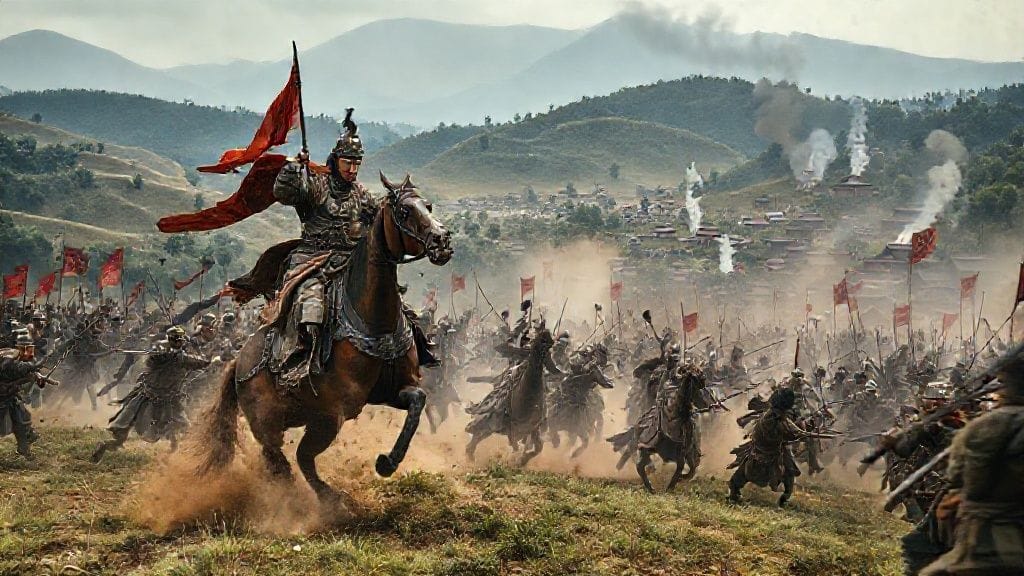
The Saxon Wars spread across the later eighth century, a conflict of attrition punctuated by brutal crescendos. Frankish legions marched along the Lippe and Weser, fort took fort, and oaths were sworn, broken, and sworn again. The Westphalian, Engrian, and Eastphalian Saxons had been the first to feel Charlemagne’s fist, their rebellions answered with waves of campaigns. Nordalbingia, set farther north, was both shielded and endangered by distance: less easily reached, yet drawn in by kinship and by raids that crossed borders like shadows slipping under a door.
The terrain itself was a combatant. Marshes slowed cavalry. Rivers obliged armies to build bridges or navigate fords that men forgot each spring. But the Franks learned, and the Carolingian machine adapted. Roads were cut, river barges equipped, supply lines hardened. With each campaign season, the empire improved its grasp on the frontier’s geometries. When the final measure approached in 803, the submission of nordalbingian saxons was not a single instant of surrender but the sum of many seasons in which the great weight of a state wore down local strength.
Yet behind the celebrations of victory lay older rhythms that the wars could not erase: winter markets at the edges of frozen creeks, carved amulets rubbing warm in the palms of mothers, elders telling long tales of hearth-gods to children drowsing by firelight. In these particulars, a people answered the new age with continuity and, when they could, with quiet resistance.
Charlemagne’s Designs on the North Sea Frontier
Charlemagne had watched the North with eyes narrowing, a ruler who understood that empires are safe not at their centers but at their edges. The Elbe frontier was a chain of risks—invasion from the Danes, instability among the Slavic polities, and Saxon insurrection that might flare again. For Aachen to sleep well, Nordalbingia could not remain a vexed threshold. The submission of nordalbingian saxons would be a keystone in a political arch: it completed the arc begun against Widukind and the Westphalians, confirmed the reach of Carolingian law over the whole Saxon body, and sealed the border with treaties and forts rather than only with prayers and fear.
Charlemagne’s designs mingled iron and ink. He sent not just soldiers but counts to count, bishops to baptize, and abbots to anchor culture with manuscripts and chant. There would be road stations and tolls, and where a toll sits, a market soon appears. It’s astonishing, isn’t it? Conquest and commerce are often twins, tugging each other along. By 803, the emperor had calibrated the levers of diplomacy with the Obodrites and of deterrence against the Danes; he had scouted the terrain through trusted agents. The stage was ready; the actors—Frankish captains, Saxon elites, Slavic princes—knew their cues.
The Tribes of Nordalbingia—Holsteiners, Sturmarii, Dithmarsi
Nordalbingia was not a monolith. The Holcetae, settled in the Holstein uplands, balanced agriculture with guarded trade to the Baltic. The Sturmarii ranged over Stormarn, a land wetter and wilder, where kinship networks braided through marsh villages. The Dithmarsii, renowned for their independence, lived close to the sea and closer still to the idea that liberty begins in the fen. These divisions mattered. Each tribe assessed the Frankish power differently; each maneuvered within a triangle—Franks to the south, Danes to the north, Obodrites to the east—that could not remain perfectly balanced forever.
The inner politics of these groups were subtle: a raid tolerated here, a bride sent there, a promise accepted and tested later. To write that the submission of nordalbingian saxons was a single act risks flattening this texture. In truth, local chieftains negotiated, resisted, and sometimes calculated that survival lay in declaring fealty while bending the terms. The greatest dramas play out not only in thronerooms but also at village moots, beside the taming of cattle and the tally of stores for winter.
Pagans, Christians, and the Missionaries in the Marsh
The frontier hummed with religion. Missionaries had been crossing into northern Saxony for decades: Willehad moved among Frisians and Saxons; Liudger, later the first bishop of Münster, evangelized with patience and manuscripts; bishops in Bremen flickered on and off as politics allowed. The marshes were slow to convert. There were gods of grove and water; there were charms that slipped between fingers as easily as river light. Priests brought relics, Latin, and the measured cadences of the psalter. The clash between oak and altar was not always open war; often, it was a negotiation, a layering of new rites over old habits.
When the submission of nordalbingian saxons took form in 803, it brought faith into the contract. Oaths were sworn in the Christian manner; churches would be built, tithes collected, and a community of belief, however fragile, would frame daily life. These acts were not trivial. Baptism set a person within the empire’s moral grammar; the sign of the cross was also a kind of political mark, an imprint of allegiance visible to any count passing through.
Obodrite Allies and the Weight of Frankish Diplomacy
East of the Elbe, the Obodrite federation moved with a dancer’s flexibility, siding with Charlemagne against shared Saxon rivals when it suited their design. Their prince Thrasco (Drożko) appears in sources as a loyal ally, and Frankish envoys traveled a well-worn path to negotiate tribute, troop support, and shared border security. This alliance was more than auxiliary force; it signaled to the Nordalbingians that Charlemagne’s hand reached beyond the Elbe, that Slavic lords could bend the frontier against them. The blow landed twice: militarily in the field, and psychologically in the knowledge that familiar neighbors now marched beside Frankish standards.
Here we glimpse diplomacy’s teeth. The submission of nordalbingian saxons was sharpened by the Obodrite presence: raids checked, escapes blocked, and treaties enforced with a web of overlapping interests. Merchants felt the shift first; safe-conduct letters multiplied, and river customs stations changed hands. What looked like a local surrender in 803 had, threaded within it, an international alignment binding Carolingian, Saxon, and Slavic futures into a single frontier logic.
The Winter Before Surrender: 802–803
In the sealed cold of 802, rumors crawled across the snow. Scouts watched for Danish stirrings; word spread of Frankish counts surveying routes and storehouses deeper south. The Nordalbingian chiefs held councils under rough timber roofs, torches flickering against faces young and old. Supplies were tallied: grain jars knocked, the echo telling how much remained. Spears were repaired, yokes mended. Yet a grim calculation worked its way through: the empire was inexorable, and fighting alone, with fields already strained, meant slow ruin.
By early 803, envoys had tested the waters with the Franks. The submission of nordalbingian saxons would not be a mere battlefield capitulation but a shaped moment—timed at a place where the riverbanks could stage a ceremony, impressive and clear to all. There were families already sending children south as hostages, both guarantee and plea; there were priests preparing fonts; there were smiths beating out iron for plowshares instead of swords, sensing which tool would secure next year’s food.
Envoys, Oaths, and Hostages: The Mechanics of Submission
Submission in the Carolingian world was theater married to administration. Envoys took the first steps, wrapped in cloaks against the marsh wind, carrying words like weighted coins. They asked for terms: land to be spared, leaders to be spared, and pathways for merchants to continue their living. The Franks replied with conditions: oaths by sacred relics, hostages of high lineage, and the planting of new authority in the form of castles, churches, and counts. And always, a ledger underlay the pageantry—carefully noted tithes and obligations to be enforced.
In this machinery, the submission of nordalbingian saxons found its ritual shape. The hostages—boys with eyes too calm for their age; young women promised in strategic marriages; elders left as sureties—were the human threads that tied distant capitals to wet meadows. “Let the oaths be sworn where all can see,” a Frankish captain might have said, echoed by a clerk scratching on parchment, “and let them be witnessed by cross and sword.” The balance of mercy and menace was no accident. If the bond held, the frontier would settle; if it broke, there was already a record of violation to justify the next wave of arms.
The Day the Standards Lowered—Ceremony of 803
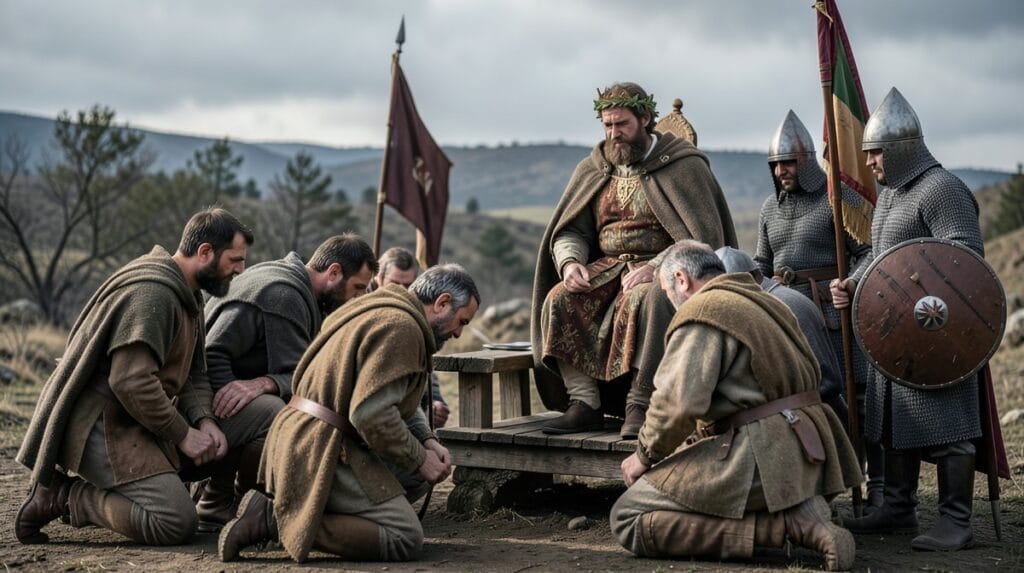
We can imagine the day, if not fix it on a precise calendar line: a gather of chieftains, a tight column of Frankish horse, priests unfurling relics. The wind catches a banner; the mud sucks at boots. A hush as a Saxon standard dips and is laid against the earth before it is raised again beneath a new overlord’s gaze. At the heart of such scenes lies the power of choreography. Witnesses anchor memory, and memory binds law.
The submission of nordalbingian saxons in that hour wore both solemnity and fatigue. Voices recited oaths. An elder touched a cross to his lips, perhaps thinking of an oath once sworn to oak and water. A lad stares at the iron nails in a reliquary and the raised knuckles of a Frankish hand. Yet the scene is not only symbol. A scribe takes names, a count assigns watches, a small chest receives a first measure of tax in kind. The Royal Frankish Annals would later distill such gravity into a line or two—“the Nordalbingians submitted”—but each syllable compresses a hundred gestures and the quiet fracture of a people’s ordinary day.
Terms of Peace—Forts, Tithes, and the Quiet Clauses
Peace comes with a ledger. The immediate terms after 803 pinned the marsh to a new frame. Forts would be maintained at strategic crossings and ferry points; any remaining strongholds refashioned under Frankish oversight. Tithes—one-tenth, symbolic and severe—would be drawn from harvest and herd, to be shared between church and administration. There were limits set on bearing arms and on gathering in large numbers without permission—clauses meant to smother rebellion before it kindled.
The submission of nordalbingian saxons contained other, quiet stipulations: passage rights for merchants under Frankish safe-conduct, obligations to provide guides and river pilots to imperial envoys, and the grant of limited local autonomy to those who complied swiftly. Intelligently, the Frankish terms co-opted local elites, promising them roles in the new order. But the sting remained: surveillance would tighten, and the marsh’s agency would now be measured against a distant court’s expectations.
Resistance Smolders: Edges of Defiance After 803
Peace is never unanimous. Stories surfaced of night gatherings in the fens, of charms buried beneath church thresholds, of cattle that “went missing” and appeared later behind new fences. Young men took to the edges where jurisdiction became a rumor more than a law. An oath can be public and yet hollow in private; a leader can bow and still dream of a season when the marsh will rise with him. The submission of nordalbingian saxons thus left space for later flare-ups, small and local—brushfires rather than wild conflagration, but dangerous enough to demand continued garrisons and oversight.
Still, there were also reconciliations. Some communities found that trade flourished under fixed tolls; some families discovered that a son who served in a Frankish retinue sent gifts southward that steadied the winter’s stores. History holds both truths at once: loss and opportunity living in the same wooden house, eating at the same rough table.
Deportation and Reordering of Lands, 804 and Beyond
The year after submission brought a grimmer turn. The Royal Frankish Annals preserve the starkness of it: after continued disturbances, large numbers of Nordalbingians were removed from their lands and resettled in the Frankish heartlands. The figure often repeated—thousands of men with their households—remains debated, but its human weight is not. Villages thinned. Fields were left with unfamiliar hands to reap them. The Obodrites received stretches of territory west of the Elbe, a reward and a strategic buffer, welding the frontier into a new configuration.
For those deported, the road south was long. Carts groaned; infants cried; elders fell behind. The submission of nordalbingian saxons, once a ritual at a riverbank, now became a calendar of separation, a replotting of memory onto strange soil. “They were led away and settled in scattered places,” a clerk might note without tears, but the people knew each step of the sorrow. Einhard, in his Life of Charlemagne, glossed the emperor’s northern policy in terms of prudence and firmness, the language of “necessity.” Yet necessity for whom? For the empire’s safety, surely; for the families, it was the arithmetic of loss, counting what could never return.
Monasteries, Markets, and the New Frankish Order
In the seasons that followed, the frontier wore new clothes. Monastic houses, modest at first, planted timber churches and sketched gardens behind ditch and fence. Scriptoria copied homilies; a monk taught boys to carve letters onto wax tablets. Markets swelled on officially sanctioned days, protected by the peace of the king. Fur and salt, iron and amber changed hands under the gaze of men who could read toll charters and enforce them.
Within this order, the submission of nordalbingian saxons gained a retrospective glow for imperial chroniclers: it looked like the first stone in a cathedral of stability. But the lived texture was messier. A Frankish count might arbitrate a boundary dispute using laws few locals could recite; a merchant might bribe a scribe to adjust a measure in the margin. Stability is not serenity; it is the successful management of frictions. Still, compared to the wild spins of earlier decades, the marsh settled into a slower, heavier turn, a rotation in which harvests and Sunday bells marked time more than war drums did.
Lives Upended: Women, Farmers, and Warriors Tell the Tale
History books favor kings and captains, but a truer measure lives in kitchens and byres. Consider a woman of Stormarn, mid-thirties, two children under seven: she keeps a small herd, brews beer thick with grain husk, barters thread for salt. The surrender meant her husband served, sometimes as a levy, sometimes transporting goods for a Frankish official. Once, she hid a small copper amulet beneath the hearthstones, a compromise between creed and inheritance. When deportations came to her road, she lashed what she owned to an ox-cart and did not look back at the house, because who can bear to watch grief reflected in a doorway?
Consider a farmer of Holstein: he liked straight furrows and a good plow. He joined the oath-taking in 803 solely because he had seen what unsown fields look like after a raid. For him, the submission of nordalbingian saxons was a promise that his children might know steady bread. He learned to kneel at Mass without choking on pride. He was less troubled by Rome than by weather. And a young warrior of Dithmarschen, who slipped into the fen after a tax collector roughened his father—he would measure the empire by the quality of its mercy when he was finally caught, and by whether the count allowed his mother to keep a milk cow.
Faith and Fear: Baptism, Relics, and Memory
Relics arrived with their own gravity. A splinter said to be of the True Cross, a bone of a martyr carried in a small gilt box, a cloth kissed by a saint’s tomb: these things could still a crowd and moisten older eyes. Priests told how baptism washed away not just sin but the memory of other loyalties, and, perhaps, a part of grief. Bells tolled from wooden towers on feast days, and villagers came, half from devotion, half from the knowledge that absence would be noticed by the wrong man.
In these rhythms, the submission of nordalbingian saxons grew into liturgy as well as law. Anniversaries might be marked by prayers for the realm’s peace; processions stitched the new faith into the marsh’s paths. And yet, memory keeps its own calendar. In winter, when the wind clawed at doors and the river froze, some old men muttered stories of the eagle that once flew free on these skies, without imperial sanction, without relic or tithe. Christianity rose like a bright roof; beneath it, the house of older memory kept one hidden room.
Annalists and Their Pens: How We Know What We Know
The problem of sources threads through all of this like a careful seam. We read the Royal Frankish Annals and find lines dense with authority, sparse with empathy. We hear Einhard’s polished Latin and admire his portrait of a ruler who measured peace as a statesman’s art. We glean later notes from the archdiocese of Hamburg-Bremen, where Ansgar would labor a generation on, to extend the church northward. But what of Nordalbingian voices? Their words, rarely gathered, live at the edges of law codes, in the habits archaeology traces, and in the silence where a people’s perspective should be.
Even so, the broad shape stands firm. There was a ratified ceremony in 803. There followed a resettlement in 804. Forts rose; churches took root; a frontier moved from noise to hum. The submission of nordalbingian saxons is not merely a line in a royal digest; it is the hinge that closed one era of Northern independence and opened another of negotiated belonging. As one annalist put it in a phrase that seems to carry far more than ink—“the matter was settled”—we must read the settlement as both act and process, both performed and enforced.
The North Sea World Responds—Danes, Frisians, and Trade
Beyond the Elbe, watchers took their measures. The Danes, whose king Godfred would soon cast a long shadow over the south by destroying the trading port of Reric and fortifying the Danevirke, weighed the Carolingian north with wary calculation. Frisians counted risk in coin tallies, shifting trade routes like water seeking easy descent. Every submission—and especially the submission of nordalbingian saxons—sent a ripple across the North Sea’s markets and war rooms. Frankish power meant safer riverine passages but also increased tolls and tighter control over the sale of arms and salt.
Merchants whose fathers had steered by stars now learned to steer by paperwork, by seals and placards. The bone dice of chance were taken from war and given to trade. For a moment, the world seemed ready to reward patience and ledger-keeping more than spear tricks. But the North never sleeps; storms come. The years would soon see raiding intensify elsewhere, and the Danes would probe the frontier with all the cunning expected of a kingdom perched at the hinge of seas. Nothing in 803 was a final ending, but it did set the table for the meals the next generation would eat.
From Submission to Integration: Law, Custom, and Carolingian Rule
Charlemagne’s administration prized law as a way to transform conquest into habit. Capitularies extended the empire’s pulse into the marsh’s capillaries: mandates about tithes, about assembling for justice, about maintaining bridges and roads. The Saxon Law, already bent in earlier campaigns, was further folded into Carolingian legal culture. Judges traveled circuits; scribes prepared lists; local magnates learned to argue not only with lineage but with paragraph and precedent. Such integration is never glamorous, but it holds the state together more firmly than trumpet blasts ever could.
The submission of nordalbingian saxons therefore becomes, in the long view, a case study in how empire makes neighbors of strangers. Custom did not vanish; it adapted. Bride-prices and wergilds found parallel forms in Latin texts. The church’s calendar overlaid the agricultural one, shifting feast and fallow a little, but not entirely. When a boy learned to read a psalm, he also learned to read a surveyor’s stake. When a woman signed herself with a cross, she also kept an eye on the rising of river water and the kind of year it forecast. Integration is a duet: empire provides the theme; the people keep the rhythm.
Conclusion
Along the Elbe in 803, as banners rustled and oaths were made, the submission of nordalbingian saxons threaded a quiet final stitch through the long fabric of the Saxon Wars. It was a conclusion and a beginning, a ceremony strong enough to fix the frontier and tender enough to leave room for sorrow. Through the agency of diplomacy, the force of arms, and the artistry of ritual, Charlemagne completed a northern strategy he had labored over for decades. But the sum cannot be paid only in political coin. It was tallied in uprooted hedges, in mothers’ folded hands, in annalists’ compact sentences, and in the slow, complex knitting together of law, liturgy, and livelihood.
To tell this story is to acknowledge its scale: from the immediate glare of 803 to the cooler light that falls on the 804 deportations and the subsequent remapping of duty and faith. The Frankish state showed its genius for systematizing victory, and the marsh communities showed their genius for surviving under new terms. The earth remembers both—furrows turned beneath new rules, and ghosts who walk the boundary lines at dusk. If the empire’s aim was stability, it found it; if the people’s aim was endurance, they found it too. In that narrow overlap, history settled down to its work.
FAQs
- What does “Nordalbingia” refer to?
Nordalbingia refers to the Saxon lands north of the Elbe River, roughly corresponding to parts of modern Holstein and the surrounding marshlands, home to groups like the Holcetae (Holsteiners), Sturmarii (Stormarn), and Dithmarsii. - Why is the year 803 significant?
In 803, a formal surrender and oath-taking marked the submission of nordalbingian saxons to Charlemagne’s authority, capping decades of Saxon conflict and securing the Carolingian Empire’s northern frontier. - What happened after the submission?
Following the ceremonies and terms of 803, continued disturbances led to large-scale deportations in 804; numerous Nordalbingians were resettled in Frankish territories, and their lands were reorganized, with the Obodrites gaining influence west of the Elbe. - Who were the Obodrites, and why did they matter?
The Obodrites were a Slavic federation east of the Elbe who allied with Charlemagne. Their cooperation provided strategic pressure on the Nordalbingians and helped enforce the new border arrangements after 803. - How did Christianity affect the region?
Christianity arrived with missionaries, churches, and tithes, becoming both a spiritual change and a political instrument. Baptism and oaths on relics formalized allegiance to the Carolingian order, embedding the new faith within governance. - What are the key sources for this history?
Primary voices include the Royal Frankish Annals, which record the northern campaigns and policies, and Einhard’s Vita Karoli Magni (Life of Charlemagne), which frames the emperor’s objectives and methods within a narrative of prudent statecraft. - Did resistance continue after 803?
Yes. While large-scale warfare subsided, low-level resistance persisted—petty raids, tax avoidance, and cultural holdouts—requiring continued oversight and garrisoning by Frankish authorities. - How did ordinary people experience these changes?
For families, change meant new taxes, church attendance, and sometimes conscription or deportation. Some benefited from safer trade; others suffered dislocation and loss. The story is one of uneven costs and gains lived out in households, not just at courts. - What role did the Danes play?
The Danes watched the frontier closely, sometimes probing it and sometimes fortifying their own lines (such as at the Danevirke). Their actions influenced Frankish strategy and the tempo of border politics. - How did 803 affect long-term regional integration?
The submission enabled Carolingian law, administration, and ecclesiastical structures to take root, gradually integrating Nordalbingia into the empire’s political and economic systems, a process visible in markets, monasteries, and the everyday practice of law.
External Resource
Internal Link
Other Resources
- Encyclopaedia Britannica – general search for the exact subject
- Google Scholar – academic search for the exact subject
- Internet Archive – digital library search for the exact subject