Table of Contents
- Washington, March 1941: A Signature in a Storm
- The Road to Aid: Neutrality’s Collapse
- Britain’s Need and America’s Dilemma
- Crafting the Bill: Words That Armed a Democracy
- Debates in Congress: Intervention, Isolation, and the Radio
- Roosevelt, Churchill, and the Arsenal of Democracy
- What the Law Authorized: Ships, Food, Secrets, Hope
- First Shipments: Convoys Across the Gray Atlantic
- Beyond Britain: China, the Soviet Union, and the Global Web
- Financing Freedom: Dollars, Debt, and Industrial Mobilization
- Home Front Frictions: Labor, Politics, and Dissent
- Intelligence and Logistics: Quiet Wars Behind the War
- Measuring Impact: Turning Points from the Atlantic to Stalingrad
- From Lend-Lease to Alliance: Toward a Postwar Order
- Conclusion
- FAQs
- External Resource
- Internal Link
Article Summary: On March 11, 1941, in Washington, D.C., Franklin D. Roosevelt signed the Lend-Lease Act, a legislative key that opened America’s factories to nations fighting the Axis. The law reflected months of political struggle over neutrality, defense, and the fate of democracy. This article examines how the legislation was drafted, debated, and deployed across oceans. It follows convoys, balance sheets, and human stories to assess its impact. We also explore Britain, China, and the Soviet Union’s reliance on U.S. aid, and the way logistics shaped victory. Throughout, we consider why the moment when the lend-lease act signed became a hinge between isolation and alliance.
Why keep reading: Because a signature in Washington altered what was possible in London, Chongqing, and Moscow, bending the course of a world war before the United States formally entered it. Follow the quiet urgency, the bitter arguments, and the ships that carried a policy from paper to perilous seas.
At a glance:
- Event: Lend-Lease Act signed into law by U.S. President Franklin D. Roosevelt
- Date: March 11, 1941
- Place: Washington, D.C., United States
- Main figures: Franklin D. Roosevelt, Winston Churchill, key members of the U.S. Congress, Allied leaders
- Why it mattered: Enabled the United States to supply Allied nations with war materiel, food, and technology, reshaping the war’s trajectory and laying foundations for a postwar alliance system.
01 – Washington, March 1941: A Signature in a Storm
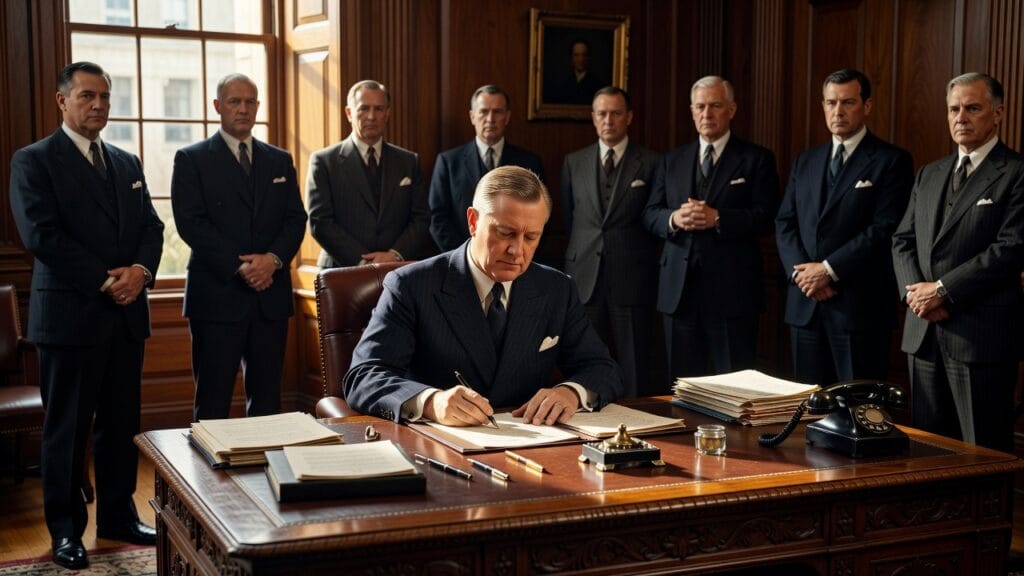
On a gray March day in Washington, Franklin D. Roosevelt reached for a pen and turned legislative text into wartime reality. Outside the White House, the capital’s rhythms went on—streetcars clanged, clerks hurried—but inside, the calculus of global survival shifted. It was not yet America’s war, but the nation was entering its gravity well.
The bill before Roosevelt was deceptively simple: allow the United States to lend, lease, or otherwise transfer defense articles to countries vital to its own defense. In practice it promised ships, aircraft, vehicles, food, and knowledge. It also promised political risk, domestic controversy, and commitments that would be measured in steel tonnage and lives saved or lost.
Reporters scribbled notes, and editors prepared headlines that could sound either resolute or ominous. Within days, radio commentaries would debate whether this moment—when the lend-lease act signed—betrayed neutrality or preserved the republic. The question hung over Washington like a new weather front, unsettled and inescapable.
02 – The Road to Aid: Neutrality’s Collapse
The law did not emerge from a peaceful decade. From the late 1930s, Congress had passed Neutrality Acts designed to avoid another 1917-style plunge into war. Yet events outran statutes. Germany’s 1939 invasion of Poland and the fall of France in 1940 forced Americans to ask whether distance could still shield them from the consequences of European collapse.
By the time Roosevelt won his unprecedented third term in November 1940, his administration was searching for legal pathways to assist Britain without triggering open war. The destroyers-for-bases deal of September 1940 foreshadowed the principle: trade American material strength for strategic position, short of formal belligerency. Pragmatism became a bridge between law and crisis.
Neutrality as a blanket doctrine frayed under pressure. Submarines, airpower, and total war ignored geography. Isolationist arguments, powerful in many communities and newspapers, confronted the reality of a Britain under nightly bombardment and an Axis alliance widening to include Japan. There was no safe legal formula that could erase peril, only choices with different risks.
03 – Britain’s Need and America’s Dilemma
Britain’s gold and dollar reserves were draining away as 1940 turned to 1941. Purchasing aircraft and munitions on a cash-and-carry basis could not continue indefinitely. Winston Churchill’s cables mixed gratitude with blunt arithmetic: without credit or alternative arrangements, supplies would slow just as the Battle of the Atlantic was intensifying.
Roosevelt read those cables with both political and strategic eyes. His “arsenal of democracy” fireside chat in December 1940 prepared the public for a more expansive role. The phrase did not merely comfort; it anchored a case that America’s safety required robust industrial outreach. Supporters and critics heard the same words and drew opposite conclusions.
In the United States, families carried the memory of World War I’s costs. Many did not want to repeat the trajectory from neutrality to trenches. Yet it is easy to forget how fragile this world still was: if Britain broke, the Atlantic could have become a hostile moat instead of a protective one. The dilemma sharpened each week.
04 – Crafting the Bill: Words That Armed a Democracy
Administration lawyers and congressional allies drafted a bill whose flexibility was its strength. It authorized the president to “sell, transfer title to, exchange, lease, lend, or otherwise dispose of” defense articles to governments whose defense the president deemed vital. The language was sweeping by design, and it alarmed critics who saw vast discretion in the executive branch.
Debates over clauses and commas mattered. Could the United States retrieve equipment after hostilities? How would repayment work? Advocates argued that accounting should not stand between allies and survival; skeptics insisted on oversight to prevent mission creep. The legislative saga unfolded in committees, hallways, and newspapers, where metaphors replaced footnotes.
Yet behind the ceremony of drafting, real ships were waiting at docks and real factories were tooling up. The urgency of time shaped the text as much as lawyers did. The Statutes at Large would preserve the final words, but the surrounding context—letters, memos, and the Congressional Record—captures an anxious winter crowding into spring.
Mini timeline:
- Sep 1940: Destroyers-for-bases deal signals a new approach.
- Dec 29, 1940: Roosevelt’s “arsenal of democracy” address primes public opinion.
- Jan–Mar 1941: Lend-Lease bill hearings and debate dominate Congress.
- Mar 11, 1941: Roosevelt signs the Lend-Lease Act into law.
05 – Debates in Congress: Intervention, Isolation, and the Radio
Congressional hearings became a proxy battlefield where future strategy was argued through America’s past. Interventionists marshaled testimony from military officers and diplomats who warned that a Europe dominated by Berlin would menace the Western Hemisphere. Isolationists countered with constitutional arguments and bitter recollections of 1917 propaganda and profiteering.
Radio magnified the passions. Senators delivered speeches for the airwaves as much as for the chamber record. Listeners in small towns and cities heard confident baritones predicting either safety through distance or doom through entanglement. The Congressional Record, while sober on paper, cannot fully convey the anxieties that flickered through kitchen radios.
In the end, majorities coalesced around the bill, tempered by amendments for oversight. The victory solved one problem and created another: having the legal authority to arm democracies required solving logistics across oceans prowled by submarines. The day after a vote rarely feels like triumph; it more often feels like instructions to begin.
06 – Roosevelt, Churchill, and the Arsenal of Democracy
Roosevelt’s relationship with Churchill fused policy and personality. Their correspondence, later published in selections and studied by historians, reveals strategic intimacy that predated America’s entry into combat. Tones varied—urgent, affectionate, sometimes wry—but a consistent line ran through them: defeat of the Axis required relentless flow of materiel.
Churchill understood both the material and psychological value of American support. Each convoy that pierced the Atlantic felt like a sentence added to Britain’s reprieve. He spoke of “the tools to finish the job,” careful not to demand what he could instead inspire. Yet behind rhetoric lay the boring heroism of requisitions, schedules, and spare parts.
Roosevelt, meanwhile, balanced domestic politics with grand strategy. He could not promise what factories had not yet produced. He could, however, promise that America’s capacity—if mobilized—would outstrip the Axis. It is astonishing how much political weight could rest on a seal, a signature, or a telegram.
07 – What the Law Authorized: Ships, Food, Secrets, Hope
The law’s scope went beyond guns and airplanes. It included trucks and locomotives, machine tools and raw materials, boots and blankets, powdered milk and penicillin. War turns on mundane items as much as on weaponry. A Soviet factory short of bearings cannot assemble tanks; a British convoy short of tinned meat loses sailors to exhaustion.
It also permitted the sharing of designs and know-how. British inventions like cavity magnetrons for radar passed to American engineers who could scale production. Conversely, U.S. mass-production techniques spread through Allied partners. The traffic of ideas moved alongside crates, transforming factories into learning centers as well as outputs of steel.
To critics, this breadth smelled like a blank check; to advocates, it read like common sense. Modern war does not respect neat categories. If a nation fights for survival, what counts as a “defense article” multiplies quickly, wrapping itself around communications, medicine, and fuel. Under Lend-Lease, hope traveled with invoices and manifests.
08 – First Shipments: Convoys Across the Gray Atlantic
With the ink dry, crates moved. The first Lend-Lease shipments rolled and sailed under flags of nervous optimism. Crews learned new routes and new risks as the Atlantic’s weather and U-boats collaborated to make every crossing a test. Naval escorts, still limited, did what they could while shipyards raced to build more protection.
Port cities pulsed. In Boston, New York, and Halifax, warehouses filled with aviation fuel, engines, and medical supplies. Paperwork caught up with pallets, and the choreography of supply began to find its rhythm. It was a rhythm interrupted by losses: a missing ship, a quiet telegram, a line crossed out in a ledger that once named people.
Survivors’ memories, preserved in oral histories and wartime diaries, evoke the daily grind: watching wakes for submarine trails, scanning the horizon for a convoy mate that should be there and isn’t, counting lifeboats. Contemporary sources suggest competence hardened by fear. The Atlantic was not only a route; it was an adversary.
09 – Beyond Britain: China, the Soviet Union, and the Global Web
As 1941 unfolded, the program widened beyond Britain. China, long at war with Japan, received trucks, aircraft, and supplies routed through Burma Road bottlenecks and, later, hazardous airlifts over the Himalayas. Each mile of mountain flight consumed fuel and nerve, proof that lines on a map rarely measure the difficulty beneath them.
After Germany invaded the Soviet Union in June 1941, Lend-Lease expanded again. The United States faced new complexities: assisting a regime with which it had deep ideological differences. Yet grand strategy overrode discomfort. Locomotives, aluminum, and tinned foods became as crucial as tanks. Arctic convoys to Murmansk stitched a northern seam in the Allied fabric.
Administration officials spoke carefully in public about these partnerships. The documentary record is fragmentary for some routes and detailed for others, but the surviving evidence points toward experimentation shaped by geography. Asia demanded airlifts and long roads; the Arctic required ice-hardened courage; the Middle East became a surprisingly busy pipeline of rails and ports.
10 – Financing Freedom: Dollars, Debt, and Industrial Mobilization
Paying for a global supply effort required fiscal imagination. Rather than straightforward sales, the policy allowed repayment in kind, return, or postwar settlements. Critics disliked the vagueness; advocates argued that rigid billing would have strangled the very allies whose survival justified the program. War finance is rarely elegant; it is a ledger of emergencies.
Industrial mobilization rendered money into metal. The expansion of U.S. factories, aided by government contracts and guarantees, produced cargo ships, aircraft, and vehicles at rates that stunned observers. Unemployment fell as new plants opened from the Great Lakes to the West Coast. Economic historians still debate precise multipliers, but the overall trajectory is unmistakable: crisis became capacity.
Beneath the rhetoric, procurement officers chased spare parts, standardized designs, and trained workforces. The details matter because they convert slogans into tonnage. Without spare tires or radio crystals, a truck is sculpture. The wisdom of the policy is measured not only by ideals but by railcars shunted and crates counted on midnight platforms.
11 – Home Front Frictions: Labor, Politics, and Dissent
Mobilization drew millions into factories, and with them came disputes over hours, pay, and conditions. Labor unions negotiated with urgency, aware that wartime shortages could tilt leverage. Strikes were rare compared to normal peacetime, but they still occurred, reminders that a democratic arsenal depends on consent as well as contracts.
Politics did not pause. Congressional oversight committees pressed the administration on allocation decisions, alleged favoritism, and bottlenecks. Newspapers aligned with different factions magnified slippages. Yet behind headlines, most citizens found themselves participating, directly or indirectly, in the effort—buying war bonds, saving rubber, or watching family members move to shipyards and airfields.
Opponents kept arguing the principle: that overseas commitments would pull the nation into foreign quarrels. Supporters countered that the Axis was not a distant quarrel but a system that erased distance. The collision of these views did not vanish after December 1941; it merely shifted terrain as liberty and sacrifice began to rhyme more often.
12 – Intelligence and Logistics: Quiet Wars Behind the War
Supplying allies invited espionage and counterespionage. Axis agents probed ports and factories; Allied services shared, sometimes grudgingly, what they knew. Code-breakers watched convoy routes intersect with radio traffic. Security measures tightened around manifests and schedules. The war of shadows accompanied the war of steel, shaping where and when ships sailed.
Logisticians emerged as decisive actors. They mapped railheads, gauged port capacities, and synchronized items that needed to arrive together. A tank without fuel is a promise without performance. The best memoirs of quartermasters read like detective stories, each chapter a puzzle of distance, weather, and human error solved under unforgiving deadlines.
Not every solution shone. Corruption scandals flared at the margins, and waste angered communities asked to save and sacrifice. Modern historians remain cautious because the surviving record is uneven; yet most patterns point to a system that learned pragmatically, adjusting flows and standards with ruthless attention to outcomes measured in battles, not meetings.
13 – Measuring Impact: Turning Points from the Atlantic to Stalingrad
Quantifying Lend-Lease’s impact tempts precision beyond our sources, yet broad strokes are visible. British air forces stayed in the fight with U.S.-built aircraft and parts; the Royal Navy’s escort capacity improved with American ships and sonar technologies; civilian calories stabilized with food imports that quieted the edge of ration lines.
On the Eastern Front, Soviet resilience drew on domestic relocation of industry and blood-chilling endurance, but Lend-Lease supplied trucks, locomotives, and food that smoothed the gears of defense and counterattack. Later Soviet accounts sometimes underplayed that aid for political reasons; Western accounts sometimes oversold it. Between them lies a synergy that is hard to deny.
In China and Southeast Asia, results were slower and more brittle. Geography throttled throughput. Still, each ton delivered kept pilots flying and armies moving. The victories of 1943 and 1944 draw from many wells—intelligence breakthroughs, Axis overreach, Soviet grit, Allied airpower—but beneath them runs a shared current of logistics that Lend-Lease helped shape.
14 – From Lend-Lease to Alliance: Toward a Postwar Order
The law did more than arm allies; it taught partners to plan together. Conferences that began with cargo lists widened into strategy and, eventually, visions of a postwar order. The Atlantic Charter echoed the moral logic of shared defense, even as colonial contradictions and national interests kept the language aspirational rather than settled.
By 1945, cooperative habits had thickened into institutions. The United Nations took shape; Bretton Woods crafted economic scaffolding. These were not inevitable outcomes, yet they were easier to imagine in a world where railcars and ships had already crossed borders according to common priorities. Material flow foreshadowed political architecture.
Ending Lend-Lease after V-E Day was abrupt, stinging those who still faced Japan and those rebuilding blasted cities. The transition exposed tensions between wartime generosity and peacetime caution. It hinted at a new kind of struggle—Cold rather than hot—where lines of aid, influence, and ideology would again become the currency of power.
Immediate consequence:
Britain’s survival odds improved, Soviet logistics gained critical elasticity, and Allied planning matured into coordinated campaigns from the Atlantic to the Pacific.
Long-term consequence:
The United States normalized large-scale overseas commitments, setting precedents for alliance management, economic statecraft, and a postwar international order anchored by American industrial and financial capacity.
15 – Conclusion
When the lend-lease act signed into law, a constitutional democracy chose to exercise power at distance, betting that arming others would safeguard itself. The wager required factories, convoys, and patience. It also required the humility to admit that values sometimes need hulls and hinges to move from intention to effect across cold seas.
Lend-Lease blurred the border between neutrality and engagement, becoming a prelude to alliance and an apprenticeship in global logistics. Its legacy survives in doctrines that marry economic capacity to strategic promise. The pen stroke of March 11, 1941 did not end the war; it opened the lanes through which victory could travel, one crate and convoy at a time.
16 – FAQs
- When was the Lend-Lease Act signed?
It was signed on March 11, 1941; that moment—when the lend-lease act signed—marked a decisive turn from strict neutrality to expansive support for Allied nations. - Where was it signed?
In Washington, D.C., within the White House, underscoring that a domestic signature could have global consequences. - Who were the main figures involved?
President Franklin D. Roosevelt led the push; Prime Minister Winston Churchill was the most visible beneficiary; members of the U.S. Congress shaped and debated the bill; Allied leaders later coordinated its implementation. - Why was the act introduced?
Britain’s resources were running out, and the Axis threat was growing. The act allowed the United States to supply materials to nations deemed vital to its own defense, aiming to keep the fight away from American shores. - What were the immediate consequences?
Accelerated shipments of arms, food, and equipment to Britain and, later, to China and the Soviet Union. Convoy operations intensified, and American industry began scaling to wartime output even before formal entry into combat. - What is the legacy of Lend-Lease?
It pioneered a model of strategic aid and alliance management, influenced postwar institutions, and demonstrated how logistics and industrial policy can be as decisive as battlefield maneuvers in shaping international outcomes.
17 – External Resource
18 – Internal Link
Other Resources
- Encyclopaedia Britannica – general search for the exact subject
- Google Scholar – academic search for the exact subject
- Internet Archive – digital library search for the exact subject
Sources and References
-
Primary Source – U.S. Government Document
“An Act to Promote the Defense of the United States (Lend-Lease Act), Public Law 77-11, 77th Congress, H.R. 1776, March 11, 1941.” In: Statutes at Large, vol. 55, pp. 31–33. Washington, D.C.: U.S. Government Printing Office, 1941.
Note: This is the official text of the Lend-Lease Act signed in Washington, D.C. on 11 March 1941. It substantiates the date, legal title, and core provisions of the legislation. -
Primary Source – Presidential Papers
Roosevelt, Franklin D. “Message to Congress on Lend-Lease,” January 6, 1941. In: The Public Papers and Addresses of Franklin D. Roosevelt, 1940 Volume, ed. Samuel I. Rosenman. New York: Macmillan, 1950.
Note: This message outlines Roosevelt’s rationale and objectives for Lend-Lease, supporting statements about U.S. strategic aims, the “arsenal of democracy,” and the political context leading up to the Act’s passage. -
Modern Scholarly Monograph
Kimball, Warren F. The Most Unsordid Act: Lend-Lease, 1939–1941. Baltimore: Johns Hopkins University Press, 1969.
Note: A detailed academic study of the origins, diplomatic negotiations, and early implementation of Lend-Lease. It supports interpretations of U.S.–British relations, the timing of the Act, and its early strategic impact. -
Modern Scholarly Monograph
Dobson, Alan P. U.S. Wartime Aid to Britain, 1940–1946. London: Croom Helm, 1986.
Note: Examines the economic and military dimensions of American aid, including Lend-Lease. It supports quantitative claims about the scale of assistance and analysis of how Lend-Lease affected Britain’s war effort and finances. -
Academic Reference Work
“Lend-Lease Act (1941).” In: Dear, I. C. B., and M. R. D. Foot, eds. The Oxford Companion to the Second World War. Oxford: Oxford University Press, 1995.
Note: Provides a concise, peer-reviewed overview of the Act, including its main provisions, key dates, and its broader significance in World War II, corroborating core factual details in the article. -
University/Research Institution Resource
Office of the Historian, U.S. Department of State. “The Lend-Lease Act.” U.S. Department of State, https://history.state.gov/milestones/1941-1945/lend-lease (accessed 2026).
Note: An official scholarly summary of Lend-Lease, supporting statements about diplomatic context, the countries that received aid, and the Act’s role in U.S. foreign policy. -
Museum/Archive Resource
Franklin D. Roosevelt Presidential Library and Museum. “Lend-Lease: The Arsenal of Democracy.” Hyde Park, NY, https://www.fdrlibrary.org/lend-lease (accessed 2026).
Note: Includes digitized documents, photographs, and interpretive essays related to the signing and implementation of the Lend-Lease Act, supporting narrative details about Roosevelt’s role and public presentation of the program. -
Library/Reference Entry
Library of Congress. “Primary Documents in American History: Lend-Lease Act.” Library of Congress, Washington, D.C., https://guides.loc.gov/lend-lease-act (accessed 2026).
Note: Curated guide to primary and secondary sources on the Lend-Lease Act. It supports the article’s factual framework and offers corroborating references on the legislative history and contemporary reactions.