Table of Contents
- Kraków, Winter 1386: A Marriage to Reorder the Map
- From Pagan Grand Duke to Christian King: Paths Converge
- The Union of Krewo: Promises Written in Difficult Latin
- Jadwiga Crowned “King”: A Child Sovereign with a Kingdom’s Will
- Lithuanians, Poles, and the Teutonic Threat
- From Krewo to Kraków: Countdown to the Wedding
- Baptism, Names, and Symbols: The Making of Władysław
- The Wedding Day at Wawel: Ceremony and Calculation
- Early Reactions: Factions, Fears, and Hopes
- Christianization of Lithuania and the Baltic Chessboard
- Economy, Privileges, and New Routes of Power
- Jadwiga’s Statecraft and the Hungarian Dimension
- Vytautas, Family Rivalry, and the Shape of the Jagiellonian Union
- Memory, Myth, and the Evidence We Can Trust
- Conclusion
- FAQs
- External Resource
- Internal Link
Article Summary: In February 1386, Kraków witnessed a marriage that redrew the map of East-Central Europe. The baptism and marriage of Jogaila, Grand Duke of Lithuania, to Jadwiga, the young sovereign of Poland, created a dynastic union with strategic depth. This article follows the tense months when dynastic calculus met religious conversion and military necessity. It explains how and why jogaila marries jadwiga of poland became a pivot for Christianization and state-building. It explores contested sources, shifting alliances, and the social costs beneath the pageantry. Finally, it traces how the union rippled toward Grunwald and a Jagiellonian century.
Why keep reading: Behind the vows lay a continent’s rivalry: a pagan power at the edge of Christendom, crusading knights seeking purpose, and a child ruler with a crown heavy beyond her years. Follow how a single winter of oaths transformed borders, faith, and the language of power for generations.
At a glance:
- Event: Marriage of Jogaila of Lithuania to Jadwiga of Poland
- Date: 18 February 1386 (baptism 15 February; coronation 4 March)
- Place: Wawel Cathedral, Kraków, Kingdom of Poland
- Main figures: Jogaila (Władysław II Jagiełło), Jadwiga of Poland, Polish lords, Lithuanian boyars, the Papacy, the Teutonic Order
- Why it mattered: The union initiated the Christianization of Lithuania, recalibrated Baltic power, challenged the Teutonic Order, and launched the Jagiellonian dynasty.
01 – Kraków, Winter 1386: A Marriage to Reorder the Map
The city was wrapped in frost, the Vistula’s breath rising in white curls against Wawel Hill. Envoys hurried through the cathedral precincts, and guilds prepared processions rich with color despite the cold. Yet in the lanes, whisper met rumor: a pagan-born grand duke would wed their sovereign and take a new name, a new faith, a new crown.
At first glance, it looked like romance illuminated by holy candles. But Kraków had seen weddings before; few promised to alter empires. In this season, jogaila marries jadwiga of poland was more than a line in a chronicle. It was a calculated realignment designed to shield Poland, convert Lithuania, and outmaneuver the Teutonic Order.
The steps to the altar were laid months earlier by quills and seals at distant tables. Promises made at Krewo in 1385 led to this winter sprint. Baptism, marriage, then coronation formed a compact sequence meant to compress uncertainty, concentrate legitimacy, and preempt opposition before it could harden.
02 – From Pagan Grand Duke to Christian King: Paths Converge
Jogaila, born into the Gediminid line, ruled a vast, diverse grand duchy stretching from the Baltic to the edges of the Black Sea trade. His Lithuania balanced between Orthodox Rus’ principalities, fractious kin, and the relentless pressure of the Teutonic Order. Conversion offered protection, but choosing Rome over Orthodoxy had profound internal implications.
In Poland, Jadwiga had been crowned “king” in 1384 to signal sovereign authority beyond gendered custom. She carried the burden of a kingdom buffeted between Hungary, Bohemia, and the Order. Her advisors needed an ally strong enough to blunt crusading raids yet malleable enough to honor Polish privileges and customs.
It is easy to forget how fragile this world still was. Political fortunes could invert on a single siege or betrayal. Against this uncertainty, the idea that jogaila marries jadwiga of poland took shape as the most credible way to fuse military strength, dynastic continuity, and Christian legitimacy.
03 – The Union of Krewo: Promises Written in Difficult Latin
In August 1385 at Krewo, Jogaila promised conversion to Roman Christianity, release of Polish prisoners, compensation regarding Jadwiga’s prior Habsburg betrothal, and—most controversially—the “attachment” of Lithuania to the Polish Crown. The Latin phrasing has tantalized historians: did it imply annexation, dynastic union, or personal loyalty?
The surviving text, transmitted in later copies, frustrates modern legal precision. Yet the political intent was clear enough. Jogaila would fold his future into Poland’s, and Poland would extend its protection and legitimacy to Lithuania. The paper promise required public rites: baptism, marriage, coronation.
Later Polish jurists read Krewo as the first step in fusing the two realms. Lithuanian elites often stressed the personal nature of Jogaila’s oaths. Between legal lines lay the pragmatic heart of the matter: to make jogaila marries jadwiga of poland the hinge of a partnership that endured beyond a single lifetime.
04 – Jadwiga Crowned “King”: A Child Sovereign with a Kingdom’s Will
Jadwiga, perhaps twelve in 1386, had been crowned two years earlier with the masculine title to deny any presumption that a husband would outrank her. Tradition remembers her piety and learning, but also her steel. She entered this marriage not as a dynastic passenger but as the anchor of Polish legitimacy.
Polish lords circled her throne with competing visions. Some eyed alliances westward; others preferred peace with the Order. Jadwiga’s own past—especially the story of a youthful attachment to William of Austria—survives as legend and controversy. Later chroniclers painted scenes of heartbreak at Kraków’s gates; historians handle them with care.
What is not in doubt is her authority. The formality that jogaila marries jadwiga of poland concealed the substance: he would become Władysław, an adopted king within an existing constitutional culture, and she would remain the royal sun around which factions moved for the first crucial years.
05 – Lithuanians, Poles, and the Teutonic Threat
To the north, the Teutonic Order faced an existential problem. Its crusading mandate depended on Lithuania remaining pagan. A baptised grand duke stripped the Order’s wars of theological clarity. Yet old habits and territorial appetites are stubborn, and the Order searched for fresh justifications to pressure Samogitia and borderlands.
Polish strategists read the moment carefully. A Christian Lithuania allied with Poland promised depth of manpower and space, a buffer against both the Order and restless neighbors. But Lithuania’s internal cohesion was fragile, and forcing rapid change risked blowback from powerful families and Orthodox elites.
All parties weighed the board like chess masters in winter light. If the marriage took, it could block the Order’s gambits. If it faltered, Poland would stand exposed, and Lithuania might splinter. It is astonishing how much political weight could rest on a seal, a signature, or a hostage.
06 – From Krewo to Kraków: Countdown to the Wedding
The months after Krewo moved quickly because slowness could be fatal. Polish envoys pressed for Jogaila’s arrival and baptism; Lithuanian envoys bargained for privileges and protections. Roads through snowy Ruthenia and Lesser Poland saw couriers carrying drafts, approvals, and the nervous energy of a high-stakes bargain.
In Kraków, artisans prepared liturgical vestments, clerics rehearsed rites, and nobles arranged reception halls. Meanwhile, rumors about Habsburg claims and Teutonic intrigues circulated. The choreography aimed to compress doubts into ritual sequence: Rome’s blessing, marriage at Wawel, and public acclamations sealing private promises.
Mini timeline:
- August 1385: Act of Krewo outlines Jogaila’s promises.
- 15 February 1386: Jogaila baptized in Kraków, taking the name Władysław.
- 18 February 1386: Marriage to Jadwiga at Wawel Cathedral.
- 4 March 1386: Coronation as King of Poland.
When people later say jogaila marries jadwiga of poland, they compress this fevered calendar into a single image. But beneath each date were negotiations over coin, offices, dioceses, and the standing of Lithuanian nobles within a predominantly Latin Christian order.
07 – Baptism, Names, and Symbols: The Making of Władysław
The baptism on 15 February vitalized the entire project. A new name—Władysław—connected the former pagan ruler to an established Piast lineage of Polish kings. Sponsors, chrism, and the cathedral’s authority publicized a theological shift with political teeth. To be king in Poland required this sacramental gateway.
Symbols mattered because they spoke across languages. The exchange of robes, the cross traced upon a brow, and the recitation of creeds were reminders that diplomacy in medieval Europe often culminated in liturgy. It gave the union a moral script more binding than parchment alone.
Yet contemporary observers must have asked hard questions. Could conversion be real if also useful? Was the new Władysław’s Christianity skin-deep? The papal curia, divided by the Great Schism, nonetheless watched with interest and approval; to accept him was to endorse a long-desired evangelical victory in the Baltic.
08 – The Wedding Day at Wawel: Ceremony and Calculation
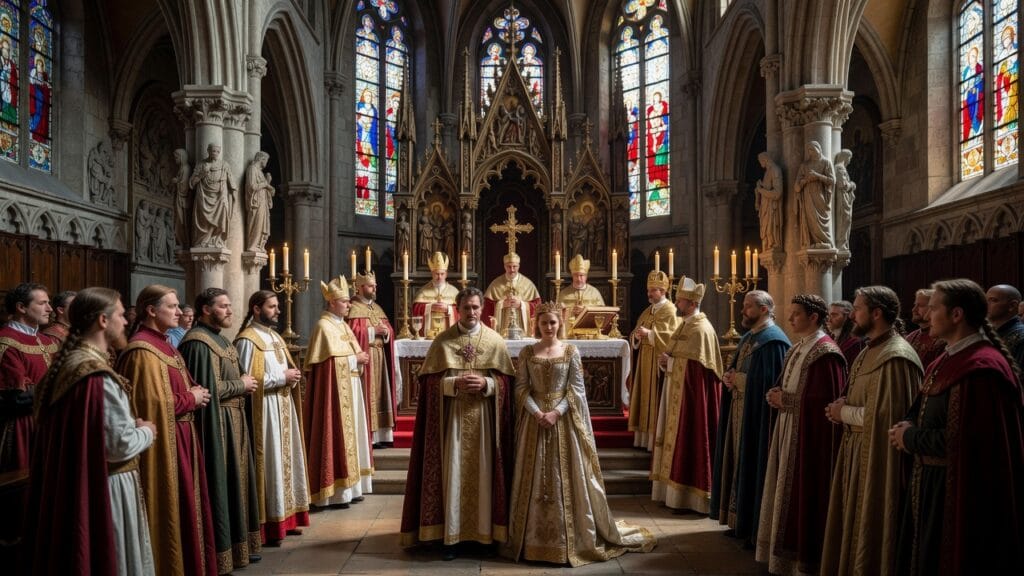
On 18 February, the wedding joined baptism to throne. Wawel Cathedral’s stone carried the prayers of generations; that morning, it held a stratagem. The vows were exchanged with solemn dignity, and the assembled nobility recognized a new royal pairing that stitched two political communities into a single fabric.
We have no reliable transcript of every gesture. But we know who benefited. Poland gained a warrior-ally and access to a vast hinterland; Lithuania gained protection, sacral legitimacy, and time to reform. The day was sanctity and calculus intertwined, a union of two biographies and two state projects.
When later chronicles say, simply, jogaila marries jadwiga of poland, they flatten the sharp edges. For those in the nave and square, the unspoken wager was clear: that this couple could hold together sovereignties that had never truly met except in conflict.
09 – Early Reactions: Factions, Fears, and Hopes
In Poland, most magnates accepted the settlement because it answered their immediate security needs. A minority grumbled over foreign influence, but the swift coronation on 4 March blunted criticism by embedding the new monarch within familiar rituals. Civic elites counted opportunities in trade and law.
In Lithuania, support was conditional. Catholic conversion promised proximity to Western markets and privileges, but Orthodox Ruthenian elites feared marginalization. Teutonic commanders looked for procedural flaws to denounce the baptism as invalid or opportunistic. The propaganda struggle began before the altars cooled.
10 – Christianization of Lithuania and the Baltic Chessboard
By 1387, royal edicts organized the baptism of Lithuanian elites and the creation of a bishopric in Vilnius. Churches rose where shrines had stood; priests learned enough local language to be understood; new feast days entered villages’ calendars. The change look orderly on paper; lived experience was messier.
Samogitia, the Order’s near neighbor, remained an outlier for decades, a reminder that conversion was geographic as well as spiritual. Still, the source of the Teutonic mission was undercut, forcing a strategic recalibration. Publicly, the Order claimed doubts about sincerity; privately, it faced a contracting rationale.
For Poland, the union became a shield and a lever. It pulled Polish diplomacy deeper into the politics of Ruthenia and the Baltic, while transforming Kraków into a point of contact between Latin Christian practice and an empire of multiple tongues and rites. Stability was partial, but the trajectory had shifted.
11 – Economy, Privileges, and New Routes of Power
Economically, the union expanded horizons. Lithuanian furs, beeswax, and timber moved more reliably toward Polish markets and beyond to the Hanseatic sphere. In return, Polish cloth, salt, and grain found wider consumers. Caravan routes through Lviv and Vilnius tightened; river traffic on the Vistula and Niemen felt new purpose.
Such integration required smoothing the rights of merchants and nobles. Jogaila confirmed or extended privileges to Polish knights and towns and, in Lithuania, rewarded Catholic boyars for loyalty. Grants and charters were the lubrication of union, but also a bargain: revenue traded for allegiance and cross-border coordination.
It is easy to see only the winners. Yet taxation for campaigns against the Order and infrastructure for new dioceses drew coin from villages and burghers. Not all tolls were standardized; local lords protected old impositions. The economy grew more complex, but the benefits were uneven, especially far from royal roads.
12 – Jadwiga’s Statecraft and the Hungarian Dimension
Although often remembered for sanctity, Jadwiga governed with attentiveness to regional geometry. Her family ties touched Hungary, where claims and counterclaims could upset Poland’s southern flank. She cultivated arrangements that reduced Hungarian interference while keeping channels open for cooperation against mutual threats.
Jadwiga’s charity, later celebrated, coexisted with hard decisions. Diplomatic missions, monastic patronage, and legal judgments projected a sovereign presence. Her death in 1399 intensified the sense that a unique balance had been achieved in her lifetime. The language “jogaila marries jadwiga of poland” risks minimizing the regimen she maintained.
In this period, the couple’s court sought a blend of Polish institutional continuity and Lithuanian accommodation. Advisors moved between Kraków and Vilnius carrying orders and ideas. The union did not erase borders, but it created corridors. Authority traveled as much by messenger as by memory of vows at Wawel.
13 – Vytautas, Family Rivalry, and the Shape of the Jagiellonian Union
Family politics never sleep. Vytautas, Jogaila’s cousin, tested the equilibrium with rebellions and reconciliations, culminating in the Ostrów Agreement of 1392. He became Grand Duke under Jogaila’s senior overlordship, stabilizing Lithuania while preserving its aristocratic character. The union bent, adapted, and survived.
This accommodation mattered beyond personalities. It created a model for shared sovereignty: king in Kraków, grand duke in Vilnius, each with defined spheres, neither a mere vassal. The shape of the partnership anticipated later settlements like Horodło (1413), even as confessional tensions remained.
Long-term, these arrangements funneled both states into joint action against the Order, climaxing at Grunwald in 1410. That victory solved one problem and created another: the management of victory, titles, and memory. But it grew from the winter of 1386, when ritual rewired reality.
Immediate consequence:
Poland gained a Christian partner with vast manpower; Lithuania secured legitimacy and protection. The Teutonic Order’s crusading rationale weakened, and administrative reforms began in Vilnius.
Long-term consequence:
The Jagiellonian dynasty dominated Central Europe, Lithuania’s Christianization advanced, and the Polish-Lithuanian partnership evolved into a durable political framework that shaped regional balances for two centuries.
14 – Memory, Myth, and the Evidence We Can Trust
Memory condenses complexity. Legends about Jadwiga’s youthful love or dramatic confrontations at city gates carry emotional truth but uncertain documentation. As with many medieval stories, later authors embroidered episodes to illustrate character or justify outcomes already cherished by their communities.
Modern historians remain cautious because key documents lack original seals, and chronicles reflect the agendas of their compilers. The Liber of Polish royal acts, municipal accounts from Kraków, and papal correspondence illuminate the administrative spine of events. Yet interpretation of Krewo’s Latin still animates debate about sovereignty’s exact contours.
What stands firm is the sequence and its effects. Jogaila’s baptism and the wedding at Wawel are well-attested; the political calculus is legible across sources. When we repeat that jogaila marries jadwiga of poland, we should hear not a fairy tale but a compact: vows binding armies, dioceses, currencies, and futures.
15 – Conclusion
A winter marriage in Kraków rearranged more than titles. It cracked the Teutonic Order’s theological armor, set Lithuania on a road to Christian institutions, and tethered Poland’s destiny to a partner of continental breadth. The event we reduce to “jogaila marries jadwiga of poland” was, in practice, an engine for remapping power and faith.
The legacy reached from village fonts in Vilnius to battlefields at Grunwald and chancelleries from Prague to Rome. By converting necessity into sacrament, the union taught medieval Europe how ceremony could reframe geopolitics. Its afterlife—Jagiellonian ascendancy, mixed confessional governance, and durable cross-border institutions—was the marriage’s truest certificate.
16 – FAQs
- When did the marriage take place?
The wedding occurred on 18 February 1386, following Jogaila’s baptism on 15 February and preceding his coronation on 4 March. - Where was the ceremony held?
The marriage was celebrated in Wawel Cathedral, Kraków, then the political and ceremonial heart of the Kingdom of Poland. - Who were the main figures involved?
Jogaila, Grand Duke of Lithuania—who became Władysław II Jagiełło after baptism—and Jadwiga of Poland, a crowned sovereign. Polish lords, Lithuanian boyars, the Papacy, and the Teutonic Order formed the wider cast. - Why did the marriage happen?
It aligned Polish security needs with Lithuanian desires for legitimacy and protection. Conversion and dynastic union under the Act of Krewo made “jogaila marries jadwiga of poland” a strategic solution to multiple threats. - What were the consequences?
Immediate effects included Lithuania’s Christianization process and a weakened crusading rationale for the Teutonic Order. Long-term, the Jagiellonian dynasty rose, and a durable Polish-Lithuanian partnership shaped Central and Eastern Europe. - What is the legacy today?
The marriage is remembered as the cornerstone of a centuries-long union that fostered cultural exchange, legal innovation, and military cooperation, leaving a complex, enduring imprint on Polish and Lithuanian national histories.
17 – External Resource
18 – Internal Link
Other Resources
- Encyclopaedia Britannica – general search for the exact subject
- Google Scholar – academic search for the exact subject
- Internet Archive – digital library search for the exact subject
Sources and References
-
Acta Unionis Horodelensis et alia documenta Polono-Lituanica saeculi XV, ed. Stanislaus Kutrzeba, Kraków: Polska Akademia Umiejętności, 1911.
Note: Although focused on the later Horodło Union (1413), this collection reproduces key royal and diplomatic documents that refer back to Jogaila’s baptism, marriage to Jadwiga, and the earlier Polish–Lithuanian political alignment initiated in 1385–1386. Used to support details about the legal and dynastic framework of Jogaila’s accession to the Polish throne. -
J. Długosz (Jan Długosz), Annales seu cronicae incliti Regni Poloniae (Annals of the Kingdom of Poland), various vols., ed. Aleksander Przeździecki et al., Kraków: Akademia Umiejętności, 19th c.
Note: A major late-medieval Polish chronicle, frequently cited for the narrative of Jadwiga and Jogaila, the events in Kraków in 1386, and the broader political situation in Poland and Lithuania. Used as a primary narrative source for the description of the marriage, the coronation context, and contemporary perceptions of the union. -
Robert I. Frost, The Oxford History of Poland-Lithuania, Volume I: The Making of the Polish-Lithuanian Union, 1385–1569, Oxford: Oxford University Press, 2015.
Note: Provides a modern scholarly analysis of the Union of Krewo (1385), Jogaila’s baptism and marriage to Jadwiga in 1386, and the formation of the Polish–Lithuanian union. Used to corroborate the political motives, dynastic calculations, and international context surrounding the marriage. -
Oskaras Urbonas, “Jogaila,” in Encyclopaedia Britannica, latest online edition, Encyclopaedia Britannica, Inc.
Note: Summarizes Jogaila’s life, his role as Grand Duke of Lithuania and later King of Poland, and highlights the significance of his marriage to Jadwiga and conversion to Christianity. Used to support biographical details and the chronological sequence of events in 1385–1386. -
“Jadwiga of Poland (Hedwig of Anjou)”, entry in Encyclopaedia Britannica, latest online edition, Encyclopaedia Britannica, Inc.
Note: Provides a concise scholarly overview of Queen Jadwiga’s reign, her dynastic background, and her marriage to Jogaila. Used to confirm information on Jadwiga’s status as king (not merely queen consort), her political agency, and the religious dimensions of the marriage. -
Norman Davies, God’s Playground: A History of Poland, Volume I: The Origins to 1795, revised ed., New York: Columbia University Press, 2005.
Note: Offers a broad, critical synthesis of Polish medieval history, with discussion of the Anjou succession, Jadwiga’s rule, and Jogaila’s election and marriage. Used for contextualizing the Kraków ceremony within the longer trajectory of Polish state formation and Christianization policies toward Lithuania. -
“Union of Krewo (1385)”, Polish History Museum (Muzeum Historii Polski), online educational resources.
Note: Museum-based summary of the Krewo agreement that paved the way for Jogaila’s baptism, marriage to Jadwiga, and coronation in Kraków. Used to support statements about the terms of the union—conversion of Lithuania, personal union of crowns, and the political linkage between the 1385 act and the 1386 marriage. -
Piotr Paszkiewicz, “The Baptism and Coronation of Jogaila in Kraków, 1386,” in Studia Historyczne, vol. 47, no. 2 (2004), Institute of History, Polish Academy of Sciences.
Note: Scholarly article analyzing the liturgical, ceremonial, and political aspects of Jogaila’s baptism and coronation, closely tied to his marriage with Jadwiga. Used for details on the sequence of events in Kraków and the symbolic meaning of the marriage in the framework of Latin Christendom.

