Table of Contents
- Setting the Stage: A Capital Without Books
- An Act of April 24, 1800
- Packing Knowledge: The First Purchases and Place
- Jefferson’s Vision After the Flames
- Rebuilding a Nation’s Memory
- Cataloging a New Republic
- Politics in the Stacks: Partisan Pressures
- Spaces and Symbols: From Capitol Rooms to Independence
- Fires, Losses, and Preservation Lessons
- Opening the Shelves: Researchers, Citizens, and Strangers
- Maps, Music, and More: Expanding the Mandate
- Copyright and the American Archive
- Wars, Budgets, and the Long 19th Century
- A National Library Emerges in the 20th Century
- Conclusion
- FAQs
- External Resource
- Internal Link
Article Summary: On April 24, 1800, Congress approved funds to purchase books for its own use in the new federal city—an unassuming line in a relocation bill that quietly created the Library of Congress. This article traces how a practical tool for legislators became a national memory institution. We follow the fragile beginnings, the 1814 fire, Jefferson’s sweeping rescue, nineteenth-century transformations, and the twentieth-century expansion into a de facto national library. We weigh evidence, note omissions, and stay alert to politics. Throughout, we examine why the library of congress established mattered then and now.
Why keep reading: Because a nation that barely had streets in its capital chose to fund ideas, and then watched those ideas burn, rebuild, and redefine what a public archive could be. The story holds conflict, reinvention, and the stubborn belief that knowledge could anchor a republic under pressure.
At a glance:
- Event: Establishment of the Library of Congress
- Date: April 24, 1800
- Place: Washington, D.C., United States (initially within the U.S. Capitol)
- Main figures: John Adams, the 6th Congress, John J. Beckley, Thomas Jefferson, Ainsworth Rand Spofford, Herbert Putnam
- Why it mattered: It laid the foundation for a national knowledge infrastructure, shaping how the United States collects, preserves, and uses information.
01 – Setting the Stage: A Capital Without Books
When Congress resolved to move from Philadelphia to the nascent city of Washington, the nation’s capital was more idea than infrastructure. Roads were muddy, residences sparse, and institutional memory thin. If lawmakers wanted to consult law, history, or science, they relied on private volumes, stray pamphlets, or distant collections unreachable in a hurried session.
Amid this logistical improvisation, the absence of a shared reference library was not a quaint oversight. It was a vulnerability in a polity that insisted debates should be informed by precedent, comparative law, and the reports of other nations. A library would not settle arguments, but it could ground them in something firmer than rumor.
The move raised practical questions: Where could texts be kept, who would procure them, and which languages or fields mattered for a legislating republic? These were not settled by grand theories. They emerged from the daily grind of committees, clerks, and members trying to do their work. In that friction, the library of congress established would be born.
02 – An Act of April 24, 1800
The Library of Congress began with a line item. The “Act making appropriations for the support of Government for the year 1800,” signed by President John Adams on April 24, included $5,000 “for the purchase of such books as may be necessary for the use of Congress.” Tucked within a relocation appropriation, it carried understated ambition.
The statute did not create a national library in the modern sense. It authorized a working collection for legislators, lodged within the Capitol, responsive to the immediate needs of drafting and debate. The wording reflected a republic wary of concentrations of power yet hungry for reliable information to guide public acts.
Administrative details were left to congressional officers, and the record shows early confusion. The Annals of Congress suggests the House and Senate tussled over procedures, even as members requested works in law, diplomacy, and history. The new collection had to serve multiple chambers and remain visibly utilitarian.
03 – Packing Knowledge: The First Purchases and Place
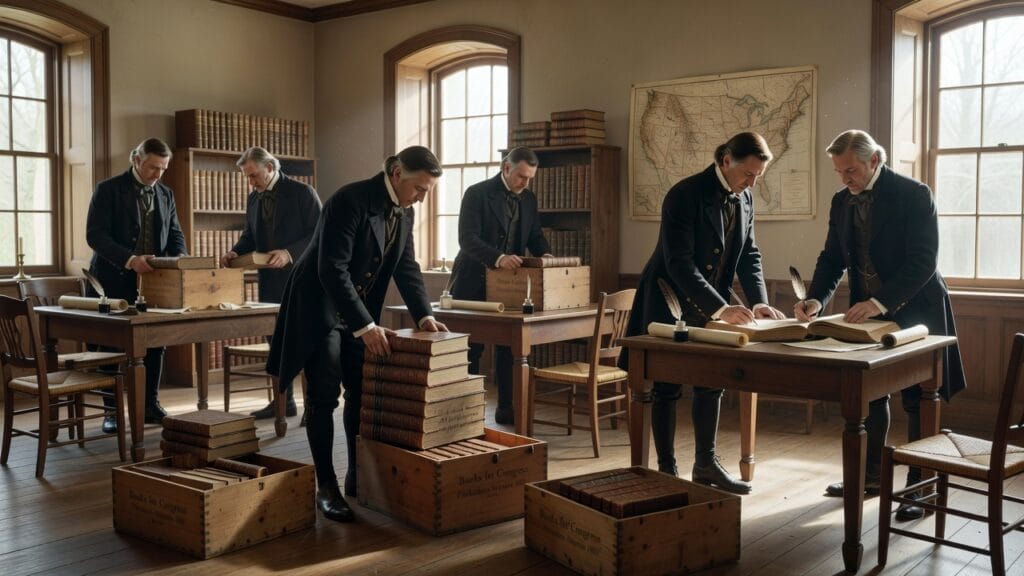
Early acquisitions were practical and international. Orders went abroad for legal digests, diplomatic correspondence, and scientific texts, often from London, reflecting the era’s publishing gravity. The collection lived in makeshift quarters within the Capitol, rooms as symbolic as they were cramped, signaling both ambition and modest means.
John J. Beckley, the House Clerk, soon became the first Librarian of Congress under a 1802 reorganization that formalized oversight. Beckley’s selections mirrored congressional anxieties: treaties, parliamentary procedure, and comparative law. Even then, the library’s purpose stretched beyond statutes to the broader knowledge a lawmaking body inevitably needed.
Mini timeline:
- 1800: Congress funds an initial $5,000 for books.
- 1802: Reorganization creates the Librarian of Congress post; John J. Beckley serves.
- 1808–1812: Purchases expand in history, geography, and science.
- 1814: British troops burn the Capitol; the library is largely destroyed.
Early catalogues were thin and often provisional. Contemporary sources suggest clerical notes doubled as inventories, revealing a working shop more than a stable archive. Each purchase was a bet on what Congress would need next week, not a comprehensive national plan, yet patterns of a broader mandate were visible.
04 – Jefferson’s Vision After the Flames
The War of 1812 turned fragility into crisis. In August 1814, British troops set the Capitol ablaze, and the library’s holdings were destroyed. Thomas Jefferson, retired at Monticello, offered Congress his personal library—6,487 volumes spanning philosophy, science, literature, and regions beyond Europe.
Jefferson argued that legislators needed more than law books; they needed the full compass of human knowledge to grasp policy’s consequences. In 1815, Congress approved the purchase. Debates were heated, some members objecting to French Enlightenment texts, others to cost, but the sale passed, recentering the institution’s identity.
This was a transformation of scope and intent. The library of congress established to serve immediate legislative needs now contained comparative religion, botany, architecture, and travel accounts. Jefferson’s classification, later documented in the Sowerby catalogue, reflected Enlightenment order and curiosity, not merely parliamentary function.
Yet behind the ceremony lay practical headaches: integrating a private scholar’s universe into a public body’s routines. Staff faced the challenge of transforming Jefferson’s taxonomy into a navigable tool for Congress, while defending the breadth of the collection against charges of irrelevance or ideological bias.
05 – Rebuilding a Nation’s Memory
The Jefferson purchase forced a reckoning with purpose. Was the library merely a service bureau to retrieve citations for bills, or a national storehouse to educate legislators about worlds unseen? The answer unfolded slowly, as cataloguing projects, reading policies, and publication budgets tugged the institution in both directions.
Modern historians debate how intentional this shift was. The surviving evidence points toward incrementalism: committees trimmed costs here, librarians defended acquisitions there, and only in aggregate did the library tilt toward national scope. But members noticed the change, relying on the wider collection for speeches and committee reports.
These years also taught a hard lesson about preservation. The 1814 fire had destroyed the earliest holdings; the 1815 infusion would be vulnerable without safer storage, trained staff, and explicit policies. In a republic wary of bureaucracy, preservation itself became a political argument about what government should safeguard.
06 – Cataloging a New Republic
Classification turned ideas into findable tools. Jefferson’s arrangement guided early shelving, but as the collection diversified, librarians experimented. By mid-century, ad hoc systems hindered access, and reformers urged professional standards to link the Capitol’s shelves with a wider American library movement then taking shape in cities and colleges.
The later Library of Congress Classification would not fully cohere until the early twentieth century, under Herbert Putnam and his staff. Yet the nineteenth century laid essential tracks: printed catalogues, subject indexing, and the recognition that lawmakers, scholars, and the public all searched differently. Systems had to anticipate multiple entry points.
It is easy to forget how fragile this world still was. A single misfiled volume could vanish into obscurity; a clerk’s resignation could dissolve memory of a subject cluster. The victory solved one problem and created another: greater breadth increased the risk of losing threads without a disciplined catalog.
07 – Politics in the Stacks: Partisan Pressures
The library sat inside the Capitol and therefore inside politics. Federalists questioned whether Jefferson’s books smuggled ideology into the stacks. Later partisans worried about which newspapers and pamphlets the library accepted, recognizing that serials could tilt perceptions of current events as much as reference books shaped long-term thinking.
Appropriations hearings became proxies for larger fights over government’s cultural role. Librarians learned to speak the language of utility, justifying acquisitions with reference to pending legislation or comparative law. Even the placement of reading tables could signal bias to a congressman convinced the other party was better served.
Yet survival depended on breadth. The library’s defensive posture—insisting it served all members equally—had a paradoxical effect. To avoid favoritism, it collected more widely, across ideologies and regions, reinforcing the idea that a national repository must be comprehensive to be fair. Politics, ironically, pushed growth.
08 – Spaces and Symbols: From Capitol Rooms to Independence
For decades, the library occupied rooms inside the Capitol, convenient but cramped, honored but imperiled. Elegant drawings published in newspapers sketched domes and galleries, yet leaks, fires, and foot traffic were constant threats. As acquisition outpaced shelving, a case for a dedicated building took shape, rooted in practical need and symbolic statement.
By the 1890s, that argument prevailed. The 1897 opening of the Library of Congress’s grand building—now the Thomas Jefferson Building—announced independence from the Capitol’s daily tumult. Murals and mosaics celebrated knowledge as a civic virtue, not merely a legislative tool, while new reading rooms tied aesthetic awe to working research.
Architecture sent a message. The republic claimed a cultural house worthy of comparison with European national libraries, a visible statement that public knowledge was a pillar of governance. Distance from the Capitol did not sever ties; it clarified roles, allowing the library to serve Congress while welcoming a broader scholarly world.
09 – Fires, Losses, and Preservation Lessons
The 1814 destruction was not the last disaster. In 1851, another fire ravaged the library, destroying a significant portion of Jefferson’s collection. The pattern was cruelly instructive: growth without dedicated protections courted loss, and ad hoc shelving turned separation into tinder, where heat moved faster than staff could respond.
These fires changed policy and mentality. Insurance of collections was impractical; prevention became doctrine. Better shelving, iron doors, and later, climate control and specialized storage reflected cumulative learning. Each architectural improvement emerged from a ledger of loss, encoded in the library’s organizational DNA.
Contemporary newspapers mourned the ruined books with surprising tenderness, reflecting a broader nineteenth-century public that saw in libraries both civic pride and personal aspiration. Recovery would be slow and piecemeal, through purchases, donations, and later, reproductions routed through expanding networks.
10 – Opening the Shelves: Researchers, Citizens, and Strangers
Access policies evolved unevenly. Initially, the library served members and staff, with exceptions for approved researchers. Over time, reading rooms welcomed a wider public, though borrowing remained restricted. The practice reinforced a principle: public funds underwrote a public right to consult, even if stewardship required controlled circulation.
Travelers’ accounts and city guides from the late nineteenth century list the Library as a destination, a civic attraction where citizens glimpsed the machinery of knowledge. The experience was both empowering and humbling. Vast catalogues promised discovery, but rules reminded visitors that preservation and order demanded patience and care.
As collections diversified—prints and photographs, maps and music—the meaning of “access” stretched. Specialized curators mediated complex materials, and reproduction technologies improved reach. The library of congress established as a legislative aid was preparing, piece by piece, to serve readers far beyond the capital’s walls.
11 – Maps, Music, and More: Expanding the Mandate
Books were only the beginning. The acquisition of maps reflected strategic and scientific priorities, from western exploration to maritime commerce. Music entered as scores and later recordings, tracking an American soundscape mixing European forms, African American innovation, and immigrant traditions that redefined cultural canons.
Prints and photographs captured moments text could not. Collections of Civil War imagery, urbanization, and landscapes gave policymakers and the public new evidence to interpret their world. A national library’s job was no longer just to cite; it was to show, enabling comparisons and arguments grounded in visual archives.
Institutional histories point to curators who advocated specialized acquisitions, often ahead of consensus. Their successes changed expectations. Legislators learned to request not merely a statute book but a map, an image set, or a song. The boundaries of “use for Congress” widened each time a new format proved its legislative value.
12 – Copyright and the American Archive
A profound shift came in 1870, when Congress centralized copyright registration and deposit at the Library of Congress. This administrative move, recorded in the Statutes at Large, had cultural consequences: it funneled American creativity—books, maps, music, and later films—into a single repository.
Now, the library accreted national memory by legal design, not solely by purchase or gift. Deposit did not guarantee selection for permanent retention, but it vastly expanded horizons. The library’s role, once primarily retrieval, now included appraisal and curation, deciding what passed from ephemera to heritage.
For publishers and creators, the system forged a link between protection and preservation. Registering work also meant trusting a federal institution with a copy. The arrangement answered critics who asked why taxpayers should subsidize culture: a functioning copyright regime required guardianship, and guardianship required a trustworthy vault.
13 – Wars, Budgets, and the Long 19th Century
The Civil War strained budgets and priorities. Yet even amid conflict, the library grew, steered by Librarian Ainsworth Rand Spofford from 1864 onward. Spofford envisioned a national library that served every American library through shared catalogues and reference services, not just Congress within the Capitol complex.
Spofford’s reports argued for a great public resource, citing European models but adapting to American federalism. He championed the new building, fought for catalogues that could circulate nationwide, and gathered collections that anticipated future research needs. His advocacy, preserved in government documents, bridged legislative pragmatism and cultural aspiration.
Economic cycles left fingerprints on the shelves. Booms funded acquisitions; busts demanded triage. Yet the institution’s inertia—its daily indexing, binding, filing—proved resilient. A reader in 1895 could navigate a far richer and steadier resource than a reader in 1825, not because visions were identical, but because routines were stronger.
14 – A National Library Emerges in the 20th Century
The twentieth century consolidated earlier experiments. Herbert Putnam, Librarian of Congress from 1899 to 1939, professionalized operations, expanded services to other libraries, and helped launch the Library of Congress Classification. Printed catalog cards, distributed nationwide, standardized bibliographic practice and made the Library the nervous system of American librarianship.
World wars and the Cold War added new dimensions: foreign acquisitions, preservation under threat, and eventually, recorded sound and moving images that complicated storage. The institution adapted with laboratories, vaults, and later digital infrastructures, gradually translating the nineteenth-century ambition into modern workflows and global partnerships.
Digital initiatives in the late twentieth and early twenty-first centuries reframed access once again. Online catalogues and digitized collections met the public where they lived, while still protecting fragile originals. In these shifts, the seed planted when the library of congress established in 1800 continued to germinate, branching into formats the founders could never have imagined.
Immediate consequence:
Standardized cataloging and shared services turned the Library into the reference backbone for countless institutions, streamlining discovery and elevating research quality across the country.
Long-term consequence:
The Library evolved into a de facto national library and global cultural archive, shaping preservation norms, copyright practice, and how democratic societies imagine public access to knowledge.
15 – Conclusion
A quiet clause in an 1800 appropriations bill birthed an institution that taught the United States to take its memory seriously. The library of congress established for legislators became a national compass, steering debates with evidence, preserving voices sketched in ink and captured in images, and insisting that governance without memory is guesswork writ large.
The Library’s path—through fire, dispute, reform, and reinvention—shows how infrastructure of knowledge can anchor a republic under stress. From Jefferson’s eclectic shelves to digital repositories, the institution translated a practical need into a civic promise: that in a changing nation, the record would endure, accessible to those who must decide what comes next.
16 – FAQs
- When was the Library of Congress established?
It originated on April 24, 1800, when Congress appropriated $5,000 for books “for the use of Congress,” a moment often summarized as the library of congress established in law. - Where was it first located?
Its earliest rooms were inside the U.S. Capitol in Washington, D.C., a convenient but vulnerable location that exposed the collection to fires and space constraints. - Who were the key figures in its early development?
President John Adams signed the establishing act; John J. Beckley served as the first Librarian of Congress after 1802; Thomas Jefferson’s 1815 sale transformed the scope; later, Ainsworth Rand Spofford and Herbert Putnam professionalized and expanded the institution. - Why did Congress create the Library?
Lawmakers needed a practical reference collection to support legislation, diplomacy, and debate. The institution began as a working tool to improve governance through organized access to reliable sources. - What were the major consequences of its early fires?
The 1814 and 1851 fires destroyed thousands of volumes, including much of Jefferson’s library. These losses drove policy changes in preservation, storage design, and eventually the push for a dedicated building opened in 1897. - What is the Library’s legacy today?
It functions as the research arm of Congress and a de facto national library, curating vast collections across formats, central to copyright deposit, and a leader in preservation and access for scholars and the public worldwide.
17 – External Resource
18 – Internal Link
Other Resources
- Encyclopaedia Britannica – general search for the exact subject
- Google Scholar – academic search for the exact subject
- Internet Archive – digital library search for the exact subject
Sources and References
-
Primary Source: “An Act to Provide for the Government of the Territory Northwest of the River Ohio,” and related early Congressional documents on the Library of Congress
U.S. Congress, Statutes at Large and Annals of Congress (1790s–1800s).
Library of Congress, A Century of Lawmaking for a New Nation.
This digital collection includes the original text of the April 24, 1800 act that formally established the Library of Congress, along with early legislative debates, helping to verify the date, legal foundation, and early purpose of the institution. -
Primary Source: Thomas Jefferson’s Library Catalogue and Related Correspondence
Thomas Jefferson Papers. Library of Congress Manuscript Division.
https://www.loc.gov/collections/thomas-jefferson-papers/
These manuscripts and catalogues document Jefferson’s sale of his personal library to Congress after the 1814 burning of the Capitol, confirming the size, scope, and intellectual orientation of the collection that became the core of the rebuilt Library of Congress. -
Library of Congress. “History of the Library of Congress.”
Library of Congress, Washington, D.C.
https://www.loc.gov/about/history-of-the-library-of-congress/
This official institutional history outlines the founding on April 24, 1800, early locations in the Capitol, the 1814 destruction and subsequent reconstruction, and the Library’s evolution into a national and research library, supporting the overall narrative and chronology. -
Cole, John Y. Jefferson’s Legacy: A Brief History of the Library of Congress.
Washington, D.C.: Library of Congress, 1993 (and subsequent digital edition).
https://www.loc.gov/item/93028380/
Cole’s scholarly survey provides context for the Library’s origins, the role of early Congresses and presidents, Jefferson’s intellectual influence, and the institution’s changing mission, reinforcing details on its founding purpose and long-term development. -
Kelly, Jason. “Library of Congress.”
In: Encyclopaedia Britannica (online edition).
https://www.britannica.com/topic/Library-of-Congress
This encyclopedia entry corroborates key dates, the basic facts of establishment in 1800, subsequent fires and reconstructions, the growth of collections, and the Library’s role as the de facto national library of the United States. -
Harris, Michael H. History of Libraries in the Western World, 4th ed.
Lanham, MD: Scarecrow Press, 1999.
Harris places the Library of Congress within the longer tradition of Western library development, providing comparative context on its function as a legislative research library, a national library, and a symbol of republican knowledge and statehood. -
Vile, John R. “Library of Congress.”
In: The Constitutional Law Dictionary and related entries, Middle Tennessee State University, The First Amendment Encyclopedia.
https://www.mtsu.edu/first-amendment/article/1442/library-of-congress
This university-hosted reference describes the Library’s constitutional and legal significance, especially its relationship to Congress and to issues of information access and copyright, supporting discussion of its governmental role and legal framework. -
Office of the Historian, U.S. House of Representatives. “The Library of Congress.”
U.S. House History, Art & Archives.
https://history.house.gov/Institution/Origins-Development/Library-of-Congress/
This institutional history from the House of Representatives provides details on the Library’s early administrative relationship to Congress, funding decisions, and shifts in oversight, supporting statements about its original legislative research function and subsequent expansion.