Table of Contents
- Rome in 596: A City of Ruins and Resolve
- Gregory the Great: A Pastor with Imperial Ambitions of the Soul
- Why England? The Anglo-Saxon Puzzle at Europe’s Edge
- Gathering the Mission: Augustine and the Roman Monks
- Letters on the Road: Frankish Diplomacy and Gaulish Fears
- Turning Back, Then Turning Again: The Crisis of Nerves
- Landfall in Kent: Meeting Æthelberht and Bertha
- Canterbury Takes Shape: A Monastery Becomes a Bridge
- Baptisms, Festivals, and a Measured Conversion
- Designing a Church: Gregory’s Blueprint for London and York
- Money, Gifts, and Logistics: The Economics of a Mission
- Resistance and Accommodation: Pagan Temples and Sacred Time
- Writing the Story: Bede, the Liber Pontificalis, and Memory
- Beyond Kent: Northumbria, the Irish Question, and Synod to Come
- Conclusion
- FAQs
- External Resource
- Internal Link
Article Summary: In 596, Pope Gregory I dispatched Augustine and a band of monks from Rome to England, setting in motion a mission that would transform religious life in Anglo-Saxon kingdoms. Crossing a fractured post-Roman landscape, they navigated Frankish politics, local fears, and unfamiliar rites. Guided by Gregory’s letters, the mission settled at Canterbury, negotiated with King Æthelberht, and adopted a gradual policy toward pagan customs. The story, preserved in the papal Register and Bede’s later narrative, reveals strategy as well as faith. This article traces causes, debates, and consequences surrounding the gregory i mission to england.
Why keep reading: A handful of monks left a besieged Rome to convert a distant people who did not speak their language. Between courage and hesitation, policy and improvisation, their journey altered political loyalties across the Channel. Follow the letters, the choices, and the fragile victories that still shape English Christianity.
At a glance:
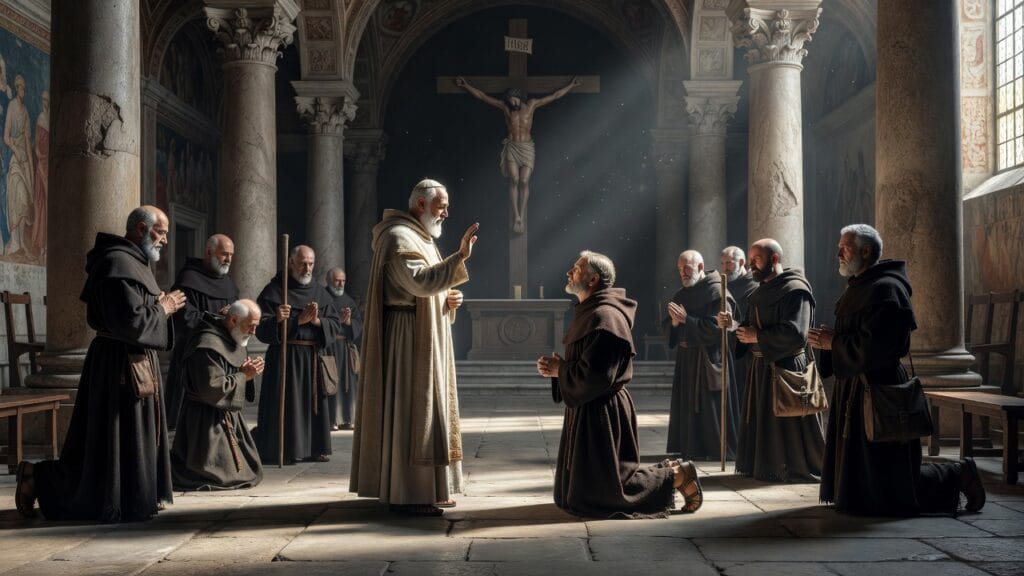
- Event: Pope Gregory I sends Augustine and monks on a mission to convert the Anglo-Saxons.
- Date: 596 (arrival in Kent traditionally dated 597; some details are debated).
- Place: Departed Rome, traveled via Gaul, landed in Kent, England.
- Main figures: Pope Gregory I, Augustine of Canterbury, King Æthelberht of Kent, Queen Bertha.
- Why it mattered: Reoriented southern English kingdoms toward Rome, established Canterbury, and set precedents for conversion policy and church organization.
01 – Rome in 596: A City of Ruins and Resolve
Rome in 596 was no imperial capital, but a battered survivor. The Lombards pressed across Italy, famine and plague were recent memories, and the civil machinery leaned on churchmen. In this tense stillness, Pope Gregory I worked with a steward’s precision and a monk’s conscience, managing grain doles while composing a plan that looked beyond Italy’s broken horizons.
The mission to England arose from this improbable center of command. From the Lateran and his monastic base on the Caelian Hill, Gregory wrote relentlessly, tended the city’s poor, and dared to imagine new Christian provinces abroad. In early correspondence and later tradition, the gregory i mission to england was both an act of pastoral care and geopolitical vision.
It is easy to forget how fragile this world still was. Letters could be lost, roads were perilous, and bishops negotiated with warlords as readily as they preached. Yet from such precarious foundations, the pope launched a band of Latin-speaking monks toward an island ruled by pagan dynasts who measured power with swords, treasure, and ancestral rites.
02 – Gregory the Great: A Pastor with Imperial Ambitions of the Soul
Gregory, once a city prefect turned monk, governed like a pastor who understood empires. He saw conversion not as conquest but as patient instruction, repeating in letters that fear of force should not mask the joy of faith. His imagination was disciplined by administration; he calculated routes, asked allies for help, and sent texts and relics as deliberately as diplomats send treaties.
Tradition remembers a scene in a Roman market, where Gregory, moved by the sight of Anglian youths, supposedly uttered the pun “non Angli, sed angeli.” Modern historians accept it as a moral tale rather than dependable reportage. But even as legend, it captures a truth: England interested him, and he believed its rulers could be reached with care and strategy.
Gregory’s Register of Letters survives in substantial form and shows a leader who mixed warmth with steel. He praised queens, urged bishops, and rebuked hesitation when it endangered souls. This was not spiritual theater; it was a sustained campaign to bring a distant people into a network of liturgy, law, learning, and Rome’s hard-won authority.
03 – Why England? The Anglo-Saxon Puzzle at Europe’s Edge
By the late sixth century, the Anglo-Saxon kingdoms were consolidating power in the southeast of the island once governed by Rome. Latin Christianity had retreated with imperial institutions two centuries earlier, lingering in western British enclaves. Gregory’s gaze fell on Kent, where Frankish influence was visible and where a Christian queen already worshiped within her own household.
Kent was not simply a religious prize; it was a hinge of trade. Through the Channel, Frankish ports connected cloth, metalwork, and ideas. If the Kentish court embraced Rome’s clergy, influence might flow by marriage alliances, coinage, and written law. Gregory’s plan weighed not only salvation, but the political stability that shared ritual and calendars could foster.
Yet behind the optimism lay uncertainty. Few in Kent knew Latin well, and the island’s sacred spaces were bound to kinship and victory feasts. Gregory expected resistance, not triumphal processions. His policy would need patience, and his envoys would need courage measured in months of cold travel and conversations in borrowed halls.
04 – Gathering the Mission: Augustine and the Roman Monks
Gregory chose Augustine, prior of the monastery of St Andrew on the Caelian Hill. Augustine was not a flamboyant orator so far as our sources show, but a steady community leader familiar with obedience and rule. Around him, roughly forty monks assembled, practical men more used to psalms than to sea voyages or royal courts.
They prepared not as merchants but as envoys of a different economy: books, relics, ritual vessels, and the memory of Rome’s liturgy. Gregory equipped them with letters of introduction and instructions to observe good order among themselves. In an age of fragile authority, even a small disagreement could fracture a mission’s credibility before it began.
Contemporary sources suggest that they left Rome by the well-worn corridors of the Via Aurelia and sea routes along Gaul. They were entering a network of bishops, abbots, and royal regents who might help—or hinder—their progress. Gregory intended the network to hold, stitching Roman discipline to Frankish hospitality and, ultimately, to Kentish consent.
05 – Letters on the Road: Frankish Diplomacy and Gaulish Fears
Gregory wrote ahead to the Frankish world, asking assistance from bishops and from the formidable Queen Brunhild, regent for young kings. The letters, preserved in his Register, request escorts, translators, and practical support. Monks could not debate in the Kentish court if pirates stalked the coast or if roads dissolved into winter mud.
The Frankish church was itself a patchwork of reform and rivalry. Gregory’s authority was moral, not military, so he relied on persuasion and reputation to kindle help across dioceses like Arles and Tours. The mission’s safety depended on cooperation between men who seldom shared a table and sometimes resented one another’s prestige.
Mini timeline:
- 590: Gregory becomes pope amid famine and Lombard pressure.
- 596: Augustine and monks depart Rome with letters to Frankish allies.
- 597: Mission reaches Kent; Augustine engages King Æthelberht at Canterbury.
- 601: Second group brings Gregory’s instructions, gifts, and the pallium.
Even with allies, the crossing posed risks. Coastal raids were common; misunderstandings were inevitable. The mission carried the aroma of Roman ambition to some and the promise of healing and law to others. Between suspicion and hospitality, Augustine’s party had to earn credibility before it could preach a single homily in Kent.
06 – Turning Back, Then Turning Again: The Crisis of Nerves
According to Bede’s later history, the mission faltered in Gaul. Alarmed by tales of a fierce people and a strange tongue, the monks considered abandoning the enterprise. Augustine reportedly returned to Rome to ask Gregory for release. Instead, the pope urged perseverance and reinforced Augustine’s leadership, sending him back with letters of encouragement and authority.
Modern historians debate the exact sequence, but the fear is plausible. This was not cowardice; it was prudence in a dangerous world. The recalibration mattered. Gregory transformed a fragile group into a disciplined band with a clearer chain of command, recognizing that political audiences respect envoys who speak with unambiguous backing.
From this point, the mission carried Rome’s seal more visibly. Titles and tokens matter in negotiation, and Augustine, now singled out in papal correspondence, could present himself as more than a wandering abbot. It is astonishing how much political weight could rest on a seal, a signature, or a messenger’s memory of a distant voice.
07 – Landfall in Kent: Meeting Æthelberht and Bertha
The monks landed in the Isle of Thanet and were escorted to the king. Bede records that Æthelberht, cautious of magic, insisted on meeting them in the open air. Such details may carry the hue of later Christian storytelling, but they fit a world where ritual space and political safety intertwined at every encounter.
Queen Bertha’s presence mattered immensely. A Frankish Christian, she had come to Kent with her own bishop, Luidhard, and worshiped at St Martin’s, an older church on the edge of Canterbury. Her household provided a linguistic and cultural bridge. Æthelberht allowed the monks to preach and gave them lodging in the city, a crucial first concession.
Negotiation, not spectacle, characterized the opening moves. The mission earned space to live, worship, and demonstrate its order. In a court where feasts tested loyalties and gifts displayed rank, the monks’ chanting processions and regular hours offered a different rhythm of power—less glittering, perhaps, but persistent and strangely compelling.
08 – Canterbury Takes Shape: A Monastery Becomes a Bridge
Canterbury became the mission’s anchor. Augustine and his monks repaired or appropriated buildings and established daily worship. From monastic cells to an emerging cathedral, their presence made new demands on local artisans and on the king’s hospitality. Sacred routines required materials: boards for lecterns, oil for lamps, bread and wine for the Eucharist.
Æthelberht granted land and protection, initiating a pattern of royal endowment that tied church and throne. Later tradition locates St Augustine’s Abbey as a royal foundation supporting the mission’s permanence. Archaeological work around Canterbury suggests continuity rather than rupture, with Roman-era sites and early churches layered into the city’s evolving sacred geography.
But this was only the beginning. Space to worship is not the same as conviction. The monks now faced the daily politics of persuasion—speaking with retainers, greeting traders, and visiting households that remembered winter feasts in sacred groves. A monastery could be a bridge, but only if people chose to cross it.
09 – Baptisms, Festivals, and a Measured Conversion
Bede narrates mass baptisms and a royal conversion soon after the monks’ arrival, with Pentecost 597 often cited as a turning point. The numbers are likely rounded by memory and hope, but the pattern holds: public rites, teaching before feasts, and careful deference to the king’s authority. Converts came not by edict alone but by persuasion in season and out.
Gregory warned that faith spread best without compulsion. The mission timed instruction with festivals when people gathered and felt the pull of joy. Even so, the swirl of old rites and new prayers created anxieties. Priests tended ancestors’ honor; warriors feared losing favor with gods who guarded victory; families worried about offending both past and present.
Even as baptisms multiplied, they did not erase older practices overnight. The mission aimed to weave Christian time into communal life, placing saints’ days and Sundays where other gatherings had long stood. The goal was not to banish joy but to redirect it, turning feast-days into catechetical moments and hearthside songs toward different heroes and hopes.
10 – Designing a Church: Gregory’s Blueprint for London and York
Gregory thought in maps. He envisioned two metropolitan sees—London and York—with twelve bishops each, a Roman-style arrangement adapted to English realities. In letters later delivered with the pallium, he set an administrative horizon that outpaced immediate possibilities but gave the mission a destiny beyond Canterbury’s walls.
Augustine asked detailed questions, preserved in the Libellus responsionum. Gregory answered with striking flexibility: different liturgical uses could be adopted if they served the good of souls; marriage prohibitions were set with pastoral prudence; bishops’ authority had limits meant to guard humility. Scholars debate the compilation’s exact textual history, but its content shaped ecclesiastical policy for generations.
The pope’s policy fused principle with pragmatism. A uniform church would come, but not by smashing local customs at first contact. Rome would guide, correct, and, where needed, wait. Such patience was not softness; it was strategy, aiming to bind kingdoms to a rhythm of worship, learning, and canon law that outlived any single king.
11 – Money, Gifts, and Logistics: The Economics of a Mission
Conversion has a ledger. Gregory sent liturgical silver, vestments, and relics, items that conferred prestige as well as sanctity. These goods moved along trade routes that also carried wine, glass, and cloth. Monasteries required predictable supplies; scribes needed parchment; visiting envoys expected hospitality. The mission’s economy intertwined with Kent’s markets and Frankish commerce.
Royal patronage stabilized that flow. Æthelberht’s grants underwrote clergy and building projects, and his court’s favor signaled to craftsmen and farmers that this new community paid its debts and blessed its allies. In return, the monks lent literacy, recorded gifts, and offered an ethic of charity that could temper the brutality of lean winters.
The gregory i mission to england emerged as a partnership of altars and granaries. Without secure stores, there were no candles to light, no codices to copy, no meals to feed the curious and the poor. Faith traveled in sacks and on carts as surely as in prayers, with every consignment a quiet test of endurance.
12 – Resistance and Accommodation: Pagan Temples and Sacred Time
One letter, sent in 601 to Mellitus, set a tone famous ever since: pagan temples should not be destroyed but purified; sacrifices to idols should be replaced with Christian feasts and blessings. Gregory’s counsel drew a careful line between eradicating error and preserving place. People could keep their gathering spots but meet a different God there.
The advice was radical in its patience. It acknowledged that memory lodges in wood and stone. If a hill had held vows for generations, it could hold them again under a new name and rite. Converted festivals offered a bridge for communities whose ancestors shaped calendars with harvests, victories, and marriages long before a Latin psalm was heard.
Critics then and now worry about syncretism. Gregory, however, saw catechesis as a long road. Better to plant a cross on a familiar ridge than to demand the ridge itself be forgotten. In practice, priests would negotiate details on the ground, feeling their way between zeal for purity and tenderness for the newly baptized.
13 – Writing the Story: Bede, the Liber Pontificalis, and Memory
Our understanding of these years leans heavily on Bede’s Ecclesiastical History, completed around 731. Bede admired Gregory and the Kentish mission, and his narrative frames events as a providential turning. He remains invaluable, yet he wrote from a generation shaped by the mission’s success, not from its fragile beginnings.
The Liber Pontificalis offers a Roman vantage, shorter and more celebratory, while Gregory’s Register grounds the story in letters that solve concrete problems. Together they preserve strategy and rhetoric, but silence much of the daily negotiation in halls and fields. The documentary record is fragmentary, and later chroniclers sometimes filled gaps with edifying tales.
Modern historians read these sources with care. Archaeology around Canterbury, St Martin’s, and early burial grounds adds material nuance, revising timelines or scale where texts speak broadly. The gregory i mission to england thus emerges as both narrative and palimpsest, its outlines firm yet its textures still under quiet scholarly revision.
14 – Beyond Kent: Northumbria, the Irish Question, and Synod to Come
Gregory died in 604; Augustine likely in the same year. Their work did not end with them. Laurence, Mellitus, and Justus carried on amid reversals. London’s early bishopric faltered when political winds shifted. Elsewhere, Paulinus journeyed north and baptized King Edwin, while Irish and Ionan missionaries spread a different Christian discipline across Northumbria.
The two currents—Roman and Irish—shared the gospel but clashed on calculation of Easter, tonsure, and some patterns of authority. The Synod of Whitby in 664, long after Gregory, resolved for Roman practice in Northumbria, a decision with cultural and political overtones. Aligning with Rome meant joining a wider world of law, learning, and continental exchange.
From Canterbury’s steady influence, scribes preserved charters, schools trained clergy, and kings weighed themselves against Christian ideals of rulership. The mission’s early fragility proved an advantage; its methods of persuasion and patience became templates for managing plural customs elsewhere. England did not become uniform overnight, but it had a center that could endure disputes.
Immediate consequence:
Establishment of a stable Christian base at Canterbury under royal protection, baptisms among Kentish elites, and a flow of texts, relics, and trained clergy into a previously fragmented religious landscape.
Long-term consequence:
Integration of southern English kingdoms into Roman ecclesiastical structures, foundations for literacy and law, and eventual alignment at Whitby that oriented England toward continental Christendom and its intellectual networks.
15 – Conclusion
From a humbled Rome, Gregory launched a mission that asked more of patience than of triumph. Augustine and his monks arrived not as conquerors but as craftsmen of trust, guided by letters that measured zeal in careful steps. In that choice lay the durable strength of the gregory i mission to england: persuasion over compulsion, bridges over barricades.
Their legacy is visible in the archbishopric at Canterbury, in calendars that re-ordered feasts, and in schools that seeded literacy across royal courts. The victory solved one problem and created another, as new alignments demanded negotiation with older loyalties. Yet by tying England to Rome’s rhythms, the mission helped shape a common life whose echoes still resound.
16 – FAQs
- When did the mission take place?
The mission was organized in 596, with Augustine’s party traditionally arriving in Kent in 597. Some details of the timeline are debated, but this sequence fits Gregory’s surviving letters and Bede’s later account. - Where did the mission start and where did it land?
It began in Rome, traveled through Frankish Gaul with papal letters of introduction, and made landfall in Kent, likely on the Isle of Thanet, before moving to Canterbury. - Who were the main figures involved?
Pope Gregory I designed the mission; Augustine led the monks and became the first archbishop at Canterbury; King Æthelberht granted protection; Queen Bertha provided a crucial Christian presence at court; later figures included Mellitus, Justus, and Paulinus. - What caused Gregory to send the mission?
Gregory combined pastoral concern with strategic vision. He saw an opportunity in Kent’s links to the Franks and in Queen Bertha’s faith. The gregory i mission to england promised both the salvation of a distant people and a more stable Christian axis across the Channel. - What were the immediate consequences?
Canterbury emerged as a Christian center under royal protection, with early baptisms among elites, monastic settlement, and the establishment of regular liturgy. Gregory’s letters also charted a blueprint for a wider English hierarchy, even if it took decades to realize. - What is the mission’s legacy?
It aligned southern England with Roman practice, seeded literacy and ecclesiastical law, and shaped political culture through ideas of Christian kingship. After subsequent debates, notably the Synod of Whitby, much of England followed the Roman calculation of Easter and maintained enduring ties to the continent.
17 – External Resource
18 – Internal Link
Other Resources
- Encyclopaedia Britannica – general search for the exact subject
- Google Scholar – academic search for the exact subject
- Internet Archive – digital library search for the exact subject
Sources and References
-
Gregory the Great, Registrum Epistolarum (Register of Letters).
Various letters dated c. 595–604, especially Ep. XI.56–64 (to Augustine of Canterbury and to bishops in Gaul and Britain).
Primary source. Latin text and critical editions in:
– Norberg, Dag (ed.), S. Gregorii Magni Registrum Epistularum, 2 vols, Corpus Christianorum Series Lat. 140–140A, Turnhout: Brepols, 1982.
– English trans. in: Martyn, John R. C. (trans.), The Letters of Gregory the Great, 3 vols, Toronto: Pontifical Institute of Mediaeval Studies, 2004.
Note: These papal letters provide direct evidence for Gregory I’s decision to send Augustine to England, outline the aims of the mission, give instructions on ecclesiastical organization and liturgy, and show how the mission was coordinated from Rome. -
Bede, Historia Ecclesiastica Gentis Anglorum (Ecclesiastical History of the English People), c. 731.
Best consulted in:
– Colgrave, Bertram & Mynors, R. A. B. (eds. & trans.), Bede’s Ecclesiastical History of the English People, Oxford: Clarendon Press, 1969.
Primary narrative source.
Note: Bede offers the classic narrative of Gregory’s inspiration to convert the Anglo-Saxons, the dispatch of Augustine and his companions from Rome, their journey via Gaul, and their reception and early work in Kent. He is the main early source for dating the mission to the later 590s. -
Markus, R. A., Gregory the Great and His World. Cambridge: Cambridge University Press, 1997.
Note: Provides a modern scholarly interpretation of Gregory I’s papacy, his pastoral and missionary theology, and the political-religious context in which the English mission was conceived. It supports statements about Gregory’s motivations, strategies, and the broader late sixth-century Roman background. -
Brown, Peter, The Rise of Western Christendom: Triumph and Diversity, A.D. 200–1000, 2nd ed. Oxford: Blackwell, 2003.
Note: Places Gregory’s mission to the Anglo-Saxons within the wider transformation of late antique and early medieval Christianity. It supports discussion of the mission’s significance for the Christianization of northwestern Europe and the integration of England into Latin Christendom. -
Mayr-Harting, Henry, The Coming of Christianity to Anglo-Saxon England, 3rd ed. University Park: Pennsylvania State University Press, 1991.
Note: A detailed academic study of Augustine’s mission and its aftermath, using both documentary and archaeological evidence. It underpins chronology, the composition and size of Augustine’s group, their route through Gaul, and their interaction with King Æthelberht and the Kentish court. -
Yorke, Barbara, The Conversion of Britain: Religion, Politics and Society in Britain c. 600–800. Harlow: Pearson Education, 2006.
Note: Analyzes the political and cultural landscape of Britain around 600, including the position of Kent and its continental connections. It supports contextual claims about why Kent was chosen as the mission’s entry point and how existing Frankish and Romano-British Christian networks shaped Augustine’s work. -
“Gregory the Great and the Mission to the Anglo-Saxons.”
In: Prosopography of Anglo-Saxon England (PASE) & related essays, University of Cambridge & King’s College London.
https://pase.ac.uk
Note: Prosopographical entries on Gregory I, Augustine, and key contemporaries, with references to primary texts and modern scholarship. Supports prosopographical details such as offices, dates, and relationships among figures involved in the mission. -
Canterbury Cathedral Archives & Library; Canterbury Cathedral web resources (esp. pages on Augustine of Canterbury and the early history of the cathedral and abbey).
https://www.canterbury-cathedral.org
Note: Provides institutional and historical background on Augustine’s establishment in Canterbury, early ecclesiastical structures in Kent, and the later commemoration of the mission. Used to corroborate the localization of Augustine’s activities and their enduring impact on the English Church.

