Table of Contents
- Burma and Britain on a Collision Course
- Border Sparks: Arakan, Assam, and the Frontier War
- The March to Ava: Strategy, Rivers, and Monsoon
- Rangoon Falls: Shock and Occupation
- Stalemate and Disease: The Hidden Battlefield
- Negotiating Terms: From Ultimatums to Draft Articles
- The Road to Yandabo: Retreat, Exhaustion, and Leverage
- Signing the Peace: 24 February 1826 at Yandabo
- The Price of Concession: Territories, Indemnity, and Hostages
- Ava’s Aftermath: Court Politics and Royal Reckoning
- Bengal’s Horizon: Company Ambition and World Trade
- People of the Delta and Hills: Everyday Lives Remapped
- Sources and Silences: Reading the War
- From Treaty to Second War: A Fragile Peace
- Conclusion
- FAQs
- External Resource
- Internal Link
Article Summary: The Treaty of Yandabo ended the First Anglo-Burmese War on 24 February 1826, redrawing the political geography of mainland Southeast Asia. This article tracks the road to that signature through frontier clashes, logistics on rivers, and contested memories. We examine Burmese court politics, Company ambitions, and the painful human costs that followed. The treaty of yandabo set the terms for territorial cessions, indemnities, and a resident at Ava. Yet its peace proved fragile, shaping relations that led to another war. We read the evidence with care, noting where sources diverge and where silence speaks loudest.
Why keep reading: A village on the Irrawaddy became the place where a kingdom recalculated its future and an empire found new momentum. The treaty fixed lines on maps, but its real force lay in rivers controlled, people displaced, and a court humbled—consequences that reverberated long after the ink dried.
At a glance:
- Event: Peace settlement ending the First Anglo-Burmese War
- Date: 24 February 1826
- Place: Yandabo village on the Irrawaddy, near Ava (Inwa), Burma
- Main figures: King Bagyidaw’s court; Gen. Sir Archibald Campbell; Governor-General Lord Amherst; Burmese ministers (Atwinwun and senior officials)
- Why it mattered: Territorial cessions and indemnities reshaped Burma’s borders, strengthened British influence in the Bay of Bengal, and set precedents that framed later conflicts.
01 – Burma and Britain on a Collision Course
Before signatures at a riverside village, there were years of movement and mistrust. The Konbaung kingdom had expanded westward into Arakan, Manipur, and Assam, seeking buffers and tribute. Across the frontier, the East India Company, victorious in India, watched anxiously as its northeastern flank felt pressure from Burmese garrisons and shifting allegiances among hill states.
Trade and security overlapped. Calcutta wanted stable borders to protect Bengal’s grain routes and a maritime order in the Bay of Bengal. Ava sought respect for its sovereignty, accustomed to tributary polities at the edges of its reach. It was a recipe for misreading intentions, and the treaty of yandabo would, in time, try to settle what armies had already decided.
Modern historians, such as Thant Myint-U, describe this frontier as a zone of ecology and empire, where rice, teak, and people moved with the seasons. The India Office Records, with their brisk administrative tone, reveal another layer: the Company thinking in dispatches and revenue columns while scouts mapped rivers and stockades.
02 – Border Sparks: Arakan, Assam, and the Frontier War
The immediate sparks lay in contested lands and confused jurisdictions. In the 1810s, Konbaung campaigns brought Assam and Manipur under Burmese influence. Skirmishes along the Chittagong frontier and rival claimants in Cachar and Jaintia entangled local rulers with distant capitals. In 1823, a clash at Shapuree Island near Chittagong hardened positions.
Each side claimed defensive rights. The Company protested incursions and sought to guard revenue-rich Bengal. Ava insisted that tributary states had obligations and that raiding from the hills justified stern response. Between legal language and military patrols, the frontier turned into the opening theater of a much larger war.
When open war began in 1824, it traveled by boat and foot along monsoon-sodden routes. Local chiefs positioned themselves carefully, sensing that survival meant guessing which patron would prevail. The British framed intervention as frontier defense. The Burmese framed it as punishment for unruly vassals and external trespass.
03 – The March to Ava: Strategy, Rivers, and Monsoon
Maps and monsoon dictated strategy. The British planned a bold strike at Rangoon, projecting force by sea to the Irrawaddy’s mouth. Control of a great river promised supply, leverage, and the threat of a march upriver to the royal city of Ava. Naval guns could batter stockades; transports could shuttle troops and food.
The Burmese fought a different kind of war, one learned over generations: fortified stockades, thick bamboo, and patient defenses meant to bleed invaders. The terrain was an ally—disease, mud, and jungle could do what muskets could not. Timing mattered. Move too late, and the rains trapped columns in green prisons.
Rivers became narratives. British dispatches tallied miles and tonnage, measuring victory in captured posts. Burmese chronicles remembered valor and sacrifice, resentful of a foe who arrived from the sea and turned familiar waterways into ready-made roads for occupation.
04 – Rangoon Falls: Shock and Occupation
The capture of Rangoon in May 1824 startled the region. The British arrived to find a largely emptied city. Supplies were scant, warehouses stripped, and the local population dispersed or hidden. Occupation solved the problem of a foothold but created new ones: feeding soldiers, coaxing trade to resume, and translating presence into advantage.
For Ava, the fall of a major port was humiliating but not definitive. Stockades inland, especially at Danubyu and along the Irrawaddy, promised to slow any thrust toward the royal center. Diplomacy did not end, but it receded behind the harder grammar of sieges and patrols.
Mini timeline:
- 1823: Clash at Shapuree Island intensifies tensions along the Chittagong frontier.
- May 1824: British forces seize Rangoon, establishing a strategic coastal base.
- April 1825: Siege of Danubyu ends; General Maha Bandula is killed by artillery fire.
- 24 Feb 1826: Peace signed at Yandabo, ending the First Anglo-Burmese War.
Supply convoys from Calcutta and Madras struggled to keep pace. Monsoon rains inflated every logistical miscalculation. Yet the occupation, despite hardship, signaled to regional observers that the Company could project power deep into a once-distant theater. The shadow of a future settlement began to lengthen over the river.
05 – Stalemate and Disease: The Hidden Battlefield
Victories on paper masked a battlefield that could not be mapped: disease. Cholera and fever thinned ranks, sometimes faster than combat. For soldiers and camp followers alike, water and climate were enemies. Rangoon’s swamps bred illness; marches across flooded lowlands broke bodies already frayed by months of campaigning.
The Burmese suffered as much. Moving men through sodden forests, feeding garrisons, and sustaining morale under naval bombardment sapped the court’s strength. When archives list casualties, both sides emphasize the enemy’s losses. The air between numbers contains absent names—porters, traders, families—forced to move, or buried without record.
Stalemate emerged as an illness-driven arithmetic. Each advance demanded a healthier river convoy and tighter discipline against looting and desertion. Each defense demanded stockades rebuilt after midnight bombardments. The eventual peace would remember battles, but its urgency was also written in fevers that no general could outflank.
06 – Negotiating Terms: From Ultimatums to Draft Articles
Negotiation took shape in letters carried along the Irrawaddy. British commanders offered ultimatums that blended security demands with territorial ambitions. Ava’s ministers sought to limit loss, testing whether money might buy time and whether diplomacy could preserve status without ceding the heartlands.
Early drafts circled similar issues: prisoners, the frontier in Assam and Cachar, and guarantees against future raids. The Company wanted more—ports, indemnity, and recognition of independent buffer states that would, in practice, tilt toward British influence. Ava weighed these against the terrifying prospect of enemy columns reaching the royal city.
The texture of those exchanges survives unevenly. British dispatches in the Bengal Political Consultations capture a tone of weary determination. Burmese royal records, formal and ceremonial, convey a court speaking with one voice. The gap between these voices would be bridged only when military facts narrowed diplomatic choice.
07 – The Road to Yandabo: Retreat, Exhaustion, and Leverage
The campaign of 1825 transformed bargaining power. The death of General Maha Bandula at Danubyu deprived the Burmese of their most dynamic commander. British columns advanced to Prome and then beyond, eating away at the protective distance Ava relied upon. By early 1826, leverage favored the side closest to the capital.
Retreat was not surrender but recalculation. Ava’s ministers sought an end that preserved the kingdom’s core while yielding peripheries already strained by rebellion and occupation. For the Company, Yandabo promised a venue close enough to Ava to signify pressure, yet removed enough to stage ceremony without humiliation.
In this narrowing corridor, the treaty of yandabo became not merely possible but necessary. Both sides needed silence along the river, however costly the ink required. The village, perched by the current, would witness a peace born less from mutual trust than from exhaustion and proximity.
08 – Signing the Peace: 24 February 1826 at Yandabo
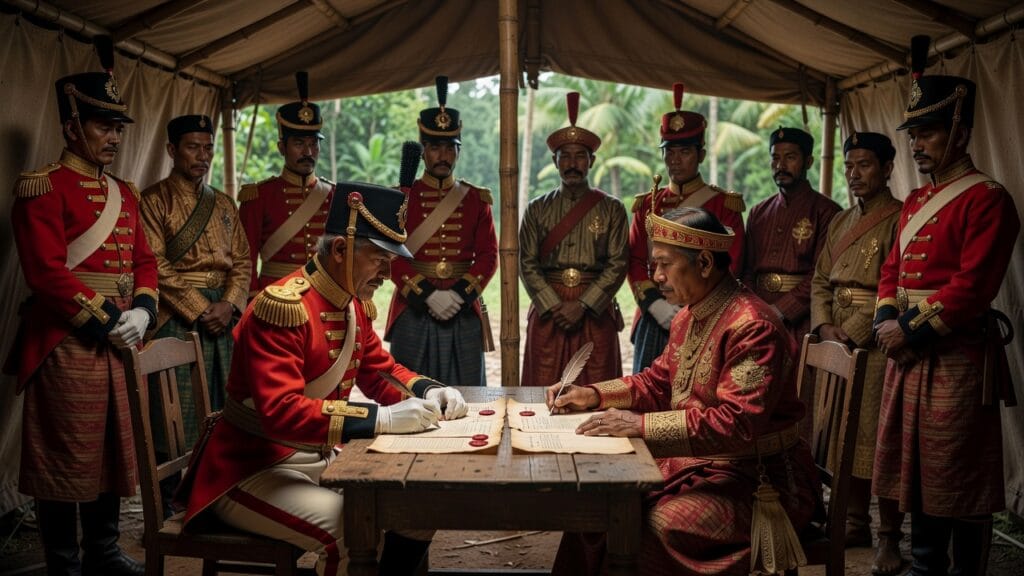
The scene at Yandabo was austere. British officers, weathered by months upriver, met Burmese plenipotentiaries dispatched from Ava’s court. Protocols mattered—seating, titles, and seals—yet behind them lay the blunt arithmetic of artillery and distance. The royal city was too near for comfort; the river flowed past like a reminder of routes now contested.
General Sir Archibald Campbell carried authority from the Governor-General in Calcutta. The Burmese envoys, senior ministers including an Atwinwun, spoke for King Bagyidaw. Contemporary British narratives emphasize efficiency; Burmese recollections, often filtered through later chronicles, stress the necessity of preserving dignity under duress. The day ended with signatures that closed one war and opened a longer argument.
Peace ceremonies tend to be remembered as decisive. Yandabo was decisive only in a legal sense. It defined terms that armies had already made likely, couching them in articles that would later be read, contested, and sometimes stretched. The river traffic resumed almost immediately, carrying word to Ava and Calcutta.
09 – The Price of Concession: Territories, Indemnity, and Hostages
The articles were stark. Burma ceded Arakan to the Company and relinquished claims over Assam, Manipur, Cachar, and Jaintia, whose independence would now be broached under British protection. Tenasserim, including Tavoy and Mergui, passed to the Company, giving it a southern coastline and later access toward Siamese frontiers. A British Resident would be received at Ava.
An indemnity of one crore rupees—ten million—was to be paid in installments. To guarantee payment, high-ranking hostages were temporarily required until the first installment cleared. Prisoners were to be exchanged, and both sides pledged to cease hostilities. The treaty’s language favored certainty, yet its implementation would reveal how brittle certainty could be.
These terms reshaped maps and markets. The Company now controlled an arc from Bengal to the Tenasserim coast, while the Burmese court grappled with losing provinces long woven into its prestige. The human meaning would surface more slowly, as administrators surveyed lands, taxed harvests, and recruited labor for roads and ports.
10 – Ava’s Aftermath: Court Politics and Royal Reckoning
Defeat’s first echo is political. In Ava, King Bagyidaw faced anger from courtiers and commanders alike. The loss of Arakan and the indemnity weighed heavily on royal finances. Bandula’s death left a vacuum, and debates at court turned to blame, reform, and the balance between isolation and wary engagement.
Modern historians point to the creeping crisis that followed. Revenue shortfalls tightened, military prestige dimmed, and regional governors tested the limits of loyalty. By the late 1830s, King Bagyidaw’s authority wavered, and his brother Tharrawaddy would later seize the throne—a dynastic shift that owed much to the atmosphere created by the 1826 settlement.
Yet, behind the political drama were day-to-day adjustments. Court scribes cataloged lost towns, while envoys managed the new normal with the Resident in Ava. Etiquette and protocol became battlegrounds where sovereignty was defended symbolically, even as material leverage had already slipped away.
11 – Bengal’s Horizon: Company Ambition and World Trade
For the East India Company, Yandabo represented more than revenge or security. It opened arteries of commerce: Arakan’s rice could help feed growing Indian cities, and Tenasserim’s ports and teak reserves promised shipbuilding timber and customs revenue. A trans-peninsular imagination took hold, linking Bengal, Burma, and emerging interests toward Siam and Malaya.
Company correspondence read the treaty as a strategic anchor. Naval patrols could now shelter along a friendly coast, and merchants pushed to restart trade in Rangoon, even under Burmese sovereignty. This vision met reality in costs: garrisoning new territories and governing unfamiliar populations demanded money, translators, and patience.
Still, the balance sheet favored long-term expansion. With Arakan and Tenasserim, the Company could triangulate regional politics, bargaining with Siam and scrutinizing the Burmese court from a closer vantage. The treaty of yandabo thus functioned as a hinge, pivoting Britain eastward while fixing Burma within a new economic geometry.
12 – People of the Delta and Hills: Everyday Lives Remapped
Maps change quickly; livelihoods adapt slowly. In Arakan, decades of turmoil had already emptied villages. British rule encouraged repopulation, drawing migrants back with the promise of lighter corvée and new markets, while also imposing surveys and cash taxes. Rice exports rose, yet smallholders navigated debt, price swings, and a bureaucracy that spoke in new registers.
In Tenasserim, coastal towns found themselves reoriented toward British shipping lanes. Timber camps pushed deeper inland. Roads crawled over hills, and labor drafts shifted seasonal rhythms. Minority communities along the hills and coasts renegotiated their place, sometimes using the new administration to escape old obligations, sometimes finding themselves squeezed between unfamiliar laws and persistent local power.
These adjustments rarely make treaties’ final pages. But they shaped memory. Stories of flight, new taxes, and uncertain justice circulated in markets and monasteries. For many, Yandabo was not a date but a boundary in family histories: before the war, after the British, and the long middle where survival took precedence over politics.
13 – Sources and Silences: Reading the War
Historians read Yandabo through asymmetrical archives. British sources are voluminous—dispatches, printed treaties, and parliamentary summaries. Burmese materials survive in chronicles, court documents, and later historical compilations. Each speaks its own language of legitimacy. The differences require careful triangulation and humility about what we cannot know.
Casualty figures vary widely, and motivations are often inferred from phrases shaped by bureaucracy or royal etiquette. The Hmannan Yazawin, compiled a few years after the war, reflects a court wrestling with defeat. Company records emphasize order restored and trade secured. Between these accounts lies a contested ground where memory serves present needs.
Modern scholarship pushes beyond binaries. Regional studies of Arakan and Tenasserim, coupled with work on Northeast India’s polities, reveal how local dynamics predated imperial confrontation. Such research complicates the narrative, showing that the treaty of yandabo settled one conflict while hardening fault lines that had long histories of their own.
14 – From Treaty to Second War: A Fragile Peace
Peace did not cure suspicion. The new frontiers demanded surveys, and surveys bred disputes. The British Resident in Ava became a symbol—a channel for dialogue and a reminder of imbalance. Local incidents along the lower Irrawaddy and in Tenasserim flared into diplomatic notes, sometimes promising, sometimes ominous.
The 1830s saw periods of quiet punctuated by bargaining over trade, pilots, and port regulations in Rangoon. When the Second Anglo-Burmese War erupted in 1852, the causes were not simply violations of Yandabo but accumulated grievances and calculations. The earlier treaty had set expectations; unmet or reinterpreted, these expectations primed both sides for renewed confrontation.
Immediate consequence:
Hostilities ceased, prisoners exchanged, and British control extended over Arakan and Tenasserim. The indemnity began to flow, and a Resident took up post in Ava, formalizing the new diplomatic corridor.
Long-term consequence:
Burma’s geopolitical room to maneuver narrowed. British strategic horizons expanded eastward, eventually contributing to the Second Anglo-Burmese War and, by stages, the annexation of Lower Burma.
It is easy to forget how fragile this world still was. A signature could still be contested by a shoal in the river, a misunderstood salute from a harbor fort, or a tax farmer’s cruelty. The victory solved one problem and created another: how to turn law into lived peace.
15 – Conclusion
At Yandabo, power spoke in the language of articles and seals, but its grammar had been set by river logistics, climate, and the collapse of distance between Rangoon and Ava. The treaty of yandabo ended a brutal war and began a new regional order, one that tethered Burma more tightly to the currents of British expansion.
Its legacy rests in altered borders, redirected trade, and memories of loss. The agreement captured a moment when the East India Company’s ambitions met a kingdom stretched thin. From that meeting came a peace that held just long enough to shape the next crisis, reminding us how much political weight can rest on a signature offered under duress.
16 – FAQs
- When was the treaty signed?
It was signed on 24 February 1826, concluding formal hostilities of the First Anglo-Burmese War after nearly two years of fighting along rivers, coasts, and forested frontiers. - Where was the treaty concluded?
At Yandabo, a village on the Irrawaddy River not far from Ava (Inwa), the Burmese royal seat at the time. The location underscored the British advance and the urgency for Burma to secure peace. - Who were the main figures involved?
General Sir Archibald Campbell signed on behalf of the British; senior Burmese ministers authorized by King Bagyidaw signed for the court at Ava. The Governor-General in Calcutta, Lord Amherst, framed British policy from afar. - What caused the war that led to the treaty?
Escalating frontier disputes in Arakan, Assam, and Manipur, plus the 1823 Shapuree Island incident near Chittagong, pushed the East India Company and the Konbaung kingdom from tense diplomacy into open conflict. - What were the main consequences of the treaty?
Burma ceded Arakan and Tenasserim, acknowledged the independence (and British influence) of Assam and Manipur, agreed to a one-crore-rupee indemnity, and accepted a British Resident at Ava. These terms restructured regional power and commerce. - What is the treaty’s legacy today?
The treaty of yandabo reshaped Burma’s borders and ushered in deeper British involvement, setting patterns that led to the Second Anglo-Burmese War and later annexations. Its memory remains tied to loss, adaptation, and the remapping of Southeast Asia.
17 – External Resource
18 – Internal Link
Other Resources
- Encyclopaedia Britannica – general search for the exact subject
- Google Scholar – academic search for the exact subject
- Internet Archive – digital library search for the exact subject
Sources and References
-
“Treaty of Yandabo, 24 February 1826.” In Aitchison’s Collection of Treaties, Engagements, and Sanads Relating to India and Neighbouring Countries, Vol. 1, Government of India, 1862–1863. (Later reprinted by the Government of India Press and various archival publishers.)
Note: Primary text of the Treaty of Yandabo, used for details on territorial cessions (Assam, Arakan, Tenasserim), indemnity terms, and the formal end of the First Anglo‑Burmese War. -
Wilson, Horace Hayman. Documents Illustrative of the Burmese War, with an Introductory Sketch of the Events of the War. London: James Madden & Co., 1852.
Note: Nineteenth‑century compilation of official correspondence, proclamations, and reports; supports the chronology of the First Anglo‑Burmese War (1824–1826), major campaigns, and British military and diplomatic perspectives that led to the Treaty of Yandabo. -
Harvey, G. E. History of Burma: From the Earliest Times to 10 March 1824, The Beginning of the English Conquest. London: Frank Cass & Co., 1925 (reprint 1967).
Note: Provides background on the Konbaung dynasty, Burmese expansion into Assam and Manipur, and the regional power balance immediately before the outbreak of the First Anglo‑Burmese War, clarifying the broader context of the treaty. -
Hall, D. G. E. Burma. London: Hutchinson University Library, 1950.
Note: Standard mid‑20th‑century survey of Burmese history; used for interpretation of the political and economic impact of the Treaty of Yandabo on the Burmese monarchy and for the long‑term shift in British‑Burmese relations following 1826. -
Charney, Michael W. A History of Modern Burma. Cambridge: Cambridge University Press, 2009.
Note: Modern academic synthesis that situates the First Anglo‑Burmese War and the Treaty of Yandabo within the broader trajectory of British imperial expansion and the “modern” era of Burmese history; used to support discussion of how the treaty paved the way for later Anglo‑Burmese conflicts and colonial rule. -
Tarling, Nicholas, ed. The Cambridge History of Southeast Asia. Volume 2, Part 1: From c. 1800 to the 1930s. Cambridge: Cambridge University Press, 1999.
Note: Provides regional Southeast Asian context, including British expansion from India toward Burma and the strategic and commercial motivations for the war and treaty; underpins comparisons with other colonial treaties and their effects on state sovereignty. -
“First Anglo-Burmese War (1824–26).” Encyclopaedia Britannica, online edition.
Note: Concise reference for key dates, principal combatants, and outcome of the conflict, confirming that the Treaty of Yandabo (1826) formally ended the First Anglo‑Burmese War and transferred control of specified territories to the British. -
British Library, Asia, Pacific & Africa Collections. Catalogue records and digitised materials relating to the First Anglo‑Burmese War and the Treaty of Yandabo (e.g., official correspondence and Burmese royal documents, early 19th c.).
Note: Archival context for primary documents referenced in secondary literature; supports statements about the nature of British and Burmese diplomatic exchanges and the documentary record of the treaty negotiations.

