Table of Contents
- Kyoto at the Edge of War: Late Heian Japan, 1180–1181
- A Child Emperor Shaped by Cloistered Power
- The Taira Strategy and the Marriage that Changed the Court
- From Abdication to a Toddler Sovereign: Antoku’s Elevation
- Sparks of Revolt: Mochihito’s Call and the First Battles
- A Capital on the Move: Fukuhara and Back Again
- Winter Hunger: Famine, Disease, and a Strained Court
- The Death of Former Emperor Takakura, 1181-01-30
- Mourning and Maneuver: Court Rituals and Realpolitik
- After Takakura: Go-Shirakawa, Antoku, and the Balance of Legitimacy
- The Fall of a Kingmaker: Kiyomori’s Final Weeks
- War Without an Anchor: 1181–1183 and the Splintering of Power
- Memory and Epic: Heike Monogatari’s Portrait of a Passing World
- What Takakura’s Death Meant for the Idea of Rule
- Conclusion
- FAQs
- External Resource
- Internal Link
Article Summary: In the winter of 1181, amid famine and civil war, Japan lost a young symbol of imperial legitimacy when Former Emperor Takakura died in Kyoto. His brief life sat at the crossroads of cloistered rule and samurai ascendancy, between Go-Shirakawa’s maneuvering and Taira no Kiyomori’s ambition. The article traces the political pressures that led to abdication, the enthronement of a toddler, and the war that followed. It examines court ritual, human suffering, and source debates. It explains how the former emperor takakura death reshaped authority. And it follows how memory transformed a personal loss into a national turning point.
Why keep reading: Because a nineteen-year-old’s death rippled through Kyoto’s palaces and out across battlefields, accelerating the collapse of an old order. This is the story of how a quiet passing altered power balances, set the pace of a civil war, and left a lasting imprint on how Japan understood rule itself.
At a glance:
- Event: Death of Former Emperor Takakura
- Date: 1181-01-30 (Jishō 5 by court reckoning; calendars differ by source)
- Place: Heian-kyō (Kyoto), within the imperial palace precincts
- Main figures: Former Emperor Takakura; Emperor Go-Shirakawa; Taira no Kiyomori; Taira no Tokuko (Kenreimon-in); Emperor Antoku
- Why it mattered: It removed a young but legitimate nexus between rival powers, sharpened the Genpei War’s stakes, and influenced succession politics at a fragile moment.
01 – Kyoto at the Edge of War: Late Heian Japan, 1180–1181
Kyoto in 1180–1181 felt brittle—court musicians still performed, incense still curled in galleries, yet supply lines frayed and rumors outpaced couriers. The former emperor takakura death would soon puncture this uneasy normalcy, but even before January 1181, the imperial capital strained under political seizures and the first tremors of full-scale war.
The Taira clan dominated the court while Minamoto leaders gathered strength far from the city. Behind lacquered screens, elders debated protocol; beyond the gates, men on horseback tested loyalties. Everyone sensed that the emperor’s person, his abdication, and his survival were more than personal matters—they were the grammar of legitimacy in motion.
Heian ritual promised continuity, yet continuity required consensus and access to resources. Famine rumors began to harden into accounts of real scarcity. What seemed a quarrel among elites revealed itself as a structural shift: courtiers who wrote scrolls struggled to influence men who wrote letters with arrowheads.
02 – A Child Emperor Shaped by Cloistered Power
Takakura was born into a palace where the most powerful sovereign did not sit on the throne. His father, Emperor Go-Shirakawa, reigned from a monastic residence, mastering the art of indirect rule that had defined the late Heian political ecosystem for decades. Under this “cloistered rule,” child emperors were tools and shields.
Takakura’s ascent in 1168 made him a young sovereign whose signatures were guided by older hands. He grew up with the language of edicts and poetry, but his fortunes were bound to the alliances of those arranging marriages, appointments, and the placement of troops. He was both heir and hostage to strategy.
The court’s choreography disguised fragility. Regents, retired emperors, and military magnates all sought to wrap the throne in their own cloth. In this arena, a prince’s birth or a young sovereign’s health could tilt balances as surely as a victory on a distant road.
03 – The Taira Strategy and the Marriage that Changed the Court
Taira no Kiyomori read the palace clearly. He understood that to dominate policy he must dominate kinship. The marriage of his daughter, Taira no Tokuko—later revered as Kenreimon-in—to Takakura stitched the warrior chieftain directly into the imperial body, changing court politics from within its most sacred space.
The alliance was not merely ceremonial. It guaranteed that the next emperor, if born to Tokuko, would be a Taira grandson, giving Kiyomori not just influence but heredity. Courtiers recorded the careful rollout of titles and dances; provincial warriors watched to see where authority would actually reside when swords were drawn.
Within a few years, the strategy bore fruit. In 1178, a son—Tokihito—was born to Takakura and Tokuko. The infant would become Emperor Antoku. The court celebrated, yet the birth set a timer on Takakura’s own reign, and on whether Go-Shirakawa’s cloistered influence could survive Kiyomori’s tightening grip.
04 – From Abdication to a Toddler Sovereign: Antoku’s Elevation
In 1180, under intensifying Taira pressure and following a drastic coup the previous year, Takakura abdicated. His toddler son Antoku took the throne, a child-emperor whose existence validated Kiyomori’s network while marginalizing Go-Shirakawa. The velvet logic of precedent was brought to bear: precedent served the powerful who cited it.
Abdication was not surrender in the late Heian world; it was a move on a crowded board. Yet this abdication was cornered. Courtiers recognized the danger of enthroning a small child in a time of rising insurgency. It meant imperial voice would be mediated by those who controlled the child’s person and the palace gates.
The young Antoku’s reign began amid shifting residences and strained ceremonies. The enthronement could not mask the rifts at court, or the gathering magnetism of revolt in the provinces. Legitimacy was intact on parchment, but in the field it depended on men who could protect seals with steel.
05 – Sparks of Revolt: Mochihito’s Call and the First Battles
Even as ceremonies crowned a toddler, rebellion found its voice. Prince Mochihito, supported by Minamoto allies, issued a call to arms in 1180, challenging the Taira’s hold on court and country. The appeal fused lineage with grievance, insisting that fidelity to the throne meant resisting its capture by a single clan.
The first engagements, including the Battle of Uji in 1180, were chaotic and symbolic. Monks, aristocrats, and warriors tested loyalties on riverbanks and bridges. The warfare remained regional yet radiated to Kyoto’s politics, where anxiety rose with each report of monasteries mobilizing and estates changing hands overnight.
Mini timeline:
- 1168: Takakura enthroned under Go-Shirakawa’s cloistered rule.
- 1178: Birth of Prince Tokihito (future Emperor Antoku) to Tokuko and Takakura.
- 1179: Kiyomori’s coup curtails Go-Shirakawa’s influence, reshaping the court.
- 1180: Takakura abdicates; Antoku enthroned; Mochihito issues a call to arms.
With rupture now open, every gesture in Kyoto carried double meaning. Orders might be obeyed for their seal or ignored for their sender. Through it all, Takakura, no longer ruling yet still central, became a living emblem that both sides invoked, even as his health and will were quietly eroding.
06 – A Capital on the Move: Fukuhara and Back Again
Kiyomori, seeking to reorder power and trade, relocated the court to Fukuhara in 1180. The move framed the Taira as imperial stewards over a maritime gateway, yet it upset the rhythms of Heian ceremony and angered aristocrats tied to Kyoto’s temples, estates, and social worlds built over generations.
Months later, the court returned to Kyoto, a retreat that signaled more than logistics. The swift reversal undermined the aura of inevitability surrounding Taira policy. If a capital could be moved and un-moved with such haste, perhaps Kiyomori’s grasp was less firm than it appeared, and perhaps favor could be withdrawn with equal speed.
For Takakura, the episode marked the shrinking of imperial agency into a stage set for rival directors. He was expected to endure transitions with smooth words and bowed head, even as his own life slipped further outside his control. The hallways were the same; the power behind the screens was not.
07 – Winter Hunger: Famine, Disease, and a Strained Court
As 1180 turned toward 1181, bad harvests and disrupted supply routes bit hard. Contemporary notes and later chronicles speak of steep prices, hungry crowds, and overburdened temples. War did not create famine, but it made famine harder to escape. The city’s formal dinners continued, though their abundance was not universal.
Hunger reshaped politics. Starving people at the city’s edges cared little for the legal theory of abdication. They noticed who distributed rice and who did not. They noticed monks who opened storehouses, and tax agents who did not relent. Legitimacy is fragile where bellies are empty and rumors move quickly.
Within palace walls, illness and exhaustion grew harder to ignore. The lines between private grief and public order blurred, and bodies—imperial and common—were equally finite. It is easy to forget how fragile this world still was, where rain patterns and clogged roads could bend history’s arc.
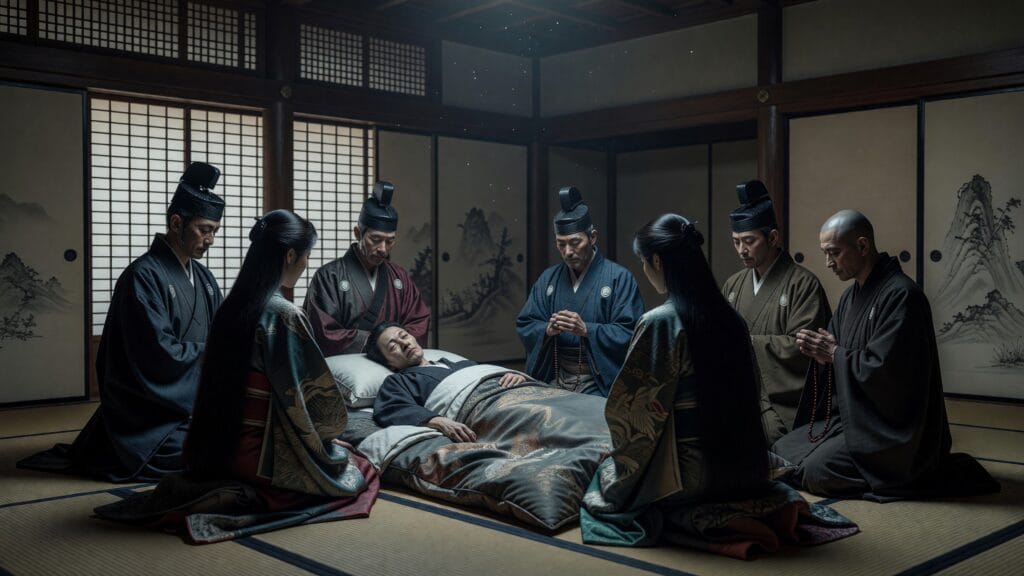
08 – The Death of Former Emperor Takakura, 1181-01-30
On the thirtieth day of the first month, 1181, Takakura died in Kyoto, nineteen years old. Court diaries date his passing with ritual precision, even as they vary on tone and cause. Later narratives speak of illness and sorrow; modern historians emphasize stress, disease, and the systemic fragility of the late Heian court.
His death unraveled a crucial thread. Though abdicated, Takakura embodied continuity between Go-Shirakawa’s cloister and Kiyomori’s palace network. The former emperor takakura death removed a pivot, leaving a child sovereign in Taira custody and a retired emperor whose control was contested. In the dim light of palace corridors, absence echoed loudly.
Funerary rites proceeded with formality, yet the atmosphere was not only grief. Courtiers recognized that with Takakura gone, the map of options narrowed. Some futures became unthinkable; others, newly possible. In wartime, even mourning rearranges alliances, because mourning itself is a public act that reallocates attention and sympathy.
09 – Mourning and Maneuver: Court Rituals and Realpolitik
The palace staged a careful choreography of prayers, offerings, and proclamations. Monks intoned, officials recorded, and messengers carried notices. The rituals (as recorded in court diaries such as Fujiwara no Kanezane’s Gyokuyō) affirmed continuity. Yet every bow also signaled to factions beyond the walls that authority remained alive and disciplined.
But behind the altar smoke, strategies clicked into place. Who would speak for Antoku? How far could Go-Shirakawa extend his influence without provoking a crackdown? War magnifies etiquette; the precise number of officials in a procession might be weighed as a message to distant warriors tracking the court’s mood like merchants track prices.
Modern historians remain cautious because the surviving record is fragmentary and steeped in agenda. We can be confident about date, place, and the political stakes. We are less certain about the inner life of mourners, beyond what formulae and later literature allow. Even so, the direction of events is unmistakable.
10 – After Takakura: Go-Shirakawa, Antoku, and the Balance of Legitimacy
With Takakura gone, two figures defined the court’s axis. Go-Shirakawa, the veteran of cloistered politics, sought to reclaim administrative reach. Antoku, a child-emperor in Taira custody, bound imperial legitimacy to the fortunes of his mother’s clan. The arrangement contained its own contradiction and its own countdown.
Legitimacy split into means and ends. The retired emperor championed procedure, edicts, and appointments; the Taira claimed guardianship of the throne’s body, the literal person of the boy-king. It is astonishing how much political weight could rest on a seal, a signature, or a hostage cradled behind a curtain.
The court’s immediate problem was communication. Orders from Go-Shirakawa carried authority but needed armed enforcement. Messages framed as Antoku’s will needed administrative compliance. The friction between these channels revealed where real power lay, and where it was merely remembered.
11 – The Fall of a Kingmaker: Kiyomori’s Final Weeks
Only weeks after Takakura’s death, Kiyomori himself sickened and died in the third month of 1181. Even if the precise circumstances are cloaked by later storytelling, the effect is unambiguous. The Taira lost their architect at the very moment when ritual confidence at court was weakest.
Without Kiyomori’s singular will, family cohesion frayed. His sons and kin were capable, but coordination wavered. The Taira still controlled impressive resources and held the young emperor, but responding to simultaneous threats—from the western seas to the eastern mountains—required a unity that only a founding patriarch had managed to enforce.
Kyoto watched for signs. Was the Taira procession thinner? Did certain aristocrats skip visits? In palatial politics, signals matter. While Go-Shirakawa probed for openings, Minamoto leaders sensed a narrowing window to press their advantage before the Taira reorganized around new leadership.
12 – War Without an Anchor: 1181–1183 and the Splintering of Power
With both Takakura and Kiyomori gone, the war entered a new phase. The Taira, bearing Antoku, retreated strategically, clinging to coastal nodes and island refuges. The Minamoto, under Yoritomo and other branches like Kiso Yoshinaka, advanced their own claims, sometimes in rivalry with one another as much as against the Taira.
The absence of a living, abdicated emperor removed a moderating symbol. In prior generations, retired emperors negotiated settlements from monastic seclusion. Now, Go-Shirakawa tried, yet the combatants’ calculations no longer presumed an elder sovereign who could safely bless compromise. Victory solved one problem and created another: it made moderation seem like weakness.
Economically, estates shifted hands under the pressures of war service and confiscation. Temples and shrines navigated dangerous waters, bargaining protection for privileges. Merchant networks adjusted to Taira maritime strategies and Minamoto inland consolidation. War was not only fought with arrows; it was fought with reallocations written into ledgers.
13 – Memory and Epic: Heike Monogatari’s Portrait of a Passing World
Later audiences encountered this age most vividly through the Heike Monogatari, with its haunting sense of impermanence. The epic offers pathos—bells tolling for vanished glories—and characters who embody the beauty and tragedy of decline. Yet it is not a chronicle; it is a crafted memory with moral intent.
In the Heike’s telling, Takakura’s world is one of splendor shadowed by doom. Go-Shirakawa, Tokuko, Antoku, and Kiyomori become figures in a meditation on power’s transience. Modern historians use the epic cautiously, cross-checking it with diaries, administrative records, and warrior compilations to extract history from lyric reflection.
Still, memory matters. The cultural afterlife of Takakura’s passing framed how later generations interpreted the Genpei War: not simply as a contest of arms, but as a reckoning over hubris, duty, and the proper distance between palace and clan. Literature archived emotion where archives lacked detail.
14 – What Takakura’s Death Meant for the Idea of Rule
Together with Kiyomori’s demise, Takakura’s passing accelerated a transformation already underway. The axis of Japanese governance shifted from court-centric patronage to warrior-led regimes that would, in time, crystallize into shogunal rule. The old system did not evaporate; it was repurposed, with emperors retaining ritual prestige while military houses managed enforcement.
Takakura’s death removed a potential mediator, a young man who might—if he had lived—have grown into a counterweight within the courtly web. That possibility is speculative, but politics is built on possibilities. Once gone, the field narrowed to a contest where legitimacy followed custody and victory rather than mature consensus.
The retired emperor’s influence remained potent, yet it was not destiny. The Minamoto recognized the opening to claim guardianship of the throne from a position of force and fidelity. The Taira, splintered, defended a vision that could no longer command the center. In this vacuum, policy began to follow provisioning more than poetry.
Immediate consequence:
Removal of a legitimizing figure in Kyoto, rising latitude for Go-Shirakawa’s interventions, and a sharper military calculus among Minamoto and Taira leaders about who could speak for the throne.
Long-term consequence:
Acceleration of samurai governance, culminating in Minamoto ascendancy and the institutionalization of dual authority—imperial ritual at court, military command in a shogunal center.
15 – Conclusion
Former Emperor Takakura’s death, recorded with courtly care on 1181-01-30, was more than a biographical endpoint. It marked the collapse of a delicate balance in which cloistered courtiers, warrior magnates, and ritual calendars sustained an older political language. With the former emperor takakura death, language yielded to logistics, and war redrafted the grammar of rule.
In the years that followed, memory elevated the tragedy while institutions absorbed its lesson. Authority would no longer hinge on a single youth behind silk screens, but on power centers capable of securing routes, enforcing decrees, and managing famine. The throne endured, yet the way Japan was governed changed, decisively and for centuries.
16 – FAQs
- When did Former Emperor Takakura die?
He died on 1181-01-30, recorded in court chronology as Jishō 5, during a winter of famine and mounting civil war. - Where did his death occur?
In Heian-kyō (Kyoto), within the imperial palace environment, where ritual and politics overlapped closely even after abdication. - Who were the main figures connected to this event?
Former Emperor Takakura; Retired Emperor Go-Shirakawa; Taira no Kiyomori; Empress Kenreimon-in (Taira no Tokuko); and the child sovereign Emperor Antoku. - What caused his death?
Contemporary records point to illness, with later narratives adding shades of stress and sorrow. Modern historians highlight famine conditions and systemic strain rather than a single dramatic cause associated with the former emperor takakura death. - What were the immediate consequences?
His passing removed a symbolic mediator, emboldened Go-Shirakawa’s maneuvering, intensified the legitimacy struggle around Antoku, and, paired with Kiyomori’s death soon after, unsettled Taira cohesion. - What is the legacy of his death?
It accelerated the shift toward samurai-led governance, shaping the path to Minamoto ascendancy and the dual structure of imperial ritual authority and military rule that defined medieval Japan.
17 – External Resource
18 – Internal Link
Other Resources
- Encyclopaedia Britannica – general search for the exact subject
- Google Scholar – academic search for the exact subject
- Internet Archive – digital library search for the exact subject
Sources and References
-
“Gyokuyō” (玉葉) by Fujiwara no Kanezane, entries for Jishō 4–5 (1180–1181).
Primary source. Court diary of regent Fujiwara no Kanezane, a key contemporary record for late Heian politics. Used to support details about the court’s response to the death of Former Emperor Takakura, the influence of the Taira (Heike) at court, and the broader atmosphere in Kyoto during the Jishō years. -
Kitagawa, Hiroshi, and Bruce T. Tsuchida, trans. The Tale of the Heike. Tokyo: University of Tokyo Press, 1975.
Although a literary and partly legendary account, this medieval war tale preserves early narratives about the Taira clan, Emperor Takakura, and the political struggle of the late 12th century. Used to illustrate how Takakura’s reign and death were remembered in later medieval Japanese tradition and to contextualize his position in the Taira–Minamoto conflict. -
Varley, H. Paul. Jinnō Shōtōki: A Chronicle of Gods and Sovereigns. New York: Columbia University Press, 1980.
Translation and study of a 14th‑century imperial chronicle. Cited for the genealogical placement of Emperor Takakura within the imperial line, the succession from Emperor Rokujō to Takakura and then to Emperor Antoku, and the retrospective view of his short reign in later court historiography. -
Hall, John Whitney, ed. The Cambridge History of Japan, Volume 2: Heian Japan. Cambridge: Cambridge University Press, 1988.
Scholarly survey of the Heian period, including its final decades. Used for the political background of late Heian Japan, the rise of warrior families, the dominance of Taira no Kiyomori in court affairs, and the structural context in which Takakura’s abdication and later death occurred. -
Adolphson, Mikael S. The Teeth and Claws of the Buddha: Monastic Warriors and Sōhei in Japanese History. Honolulu: University of Hawai‘i Press, 2007.
Academic monograph on late Heian–Kamakura religious and military institutions. Drawn on for understanding the instability and armed conflict of the late 12th century (including tensions around Kyoto) that formed the broader backdrop to Takakura’s reign and post‑abdication years. -
Nussbaum, Louis‑Frédéric, and Käthe Roth. Japan Encyclopedia. Cambridge, MA: Harvard University Press, 2005. (Entries: “Takakura Tennō,” “Taira no Kiyomori,” “Genpei War.”)
Authoritative reference work offering concise, vetted entries on individual emperors and key political actors. Used to confirm basic biographical data for Emperor Takakura (birth and death dates, reign years), his relationship to the Taira clan, and the chronology of the early Genpei War. -
National Diet Library of Japan, “Portraits of Modern Japanese Historical Figures – Emperors of Japan” and digital collections on the Heian and Kamakura periods.
Official Japanese library resources providing curated biographical notes and historical overviews. Consulted to corroborate information about Takakura’s status as a “former emperor” (jōkō), the date and place of his death, and the sequence of emperors in the late Heian period. -
Brown, Delmer M., and Ichirō Ishida, eds. The Future and the Past: A Translation and Study of the Gukanshō. Berkeley: University of California Press, 1979.
Translation of the early 13th‑century historical work Gukanshō, written by the monk Jien. Used to support interpretations of the political decline of the late Heian court, Jien’s assessment of the Taira regime, and how Takakura’s reign and death are situated within the broader narrative of imperial and warrior power.