Table of Contents
- Setting the Jordan Valley: Winter on the Edge of Empires
- Sources and the Shape of Memory
- From Ajnadayn to Damascus: The Road to Fahl
- The Byzantine Defensive Line at Pella
- Rashidun Command Decisions
- Terrain, Floods, and the Marsh Strategy
- The Night of Fahl: Battle Unfolds
- Aftermath in the Valley: Baysan and Tiberias
- Politics of Victory: Caliphate and Empire Recalculated
- Society in Transition: Tax, Land, and Towns
- Faith and Framing: How Communities Interpreted the Battle
- Weighing the Numbers: Armies, Casualties, and Claims
- From Fahl to Yarmouk: Strategic Bridge
- Remembering Fahl: Chronicles, Place-Names, and Archaeology
- Conclusion
- FAQs
- External Resource
- Internal Link
Article Summary: In the winter of 635–636, near Pella (Fihl/Fahl) in the Jordan Valley, a clash shaped the map of the Levant. The Rashidun armies, fresh from Damascus, met a reorganized Byzantine force guarding the road to Palestine. Contemporary and later chronicles describe flooding fields, night attacks, and a decisive Muslim victory. This article reconstructs the battle of fahl through careful reading of Arabic futuh accounts and Greek/Armenian chronicles while tracing its political and social aftershocks. We follow the march from Ajnadayn to Pella and on to Yarmouk, tracking how logistics, terrain, and command decisions worked together. The result is a documentary-style narrative grounded in sources yet alert to uncertainty. What emerged was not only territory changing hands, but a new framework of governance, taxation, and memory.
Why keep reading: A flooded battlefield, a winter night, and two empires at the edge of change—Fahl is a story of improvisation under pressure. Follow how mud, morale, and strategy intersected to determine who would hold the Jordan Valley and how that decision rippled toward the pivotal showdown at Yarmouk.
At a glance:
- Event: Battle near Pella (Fihl/Fahl) in the Jordan Valley during the early Muslim conquests
- Date: Commonly dated to December 635 or January 636; exact day uncertain
- Place: Vicinity of Fahl (Pella) and Baysan (Beit She’an), lower Jordan Valley
- Main figures: Rashidun commanders Abu Ubayda ibn al-Jarrah, Khalid ibn al-Walid, and Shurahbil ibn Hasana; Byzantine commanders variously identified in later sources
- Why it mattered: Opened routes into Palestine and Jordan, set conditions for the Yarmouk campaign, and accelerated administrative and fiscal transformations in the Levant
01 – Setting the Jordan Valley: Winter on the Edge of Empires
In the Jordan Valley’s low basin, winter can turn fields into slick, heavy ground. Around Fahl—known in Greek and Latin as Pella—streams feed the Jordan and marshy patches interrupt farmland. In 635–636 this landscape was not a backdrop, but an actor, shaping decisions that would determine who controlled the narrow passageways between Syria and Palestine.
To the north lay Damascus, recently entered by the Rashidun armies; to the west, the road slid toward Tiberias and the Galilee; to the south, tracks led into Arabia and Egypt. Here, at a hinge between frontiers, the battle of fahl unfolded. Its fight was not only for walls and bridges, but for river crossings, supply corridors, and the morale of marching armies.
The region still bore the imprint of Roman and Byzantine rule—fortified towns, cultivated estates, tax registers, and a Christian religious geography of monasteries and churches. But this was only the beginning of a transition. Armies moved through spaces heavy with administration and memory, and the ground itself, saturated with water, would enter the calculus of war.
02 – Sources and the Shape of Memory
We know Fahl through layered testimonies. Arabic “futuh” literature, like al-Baladhuri’s accounts and al-Tabari’s compilations, sketches the campaign’s arc, sometimes with dramatized set pieces—flooded fields, a night assault, and the sudden collapse of Byzantine order. Greek and Armenian chronicles, including the Chronicle of Theophanes and the History attributed to Sebeos, provide parallel but not identical timelines.
Modern historians read these with care because the documentary record is fragmentary. Where numbers balloon in later retellings, administrative papyri and archaeology are often quieter, pointing to changes in taxation, landholding, and urban rhythms rather than precise casualty lists. The result is a mosaic: convincing in outline, debated in its smallest tesserae.
Archaeological work around Pella and Beit She’an gives texture—urban layers, bathhouses, irrigation channels, farmsteads, and reused building stones. These traces do not narrate the clash directly, but they anchor the setting and suggest what could be flooded, occupied, or spared. Against that material stage, the manuscripts offer motive, sequence, and the names of those who gambled in winter.
03 – From Ajnadayn to Damascus: The Road to Fahl
Months earlier, the Rashidun armies had tested Byzantine strength at Ajnadayn, likely in 634, gaining momentum toward Syria’s interior. By September 635, Damascus fell after a protracted siege and negotiations. Even in victory, Muslim commanders knew the next problem waited downstream: imperial forces regrouping near Fahl to seal the Jordan crossings and stabilize Palestine.
Abu Ubayda ibn al-Jarrah, as overall commander in Syria, faced a straightforward dilemma masked by muddy complexity. Pursue the retreating Byzantine formations quickly and risk winter logistics, or pause and allow the empire to entrench? The decision, recorded with variations across Arabic sources, was to push south and east—toward the valley floor, the river, and the bottlenecks that mattered.
Units associated with Shurahbil ibn Hasana and Amr ibn al-As advanced into the Jordan district. Khalid ibn al-Walid’s mobile contingent, famed for speed, operated as the edge of a blade—bridging gaps, threatening flanks, and testing defenses. The path from Damascus to Fahl was not a straight line on a map; it was a choreography of probes, messengers, and supply animals trudging into early winter.
04 – The Byzantine Defensive Line at Pella
Byzantine strategy at Fahl seems to have prioritized terrain manipulation. Later Arabic narratives speak of deliberate flooding—opening canals or dams to saturate fields and fix cavalry in place. Whether executed by engineering units or local labor, the tactic aligns with the valley’s hydrology, where small changes produce broad marshes across low ground.
Identifying the Byzantine field commanders is harder. Some accounts name figures associated with Heraclius’s administration, while others preserve garbled titles—sacellarius or dux—more than personal names. The range of designations points to an emergency composite force: garrison troops, local levies, and detachments pulled from towns hoping to hold the river line.
What they defended was more than a camp. Pella was an old Decapolis city with access to the highlands and the Jordan. To its northwest lay Baysan, a nodal town with roads radiating toward Tiberias and the Jezreel. A stand here, if it held, could have closed the gate Rashidun columns had pried open at Damascus.
Mini timeline:
- 634: Battle of Ajnadayn tests Byzantine defense in Palestine
- September 635: Damascus surrenders after siege and negotiation
- Dec 635–Jan 636: Clash near Fahl/Pella in the flooded Jordan Valley
- August 636: Yarmouk decides the Syrian theater decisively
05 – Rashidun Command Decisions
The Rashidun high command divided responsibilities by region, a practice that allowed flexibility during the winter turn south. Abu Ubayda maintained overall direction, but delegated movement and contact to leaders with different tactical signatures: Shurahbil for the Jordan approaches, Amr for Palestine, and Khalid for rapid response and shock.
Such modular command mattered in the valley. Flooded fields could trap whole wings if they advanced in a single block. Instead, the columns sought firmer ground and tried to upset the Byzantine deployment before it solidified. The sources emphasize correspondence between commanders—orders and replies—underscoring how much political weight could rest on a seal, a signature, or a messenger’s memory.
Winter logistics presented a second, less visible front. Animals needed fodder; men needed dry firewood and shelter. To fight at night in a marsh was to court exhaustion. Yet the decision to engage suggests confidence in cavalry discipline, archery in close quarters, and the ability to coordinate under grim conditions. It was calculated risk, not recklessness.
06 – Terrain, Floods, and the Marsh Strategy
Later chroniclers claimed the Byzantines relied on water to blunt the speed of Rashidun cavalry. Strategically, this made sense: heavy or compact infantry holds better in soft ground than horses do, and missile exchanges across mud can stall momentum. If the ground near Fahl and Baysan became a shallow lake, mounted maneuver would shrink to dangerous lanes.
Arab commanders adapted by choosing when and where to initiate contact. Contemporary sources suggest scouts mapped passable routes by day, clocking water depths and testing berms. The plan, as reconstructed from the narratives, was to exploit any fatigue and overconfidence in the Byzantine lines, then drive them into their own saturated defenses.
It is easy to forget how fragile this world still was. A sudden rise in a stream, a miscalculation of distance in dusk light, and an elite unit could vanish into the dark and reeds. The valley rewarded those who took the measure of the ground—and punished those who believed mastery of men alone would carry the night.
07 – The Night of Fahl: Battle Unfolds
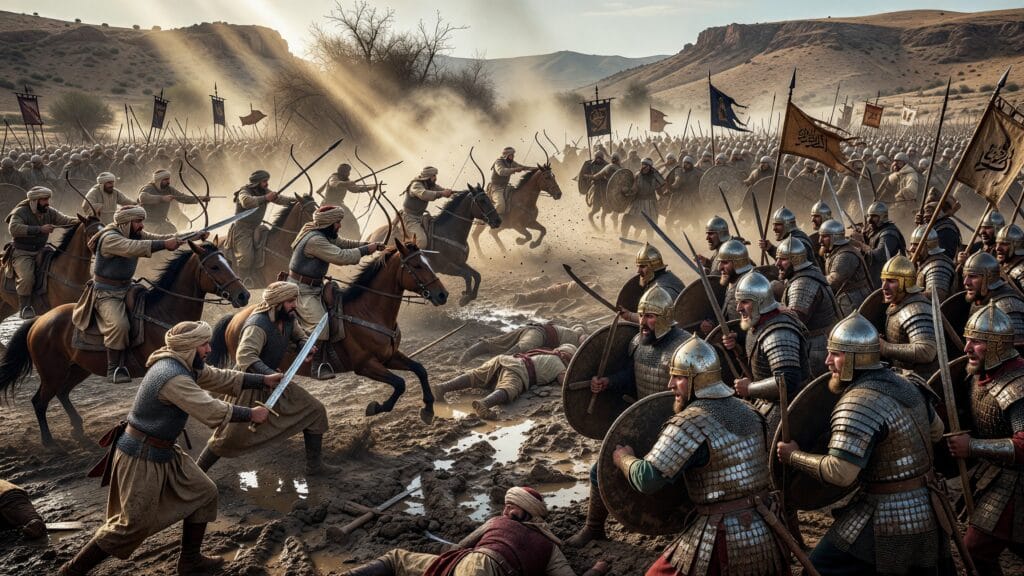
Most textual traditions agree on a core moment: a night engagement in or near the flooded fields. Some describe a sharp attack that broke a wing of the Byzantine army and spread panic into a position constrained by water. Others stress prolonged fighting punctuated by cries in the dark, where mud turned retreats into routs and routs into drownings.
The Arabic narratives commonly associate Khalid ibn al-Walid with decisive movement—either a flanking charge or a rapid reinforcement when the lines thinned. Abu Ubayda’s steadiness and Shurahbil’s local pressure combined to grind the defense down. Whatever the exact configuration, the battle of fahl ended with Byzantine forces unable to hold Pella’s approaches.
Modern historians debate scale. Was this a modest but symbolically powerful encounter, or a large engagement clearing the Jordan sector? The surviving evidence points toward a significant victory with immediate operational effects. Towns that had hesitated now negotiated. Roads that had been skirmish lines became conduits for capitulation or flight.
08 – Aftermath in the Valley: Baysan and Tiberias
When the defense near Fahl collapsed, the center of gravity shifted to Baysan and then to Tiberias. Reports in al-Baladhuri describe negotiated surrenders—terms that allowed inhabitants to remain under payment of jizya and preservation of property and worship. The fall of these towns offered staging points for operations deeper into Palestine and toward the Galilee rim.
Surrender was rarely a single act. Delegations, hostages, and oaths moved between camps and city gates. Grain stores, taxation schedules, and the rights of local notables became bargaining chips. The victory solved one problem and created another: administering a mixed landscape of Christians, Jews, and others, all with claims rooted in long-settled patterns of land and law.
Heraclius, in Antioch or further north, could read the implications on a map. The Jordan Valley’s loss made sustaining a forward line in Palestine far more expensive. For the Rashidun side, momentum accelerated. With roads and river fords opened, units could redeploy rapidly, a flexibility that loomed larger with each town that chose terms over resistance.
09 – Politics of Victory: Caliphate and Empire Recalculated
For the nascent caliphal administration, Fahl’s outcome reinforced the strategic wisdom of pushing south in winter rather than waiting for spring. It validated the judgment of commanders who risked morale and supply lines against a terrain trap. In Medina, letters would have framed the news as both providential and the fruit of discipline and unity in command.
On the Byzantine side, the defeat compounded earlier losses and narrowed options. Heraclius’s empire had survived a generation-long war against the Sasanids only to face a mobile enemy who refused the old playbook. Whether or not imperial orders specified holding Fahl, the political message of failure there carried north into council chambers and treasuries.
Officials in the towns still loyal to Byzantium had to recalculate. Could Constantinople protect them this season, or would prudence demand negotiation? It is astonishing how much political weight could rest on a seal, a signature, or a hostage sent from a city wall to a campfire—a small human act tilting the balance of regional power.
10 – Society in Transition: Tax, Land, and Towns
Fahl’s aftermath is legible not only in chronicles but in how taxes and land rents shifted. The diwan system, evolving as conquests proceeded, required estimates of local production, fixed payments, and negotiated protections. In places like Baysan and the environs of Pella, Christian and Jewish communities stayed, their obligations redirected to new collectors and military stipends.
Continuity and change intertwined. Many village structures and town councils persisted, even as Greek and provincial administrators gave way to Arabic-speaking officials. Patterns of pilgrimage and monastic life adjusted to the new fiscal climate, with bishops and abbots testing the boundaries of vows, property, and authority under new patrons.
Evidence from later papyri in the broader Levantine sphere, while not specific to Fahl, suggests administrators prioritized grain, irrigation maintenance, and measuring taxable acreage. Such concerns imply that, after the battle, armies did not merely pass through—they promoted an order capable of feeding garrisons, paying stipends, and keeping fields productive even in a recently contested valley.
11 – Faith and Framing: How Communities Interpreted the Battle
Victors and survivors framed Fahl through lenses of meaning. Early Muslim tradition often treats success as a sign of divine favor married to effective leadership. Sermons and reports praise courage, cohesion, and steadfastness in hardship—especially important when victory came through mud, darkness, and the discomfort of unfamiliar ground.
Christian communities wrestled with a different vocabulary. Some chroniclers emphasized sin and repentance; others saw in the shifting political order the inscrutable will of God, testing the faithful or punishing the proud. Armenian and Greek writers record anxiety about taxation and security more than battlefield detail, indicating how ordinary life weighed as heavily as martial honor.
Across confessional lines, the valley returned to routines—prayer, trade, farming, festival—with new patrons above. The adaptation itself became a kind of narrative. Towns that had once boasted of imperial connections now told stories of prudent surrender, wise bargaining, or charity from new rulers. The language of survival softened the shock of defeat.
12 – Weighing the Numbers: Armies, Casualties, and Claims
How many fought at Fahl? Later sources present figures that swell with hindsight—tens of thousands on each side, losses beyond counting. Modern scholarship urges restraint. The valley’s carrying capacity, winter conditions, and supply constraints argue for more modest numbers, significant enough to decide a sector but unlikely to resemble grand set pieces imagined centuries later.
Casualty claims are likewise suspect. Drownings in marshes, night confusion, and the collapse of a position can produce outsized psychological effects without producing the massive corpses that later writers describe. The battle of fahl mattered less for a toll measured in thousands than for the doors it opened and the morale it reinforced for the campaigns ahead.
Where evidence does gain traction is in aftermath. The rapid submission of Baysan and Tiberias, the reported flight of Byzantine contingents, and the consolidation of routes toward Palestine and the Galilee together indicate a substantial defeat for the imperial side. Operationally, Fahl cleared corridors that mattered when armies turned toward the Yarmouk basin.
13 – From Fahl to Yarmouk: Strategic Bridge
Fahl did not decide Syria, but it reconfigured the chessboard. With the Jordan Valley opened, Rashidun commanders could mass forces without constant harassment from the east bank. They pressed into Palestine, secured towns by treaty, and freed units for the northern pivot that would culminate at Yarmouk, a battle that set the seal on Byzantine retreat from inland Syria.
The victory at Fahl was therefore a bridge—geographical and chronological. It linked the hard-won Damascus campaign to the decisive maneuvering of 636. It also taught lessons: avoid being canal-locked by enemy engineering, probe marsh edges before committing cavalry, and exploit night when defenders rely on fixed ground. Commanders carried those lessons north.
Yet behind the ceremony of triumph lingered practical concerns. Roads damaged by flooding needed repair; supplies had to be shifted from the valley to highland depots; scouts tracked Byzantine concentrations. As the weather warmed, momentum mattered. Every week without a counterstroke made imperial recovery less likely and Rashidun control more routine.
Immediate consequence:
Byzantine defenses in the Jordan sector unraveled, leading to swift capitulations at Baysan and Tiberias and granting Rashidun forces freedom to redeploy across Palestine.
Long-term consequence:
Fahl’s outcome helped set conditions for the victory at Yarmouk, accelerated administrative transition in the Levant, and reshaped regional trade and taxation under early Islamic rule.
14 – Remembering Fahl: Chronicles, Place-Names, and Archaeology
Memory thickened around Fahl in at least three ways. Chronicles preserved a compact drama—winter, flood, night—retold to emphasize courage and providence. Place-names kept older identities alongside new ones: Pella beside Fihl, Baysan beside Beit She’an, echoing bilingual or multilingual lived experience. Archaeological layers quietly tracked adaptation, reuse, and continuity amid change.
Even today, drainage lines and tell sites hint at how flooding might have unfolded. Excavations around Pella reveal Late Antique urbanism adjusting to new priorities without uniform rupture. Bathhouses continued, churches remained, and workshops reoriented output. The transformation was neither instant nor total; it was paced by local bargains and by the rhythm of seasons that armies could not command.
Historians return to Fahl because it illuminates the texture of conquest. It reminds us that decisive battles are often decided by terrain as much as by bannered leaders, and that political revolutions are anchored in stubborn geographies—ford, hill, and farm. In that ordinary landscape, the extraordinary became possible, and a regional order turned a corner.
15 – Conclusion
In the end, the winter clash near Pella was not only a military episode but a rebalancing of a world. The battle of fahl fused leadership, improvisation, and landscape into a victory that opened the Jordan Valley and prepared the ground for Yarmouk. Its significance lies in the doors it unlocked—strategic corridors, political negotiations, and administrative transformations.
Measured against empires, Fahl seems small; measured against consequences, it was immense. It taught commanders to read water and mud as carefully as maps, reassured communities that survival could coexist with change, and set the Levant on a new trajectory. From flooded fields to treaties at city gates, history turned on the valley’s uncertain ground.
16 – FAQs
- When did the battle occur?
Most sources place the fighting in December 635 or January 636, acknowledging that the precise day is uncertain due to fragmentary records and differing chronicle traditions. - Where was the battlefield?
Near Fahl (Arabic Fihl), the ancient city of Pella, in the lower Jordan Valley, with related actions and surrenders at Baysan (Beit She’an) and along routes toward Tiberias. - Who were the main commanders?
On the Rashidun side: Abu Ubayda ibn al-Jarrah, Khalid ibn al-Walid, and Shurahbil ibn Hasana feature prominently in Arabic sources. Byzantine command is less certain, with later texts preserving titles and scattered names rather than a single undisputed leader. - What caused the battle?
After Damascus fell in 635, Byzantines aimed to stabilize the Jordan crossings and protect Palestine by concentrating near Pella. The Rashidun command chose to press south in winter to prevent imperial consolidation and keep the initiative. - What were the consequences?
The victory opened the Jordan Valley, triggered the submission of towns like Baysan and Tiberias, and allowed redeployment toward Palestine and the north. It set favorable conditions for the decisive campaign that ended at Yarmouk. - Why does the battle of fahl matter today?
It illustrates how terrain, logistics, and adaptive command can outweigh pure numbers, and how a localized clash can redirect regional history. The battle also marks an early phase in the administrative transition that reshaped the Levant under Islamic rule.
17 – External Resource
18 – Internal Link
Other Resources
- Encyclopaedia Britannica – general search for the exact subject
- Google Scholar – academic search for the exact subject
- Internet Archive – digital library search for the exact subject
Sources and References
-
Al-Tabari, Abu Ja’far Muhammad ibn Jarir.
The History of al-Ṭabarī, Volume 12: The Battle of al-Qādisiyyah and the Conquest of Syria and Palestine. Translated by Yohanan Friedmann. Albany: State University of New York Press, 1992.
Note: A key primary narrative source for the early Islamic conquests, including the campaigns in Syria and Palestine; provides early Muslim accounts of battles in the Jordan Valley and the strategic context surrounding engagements like the Battle of Fahl. -
Balādhurī, Aḥmad ibn Yaḥyā al-.
Futūḥ al-Buldān (The Conquests of the Lands). Translated by Philip Hitti. London: Luzac & Co., 1916; reprints and modern Arabic editions.
Note: Primary-source compilation of traditions on the Muslim conquests; offers early descriptions of the conquest of the Jordan Valley region, including the capture of nearby towns and the broader operational framework of the campaigns in Bilād al-Shām. -
Donner, Fred M.
The Early Islamic Conquests. Princeton: Princeton University Press, 1981.
Note: Modern scholarly analysis of the early Islamic expansions under the Rashidun Caliphate; discusses military organization, strategy, and chronology of campaigns in Syria and Palestine, clarifying dates, routes, and commanders relevant to the fighting in and around the Jordan Valley. -
Kaegi, Walter E.
Byzantium and the Early Islamic Conquests. Cambridge: Cambridge University Press, 1992.
Note: Examines Byzantine defenses and responses to the Arab conquests; provides context on Byzantine military structures, frontier strategy, and the significance of locations such as Pella/Fahl and the Jordan Valley in late antique warfare. -
Greatrex, Geoffrey, and Samuel N. C. Lieu.
The Roman Eastern Frontier and the Persian Wars (Part II, 363–630 AD). London/New York: Routledge, 2002.
Note: Offers detailed background on the late Roman–Byzantine eastern frontier before the Islamic conquests; helps situate the strategic importance of the Levant and the Jordan Valley and explains the state of Byzantine forces and administration on the eve of the Battle of Fahl. -
“Pella in Jordan (Tabaqat Fahl).”
Australian Archaeological Institute at Athens / University of Sydney Pella Excavation Project.
https://www.pella.cass.anu.edu.au/
Note: Archaeological and historical information on ancient Pella (modern Tabaqat Fahl) in the Jordan Valley; supports identification of Fahl with Pella, outlines the site’s occupation history, and provides material context for the city at the time of the 7th‑century conflicts. -
“Pella (Tabaqat Fahl).”
In: Oxford Classical Dictionary, online edition, Oxford University Press.
https://doi.org/10.1093/acrefore/9780199381135.013.4903
Note: Concise scholarly overview of Pella’s history from Hellenistic to late antique times; corroborates its location in the Jordan Valley, its role in regional networks, and its continuity into the period of the early Islamic conquests. -
Ostrogorsky, George.
History of the Byzantine State. Revised edition. New Brunswick, NJ: Rutgers University Press, 1969.
Note: Provides political and military narrative of the Byzantine Empire in the 7th century; gives broader imperial context for Heraclius’s reign, the aftermath of the wars with Sasanian Persia, and the weakening of Byzantine control in Syria and Palestine prior to battles such as Fahl.