Table of Contents
- Prologue: A City of Seals and Shadows
- France at War with Itself: Armagnac vs. Burgundian
- Henry V’s Ascendancy and the Road to Troyes
- The Assassination at Montereau and the Burgundian Pivot
- Negotiating a Crown: From Rouen to Troyes
- The Royal Court of Madness: Charles VI and Isabeau
- The Treaty’s Text: Heirship, Marriage, and Disinheritance
- Ceremony at Troyes: Oaths, Seals, and Public Theater
- A Kingdom Divided: Paris, Reims, and the Loire
- War After Peace: Henry V’s Death and the Dual Monarchy
- Joan of Arc and the Unraveling
- Money, Towns, and the Cost of Rule
- The Final Break: Treaty of Arras and Aftermath
- Memory and Myth of Troyes
- Conclusion
- FAQs
- External Resource
- Internal Link
Article Summary: On 21 May 1420, in the cathedral city of Troyes, a treaty redrew the map of the Hundred Years’ War. With the treaty of troyes signed, Henry V of England became regent and heir to the French throne, disinheriting the Dauphin Charles. The pact united the English crown and the Burgundian faction, exploiting France’s civil war. Yet the agreement proved fragile after Henry V’s death. Joan of Arc, shifting alliances, and city finances would undo its careful architecture. This article traces the deal’s making, meaning, and long afterlife.
Why keep reading: A royal signature promised to end a century of conflict, yet it birthed a new struggle over legitimacy and memory. This is the story of how seals and oaths tried to bind a broken kingdom—and how soldiers, townspeople, and an unexpected teenager changed the outcome.
At a glance:
- Event: Treaty of Troyes
- Date: 21 May 1420
- Place: Troyes, Kingdom of France
- Main figures: Henry V of England; Charles VI of France; Queen Isabeau of Bavaria; Philip the Good of Burgundy; the Dauphin Charles (later Charles VII)
- Why it mattered: Disinherited the Dauphin, made Henry V heir and regent of France, and reoriented the war through the Anglo-Burgundian alliance.
01 – Prologue: A City of Seals and Shadows
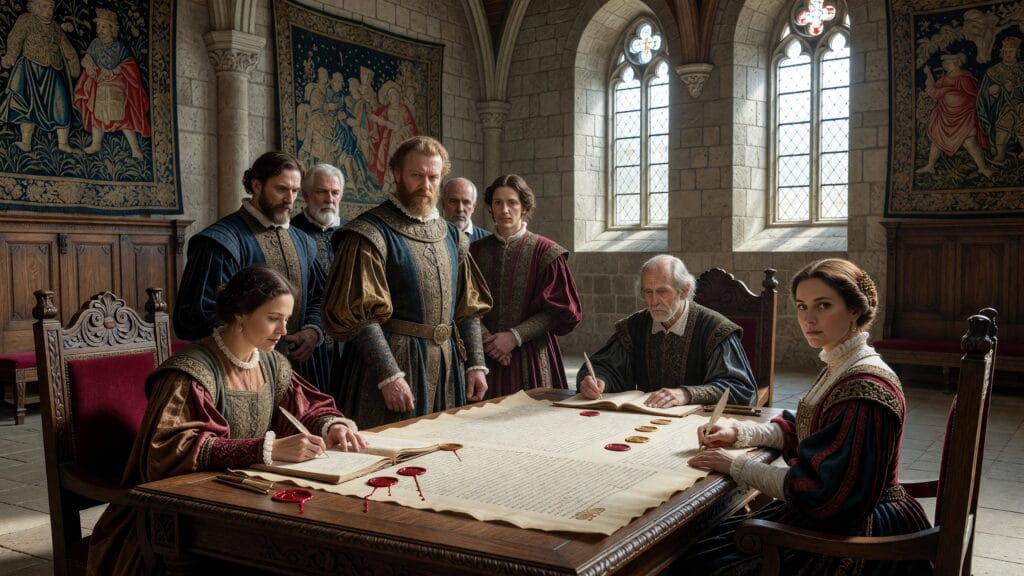
On a spring day in 1420, Troyes held its breath. Inside its cathedral precincts, scribes prepared vellum, notaries sharpened quills, and courtiers rehearsed a political theater meant to end a generation of bloodletting. When the treaty of troyes signed, every ribbon and seal carried the weight of two kingdoms and the debts accumulated by war.
From the surrounding streets came the less ceremonial sounds of a garrisoned town. Tavern whispers measured hope against fear, estimating whether English paymasters or Burgundian captains would be kinder creditors. Peace proclaimed in parchment would now be tested by soldiers’ discipline and hungry markets, because victory on paper rarely ended battles in the fields.
It is easy to forget how fragile this world still was. Plague had already cut lines through families; taxation gnawed at harvests; and France’s civil war made loyalty as uncertain as the weather. To some in Troyes, this new accord promised order; to others, it foreshadowed occupation wearing a finer cloak.
The cathedral’s cool air preserved the moment. Witnesses watched ink darken on the page, and the clatter of wax seals hardened the decision. But this was only the beginning of a longer contest: could a treaty stitch together a kingdom divided by violence, or would it merely postpone a reckoning written elsewhere?
02 – France at War with Itself: Armagnac vs. Burgundian
By 1420, France’s greatest enemy was often France itself. The Armagnac faction, loyal to the Dauphin Charles, and the Burgundians, rallied around the dukes of Burgundy, had transformed political disagreement into urban coups, assassinations, and sieges that scarred communities from Paris to the Loire.
Paris tilted toward Burgundy after 1418, while the Dauphin’s court held the Loire towns and a stubborn sense of legitimacy. Each side accused the other of tyranny; each governed where it could pay soldiers and persuade guilds. The king, Charles VI, drifted in and out of lucidity, making sovereignty as elusive as stability.
The civil war offered England an opening. Henry V marched into a fractured France, able to bargain with one faction while fighting the other. The Burgundian leaders saw in him a partner to defeat the Armagnacs; the English king saw in Burgundy a bridge to the French crown that victories alone might not secure.
03 – Henry V’s Ascendancy and the Road to Troyes
Henry V’s triumph at Agincourt in 1415 did more than thin France’s nobility; it proved he could win against odds and harvest the political profits of victory. By taking Normandy town by town, and by enforcing discipline that compared favorably with freebooting bands, he turned conquest into administration.
Rouen’s capitulation in 1419 gave England a wealthy port and a staging ground for diplomacy. From there, emissaries and prelates carried messages to Burgundian councils and to the queen’s entourage. Henry understood that treaties shape battlefields as efficiently as cannons, and that France’s civil war could be translated into English succession.
He would not gamble everything on force alone. The king cultivated an image of just governance, blending crusader zeal with bureaucratic competence. Yet behind this image stood siege engines, garrisons, and a ledger. The ledger mattered most: towns that paid contributed to peace; towns that resisted paid another way.
Mini timeline:
- 1415: English victory at Agincourt accelerates negotiations by force of reputation.
- 1418: Burgundians seize Paris; Armagnacs retreat south and west.
- 1419: Assassination at Montereau collapses talks with the Dauphin.
- 1420: Treaty drafted and concluded at Troyes, uniting England and Burgundy.
04 – The Assassination at Montereau and the Burgundian Pivot
In September 1419, a parley on the bridge at Montereau ended in murder. John the Fearless, Duke of Burgundy, was killed amid a swirl of guards and accusations, an act that Burgundian chroniclers would remember as treachery. The Dauphin’s circle insisted it was self-defense in a confrontation turned violent.
The killing changed the political geometry overnight. Philip the Good, John’s son, vowed vengeance and abandoned any rapprochement with the Dauphin. What had been a triangle of negotiation snapped into a line connecting England and Burgundy while isolating the Dauphin’s court along the Loire.
Contemporary narratives, such as the Chronique de Monstrelet, cast the event as a defining rupture. Modern historians stress that earlier mistrust and competing visions of royal authority already poisoned the atmosphere. Still, after Montereau, the path that led to Troyes required fewer detours and permitted bolder English claims.
05 – Negotiating a Crown: From Rouen to Troyes
Negotiation demanded more than military leverage; it required language that could transform a conqueror into a regent. Delegations met in ecclesiastical spaces from Rouen to Troyes, drafting articles that reimagined inheritance, guardianship, and obedience in the vocabulary of canon law and royal custom.
Henry’s envoys pressed for recognition not merely as ally but as heir. Burgundian councillors bargained for guarantees: respect for privileges, the safety of Paris, and compensation for old wounds. The queen’s circle, anxious to stabilize a monarchy overshadowed by the king’s illness, weighed peace against the Dauphin’s contested future.
It is astonishing how much political weight could rest on a seal, a signature, or a hostage. Draft articles multiplied in Latin and French; translators steered nuance. The parties searched for formulations that would bind oaths to institutions, ensuring that the treaty would govern not only men but their successors.
06 – The Royal Court of Madness: Charles VI and Isabeau
Charles VI’s intermittent illness had long eroded royal authority. At moments lucid, often withdrawn, the king embodied the crown’s sanctity even as he could not consistently exercise it. That paradox made the treaty both urgent and controversial: a sovereign had to authorize a settlement that redefined sovereignty itself.
Queen Isabeau of Bavaria emerges in the sources as a practical power-broker. Later pamphleteers maligned her, but the surviving evidence points toward a woman managing catastrophe with the tools available: alliances, guardianship over the royal children, and negotiations that might salvage order from civil war.
Burgundy’s influence threaded through the royal apartments. With Philip the Good’s backing, Isabeau and her councillors could present the treaty as a rescue of the realm from factional usurpers. The Dauphin’s partisans countered that a mother had betrayed her son, a charge sharpened by political theater and the rhetoric of treason.
07 – The Treaty’s Text: Heirship, Marriage, and Disinheritance
The treaty declared Henry V “heir and regent of France” during Charles VI’s life and successor upon his death. It disinherited the Dauphin Charles on the grounds of disobedience and alleged complicity in Burgundian bloodshed, legal reasoning that sought to turn civil war into grounds for exclusion.
To cement the pact, Henry married Catherine of Valois, Charles VI’s daughter. The match embodied the merger of lines that the articles described in prose. It promised children who would bridge kingdoms, and it gave the treaty a human face, asking wedding bells to muffle the sound of marching boots.
Administrative clauses followed the grand ones. The treaty affirmed rights in Paris, envisaged a joint council, and directed seals and letters to reflect Henry’s authority. Rymer’s Foedera later preserved key texts, while the Parliament Rolls of England record how London’s political nation absorbed this new constitutional geography.
08 – Ceremony at Troyes: Oaths, Seals, and Public Theater
Witnesses assembled in Troyes for an event that aspired to be more than a signature. They watched oaths sworn on relics and seals pressed into wax, gestures meant to anchor words in sacral time. On 2 June 1420, the marriage of Henry and Catherine completed the tableau the treaty had staged.
Chroniclers emphasize the choreography: processions, proclamations, and the cascade of confirmations that followed. Royal clerks produced authenticated copies to circulate to towns and chapters. The Journal d’un Bourgeois de Paris, though hostile to Armagnacs, conveys the relief and apprehension of a city trained to hear promises with armed men nearby.
Yet behind the ceremony lay practicalities. The garrison had to be fed; annuities promised to collaborators had to be paid; and wary townspeople measured the distance between parchment ideals and marketplace realities. The treaty of troyes signed, but only taxes, patrols, and courts would decide if subjects experienced it as peace.
09 – A Kingdom Divided: Paris, Reims, and the Loire
Paris largely accepted Burgundian and English administration after 1420, hoping for steady markets and safer streets. Farther east, Reims—the coronation city—stood as a symbol of legitimacy that remained contested. Whoever controlled its cathedral could translate political claims into sacred kingship under the oil of Saint Remigius.
South and west of the Loire, the Dauphin’s regime survived among loyal towns and shifting coalitions of nobles. They rejected the disinheritance as void, arguing that a king clouded by illness could not unmake the dynastic order. Canon lawyers and preachers prepared arguments as soldiers prepared defenses.
The treaty of troyes signed had not ended the war; it had given each side a new vocabulary. For Anglo-Burgundians, governance became restoration. For Armagnac partisans, resistance became fidelity. Maps now communicated more than garrisons; they depicted rival interpretations of law, ceremony, and divine favor.
10 – War After Peace: Henry V’s Death and the Dual Monarchy
Fate played a decisive hand in 1422. Henry V died at Vincennes in late August, and Charles VI followed him in October. The crown the treaty imagined for an English warrior king now fell to an infant: Henry VI, proclaimed king of England and France by his regents.
The Duke of Bedford assumed the French regency, while Gloucester guarded interests in England. They worked to honor the treaty, minting a dual monarchy on coin and in proclamations. The arrangement depended on Burgundian partnership and on revenues from Norman customs and Parisian taxes to feed a sprawling garrison network.
The victory solved one problem and created another. Without Henry V’s charisma and presence, the pact’s legitimacy lay more nakedly in seals and soldiers. In councils and marketplaces, questions resurfaced: could a baby bind towns in obedience, and could administrators persuade where a conqueror had once commanded?
11 – Joan of Arc and the Unraveling
In 1429, a teenager from the borderlands of Champagne and Lorraine entered the Dauphin’s court and altered the tempo of the war. Joan of Arc promised deliverance and insisted on action; the relief of Orléans became both a military and a psychological turning point that stunned veteran commanders.
Her convoy north to Reims reopened the road to coronation. On 17 July 1429, Charles was anointed as Charles VII, surrounded by towns that sensed the winds shifting. The ritual did what the Armagnacs had long sought: it gave their claim a ceremony as potent as any treaty.
Anglo-Burgundian leaders denounced this sacrament as empty, yet morale mattered as much as doctrine. English garrisons still held key fortresses, but the tide’s first pull was visible. The treaty of troyes signed nine years earlier now seemed a scaffold left standing as a new building rose beside it.
12 – Money, Towns, and the Cost of Rule
War’s arithmetic governed daily life more than diplomacy did. Town councils wrestled with tallages, salt taxes, and forced loans demanded by whichever authority held the nearest gate. Merchants calculated exchange risks, and peasant communities petitioned for remissions, offering loyalty in the currency of grain and quiet roads.
English administration prided itself on order, yet even orderly exactions bit hard. Burgundian allies expected rewards; garrisons required pay; and fortification repairs devoured budgets. Under the Dauphin, hastily rebuilt institutions also needed revenue and trust, two commodities scarce after decades of raids, plunder, and broken pledges.
Human choices traced the map of allegiance. A town that had suffered under one captain might welcome another, only to learn that uniforms changed faster than tax ledgers. The documentary record is local and vivid here, revealing a population navigating survival more than ideology as flags rose and fell.
13 – The Final Break: Treaty of Arras and Aftermath
In 1435, Burgundian patience with the English thinned. The Treaty of Arras reconciled Philip the Good with Charles VII, acknowledging the trauma of John the Fearless’s murder and offering reparations and privileges. With Burgundy’s departure, the scaffolding of Troyes lost a principal support.
Bedford died the same year, and English strategy sagged without its most capable regent. French royal armies, reorganized under Charles VII’s reforms, pressed into Normandy and Guyenne. Victories at Formigny in 1450 and Castillon in 1453 reduced the English mainland footprint to Calais, completing a reversal unthinkable in 1420.
The treaty of troyes signed in triumph now read like a document from a different century. Memory softened its edges, but the administrative debris—lodged in town accounts and chancery entries—showed how deeply it had once reached. The political imagination it proposed could not survive the realignments of men and money.
Immediate consequence:
Anglo-Burgundian unity isolated the Dauphin, stabilized Paris under new terms, and reoriented sovereignty by making Henry V regent and heir through marriage and oath.
Long-term consequence:
Burgundy’s later reconciliation with Charles VII, renewed French institutions, and shifting war finance undermined the settlement, leading to England’s loss of nearly all territories by 1453.
14 – Memory and Myth of Troyes
Later centuries remembered Troyes through competing lenses. English tradition, amplified by chroniclers and dramatists, pictured Henry V as a warrior-statesman who nearly mastered a dual monarchy. French memory emphasized endurance through catastrophe, transforming the Dauphin’s precarious survival into a story of national resurrection.
Shakespeare’s stage fixed the image of a courtship between Henry and Catherine that made politics seem almost romantic. Historians point readers back to less glamorous paper trails: letters patent, town accounts, and proclamations that reveal negotiation, payment cycles, and the slow production of consent and dissent.
Troyes also lived on in constitutional debate. Could an ailing king alter succession? Did factional misdeeds justify exclusion from the line? Jurists argued both sides, while the dynasty took its own turn. The marriage that sealed the treaty eventually linked Valois to Tudor, extending Troyes’s shadow into English politics.
The treaty of troyes signed did not settle who owned the future; it structured a contest over how authority should look. That is why it endures in classrooms and archives: as an instruction in how paper, ritual, and force interact, and how each can fail when the other shifts.
15 – Conclusion
In 1420, amid civil war and exhaustion, a treaty promised to compress two crowns into one coherent order. For a moment it worked, converting victories into titles and marriage into policy. But legitimacy proved to be a moving target, and when men, money, and memory rearranged themselves, the edifice cracked.
As the treaty of troyes signed recedes in time, its lesson remains immediate. Lasting settlements must secure more than signatures; they must bind rival loyalties, finance daily governance, and survive unplanned succession. Troyes failed that ultimate test, yet in failing it reshaped a century, and the Europe that followed.
16 – FAQs
- When was the Treaty of Troyes concluded?
The treaty was concluded on 21 May 1420, in the late spring phase of the Hundred Years’ War, after months of negotiations and years of military pressure. - Where was it signed and why there?
It was signed in Troyes, a cathedral city in Champagne aligned with Burgundian interests, offering a secure venue and ecclesiastical setting that enhanced the ceremony’s legitimacy. - Who were the principal figures behind the accord?
Henry V of England; Charles VI of France; Queen Isabeau of Bavaria; and Philip the Good of Burgundy were central, while the Dauphin Charles—disinherited by the pact—stood as the excluded protagonist. - What caused the treaty to take shape?
England’s military ascendancy, France’s Armagnac–Burgundian civil war, and the assassination at Montereau pushed Burgundy toward England. The combination made a political settlement appear the fastest route to order. - What were its immediate consequences?
Henry V became regent and heir to France, married Catherine of Valois, and gained recognition in Paris. The Dauphin’s camp condemned the move, hardening the war into a battle over law and legitimacy. - What is its long-term legacy?
Though the treaty of troyes signed seemed to crown a dual monarchy, it unraveled after Henry V’s death. Joan of Arc’s interventions, Burgundian realignment at Arras, and French institutional reforms led to the English loss of nearly all French territories by 1453.
17 – External Resource
18 – Internal Link
Other Resources
- Encyclopaedia Britannica – general search for the exact subject
- Google Scholar – academic search for the exact subject
- Internet Archive – digital library search for the exact subject
Sources and References
-
Rymer, Thomas (ed.). Foedera, Conventiones, Litterae et Cujuscunque Generis Acta Publica, vol. 4. London: Record Commission, 1816–1830 (orig. 18th c.).
Note: Primary source collection that includes the official Latin and French diplomatic texts related to the Treaty of Troyes and other Anglo-French agreements during the reign of Henry V. Useful for verifying the treaty’s clauses, signatories, and formal political language. -
Pertz, Georg Heinrich (ed.). Monumenta Germaniae Historica, Scriptores, vol. 11 (includes Enguerrand de Monstrelet, Chronique). Hanover: Hahn, 1854.
Note: Medieval chronicle (primary narrative source) that describes the political situation in France during the later stages of the Hundred Years’ War, including the Burgundian–Armagnac conflict and the context leading to the Treaty of Troyes. -
Curry, Anne. Henry V. London: Longman, 2005.
Note: Modern scholarly biography that analyzes Henry V’s military campaigns, diplomacy, and aims in France, including his role in negotiating and enforcing the Treaty of Troyes and his position as heir and regent of France after 1420. -
Allmand, Christopher. The Hundred Years War: England and France at War c.1300–c.1450. Cambridge: Cambridge University Press, 1988.
Note: Academic study providing broader context for the Hundred Years’ War, explaining the political fragmentation of France, the Burgundian alliance with England, and the significance of the Treaty of Troyes within the long conflict. -
Vaughan, Richard. John the Fearless: The Growth of Burgundian Power. Woodbridge: Boydell Press, 2002 (reprint).
Note: Focuses on the Burgundian dukes and the internal French civil war that set the stage for English influence. Clarifies the Burgundian role in making the treaty possible and the political dynamics around Troyes in 1420. -
Famiglietti, Richard C. Royal Intrigue: Crisis at the Court of Charles VI, 1392–1420. New York: AMS Press, 1986.
Note: Scholarly monograph detailing the mental illness of Charles VI, factional struggles among French princes, and the diplomatic maneuvering that culminated in the Treaty of Troyes and the disinheritance of the Dauphin Charles. -
“Treaty of Troyes (1420).” In Encyclopædia Britannica, online edition.
https://www.britannica.com/event/Treaty-of-Troyes
Note: Concise, peer‑reviewed reference article summarizing the circumstances, main provisions, and historical impact of the Treaty of Troyes, including the recognition of Henry V as heir to the French throne. -
“The Hundred Years War.” The National Archives (UK), Education & Research Guides.
https://www.nationalarchives.gov.uk/education/resources/hundred-years-war/
Note: Provides contextual materials and selected translated documents on the Anglo-French conflict in the early 15th century, supporting background information on Anglo-French relations and the military-political environment around 1420.

