Table of Contents
- The Eastern Frontier Turns West: Cyrenaica on the Eve of 642
- Marching Beyond the Nile: ‘Amr ibn al-‘As Tests the Frontier
- Inside Barqa: A Byzantine Town Between Tribes and Sea
- Scouts, Skirmishes, and Signals: The Road to Negotiation
- Terms at the Gate: Treaty, Tribute, and a Calculated Surrender
- Barqa Under New Rule: Garrison, Governance, and Grain
- What the Sources Say and What They Omit
- Tribes and Trade: Berber, Arab, and Greek Worlds Intertwined
- Faith in Transition: Churches, Jurists, and the Status of the Conquered
- From Barqa to Tripoli: The Corridor to Ifriqiya
- Money and Movement: Taxation, Caravans, and the Desert Edges
- Resistance and Accommodation: How People Lived the Change
- A Wider Mediterranean Chessboard: Byzantium, Exarchs, and Caliphs
- Weighing the Outcomes: Immediate and Enduring Consequences
- Conclusion
- FAQs
- External Resource
- Internal Link
Article Summary: In 642, a frontier decision turned the Mediterranean balance: the Muslim army that had mastered Egypt moved west to Cyrenaica and accepted Barqa’s surrender on negotiated terms. This study reconstructs the setting, the march, and the treaty, then follows the political and social results. The conquest of barqa emerges as less a single clash than a recalibration of power across desert and sea. We examine fragmentary Arabic and Byzantine sources, highlight contested details, and trace how tribute, garrisons, and alliances opened the corridor to Tripoli and Ifriqiya. The article places ordinary lives alongside imperial strategies to understand what changed—and what endured.
Why keep reading: A city surrendered without a famous battle, but the stakes were immense: secure Egypt’s flank or leave it exposed to counterattack. Between caravan dust and coastal winds, commanders wagered on negotiation, and communities measured liberty against levy. Follow the choices that reoriented North Africa and set the Maghreb’s next chapter in motion.
At a glance:
- Event: Surrender and incorporation of Barqa (Barce) into the expanding Rashidun polity
- Date: 642 CE (some traditions place it 642/643; exact month uncertain)
- Place: Barqa, Cyrenaica (eastern Libya; inland from modern Benghazi)
- Main figures: ‘Amr ibn al-‘As; local Byzantine officials; Caliph ‘Umar ibn al-Khattab in the background
- Why it mattered: Secured Egypt’s western frontier, reconfigured trade-tax networks, and opened the route to Tripoli and the later Maghreb campaigns
01 – The Eastern Frontier Turns West: Cyrenaica on the Eve of 642
By 642, Egypt’s new rulers looked beyond the Nile. The coastal cities of Cyrenaica—Barqa, Ptolemais, Berenice—had once been wealthy Hellenistic foundations, now a peripheral Byzantine district recovering from wars and plague. Garrisoned, taxed, yet understaffed, the region depended on caravan routes and a thin chain of forts that struggled to command the wide steppe.
The Rashidun leadership faced a strategic dilemma. Hold Egypt defensively and wait for Byzantine reprisals, or move quickly west and neutralize nearby bases. In this calculus, the conquest of barqa offered not spoils alone but a screen against counterattack, a lever for trade, and a political signal to tribes watching the direction of power.
Contemporary observers left few lines on the moment before contact. Farmers near the Green Mountain, sailors in the small harbors, and monks in scattered monasteries all sensed change. News from Alexandria traveled with merchants and refugees; anxiety and opportunity mingled in market talk as horsemen appeared on the horizons.
02 – Marching Beyond the Nile: ‘Amr ibn al-‘As Tests the Frontier
‘Amr ibn al-‘As, the conqueror of Egypt, probed westward with detachments hardened by desert marches and set-piece sieges. Some accounts suggest he sought or received approval from Caliph ‘Umar; others imply initiative at the edge of communication. Either way, the push toward Barqa relied on mobility, reconnaissance, and the expectation that the city would not risk annihilation.
The column advanced along tracks used by traders and herders, threading wells and oases known to guides who spoke Arabic, Greek, and Berber tongues. Speed was a message and a tactic: appear before defenders could coordinate, then place terms that made resistance look imprudent. Skirmishes occurred, but they were probes, not pitched battles.
03 – Inside Barqa: A Byzantine Town Between Tribes and Sea
Barqa occupied inland ground not far from the coast, tied to regional ports but buffered by the plateau. Its administration answered to Byzantine authorities in Africa, yet the state’s presence could feel distant. A local dux or comes commanded a small garrison; urban councils and churchmen mediated everyday disputes and revenues.
Ethnically and linguistically mixed, Barqa’s population included Greek-speaking townspeople, Latin-influenced officials, Coptic and local Arabic dialect speakers, and Berber communities like the Luwata. The city’s wealth was modest, sourced from pastoralism, small-scale agriculture, and trade passing between Egypt and Tripolitania. It was a place to bargain, not to defy at all costs.
Religious life added complexity. Chalcedonian bishops maintained ties with imperial orthodoxy, while non-Chalcedonian Christians had longstanding grievances from earlier ecclesiastical conflicts. Those tensions did not guarantee sympathy for outside armies, but they did weaken the impulse to fight zealously for distant emperors.
04 – Scouts, Skirmishes, and Signals: The Road to Negotiation
As the Arab force approached, scouts gauged water, forage, and morale inside the walls. Minor engagements likely tested outposts, demonstrating reach without inviting attrition. Dust on the horizon and rumors of Alexandria’s fall mattered as much as arrows; psychology could spare horses and lives in a landscape where logistics ruled outcomes.
Messengers crossed lines with propositions framed as law and mercy: submit to the new authority, pay a capitation tax, keep property and faith, and avoid siege. For the city, the calculation was brutal arithmetic. A long defense seemed untenable, and relief from Carthage or Constantinople was unlikely to outrun exhaustion and fear.
When communities believe tomorrow’s order will preserve their livelihoods, stasis becomes surrender dressed as prudence. Negotiation did not erase anxiety, but it replaced uncertainty with manageable obligations, and it answered the most urgent question: how to survive the week, not the century.
05 – Terms at the Gate: Treaty, Tribute, and a Calculated Surrender
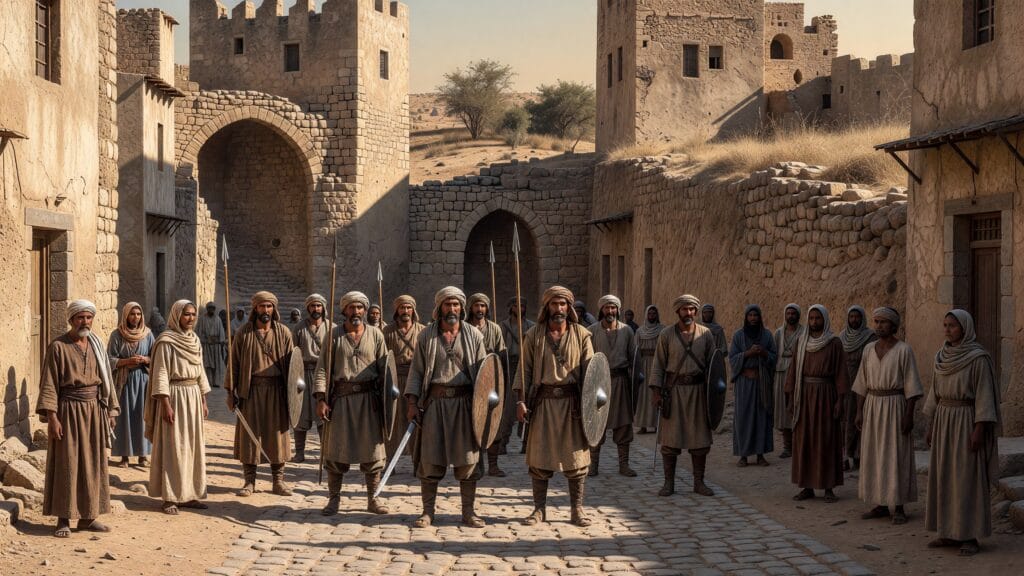
Tradition preserves a moment at Barqa’s gates when local notables accepted terms. The details vary across chronicles, yet a pattern holds: payment of a per-person tax, protection for the churches and private property, and admission of a small garrison or the stationing of forces nearby. Barqa became a frontier town under new stewardship, not a ruin.
Some narratives speak of a lump-sum indemnity or specific dinar totals; others imply household assessments indexed to capacity. Precision is doubtful, but the thrust is clear. Tribute purchased predictability, and predictability was priceless to urban dwellers whose prosperity depended on stable routes and regular markets.
Mini timeline:
- 641: Alexandria submits; Egypt’s political center shifts to Fustat.
- 642: March west; Barqa’s surrender on negotiated terms.
- 643–644: Consolidation along the coast; Tripoli brought under control.
- 647: Campaign reaches Sufetula in modern Tunisia under ‘Abdallah ibn Sa‘d.
To later memory, this episode exemplified policy: conquer decisively, then govern lightly if tribute flowed. The conquest of barqa thus resembled a contract more than a catastrophe, with mutual obligations that would be contested, adjusted, and occasionally ignored as seasons turned.
06 – Barqa Under New Rule: Garrison, Governance, and Grain
After surrender, administration had to be made visible but not suffocating. A commander judged reliable was installed to oversee revenues and adjudicate disputes alongside local authorities. The new fiscal regime aimed to keep grain and flocks moving, not to empty storehouses. Too much pressure risked revolt; too little invited Byzantine intrigue.
Fustat became the point of reference, connected by a corridor of patrols and watchpoints. Caravans now paid into a system aligned with the conquerors’ priorities, while workshops and farms adapted to new officials and seals. For ordinary people, the rhythm of dues and decrees mattered more than dynastic names.
Geography kept Barqa strategic. It guarded approaches to Egypt and opened paths to Tripolitania. Whoever held Barqa did not master North Africa, but they anchored it. The city’s status as a secured rear-area allowed planners to think beyond the next harvest and imagine operations along the wider littoral.
07 – What the Sources Say and What They Omit
The Arabic conquests are narrated by works like al-Balādhurī’s Futūh al-Buldān and al-Ṭabarī’s history, which offer treaty formulas, commander names, and sequences of towns. For Cyrenaica, these accounts emphasize negotiated settlements and modest garrisons. Byzantine or Coptic voices, such as the Chronicle of John of Nikiu, are terser and often Egypt-centered.
Archaeology in Cyrenaica helps but cannot time-stamp a surrender. Layers at sites like Ptolemais and Berenice reveal continuity in occupation with signs of late antique contraction preceding any Muslim arrival. Coin finds and church repairs suggest adaptation rather than abrupt collapse, consistent with a treaty rather than sack.
Modern historians remain cautious, noting that formulaic treaty clauses can blur unique local conditions. Yet the convergence on negotiated submission, and the absence of explicit sack reports, give weight to the reconstruction of Barqa’s fall as a carefully managed transition in 642.
08 – Tribes and Trade: Berber, Arab, and Greek Worlds Intertwined
Conquest settled sovereignty, but influence required allies. Berber groups along the steppe and mountain zones gauged opportunities in escorting caravans, sharing wells, and drawing stipends. Arab contingents learned the value of tribal diplomacy, trading horses and marriage ties for access to routes that no imperial map fully controlled.
Greek-speaking townspeople recalculated their futures in a commercial idiom. With the road to Egypt secure, Cyrenaican produce could find markets across the delta and, in time, beyond. Brokers who could navigate Arabic and Greek norms became indispensable, their ledgers quietly recording the empire shift more than proclamations did.
This interplay remade the region less through edicts than through bargains. A new sovereign language entered contracts; new tax agents stamped tablets and papyri; new patrons sponsored repairs. Out on the steppe, alliances were fluid, but the caravan clocks favored those who kept the peace, not those who courted glory.
09 – Faith in Transition: Churches, Jurists, and the Status of the Conquered
Religious policy followed the template honed in Syria and Egypt: protect churches, allow worship, levy a tax on non-Muslims, and demand political loyalty. For some local Christians—especially those estranged from imperial orthodoxy—this arrangement could feel less intrusive than earlier doctrinal policing, though new hierarchies and burdens brought their own unease.
Jurists working under the Rashidun umbrella adapted principles to conditions on the ground, balancing revenue needs with the reputational value of fair treatment. Bishops remained figures of civic authority, now also acting as community intermediaries with governors. The outcome was neither facile harmony nor relentless persecution; it was negotiated coexistence.
Over generations, conversion patterns would reshape identities, but in 642 the immediate fact was continuity under supervision. Bells still called congregations; scribes still copied texts. What changed first was whose name framed protection and whose officers tallied the tax.
10 – From Barqa to Tripoli: The Corridor to Ifriqiya
Once Barqa was settled, attention shifted along the coast to Tripoli. The littoral offered harbors, but the real constraint was water. Forces moved in stages, relying on wells and negotiating with tribes for passage. In this rhythm, the conquest of barqa was less an endpoint than a launching pad, a rear base for the next negotiation or siege.
Chronicles place Tripoli’s submission a year or two later, after pressure by land and sea. By then Barqa’s role as relay and depot mattered. Horses, grain, and intelligence flowed through it, turning the city into a hinge between a pacified Egypt and a still-contested Maghreb.
In later decades, commanders like ‘Uqba ibn Nāfi‘ would push far west, but their road began here. Without a secured Cyrenaica, every mile past the Libyan frontier would have pulled the enterprise taut over a dangerous void.
11 – Money and Movement: Taxation, Caravans, and the Desert Edges
Economy explains as much as arms. Tribute from Barqa added to the fiscal base sustaining garrisons and administration, while regulated tolls on caravans signaled a state presence that merchants could price into contracts. Predictability, even at a cost, beats hazard, and trade responded accordingly.
The state learned from the desert. Patrols did not chase raiders blindly; they escorted value and deterred opportunists by making coordination difficult. Meanwhile, tax registers grew more precise, linking names to obligations. In this bureaucracy of survival, scribes were as decisive as swordsmen.
Egypt’s grain surplus radiated outward, and Cyrenaica staked a claim in that traffic. Ports that had languished gained pulse from safer roads, while inland markets stabilized. The transformation felt incremental, but a few seasons without panic is how new orders become old facts.
12 – Resistance and Accommodation: How People Lived the Change
Not everyone welcomed the new authority. Some soldiers deserted west; a few towns resisted taxes; tribal groups tested weak patrols. Yet the balance favored accommodation. Those who found a niche—as translators, suppliers, or local officials—absorbed shocks for their communities and preserved room to maneuver within the fresh hierarchy.
Even small decisions reveal the human texture. A family weighing the tax against the risks of flight, a monk deciding whether to petition the governor, a caravan boss choosing routes based on a commander’s reputation—such choices, replicated thousands of times, stabilized the settlement more than proclamations did.
13 – A Wider Mediterranean Chessboard: Byzantium, Exarchs, and Caliphs
Strategically, Barqa’s fall signaled to Byzantine Africa that the long frontier had shifted. The Exarchate at Carthage watched its eastern flank turn uncertain, even as Constantinople faced Persian aftershocks and new Arab offensives. Naval capacity mattered, yet sea power could not hold inland towns without costly expeditions.
For the Rashidun leadership, the capture by treaty aligned with a broader pattern: move fast, secure revenue, and avoid attritional sieges when negotiation would suffice. This conserved strength for future campaigns while depriving opponents of footholds for counterattacks toward Egypt.
It is easy to forget how fragile this world still was. A poor harvest, a plague ripple, or a Byzantine raid could have reversed gains. But the linked chain from Fustat to Barqa, and then to Tripoli, proved resilient enough to weather shocks that once would have shattered it.
14 – Weighing the Outcomes: Immediate and Enduring Consequences
The immediate outcome was clear: Egypt’s west was buffered, tribute flowed, and caravans adjusted. Less visible, but profound, were the new relationships among towns, tribes, and the state. Patterns of accommodation took root, lowering the cost of administration and shortening the odds against future advances along the coast.
Over time, Barqa’s surrender affected identity. Arabic gained prestige in administration and commerce; local elites reoriented loyalties; religious communities learned to argue cases before different judges. The conquest of barqa thus seeded long-term cultural shifts that unfolded across generations, not merely seasons.
Immediate consequence:
Byzantine capacity to threaten Egypt from the west collapsed; tribute and market flows stabilized Cyrenaica under new authority.
Long-term consequence:
Cyrenaica became the hinge for later Maghreb campaigns and a corridor of linguistic, legal, and social transformations across North Africa.
The victory solved one problem and created another: how to hold what had been gained without overextending supply and patience. Barqa’s example—rule by pact, not pyre—offered a durable, if imperfect, answer.
15 – Conclusion
Seen close-up, 642 at Barqa is a study in calculated restraint. A city looked east, measured the limits of imperial relief, and chose tribute over siege; a commander looked west, weighed supply against ambition, and chose a treaty that turned the frontier. Across the steppe, this bargain kept caravans moving and made patience a weapon.
In the broader arc, the conquest of barqa secured Egypt’s flank and opened the road to Tripoli, then to Ifriqiya. It signaled a governing style that many communities could live with—at a cost—and it launched cultural and economic currents that would redefine North Africa. The surrender at Barqa was quiet, but its echoes travel far.
16 – FAQs
- When did the event occur?
Most traditions place Barqa’s surrender in 642 CE, though some sources imply a 642/643 window and do not specify a month. - Where did it happen?
At Barqa (Barce) in Cyrenaica, eastern Libya, inland from the Mediterranean coast near the region of the Green Mountain. - Who were the main figures?
‘Amr ibn al-‘As led the westward advance after conquering Egypt, operating under the Rashidun Caliphate led by ‘Umar ibn al-Khattab; local Byzantine officials negotiated the city’s surrender. - What caused the advance on Barqa?
Strategic necessity drove it: securing Egypt’s western frontier, denying Byzantium a springboard for counterattack, and integrating coastal trade-tax systems that linked Egypt to Tripolitania. - What were the key consequences?
Immediate stabilization of Cyrenaica under tribute and garrison, safer caravan routes, and a platform for subsequent moves toward Tripoli and Ifriqiya. Over time, administrative and cultural shifts reshaped local society. - What is the legacy of the conquest?
The conquest of barqa exemplifies the Rashidun pattern of negotiated incorporation, which influenced how North African communities adapted to new rule and how later campaigns extended west with Barqa as a secure hinge.
17 – External Resource
18 – Internal Link
Other Resources
- Encyclopaedia Britannica – general search for the exact subject
- Google Scholar – academic search for the exact subject
- Internet Archive – digital library search for the exact subject
Sources and References
-
al-Balādhurī, Aḥmad b. Yaḥyā. Futūḥ al-Buldān (The Conquests of the Lands). Translated by Philip Khuri Hitti. New York: Columbia University Press, 1916.
Note: A key early Islamic chronicle describing the Arab conquests in Egypt and North Africa, including the campaigns of ʿAmr ibn al-ʿĀṣ. Used for details on the sequence of operations after the fall of Egypt and the early advance into Cyrenaica (Barqa). -
al-Ṭabarī, Muḥammad b. Jarīr. The History of al-Ṭabarī, Volume XIII: The Conquest of Iraq, Southwestern Persia, and Egypt. Translated by Gautier H. A. Juynboll. Albany: State University of New York Press, 1989.
Note: Though focused primarily on Iraq and Egypt, this major primary narrative source provides context on ʿAmr ibn al-ʿĀṣ, the organization of the early conquests, and the political framework within which the advance into Barqa took place. -
Butler, Alfred J. The Arab Conquest of Egypt and the Last Thirty Years of the Roman Dominion. Oxford: Clarendon Press, 1902.
Note: Classic scholarly study of the Arab conquest of Egypt and the subsequent moves westward into Cyrenaica. Used for the dating of the campaign (around 642), the role of ʿAmr ibn al-ʿĀṣ, and the transition from Byzantine to Arab rule in Barqa. -
Hrbek, Ivan. “The Arab Conquest of North Africa and the Iberian Peninsula.” In UNESCO General History of Africa, Volume III: Africa from the Seventh to the Eleventh Century, edited by M. Elfasi and Ivan Hrbek, 20–44. Paris: UNESCO, 1988.
Note: Provides a modern, peer‑reviewed synthesis of the Arab expansion into North Africa, including Cyrenaica and Barqa. Used for broader regional context, the strategic importance of Barqa, and the integration of Cyrenaica into the emerging Islamic polity. -
Abun-Nasr, Jamil M. A History of the Maghrib in the Islamic Period. Cambridge: Cambridge University Press, 1987.
Note: Standard academic work on the Islamic history of the Maghrib. Used to situate the conquest of Barqa within the longer-term development of North Africa, including administrative changes and the interaction between Arab conquerors, local populations, and Byzantine remnants. -
Millar, Fergus. “The Roman Provinces of Cyrenaica and Crete.” In The Roman Near East, 31 BC–AD 337, 183–188. Cambridge, MA: Harvard University Press, 1993.
Note: Utilized for background on Cyrenaica/Barqa as a late Roman and Byzantine province: its administrative status, urban centers (such as Berenice/Benghazi and Barqa), and strategic position before the Arab conquest. -
Oxford Research Encyclopedias. “Cyrenaica.” In Oxford Classical Dictionary (online edition). Oxford University Press.
Note: Provides concise, up‑to‑date scholarly reference on the geography and historical development of Cyrenaica, supporting statements on the region’s earlier Greek, Hellenistic, and Roman background that framed its situation on the eve of the 7th‑century conquest. -
Library of Congress. “Libya: A Country Study.” Federal Research Division, Library of Congress. Washington, D.C., various editions.
Note: Used for general historical overview of Libya, including the early Islamic period and the incorporation of Barqa/Cyrenaica into successive Islamic polities, corroborating the long-term political and administrative consequences of the 642 conquest.

