Table of Contents
- England on Edge: Richard II’s Absence and a Vacant Stage
- Exile and Resolve: Bolingbroke’s Road to Rebellion
- The Humber Coast: Choosing Ravenspur as the Landing Ground
- 4 July 1399: Coming Ashore and the First Oaths
- Gathering the North: Beverley, Hull, and Percy Calculations
- March to Power: Seizing Pontefract and the Lancastrian Claim
- Richard in Ireland: News, Delays, and Strategic Missteps
- Propaganda and Piety: Messages, Letters, and the Arundel Factor
- Collision Course: Bristol, Executions, and Momentum
- Parliament and Principle: From Inheritance to the Crown
- The Deposition: Flint Castle to Westminster
- Resistance and Aftermath: Uprisings, Wales, and the North
- Memory and Myth: Chroniclers, Shakespeare, and the Landing
- Why Ravenspur Matters: Geography, Ports, and Precedent
- Conclusion
- FAQs
- External Resource
- Internal Link
Article Summary: In July 1399, as King Richard II campaigned in Ireland, Henry of Bolingbroke returned from exile and landed on the lost Yorkshire coast near Ravenspur. The moment, often dated 4 July, began a march that toppled a king and birthed the Lancastrian dynasty. This article follows the path from coastal arrival to deposition, exploring logistics, alliances, propaganda, and law. It revisits contested evidence around where and when Henry Bolingbroke lands at Ravenspur, and why his aims shifted from inheritance to crown. The narrative weighs contemporary chronicles, later memory, and modern scholarship to show how geography, timing, and politics intertwined.
Why keep reading: A quiet shoreline became the launchpad for a revolution. Follow how a calculated return from exile unraveled a king’s authority, and why the choices made in the first weeks after the landing determined not only who wore the crown in 1399, but the course of English politics for generations.
At a glance:
- Event: Henry of Bolingbroke’s return from exile and landing on the Yorkshire coast
- Date: Commonly given as 4 July 1399 (some sources suggest 3–6 July)
- Place: Ravenspur/Ravenspurre near Spurn Head, Holderness, Yorkshire (site now lost to the sea)
- Main figures: Henry Bolingbroke (later Henry IV), King Richard II, Henry Percy (Earl of Northumberland), Thomas Arundel (Archbishop), “Hotspur” Percy
- Why it mattered: Initiated the deposition of Richard II and the Lancastrian accession, reshaping late medieval English monarchy and politics
01 – England on Edge: Richard II’s Absence and a Vacant Stage
England in the summer of 1399 was governed at a distance. Richard II had sailed to Ireland to crush resistance there, leaving behind a realm watched by councillors who lacked his authority and presence. On those watched coasts and in northern shires, the absence felt like an opportunity to some and an invitation to settle scores.
Against that backdrop, the phrase henry bolingbroke lands at ravenspur captures more than a movement on a map; it condenses a political weather change. The confiscation of his Lancastrian inheritance earlier that year had turned a noble grievance into a constitutional storm waiting for a gale.
Local loyalties were delicate, influenced by fear of royal reprisal and resentment at perceived misrule. It is easy to forget how fragile this world still was—where a letter, a rumor, or the arrival of a single ship could tilt a county’s balance inside a week.
02 – Exile and Resolve: Bolingbroke’s Road to Rebellion
Henry had not intended to be a perpetual exile. Banished in 1398 after a quarrel with Thomas Mowbray, Duke of Norfolk, he learned in early 1399 that his father John of Gaunt had died. Instead of automatic succession, Richard seized the Lancastrian estates, denying Henry the vast resources that defined his status.
In France, he sought permission to return, first drafting a posture of limited redress: to “recover his heritage,” not to contest the crown. Ships were hired, men gathered, and trusted allies like Thomas Arundel, the exiled archbishop, aligned with him. Behind prudential language lay hard arithmetic of power.
03 – The Humber Coast: Choosing Ravenspur as the Landing Ground
Ravenspurre, once a thriving port on the Holderness peninsula, had long been exposed to the North Sea’s assaults. By the fifteenth century much of it was lost, but in 1399 it offered access to Yorkshire’s roads and a short approach to sympathetic magnates. Geography made the first move plausible.
Contemporary sources vary on the exact landing point, with some later writers preferring nearby options like Bridlington. Modern historians debate details because the coastline has shifted dramatically. Still, the tradition that henry bolingbroke lands at ravenspur holds, supported by chroniclers who anchor the story in the Humber’s treacherous waters and isolated sands.
Secrecy mattered. A remote shore gave Henry a chance to orient his men, send envoys to local religious houses, and test the mood in towns like Beverley and Kingston upon Hull. It placed him as close as possible to allies while creating a narrow, defensible entry corridor.
04 – 4 July 1399: Coming Ashore and the First Oaths
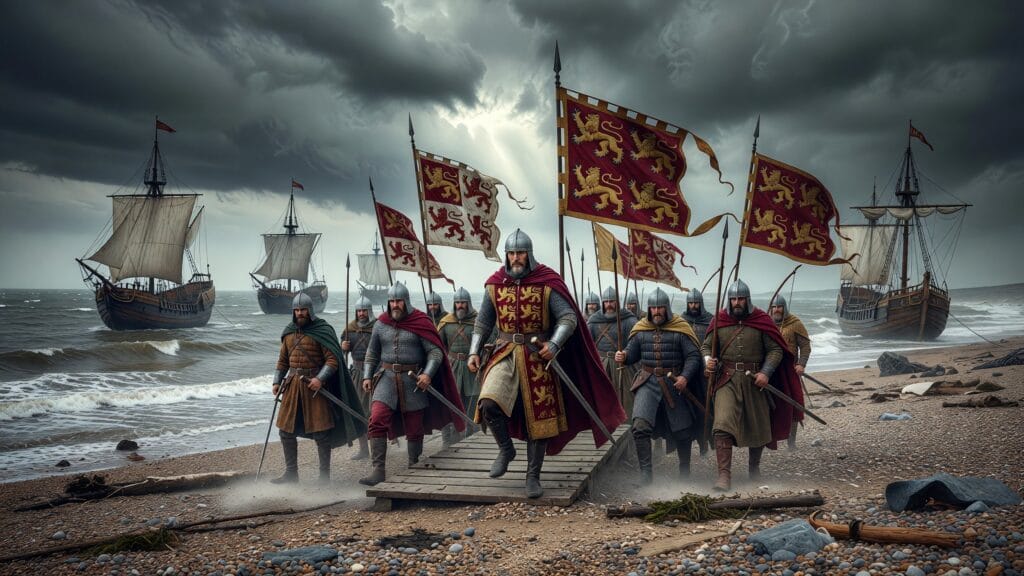
The landing date is usually given as 4 July, though not all witnesses agree, and the documentary record is fragmentary. What matters is the choreography: disembarkation, banners kept low, messengers sent ahead, and proclamations that Henry had returned for his rights. He framed his cause as lawful correction, not upheaval.
Men from the ships were sworn, and a nucleus of retainers secured the beachhead. Henry’s words stressed fidelity to the common weal and the relief of unjust burdens, signaling to gentry and townsfolk that support did not equal treason. The first oaths were pragmatic, and they produced the next recruits.
By afternoon, small detachments tested nearby roads while scouts assessed who might offer provisions, guides, or gates unbarred. The landing turned into momentum once carts rolled inland, and letters bearing seals raced faster than hooves, asserting that a wronged lord had come home rather than a rebel seeking a crown.
05 – Gathering the North: Beverley, Hull, and Percy Calculations
Hull’s civic leaders were cautious, wary of admitting a force that could invite royal punishment. Beverley’s canons and merchants watched just as closely, calculating between conscience and survival. In such places, a safe promise mattered more than a stirring speech, and Henry’s “inheritance only” line opened doors without breaking oaths.
Meanwhile, the Percies—Northumberland and “Hotspur”—measured Henry’s chances against their own grievances with Richard’s governance. They did not commit blindly; they waited for proof that men would rally and for signs the crown could not respond quickly. When they moved, entire swathes of the north tilted toward Henry overnight.
Mini timeline:
- Early 1399: John of Gaunt dies; Richard seizes Lancastrian estates.
- Late June 1399: Henry sails from the continent with allies, including Archbishop Arundel.
- 3–6 July 1399: Landing near Ravenspur on the Humber; first proclamations of lawful return.
- Mid–late July 1399: Northern support coalesces; march south gathers pace.
06 – March to Power: Seizing Pontefract and the Lancastrian Claim
Pontefract Castle, Lancastrian to its core, became an anchor for supplies and legitimacy once Henry reached it. Control of this fortress signaled not only a return to inherited ground but a base from which letters, safe-conducts, and musters could flow. Castles made proclamations visible in stone.
At Pontefract, the fiction of a limited return began to stretch. Men who joined Henry believed grievances ran deeper than property. They had seen offices sold, justice unevenly done, and royal favorites flourish. Recovering estates required redrawing the political map, and the castle’s shadow suggested that more than restitution was underway.
Yet Henry remained careful. He continued to brandish the language of lawful remedy, even as each pledge, sealed and dispatched, created a ruling structure waiting for its king. The victory solved one problem and created another: momentum that demanded a destination beyond mere inheritance.
07 – Richard in Ireland: News, Delays, and Strategic Missteps
Richard’s campaign in Ireland was no small operation, and it temporarily enhanced his aura. But Ireland was also distance, delay, and the risk of stale information. News that a banished cousin had stepped ashore in Yorkshire reached him days late and stripped the Irish success of political value at home.
His return route was complicated by logistics, divided counsel, and the need to assemble loyal shires while disbanding others. Some of his closest counselors underestimated northern discontent, and by the time royal ships neared Wales, Henry had entrenched alliances. The king was coming home to a different England than he had left.
Modern historians remain cautious because the surviving record is patchy on exact timings. Yet patterns emerge: Richard’s absence limited face-to-face patronage and enforcement. His authority relied on letters and proxies, while Henry’s case traveled by rumor, road, and ready magnates who preferred bargaining to obedience.
08 – Propaganda and Piety: Messages, Letters, and the Arundel Factor
Every movement needed a message. Thomas Arundel, the exiled archbishop, supplied the moral grammar for Henry’s advance. Sermons and letters hinted that kingship had conditions—justice, counsel, and stewardship—conditions Richard had allegedly broken. The language was religious yet constitutional, invoking not revolt but remedy.
In towns and abbeys, Henry’s scribes assured communities their rights would be defended, debts reconsidered, and arbitrary exactions checked. It was not pure rhetoric; it was a promise designed to be measurable once power changed hands. Behind it, Arundel’s authority gave spiritual ballast to what could otherwise appear a naked grab.
Chroniclers like Adam of Usk preserve fragments of these appeals, while Thomas Walsingham’s narrative at St Albans filters them through monastic suspicion. The biases are apparent, but the through line is clear: Henry’s camp used faith-inflected law to argue that loyalty to him squared with fidelity to order itself.
09 – Collision Course: Bristol, Executions, and Momentum
As the forces converged, Bristol became a hinge. Henry’s men captured prominent royal counselors—Sir John Bussy, Sir Henry Green, and the Earl of Wiltshire—figures tarred in northern opinion as architects of misrule. Their swift executions in late July stiffened Henry’s claim that he was restoring balance, not unmaking it.
Harsh measures sent a message that neither office nor favor shielded those deemed to have misled the king. Later chroniclers claimed crowds approved, though such unanimity is doubtful. Still, the political effect was immediate: fence-sitters judged that Henry would decide events more rapidly than the distant royal host.
This was the point where many historians see the mask slipping. Even if henry bolingbroke lands at ravenspur as a claimant to inheritance, Bristol’s gallows implied a sovereign’s jurisdiction. Punishment on that scale, by a force in the field, edged past restitution into regime change, drawn with rope and witnessed by townsfolk.
10 – Parliament and Principle: From Inheritance to the Crown
Lawyers and lords needed a framework to justify what reality had already delivered. By late summer, discussion turned to Parliament’s role in condemning Richard’s misgovernment and legitimizing a transfer. The “Record and Process of the Deposition of Richard II” would later assemble articles, confessions, and ceremony into a story of lawful change.
Some contemporaries insisted Henry’s claim rested on descent from Henry III and Edward III as well as right by conquest. Others preferred to emphasize Parliament’s voice, binding the new reign to counsel. These were choices with consequences, shaping the constitutional memory that later centuries would debate.
The shift was not instantaneous. Henry’s own language evolved from “restoring my heritage” to accepting acclamation and sanction for the crown. Semantics tracked strategy: reassure first, rule later. Yet behind the ceremony stood soldiers, sheriffs, and seals—an infrastructure of obedience transferring title from one king to another.
11 – The Deposition: Flint Castle to Westminster
Richard landed in Wales late in July, only to find support evaporating. By mid-August he was at Flint Castle, negotiating under duress. The meeting with Henry there became a symbol of reversal: a crowned king reduced to bargaining for terms that shrank by the hour as defections spread.
Richard was taken to London, his authority eroded to ceremony without command. On 30 September 1399, in a carefully staged session, he was deposed, with articles read out detailing failures of rule. A fortnight later, Henry was crowned at Westminster, the rite transforming a rebel’s momentum into a monarch’s legitimacy.
Yet behind the ceremony lay choices that would haunt the new regime. Richard’s fate after deposition—death in early 1400 at Pontefract, likely by starvation—spawned rumors and rebellions. A king had fallen, but the manner of his fall made martyrdom and memory tools for Henry’s enemies.
12 – Resistance and Aftermath: Uprisings, Wales, and the North
The crown Henry won did not immediately pacify the realm. The Epiphany Rising of 1400 tried to reverse events, and in Wales, Owain Glyndŵr’s revolt erupted by 1400–1401, demanding men and money. Scotland probed the border. The price of victory in 1399 was a chessboard alive with perilous moves.
Local societies paid. Taxes rose to fund garrisons, and justice itineraries became political tests, measuring whether the king’s peace truly reached shire and borough. Old loyalties fractured, especially where Richard’s affinity had been strong. The new regime learned that a swift ascent creates long shadows that governance must patiently dispel.
Still, Henry’s household and council forged routines that outlived the crises. Parliament would meet with regularity, and the idea that counsel could correct kingship—mooted in 1399’s proclamations—became a thread in the fabric of later constitutional thought, however imperfectly woven in the years immediately following.
13 – Memory and Myth: Chroniclers, Shakespeare, and the Landing
The landing’s memory traveled far beyond the Humber’s sands. Chroniclers preserved the outline, sometimes shifting dates or ports, sometimes polishing motives. Centuries later, Shakespeare’s “Richard II” made the political drama a stage event, compressing motives and magnifying character to reflect Tudor concerns about legitimacy and rebellion.
Sources disagree not so much on whether henry bolingbroke lands at ravenspur as on the implications of that act. Was it a limited protest that spiraled, or a carefully masked strategy? The answer often mirrors a writer’s view of rightful monarchy, of Parliament’s voice, and of divine sanction in politics.
Modern scholarship, wary of teleology, resists turning the landing into a foregone coronation. Geography, timing, and alliances mattered. The sea and the shore—lose enough ground to flooding, and the only record left is in parchment and memory. Ravenspur’s vanishing reminds us how evidence itself can erode.
14 – Why Ravenspur Matters: Geography, Ports, and Precedent
Ravenspur’s significance lies in logistics as much as legend. The Holderness coast afforded access to the north’s political spine while keeping London distant. Its relative isolation enabled a landing that was both bold and plausibly deniable: a place to say, “I come only for my own,” and then to prove it by mustering.
The Humber estuary formed a maritime gateway into England’s interior economies. Control of nodes like Beverley, York’s approaches, and Pontefract meant access to credit, carts, and grain. Politics followed the arteries of movement; Henry’s planners read the map with a soldier’s eye and a steward’s ledger.
The place also set a precedent in political imagination. When later writers pictured the scene—henry bolingbroke lands at ravenspur—they saw a liminal ground between exile and authority, sea and soil, claim and crown. Geography shaped narrative, and narrative hardened into a constitutional milestone taught to generations as a warning and a model.
Immediate consequence:
Rapid northern alignment behind Henry, seizure of key castles, executions at Bristol, and collapse of Richard’s support network as the king returned too late to reassert patronage and presence.
Long-term consequence:
Establishment of the Lancastrian dynasty, normalization of deposition by parliamentary process, and a lingering vulnerability in kingship that echoed through fifteenth-century conflicts, including the Wars of the Roses.
15 – Conclusion
On a shifting shore that would itself vanish, Henry’s return turned grievance into regime. The line often repeated—henry bolingbroke lands at ravenspur—marks the hinge where absence, geography, and calculation aligned to unmake a king. It was less a single moment than a corridor of decisions, each narrowing the options for both rivals.
From that beachhead flowed depositions read, seals transferred, and a monarchy refashioned to answer Parliament as much as lineage. The legacy was ambivalent: a new dynasty and a precedent for lawful rebellion. England afterward remembered the shoreline because it taught that power can come quietly, with a footstep on wet sand.
16 – FAQs
- When did the landing occur?
Most accounts place the landing on 4 July 1399, though some sources suggest a window between 3 and 6 July. The documentary record is incomplete, and chroniclers differ on precise dating. - Where exactly did Henry land?
Tradition holds he landed at Ravenspur/Ravenspurre near Spurn Head on the Holderness coast. Coastal erosion has erased the medieval site, fueling scholarly debate, but the Humber shoreline remains the most credible locus. - Who were the main figures involved?
Henry of Bolingbroke (later Henry IV) led the return. Key allies included Henry Percy, Earl of Northumberland, “Hotspur” Percy, and Archbishop Thomas Arundel. Opposed was King Richard II and his circle of counselors and royal officers. - Why did Henry return from exile?
Richard II had seized Henry’s Lancastrian inheritance after John of Gaunt’s death, prompting Henry to claim restitution. What began as a move to recover estates escalated, and as henry bolingbroke lands at ravenspur, his aims expanded amid growing support and royal absence. - What were the immediate consequences?
Northern support consolidated around Henry, key castles were secured, and at Bristol several of Richard’s counselors were executed. Richard, returning from Ireland, found his authority collapsing and was later deposed in September 1399. - What is the long-term legacy of the landing?
The landing set in motion the Lancastrian accession and normalized deposition through parliamentary process. It reshaped ideas of kingship, counsel, and legitimacy, with echoes reaching into the fifteenth century and the political culture that nurtured the Wars of the Roses.
17 – External Resource
18 – Internal Link
Other Resources
- Encyclopaedia Britannica – general search for the exact subject
- Google Scholar – academic search for the exact subject
- Internet Archive – digital library search for the exact subject
Sources and References
-
Thomas Walsingham, Historia Anglicana, ed. and trans. Henry T. Riley (Rolls Series), 2 vols., London: Longman, 1863–64.
Primary source. A contemporary monastic chronicle that narrates the political crisis of Richard II’s last years, including Henry Bolingbroke’s return to England in 1399, the northern landing, movements through Yorkshire, and the gathering of support that led to Richard’s deposition. -
Adam of Usk, Chronicon Adae de Usk, A.D. 1377–1421, ed. Edward Maunde Thompson, London: Royal Historical Society, 1876.
Primary source. First-hand account by a Welsh cleric and lawyer who describes the events of 1399, providing detail on Bolingbroke’s invasion, the response of the English political community, and the transition from Richard II to Henry IV, helping to corroborate the timing and character of Henry’s return. -
Chris Given-Wilson, Henry IV, New Haven & London: Yale University Press, 2016.
Modern scholarly source. A major modern biography of Henry IV that reconstructs his exile, the circumstances of his landing in Yorkshire in 1399, his stated aims on returning, and the broader political significance of the Ravenspur episode in the seizure of the throne. -
Anthony Tuck, Richard II, New Haven & London: Yale University Press, 1973.
Modern scholarly source. Provides analysis of the late reign of Richard II, including the confiscation of Bolingbroke’s inheritance, the political missteps that encouraged Henry’s return, and a detailed narrative of the 1399 crisis in which the landing in Yorkshire forms a key turning point. -
Nigel Saul, Richard II, New Haven & London: Yale University Press, 1997.
Modern scholarly source. Offers a comprehensive political and social overview of Richard II’s kingship, with close attention to the events of 1399, the northern power structures (Percy and Neville families), and the way Henry’s landing in Yorkshire rapidly shifted the balance of support against the king. -
“Henry IV (Henry Bolingbroke),” in Oxford Dictionary of National Biography (ODNB), Oxford University Press, online edition.
Modern reference source. Concise, peer‑reviewed biographical entry that confirms key factual details about Henry Bolingbroke’s birth, exile, return to England in 1399, the route of his landing in the north, and his subsequent assumption of the crown as Henry IV. -
Michael Bennett, “Ravenspur and the Landing of Henry of Bolingbroke, July 1399,” in Yorkshire Archaeological Journal, vol. 58, 1986, pp. 71–84.
Modern scholarly article. Focused study on the exact location and context of Henry’s landing in Yorkshire, analyzing documentary and topographical evidence for Ravenspur (or Ravenspurgh) and discussing its significance in the military and logistical planning of the 1399 invasion. -
“Ravenspur (Ravenser Odd),” The National Archives & Historic England resources on Lost Towns of the Yorkshire Coast.
Institutional reference. Provides historical and geographical background on the medieval port settlements on the Holderness coast, including Ravenspur/Ravenser Odd, supporting discussion of the local setting and the strategic suitability of this part of Yorkshire for Henry’s landing in 1399.

