Table of Contents
- Stage and Setting: Versailles in Late June 1919
- From Armistice to Agenda: Building the Peace
- Wilson’s Ideals and Clemenceau’s Resolve
- Germany Summoned, Germany Excluded
- The Terms on Paper: Borders, Blame, and Billions
- A Ceremony of Theatre and Strategy: 28 June 1919
- Reactions at Home: Berlin, Paris, London, Washington
- Empires Broken, New States Born
- Economy and Reparations: Counting the Cost
- The League of Nations: Promise and Limits
- Violence in the Wake: Uprisings and Paramilitaries
- Historians Debate: Was the Peace Too Harsh—or Too Soft?
- Memory, Myth, and the Road to 1939
- What Endured: International Law, Self-Determination, and Remembrance
- Conclusion
- FAQs
- External Resource
- Internal Link
Article Summary: On 28 June 1919, diplomats gathered in the Hall of Mirrors at Versailles to seal a peace that would reshape borders, topple assumptions, and govern the interwar world. This article follows the months between armistice and signature, the competing aims of the “Big Three,” and the terms imposed on Germany and its allies. It explores reactions, economic disputes, and the League of Nations. It also examines the treaty’s lingering controversies and its place in collective memory. The phrase “treaty of versailles signed” became shorthand for an uneasy peace whose legacy proved both constructive and combustible.
Why keep reading: Behind the gilded mirrors stood a shattered continent and negotiators haunted by the last four years. The treaty promised order but carried seeds of turmoil, and the path from pen strokes to street protests, from reparations to radicalization, reveals how a peace settlement can both end a war and begin a new struggle.
At a glance:
- Event: Signing of the Treaty of Versailles
- Date: 28 June 1919
- Place: Hall of Mirrors, Palace of Versailles, France
- Main figures: Georges Clemenceau, Woodrow Wilson, David Lloyd George, German signatories Hermann Müller and Johannes Bell
- Why it mattered: Ended the state of war with Germany, redrew borders, established the League of Nations, and set terms that influenced European politics through the 1930s and beyond.
01 – Stage and Setting: Versailles in Late June 1919
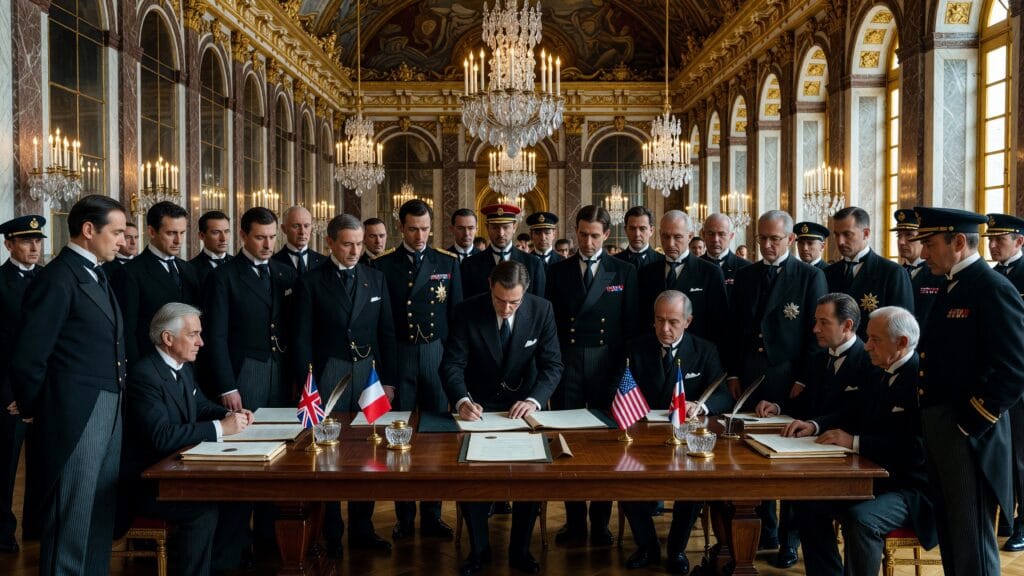
The Hall of Mirrors glittered with chandeliers and gilt, a setting chosen as much for symbolism as for ceremony. French officials remembered 1871, when a German Empire had been proclaimed in this same space after France’s defeat, and they intended to invert that memory with a new message of authority and redress.
Delegates arrived after months of wrangling, clutching documents heavy with clauses, annexes, and maps. Outside the palace, trains deposited reporters, soldiers on leave, and curious onlookers into towns still scarred by wartime rationing and grief. When the treaty of versailles signed, the scene would be theater and statecraft entwined.
Inside the palace corridors, translators, clerks, and military aides navigated a maze of languages and agendas. The signatures would be swift, but the deliberations behind them had been anything but. The setting magnified the moment, yet it could not soften what the terms would actually mean for those beyond the mirrors.
02 – From Armistice to Agenda: Building the Peace
The guns fell silent on 11 November 1918, but a true peace still had to be built. The armistice terms left Germany occupied along the Rhine and blockaded at sea, while the Allies convened in Paris to design a settlement that could prevent renewed German aggression and stabilize a map torn by empire’s collapse.
Multiple committees formed to tackle issues from reparations to minority rights, with an unwieldy apparatus meeting in grand hotels and crowded offices. The peace conference spent months defining formulas for damage, sovereignty, and responsibility. By spring 1919, impatience hardened into political necessity: the public demanded closure; soldiers demanded demobilization; treasuries demanded certainty.
03 – Wilson’s Ideals and Clemenceau’s Resolve
American President Woodrow Wilson carried the rhetoric of the Fourteen Points, promising self-determination and an international body to arbitrate disputes. French Premier Georges Clemenceau, whose nation had bled on the Western Front and seen towns destroyed, demanded guarantees, reparations, and a military curb to neutralize future German threats.
British Prime Minister David Lloyd George sought balance: limit Germany enough to protect Europe but not so much that its economy collapsed and destabilized trade. Public opinion at home tugged at each leader differently. For Wilson, idealism met congressional skepticism; for Clemenceau, security eclipsed sentiment; for Lloyd George, electoral promises circumscribed policy.
Compromise emerged as a set of imperfect bargains. The League of Nations found its place in the treaty; territorial adjustments nodded toward ethnic maps but never fully matched them. The settlement froze a wartime coalition into peacetime calculations, reflecting not just principle, but power, fear, and the arithmetic of votes and guns.
04 – Germany Summoned, Germany Excluded
Germany did not join the drafting. It was summoned to receive terms in May 1919, arriving at the Trianon Palace Hotel under military escort, a delegation of lawyers, economists, and officials armed with memoranda but largely without leverage. The asymmetry was deliberate: the victors wrote; the defeated answered.
The German reply, a vast counter-memorandum, rejected war guilt and denounced territorial transfers, reparations, and colonial mandates. Yet few Allied leaders felt inclined to renegotiate. The conference allowed minor adjustments and clarifications but insisted on a swift signature, a choice born of their own fractured unity and public impatience.
In Berlin, the question of whether to sign convulsed the new republic. Resignations followed, and protests flared. A refusal could invite military occupation and starvation under blockade; acceptance could brand the republic as traitorous from birth. In the end, pragmatism overcame fury, but scars from that decision ran deep.
05 – The Terms on Paper: Borders, Blame, and Billions
The treaty redrew Germany’s frontiers: Alsace-Lorraine went to France; Eupen-Malmedy to Belgium; Northern Schleswig awaited a plebiscite; the Polish Corridor opened access to the sea, and Danzig became a Free City under League oversight. Germany lost all overseas colonies, transferred as mandates to Allied powers under League supervision.
Article 231 assigned responsibility for the war’s losses to Germany and its allies, a clause that stung symbolically more than it clarified financial sums. Reparations were left to a commission that would, in 1921, set a final figure. Military provisions capped Germany’s army at 100,000 men and forbade heavy weapons, submarines, and an air force.
Mini timeline:
- 11 Nov 1918: Armistice ends fighting on the Western Front.
- 18 Jan 1919: Paris Peace Conference opens.
- 7 May 1919: Germany receives the draft treaty.
- 28 Jun 1919: Treaty of Versailles signed at the Hall of Mirrors.
The League of Nations Covenant opened the treaty, blending hopes for arbitration with mechanisms for sanctions. For some, this architecture compensated for harsh clauses; for others, it dressed power politics in judicial language. The text combined legal aspiration with punitive calculation, a double image visible from its first page to its last.
06 – A Ceremony of Theatre and Strategy: 28 June 1919
The chosen date held symbolism: exactly five years after the assassination of Archduke Franz Ferdinand in Sarajevo. In the Hall of Mirrors, the Allied delegations took their places first, followed by the German signatories Hermann Müller and Johannes Bell, who were escorted in and out with brisk formality and few words exchanged.
Pens scratched, seals impressed, and the new order gained the sanction of ink. Photographers captured stern profiles and crowded galleries, where observers strained to witness the moment. The Germans signed quickly, then departed, leaving Allied leaders to greet applause they heard as vindication of sacrifice and resolve.
Yet behind the choreography lay strategy. The venue advertised France’s recovery; the speed of the ceremony signaled closure; the limited German role emphasized the treaty’s punitive character. What the cameras could not show were the political wagers embedded in every article, already poised to be tested by restless publics and uncertain economies.
07 – Reactions at Home: Berlin, Paris, London, Washington
Berlin shook with anger, resignation, and fear. The new Weimar coalition, already fragile, faced a chorus branding the agreement a Diktat. Newspapers printed the terms in dense columns, and readers scanned for lost territories, payments owed, and the humiliations of disarmament. Many accepted signing as survival, not consent.
In Paris, the mood blended relief with debate over whether the settlement was severe enough. Clemenceau’s supporters praised iron safeguards; critics fretted that enforcement would waver once Allied armies demobilized. London’s responses traced fault lines between imperial realist caution and sympathy for a Germany whose markets British trade still needed.
Across the Atlantic, the United States applauded the promise of the League but wrestled with sovereignty and party politics. The Senate would ultimately refuse to ratify the treaty, a decision that weakened the League at birth and left America powerful yet structurally absent from the new institution it had championed.
08 – Empires Broken, New States Born
The Versailles settlement resonated beyond Germany. Though separate treaties addressed Austria, Hungary, Bulgaria, and the Ottoman Empire, the Paris framework encouraged the making of new states from imperial wreckage. Poland reemerged; Czechoslovakia and Yugoslavia formed; the Baltic states edged toward independence amid civil wars and interventions.
These borders, often drawn through mixed populations, created minority problems that international law struggled to resolve. Minority treaties sought to guarantee rights, but enforcement relied on diplomacy and League authority rather than robust coercive power. Local grievances, national myths, and economic stresses would exploit this weakness.
For the victors, mandates in Africa and the Middle East offered both resources and responsibilities. Officially, the League framed mandates as tutelage toward self-government. In practice, colonial competition persisted under new banners. The language shifted from conquest to guardianship, but inhabitants of mandated territories rarely controlled their futures in this rebranded order.
09 – Economy and Reparations: Counting the Cost
Reparations lay at the center of the treaty’s economic puzzle. The commission tasked with calculating Germany’s liability confronted vast uncertainties: war damage estimates varied, exchange rates fluctuated, industrial capacity was hard to measure, and political will in debtor and creditor states changed with each election and strike.
John Maynard Keynes, a British delegate turned critic, departed Paris in protest and published The Economic Consequences of the Peace. He warned that punitive sums would crush Germany and destabilize Europe. Many contemporaries read his argument as prophecy, though later scholars have noted that actual payments were lower than the most alarming figures suggested.
Germany’s postwar inflation, culminating in the hyperinflation of 1923, drew from complex causes: fiscal deficits, political shocks, Ruhr occupation, and domestic choices. Reparations remained a catalyst and a symbol, even when numbers on paper did not match popular fears. It is easy to forget how fragile this world still was, monetarily and politically.
10 – The League of Nations: Promise and Limits
Embedded at the treaty’s start, the League of Nations promised arbitration, collective security, and a new diplomacy. It created a council and assembly, developed procedures for disputes, and sponsored humanitarian work. In an era desperate for norms, it was a remarkable innovation, however imperfectly realized by states jealous of sovereignty.
The U.S. Senate’s refusal to ratify deprived the League of the era’s rising power, and key members sometimes exempted themselves from enforcement. When crises erupted, from Manchuria to Abyssinia, limited sanctions met determined aggression. The League worked best where power politics allowed it to, less well when they did not.
Even so, the League nurtured practices that would inform later international bodies: minority petitions, refugee support, and health campaigns. The institutional memory it built survived its political failures, offering templates for cooperation that the United Nations and specialized agencies later refined.
11 – Violence in the Wake: Uprisings and Paramilitaries
Peace on paper did not mean peace in streets and fields. In Germany and Eastern Europe, demobilized soldiers formed paramilitary units, while revolutionary agitation and counterrevolutionary force defined politics. The Kapp Putsch of 1920 demonstrated the Weimar state’s fragility; border regions saw plebiscites, strikes, and skirmishes that blurred civilian and military lines.
In Upper Silesia, competing national claims erupted into insurgency and intervention before a League-mediated partition. Along the Baltic frontier, wars and uprisings redrew local realities faster than diplomats could track them. The gap between conference maps and lived geography created a landscape of unsettled sovereignties and persistent tension.
France’s occupation of the Ruhr in 1923, meant to enforce payment obligations, provoked passive resistance and economic chaos. The victory solved one problem and created another, demonstrating how enforcement could destabilize the very order it sought to uphold. By mid-decade, stabilization plans tried to reconcile capacity to pay with political endurance.
12 – Historians Debate: Was the Peace Too Harsh—or Too Soft?
The debate began almost immediately and never ended. Critics argued that reparations and humiliation fueled extremism in Germany; others contended the treaty was not enforced robustly enough and that German power remained considerable. The comparison point—what alternative could have worked—remains elusive in a Europe exhausted, polarized, and grieving.
Contemporary German protests fixated on Article 231, equating it with moral condemnation and unlimited liability. Yet the clause’s legal function, as several scholars note, was chiefly to establish a basis for claims rather than a moral judgment pronounced in perpetuity. Symbols moved faster than legal commentary in the political bloodstream.
Modern historians remain cautious because the surviving record is fragmentary where economic damage met political pressure. Archival studies suggest that while reparations strained Germany, domestic choices, geopolitical shocks, and the Great Depression mattered at least as much. The treaty’s critics and defenders alike wrestle with counterfactuals that evidence can only partly illuminate.
13 – Memory, Myth, and the Road to 1939
Over the 1920s and 1930s, political movements in Germany cultivated the “stab-in-the-back” myth, claiming that soldiers had not been defeated in the field but betrayed by civilians, socialists, and Jews. The treaty’s signature became a convenient emblem of that narrative, despite battlefield realities and the collapse of German allies.
Propagandists framed reparations as national strangulation, even during years when payments were suspended or renegotiated. Internationally, skepticism about Versailles grew as new crises eclipsed old arguments. By the 1930s, revisionist powers treated the treaty as something to be overcome, testing each limitation with incremental breaches and audacious rhetoric.
Yet behind these politics of memory lay millions trying to rebuild homes and livelihoods. Monuments appeared in town squares from Flanders to Silesia, names carved in stone that dignified loss without dictating policy. Memory could inspire reconciliation or grievance, and in those choices, the future was quietly decided.
14 – What Endured: International Law, Self-Determination, and Remembrance
Despite its flaws, Versailles marked a turning point in how states thought about international responsibility. Reparations, minority protections, and a permanent forum for diplomacy pointed toward law, however unevenly applied. The architecture was fragile, but the idea that war’s end required rules, not merely armistices, proved hard to uproot.
Self-determination advanced in rhetoric and partially in practice, even as strategic interests tempered maps. Petitioning procedures offered minorities a voice, however small, in international forums. War crimes discussions, though limited, opened legal pathways that later generations would widen, culminating in post-1945 institutions and conventions.
Immediate consequence:
Hostilities formally ended with Germany; borders shifted; disarmament rules applied; and a framework for reparations and international arbitration took shape, offering a fragile scaffolding for recovery and new diplomacy.
Long-term consequence:
Political polarization in Germany intensified, the League struggled without U.S. participation, and debates over justice and stability shaped a generation—informing both the failures of the 1930s and the more durable international order after 1945.
The lessons drawn from Versailles are contested, but the drive to tie diplomacy to institutions endured. In that sense, the treaty was both an end and a beginning. It showed how much political weight could rest on a seal, a signature, or a hostage, and how easily designs on paper could fray under pressure.
15 – Conclusion
Versailles closed one chapter with a flourish of signatures, yet opened another full of unresolved tensions. In the Hall of Mirrors, victors sought justice, security, and a safer world; outside, societies battered by war faced shortages, debts, and disillusion. The treaty of versailles signed became an emblem of hope and grievance at once.
Its legacy runs in two currents: the fragile interwar order that stumbled into crisis, and the longer arc of institutional experiments that would inform post-1945 reconstruction. Reading the treaty as either triumph or tragedy misses the point. It was an improvised peace in a broken world, and its consequences still shape how we imagine the end of war.
16 – FAQs
- When was the Treaty of Versailles signed?
It was signed on 28 June 1919, exactly five years after the assassination of Archduke Franz Ferdinand in Sarajevo, a deliberate choice to frame an ending against the war’s originating shock. - Where was it signed?
The ceremony took place in the Hall of Mirrors at the Palace of Versailles, France, a venue chosen for its symbolism and for France’s desire to reverse the humiliation of 1871 in the same space. - Who were the key figures involved?
Among the most influential were Georges Clemenceau of France, Woodrow Wilson of the United States, and David Lloyd George of Britain. Germany’s signatories were Hermann Müller and Johannes Bell, who executed their role under heavy political pressure. - What caused the treaty’s harsh terms?
Allied leaders sought to prevent renewed German aggression, compensate for devastation, and satisfy domestic opinion. Their negotiations balanced Wilsonian ideals with Clemenceau’s security demands and Lloyd George’s political calculations, producing compromises that many later judged either excessive or insufficient. - What were the main consequences?
Germany lost territory, colonies, and military capacity; reparations were imposed; and the League of Nations was established. Political polarization deepened within Germany, while new states emerged from collapsed empires. Economic instability and later crises amplified the treaty’s most contentious effects. - What is the treaty’s legacy today?
It remains a case study in postwar settlement design—its mix of ideals, punishments, and institutions informs debates on peacebuilding. In popular shorthand, “treaty of versailles signed” evokes the promise and perils of ending wars with documents that societies must still choose to honor.
17 – External Resource
18 – Internal Link
Other Resources
- Encyclopaedia Britannica – general search for the exact subject
- Google Scholar – academic search for the exact subject
- Internet Archive – digital library search for the exact subject
Sources and References
-
Primary Source – Official Treaty Text
Treaty of Peace with Germany (Treaty of Versailles), June 28, 1919. In: League of Nations Treaty Series, vol. 2, pp. 43–299. Geneva: Secretariat of the League of Nations, 1920. Digitized by: United States Government Publishing Office / Avalon Project, Yale Law School, https://avalon.law.yale.edu/subject_menus/versailles_menu.asp.
Note: This is the full official text of the Treaty of Versailles and supports all specific details about territorial clauses, disarmament articles, reparations provisions, and the creation of the League of Nations. -
Primary Source – Allied Perspective
Clemenceau, Georges, Woodrow Wilson, and David Lloyd George. The Versailles Treaty: The Economic and Financial Clauses, with a Commentary and Introduction. London: His Majesty’s Stationery Office, 1919. Available via: The National Archives (UK) and Internet Archive.
Note: Provides contemporary explanations and justifications by key Allied leaders for the economic and financial aspects of the treaty, supporting discussion of reparations, Allied aims, and the reasoning behind specific economic measures. -
Academic Monograph – Comprehensive Overview
MacMillan, Margaret. Paris 1919: Six Months That Changed the World. New York: Random House, 2001.
Note: A leading modern scholarly account of the Paris Peace Conference, used for broader context on the negotiations in Versailles, the roles of Wilson, Clemenceau, and Lloyd George, and how the June 28, 1919 signing fit within the wider peace settlement. -
Academic Monograph – Origins and Consequences
Henig, Ruth. The Versailles Treaty: The Making of a Controversial Peace, 1919–1923. London: Routledge, 1995.
Note: Offers detailed analysis of the treaty’s formation, implementation, and early criticisms, supporting statements about contemporary German reactions, the “war guilt” clause (Article 231), and the treaty’s contested legacy between the wars. -
Scholarly Synthesis – War Guilt and Reparations
Boemeke, Manfred F., Gerald D. Feldman, and Elisabeth Gläser, eds. The Treaty of Versailles: A Reassessment after 75 Years. Publications of the German Historical Institute. Cambridge: Cambridge University Press, 1998.
Note: Collection of academic essays reassessing the treaty’s economic, political, and ideological consequences; supports nuanced interpretations of reparations, the “harsh vs. moderate” debate, and long-term effects on Weimar Germany and European stability. -
Encyclopedic Overview – Context and Key Provisions
“Treaty of Versailles.” Encyclopaedia Britannica, online edition, last updated 2024. https://www.britannica.com/event/Treaty-of-Versailles-1919.
Note: Provides a concise, peer-reviewed summary of the treaty’s main terms, the date and place of signing (Versailles, June 28, 1919), participating powers, and its significance in the aftermath of World War I. -
University Resource – Paris Peace Conference and Versailles
“The Paris Peace Conference and the Treaty of Versailles, 1919–1920.” Office of the Historian, U.S. Department of State. https://history.state.gov/milestones/1914-1920/paris-peace.
Note: An official U.S. government historical overview used for context on American diplomacy, Wilson’s Fourteen Points, debates over the League of Nations, and the U.S. Senate’s rejection of ratification. -
Archival / Museum Context – Versailles and the Ceremony
Musée de l’Armée (Hôtel des Invalides), Paris. “La signature du traité de Versailles (28 juin 1919)” and related digital exhibits on the First World War and peace settlements. https://www.musee-armee.fr.
Note: Provides visual and archival material on the signing ceremony at the Palace of Versailles, the Hall of Mirrors, and French commemorative perspectives, supporting details about the location, symbolism, and public perception of the event.