Table of Contents
- Rome on the Edge: Moesia and Thrace after 378
- From Adrianople to Accommodation
- Theodosius Reshapes an Army
- Gothic Leadership and a Fractured Enemy
- The Stubborn Years: Campaigns and Negotiations 380–382
- Inside the Peace: What the 382 Foedus Likely Said
- Faces at the Table: Envoys, Generals, and a City Watching
- Bread, Land, and Gold: The Economics of Settlement
- Faith and Identity along the Danube
- Life after War: Villages, Markets, and Marching Camps
- A New Roman Army? Federates and Command
- Stagecraft and Spin in Constantinople
- Provincial Voices: Fear, Resentment, and Accommodation
- The Long Shadow: From 382 to Alaric and Beyond
- Conclusion
- FAQs
- External Resource
- Internal Link
Article Summary: In 382, after years of grinding war along the lower Danube, Emperor Theodosius I concluded a peace with the Goths that reshaped the Eastern Roman Empire. This agreement, often called the foedus of 382, allowed Gothic groups to settle in Moesia and Thrace as military allies. Its terms are imperfectly preserved, but its consequences were profound. The treaty stabilized a devastated frontier, reconfigured the imperial army, and set a precedent reverberating into the fifth century. This article reconstructs the political negotiations, social transformations, and human stakes of theodosius i peace treaty, grounding the narrative in cautious reading of fragmentary sources.
Why keep reading: What looked like a compromise to stop the bleeding became a blueprint for a new kind of empire. The 382 settlement was not simply a handshake; it was a risky redesign of power at Rome’s edge, where former enemies settled inside imperial borders while promising to fight for the very state they had battered.
At a glance:
- Event: Peace treaty between Theodosius I and Gothic groups (Foedus of 382)
- Date: 382, likely autumn (exact date uncertain)
- Place: Negotiations centered in Constantinople; settlement zones in Moesia and Thrace along the lower Danube
- Main figures: Theodosius I; Roman generals Saturninus, Richomeres, Promotus; Gothic leaders from Terving and Greuthung groups
- Why it mattered: Stabilized the frontier and pioneered federate settlement within imperial territory, reshaping Roman military and politics.
01 – Rome on the Edge: Moesia and Thrace after 378
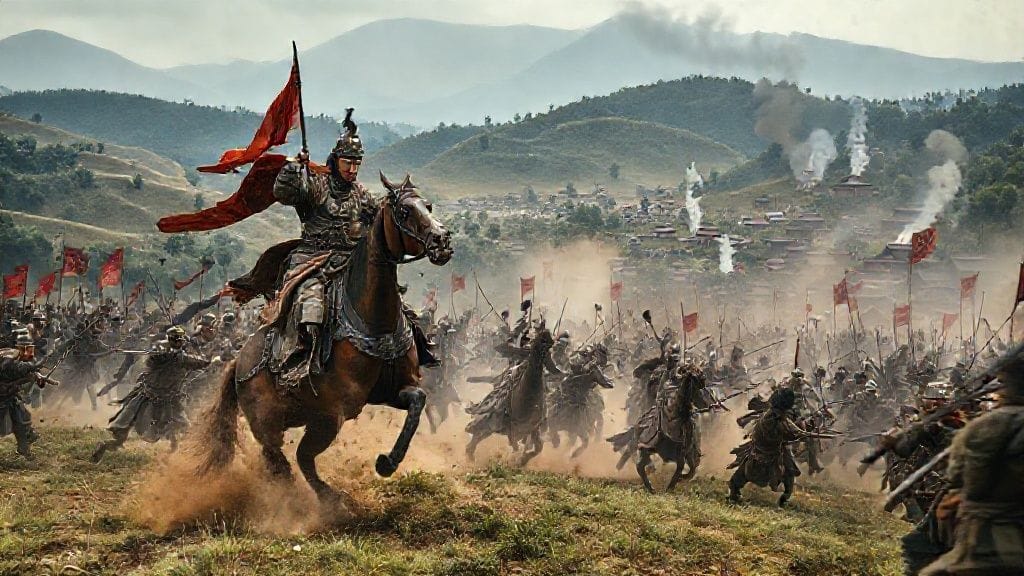
The landscape that framed the treaty was a scarred frontier. Moesia and Thrace, knitted by rivers, roads, and shattered towns, were still reeling from the catastrophe at Adrianople in 378. Farmsteads smoldered, fields lay untended, and fortified towns became islands in a sea of uncertainty as Gothic bands roved for supplies.
Geography determined strategy. The Danube acted as both line and lure, a watery boundary the empire had tried to hold for centuries. But the Hunnic shock to the steppe and the pressure on Gothic communities pushed them across, transforming the frontier from a defensive belt into a negotiation table.
Amid these realities, the imperial government faced a choice: attempt another costly reconquest or bargain with the people already inside. Neither option promised purity. Both required money, men, and political will at a moment when the East struggled to bury its dead and rebuild its regiments.
02 – From Adrianople to Accommodation
The news of Emperor Valens’ death at Adrianople spread terror and caution in equal measure. Survivors brought reports of Roman cohesion cracking under heat, dust, and Gothic cavalry. For months afterwards, the empire fought a war of movements, protecting cities while avoiding decisive defeat.
Rome did not collapse, but neither did it crush the Gothic coalitions. Defensive garrisons stiffened urban hearts, while Gothic groups learned the rhythms of Roman supply. Stalemate bred rethinking. Theodosius, raised to the purple in 379, probed for a settlement that might turn raiders into partners without surrendering sovereignty.
03 – Theodosius Reshapes an Army
Theodosius I inherited an exhausted military machine. Recruiting veterans’ sons and provincial peasants only filled part of the gap. He also turned to Gothic prisoners and defectors, offering enlistment and survival in place of revenge. This improvisation began before the treaty, foreshadowing the accommodation that followed.
Constantinople, still young as an imperial capital, became a workshop of recovery. New units were named, officers rewarded, and the emperor’s presence steadied nerves. Yet quick repairs could not erase structural strains. Ammunition, horses, and pay were finite; the Danube winter set the tempo; and every march carried risk of ambush.
04 – Gothic Leadership and a Fractured Enemy
The Goths were never a single army with a single voice. Groups that Roman writers called Tervingi and Greuthungi were networks of clans and cavalry bands under shifting leaders. Some were eager for Roman pay and stable land; others preferred plunder and autonomy. Fritigern’s star faded, and other warlords rose and fell with the season.
Roman observers often treated this fluidity as weakness. Yet it gave Gothic negotiators leverage: if one group refused terms, another might accept, and the overall pressure on the frontier continued. This made final victory distant but made a complex settlement thinkable, even necessary, by 382.
Within Gothic ranks, trauma and adaptation marched together. Years of flight from the Huns, then revolt, then siege, hardened attitudes. But it also showed the practical value of Roman roads, markets, and doctors. Quietly, the idea of living inside the empire—on tolerable terms—gained supporters among the weary.
05 – The Stubborn Years: Campaigns and Negotiations 380–382
Between 380 and 382, the frontier saw raids, counter-raids, and guarded parleys. Roman generals like Saturninus and Promotus alternated blows with offers, feeling for a point where gold, grain, and honor could outweigh vengeance. Theodosius advanced carefully, aware that a single disaster might unmake his fragile army.
Climate and harvest cycles shaped tactics. Winter favored bargaining; summer favored foraging raids. Plague rumors haunted camps, and deserters whispered about better rations across the lines. It is easy to forget how fragile this world still was, where supply wagons could mean the difference between alliance and mutiny.
Mini timeline:
- 376: Large Gothic groups cross the Danube seeking refuge; tensions escalate.
- 378: Battle of Adrianople; Emperor Valens killed; Roman defeat.
- 379–381: Theodosius becomes emperor in the East; mixed campaigning and recruitment.
- 382: Peace concluded with Gothic groups for settlement in Moesia and Thrace.
06 – Inside the Peace: What the 382 Foedus Likely Said
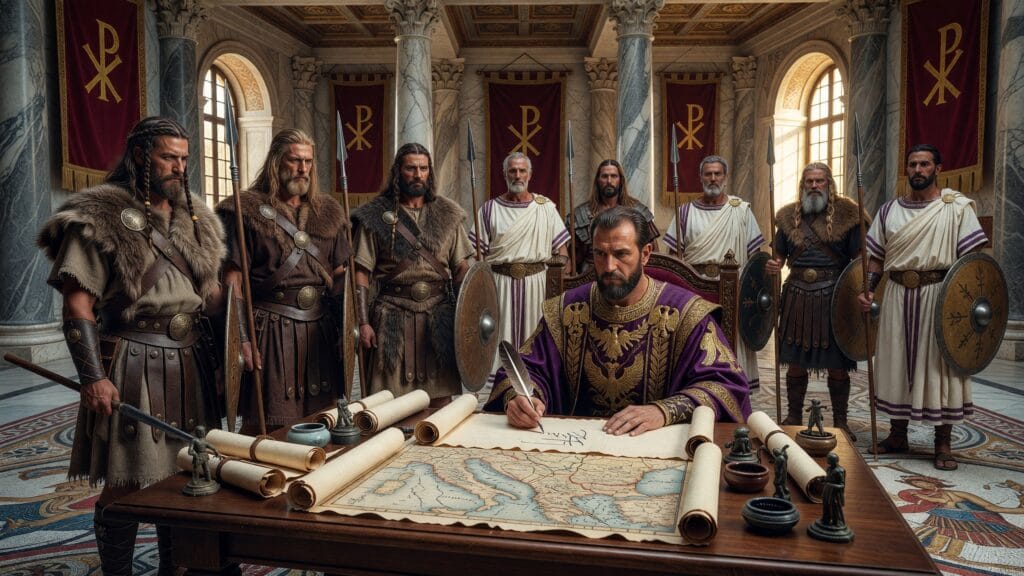
The text of the treaty does not survive, and modern historians debate finer points. Yet contemporary references and later compilers converge on a broad outline. Gothic groups were settled on imperial soil, probably along the lower Danube in Thrace and Moesia, and were expected to serve militarily when called.
In exchange, they received land or the use of land, often framed as collective holdings rather than taxable private plots. Rations and pay were promised, with obligations balanced by imperial oversight. Command arrangements were likely hybrid: Gothic leaders retained authority within their communities while coordinating with Roman generals.
This was not a surrender, nor a Roman capitulation. It was a reconfiguration. Theodosius sought to convert an uncontrollable problem into a managed partnership. The theodosius i peace treaty thus founded a model: federate settlement inside the empire with military service as the currency of belonging.
07 – Faces at the Table: Envoys, Generals, and a City Watching
Negotiations likely unfolded in stages near Constantinople, where the emperor’s household, senate, and clergy watched closely. The orator Themistius, in a speech from 383, praised the emperor’s clemency, suggesting that public messaging quickly reframed former enemies as wards and allies. Rhetoric was policy’s velvet glove.
On the Roman side, Saturninus and Promotus emerge in scattered references as key executors of frontier strategy. Their patrols pushed bands toward talks, while their scribes drafted careful terms. On the Gothic side, multiple envoys carried proposals, speaking for communities rather than a single sovereign.
The death of Athanaric in Constantinople in 381 provided symbolic theater. Brought into the city and honored with a public funeral, he stood for a possibility: barbarians who recognized the empire’s majesty. The empire signaled not only strength but also a path to dignity within its embrace.
08 – Bread, Land, and Gold: The Economics of Settlement
At the heart of the arrangement lay numbers: bushels of grain, head of cattle, bolt of cloth, coins for stipends. Granting land or usufruct to Goths relieved immediate fiscal pressure by turning raiders into producers. But it also meant foregoing some tax revenue and dedicating rations—the annona—to allies now living within imperial lines.
Regional markets adjusted. Towns like Marcianopolis and Hadrianople became exchange nodes where surplus grain, iron tools, and animal stock crossed new cultural frontiers. Smugglers and fixers thrived, and imperial officials kept ledgers that tried—often in vain—to tame the currents of frontier trade.
Economically, the settlement was an insurance policy. The empire spent to reduce military volatility, betting that stable Gothic households would need fewer bribes and punishments. The cost was measurable; the savings, indirect but real, in the form of fewer burned villas and longer planting seasons without fear.
09 – Faith and Identity along the Danube
Religion shadowed politics. Many Goths were Christians of the Arian persuasion, converted through earlier missions tied to Ulfilas. The Eastern court under Theodosius leaned Nicene, culminating in the Council of Constantinople in 381. Living together did not erase these divides; it taught workarounds for them.
Clerics and commanders alike saw that doctrinal unity was a luxury on a wounded frontier. Garrison chapels and Gothic assemblies maintained parallel devotions, with occasional conversions in both directions. Socrates and Sozomen, church historians of the fifth century, reflect this complicated coexistence without pretending it dissolved into harmony.
10 – Life after War: Villages, Markets, and Marching Camps
After 382, a traveler crossing Thrace would have seen mixed landscapes of recovery. Gothic farms reclaimed fallow fields; Roman villas repaired walls and presses; patrols moved along repaired roads while herders shifted flocks to safer pastures. It was not peace as Romans once imagined, but it was peace enough to plan the next harvest.
Seasonal fairs returned, cautious and policed. Translators mediated prices and insults. Children learned vocabulary across fences. The imagery is tempting to romanticize, but the frontier remained brittle. One bad winter, a predatory tax official, or a commander’s arrogance could snap the threads of patience.
Yet behind the ceremony of accord, people made daily peace again and again. These repeated acts of coexistence—trading, marrying, burying—gave the 382 settlement the social depth that paper promises alone could never compel. It is astonishing how much political weight could rest on a seal, a signature, or a hostage.
11 – A New Roman Army? Federates and Command
Militarily, the settlement accelerated a trend: armies of the later empire were increasingly coalitions under imperial pay. Federate contingents entered Roman campaigns with their own officers, their tactical strengths—cavalry shock, scouting acuity—complementing imperial infantry. Commanders learned when to direct and when to partner.
Ambiguity was inherent. Did federates swear loyalty to the emperor or to their chiefs who pledged service? Both, in practice. This dual allegiance sometimes generated friction on campaign and in pay disbursements. Yet during Theodosius’s reign, the arrangement generally held, suggesting that clear incentives outpaced provocations.
The theodosius i peace treaty therefore became a workshop for command culture. Roman doctrine absorbed federate skills; federate warriors absorbed Roman logistics. The blend gave the East a resilient, if sometimes unruly, military ecology capable of confronting Persia, guarding the Balkans, and policing ambitious governors.
12 – Stagecraft and Spin in Constantinople
Policy needed narrative. Theodosius’s court carefully wrapped the treaty in the language of clemency and Roman universalism. Themistius emphasized that mercy had tamed force and that barbarians, awed by civilization, accepted a place within it. This messaging reassured urban elites and framed compromise as triumph.
Yet behind the ceremony, practical politicians counted risks. Senators asked about tax inflows, grain prices, and the precedent for other groups on the Danube. Generals considered recruitment and promotion, wary of being outranked in influence by Gothic notables whose men held the cavalry edge in key battles.
Public statues and festival processions depicted order restored. Imperial mints struck coins that promised security under a vigilant emperor. In these images, the 382 peace was less a deal with variables than the renewal of a cosmic hierarchy: Rome at the center, allies orbiting under its light.
13 – Provincial Voices: Fear, Resentment, and Accommodation
Provincials closest to the frontier voiced the sharpest anxieties. Landholders who had fled to fortified towns feared sharing river plains with yesterday’s raiders. Town councils calculated whether renewed trade could compensate for lost rents. Soldiers muttered that federates grabbed pay without enduring drill-field discipline.
Still, some communities saw opportunity. Labor shortages eased as Gothic hands cleared fields and repaired mills. Frontier markets expanded, with artisans retooling for a clientele that wanted spurs, saddles, and serviceable textiles more than luxury tableware. Pragmatism, if not trust, could overcome memory when survival required it.
Modern historians remain cautious because the surviving record is fragmentary. Most complaints and accommodations never entered texts; what we possess are hints in legal codes, sermons, and panegyrics. But those hints sketch a society that decided to live with complexity rather than attempt another round of annihilation.
14 – The Long Shadow: From 382 to Alaric and Beyond
The 382 settlement set a pattern that later generations inherited and contested. In the early fifth century, Alaric—himself a product of federate service—leveraged similar expectations for land and status, culminating in the sack of Rome in 410. The precedent from Thrace and Moesia thus radiated westward with unintended force.
Yet it would be simplistic to draw a straight line from foedus to fall. The Eastern Empire learned faster. It refined federate management, fortified key passes, and balanced ethnic units within its command structure. While the West faltered under cumulative pressures, the East adapted, surviving and even flourishing in later decades.
Seen across centuries, the theodosius i peace treaty did not end conflict; it reframed it. The empire traded the dream of uniform authority for a layered sovereignty in which allied peoples guarded imperial borders while maintaining communal identities. This accommodation proved durable, if never fully comfortable.
Immediate consequence:
Raiding declined, harvests resumed, and the Eastern court reasserted control over key roads and towns. Gothic warriors entered imperial pay, and the Danube frontier stabilized enough to redirect resources to other theaters.
Long-term consequence:
A precedent for internal federate settlement shaped fifth-century politics, enabling both military resilience and episodes of leverage by allied leaders who demanded recognition, land, and command roles inside the imperial system.
15 – Conclusion
The 382 peace in Moesia and Thrace emerged from exhaustion and calculation. Theodosius I, working with pragmatic generals and wary senators, exchanged the illusion of total victory for a workable order. The theodosius i peace treaty became a hinge, turning enemies into allies and fields of ashes into fields of grain.
Its legacy reached far beyond the lower Danube. It taught the empire to rule through layered loyalties, incentives, and shared risk. It also planted seeds of future bargaining and pressure from within. In that balance—between stability and dependency—the later Roman world learned how to endure, adapt, and sometimes falter.
16 – FAQs
- When was the treaty signed?
In 382, likely during the autumn months. The exact day is not preserved in surviving sources, and modern scholars cautiously cite the year without specifying a date. - Where did the agreement take place?
Negotiations centered in and around Constantinople, with the settlement zones for Gothic groups established in Moesia and Thrace along the lower Danube frontier. - Who were the main figures involved?
Emperor Theodosius I oversaw policy; Roman generals such as Saturninus, Richomeres, and Promotus executed frontier strategy; Gothic envoys represented Terving and Greuthung communities rather than a single monarch. - What caused the treaty to be pursued?
The disaster at Adrianople in 378, years of stalemated campaigning, and the heavy costs of continued war compelled a negotiated solution that could stabilize the frontier while rebuilding the army. - What were the key consequences?
The treaty reduced raiding, enabled Gothic settlement inside the empire, and integrated federate units into imperial campaigns. Over time, this precedent empowered allied leaders to negotiate status and land within imperial structures. - What is the legacy of theodosius i peace treaty?
It pioneered federate settlement as a durable instrument of Roman policy, influencing fifth-century politics from the Balkans to Italy. The arrangement strengthened the Eastern Empire even as it introduced long-term challenges in command, loyalty, and taxation.
17 – External Resource
18 – Internal Link
Other Resources
- Encyclopaedia Britannica – general search for the exact subject
- Google Scholar – academic search for the exact subject
- Internet Archive – digital library search for the exact subject
Sources and References
-
Ambrose of Milan. Epistulae (Letters), esp. Epistle 24 and related correspondence with Theodosius I. In: Sancti Ambrosii Opera, ed. by M. Zelzer, Corpus Scriptorum Ecclesiasticorum Latinorum (CSEL). Vienna: Österreichische Akademie der Wissenschaften, various vols., 1968–.
Note: Contemporary primary source offering insight into Theodosius I’s policies toward “barbarian” groups, imperial ideology, and church‑state relations in the later 4th century, which provides context for his settlement with the Goths after 382. -
Themistius. Orationes (Orations), esp. Oration 16 and 19. In: Themistii Orationes, ed. H. Schenkl. Leipzig: Teubner, 1902; English trans. in P. Heather & D. Moncur (trans.), Politics, Philosophy, and Empire in the Fourth Century: Select Orations of Themistius. Liverpool: Liverpool University Press, 2001.
Note: Panegyrical but near‑contemporary source that reflects imperial presentation of Theodosius’s Gothic policy and the broader political rationale for the 382 settlement, helping to contextualize how the treaty was framed in official discourse. -
Heather, Peter. Goths and Romans 332–489. Oxford: Clarendon Press, 1991.
Note: Key modern monograph that reconstructs the sequence from the Gothic crossing of the Danube in 376 through the Gothic War and the 382 treaty; provides detailed analysis of the legal status of the Goths, their settlement in Moesia and Thrace, and the military‑political implications for the Eastern Empire. -
Lenski, Noel. “The Gothic War and Theodosius.” In: The Cambridge Companion to the Age of Constantine, 2nd ed., ed. Noel Lenski, pp. 439–461. Cambridge: Cambridge University Press, 2012.
Note: Scholarly chapter that situates the 382 peace within Theodosius I’s broader military and diplomatic strategy, discussing the terms of settlement (foederati status, land in the Balkans, obligations of Gothic troops) and the impact on imperial defense in Thrace and Moesia. -
Wolfram, Herwig. History of the Goths. Trans. T. J. Dunlap. Berkeley: University of California Press, 1988.
Note: Standard academic study of Gothic history; chapters on the 4th century analyze the migration across the Danube, the Battle of Adrianople, negotiations with Theodosius I, and the nature of the 382 agreement, clarifying Gothic leadership, internal factions, and settlement areas. -
Jones, A. H. M. The Later Roman Empire 284–602: A Social, Economic and Administrative Survey, Vol. 1. Oxford: Blackwell, 1964.
Note: Classic reference for the administrative and military structures of the late empire; provides essential background on provincial organization in Moesia and Thrace, the foederati system, and how the Gothic treaty fitted into existing Roman legal and military practice. -
“Theodosius I.” In: Encyclopaedia Britannica, online edition. Encyclopaedia Britannica, Inc.
Note: Concise, peer‑reviewed overview of Theodosius I’s reign, including his role in ending the Gothic War in 382, confirming chronology, major events, and the broad significance of the peace with the Goths for the Eastern Roman Empire. -
Dumbarton Oaks Research Library and Collection. “Theodosius I and the Goths.” In: Byzantine Collection – Online Resources. Dumbarton Oaks, Trustees for Harvard University.
Note: Museum and research‑center resource that synthesizes current scholarship on Theodosius I, Gothic foederati, and the Balkans; used to corroborate interpretations of the treaty’s longer‑term consequences for the Eastern Roman military and for the integration of Gothic groups into imperial structures.