Table of Contents
- Britain on the Eve of 685: Northumbria and the Pictish Frontier
- Kings and Churches: Ideology and the North after Whitby
- Bridei mac Bili: Assembling a Pictish Coalition
- Ecgfrith’s Calculus: Power, Counsel, and the Choice to Invade
- Toward the Mire: The 685 Campaign Begins
- The Field and the Lake: Terrain as Strategy
- Breaking the Shieldwall: The Battle Unfolds
- A Crown in the Bog: Ecgfrith’s Last Moments
- A Kingdom Recoils: Aldfrith and Northumbria After the Defeat
- Pictland Triumphant: Statecraft, Stones, and the North Sea World
- Where Was Nechtansmere? The Dunnichen Debate
- Traces and Toll: Archaeology, Memory, and the Human Cost
- Conclusion
- FAQs
- External Resource
- Internal Link
Article Summary: On 20 May 685, the Pictish king Bridei mac Bili shattered Northumbria’s northern supremacy at a swampy lake remembered as Nechtansmere. This article reconstructs the political and spiritual stakes leading into the battle of nechtansmere, traces the campaign north, and narrates the ambush that killed King Ecgfrith. Drawing on Bede and the Irish annals, it examines competing site theories, human costs, and the reshaped map of power. Northumbria recalibrated under Aldfrith; Pictland consolidated identity. The fight’s legacy reaches deep into how Scotland formed from contested frontiers and memory-rich landscapes.
Why keep reading: A young kingdom wagered everything on a march into unfamiliar terrain; an older one waited with patience and a lake at its back. Behind the clash lay a struggle over tribute, faith, and the right to define the North. Follow the road to a battlefield whose location is still argued, yet whose consequences were unmistakable.
At a glance:
- Event: The Battle of Nechtansmere (Dún Nechtain, Dunnichen or Dunachton debated)
- Date: 20 May 685 (per Bede; accepted by most historians)
- Place: Traditionally Dunnichen, Angus; alternative argument for Dunachton, Strathspey
- Main figures: Bridei mac Bili, king of the Picts; Ecgfrith, king of Northumbria
- Why it mattered: Ended Northumbrian dominance north of the Forth; enabled Pictish consolidation and altered the religious-political balance across northern Britain.
01 – Britain on the Eve of 685: Northumbria and the Pictish Frontier
Mid-seventh-century Britain was a mosaic of kingdoms bound by tribute, marriage, and missionary ties. Northumbria, forged from Bernicia and Deira, looked both south to rival Mercia and north to Pictland’s hillforts and glens. Its kings had extracted submission from neighboring polities, but the ground beyond the Forth remained slippery, contested, and difficult to hold.
To the north, Pictland was not a monolith but a constellation of power centers speaking related tongues and bound by kinship and opportunistic allegiance. Bridei mac Bili sat atop this web, drawing strength from alliances that reached west toward Alt Clut and beyond. The frontier itself was less a line than a constantly negotiated zone of influence.
Into this world came the battle later remembered as Nechtansmere. The focus keyword, battle of nechtansmere, signals not only a site but a fulcrum where political geography shifted. The marshy basin and encircling ridges that framed the fight symbolized how terrain could erase the advantages of a larger, celebrated kingdom in a single afternoon.
02 – Kings and Churches: Ideology and the North after Whitby
Religion carried political freight. Since the Synod of Whitby in 664, Northumbria championed Roman liturgical practice, while the great monastery of Iona and its satellites remained influential among the Picts and in Dál Riata. Conversion did not create peace; it offered competing visions of authority and community that rulers tried to harness.
Monasteries such as Lindisfarne, Monkwearmouth, and Jarrow radiated Northumbrian prestige and literacy. To the north, monastic communities linked to Iona shepherded spiritual life but also provided counsel to rulers wary of Northumbrian overlordship. Ideological alignment could determine whether a bishop’s letter soothed a border—or whether a hermit’s warning went unheeded.
It is easy to forget how fragile this world still was. Lines of allegiance were thin, and a king’s piety did not guarantee obedience from distant valleys. The moral theater of kingship intertwined with strategic necessity, making sermons and spearpoints instruments of the same bargaining table.
03 – Bridei mac Bili: Assembling a Pictish Coalition
Bridei mac Bili’s background linked him to the kingdom of Alt Clut, modern Dumbarton Rock, suggesting a web of kin-strategy rather than a single tribal base. As king of the Picts from the 670s, he sought leverage against Northumbrian intrusion. Consolidating Pictland meant fusing local elites into an enterprise greater than any one valley.
Contemporary sources suggest Bridei’s power gathered around central and eastern Pictland, where hillforts overlooked fertile straths. Marriage diplomacy, strategic hostages, and seasonal warfare knitted together a coalition. His goals were pragmatic: control lines of movement, secure tribute, and ensure that Pictish authority, not Northumbrian taxation, shaped life beyond the Forth.
Modern historians debate whether Bridei pursued a deliberate state-building project or simply navigated crises skillfully. Either way, he sensed a chance. Northumbria looked stretched; Mercia watched for advantage. If a decisive victory could humble Ecgfrith, Pictland might emerge not as a dependency but as a partner in a new balance of power.
04 – Ecgfrith’s Calculus: Power, Counsel, and the Choice to Invade
Ecgfrith inherited an ambitious Northumbria in 670, proud of victories yet wounded by setbacks. He ruled through earls and bishops, binding church and nobility to royal aims. Yet royal correspondence hints at advice urging caution, including spiritual counsel to avoid rash warfare in hostile ground beyond secure lines of supply.
Later chroniclers claimed that holy men warned Ecgfrith against the northern campaign. Bede, writing within a generation, has Cuthbert of Lindisfarne and others counseling restraint. Whether sermon or memory, the story captures something real: the invasion was risky, and people close to power knew it. Still, kingship demanded demonstration.
The victory solved one problem and created another, Ecgfrith may have reckoned: punish Pictish defiance, then reassert Northumbrian law. But raiding into Pictland was different from governing it. Hills hid movement, loyalties shifted with the seasons, and an enemy who chose the ground could turn a triumph into a disaster.
05 – Toward the Mire: The 685 Campaign Begins
In spring 685, Northumbrian forces gathered and advanced along corridors they had used before, probably pushing past the Forth into eastern Pictland. Scouts and guides would have been essential, drawn from communities whose allegiance was uncertain. The army moved faster than a harvest could follow, pressing toward a decision.
Pictish resistance avoided decisive confrontation at first. Harassment, withdrawals, and the promise of a main force beckoned Ecgfrith deeper. It is plausible that local elites provided Bridei intelligence about routes and bottlenecks. A carefully chosen field, near waterlogging and enclosed by slopes, would strip invaders of cavalry value and tactical flexibility.
Mini timeline:
- 664: Synod of Whitby shapes Northumbrian church alignment.
- 679: Northumbria checked by Mercia at the River Trent.
- 684: Northumbrian raid on Ireland signals reach but also overextension.
- 685: 20 May, the battle of Nechtansmere; Ecgfrith killed, Picts victorious.
Contemporary observers would have recognized the moment’s gravity. A great king marching north promised plunder to followers and penalties to holdouts. On the other side, families nailed their hopes to one maneuver: entice, contain, and break the enemy where his confidence turned into exposure.
06 – The Field and the Lake: Terrain as Strategy
The name Nechtansmere evokes a lake—“mere”—likely fringed with bog. Tradition places the field near Dunnichen in Angus, beside low hills and a now-drained moss. Alternative scholarship favors Dunachton in Badenoch, hard by Loch Insh and tight defiles. Either way, water and constriction form the stage for an ambush.
Bede’s outline is spare but suggestive: the Northumbrians pursued and were drawn into confined ground where Pictish forces struck decisively. Cavalry could not redeploy easily; infantry shieldwalls struggled to adapt once flanks were threatened. A hill rising near a wet basin would turn retreat into drowning chaos rather than orderly withdrawal.
It is astonishing how much political weight could rest on a path between two slopes or a fordable edge of a moss. If Bridei arrayed hidden reserves and used the folds of land to mask movement, then the moment of reveal—when the pursuers became encircled—would have felt like the world snapping shut.
07 – Breaking the Shieldwall: The Battle Unfolds
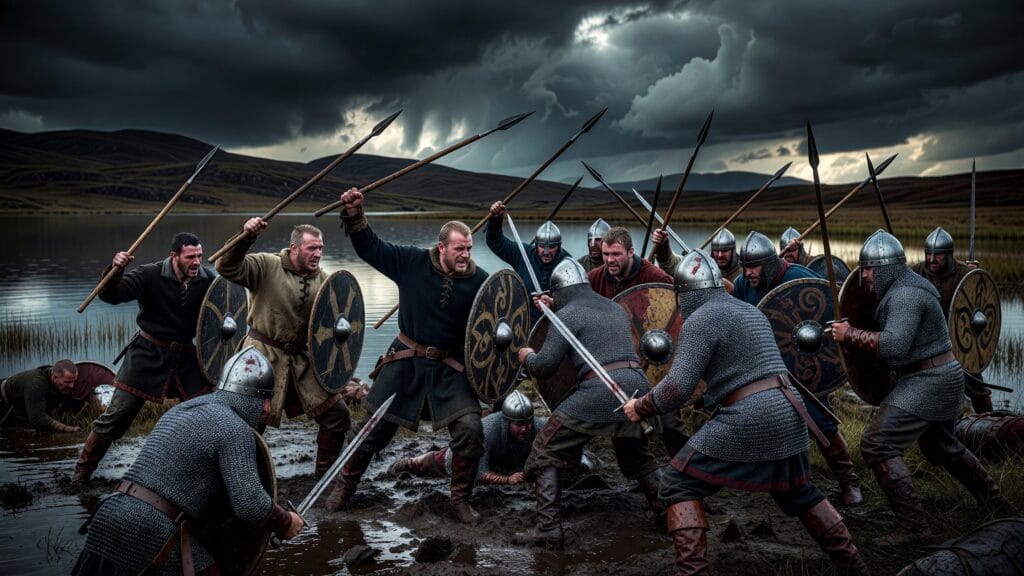
Accounts describe Ecgfrith pressing hard against a Pictish body that withdrew deliberately. The Northumbrians chased, confident their momentum would crack resistance. Then the ground betrayed them. A pivot on the heights, a surge from concealed positions, and the pursuers found their lines bent and then pierced.
Later tradition remembers slaughter near the water’s edge, where men dragged through mud could not raise shields in time. Signal horns and shouted orders would have been swallowed by distance and wet turf. Once the royal standard faltered, cohesion bled away. Kingship could inspire courage, but it could not drain a marsh.
Scholars reconstruct tactics cautiously, aligning Bede’s notes with landscapes that could channel an army into a cul-de-sac. Whether at Dunnichen or Dunachton, the underlying logic holds: a defending force shaped the field to fit its strengths, then timed its counterstrike to shatter the king’s spearhead before help could reach it.
08 – A Crown in the Bog: Ecgfrith’s Last Moments
However Ecgfrith fell—surrounded on foot, cut down in flight, or trapped at water’s edge—the symbolism was unmistakable. Northumbria’s aura of northern invincibility died with him. Bede frames it within a moral calculus, the wages of ignoring counsel, yet even without sermonizing the fact remained: a king lay dead in hostile land.
Tradition remembers that few Northumbrian nobles escaped. Royal companions fought to the end, buying their lord minutes with blood. Recovery of bodies would have been grim and incomplete in mire and thicket. The shock back home would echo in monasteries and halls, where news arrived as rumor before hard confirmation.
The battle of nechtansmere thus became a narrative hinge. It turned personal tragedy into public reordering. In such moments, generations later readers tend to seek heroic last stands or treacheries. The sources spare us theatrics. They record a calculated defense, a rash advance, and the simple arithmetic of ground and steel.
09 – A Kingdom Recoils: Aldfrith and Northumbria After the Defeat
Power abhors a vacuum. Ecgfrith’s half-brother Aldfrith, long associated with Iona’s scholarly world, returned to claim the throne. His reign emphasized consolidation and learning, suggesting a deliberate turn inward. The frontiers hardened. Northumbria ceased to project dominance beyond the Forth, even as it maintained strength within its core shires.
Royal rolls suggest a more administrative picture than later chronicles: land grants, church endowments, and legal settlements reknit authority. Monastic centers flourished, producing a cultural efflorescence that would later include the Lindisfarne Gospels. Prestige shifted from conquest to craftsmanship, from tribute-gathering rides to scriptorium light across vellum.
Yet behind the ceremony, shortages likely bit. Lost tribute from the north reduced royal largesse. Some aristocratic families saw their prospects dim, while others pivoted to court service or ecclesiastical patronage. Military reputation needed repair, but time and patience would be the tools, not rash forays into unforgiving ground.
10 – Pictland Triumphant: Statecraft, Stones, and the North Sea World
For Bridei, victory offered more than vindication. It gave leverage to demand allegiance from fence-sitting elites and to redefine external relationships. The Pictish heartlands could now integrate coastal corridors and interior straths more reliably, fencing off Northumbrian interference and renegotiating ties with Dál Riata and Alt Clut.
Archaeology and art hint at consolidation. Symbol stones proliferated, their enigmatic motifs and crosses signaling identities that were both local and increasingly aligned with Christian kingship. Forts controlling passes and river mouths mattered anew. With Britain’s northern axis reset, the North Sea’s trading routes became opportunities rather than threats.
Religious influence shifted as well. Iona’s authority resonated in Pictland, even as Roman practice continued to spread. Instead of producing a confessional border, Nechtansmere created space for negotiated coexistence between liturgical traditions. Kings balanced piety with politics, seeking holy prestige while guarding hard-won autonomy.
Immediate consequence:
Northumbrian power north of the Forth collapsed; Pictish elites rallied to Bridei; border communities recalibrated allegiance, and tribute flows reversed or ceased.
Long-term consequence:
The northern map stabilized around stronger Pictish kingship; Northumbria emphasized culture and governance over expansion; pathways opened toward the eventual emergence of a Scottish kingdom.
11 – Where Was Nechtansmere? The Dunnichen Debate
Place anchors memory. For more than a century, Dunnichen in Angus has been the traditional site, featuring a hill overlooking what was once Dunnichen Moss, drained in modern times. The landscape aligns with Bede’s cues: a lake-edge killing ground bounded by slopes where ambush might unfold with terrible efficiency.
Yet another school of thought champions Dunachton by Loch Insh, arguing that the toponym “Dún Nechtain” better matches that locale and that the strategic logic of luring Ecgfrith deeper inland still fits. Advocates point to routes through Badenoch and a topography that could similarly entrap a fast-moving Northumbrian vanguard.
Modern historians debate because the documentary record is sparse and medieval place-names are malleable. The Annals provide no coordinates; Bede gives few geographic specifics. Field finds, altered wetlands, and centuries of agricultural change complicate reconstruction. The surviving evidence points toward a lake and a trap—precise bearings remain contested.
12 – Traces and Toll: Archaeology, Memory, and the Human Cost
Archaeological proof of the battle is elusive. Wetlands were later drained; metalwork redistributions blur patterns. Stray weapon finds and Pictish stones nearby offer context rather than certainty. Historians therefore read landscapes as texts, testing whether paths, ridgelines, and former mires match the skeleton of Bede’s narrative.
Human consequences were more tangible in their time. Households dependent on Northumbrian stipends lost income; widows and orphans recalculated dependencies; captives changed hands along new political currents. On the Pictish side, families secured land and status that came with supporting a victorious king, binding them to future campaigns and levies.
Economically, borders shape markets. Control of fords, ports, and fairs can redirect silver and salt. After 685, Pictish polities likely captured a greater share of regional exchange, while Northumbrian merchants adapted by strengthening southern routes. Even in victory or defeat, the peasants’ harvests still decided how far armies might march next spring.
13 – Conclusion
The battle of nechtansmere was a hinge on which northern Britain swung. In a few fevered hours beside a lake, Bridei’s careful coalition turned terrain into strategy and broke a great king’s advance. Northumbria recalibrated, Pictland consolidated, and the frontier transformed from tributary corridor into a boundary where peers negotiated rather than overlords commanded.
Its deeper meaning lies in how landscape, belief, and politics converged. Bede’s brief account and the Irish annals’ terse notices leave room for debate, but not about consequence. From this defeat and victory flowed a century of altered alignments that helped make the conditions in which a Scottish kingdom could later take shape.
14 – FAQs
- When did the battle take place?
Most authorities, following Bede and the Irish annals, accept 20 May 685 as the date of the battle. - Where was Nechtansmere?
Tradition places it at Dunnichen in Angus near a former moss; an alternative hypothesis favors Dunachton by Loch Insh. The documentary record is fragmentary, so the exact site remains debated. - Who were the main figures?
The Pictish king Bridei mac Bili led the defenders; King Ecgfrith of Northumbria led the invaders and was killed during the battle. - What caused the conflict?
Northumbria sought to punish defiance and reassert dominance north of the Forth, while Bridei aimed to preserve Pictish autonomy and reshape regional allegiance. Ideological tensions after Whitby added pressure but were not the sole cause. - What were the consequences?
Northumbrian control beyond the Forth collapsed; Pictland consolidated power; Aldfrith’s Northumbria turned toward consolidation and culture. The event reset northern British politics for generations. - What is the legacy of the battle of nechtansmere?
It curtailed Northumbrian expansion, strengthened Pictish kingship, and helped create conditions for the later emergence of a unified Scottish realm, while also shaping the religious and cultural balance across the North.
15 – External Resource
16 – Internal Link
Other Resources
- Encyclopaedia Britannica – general search for the exact subject
- Google Scholar – academic search for the exact subject
- Internet Archive – digital library search for the exact subject
Sources and References
-
Bede, Ecclesiastical History of the English People, Book IV, esp. chs. 21–26. Various critical editions; English translation by Bertram Colgrave and R. A. B. Mynors (Oxford: Clarendon Press, 1969).
Note: Primary narrative source for the Battle of Nechtansmere and its context, including King Ecgfrith’s rule, the conflict with the Picts under Bridei mac Bili, and the political and religious situation in late 7th-century Northumbria and Pictland. -
Annals of Ulster, entry for the year 685 (“Bellum Duin Nechtain” / “The battle of Dún Nechtain”). In: Annala Uladh: Annals of Ulster, ed. and trans. Seán Mac Airt and Gearóid Mac Niocaill (Dublin: Dublin Institute for Advanced Studies, 1983). Also available via the CELT project, University College Cork.
Note: Primary annalistic record of the battle, giving the date (A.D. 685) and identifying it as the battle of Dún Nechtain; supports the chronology, the naming of the engagement, and its recognition in contemporary Irish sources. -
Annals of Tigernach, entries for the late 7th century. In: Annals of Tigernach, ed. W. Stokes, Revue Celtique 17–18 (1896–1897). Modern digital edition via CELT, University College Cork.
Note: Corroborates the occurrence and significance of the battle within the broader Irish and British context; useful for cross-checking the date and the identification of the contestants. -
Woolf, Alex. From Pictland to Alba, 789–1070. The New Edinburgh History of Scotland, vol. 2. Edinburgh: Edinburgh University Press, 2007.
Note: Although focused on a slightly later period, Woolf provides a detailed discussion of Pictish kingship, the legacy of Bridei mac Bili, and the longer-term consequences of Nechtansmere for Pictish power and the political landscape of northern Britain. -
Fraser, James E. The New Edinburgh History of Scotland, Volume 1: From Caledonia to Pictland: Scotland to 795. Edinburgh: Edinburgh University Press, 2009.
Note: Offers a modern synthesis on early medieval Scotland and the Picts, including a substantial analysis of the Battle of Nechtansmere, its location, and its impact on the balance of power between Northumbria and the Pictish kingdom. -
Higham, N. J. The Kingdom of Northumbria AD 350–1100. Stroud: Sutton Publishing, 1993.
Note: Provides context on Northumbrian expansion, the reign of Ecgfrith, military campaigns in the north, and the strategic significance of the defeat at Nechtansmere for Northumbrian hegemony in Britain. -
Royal Commission on the Ancient and Historical Monuments of Scotland (RCAHMS) / Canmore. “Dunnichen, Battle Site; Dunnichen Hill.” https://canmore.org.uk/site/34251/dunnichen
Note: Archaeological and topographical information on Dunnichen in Angus, traditionally identified as the site of Nechtansmere; supports discussion of the battlefield’s proposed location, landscape features, and alternative hypotheses. -
University of Glasgow, School of Humanities, Queen’s College Cambridge / Pictish Arts Project (via the earlier SCRAN and museum collections).
Representative entry: Hunterian Museum and Art Gallery, University of Glasgow, Pictish stone material from Angus and eastern Scotland.
Note: While not a narrative source for the battle itself, these academic and museum resources underpin statements about Pictish material culture, symbols, and the broader cultural context of the Pictish kingdom at the time of Nechtansmere.

