Table of Contents
- Setting the Stage in the Italian Wars
- The Road to Ravenna: Winter Maneuvers of 1511–1512
- Armies Gather on the Ronco
- Commanders and Characters
- Plans, Earthworks, and Artillery Innovations
- Easter Sunday: Opening Bombardment
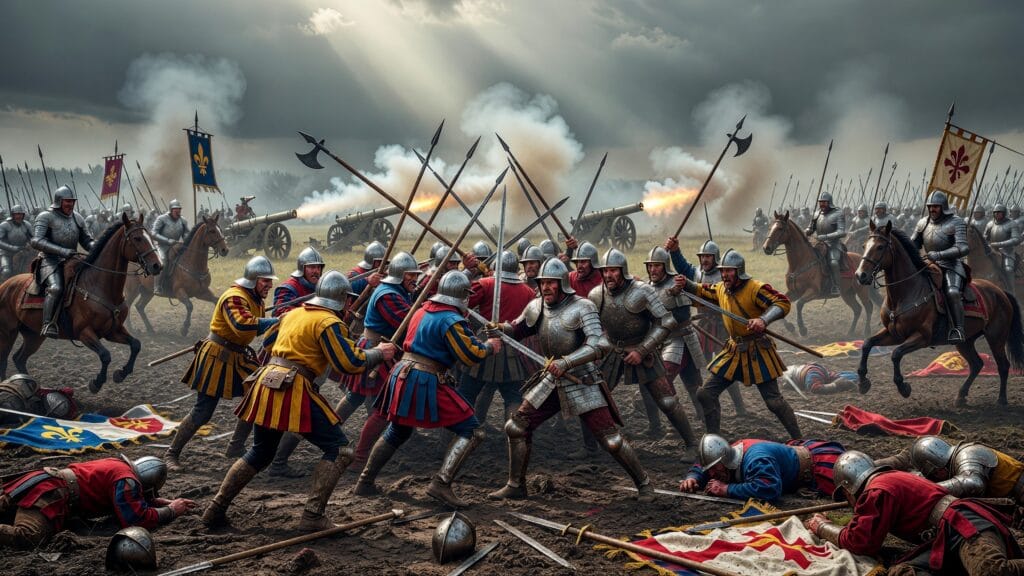
- Cavalry Clashes and Infantry Grind
- The Ferrara Guns Change the Field
- Breach of the Lines and the Flight
- Death of Gaston de Foix
- Sack of Ravenna and the Civilian Toll
- Political Shockwaves across Italy
- Military Lessons and the Shape of Modern War
- Remembering Ravenna: Sources and Debates
- Conclusion
- FAQs
- External Resource
- Internal Link
Article Summary: On 11 April 1512, outside Ravenna along the Ronco River, a French army won a brutal victory over a Spanish–Papal force in one of the Italian Wars’ most devastating clashes. The battle of ravenna 1512 spotlighted evolving gunpowder warfare, earthworks, and the deadly interplay between pike, sword, and cannon. France’s triumph proved pyrrhic: its brilliant commander, Gaston de Foix, fell in pursuit, blunting strategic gains. Ravenna’s sack underscored the civilian costs of Renaissance conflicts. This article traces the campaign, the commanders, the tactics, and the political aftershocks. It asks how a battlefield victory unraveled into a longer French retreat.
Why keep reading: Victory and calamity unfolded in the same afternoon. Discover how innovative artillery and entrenched infantry reshaped early modern combat, why a single death changed Europe’s balance, and how an Easter battle scarred a city while redirecting an entire war’s momentum.
At a glance:
- Event: Battle of Ravenna
- Date: 11 April 1512 (Easter Sunday)
- Place: Near Ravenna, Papal States, along the Ronco River
- Main figures: Gaston de Foix; Alfonso I d’Este; Ramón de Cardona; Fabrizio Colonna; Pedro Navarro
- Why it mattered: A tactical French victory that accelerated gunpowder-era tactics but cost France its best commander and strategic initiative in Italy.
01 – Setting the Stage in the Italian Wars
The Italian Wars began as princely ambitions collided with city-state wealth and papal power. By 1512, the League of Cambrai had dissolved into new alignments, and Pope Julius II forged the Holy League against France. Lombardy and Romagna became contested corridors, where reputation, money, and mercenary loyalties often shifted faster than campaign plans.
France, entrenched in Milan, still wielded considerable strength but faced a coalition drawing on Spanish infantry skill, papal legitimacy, and imperial pressure. In this swirl, the battle of ravenna 1512 would test whether sheer battlefield brilliance could outweigh diplomatic encirclement. The answer would come amid smoke and trench lines outside a city famed for late Roman mosaics.
It is easy to forget how fragile this world still was. Professional armies were becoming permanent, but supply and command remained precarious. A lost bridge, a missed wagon train, or an impulsive charge could pivot destinies. France’s young star, Gaston de Foix, would gamble everything on speed and surprise.
02 – The Road to Ravenna: Winter Maneuvers of 1511–1512
In late 1511, Julius II’s Holy League turned Italian politics into a chessboard of sieges and raids. French forces sought to secure Romagna, pressing Venice while watching for Spanish advances from Naples. Winter did not halt movement; it sharpened calculation. Roads, rivers, and fortified towns weighed as heavily as any royal proclamation.
By early 1512, the Viceroy of Naples, Ramón de Cardona, pushed north with Spanish and papal troops. He aimed to pry the French from the Adriatic corridor, where Ravenna guarded routes inland. Facing him, Gaston de Foix assembled a mixed host of French gendarmes, Gascon shot, and German Landsknechts, anchored by the formidable guns of Ferrara.
Mini timeline:
- 1511 (Autumn): Julius II proclaims the Holy League against France.
- 1512 (January–February): Skirmishes and sieges across Romagna; French consolidate around Imola and Faenza.
- 1512 (March): Cardona advances toward Ravenna; French shadow the movement.
- 1512 (11 April): Easter Sunday clash on the Ronco River—Ravenna’s fields become a killing ground.
03 – Armies Gather on the Ronco
The battlefield coalesced south of Ravenna, along the Ronco River’s bends and embankments. Cardona’s army entrenched behind ditches and wagons, a fortified camp shaped by the ingenuity of Pedro Navarro, famed engineer of mines and fieldworks. Earth and timber, not stone, would be the day’s first defense against iron and lead.
Across the watercourses, France arrayed heavy cavalry—armored gendarmes—beside blocks of German Landsknechts wielding long pikes, with Gascon arquebusiers threading the intervals. The true revolution sat low on wooden carriages: rows of culverins and falconets, their mouths black with soot, cool morning air shimmering above the barrels.
Both sides recognized the paradox of protection. Navarro’s trenches shielded his infantry from cavalry, but also fixed them in place under bombardment. The French, strong in mobile shock, must coax or smash the defenders out. As priests in both camps marked Easter rites, the commanders prepared to violate the day’s message with powder and steel.
04 – Commanders and Characters
Gaston de Foix, Duke of Nemours, had risen swiftly, credited with breathtaking marches and sudden strikes. Young, daring, and impatient, he embodied the offensive spirit dear to French chivalry but increasingly constrained by gunpowder warfare’s realities. His lieutenants included Jacques de La Palice and the celebrated chevalier Bayard, veterans tempered by misfortune and audacity.
Opposite stood Ramón de Cardona, Viceroy of Naples, abler at managing a coalition than at battlefield theatrics. He relied on Fabrizio Colonna to marshal noble cavalry, and on Pedro Navarro to turn spades and wagons into a fortress. Spanish infantry—pike, arquebus, and the nimble sword-and-buckler men—formed the army’s stubborn heart.
Beyond these headliners, other figures loomed. Alfonso I d’Este, Duke of Ferrara, had mastered artillery’s art and logistics; his pieces were prized for range and reliability. The German Landsknechts—hard-bitten professionals under their own captains—brought disciplined pike squares whose rivalry with Spanish infantry would soon ignite a grinding contest at close quarters.
05 – Plans, Earthworks, and Artillery Innovations
Cardona’s plan was defensive, preferring to absorb French energy against prepared ditches rather than risk the open field. Navarro’s fieldworks featured angled fronts to deflect cavalry, with gun placements behind ramparts and a wagon barricade stitching the camp’s vulnerabilities. The Ronco’s banks offered both a barrier and a flank hazard.
The French plan mixed traditional shock with new science. Gendarmes would pin or break enemy horse, Landsknechts would assail the entrenchments, and artillery would crash through the carefully measured Spanish-Papal defenses. Above all, the French counted on Alfonso d’Este’s mobility with guns, shifting batteries to rake enemy lines rather than merely duel at a distance.
Nothing in Italy drew more investor interest than artillery in 1512. Casting bronze required capital and craft, while trained gunners were scarce. The French and their Italian allies had invested; the Spanish-Papal side, while competent, would struggle to match maneuver with weight of fire. This imbalance would shape both the tempo and the carnage.
06 – Easter Sunday: Opening Bombardment
Morning prayers gave way to thunder. Artillery opened the battle, initially in patient rhythm, then in escalating fury as each side sought to silence the other’s crews. Cannonballs smashed earthworks, felled wagons, and tore lanes through clustered men. Dust and splinters clouded the line between bravery and confusion.
Contemporary observers remarked on the unusually intense counter-battery fire. The French guns, more numerous and flexibly deployed, gradually asserted superiority. Yet Navarro’s trenches dampened the killing power by lowering the target profile, forcing the French to close. The documentation emphasizes this duel as more than prelude; it was a test of logistics and nerve.
But this was only the beginning. As the bombardment raked the camp’s edges, both commanders gauged their chances. To stay under fire risked disintegration; to sally invited disaster on open ground. The stage was set for cavalry to thrash the flanks and for infantry to storm the sharpened stakes.
07 – Cavalry Clashes and Infantry Grind
French gendarmes in steel harness trotted forward, lances level, banners cutting the smoke. Spanish and Italian cavalry met them in brittle charges that splintered into saber work and wrestling horses. Glory was brief, cost high. Cavalry could check cavalry, but breaking entrenched foot would demand other tools and other sufferings.
At the trenches, German Landsknechts advanced with drums and pikes, Gascon arquebusiers darting to pepper defenders with shot. Inside Navarro’s lines, Spanish infantry mixed pikes with rodeleros—sword-and-buckler men who slipped past pike points to lash at gaps. The result was a dreadful press, men shoving and stabbing without vision beyond the forest of ash shafts.
Modern historians warn against tidy diagrams here. The melee surged and stalled in places, with no uniform outcome. French pressure mounted as artillery nudged forward and cavalry harried the perimeter. Yet every foot gained near the wagon wall cost blood and breath, and neither side possessed a secure reserve to impose a quick decision.
08 – The Ferrara Guns Change the Field
Alfonso d’Este’s artillery, drawn from Ferrara’s renowned foundries, executed the day’s boldest maneuver. Shifting guns along the Ronco’s bank, his crews found angles that enfiladed parts of the Spanish-Papal camp. Shot raked lengthwise, cutting files instead of ranks, multiplying terror in trenches never designed for lateral fire.
Cardona’s men could neither match the mobility nor answer the crossfire effectively. Some batteries answered bravely, but ammunition and training could not bend physics. As Ferrara’s culverins barked from the flank, the defenders’ cohesion wavered. The French infantry sensed the slackening and leaned harder into the works, while cavalry probed for a widening seam.
The victory solved one problem and created another. Enfilade fire softened the lines, but it also pulled French assets toward the river, risked overextension, and encouraged a costly confidence. Nemours read the moment as one to press ruthlessly, trusting discipline to keep brigades aligned under the cannonade’s cloak.
09 – Breach of the Lines and the Flight
Eventually the defenses buckled. French and allied infantry broke through segments of the wagon wall, toppling barricades and driving wedges into Navarro’s works. Spanish infantry fought yard by yard, but the geometry failed them; trenches built to absorb shock and fire could not flex once flanking guns and relentless pike blocks cracked the joints.
As formations unraveled, notable captures piled up. Fabrizio Colonna was taken, as was the engineer Pedro Navarro, their loss a symbolic and practical blow to the coalition. Ramón de Cardona extricated himself, maintaining enough mounted order to prevent total annihilation, but the field belonged to France in smoke and ruin.
Amid retreat and capture, discipline remained patchy. Some Spanish colunellas fell back in knots, others fled toward Ravenna. French cavalry pursued with vigor, seeking to turn defeat into catastrophe. The costs, already staggering, were about to grow in a final, fateful dash that no expiring army could fully prevent.
10 – Death of Gaston de Foix
Gaston de Foix rode into the pursuit, pressing scattered foes toward the river and the roads north. In that chaos, he met his end. Accounts vary: some describe arquebus fire cutting him down near a ditch; others suggest a clash with remnant cavalry. The documentary record is fragmentary, and certainty will not return.
What is clear is the consequence. Without Nemours, the French army lost its most dynamic strategist, the conductor of its tempo. Victory on the field could not substitute for leadership in the weeks ahead. Officers like La Palice and Bayard possessed courage, but the orchestration that bound French arms together died on the Ronco’s bank.
Later chroniclers claimed omens and laments, but the hardest evidence rests in the campaign’s unraveling. The battle of ravenna 1512 had proven France’s tactical edge under Nemours, yet the same moment stole the mind best able to use it. The price of triumph became a strategic bill that fell due immediately.
11 – Sack of Ravenna and the Civilian Toll
Ravenna suffered in victory’s shadow. As defeated troops streamed past and order frayed, elements of the French host—Landsknechts and Gascon infantry among them—entered the city. Plunder, revenge, and fear followed the colors. Churches and houses were not spared, and residents learned again how quickly war collapses the distinction between battlefield and home.
Contemporary reports diverge in detail but converge in grief. Clerics decried desecration during Eastertide, and merchants reckoned losses in silver and silk rather than allegiances. The city’s late antique monuments, so proudly kept, stood alongside smashed doors and blackened rafters. War left moral scars not recorded on musters or maps.
Such scenes were not unique to Ravenna, but their timing fixed them in cultural memory. An Easter liturgy muted by cannon, a city shaken by allies and enemies alike—these images fueled sermons and histories, turning a military episode into a moral parable about the wages of ambition and the frailty of restraint.
12 – Political Shockwaves across Italy
France held the field but found the chessboard less forgiving. Julius II’s diplomacy rallied allies even in defeat, and Swiss contingents loomed over Lombardy. Without Nemours, French coordination weakened, and the triumph at Ravenna did not translate into a stabilized Romagna. Within months, pressure mounted from multiple directions.
The Holy League capitalized on French exhaustion and leadership loss. Key prisoners deprived the coalition of talent, yet broader resources—from Spain, the Empire, and Swiss cantons—kept the anti-French arc intact. Venice, ever opportunistic, maneuvered for survival and advantage, ensuring that no single victory could settle Italy’s balances for long.
Immediate consequence:
French tactical dominance gave way to strategic hesitation; coalition morale dipped, but fresh forces moved to contain France. Ravenna itself endured occupation anxieties and rebuilding amid the scent of burned timber.
Long-term consequence:
France’s withdrawal from much of Italy followed within a year, aided by Swiss victories. The battle accelerated artillery-centric doctrines and fed reforms in Spanish infantry practice that would culminate in the later tercio system.
It is astonishing how much political weight could rest on a single commander’s death. Letters that spring and summer speak a common language of opportunity and fear. Ravenna’s outcome briefly cracked the Holy League’s will, but the absence of Nemours hardened its resolve and denied France the unifying spark to exploit the breach.
13 – Military Lessons and the Shape of Modern War
Ravenna displayed an uneasy marriage of medieval shock and modern fire. Cavalry heroics still mattered, but they could not alone shatter good infantry behind earthworks. Artillery’s mobility and flanking potential emerged decisively, particularly when a skilled prince like Alfonso d’Este managed crews, powder, and position as an integrated system.
Infantry tactics likewise evolved in blood. Spanish rodeleros showed how blades could disrupt pike blocks, though only briefly and with high risk. Landsknechts demonstrated resilience but also vulnerability when pinned by shot or cut by enfilade. The balance of pike and shot was not yet solved; Ravenna’s lesson was that configuration and ground ruled outcomes.
Writers of the age took note. Machiavelli, though not present, argued increasingly for disciplined infantry and citizen militias, while professional commanders doubled down on fortification and fieldworks. Modern historians see Ravenna as a hinge—proof that artillery and entrenchment could remake battle mathematics, even as leadership and supply still tipped the scales.
14 – Remembering Ravenna: Sources and Debates
The story we inherit is filtered through pens with stakes in the outcome. Guicciardini wrote with Florentine concerns in mind, praising prudence where chivalry failed. Paolo Giovio’s portraits lent color but sometimes favored moral clarity over operational fog. Spanish chroniclers emphasized steadfastness amid misfortune, guarding the honor of troops who did not choose their ground.
Modern scholarship tempers these voices. Analysts stress how logistics, riverine terrain, and artillery carriages shaped decisions often ascribed to personality. The surviving evidence points toward a victory earned by material advantages used with operational daring, then compromised by the sudden loss of the very daring commander who wove them together.
Debates persist on casualty totals, the exact sequence of infantry collisions, and the moment of Nemours’s death. The best practice is caution. Where dispatches contradict and chronicles embellish, patterns matter more than pinpoint certainties. In those patterns, the battle of ravenna 1512 reveals a transition: from feudal impulse to managerial war.
15 – Conclusion
The battle of ravenna 1512 was a paradox made visible. France proved that artillery mobility, disciplined pike, and audacious leadership could blast through fortified camps, even on a holy day. Yet one commander’s fall converted triumph into attrition. Strategy resumed its patient arithmetic, and France soon paid with withdrawals what it had won with blood.
Ravenna’s long echo is neither simple glory nor simple caution. It pressed Europe toward combined-arms doctrines, refined earthworks, and a harsher acceptance of civilian vulnerability. In its smoke, we glimpse the coming centuries of state warfare: power constrained by logistics, victory shadowed by unintended consequences, and the fate of campaigns hinging on a few lethal minutes.
16 – FAQs
- When did the battle take place?
The battle occurred on 11 April 1512, which was Easter Sunday, during the protracted Italian Wars that reshaped Renaissance power politics. - Where was the battlefield located?
It unfolded near Ravenna in the Papal States, along the Ronco River’s banks and floodplain, where entrenchments and waterways shaped tactics and movement. - Who were the main commanders and forces?
France was led by Gaston de Foix, supported by Jacques de La Palice, Bayard, and Alfonso I d’Este with Ferrara’s artillery. The Spanish–Papal army was commanded by Viceroy Ramón de Cardona, with Fabrizio Colonna and engineer Pedro Navarro. - What caused the confrontation?
After the Holy League formed against France, both sides sought control of Romagna’s strategic corridor. Cardona advanced to dislodge the French from around Ravenna, prompting a showdown driven by logistics, prestige, and shifting alliances. - What were the immediate consequences?
France won tactically, capturing key leaders like Colonna and Navarro, but Gaston de Foix was killed. The victory could not be consolidated; within a year increasing pressure and Swiss interventions forced significant French retreats. - What is the legacy of the battle?
The battle of ravenna 1512 showcased the ascendancy of mobile artillery and entrenched infantry, foreshadowed the pike-and-shot balance, and revealed how leadership dynamics could invert strategic outcomes despite battlefield success.
17 – External Resource
18 – Internal Link
Other Resources
- Encyclopaedia Britannica – general search for the exact subject
- Google Scholar – academic search for the exact subject
- Internet Archive – digital library search for the exact subject
Sources and References
-
Primary Source – Official Correspondence on the Campaign
Niccolò Machiavelli, Legazioni e Commissarie, in Opere, ed. by Corrado Vivanti, vol. 3 (Turin: Einaudi, 1999).
Note: Includes Machiavelli’s diplomatic dispatches describing the 1511–1512 campaign in Romagna and the context of Franco‑Papal‑Spanish fighting in northern Italy, helping to corroborate political background and military movements around Ravenna. -
Primary Source – Italian Chronicle of the War
Francesco Guicciardini, La Historia d’Italia, ed. by E. S. di San Martino (Turin: Einaudi, 1970) [originally composed c. 1537–1540].
Note: A contemporary narrative of the Italian Wars; provides a detailed account of the 1512 campaign, the forces involved, and the consequences of the Battle of Ravenna for the Papal States and the wider Italian balance of power. -
Modern Scholarly Study of the Italian Wars
Michael Mallett and Christine Shaw, The Italian Wars: 1494–1559 (Harlow: Pearson/Longman, 2012).
Note: Offers a comprehensive modern synthesis of the Italian Wars, including a focused discussion of the 1512 Battle of Ravenna, the commanders (e.g., Gaston de Foix), troop composition, tactics, and the strategic impact on France and the Papacy. -
Military Analysis of the Battle
David Eltis, “The Military Revolution in Sixteenth-Century Europe,” in European Warfare, 1350–1750, ed. Frank Tallett and D. J. B. Trim (Cambridge: Cambridge University Press, 2010), pp. 37–56.
Note: Discusses developments in artillery, infantry, and combined‑arms tactics in early sixteenth‑century Europe and uses battles such as Ravenna to illustrate transitions in battlefield practice mentioned in the article (heavy artillery use, mixed pike and shot formations). -
Biographical and Contextual Information on Key Commanders
“Gaston de Foix,” in
Encyclopaedia Britannica Online, Encyclopaedia Britannica, last updated 2024,
<https://www.britannica.com/biography/Gaston-de-Foix>.
Note: Provides authoritative biographical details on the French commander killed at Ravenna, supporting statements about his role, age, reputation, and the significance of his death for French strategy in Italy. -
Academic Overview of the Papal States and the War
Paolo Prodi, Il sovrano pontefice: Un corpo e due anime. La monarchia papale nella prima età moderna (Bologna: Il Mulino, 1982).
Note: Explains the political and territorial nature of the Papal States and the papal monarchy in the early sixteenth century, underpinning the article’s discussion of papal politics, alliances, and the impact of the battle on Papal temporal power. -
Local and Regional Historical Context
Museo Nazionale di Ravenna, “La Ravenna del Rinascimento e le guerre d’Italia,” Ministero della Cultura (MiC), Italy, <https://museinazionaliravenna.cultura.gov.it/> (accessed 2026).
Note: The museum’s historical materials on Renaissance Ravenna and the conflicts affecting the city provide context on Ravenna’s strategic location, fortifications, and the local consequences of the 1512 battle. -
Reference Work on Italian Renaissance Warfare
Clifford J. Rogers (ed.), The Oxford Encyclopedia of Medieval Warfare and Military Technology, vol. 2 (Oxford: Oxford University Press, 2010), entries on “Italian Wars” and “Artillery.”
Note: Supplies scholarly reference data on army sizes, weaponry, and organizational patterns typical of the Italian Wars, supporting numerical ranges and descriptions of forces and armaments attributed to the Battle of Ravenna.

