Table of Contents
- Rome in 741: A City Between Empires and Kingdoms
- Election Day at the Lateran: How Zacharias Became Pope
- The Byzantine Shadow: Iconoclasm and Distant Authority
- Negotiating with Liutprand: Early Diplomacy Across the Tiber
- Towns Restored: Mapping the First Papal Territorial Gains
- Rome’s Economy and the Papal Patrimonies
- Shepherding Souls: Reform and Missions with Boniface
- The Frankish Question: Pepin’s Bid for a Crown
- Aistulf Ascendant: The Lombard Turn to Aggression
- Guarding the City: Fortifications, Grain, and Ritual
- From Stewardship to Statehood: The Slow Birth of a Papal Territory
- Death and Succession: From Zacharias to Stephen
- Memory and Sources: Reading the Eighth Century Carefully
- Consequences and Counterfactuals: Choosing Alliance Over Isolation
- Conclusion
- FAQs
- External Resource
- Internal Link
Article Summary: In December 741, the Roman clergy and people elevated the archdeacon Zacharias to the papacy, inaugurating a decade that quietly transformed Italy’s political map. This study follows the ceremonies, negotiations, and letters that marked pope zacharias accession and the early scaffolding of papal territorial authority. It explores diplomacy with Lombard kings, entanglements with a distant Byzantine court, and moral partnerships forming in the Frankish north. Through careful reading of the Liber Pontificalis and contemporary correspondence, we reconstruct choices made under pressure. The legacy: a pope who traded spears for signatures, and prepared the ground on which the Papal States would soon stand.
Why keep reading: The drama of 741 was not a battle but a decision: would Rome cling to a faltering empire or wager on new allies? Watch how a soft-spoken archdeacon steered a city between kings, emperors, and raiders—turning spiritual authority into fragile but real territorial power.
At a glance:
- Event: Accession of Pope Zacharias
- Date: 10 December 741 (traditional date for the start of his pontificate)
- Place: Rome, primarily at the Lateran complex
- Main figures: Pope Zacharias; Lombard kings Liutprand, Ratchis, and Aistulf; Pepin the Short; the missionary Boniface; Byzantine Emperor Constantine V
- Why it mattered: Set diplomatic patterns and moral claims that encouraged Frankish partnership and seeded the territorial idea behind the Papal States.
01 – Rome in 741: A City Between Empires and Kingdoms
Rome in 741 pulsed with ritual and uncertainty. The Byzantine emperor still reigned in theory, but imperial soldiers were scarce, and orders came slowly from Constantinople. North and east, Lombard dukes pushed against the patchwork Duchy of Rome, weighing opportunity against tradition, while merchants carried whispers of new Frankish ambitions beyond the Alps.
It was a city of memory—arches, basilicas, and the slow liturgy of seasons—yet also a city of negotiation. Priests moved between chancelleries, abbots traveled as envoys, and every procession was partly prayer, partly statement. In this tense world, pope zacharias accession would test whether pastoral patience could be political strategy.
The Lateran Palace remained the papal heart, its halls doubling as chancery, audience room, and symbolic court. The pope was a bishop, but also Rome’s daily manager: organizer of bread, ransomer of captives, arbiter among disputing nobles. In the absence of consistent imperial protection, management became a form of defense.
Outside the walls, fields depended on seasonal calm. Yet rumor worked like weather, unsettling the countryside. If the Lombards advanced or the imperial tax-man arrived, villages adjusted quickly. Rome survived through relationships—pious gifts, oaths, and truces that often mattered more than edicts from emperors far away.
02 – Election Day at the Lateran: How Zacharias Became Pope
Gregory III died in late November 741, and the Roman clergy moved quickly. Within days, they acclaimed the archdeacon Zacharias, a figure known for administrative skill and gentle speech. He was, tradition says, of Greek background, a reminder of Rome’s Mediterranean ties and a church leadership accustomed to crossing languages.
There was no conclave in the later sense. Romans—clergy and leading laymen—gathered, affirmed a name, and the new bishop took his seat after necessary rites. Confirmation from the emperor or exarch was customary but loosening in practice, especially with imperial turmoil nearby. Here, pope zacharias accession showed how local consensus could substitute for distant approval.
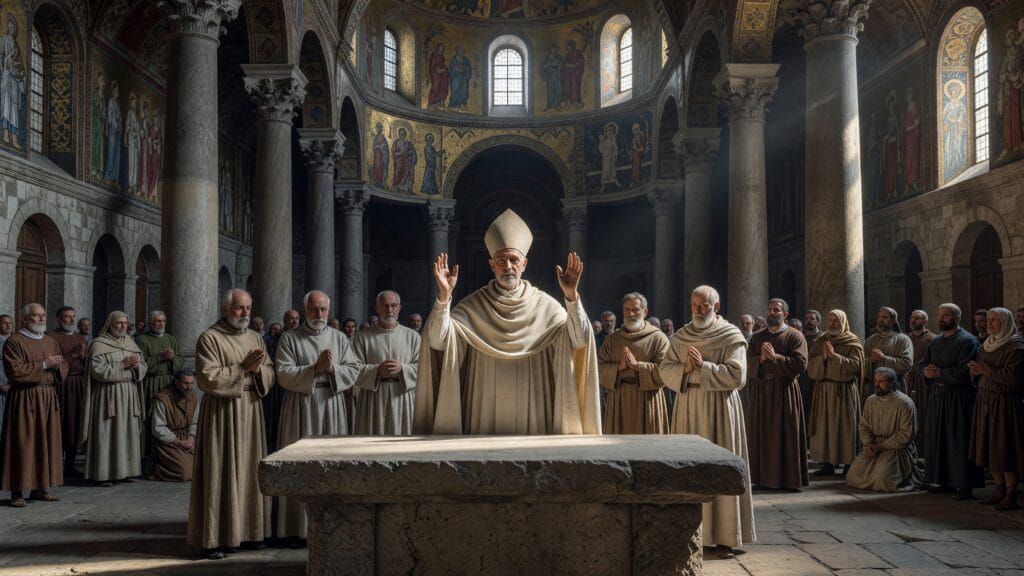
The coronation procession moved through familiar streets. Bells marked continuity; crowds signaled legitimacy; the altar sealed intention. Yet behind ceremony lay logistics: registers updated, envoys briefed, grain accounts reviewed. The new pope inherited holy obligations and urgent files—Lombard demands, imperial tensions, and a fragile civic budget.
Zacharias’ immediate posture was conciliatory without being weak. He answered letters, received embassies, and signaled willingness to bargain for peace. Rome needed a shepherd who could talk in the language of salvation and survival, taking neither spear nor parchment for granted when either might still fail.
03 – The Byzantine Shadow: Iconoclasm and Distant Authority
In 741, Byzantium was convulsed by a succession crisis and the fight over icons. Emperor Constantine V faced the usurper Artabasdos, and court theology mixed with civil war. Rome, a city of images and relics, watched a debate that had already chilled relations with Gregory III, yet still needed imperial goodwill when it could be had.
Zacharias chose a quieter stance than open confrontation. He defended Rome’s practices, favored images in devotion, and maintained communion where possible. He did not ignite fresh censure against the emperor, preferring to keep doors ajar. In these choices, he read the political climate as carefully as the canons.
Iconoclasm complicated diplomacy with Ravenna, the imperial exarchate charged with Italian defense. The exarch’s authority was real but uneven, and his resources shrinking. Zacharias looked for workable arrangements—gifts, intercessions, and seasonal truces—that would let Rome protect its liturgy while avoiding a showdown it could not win.
It is easy to forget how fragile this world still was. With armies moving in the north and arguments burning in the east, a papal letter could be a shield or a spark. Zacharias wrote as if every phrase carried both responsibility and risk, aiming to preserve Rome’s worship, and its room to maneuver.
04 – Negotiating with Liutprand: Early Diplomacy Across the Tiber
The great Lombard king Liutprand, devout and shrewd, had long pressed against Roman territory. Zacharias took the road north, meeting him where leverage could be found—sometimes near Terni, later at Pavia, according to the Liber Pontificalis. He did not command; he persuaded, mixing appeals to piety with a careful sense of Lombard interests.
Negotiations with Liutprand produced concrete returns. Towns taken from the Duchy of Rome were restored, captives were released, and truces lengthened. These were not grand surrenders but small, cumulative turns of the screw. Each retrieved outpost meant safer roads for pilgrims, more predictable harvests, and fewer watchfires on the horizon.
Modern historians stress that such diplomacy traded on reputation as much as theology. Zacharias treated Liutprand as a moral interlocutor, not a caricatured invader. The king, aging and conscious of legacy, responded to a pope who framed concessions as pious acts. It was politics framed within penitential language, and sometimes that worked.
The record remains indirect. We infer itineraries from brief notices, narrative hints, and monastic memory. Still, the pattern is clear: in Zacharias’ first years, papal diplomacy softened Lombard pressure without swords. It is astonishing how much political weight could rest on a seal, a signature, or a hostage.
Mini timeline:
- 741-12-10: Zacharias begins his papacy in Rome.
- 743: Peace arrangements with Liutprand return towns to the Duchy of Rome.
- 749: Aistulf becomes Lombard king, reversing earlier moderation.
- 751: Pepin, backed by papal judgment, becomes King of the Franks; Ravenna falls to Lombards.
05 – Towns Restored: Mapping the First Papal Territorial Gains
When the Liber Pontificalis lists towns restored to Rome under Zacharias, it speaks in administrative tones with pastoral consequences. Places like Ameria, Blera, Orte, and Bomarzo—small to us—mattered intensely to travelers, soldiers, and peasants. Their return reknit a defensive fringe that kept raiders farther from Rome’s gates.
The precedent mattered, too. A generation earlier, Liutprand’s “Donation of Sutri” to Pope Gregory II created a novel arrangement: territory linked to the apostolic see as much as to emperor or king. Zacharias operated within that precedent, expanding it by practice more than manifesto, showing how papal possession could be practical governance.
We should not picture a neat border. Eighth-century Italy was a mosaic—Duchy of Rome, Lombard duchies, and imperial fragments stitched to riverways and hill towns. A “papal” place was often a cluster of loyalties: a church estate, a garrison loyal to a duke, a local notable friendly to Rome, and a pact renewed each season.
Yet over time, these restored nodes formed corridors. Couriers could move more safely; market days revived; tax and tithe officials trudged their rounds. Without a grand proclamation, Zacharias’ settlements made space for practical sovereignty, the seedbed in which a later term—Papal States—would take root and grow.
06 – Rome’s Economy and the Papal Patrimonies
Beyond diplomacy, Zacharias had to feed a city. The papal patrimonies—church lands in Italy and sometimes beyond—were managed to send grain, oil, and rents to Rome. Letters from his pontificate suggest a bishop who knew the value of warehouses, overseers, and fair purchase, not just altars and anointing oils.
Slavery had not vanished from early medieval Italy. The Liber Pontificalis credits Zacharias with ransoming captives and forbidding the sale of free Christians into slavery, especially when hunger made families vulnerable. These acts were moral claims and public policy: keep households intact, keep anger low, and keep loyalty bound to the city that intervened.
Economic rhythms shaped political options. A well-provisioned Rome could hold long processions, host councils, and sustain garrisons without panic. A hungry Rome was prey for rumor and revolt. Zacharias understood that a stable ledger supported a stable liturgy, and the latter, in turn, conferred legitimacy on the former.
As Mediterranean trade ebbed, local estates gained importance. The pope’s officials needed skill as negotiators and farmers, counting stores and monitoring harvests. In this light, pope zacharias accession was not just a spiritual event; it installed a manager who treated granaries as tools for peace.
07 – Shepherding Souls: Reform and Missions with Boniface
While guarding Rome, Zacharias also looked north to the missionary surge led by Boniface. The correspondence between them, preserved in Boniface’s letter collection, shows the pope adjudicating moral queries, supporting the reorganization of bishoprics in Bavaria, and encouraging reform among Frankish and German clergy.
These letters mix pastoral concerns with political ones. When Zacharias endorsed synods or corrected abuses, he quietly strengthened episcopal order in regions where palace and church were renegotiating power. That order would matter when Pepin later sought a new crown, for a reformed church could bless a new regime with less turbulence.
Zacharias’ tone was rarely thunderous. He corrected, consoled, and cited precedent more than passion. For converts and clergy in the north, the Roman bishop’s practical counsel felt like a hand on the shoulder, and a reminder that the see of Peter cared how newly Christian regions governed both altar and marriage bed.
Mission and reform deepened Rome’s soft power. Bishops formed in these standards would remember who guided them. When times grew rough in Italy, those memories became bridges down which envoys traveled, carrying letters that blended scripture, canon law, and the quiet expectations of alliance.
08 – The Frankish Question: Pepin’s Bid for a Crown
By 751, the mayor of the palace, Pepin the Short, was effectively ruling the Franks while a Merovingian king sat as figurehead. Through Boniface, Pepin asked a moral question with pointed politics: should the one who holds power also be king? Zacharias answered yes, framing legitimacy in terms of function and justice.
The Royal Frankish Annals present this as a straightforward decision, but historians note the layered context. Rome needed a counterweight to Lombard pressure and a partner beyond a struggling empire. The judgment granted Pepin moral cover to depose Childeric III, and it gave Rome a friend with armies it did not directly command.
Here the horizon widened. While the famous “Donation of Pepin” would come later under Stephen II, Zacharias’ reasoning made that path thinkable. He set the premise: papal authority could interpret kingship’s morality. In turn, a king might see Rome as a partner, not a supplicant, and reorganize loyalties around a sanctified bargain.
In this light, pope zacharias accession rippled far beyond the Tiber. A question asked in Francia and answered in Rome rearranged western politics. The pen did not replace the sword, but it told the sword where to point, and why that direction could be called just.
09 – Aistulf Ascendant: The Lombard Turn to Aggression
Liutprand died in 744. After a brief and unstable interlude, Aistulf took the Lombard throne in 749 and pressed with new aggression. He later captured Ravenna in 751, delivering a symbolic blow to Byzantine authority in Italy. For Rome, the buffer that once absorbed Lombard pressure was now a Lombard stronghold.
Zacharias relied on tribute and time, purchasing space for the city to breathe. He sought to treat with Aistulf as he had with Liutprand, but the balance had shifted. Without a strong exarch and with the emperor distracted, negotiation needed a new reinforcement—one that papal letters alone could not supply.
Yet behind the outward similarity of embassies lay a sharpening calculation. The pope’s court began to imagine northern aid as more than encouragement; it became the scenario for survival. The stage was set for his successor’s fateful journey across the Alps, a path cleared by Zacharias’ earlier answers and alliances.
Events moved quickly but without the drama of sieges at Rome’s walls. The danger was structural: a regional power’s rise and an empire’s ebb. Zacharias’ Rome survived by crafting time—payments, prayers, and carefully placed trust—until a new protector could be convinced to act.
10 – Guarding the City: Fortifications, Grain, and Ritual
Defense in eighth-century Rome was not only walls and gates. It was also granaries filled before winter, road patrols paid on time, and liturgies that reassured a nervous populace. Zacharias reinforced what he could—the routines that kept alarm from boiling into unrest—while repairing churches as symbols of continuity.
Processions mattered. When clergy carried relics through neighborhoods, they marked territory in sacred terms and reminded residents of a city cared for by its bishop. The psychology of public worship, sustained by enough bread and enough order, kept small anxieties from turning into larger betrayals.
The pope’s court, modest by imperial standards, still had specialists: notaries crafting letters, stewards counting stores, and envoys who knew when a gift might diffuse a crisis. Their work enabled Rome to face threats with fewer swords drawn and fewer lives lost than a purely military response would have demanded.
We can picture no triumphant battlements added in these years, but rather a thousand tasks done on time. In quiet competence lay resilience. The city endured because its shepherd treated administration as a daily liturgy, where balance sheets and blessings each kept fear at bay.
11 – From Stewardship to Statehood: The Slow Birth of a Papal Territory
Historians warn against anachronism: Zacharias did not declare a “Papal State.” Yet in practice, he administered territories, levied resources, defended roads, and negotiated as a territorial power. The idea that these lands were Saint Peter’s patrimony matured in these routines, not in a single charter.
Texts later associated with papal claims—like the forged Donation of Constantine—reflect this maturation, though likely composed after Zacharias. More crucial is how people behaved. Towns paid tribute to Rome and looked to the pope’s envoys for justice. Boundaries became habits before they were lines on a map.
Here, the moral vocabulary of stewardship—care for churches, ransoming captives, restoring towns—overlapped with the habits of statehood. When a pope exercised authority for the community’s safety, neighbors recognized that authority. By the time Stephen II traveled to Pepin, the logic of papal territory was already familiar on the ground.
In this sense, pope zacharias accession inaugurated a decade that taught Rome how to be a state without saying so. The city learned which levers worked, which oaths held, and which allies kept faith. When later gifts and titles came, they landed on soil already prepared.
12 – Death and Succession: From Zacharias to Stephen
Zacharias died on 15 March 752. The transition that followed was complicated by a quirk of numbering: a Stephen elected soon after died before consecration, and medieval lists later disagreed whether to count him. The active successor remembered is Stephen II (often styled Stephen II/III), who soon took Rome’s case to Pepin face to face.
That journey, and the military aid it secured, stood on foundations Zacharias had laid. He had normalized the idea that a pope could influence kingship and that kings might answer in kind. He had shaped a diplomatic habit, a language of gifts and justice, that made Stephen’s dramatic appeals comprehensible.
Death closed one set of letters and opened another. But the correspondents remained connected: bishops trained under Roman reform, Frankish magnates alert to papal judgments, and Lombard rulers attentive to moral suasion. Continuity across succession was the quiet triumph of Zacharias’ management, turning a vulnerable city into a negotiating power.
Later chroniclers remembered him as mild and effective, a repairer of churches and a redeemer of captives. The reputation matched the policy: use gentleness as strategy, and exhaust the tools of peace before calling for arms. In the years that followed, that patient legacy showed its strength.
13 – Memory and Sources: Reading the Eighth Century Carefully
The documentary record for Zacharias is thinner than modern readers might hope. The Liber Pontificalis gives a papal perspective, blending praise with detail. Boniface’s letters open a window from the north, while the Royal Frankish Annals frame events to celebrate Carolingian ascendancy. Paul the Deacon narrates Lombard affairs with pride and regret.
These sources agree on broad movements—Zacharias’ diplomacy, Pepin’s rise, Lombard aggression—but differ on emphasis. When the Liber calls a concession “pious,” a Lombard writer might call it “prudent.” When the Annals describe papal sanction, they also underline Frankish strength. Reading them together yields a more human portrait than any single voice allows.
Modern historians debate precise itineraries, the list of returned towns, and the extent of papal administration before Stephen II’s embassies. Some evidence is late, and some probably polished for effect. Yet the contours hold: a decade of careful choices kept Rome safe and taught it where to seek future security.
We should resist tidy narratives. Zacharias did not orchestrate a master plan from the start. He adjusted, learned, and risked his authority in letters more than in arms. That is precisely what makes his pontificate a compelling case of leadership under constraint, where survival and principle met in patient acts.
14 – Consequences and Counterfactuals: Choosing Alliance Over Isolation
What if Zacharias had refused Pepin’s question, or demanded a price too soon? A stricter stance might have preserved a purist posture but left Rome isolated when Aistulf pressed hardest. Conversely, a reckless bargain could have entangled Rome in Frankish politics before trust had formed, risking backlash on both sides.
The path he chose—recognize de facto power in moral terms, while tending Italy’s near-term peace—balanced realism with pastoral duty. It created a political theology that kings found both flattering and limiting: sanctified rule came with expectations. For Rome, that calculus prepared the scene for territorial protection without abdicating spiritual claims.
Consequences unfolded in layers. Pepin’s kingship gained sheen; Stephen’s embassies soon gained troops; and Rome gained space to develop administration on its own terms. Yet the choice also tied papal fortunes to Frankish stability, a partnership that required constant tending and would evolve through glories and frictions alike.
History rarely announces turning points in banners. Here it sounded like measured replies, seasonal treaties, and a pope who protected his city by multiplying the number of people invested in its survival. The strategy did not cure the peninsula’s violence, but it shifted who had the last word when violence surged.
Immediate consequence:
Stabilization of Rome’s frontiers through restored towns and purchased truces, coupled with strengthened ecclesiastical ties to reforming bishops in the Frankish world.
Long-term consequence:
Legitimacy for Carolingian rule and the political-theological groundwork for the Papal States, enabling later popes to claim and defend temporal authority as steward of Saint Peter’s patrimony.
15 – Conclusion
Pope Zacharias governed a Rome that could not afford illusions. He answered iconoclast emperors with measured communion, Lombard kings with pious diplomacy, and Frankish magnates with moral clarity. In the quiet choreography of letters and restituted towns, pope zacharias accession became a hinge: the city learned to be both church and state without naming it so.
What endured was a template. When Stephen pleaded with Pepin, he stood on ground Zacharias had graded—practical, relational, and credible to kings. The Papal States did not spring from a single grant; they grew from seasons of stewardship. Zacharias’ decade shows how a shepherd’s staff could trace, slowly and surely, the outline of a polity.
16 – FAQs
- When did Zacharias become pope?
Tradition dates the start of his pontificate to 10 December 741, which marks the moment generally cited as pope zacharias accession and the beginning of his decade-long governance. - Where did his accession take place?
In Rome, centered on the Lateran complex, where the bishop of Rome resided, administered, and celebrated the liturgy that signaled his authority to clergy and people. - Who were the main figures connected to his early reign?
Pope Zacharias; Lombard kings Liutprand, Ratchis, and Aistulf; the missionary-bishop Boniface; Frankish leader (later king) Pepin the Short; and Byzantine Emperor Constantine V, whose policies shaped distant pressures. - What caused the political realignment during his pontificate?
The combination of Lombard advances, Byzantine weakness, and Frankish consolidation under Pepin pushed Rome to seek new guarantees for survival, prompting moral-political decisions that reoriented alliances. - What were the immediate consequences for Rome?
Recovered towns around the Duchy of Rome, reduced raiding through negotiated truces, firmer control over church patrimonies, and reformed ties with northern bishops that increased Rome’s influence beyond Italy. - What is the legacy of his rule?
A diplomatic template that enabled later popes to secure Frankish protection and articulate territorial claims, laying groundwork for the Papal States and for enduring debates over spiritual and temporal power in the Latin West.
17 – External Resource
18 – Internal Link
Other Resources
- Encyclopaedia Britannica – general search for the exact subject
- Google Scholar – academic search for the exact subject
- Internet Archive – digital library search for the exact subject
Sources and References
-
Liber Pontificalis: The Book of the Popes, Volume I: To the Pontificate of Gregory I, trans. Raymond Davis, Liverpool: Liverpool University Press, 1989.
Note: Primary narrative source for Pope Zacharias’s election, character, building works in Rome, relations with the Lombards, and early governance of the Roman Church and the emerging Papal States. -
Monumenta Germaniae Historica (MGH), Epistolae selectae, Vol. II, ed. Ernst Dümmler, Berlin: Weidmann, 1895.
Note: Collection of early medieval letters, including correspondence between Pope Zacharias and Frankish rulers; supports details of his diplomatic role and wider political context in Europe around 741. -
Duffy, Eamon. Saints and Sinners: A History of the Popes. 4th ed., New Haven: Yale University Press, 2015.
Note: Modern scholarly overview of the papacy; provides context on Zacharias’s place in papal history, his accession in 741, and his role in consolidating the temporal authority of the Papal States. -
Mann, Horace K. The Lives of the Popes in the Early Middle Ages, Vol. I: The Popes under the Lombard Rule, 590–752. London: Kegan Paul, Trench, Trübner & Co., 1902.
Note: Detailed historical study of popes during Lombard domination; covers Zacharias’s election, his policies in Rome, dealings with Lombard kings, and the territorial evolution of papal authority. -
Norwich, John Julius. Byzantium: The Early Centuries. London: Penguin Books, 1990.
Note: Provides political background on the relationship between Rome and Constantinople in the eighth century, clarifying the imperial context in which Zacharias acceded to the papacy and negotiated de facto independence in the Papal States. -
“Zacharias, Pope.” In Encyclopaedia Britannica, online edition, Encyclopaedia Britannica, Inc.
Note: Concise scholarly reference confirming key dates (accession in 741, death, origin in Greek-speaking southern Italy) and summarizing his main actions as pope, used to cross-check chronology. -
University of Notre Dame, Medieval Institute. “The Papal States in the Early Middle Ages.” Teaching resource, University of Notre Dame.
Note: Academic overview of the formation and development of the Papal States; supports statements about the broader institutional and territorial context of papal rule during and after Zacharias’s pontificate. -
Vatican Apostolic Library / Vatican Secret Archives (Archivio Apostolico Vaticano). Catalogues of Papal Registers and Early Medieval Documents.
Note: Archival reference indicating the existence of papal documents and charters from Zacharias’s pontificate; underpins mentions of his official acts and administrative decisions in Rome and the surrounding territories.