Table of Contents
- Kyiv on the Edge: September 1941
- Orders, Ideology, and the Road to Killing
- Notices and the March to the Ravine
- Two Days at Babi Yar
- Perpetrators and Complicity
- Witnesses, Escape, and Silence
- The City After the Massacre
- Erasing the Evidence, 1943
- Counting the Dead and the Debate
- Struggles over Memory in the Soviet Era
- Culture, Poetry, and Global Awareness
- Trials and the Search for Justice
- The Holocaust by Bullets Context
- Why Babi Yar Still Matters
- Conclusion
- FAQs
- External Resource
- Internal Link
Article Summary: In late September 1941, within days of occupying Kyiv, German security forces and their auxiliaries murdered the city’s Jews at the ravine of Babi Yar. This article reconstructs the orders, the lethal choreography, and the aftermath of the babi yar massacre. It considers complicity, survivors’ voices, and the struggle over memory under Soviet rule. Using operational reports and later testimonies, it weighs contested numbers. Finally, it situates Babi Yar within the broader “Holocaust by bullets,” tracing how culture, law, and memorials transformed a crime scene into a moral landmark.
Why keep reading: At Babi Yar, genocide unfolded as a public operation beside a living city, without camps or gas chambers. The ravine reveals not only how the crime happened but also how societies justified, denied, remembered, and finally confronted it—turning a landscape into evidence and a memory into responsibility.
At a glance:
- Event: Mass murder of Kyiv’s Jews at Babi Yar ravine, followed by continued executions of other groups
- Date: 29–30 September 1941 for the principal killing action; subsequent killings through 1943
- Place: Babi Yar ravine, on the outskirts of Kyiv, Ukrainian SSR, USSR
- Main figures: Einsatzgruppe C (Otto Rasch), Sonderkommando 4a (Paul Blobel), Order Police battalions, local auxiliary police
- Why it mattered: One of the largest single-massacres of the Holocaust by bullets; a defining case of ideological violence, collaboration, and contested memory
01 – Kyiv on the Edge: September 1941
When German forces entered Kyiv on 19 September 1941, the city was exhausted by bombardment and evacuation. The Soviet retreat left mines and booby traps that exploded days later, destroying central buildings and killing occupying troops. Streets were choked with refugees, wounded soldiers, and civilians trying to reclaim homes in a city suddenly under foreign rule.
Kyiv’s Jewish population had already been cut by evacuation, mobilization, and flight. Still, tens of thousands remained, among them the elderly, the poor, and those who believed the war would spare them if they kept their heads down. They were about to discover that the occupiers had arrived with a plan that made no room for survival.
In the weeks that followed, the city’s edges became staging grounds for a new kind of warfare: ideological murder by mobile units. The babi yar massacre would not be a spontaneous reprisal, though the explosions offered a pretext. It was a methodical operation rooted in orders given before Kyiv fell, calibrated to annihilate a community in two days.
02 – Orders, Ideology, and the Road to Killing
The invasion of the Soviet Union in June 1941 brought with it Einsatzgruppen—mobile killing squads charged with eliminating “enemies,” especially Jews. Their mandate blended state security with racial ideology. By September, they had already murdered tens of thousands across Ukraine, Belarus, and the Baltics, guided by directives from SS leadership.
In Kyiv, the explosions that followed the occupation were cited in German announcements as justification for harsh reprisals. Yet contemporary directives point to a broader goal: to remove Jews from the city altogether. The order to assemble was framed bureaucratically, but the infrastructure mobilized—transport, guards, ammunition—revealed that mass killing was the intended outcome.
03 – Notices and the March to the Ravine
On 28 September, notices appeared around Kyiv ordering all Jews to assemble the next morning with documents, valuables, and warm clothing. The instructions implied resettlement. Many residents read the notices, argued over rumors, and tried to interpret what “evacuation” might mean. Some hid with non-Jewish friends; many more complied, hoping to avoid worse punishment.
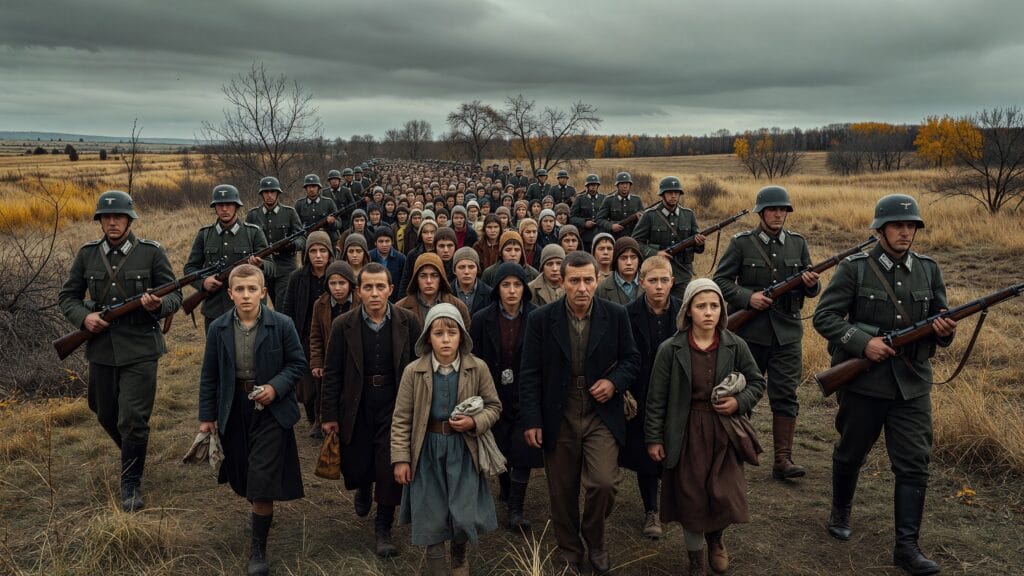
On 29 September, they gathered at set points and were directed toward the northwest outskirts. The route passed through city streets where non-Jewish neighbors watched, helped, or looked away. Along the way, guards sorted and drove the columns faster. The ravine, Babi Yar—“Grandmother’s Gully”—lay ahead, an innocuous topography soon to become a crime scene.
Families carried bundles and official papers, clinging to the ordinary rituals of relocation. But as the march neared the killing site, signs accumulated—barbed wire, confiscations, beatings—exposing the deception. The babi yar massacre would unfold by stripping identity and hope in a sequence of orders that erased dignity step by step.
04 – Two Days at Babi Yar
At the ravine, victims were forced to hand over belongings and undress. Guards formed corridors to funnel people toward the edge. Machine guns waited below. The sequence was engineered for speed: push, force down into the gully, fire in volleys, and repeat. The sounds echoed off earth walls, swallowing evidence almost as quickly as it was created.
Children were torn from parents, the elderly shoved; those who resisted were beaten or shot on the spot. The killing stretched across 29 and 30 September, carried out with chilling efficiency. By night, lights illuminated the site; by day, the city heard gunfire that seemed to come from a place just beyond ordinary daily life.
Mini timeline:
- 19 Sep 1941: German forces occupy Kyiv.
- 28 Sep 1941: Notices order Kyiv’s Jews to assemble.
- 29–30 Sep 1941: Mass shooting at Babi Yar ravine.
- Aug–Sep 1943: Bodies exhumed and burned to hide evidence.
05 – Perpetrators and Complicity
The killing was organized by Sonderkommando 4a of Einsatzgruppe C, commanded locally by Paul Blobel and overseen by Otto Rasch. Order Police battalions and Waffen-SS personnel provided crucial manpower. Soldiers of the Wehrmacht secured perimeters and logistics, while local auxiliary police participated in cordons, searches, and, in some instances, direct violence.
Participation varied in form and intensity, but the machinery relied on many hands. Drivers transported ammunition; clerks recorded lists; interpreters barked orders. Civilians scavenged after the shootings, an opportunistic complicity that deepened the crime’s social reach. Modern historians caution that while not everyone shot, the event drew in concentric circles of involvement.
Responsibility is often discussed in tiers—planners, executors, and beneficiaries. Yet behind the tiers stood an apparatus built to normalize annihilation as administrative work. The babi yar massacre showed how lethal ideology could be distributed across ordinary roles, where a signature, a nod, or a posted notice helped turn a ravine into a killing ground.
06 – Witnesses, Escape, and Silence
Some victims escaped by tumbling into the ravine among the dead and climbing out at night. Others survived because they were misidentified, hidden by neighbors, or absent when the order came. Their testimonies later described the sequence in stark, spare detail, often avoiding embellishment because memory itself felt like a wound.
Non-Jewish residents also witnessed aspects of the operation: convoys on the streets, shots rolling across the air, the sudden emptiness of Jewish apartments. A few tried to help; many stayed still, fearing denunciation. The act of seeing, but not being able to intervene, marked witnesses who later struggled with disbelief and guilt.
07 – The City After the Massacre
In the days after, Kyiv felt different. Jewish markets were gone, and apartments were reassigned. Looting, sometimes organized by authorities, sometimes freelance, broke the fragile boundary between private grief and public gain. The city’s administration changed signage and routines, while hunger and fear persisted as winter approached.
The ravine did not cease to function as a killing site. Over the following months, Roma, Soviet prisoners of war, suspected partisans, and Ukrainian nationalists were taken to Babi Yar. The site became an extension of occupation policy, a place where the city’s unwanted—by definition of the regime—were disposed of beyond the legal record.
For those who had lost neighbors, silence often felt like safety. Yet whispers carried, and stories circulated in kitchens behind closed shutters. The babi yar massacre was at once widely known and deliberately unspoken, occupying the city’s imagination as a place where the ground itself knew more than people dared say.
08 – Erasing the Evidence, 1943
As the tide of war turned and the Red Army advanced, the SS sought to erase traces of mass shootings across occupied territory. At Babi Yar in 1943, prisoners were forced to exhume bodies and burn them on pyres built from railroad tracks and fuel. Those prisoners were then executed, an attempt to silence witnesses.
This operation, part of Sonderaktion 1005, was supervised by the same officer who had commanded the killings in 1941. The smell, the smoke, the systematic stirring of bones—these were not remembered by many outside the circle of captives, but they left a distinct signature in testimony gathered after the war.
Erasure never fully worked. Scattered bones remained. So did documents, orders, and the patterns of absence. The effort to destroy evidence inadvertently created new evidence: witnesses compelled into the center of the atrocity who later described, with harrowing economy, what it took to transform a ravine into ash.
09 – Counting the Dead and the Debate
An operational report filed by the killing units in early October 1941 recorded 33,771 Jews shot over the two days. Historians often cite this figure as the number for the principal action, while emphasizing that later killings at Babi Yar raised the total of victims—Jews and non-Jews—into the tens of thousands more.
The total number of people murdered at the ravine between 1941 and 1943 remains debated, with estimates generally ranging from 70,000 to over 100,000. The documentary record is fragmentary, and wartime chaos complicates precise counting. Scholars cross-check military reports, postwar investigations, and demographic studies to approach a careful range.
10 – Struggles over Memory in the Soviet Era
After liberation in 1943, Soviet authorities documented German crimes, but public commemoration took a different shape. The ravine was marked as a site of fascist atrocities against “peaceful Soviet citizens,” omitting explicit Jewish identity. This language reflected a universalizing narrative of suffering that sidelined the specificity of antisemitic intent.
Worse, the physical landscape was reshaped. The ravine was gradually filled with waste and industrial slurry. In 1961, a catastrophic mudslide at Kurenivka killed many, a disaster linked to the destabilized terrain of Babi Yar. The disaster revealed how even landscape engineering could collide with buried history, turning neglect into new danger.
Still, dissenting memory found forms. In 1961, the poet Yevgeny Yevtushenko published “Babi Yar,” denouncing antisemitism and the silence around the site. Dmitri Shostakovich set the poem in his Thirteenth Symphony, premiered in 1962. The arts carried the name “Babi Yar” further than official plaques, insisting on specificity against euphemism.
11 – Culture, Poetry, and Global Awareness
Yevtushenko’s poem begins with the striking admission that there is no monument at Babi Yar. In making absence itself the subject, he transformed the ravine into a symbol of suppressed history. Shostakovich’s music amplified the words, using bass voices and austere orchestration to give public sound to a censored grief.
Outside the Soviet Union, Anatoly Kuznetsov’s documentary novel “Babi Yar,” published in the West, compiled testimonies and records into a narrative that reached global audiences. Later, journalism and documentaries, along with museum exhibits, turned Babi Yar into a reference point for understanding how quickly communities could be erased under occupation.
Memory work was not only artistic. Academic studies by scholars such as Karel C. Berkhoff and Timothy Snyder situated the site within broader patterns of wartime violence in Ukraine. Their analyses emphasized both local dynamics and the machinery of the German occupation, helping audiences see Babi Yar not as an isolated horror but as a systemic event.
12 – Trials and the Search for Justice
Justice for Babi Yar came in fragments. At the Nuremberg Einsatzgruppen Trial, Paul Blobel was convicted and later executed, but many lower-level participants received lighter sentences or evaded prosecution. Occupation-era policemen faced trials in Kyiv and elsewhere; some were hanged in public, others served prison terms that now seem painfully brief.
Legal proceedings depended on the availability of documents and witnesses. In some cases, evidence came from the very reports the perpetrators filed, including the figure of 33,771. In others, survivor testimony underpinned accusations, raising challenges of trauma, memory, and translation. Courts had to weigh precision against the inherent opacity of mass crime.
The law achieved something important: it inscribed facts into a public record. Yet it also exposed limits—the gap between moral catastrophe and judicial conclusion. The babi yar massacre forced jurists to confront how bureaucratic murder produces evidence even as it tries to annihilate witnesses, leaving societies to reconstruct truth from the paperwork of atrocity.
13 – The Holocaust by Bullets Context
Babi Yar was one of many mass shootings across Eastern Europe between 1941 and 1944. Before the gas chambers reached their deadly scale, the Holocaust advanced through rifles and pits, delivered by mobile units moving with the front. Villages and small towns knew mass murder not as distant rumor but as the arrival of trucks and orders.
Investigations in recent decades, including fieldwork by organizations documenting mass graves, have mapped thousands of sites. Interviews with elderly witnesses, ballistic evidence, and terrain analysis corroborate a pattern: selections, marches, stripping, shooting, covering, and later exhumation. Babi Yar stands among the largest, but its procedures echo across the region’s soil.
Understanding this context matters. It shows that genocide did not require camps to begin or to succeed. It required ideology, logistics, and people to carry out instructions. The ravine at Kyiv reveals how quickly a city space can host annihilation, and how deeply the consequences can grow roots in communal and national life.
14 – Why Babi Yar Still Matters
The name “Babi Yar” remains a warning about what ideological war, state power, and societal fear can do together. The babi yar massacre teaches how deception—resettlement notices, bureaucratic euphemisms—precedes violence, and how ordinary infrastructure can be turned into a conveyor belt for murder. It also shows how denial tries to finish the work of killing.
Today, commemoration at the site includes memorials that explicitly acknowledge Jewish victims alongside other groups murdered there. Debates about narrative and representation continue, fueled by new research and by the region’s political upheavals. The ravine urges a drafting of memory that is precise, capacious, and resistant to propaganda.
Immediate consequence:
Kyiv’s Jewish community was shattered in two days, its social and cultural life eradicated, and its property seized or redistributed under occupation rule.
Long-term consequence:
The site became a focal point of global Holocaust memory, while battles over acknowledgment—and attempts at erasure—shaped how the Soviet Union and later Ukraine addressed past atrocities.
15 – Conclusion
What happened at the ravine outside Kyiv was not a sudden spasm of violence but a planned operation that drew strength from orders, ideology, and the complicity of systems and individuals. The babi yar massacre can be traced through notices, roads, and rifles, but also through the absences it left—empty homes, interrupted songs, and silences that lasted decades.
Its legacy reaches beyond a single place. Babi Yar teaches how genocide can occur in daylight, beside a city that keeps breathing. It presses readers to see how memory is contested and how truth is built from patient attention to sources. In naming the ravine, we refuse the finality that denial seeks.
16 – FAQs
- When did the massacre occur?
The main killing operation took place on 29–30 September 1941, with additional executions at Babi Yar continuing into 1943. - Where did it happen?
At Babi Yar, a ravine on the outskirts of Kyiv, then part of the Ukrainian SSR in the Soviet Union. - Who were the main perpetrators?
Sonderkommando 4a of Einsatzgruppe C led the operation, with Paul Blobel in command locally, supported by Order Police units, Waffen-SS personnel, and local auxiliary police. Wehrmacht elements secured perimeters and logistics. - Why did it happen?
Guided by Nazi racial ideology and anti-Jewish directives issued before the city fell, the operation aimed to eliminate Kyiv’s Jews. The explosions in Kyiv after occupation were cited as pretext but were not the underlying cause. - How many people were killed?
An Einsatzgruppen report recorded 33,771 Jews murdered during 29–30 September. Later killings at the ravine raised the total number of victims—Jews and others—into the tens of thousands more; estimates generally range from 70,000 to over 100,000. - What is the legacy today?
Babi Yar stands as a central case in the “Holocaust by bullets,” shaping global understanding of mobile mass shootings. Memorials, scholarship, and culture preserve the memory of the babi yar massacre while ongoing debates seek accurate, inclusive commemoration.
17 – External Resource
18 – Internal Link
Other Resources
- Encyclopaedia Britannica – general search for the exact subject
- Google Scholar – academic search for the exact subject
- Internet Archive – digital library search for the exact subject
Sources and References
-
“The Einsatzgruppen Reports: Selections from the Dispatches of the Nazi Death Squads’ Campaign Against the Jews, July 1941–January 1943.” Edited and translated by Yitzhak Arad, Shmuel Krakowski, and Shmuel Spector. New York: Holocaust Library, 1989.
Note: Primary source collection containing original Einsatzgruppen reports and operational dispatches that document mass shootings in Eastern Europe, including those carried out by Einsatzgruppe C in and around Kyiv. Supports details on the perpetrators, method of killing by shooting, and the broader context of the “Holocaust by bullets.” -
“Nazi Conspiracy and Aggression” (The Nuremberg “Blue Series”). Office of United States Chief of Counsel for Prosecution of Axis Criminality. Washington, D.C.: U.S. Government Printing Office, 1946–1948.
Note: Primary-source trial record that includes documentary evidence and testimonies on Einsatzgruppen activities and crimes committed on the Eastern Front. Used to corroborate the legal and judicial framing of the Babi Yar massacre as a crime against humanity and as part of the broader Nazi program of extermination. -
Arad, Yitzhak. Holocaust in the Soviet Union. Lincoln and Jerusalem: University of Nebraska Press & Yad Vashem, 2009.
Note: Comprehensive scholarly study of Nazi anti-Jewish policy and mass shootings in the territories of the former USSR. Provides demographic estimates of victims, discusses the role of the Wehrmacht and local collaborators, and situates Babi Yar within the systematic annihilation of Jews in Soviet Ukraine. -
Lower, Wendy. Nazi Empire-Building and the Holocaust in Ukraine. Chapel Hill: University of North Carolina Press, 2005.
Note: Academic monograph that analyzes Nazi occupation policies in Ukraine, including in Kyiv. Supports discussion of administrative control, anti-Jewish measures, and the interaction between German authorities and local auxiliary police that facilitated operations like the Babi Yar shootings. -
Piotrowski, Tadeusz. “Babi Yar.” In: Encyclopedia of Camps and Ghettos, 1933–1945, Vol. II: Ghettos in German-Occupied Eastern Europe, Part A, edited by Geoffrey P. Megargee, 95–101. Bloomington: Indiana University Press & United States Holocaust Memorial Museum, 2012.
Note: Detailed encyclopedic entry prepared under the auspices of the U.S. Holocaust Memorial Museum. Provides a concise scholarly synthesis of the events at Babi Yar, including chronology, victim numbers, and the later destruction of evidence by Sonderaktion 1005. -
United States Holocaust Memorial Museum (USHMM). “Babi Yar.” Holocaust Encyclopedia.
https://encyclopedia.ushmm.org/content/en/article/babi-yar
Note: Curated reference entry that outlines the timeline of the massacre (29–30 September 1941), identifies the main German units and local collaborators involved, and summarizes postwar investigations and commemorative efforts. Used for confirming dates, scale of killings, and subsequent memory of Babi Yar. -
Yad Vashem – The World Holocaust Remembrance Center. “Babi Yar: Massacre of the Jews of Kiev.”
https://www.yadvashem.org/holocaust/about/babi-yar.html
Note: Authoritative overview drawing on archival documents, testimonies, and research. Supports specific details about victim selection, the sequence of events on 29–30 September 1941, and later mass shootings at the site targeting Roma, Soviet POWs, and other groups. -
Shostakovich, Dmitri. Symphony No. 13 in B-flat minor, Op. 113 “Babi Yar” (1962). Texts by Yevgeny Yevtushenko.
Note: A cultural-historical primary source reflecting Soviet-era memory and censorship surrounding Babi Yar. The symphony, based on Yevtushenko’s poem “Babi Yar,” documents evolving public commemoration and the political sensitivity of acknowledging the specifically Jewish character of the massacre.