Table of Contents
- Lisbon Awaits: September 1499
- The Voyage That Rewired the World
- The Azores Interlude and a Brother’s Death
- First Sight of the Tagus: Pageant and Politics
- King Manuel I’s Strategy Behind the Celebration
- News from India: Calicut, Cochin, and a Fractured Ocean
- Counting the Cost: Scurvy, Storms, and Survivors
- Measuring the Profits and the Promise
- Sources, Silences, and the Date Debate
- From Return to Empire: The Policy Chain Reaction
- Religion, Ritual, and the Portuguese Imagination
- Lisbon Transformed: Markets, Maps, and Mariners
- Rivals React: Venice, Mamluks, Ottomans, and Castile
- Memory, Myth, and the Making of a National Hero
- Conclusion
- FAQs
- External Resource
- Internal Link
Article Summary: This article reconstructs the day Vasco da Gama’s homebound ships entered Lisbon in 1499 and the cascade of consequences that followed. It traces the perilous first voyage to India, the emotional Azores detour, and the political theater of reception on the Tagus. It weighs sources that dispute the exact date and sequence, noting how tradition and record diverge. It situates the return within broader Mediterranean and Indian Ocean rivalries. From pageantry to policy, it shows why vasco da gama returns to lisbon marked a hinge in global history.
Why keep reading: Because behind the triumphant sails lay funerals, frail crews, and contested reports that shaped an empire’s next move. The moment felt like an ending, but it was also the beginning of a century-long struggle for the spice routes and a new map of the world.
At a glance:
- Event: Return of Vasco da Gama from the first sea voyage from Europe to India
- Date: 18 September 1499 (traditional date; some sources suggest early September)
- Place: Lisbon, Kingdom of Portugal; approach via the Tagus estuary
- Main figures: Vasco da Gama, King Manuel I, Nicolau Coelho, Paulo da Gama
- Why it mattered: Confirmed a direct sea route to India, reconfigured global trade, and accelerated the formation of the Portuguese Estado da Índia.
01 – Lisbon Awaits: September 1499
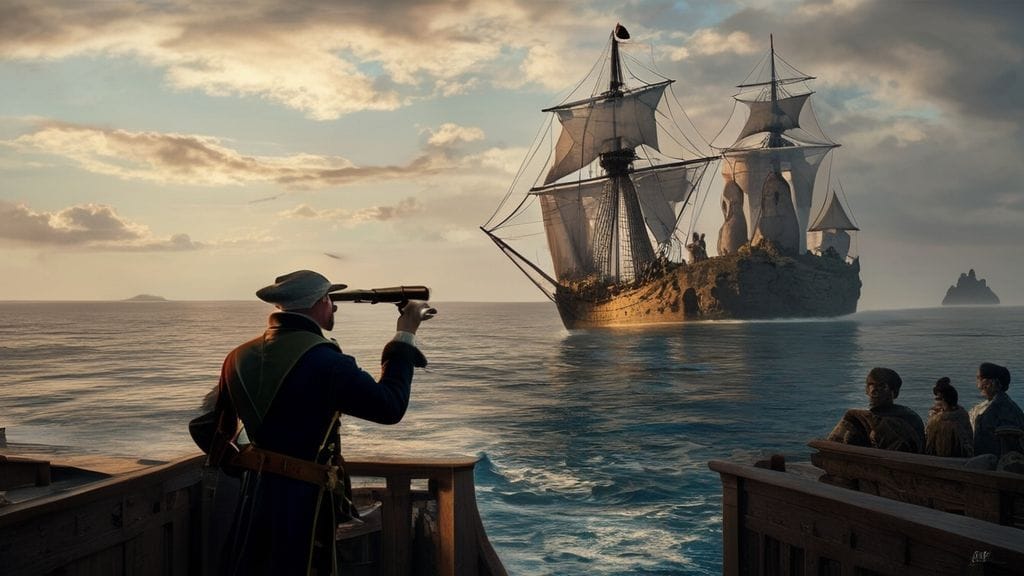
On a late-summer morning in 1499, Lisbon looked to the river that fed its fortunes. The Tagus carried rumors before it carried sails, and the rumors said that Portugal had threaded the rim of Africa and touched India’s pepper coast. As masts edged the horizon, an anxious city leaned into the wind of possibility.
The men returning had looped a continent and survived a season of scurvy and storms. Their arrival was at once maritime fact and political theater. When vasco da gama returns to lisbon, the waterfronts of the Ribeira quarter stood ready to convert hard voyage into royal narrative—a story Manuel I needed the world to hear.
Contemporaries remembered bells and processions, but the exact sequence evaporates in the sea-sprayed distance of time. What matters is that Lisbon became a stage where navigation met nation. The fleet’s scarred hulls and solemn flags carried the weight of an experiment that had begun under Prince Henry’s long shadow and Bartolomeu Dias’s hard-won cape.
02 – The Voyage That Rewired the World
The voyage left Lisbon in July 1497 as a disciplined gamble. Four ships, including the São Gabriel and São Rafael, slipped past the familiar Canaries and sought winds few Europeans understood. Dias’s charts suggested a path; the ocean answered with a corridor of storms. When land finally offered anchorage, it was East Africa’s coral coasts and wary harbors.
From Malindi a skilled pilot guided them across the open ocean, a single bold tack to the Malabar Coast. Later chroniclers named the pilot Ibn Majid, but modern historians doubt this identification, noting ambiguities in Arabic and Portuguese records. Calicut appeared like an answer to a riddle: the port of pepper where Europe’s questions met Indian Ocean hierarchies.
It is easy to forget how fragile this world still was. A cracked mast, a clumsy gift, a fever on the return—any could have erased the route and left Europe waiting another generation. Instead, the ships turned west with enough spices and stories to convince a court that the gamble would pay.
03 – The Azores Interlude and a Brother’s Death
Homeward, the fleet split. The swift caravel Berrio under Nicolau Coelho raced ahead, driven by winds and news. Vasco stayed in the Azores with his gravely ill brother, Paulo. On Terceira, care could be found, but not a cure. The price of discovery suddenly felt intimate, measured not in sacks of pepper but in a brother’s breath.
Tradition remembers Paulo’s death at Angra do Heroísmo, his body interred far from Lisbon’s warmth. That loss delayed the admiral’s return and fuelled the later confusion over dates. When vasco da gama returns to lisbon was written into civic memory, it had to cover the ache of a funeral folded into victory.
By the time Vasco finally steered for the Tagus, the city already knew the outlines. The Berrio had brought the first thunderclap of news weeks earlier, and Lisbon’s merchants had begun counting future profits. Yet behind the ceremony gathering on the quays, there was a sailor who had not come back, and a commander who had kept watch as kin slipped away.
04 – First Sight of the Tagus: Pageant and Politics
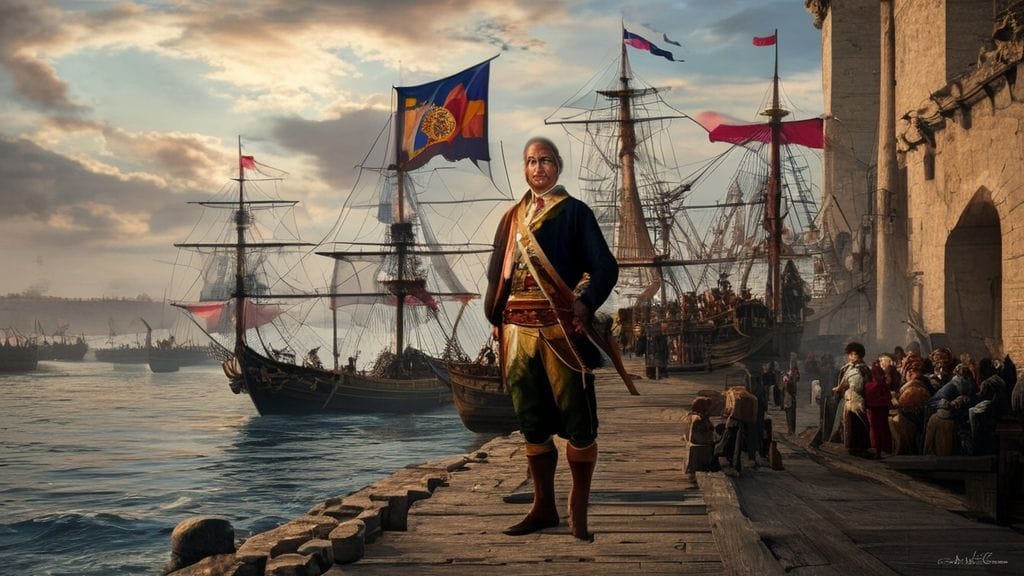
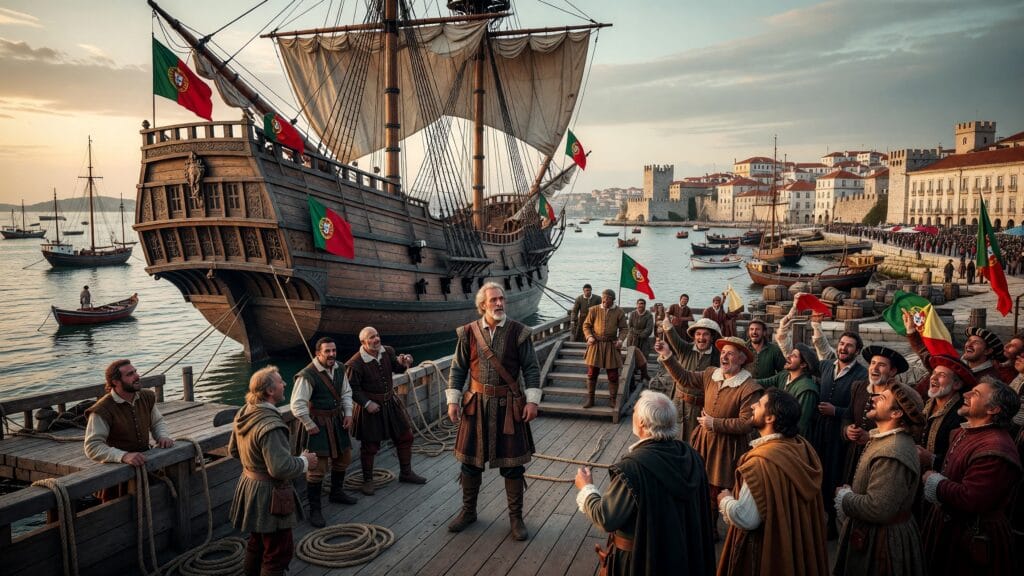
Harbor entries are rarely spontaneous. Processions carry messages to the eye: flags, trumpets, and choreographed greetings that convert arrival into legitimacy. When Vasco’s vessels crept into the Tagus, the waterfront convulsed with ceremony. Chroniclers evoke bells, a royal audience, and a liturgical note of thanksgiving, though specifics differ across texts.
King Manuel I, styled “the Fortunate,” understood the optics. The quayside spectacle was a state communiqué: Portugal had found a road to India that bypassed Venetian brokers and Mamluk tariffs. If the date—perhaps 18 September—was etched in proclamations, the spectacle was etched in memory. The city became a living proclamation of intent.
Mini timeline:
- July 1497: Fleet departs Lisbon, rounds the Cape of Good Hope.
- May 1498: Reaches Calicut on India’s Malabar Coast.
- July 1499: Berrio reportedly reaches Lisbon first with news.
- September 1499: Vasco enters the Tagus after Azores delay; Lisbon celebrates.
It is astonishing how much political weight could rest on a sail or a salute. Lisbon’s staging that day threaded piety through power. The procession, likely including clergy, courtiers, and guilds, advertised a monarchy aligned with Providence, steering a small kingdom into oversized oceans and oversized ambitions.
05 – King Manuel I’s Strategy Behind the Celebration
For Manuel I, glory was also policy. The return fixed his kingship to a program of expansion that had been incubating across decades of Atlantic ventures, from Madeira to São Tomé. Pageantry gathered public attention; decrees, contracts, and outfitting lists would harvest it. The king moved quickly to institutionalize what the fleet had proven possible.
Rewards followed. Vasco was honored and pensioned; officers like Nicolau Coelho received recognition. The full scope and timing of titles, including the admiralty, were spread across subsequent years, but the direction was unmistakable. Lisboan docks soon filled with the hammer-speech of shipwrights as the crown prepared a larger armada.
But this was only the beginning. The victory solved one problem and created another: a route existed, but it had to be defended, provisioned, and made profitable against entrenched networks. Lisbon’s festival concealed spreadsheets of risk. Manuel’s council weighed gold, ships, and lives, and found themselves drafting a blueprint for empire.
06 – News from India: Calicut, Cochin, and a Fractured Ocean
What did the sailors actually report? Calicut’s ruler, the Zamorin, had welcomed the novelty yet measured it against the interests of Muslim merchants who dominated the spice trade. Portuguese gifts, modest by local standards, underwhelmed. Misunderstandings hardened into tension. At Anjediva, violence broke, foreshadowing future confrontations along the coast.
Still, the voyage had touched allies-in-waiting. Cochin and Cannanore offered alternative openings, especially as Portuguese guns whispered promises of protection. The Indian Ocean was not a vacuum; it was a federation of port-polities, guilds, and rivalries. Lisbon’s next fleets would exploit those cracks, alternately bargaining and blasting their way into markets.
The sailors’ reports gave a map more social than cartographic. They sketched who controlled warehouses, who set prices, and who could be coaxed into alliances. When vasco da gama returns to lisbon pulsed through Lisbon’s streets, the most valuable cargo may have been not pepper but intelligence about this contested oceanic world.
07 – Counting the Cost: Scurvy, Storms, and Survivors
Triumph bled into tally. The crews had been thinned by scurvy, a disease Europeans struggled to understand, and by violent encounters ashore. Conditions aboard—a diet of hard biscuit, salted meat, and rationed water—left gums raw and bodies failing. The voyage’s ledger included profits and promises, but also funerals and empty hammocks.
The exact number of survivors is debated, yet contemporary suggestions indicate heavy losses. The stores ship had been scuttled on the outward voyage. By the time the Berrio sprinted home and the admiral’s ship followed, the fleet had shrunk, and Lisbon families were learning that discovery could mean a mourning dress.
It is easy to forget how many hands made the route possible: pilots from Malindi, translators, ship carpenters, and anonymous deckhands. The return immortalized one name, but the voyage’s labor was collective and multicultural, stitched from knowledges that had long existed in the Indian Ocean before Portugal arrived.
08 – Measuring the Profits and the Promise
Spice was arithmetic. Pepper bought in India could be sold for multiples of its price in Europe, even after freight and losses. The cargo that came with the Berrio and the admiral’s ship hinted at margins that could finance more fleets, more fortresses, and more guns. Merchants inhaled the aroma and exhaled calculations.
Yet the profits were not just immediate. They promised leverage over competitors and bargaining power with allies. Lisbon’s Casa da Índia would soon centralize auctions and regulate trade, tying the oceanic venture to a royal monopoly. When vasco da gama returns to lisbon became a phrase on everyone’s lips, it translated directly into contracts and credits.
Economic consequences rippled outward. Artisans found work fitting hulls and casting artillery. Farmers supplied provisions for fleets that would winter in the Tagus. Maps, charts, and rutters entered copying workshops. The voyage’s returns multiplied across the city’s workshops, embedding discovery into the everyday economy of Lisbon.
09 – Sources, Silences, and the Date Debate
Even famous days can blur. Some sources place Vasco’s arrival in early September 1499; others point to mid or late September, with 18 September often cited in later tradition. The discrepancy stems from staggered arrivals, losses at sea, and the fact that the Berrio delivered the headline weeks before the admiral himself.
Our best guides are partial. The Roteiro da Viagem de Vasco da Gama, attributed by some to Álvaro Velho, gives invaluable navigational detail but is reticent on Lisbon’s reception. João de Barros’s “Décadas da Ásia,” written decades later, shaped national memory, while Gaspar Correia’s “Lendas da Índia” embroidered vivid but sometimes contested stories.
When historians write that vasco da gama returns to lisbon, they are tracing a moving target: news arriving in July, grief in the Azores, and then the admiral’s ship in September. The story coheres around the idea of a city turned toward the river, awaiting confirmation that the world had, in fact, changed.
10 – From Return to Empire: The Policy Chain Reaction
The news set off a policy chain reaction. Manuel I commissioned larger armadas, culminating in fleets that would mix trade with coercive diplomacy. Pedro Álvares Cabral’s 1500 voyage, which stumbled upon Brazil before reaching India, established a permanent presence and provoked conflict, including the destruction of a Portuguese factory at Calicut.
By 1502, a reinforced expedition under Vasco returned to the Indian Ocean with a mandate to impose cartazes—safe-conducts—and to use violence where bargaining faltered. The Estado da Índia took shape piecemeal: forts, captains, and treaties stitched together from Hormuz to Malacca. The moment of return had weaponized information into policy.
In this light, the phrase vasco da gama returns to lisbon reads like a trigger. It was not merely a triumphant homecoming; it was a hinge in administrative imagination, where a European monarchy began to conceive of power projected along sea lanes as routine statecraft, not singular adventure.
11 – Religion, Ritual, and the Portuguese Imagination
Religion threaded through the narrative. The Cross of the Order of Christ emblazoned sails and royal rhetoric alike. Processions and Te Deum hymns framed the voyage as providential, a Christian thrust into waters governed, in European eyes, by Muslim intermediaries. Piety sanctified policy, drawing moral lines onto nautical charts.
Manuel’s later patronage at Belém—most famously the Jerónimos Monastery—became a stone memory of these ventures, dedicated to prayer for sailors and thanks for safe returns. Historians caution against reading these monuments as literal diaries, yet they express how the dynasty wove discovery into the sacred fabric of rule.
The admixture of faith and force was not unique to Portugal, but Lisbon’s liturgies gave it a distinct cadence. Blessings over ships, sermons on mission, and the veneration of mariner saints carried political currents. The return from India arrived not only to markets but to altars, inscribing oceanic ambition in ritual time.
12 – Lisbon Transformed: Markets, Maps, and Mariners
Lisbon itself shifted. The waterfront swelled with warehouses stacked for the next auctions. Dutch, German, and Italian factors listened for prices, while Portuguese pilots traded stories that would become routes. Mapmakers gathered scraps of latitude, currents, and capes, drawing lines that stitched together an emerging planet.
The Casa da Índia centralized this new knowledge, enforcing secrecy when it could and buying silence when it must. Mariners who had tasted the monsoons became prized commodities, moving between armadas as human repositories of lived geography. When vasco da gama returns to lisbon solidified into a civic legend, it also became a recruitment poster.
The social consequences flowed downhill and sideways. Apprenticeships shifted as boys angled for maritime futures. Inns near the docks grew loud with negotiation. The city’s diet even changed as new tastes filtered into kitchens. Discovery did not just alter the globe; it remodeled neighborhoods, reconfigured skills, and rewrote the ambitions of a generation.
13 – Rivals React: Venice, Mamluks, Ottomans, and Castile
Beyond Portugal, alarm bells rang. Venice, whose prosperity had long ridden spice-laden galleys from Alexandria, read the news like a threat memo. The Mamluk Sultanate faced shrinking customs duties and a geopolitical squeeze. The Ottomans, inheritors of Constantinople and guardians of crucial choke points, took stock of a European challenge arriving by the back door.
Diplomacy and war followed. Venetian envoys probed for intelligence; Mamluk fleets, with Gujarati allies, clashed with the Portuguese at sea, setting the stage for the climactic Battle of Diu in 1509. Castile, meanwhile, measured its own Atlantic successes and the 1494 Tordesillas line, working out how to complement or compete with Portuguese arcs.
Immediate consequence:
European spice supplies diversified, Lisbon’s prestige surged, and the crown accelerated armament and recruitment for India-bound fleets. Rivals began adjusting prices and scouting alliances.
Long-term consequence:
The Indian Ocean became a zone of sustained conflict and negotiation, leading to a Portuguese seaborne empire, the decline of certain Mediterranean intermediaries, and a durable reconfiguration of global trade.
The victory solved one problem and created another: control of a route required a navy in being and a diplomacy of fear and favor. Lisbon learned quickly that the ocean’s freedoms came with responsibilities—convoys to organize, treaties to enforce, and bruised rivals keen to recover their margins.
14 – Memory, Myth, and the Making of a National Hero
Memory simplifies. Lisbon’s return scene was retold until it felt inevitable: a hero sails, a king blesses, an empire begins. Yet modern historians insist on the complexity beneath the celebratory crust—the compromises in India, the contested dates, the many hands that steadied the tiller. Hero-making abridges; scholarship restores.
Later centuries would crown Vasco with epic poetry, statues, and schoolbook certainty. The “Lusíadas” by Luís de Camões canonized the voyage in a mythic register, binding the navigator’s grit to a nation’s destiny. Public monuments offered stone answers to questions the archives approach with more hesitation.
And still, the core image endures: a scarred ship on a bright river, a city crowded to the quays. When people say vasco da gama returns to lisbon, they summon not just an arrival but an argument about who gets remembered and how the messy labor of contact is turned into clean-lined heritage.
15 – Conclusion
On or around 18 September 1499, a battered Portuguese ship slipped into the Tagus, and Lisbon chose to see in it a future. The phrase vasco da gama returns to lisbon compresses months of fear, negotiation, and loss into a single civic heartbeat. That heartbeat synchronized a kingdom’s plans with an ocean’s possibilities.
The return did not end a story; it inaugurated an era. It bent trade routes, spurred conflict, and rewired statecraft across continents. Its legacy is double-edged—opening worlds and closing others, enriching some while imperiling many. To watch the sails appear again on the Tagus is to watch global history crest a horizon and never look back.
16 – FAQs
- When did Vasco da Gama return to Lisbon?
Tradition cites 18 September 1499, though some sources place his arrival in early or mid-September. The confusion partly stems from the Berrio reaching Lisbon weeks earlier with the first news. - Where did the return take place?
Lisbon, on the Tagus estuary. The city’s quays and churches hosted the reception, framing the event as both a civic celebration and a statement of royal policy. - Who were the main figures involved?
Vasco da Gama led the expedition; King Manuel I arranged the reception and subsequent policy; Nicolau Coelho captained the swift Berrio; Paulo da Gama, Vasco’s brother, died in the Azores during the return. - What caused this voyage and its return to matter so much?
The voyage proved a direct sea route from Europe to India, promising vast profits and political leverage. When vasco da gama returns to lisbon, it validated decades of Atlantic experiments and justified rapid expansion into the Indian Ocean. - What were the immediate consequences?
Celebration gave way to mobilization: larger fleets were outfitted, trade was centralized through the Casa da Índia, and negotiations—often backed by force—began with Indian Ocean polities. Rival powers recalibrated in response. - What is the long-term legacy?
Portugal built a seaborne empire, reshaping global trade and diplomacy. The legacy includes cultural exchanges, maritime technologies, and enduring debates about violence, commerce, and the human costs of early modern empire.
17 – External Resource
18 – Internal Link
Other Resources
- Encyclopaedia Britannica – general search for the exact subject
- Google Scholar – academic search for the exact subject
- Internet Archive – digital library search for the exact subject
Sources and References
-
Primary Source – Official Report of the Voyage
“Esmeraldo de Situ Orbis” by Duarte Pacheco Pereira (c. 1505–1508). Critical edition in:
Duarte Pacheco Pereira, Esmeraldo de Situ Orbis, ed. Joaquim Barradas de Carvalho. Lisbon: Comissão Nacional para as Comemorações dos Descobrimentos Portugueses, 1991.
Note: A contemporary Portuguese account that describes early Portuguese oceanic exploration and the opening of the sea route to India, corroborating the context and importance of Vasco da Gama’s expeditions, including his first voyage completed with his return to Lisbon in 1499. -
Primary Source – Royal Documentation
Cartas de D. Manuel I (Letters of King Manuel I), in: Corpo Diplomático Portuguez, vols. I–II, ed. Visconde de Santarém. Paris: J. P. Aillaud, 1846–1874.
Note: Contains royal correspondence and official letters from King Manuel I concerning the voyage of Vasco da Gama, royal rewards, and the strategic significance of the new sea route, supporting details about the political and economic impact of da Gama’s successful return to Lisbon. -
Primary Source – Contemporary Chronicle
Gaspar Correia, Lendas da Índia, 4 vols., ed. Rodrigo José de Lima Felner. Lisbon: Academia das Ciências de Lisboa, 1858–1864 (originally written 16th century).
Note: A detailed 16th‑century chronicle of Portuguese activities in India; provides narrative descriptions of Vasco da Gama’s first voyage, his arrival back in Portugal, and the early organization of the Carreira da Índia (India Run), supporting narrative elements about the voyage and its reception. -
Modern Scholarly Study – Comprehensive Biography
Sanjay Subrahmanyam, The Career and Legend of Vasco da Gama. Cambridge: Cambridge University Press, 1997.
Note: A major academic reassessment of Vasco da Gama, using Portuguese, Indian, and other archival sources. It analyzes the chronology of the 1497–1499 voyage, the date and circumstances of his return to Lisbon, and the subsequent construction of his reputation, supporting both factual details and the broader interpretive framing of his historical significance. -
Modern Scholarly Study – Portuguese Expansion
A. R. Disney, A History of Portugal and the Portuguese Empire, Vol. 2: The Portuguese Empire. Cambridge: Cambridge University Press, 2009.
Note: Provides context for Portugal’s maritime expansion under Manuel I, the economic aims of reaching India by sea, and the structural consequences of da Gama’s successful return (creation of a permanent Asia trade system, changes in Lisbon’s role, and the rise of the Estado da Índia). -
Modern Scholarly Study – Economic and Maritime Context
Fernand Braudel, The Mediterranean and the Mediterranean World in the Age of Philip II, Vol. 1. Berkeley: University of California Press, 1995 (original French ed. 1949).
Note: While focused on a slightly later period, Braudel’s classic work explains the shift in global trade networks initiated by Portuguese voyages around Africa to India, helping to contextualize how da Gama’s return to Lisbon in 1499 altered long‑distance trade between Europe and Asia. -
Encyclopedic Reference – Historical Overview
“Vasco da Gama.” Encyclopaedia Britannica Online. Encyclopaedia Britannica, Inc. (accessed 2024).
Note: Summarizes the key dates of da Gama’s life, details of the 1497–1499 voyage, the return to Lisbon, and the immediate consequences for Portuguese imperial policy, supporting the basic chronological framework of the event. -
Museum / Library Resource – Primary Materials and Context
Biblioteca Nacional de Portugal, digital collections on “Descobrimentos Portugueses” (Portuguese Discoveries), including maps, royal charters, and early printed narratives: https://bndigital.bnportugal.gov.pt (accessed 2024).
Note: Hosts digitized early cartographic and documentary evidence related to the discovery voyages and Lisbon’s role as an imperial capital, supporting statements about the centrality of Lisbon in managing and benefiting from the new sea route to India after da Gama’s return.