Table of Contents
- Prologue: Kandahar After Nadir Shah’s Death, 1747
- The Loya Jirga at Shahr-e Safa: A Crown Without a Throne
- Ahmad Khan Abdali: From Hostage to Commander to Founder
- Ceremony and Symbol: Cloaks, Titles, and Oaths
- Building a Center: Kandahar’s Early Institutions
- Uniting the Durrani Confederation
- Seizing Kabul and Ghazni: The Northern Gate
- Herat and the Western Horizon
- Punjab and Delhi: Opportunity and Entanglement
- Money, Power, and Administration: Revenue, Plunder, and Appointments
- Faith, Poetry, and the Making of Authority
- Rivals on Every Horizon
- Lives in Motion: Traders, Tribes, and Warfare’s Shadow
- From Abdali to Durrani: Turning Point and Memory
- Conclusion
- FAQs
- External Resource
- Internal Link
Article Summary: In the autumn of 1747, amid the collapse of Nadir Shah’s empire, Ahmad Khan Abdali was chosen near Kandahar as sovereign, transforming a desperate interregnum into a new polity. This article follows the volatile months in which Afghanistan’s Durrani Empire took shape. We trace the loya jirga, contested symbols of legitimacy, and the first campaigns to secure Kabul, Ghazni, and Herat. We chart the pull of the Punjab and Delhi, and the administrative scaffolding built at Kandahar. Through contested sources and human consequences, we examine how and why ahmad shah durrani establishes durrani empire became a turning point in regional history. The narrative closes by weighing legacies carried into modern Afghan identity and South Asian geopolitics.
Why keep reading: A new empire was declared by a young commander with no safe borders, no fixed treasury, and rivals on every horizon. Follow the knife-edge decisions and fragile alliances that turned a tribal confederation into a kingdom whose reach redefined the politics of Iran, Afghanistan, and India.
At a glance:
- Event: Establishment of the Durrani Empire by Ahmad Shah at/near Kandahar
- Date: October 1747 (some details of the exact day and ceremonial site are debated)
- Place: Kandahar region, with a loya jirga traditionally located at Shahr-e Safa
- Main figures: Ahmad Khan Abdali (Ahmad Shah Durrani), Sufi leaders such as Sabir Shah (per tradition), tribal elders of the Abdali/Durrani confederation
- Why it mattered: It created a durable Afghan empire that altered power balances across Central and South Asia, linking Kabul, Kandahar, Herat, and the Punjab under one crown.
01 – Prologue: Kandahar After Nadir Shah’s Death, 1747
News of Nadir Shah’s assassination in June 1747 raced across the arid plains with the velocity of rumor. Garrisons that owed him tribute wavered, and commanders guarding caravan routes weighed new loyalties. In Kandahar, where trade met frontier, the vacuum felt immediate: authority dissolved faster than the summer snowmelt in the nearby mountains.
Merchants delayed departures, sensing sudden risk on roads that only weeks earlier had felt reasonably policed. Local chiefs tallied their horsemen and ammunition while messengers rode to elders. In this uneasy world, ahmad shah durrani establishes durrani empire would soon become not just an outcome but a response to chaos, a promise that walls would hold and markets would open.
Yet the city did not stop breathing. Kandahar’s bazaars still smelled of leather and cumin, and the rhythmic pound of millstones echoed behind mud-brick alleys. But behind the habit of commerce, uncertainty gnawed: who would provide justice, protection, and coinage worthy of trust when yesterday’s empire lay in shards?
02 – The Loya Jirga at Shahr-e Safa: A Crown Without a Throne
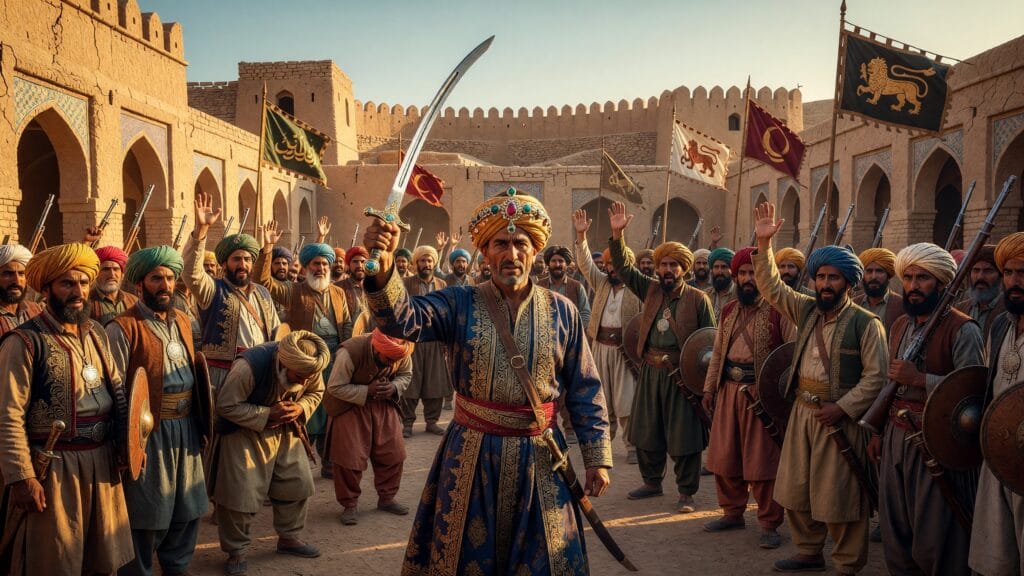
In the weeks after Nadir Shah’s fall, tribal notables convened a loya jirga near Kandahar, often located by tradition at Shahr-e Safa. Delegations came with grievances, ambitions, and hostages of reputation. They sought not merely a leader but a settlement under which rival clans might coexist without tearing the land apart.
Contemporary and later chroniclers suggest the assembly considered multiple candidates, some older, some with longer-standing claim. What Ahmad Khan Abdali possessed, besides youth and charisma, was the confidence of men who had survived hard campaigns with him. He offered not a bloodline beyond dispute, but a plausible future stitched from shared victories.
The jirga’s logic was coldly pragmatic: the man who could gather horsemen, secure revenue, and mediate quarrels would be king. Yet behind the horse-trading stood ritual, oaths, and symbols. In landscapes where roads were fragile and paperwork scarce, reputation and ceremony were the bridges that let power cross the rivers of distrust.
03 – Ahmad Khan Abdali: From Hostage to Commander to Founder
Ahmad Khan Abdali’s path to kingship ran through captivity and service. As a young Abdali noble, he spent time in Persian custody and then rose under Nadir Shah’s gaze as a talented cavalry leader. His experience linked him to Persian military reforms even as he remained unmistakably Afghan in allegiance and speech.
What he learned in those years—discipline, logistics, and the value of speed—proved decisive. He cultivated allies by sharing plunder equitably and kept rivals close enough to monitor them. To men weary of arbitrary rule, he projected steadiness, a quality rare enough to feel like justice.
When the opportunity emerged in 1747, he possessed the portable assets that mattered: loyal squadrons, relationships among Sufi intermediaries, and credibility with traders who favored safe roads. That combination, more than ceremonial flourish, allowed his claim to reach beyond a single valley or tribe.
04 – Ceremony and Symbol: Cloaks, Titles, and Oaths
Accounts of the coronation vary, but several threads recur. Later tradition holds that Sufi authority blessed Ahmad’s election, some saying a saintly figure placed a cloak upon him as a sign of sanctioned rule. Whether the famous Kandahar cloak was involved at that moment remains debated; still, the story itself helped solidify legitimacy.
Another tradition recalls the bestowal of the title Durr-i Durran—“Pearl of Pearls”—from which the empire derived its name. Some historians argue this title emerged gradually rather than in a single epiphany. Either way, a ruler without an arch of stone needs a canopy of words; titles functioned as architecture when brick could be toppled.
Oaths mattered as much as crowns. Tribal leaders pledged service in exchange for recognition of their lands and rights. Ahmad pledged impartiality in adjudicating disputes. In a world where paper archives were light, the archive of honor—remembered promises, witnessed by elders—policed conduct as effectively as soldiers at a gate.
05 – Building a Center: Kandahar’s Early Institutions
Early in his reign, Ahmad Shah leaned on Kandahar as his administrative heart. Caravanserais doubled as intelligence hubs, and the bazaar became a bellwether for policy. When merchants believed banditry would be punished, credit flowed; when they doubted it, grain prices rose, and whispers of flight began.
He tasked trusted lieutenants with tax assessment and local policing, blending tribal custom with inherited Persian registries where available. To demonstrate continuity, he issued coinage, a tangible declaration that promises would be honored in silver as well as speech. If Kabul or Herat beckoned, Kandahar still served as the throne’s anvil.
Security came first. Garrisons at key gates, patrols along caravan routes, and adjudication sessions in which commoners could present petitions all signaled a recalibrated order. Not every reform bit deeply, but the expectation that judgments could be appealed to a central figure began to change behavior at village scales.
06 – Uniting the Durrani Confederation
The Abdali clans—soon called Durrani in honor of their chosen king—did not melt into a single body overnight. Chiefs expected their autonomy, stipends, and the right to lead in war. Ahmad Shah wielded a delicate arithmetic, balancing grants of land and booty against demands for discipline when campaigns began.
Rivalries with the Ghilzai and other groups simmered. To prevent open conflict, Ahmad Shah arranged marriages, rotated command, and set up adjudication councils where affronts could be aired before they turned into raids. He understood that enforcing absolute uniformity would shatter the very alliance he needed to survive beyond Kandahar’s walls.
In this confederational model, authority was not a straight line; it moved in circles, returning to the center when caravans could travel and out to the periphery when snows closed the passes. For a time, the arrangement held, creating the political oxygen the nascent empire required.
07 – Seizing Kabul and Ghazni: The Northern Gate
With his authority recognized near Kandahar, Ahmad Shah moved swiftly to secure Kabul and Ghazni, crucial to controlling the routes into the Hindu Kush and beyond. These were not merely trophies; they were locks for the doors of Afghanistan, key to channeling trade and military movement.
Contemporary sources suggest that initial resistance in Kabul was minimal, a reflection of exhaustion after the Persian wars and local calculation that Ahmad’s coalition could offer stability. Ghazni followed, and with both cities in hand, a corridor connected Kandahar to the northern markets and summer pastures.
Mini timeline:
- June 1747: Nadir Shah assassinated in Iran; imperial framework collapses.
- October 1747: Loya jirga near Kandahar chooses Ahmad Khan Abdali as ruler.
- 1747–1748: Kabul and Ghazni secured; early administrative measures initiated.
- 1750–1751: Herat brought into the orbit of the new Durrani regime.
These gains reassured allies and unnerved opponents. A king who held Kabul could speak to the Turkic khanates and to Indian courts alike. Ahmad Shah’s envoys now had news to deliver and terms to propose, backed by the unblinking fact of walls and banners under his name.
08 – Herat and the Western Horizon
Herat, the garden city of the west, posed a stiffer challenge. Its allegiance tilted with the fortunes of Persian dynasties, and local elites prized autonomy. Ahmad Shah tested a mix of negotiation and force, seeking a settlement that honored Herat’s prestige while integrating its revenue into his budget.
By 1750–1751, Herat leaned firmly into the Durrani sphere. Yet the city’s capture was more than a line on a map; it connected the empire to Khorasan’s networks of scholars, Sufi lodges, and artisans. Textile guilds and caravan keepers found new patrons, and with them came the promise of predictable dues rather than arbitrary levies.
Still, the western frontier never slept. Persian contenders watched warily. Ahmad Shah’s commanders garrisoned forts and bargained for grain with landlords who saw themselves as partners, not subjects. The balance was uneasy but productive, enough to stabilize a revenue stream that would underwrite adventures to the east.
09 – Punjab and Delhi: Opportunity and Entanglement
The Punjab and the tottering Mughal court beckoned with wealth and risk. The routes from Peshawar toward Lahore promised rich customs, and the politics of Delhi offered tribute from those who feared worse alternatives. Ahmad Shah moved deliberately, testing defenses and gauging the reactions of Sikh misls and regional nawabs.
In 1748 he probed the frontier, and by the mid-1750s he returned with greater force, culminating in interventions that reshaped Delhi’s courtly arithmetic. Tribute and plunder fed his treasury, but each foray created obligations—promises to allies, guarantees to merchants, and, inevitably, resentments among those displaced by shifting rule.
This eastern policy entwined the Durrani Empire with the destinies of countless Punjabis, Marathas, and Mughals. Victories stabilized Kandahar’s coffers, yet they also spawned new enemies. The victory solved one problem and created another, a pattern that would define Ahmad Shah’s long reach into the subcontinent.
10 – Money, Power, and Administration: Revenue, Plunder, and Appointments
Empires breathe on revenue. Ahmad Shah’s coffers drew from land taxes, caravan duties, minting fees, and—crucially in the early years—campaign plunder and tribute. The Punjab expeditions injected liquidity that paid stipends, bought grain, and ensured garrisons did not mutiny when supplies ran thin in winter.
He appointed provincial governors who combined military command with fiscal duties, demanding remittances while tolerating local arrangements that maintained order. Records in Persian administrative style—tight but not exhaustive—appear in references by later historians, who piece together a system pragmatic enough to function across deserts and passes.
Coinage bearing his titles circulated from Kandahar to Kabul, a portable statement of authority. Yet coin alone could not compel obedience. Ahmad Shah relied on frequent inspections, hostage-exchanges among elites, and the subtle incentives of honor, ensuring that provincial commanders sought favor from a center that could reward or replace them.
11 – Faith, Poetry, and the Making of Authority
Religion and culture did not sit apart from power; they braided into its cords. Sufi leaders provided a language of legitimacy that resonated across tribal lines. If a saint’s blessing accompanied the oath, the oath took on a weight that neither spear nor coin could supply alone.
Ahmad Shah himself wrote poetry in Dari, a form of self-fashioning common among rulers of the Persianate world. Verses praising justice and humility projected an ideal of kingship even as campaigns demanded ruthlessness. It is easy to forget how fragile this world still was; the poem became a promise that policy tried to keep.
Clerics mediated disputes and sanctified public events, while shrines anchored communal memory. Though later chroniclers may have embellished aspects of the coronation, the broader pattern holds: spiritual networks bolstered state-building, and the state, in turn, patronized scholars and endowments that amplified its voice.
12 – Rivals on Every Horizon
To the west, Iranian contenders nursed ambitions in Khorasan; to the north, khanates watched the passes with transactional interest; to the east, Marathas and Sikhs reshaped power in India. The Durrani Empire could not stand still without losing ground. Diplomacy, marriages, and punitive raids formed a triad of responses.
Ahmad Shah calculated risk as if solving for weather. He struck when snow and supply favored movement and paused when caravans needed protection more than soldiers needed glory. This rhythm, though imperfect, kept his domains from unraveling under the sheer strain of distance and diverse loyalties.
Even so, contests intensified. Later interventions in India would culminate in titanic battles, but in 1747–1751 the struggle was to survive the founding. Each treaty bought time; each garrison tied down funds. The empire lived by motion, a caravan-state whose sovereignty rolled on wheels and hooves.
13 – Lives in Motion: Traders, Tribes, and Warfare’s Shadow
What did the founding mean for ordinary people? Caravaneers measured it in tolls reduced or raised, guards posted or withdrawn. Farmers read it in the price of seed and the predictability of tax collectors. When Ahmad Shah’s men restored patrols, merchants chanced longer routes; when rumors of rebellion spread, they turned back.
War scattered lives. Captives were ransomed, families relocated to safer districts, and artisans recruited to repair fortifications or mint coins. On market days, gossip moved as fast as cash. The rumor that Kabul had fallen or Herat was secure could shift prices in Kandahar by sundown.
And yet, amid disruption, opportunities surfaced. Traders who understood the new geography prospered, opening warehouses where tax receipts could be verified and disputes settled without violence. For many, the Durrani name came to mean less terror on the road, more certainty at the scale, and a judge who might actually appear.
14 – From Abdali to Durrani: Turning Point and Memory
Names carry agendas. By embracing the title Durr-i Durran and extending it to his confederation, Ahmad Shah nudged identity from a narrower Abdali lineage toward a broader Durrani framework. This was politics by vocabulary, a bid to weld diverse clans to a shared banner without erasing their autonomy.
Later generations would argue over what began exactly in October 1747—empire, kingdom, or confederation under a king. Modern historians stress the fluidity of the arrangement. But this was only the beginning: the brand of Durrani gave coherence to expansions that followed, from Kabul and Herat to Lahore and Delhi’s gates.
Immediate consequence:
Security improved on key routes, elite rivalries were mediated, and a recognized mint and court emerged at Kandahar, projecting predictable authority across nearby districts.
Long-term consequence:
A transregional empire took shape, influencing Iranian, Afghan, and Indian politics for decades. The Durrani identity seeded institutions that outlived Ahmad Shah and framed Afghan statehood debates into the modern era.
Memory is never neutral. Afghan chronicles celebrate the unification and piety; Indian narratives measure costs in tribute and disruption; Persian accounts worry about the loss of Khorasan influence. The truth moves among them: a hard-won sovereignty forged by calculation, belief, and the will to keep caravans moving.
15 – Conclusion
The autumn scene near Kandahar—elders gathered, oaths sworn, a young commander elevated—was more than ceremony. It marked the pivot from imperial collapse to a new architecture of power, in which mounted speed and ritual legitimacy built a state. In this narrative, ahmad shah durrani establishes durrani empire is both headline and hinge, describing an act that reordered space from Herat to the Punjab.
What endured were not just cities taken or taxes assessed, but a template: authority tethered to confederation, mobility harnessed to law, and spiritual sanction wedded to policy. From Abdali to Durrani, from Kandahar’s bazaars to Kabul’s gates, the founding left a durable idea of Afghan kingship whose echoes still sound in the region’s political grammar.
16 – FAQs
- When was the Durrani Empire founded?
Most accounts place the founding in October 1747, when a loya jirga near Kandahar selected Ahmad Khan Abdali as ruler. In brief: ahmad shah durrani establishes durrani empire at this moment amid the breakdown following Nadir Shah’s assassination. - Where did the key selection and early consolidation occur?
The decisive assembly occurred near Kandahar, often remembered as Shahr-e Safa. Early consolidation then moved through Kabul, Ghazni, and later Herat, anchoring authority across Afghanistan’s central corridors. - Who were the principal figures in the founding?
Ahmad Khan Abdali—later styled Ahmad Shah Durrani—stood at the center, supported by tribal elders of the Abdali/Durrani confederation and legitimized, according to tradition, by Sufi leaders such as Sabir Shah. - What caused the empire’s sudden emergence?
The assassination of Nadir Shah in 1747 left a power vacuum. Ahmad Shah fused military credibility, tribal mediation, and ritual legitimacy, creating a coalition strong enough to stabilize Kandahar and expand toward Kabul and Herat. - What were the main consequences in the first years?
Security improved along caravan routes, Kabul and Ghazni were secured, Herat joined the orbit by 1750–1751, and expeditions to the Punjab generated revenue, entangling the empire with Delhi’s politics. - What is the legacy of Ahmad Shah’s founding?
He established a transregional Afghan empire and a Durrani identity that influenced statecraft for generations. The model of confederational kingship, blending mobility, ritual, and negotiated authority, shaped Afghan governance into the modern era.
17 – External Resource
18 – Internal Link
Other Resources
- Encyclopaedia Britannica – general search for the exact subject
- Google Scholar – academic search for the exact subject
- Internet Archive – digital library search for the exact subject
Sources and References
-
“Ahmad Shah Durrani.” Encyclopaedia Iranica.
Provides a scholarly overview of Ahmad Shah Durrani’s life, his election as leader in Kandahar in 1747, the formation and early expansion of the Durrani Empire, and his role in Afghan state-building. -
Vogelsang, Willem. The Afghans. Oxford: Blackwell Publishing, 2002.
Offers detailed modern scholarship on the political and tribal landscape of 18th‑century Afghanistan, including the collapse of the Safavid and Hotak powers, the rise of the Abdali (later Durrani) confederation, and the circumstances surrounding Ahmad Shah’s accession in Kandahar. -
Noelle, Christine. State and Tribe in Nineteenth-Century Afghanistan: The Reign of Amir Dost Muhammad Khan (1826–1863). Richmond: Curzon, 1997.
While focused on the 19th century, this work includes substantial background on the Durrani imperial framework created in the mid‑18th century and explains how Ahmad Shah’s political structures and tribal alliances shaped later Afghan governance. -
“Durrānī Dynasty.” Encyclopaedia Britannica (online edition).
Summarizes the establishment of the Durrani (Abdali) dynasty in 1747, the role of Kandahar as an early center of power, and the empire’s territorial reach—supporting chronological and political details about the founding of the state. -
Elphinstone, Mountstuart. An Account of the Kingdom of Caubul, and its Dependencies in Persia, Tartary, and India. 2nd ed. Revised. London: Longman, Hurst, Rees, Orme, and Brown, 1819.
A near-contemporary (early 19th‑century) narrative based on extensive travel and interviews, describing Afghan political traditions, tribal structures, and historical memories of Ahmad Shah Durrani and the empire’s consolidation—used to corroborate descriptions of governance and social organization. -
“The Abdālīs (Durrānīs) and the Rise of Ahmad Shah.” In: The Cambridge History of Iran, Volume 7: From Nadir Shah to the Islamic Republic, edited by Peter Avery, Gavin Hambly, and Charles Melville. Cambridge: Cambridge University Press, 1991.
Academic chapter explaining the regional power vacuum after Nadir Shah’s death, the selection of Ahmad Shah at Kandahar in 1747, and the early military campaigns that defined the Durrani Empire’s frontiers. -
Kaye, John William, ed. History of the War in Afghanistan, Vol. 1. London: Bentley, 1851.
Contains 18th‑ and early 19th‑century documentary material and retrospective accounts regarding the Durrani rulers, including references to Ahmad Shah’s conquests in India and Persia—supporting the article’s discussion of the empire’s external campaigns. -
“Afghanistan: History – The Durrani Empire.” Library of Congress, Country Studies (U.S. Federal Research Division).
Offers a concise, government‑sponsored scholarly overview of the Durrani period, including Ahmad Shah’s founding of the empire, its administrative character, and its long‑term significance for Afghan state formation.

