Table of Contents
- The Dawn Before the Disaster: Veracruz in the Late 18th Century
- Nature’s Threat Beneath the Surface: Understanding San Martín Volcano
- A City on Edge: Veracruz’s Social and Economic Fabric Prior to 1793
- The First Tremors: Early Signs of Volcanic Activity
- The Eruption Unfolds: Chronology of the San Martín Catastrophe
- Flames and Ashes: Witnesses to the Fiery Sky
- Human Stories Amidst the Chaos: Survival, Loss, and Courage
- The Aftermath: Physical Devastation and Immediate Responses
- The Impact on Veracruz’s Trade and Colonial Economy
- Religious Interpretations and Cultural Reactions to the Disaster
- Colonial Authorities and Emergency Governance
- The Path to Recovery: Rebuilding a City from Ashes
- Ecological Consequences: Changing Landscapes and Agriculture
- The San Martín Eruption in the Larger Context of Mexican Volcanism
- Legacy and Memory: How 1793 Shaped Veracruz’s Identity
- From Ashes to Awareness: Advances in Volcanology Spurred by San Martín
- The San Martín Eruption in Contemporary Mexican Historical Imagination
- Modern Reflections on a Forgotten Catastrophe
- Lessons Learned: Volcanic Risks in Colonial Times and Today
- Conclusion
- FAQs
- External Resource
- Internal Link
1. The Dawn Before the Disaster: Veracruz in the Late 18th Century
In the humid, bustling port city of Veracruz, 1793 began like any other tropical morning. The early sun struggled through a sky heavy with humidity, warming the stone-paved streets where merchants, sailors, and residents prepared for another day of commerce and colonial routine. Veracruz, perched on the Gulf of Mexico’s edge, was the crown jewel of New Spain’s eastern trade—a gateway to distant continents and to the wealth that flowed from the Americas.
Yet beneath this seemingly vibrant surface, a restless giant lurked: the San Martín volcano, a sentinel watching over the city from its lofty perch, hidden in the shadows but capable of shaping destinies. What locals knew then as a distant and dormant mountain would soon ignite nightmares of fire and ash, testing the spirit of a colony caught entirely unprepared. The peaceful rhythms would shatter dramatically. This is the story of how nature’s fury engulfed Veracruz in 1793 and forever altered its path.
2. Nature’s Threat Beneath the Surface: Understanding San Martín Volcano
San Martín was no ordinary volcano. Part of the Trans-Mexican Volcanic Belt—a region dotted with some of the most active and historic volcanoes in the Americas—it stood as both a geological marvel and a latent hazard. While largely dormant during the 1700s, the tension beneath its crust was like a tightly wound spring. Volcanoes in this corridor had shaped Mexican history long before the Spanish arrived, their eruptions etched into indigenous legends as forces of divine wrath or creation.
Here, superheated magma churned miles below, deep fractures and underground chambers slowly filling with molten rock. The San Martín edifice had forged the landscape with each eruption over millennia. But by the late 18th century, an uneasy calm prevailed—until the tectonic plates whispered of imminent upheaval, sending faint warnings that went largely unheeded.
3. A City on Edge: Veracruz’s Social and Economic Fabric Prior to 1793
Veracruz was a city of contrasts. Its prosperity sprung from the Atlantic trade routes, importing European goods and exporting silver, hides, and tropical commodities. This wealth, however, was unevenly distributed. The port thrived with merchants, colonial officials, African slaves, indigenous peoples, and mestizos all intertwined in a complex social hierarchy.
Despite its economic vitality, Veracruz was plagued by vulnerabilities: tropical diseases, mercenary raids, and the ever-present threat of hurricanes shaped daily life. A disaster of volcanic nature was not at the forefront of fears; the great mountain remained a silent guardian, overlooked by those absorbed in the tangles of colonial ambition and survival.
4. The First Tremors: Early Signs of Volcanic Activity
The warning signs came subtly and then with growing intensity. Months before the infamous eruption, residents began to notice strange phenomena: rumblings deep beneath the earth, minor earthquakes rocking buildings, strange sulfurous smells wafting in the breeze, and unexplained tremors that frightened animals and unsettled even the stoic populace.
Yet scientific understanding of volcanism was primitive at best. Colonial authorities attributed these signs to natural but incomprehensible forces, often invoking religious explanations rather than natural science. As the tremors grew stronger in early 1793, anxiety mounted, but preparation was minimal.
5. The Eruption Unfolds: Chronology of the San Martín Catastrophe
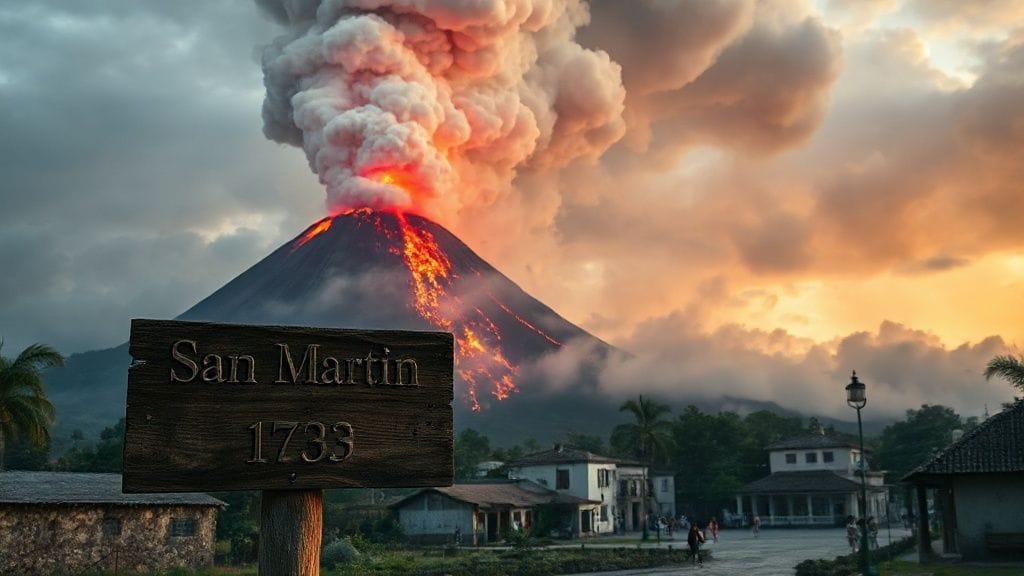
In April 1793, the volcano finally unleashed its fury. The eruption began with a violent explosion heard tens of miles away, shaking Veracruz to its core. Ash and cinders spewed into the atmosphere, darkening the sky in an apocalyptic eclipse that turned day into night. Lava flows crept down the mountainside, consuming distant farmlands and inexorably moving toward human settlements.
Over days and weeks, repeated blasts cast debris across wide areas, while pyroclastic flows—deadly avalanches of hot gas and rock—raced down the flanks, obliterating everything in their path. Rivers turned to mud and ash, suffocating aquatic life and contaminating drinking sources, while residents fled in panic or hunkered down in desperate prayers.
6. Flames and Ashes: Witnesses to the Fiery Sky
Contemporary accounts reveal a city gripped by terror and wonder. Juan Bautista, a local priest, wrote in his diary: “The heavens burn as if in the final judgment; black clouds rain fire and death upon us.” Merchants lost valuable cargo, homes crumbled under the weight of volcanic deposits, and the once-celebrated port found itself shrouded in an unrelenting grey veil.
Stories from survivors describe nights illuminated by eerie glows, rivers of molten rock that hissed and crackled like the wrath of an angry god, and animal migrations as nature desperately escaped the unfolding calamity. The eruption also revealed the fragility of colonial control, as communications faltered and fear spread like wildfire.
7. Human Stories Amidst the Chaos: Survival, Loss, and Courage
Amid the disaster, human resilience and tragedy intertwined. Families were separated, some perished while braving lava flows; others displayed heroic efforts rescuing neighbors or tending to the wounded. Anecdotes portray a community torn between helplessness and determination.
One striking story tells of Rosa Meléndez, a merchant’s wife, who single-handedly led children to safety across the ash-choked streets. Another tells of enslaved Africans whose knowledge of the rugged terrain proved crucial in guiding escape routes—an ironic reversal in a society built on brutal hierarchies.
8. The Aftermath: Physical Devastation and Immediate Responses
When the skies finally cleared, the landscape was unrecognizable. Fields were buried beneath thick layers of ash and pumice; the coastline was altered as volcanic deposits reshaped the shoreline. Veracruz’s infrastructure lay in ruins: warehouses, docks, and homes destroyed or damaged beyond repair.
Colonial authorities scrambled to restore order, organizing relief efforts and distributing food and water amid shortages. Yet logistical challenges, compounded by damaged roads and communication lines, hindered swift recovery.
9. The Impact on Veracruz’s Trade and Colonial Economy
Veracruz’s role as a pivotal port suffered dramatically. Maritime traffic slowed as ships hesitated to dock amid instability. The export of vital goods like silver plummeted, unsettling Spanish imperial revenues. Insurance costs skyrocketed, and traders debated relocating operations inland or to other more stable ports.
This economic shock resonated across New Spain, revealing the vulnerability of colonial enterprises to environmental catastrophe. It exposed the fragile interdependence between nature and commerce that shaped the colonial world.
10. Religious Interpretations and Cultural Reactions to the Disaster
The eruption quickly assumed a religious and cultural dimension. Many colonists interpreted it as divine punishment—a manifestation of God’s wrath against sin or an apocalyptic omen. Churches filled with penitents and processions were organized to seek divine mercy.
Indigenous communities brought their own mythological frameworks to bear, framing the eruption within a cosmic narrative of rebirth and destruction. These interpretations affected social cohesion and influenced colonial policy, reinforcing calls for moral reform alongside practical rebuilding.
11. Colonial Authorities and Emergency Governance
The colonial government’s response was a mixture of authoritarian control and emergent crisis management. Military units maintained order against looting and unrest, while officials appointed emergency committees charged with allocating scarce resources.
Yet the disparate responses exposed weaknesses in colonial administration: a rigid hierarchy struggled to balance top-down commands with local needs, and the absence of scientific expertise hampered informed decision-making. The disaster contributed to evolving notions of governance, disaster preparedness, and public welfare.
12. The Path to Recovery: Rebuilding a City from Ashes
Recovery was slow, painstaking, and fraught with setbacks. Rebuilding involved not just physical reconstruction but also economic revitalization, public health campaigns against ash-induced diseases, and psychological healing.
A surge in migration brought laborers from surrounding areas. Architectural styles evolved to incorporate volcanic materials, and urban planning adjusted to new geographical realities. Over decades, Veracruz reinvented itself, shaped indelibly by the eruption’s legacy.
13. Ecological Consequences: Changing Landscapes and Agriculture
The eruption’s environmental toll extended beyond immediate destruction. Agricultural lands’ fertility was initially devastated, causing food shortages.
Yet over time, volcanic soils enriched with minerals enhanced agriculture, supporting long-term growth in specific crops. Forests regrew along ash-dusted slopes, and new ecosystems emerged, a testament to nature’s resilience amid catastrophe.
14. The San Martín Eruption in the Larger Context of Mexican Volcanism
1793’s eruption was one among several significant Mexican volcanic events, including the famous 1737 eruption of Popocatépetl and the 1913 Paricutín birth. San Martín’s activity added valuable, if tragic, data to the tapestry of geological history in Mexico.
Volcanoes shaped cultural identities, migration patterns, and political borders; they were forces of destruction and renewal alike. Understanding San Martín enriches insights into human adaptations to a volatile land.
15. Legacy and Memory: How 1793 Shaped Veracruz’s Identity
The San Martín eruption entered collective memory as a defining moment in Veracruz’s history. Stories passed down generations embedded the disaster in folklore, art, and local traditions.
Commemorations, oral histories, and later historical writings emphasized themes of survival and rebirth, weaving the eruption into the city’s identity and sense of endurance against overwhelming odds.
16. From Ashes to Awareness: Advances in Volcanology Spurred by San Martín
Scientific interest in San Martín grew after 1793, marking a turn toward more systematic observations of volcanic phenomena in New Spain. Although formal volcanology was nascent, colonial scholars and later Mexican scientists began cataloguing eruptions, seismic events, and volcanic morphology with greater precision.
This helped lay groundwork for modern hazard assessment and risk mitigation practices, vital for a country still marked by active volcanoes.
17. The San Martín Eruption in Contemporary Mexican Historical Imagination
Modern Mexican historians and cultural commentators have revisited the 1793 eruption as more than a geological footnote. It is now framed as a pivotal event reflecting colonial vulnerabilities, human resilience, environmental interconnection, and the complex legacies of empire.
Artistic representations, literature, and academic works explore the eruption’s human drama and its lessons for managing natural disasters in a changing world.
18. Modern Reflections on a Forgotten Catastrophe
Despite its scale, San Martín’s eruption faded from global awareness, overshadowed by larger catastrophes in history. Today, renewed interest arises from climate change debates and disaster preparedness concerns.
Its story resonates in contemporary Veracruz, reminding citizens and policymakers alike of the ever-present balance between nature’s power and human endeavor.
19. Lessons Learned: Volcanic Risks in Colonial Times and Today
The 1793 eruption offers cautionary insights: the importance of early warning systems, the need for scientific literacy among authorities and populations, and the resilience of communities when supported effectively.
Mexico’s approach to volcanic risk now incorporates lessons etched centuries ago at San Martín, blending tradition and modern technology.
20. Conclusion
The eruption of San Martín in 1793 was more than a natural disaster. It was a profound human story of fear, loss, resilience, and transformation. It etched itself into Veracruz’s soul, forever altering the city’s landscape and people’s lives. In the fiery crucible of volcano and ash, a community learned to endure, rebuild, and adapt.
History is alive in these layers of ash—whispering stories of humanity’s fragile but indomitable bond with nature.
FAQs
Q1: What geological factors led to the San Martín eruption in 1793?
A1: San Martín’s eruption was caused by tectonic activity along the Trans-Mexican Volcanic Belt, where the North American Plate interacts with the Cocos Plate. Magma build-up and pressure beneath the volcano ultimately ruptured the surface, triggering the explosion.
Q2: How did the eruption affect Veracruz’s economy and trade networks?
A2: The eruption disrupted Veracruz’s port operations, damaged infrastructure, and slowed export-import activities, destabilizing local and colonial economies, notably impacting silver exports critical to Spain’s colonial wealth.
Q3: Were there any early warning signs that people noticed before the eruption?
A3: Yes, months prior to the eruption, residents observed earthquakes, ground tremors, unusual gas emissions, and strange atmospheric phenomena, though these were poorly understood and not acted upon significantly.
Q4: How did colonial authorities respond to the disaster?
A4: They imposed emergency governance measures, including maintaining order, distributing aid, and attempting reconstruction, but faced logistical and administrative challenges limiting efficacy.
Q5: What is the cultural significance of the San Martín eruption for Veracruz today?
A5: It is seen as a symbol of resilience and transformation, embedded in local folklore and commemorated as a historic moment that shaped the city’s identity.
Q6: Did the eruption influence scientific study of volcanoes in Mexico?
A6: It contributed to a growing awareness and documentation of volcanic activity in New Spain, laying early foundations for volcanology in the region.
Q7: How does San Martín compare to other Mexican volcanoes historically?
A7: While less globally renowned than Popocatépetl or Paricutín, San Martín’s eruption was significant for its regional impact and is part of Mexico’s wider volcanic history.
Q8: What lessons from 1793 remain relevant in modern disaster management?
A8: The importance of early warnings, infrastructure resilience, community preparedness, and scientific understanding remain crucial to managing volcanic hazards today.

