Table of Contents
- A Mountain Awakens: Setting the Stage in 1818 Mexico
- The Land of Fire and Snow: Geography and Myth of Nevado de Colima
- New Spain on the Brink: Colonial Turmoil Before the Eruption
- Whispers from the Crater: Early Signs of the 1818 Unrest
- The Day the Sky Turned to Ash: The 1818 Nevado de Colima Eruption Unleashed
- Darkness at Noon: Ash Clouds, Thunder, and Falling Stones
- Villages in Peril: Flight, Fear, and Survival on the Slopes
- Messages in Smoke: Indigenous Memories and Sacred Narratives
- Between Crown and Volcano: Colonial Authorities Confront Disaster
- Ash on the Sugarcane: Economic Shockwaves Across Western New Spain
- Revolution Under a Darkened Sun: Eruption Amid Independence Wars
- Eyes from Afar: Travelers, Priests, and the First Written Accounts
- From Terror to Science: Early Volcanology and Nevado de Colima
- After the Fire: Recovery, Memory, and Silent Years on the Mountain
- Echoes Through Centuries: Later Eruptions and the Legacy of 1818
- Lives Measured in Ash: Human Stories from the Slopes of Colima
- Reading the Mountain Today: Risk, Research, and Preparedness
- Conclusion
- FAQs
- External Resource
- Internal Link
Article Summary: In early 1818, the Nevado de Colima eruption shattered the quiet routines of western New Spain, casting ash over fields, villages, and battle lines of a country struggling toward independence. This article follows the volcano from its deep pre-colonial myths and rugged geography through the terrifying days when the sky darkened and stones fell like artillery. We trace how the nevado de colima eruption intersected with colonial politics, local economies, and indigenous cosmologies, transforming a natural event into a historical turning point. Eyewitness reports, priestly chronicles, and later scientific studies help reconstruct the scale of the disaster and the emotions it stirred. The narrative explores how ashfall crippled agriculture, displaced families, and subtly altered the course of regional power during a fragile revolutionary period. We also examine how the 1818 nevado de colima eruption later shaped emerging volcanology, feeding debates about divine punishment versus natural law. Finally, we follow its legacy through subsequent eruptions into the modern era, where improved monitoring, memory, and preparedness are forged from the lessons of 1818. Through this lens, the nevado de colima eruption becomes not only a geological event but also a human story of fear, resilience, and adaptation at the edge of the fire-mountain.
A Mountain Awakens: Setting the Stage in 1818 Mexico
In the spring of 1818, long before radio bulletins or satellite images could warn anyone of approaching danger, the people living in the shadow of Nevado de Colima awoke to a world that would never again feel entirely safe. The mountain had always dominated the horizon of western New Spain, its snow-capped summit and craggy shoulders rising above forests and fields, a looming presence woven into prayers, legends, and the simple act of looking toward the sky to know the weather. On most days it was merely a distant shape against the blue—a compass point more than a threat. But that year, as wars of independence tore at the political fabric of the colony, the earth itself prepared a violent intervention.
The nevado de colima eruption of 1818 did not begin as a single spectacular explosion, but with whispers: faint tremors that jittered cups and rattled roof tiles, thin whispers of steam curling from places that had seemed cold and inert. In a region where earthquakes were no strangers, villagers shrugged at first. They crossed themselves; they muttered about God’s displeasure or Saint Joseph’s protection; they tightened the harness on their mules and went about their work. Yet, as days passed, the tremors lengthened, the sound beneath the earth deepened from a murmur into a dull, sustained growl. Dogs paced circuits in courtyards, ears twitching. Birds lifted suddenly from trees in panicked swarms. At night, some swore they saw a faint red glimmer near the summit, like embers stirring in an unseen hearth.
Mexico in 1818—though no one yet called it that officially—was a land in between. It was between empire and nation, between subjugation and self-rule, and now between tranquility and volcanic fury. The nevado de colima eruption would etch itself into local memory not only as a terrifying natural disaster but as part of the larger story of a society in upheaval. While insurgent and royalist forces skirmished on dusty roads and in mountain passes, a more ancient force assembled itself far beneath their feet, indifferent to flags, proclamations, and dynastic claims. The stage, in other words, was crowded: human actors, political dramas, and now the raw, irresistible power of geology.
The Land of Fire and Snow: Geography and Myth of Nevado de Colima
Nevado de Colima occupies a dramatic niche in Mexico’s central-western volcanic belt, one of two imposing sentinels—together with its more active neighbor, Volcán de Fuego, or Fire Volcano. Though often called Nevado de Colima, the massif actually straddles the border between the modern states of Jalisco and Colima, rising to over 4,200 meters above sea level. In the early nineteenth century, before precise measurements and standardized maps, people knew it instead through experience: how the air cooled sharply on its slopes; how, after rain, streams rushed colder from its flanks; how snow sometimes lingered on its crown like a pale halo.
This land was never a blank slate awaiting Spanish naming. Long before caravels appeared on distant coasts, indigenous peoples—Nahuas, Purépecha, and others—had walked and watched this mountain. They told stories of fire-serpents coiled within it, of gods whose tempers could melt stone, of battles fought in the underworld whose tremors could be felt in the villages above. The twin structure of the massif and the Fire Volcano fed a rich symbolic language: a sleeping elder (the Nevado, with its snow and apparent calm) and a younger, more impulsive sibling (the Fuego, often smoking or rumbling). To live at their feet was to inhabit a sacred frontier, a place where earth and sky could erupt into conversation at any time.
By 1818, Spanish colonial authorities had layered their own categories over this landscape. They spoke of estates and parishes, of corregimientos and alcaldías; they taxed the harvests grown in the volcanic soils, famed for their fertility. Small towns like Zapotlán el Grande (today Ciudad Guzmán) and villages across what is now southern Jalisco and northern Colima depended on the generous ash-enriched fields that radiated outward from Nevado de Colima. Maize, beans, and sugarcane anchored their economies. Thus, the mountain was both mythic and mundane: its ancient fire made the soil rich, and that soil fed cattle, families, and soldiers on both sides of the independence conflict roaring across New Spain.
Yet even the colonial gaze could not entirely erase awe. Travelers wrote of the spectacular silhouette of Nevado de Colima at dawn, its summit catching the earliest light, while the lower valleys still clung to mist. Local clergy, writing in parish records, occasionally referenced “el Nevado” in moments of meteorological drama—storms rolling down from its heights, unexpected frosts, or hailstorms whose ferocity they attributed to divine moods. When, in 1818, the mountain began to stir in ways that were no longer subtle, it did so against a deep palimpsest of meaning. The nevado de colima eruption would be perceived through both indigenous and Spanish lenses, half myth and half chronicle, but in every case intensely personal.
New Spain on the Brink: Colonial Turmoil Before the Eruption
To grasp the full significance of the 1818 eruption, one must first step into the larger drama of New Spain in its final, convulsive decade as a Spanish colony. Since 1810, the territory had been rocked by the wars of independence, first under the charismatic and tragic figure of Miguel Hidalgo y Costilla, then through waves of insurgents who continued the struggle after his execution. By 1818, the rebellion had fragmented into localized conflicts, yet the sense that the old order was dying hung heavily across the land.
In the western provinces, royalist troops and insurgent bands often occupied the same valleys only days apart. Supply lines were fragile, loyalty uncertain, and villages paid dearly to whichever side passed through last. Hunger and requisitions bit into peasant households; rumors of massacres and betrayals drifted down mountain roads. The rhythms of planting and harvest already labored under the burdens of war: young men forcibly conscripted, mules seized, fields left fallow. Against this background of insecurity, anything unusual in the natural world took on exaggerated meaning.
The nevado de colima eruption arrived into this charged atmosphere like an omen written not in stars but in ash. For royalist commanders stationed in towns like Colima or Guadalajara, reports of the mountain’s growing restlessness were an unwelcome complication in an already precarious situation. For insurgent leaders moving through the rugged highlands, the murmurs of the earth were folded into a rhetoric of divine justice: perhaps, they suggested, God himself was rising against the crown, shaking the very ground of royal authority. Ordinary villagers—many of whom were caught between these competing narratives—simply knew that war was bad enough without the sky itself joining the assault.
Moreover, the colonial administration’s ability to respond to natural disasters was limited and entangled in politics. Relief measures, food redistribution, and rebuilding efforts all depended on authorities whose primary focus was military control. When the nevado de colima eruption sent ash and rock raining down on communities, every choice made by local officials—whom to help first, where to rebuild, how to interpret the calamity from the pulpit—resonated within the larger conflict over legitimacy. The mountain did not choose a side, but every side would seek to interpret the mountain.
Whispers from the Crater: Early Signs of the 1818 Unrest
The earliest human records of the 1818 activity do not speak of catastrophe but of unease. Farmers noticed that their cattle became skittish, pulling away from certain watering holes near the foothills. Late in 1817 and the opening months of 1818, small earthquakes were felt with increasing frequency. At first, they were the kind that made people pause in their conversations, wait for the rattle of spoons to subside, and then resume as if nothing had happened. In western New Spain, such tremors were a familiar annoyance, like sudden storms.
But as the weeks passed, the tremors took on a pattern that even the uneducated eye could not ignore. They clustered during certain days, with nights lit by an unnerving, occasional red reflection on the underbelly of clouds above the Nevado. In some villages, people claimed to hear a sound “like a distant cart full of stones rolling beneath the earth,” a metaphor that would recur in multiple testimonies. Priests in parishes around the volcano reported cracked walls and fallen plaster; they dutifully entered these unusual occurrences into their records, sometimes with pious reflections on God’s inscrutable will.
Volcanic gases may have begun to seep more intensely from fumaroles high on the slopes, though few from the valleys below climbed high enough to see them. Hunters and woodcutters returning from the upper forests spoke of a faint sulfurous smell and of bare patches where snow seemed to melt faster than usual. Their warnings, however, often dissolved in the breezy skepticism of neighbors who had heard such tales before without incident. In a world without seismographs or gas analyzers, the mountain’s language was easy to misread.
Yet some listened more closely. Among indigenous elders, oral traditions held that “when the mountain grumbles at night, the villages must watch the sky.” Stories from past centuries of fire and ash—possibly dimly remembered earlier eruptions—surfaced around hearths. Women stirred thin stews over low flames and told children not to stray far from home. Still, few imagined the scale of what was assembling beneath the Nevado’s slopes. The 1818 nevado de colima eruption was, in a sense, already underway long before its visible climax; it had begun in subtle shifts, in nervous animals, in hairline cracks, in the uneasy sleep of those who sensed that the earth beneath them was no longer entirely solid.
The Day the Sky Turned to Ash: The 1818 Nevado de Colima Eruption Unleashed
At some point in the early months of 1818—historians debate the exact date, as local calendars and later reconstructions differ—the mountain made its intentions known with violence that brooked no doubt. Villagers on the lower slopes awoke before dawn to a deep, rolling thunder that did not fade as storms typically did. Instead, it grew, swelling like the roar of an approaching army. Windows rattled; doors swung on their hinges. In the dim grey light, people rushed from their houses and looked toward the Nevado.
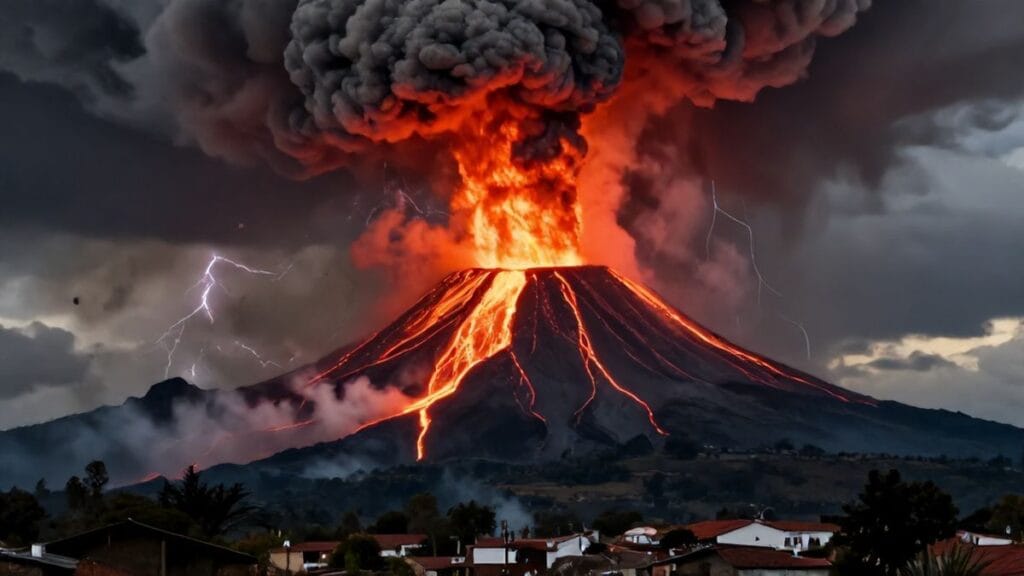
What they saw would linger in memory for generations: a towering column of ash and steam rising from the massif, boiling upward into the sky. At its base, the mountain’s upper slopes seemed to dissolve into a fury of grey and black, snow and rock torn apart by exploding gas. Lightning flickered within the rapidly rising plume—a phenomenon today known as volcanic lightning, then interpreted as war in heaven. The nevado de colima eruption had moved into its climactic phase, and the normally serene, snow-dusted peak now seemed crowned in smoke and flame.
Contemporary descriptions, though scarce and filtered through the lens of fear, speak of the sound as deafening, a continuous barrage like roaring cannons. Given that New Spain was already steeped in the noise of war, it is telling that witnesses struggled to find metaphors beyond artillery to convey the mountain’s voice. Ash began to fall almost immediately in nearby settlements: at first as a fine, almost imperceptible dust, then as a steady grey drizzle coating roofs, trees, and faces. Children looked up in confusion at the strange “snow” that did not melt.
Moments of intense explosion punctuated the sustained column, sending incandescent blocks of rock and ash—in pyroclastic surges—down gullies and ravines. Some of these deadly currents likely did not reach the most populated valleys, but they must have terrified anyone on the higher flanks. Forests shuddered as branches snapped and trunks burned; animals fled blindly downslope. The nevado de colima eruption tore at the summit and upper slopes, reshaping the mountain’s profile in ways that careful later observers would detect.
For hours, perhaps days, the column remained. Winds dragged ash across wide territories, turning daytime into an eerie twilight in towns many leagues away. Travelers on roads between Guadalajara and the Pacific coast reported horses shying as the ash thickened, hooves slipping on an accumulating carpet of fine grey powder. Near the source, lava may have extruded, though the 1818 event is remembered more for its explosive character than for broad lava flows. The key experience for most humans was not rivers of molten rock but the sky itself transformed into a heavy, suffocating ceiling of ash.
Darkness at Noon: Ash Clouds, Thunder, and Falling Stones
As the nevado de colima eruption peaked, one of its most haunting effects was the strange, unnerving darkness that fell over the region. Across western New Spain, people later recalled midday skies as dim as dusk, birds silent, and a taste of grit on their tongues with every breath. Ash, carried by shifting winds, did not fall evenly. Some villages received light dusting, others were hammered by thick deposits that clogged gutters, broke branches, and collapsed poorly supported roofs.
Thunder rolled continuously—some of it genuine atmospheric thunder triggered by the violent plume, some merely the echo of the mountain’s internal detonations. Within the dense column, charged particles collided, producing brilliant flashes of volcanic lightning that arced silently in the distance, too far for the thunderclap to be heard over the constant roar. To many, it felt as if the Last Judgment had arrived. Parish bells rang not according to the usual timetable of liturgy, but as frantic summons to prayer and, in some places, to flight.
In several settlements closer to the volcano, stones fell. These were not the molten fireballs of later popular imagination but solid fragments of old rock blasted upward and then rain down, still dangerously hot. Roof tiles cracked; thatched roofs smoldered; fields were pocked with fresh impact scars. One local account—preserved in a nineteenth-century priest’s compilation of earlier testimonies—described “stones as large as a man’s head descending with such force that they buried themselves a hand’s breadth into the earth.” It is astonishing, isn’t it, to imagine such rain from a seemingly serene mountain only days before?
Visibility dropped drastically. Travelers became disoriented, losing the silhouettes of familiar peaks and the guiding line of the sun. In the worst-hit areas, people groped their way along roads, eyes stinging, nostrils clogged with ash-mud whenever they tried to moisten their lips. Water sources swiftly turned grey; open cisterns and streams filled with slurry. Anyone with the presence of mind to cover their mouth with cloth fared slightly better, but there was little true protection. Children coughed violently; the elderly struggled for breath.
This darkness was more than physical. It was psychological, a canvas onto which people projected their fears and beliefs. In churches, kneeling crowds merged into a single muttering mass, the ash settling silently on shawls and shoulders as priests raised trembling hands, promising that repentance might soften divine wrath. In fields, farmers stared helplessly at crops disappearing under an ever-thickening blanket, calculating in grim silence what this would mean for the months ahead. The nevado de colima eruption was not simply an event of fire and stone; it was a prolonged encounter with a world where the most basic anchor—the cycle of day and night—momentarily broke its ancient promise.
Villages in Peril: Flight, Fear, and Survival on the Slopes
Close to the Nevado’s flanks, the eruption turned daily life into a series of improvised decisions. Some villagers fled at the first heavy tremors, gathering children, a few possessions, and animals they could manage to drive before them. Others hesitated, torn between fear of the volcano and fear of abandoning homes that represented generations of effort. Still others, bound by illness, age, or poverty, simply could not leave even if they wanted to. Each household played out its own small drama against the unfolding catastrophe.
Those who fled often did so along narrow trails and rough roads choked with the same ash that fell on their rooftops. Visibility low, they clung to familiar landmarks: an old ceiba tree, a curve in the river, the distant bell of a neighboring parish. Mothers wrapped infants in shawls dampened to filter the air; men walked ahead, scouting for falling debris and collapsing bridges. Huddled groups met others coming from farther upslope, carrying stories of cracked walls, burning thatch, and cattle blinded by dust. Fear flowed as freely as the ash-laden streams cascading down from the mountain.
Yet behind the terror were countless acts of quiet courage. Families took in neighbors, crowding multiple households into single surviving structures in safer zones. Local priests, despite their own fright, remained to ring bells and offer what reassurance they could. In some places, indigenous ritual specialists, often dismissed by colonial authorities, were suddenly sought out again, asked to interpret the mountain’s rage and intercede with ancient powers. Survival became not just a matter of physical escape but of mental frameworks strong enough to absorb what was happening.
Stories from later years, recounted by grandchildren who had heard them at firesides, often focus on small details. A woman who refused to abandon a cherished saint’s image and carried it miles through the ash. A boy who led a half-blinded mule by the sound of its breathing. A group of men who returned up the slope during a lull in activity to rescue trapped livestock, risking their lives to save the economic backbone of their community. These personal fragments give the nevado de colima eruption a human face, reminding us that statistical summaries—ash thickness, eruption column height, affected radius—only scratch the surface of lived experience.
Not all survived. The death toll from the 1818 eruption is difficult to calculate with precision; colonial records are incomplete, and many losses were folded into the already horrendous toll of war and disease. Some likely died in collapsing structures, others from respiratory distress, exposure, or injuries sustained during chaotic flight. To surviving families, each of these deaths was not a number but a permanent absences: a father who never returned, a child swallowed by the crowd in the grey darkness, a grandmother whose coughing never stopped. The mountain’s violence inscribed itself onto family trees as missing branches.
Messages in Smoke: Indigenous Memories and Sacred Narratives
For the indigenous communities long rooted in the valleys and highlands around Nevado de Colima, the 1818 eruption was not a inexplicable anomaly but part of a longer conversation between humans and landscape. Generations had watched the Fire Volcano’s occasional plumes, felt the earth twitch beneath their homes, and kept stories alive in which mountains spoke, bargained, and at times punished. The nevado de colima eruption, in this worldview, was a message—a severe one, perhaps, but intelligible if approached with the right questions.
Oral traditions recorded decades later suggest that some elders interpreted the event as a correction: humans had broken reciprocal bonds with the land through excess, disrespect, or neglect of ceremony. Colonial disruptions—forced labor, Christianization, the seizing of communal lands—were not merely political or economic affronts; they ruptured cosmological balances. When the mountain roared in 1818, some saw it as the earth’s body reacting to centuries of insult. “It is the old one telling us he has not forgotten us,” one remembered phrase puts it.
Within church walls, Catholic priests framed the eruption as divine chastisement for sin, urging confession and renewed piety. Yet outside, under the same falling ash, indigenous ritual understandings persisted, sometimes quietly woven into Christian forms. Offerings might be placed, not openly at pre-Hispanic shrines now denounced as pagan, but at the foot of crosses on hillsides or at saint statues that, in local imagination, blurred with older gods of fire and rain. The mountain itself remained a sacred being, whatever new names arrived in official documents.
These parallel interpretations did not always clash. In times of danger, people drew on every available framework for making sense of events. A woman might attend Mass and light a candle to the Virgin, then at home sprinkle a little maize flour toward the invisible summit while whispering words taught by her grandmother. The nevado de colima eruption thus became a crucible in which different layers of belief fused, forming a distinctive regional religious culture that carried echoes of both Toledo and Tenochtitlan.
Long after the ash settled, stories of 1818 entered the repertoire of warnings passed to children. They were folded into admonitions to respect the mountain, to farm responsibly, to listen when animals grew restless. Each retelling adjusted details—dates, colors, sounds—but preserved a central lesson: that the earth, too, has a memory and a temper. In this sense, indigenous narratives functioned as informal risk communication long before modern hazard maps, preserving across generations what sheer data could never fully convey about the character of Nevado de Colima.
Between Crown and Volcano: Colonial Authorities Confront Disaster
For colonial officials charged with maintaining order in western New Spain, the 1818 eruption arrived as an unwelcome and bewildering challenge. Royal decrees and military discipline were of little use when ash clogged streets and the ground itself shook beneath their barracks. Yet the logic of empire demanded a response, both practical and symbolic. The crown, even in its waning strength, had to appear capable of protecting its subjects—even from mountains.
Local governors and alcaldes first sought information: messengers were dispatched toward the affected areas, though their journeys were slowed by poor visibility and damaged routes. Reports returned unevenly, some exaggerated by panic, others downplaying the seriousness for fear that admission of chaos might invite disciplinary action. Estimates of how far the ash had spread—some accounts speak of fallout reaching towns over 100 kilometers away—filtered slowly into administrative centers like Guadalajara.
In the short term, authorities focused on keeping basic functions running. Markets had to reopen, even if the maize on offer wore a thin coat of grey. Roads needed clearance so troops and goods could move. Churches, crucial for social cohesion, required at least makeshift repairs to host masses of thanksgiving once the worst seemed to have passed. A few decrees ordered special prayers and processions, framing the eruption as a test of loyalty and faith, subtly reminding populations that the crown, too, bowed before God’s will.
But political calculations lurked beneath every decision. In regions with strong insurgent presence, royalist officers worried that the dislocation caused by the nevado de colima eruption might strengthen rebel recruitment: hungry, frightened peasants made fertile ground for anti-colonial rhetoric. Conversely, insurgent leaders had to decide whether to exploit the chaos—cutting lines of communication and seizing weakened towns—or to offer aid, presenting themselves as compassionate protectors where the crown seemed distant and ineffectual.
We find hints of these tensions in scattered correspondence. One provincial official, writing to a superior in Mexico City, lamented that “the calamities visited upon this province by the mountain’s fury have multiplied the miseries already wrought by seditious brigands.” Another, more pious in tone, suggested that the eruption proved that “only the firm hand of His Catholic Majesty, guided by Providence, can steer this kingdom between rebellion and ruin.” Both statements, in their different ways, sought to fold volcanic disaster into the existing narrative frameworks of imperial legitimacy.
There was little in the way of formal disaster relief as we understand it today. Some tax remissions may have been granted; occasional shipments of grain allocated; appeals for alms circulated among wealthier urban residents. Yet the burden of recovery fell primarily on local communities, who relied on kin networks, communal labor, and sheer endurance. In this, as in so many realms, the mountain’s verdict exposed the limits of distant authority. The nevado de colima eruption was a stark reminder that empire’s reach, though extended across oceans, could falter at the edge of a single volcanic crater.
Ash on the Sugarcane: Economic Shockwaves Across Western New Spain
In a region whose prosperity rested largely on what could be coaxed from the soil, the eruption’s ashfall represented not only a momentary inconvenience but a profound economic shock. Volcanic ash is paradoxical: in the long run it can enrich soils, but in the short term it smothers them. In 1818, farmers watched in horror as fields of maize, beans, and sugarcane disappeared beneath a grey mantle. Tender shoots snapped under the weight; leaves burned where hot particles landed.
Immediate harvests were compromised, and future ones uncertain. Some crops could be salvaged if the ash layer was thin and rains came at the right time to wash it into the deeper soil rather than creating a sealing crust. But this delicate balance required labor and tools that many war-torn communities lacked. On larger estates, landowners could mobilize peons and draft animals to clear canals and dig drainage ditches; on smallholdings, families worked with their own hands in a race against time and exhaustion.
Livestock suffered too. Pastures, suddenly coated in abrasive ash, became poor grazing grounds. Cattle, horses, and mules inhaled dust with every breath, their eyes watering. Water sources turned cloudy, sometimes dangerously so when volcanic chemicals leached into small ponds and streams. In an economy where transport animals were lifelines for trade and military supply, any loss among them reverberated across markets and battlefronts alike.
Prices responded in the brutally predictable way. Grain costs rose in towns that depended on the fertile volcanic hinterlands; poor families, who already devoted a large portion of their income to food, found themselves cutting meals, watering down stews, or dipping further into debt. Merchants with stores of less-affected grain in distant districts suddenly held valuable commodities; some no doubt engaged in speculation, while others responded to church and community pressure to sell at “Christian” prices. The nevado de colima eruption thus intensified existing inequalities, concentrating hardship among those with the fewest buffers.
There was, however, a longer arc to the story. As ash integrated into the soil over subsequent seasons, some fields would have regained or even surpassed their previous fertility, yielding generous harvests that farmers might, in hindsight, attribute to the mountain’s reluctant generosity. But those eventual benefits did little to alleviate the immediate crisis of 1818–1819. For many households, the eruptions turned an already precarious existence—strained by war levies and disrupted trade—into a tightrope walk above famine.
Economic historians have sometimes struggled to disentangle the specific impact of the nevado de colima eruption from the broader chaos of the independence period. Yet by closely reading parish tithe records, estate accounts, and scattered complaints to authorities, a pattern emerges: lower yields, higher prices, more debt, and in some cases, migration away from the most affected areas. The mountain, in other words, did not act alone; it threw its weight into a landscape already tipping under manifold pressures.
Revolution Under a Darkened Sun: Eruption Amid Independence Wars
The coincidence of the 1818 eruption with the late phase of Mexico’s war of independence has long fascinated historians. Nature and politics rarely coordinate their timetables, yet their events often overlap in ways that shape each other’s consequences. In western New Spain, the nevado de colima eruption played out on a stage already crowded with competing armies, clandestine networks, and fragile loyalties.
For insurgent groups, the eruption presented both danger and opportunity. On the one hand, ashfall and damaged infrastructure disrupted their own supply lines and safe havens; on the other, the chaos humbled royal authorities and exposed the limits of imperial benevolence. Some insurgent leaders framed the event in explicitly providential terms, suggesting in proclamations and sermons that the same God who reportedly favored the oppressed with signs now showed displeasure with the colonial order through cataclysm. “Even the mountains revolt,” one such text reportedly proclaimed, a phrase that would echo in later nationalist rhetoric.
Royalist commanders, for their part, attempted to harness the event differently. In homilies delivered by chaplains and loyal clergy, the eruption was folded into narratives stressing the need for unity under the crown as a bulwark against chaos. The moral was clear: if people continued to abandon legitimate authority and join “bandits” and “heretics,” then calamities, both human and natural, would multiply. The mountain’s fury, in this reading, chastised all sides equally, urging a return to obedience and order.
On the ground, however, ideology often took a back seat to pragmatism. Ash-covered villages needed food and shelter more than they needed manifestos. Insurgent and royalist soldiers alike sometimes found themselves assisting in relief efforts, if only to secure local goodwill. In certain cases, brief local truces may have emerged—informal understandings that for a few days or weeks, fighting would pause while communities dug themselves out. These fleeting moments of shared vulnerability did not end the war, but they reveal how natural disasters can carve out unusual spaces of cooperation in otherwise bitter conflicts.
After independence was achieved a few years later, the memory of the 1818 eruption was gradually absorbed into the broader national story. It became one more trial through which the Mexican people had passed on their road to sovereignty, a kind of natural anvil on which the new nation had been hammered. Although it did not directly cause political change, the nevado de colima eruption added a visceral dimension to the era’s sense of upheaval: when people later recalled those years, they did not remember only battles and proclamations, but also the day when ash fell like snow and the noon sun vanished behind a volcanic veil.
Eyes from Afar: Travelers, Priests, and the First Written Accounts
The 1818 eruption occurred in a world on the cusp of scientific transformation but still largely dependent on the written observations of a few literate witnesses. Among the most important chroniclers were clergy, whose positions near the heart of communities and their duty to record extraordinary events in parish books made them natural, if often reluctant, reporters of catastrophe. We have references to “the great trembling of the earth and the mountain’s smoke” in ecclesiastical records from towns around Nevado de Colima, framed in language equal parts devout and descriptive.
Some priests attempted rudimentary quantification: they noted the hours during which ash fell, estimated its thickness on church courtyards, and described the color of the sky. Their accounts, though imprecise by modern standards, provide crucial data points for reconstructing the eruption’s intensity and geographic reach. One such priest wrote that “for three days the sun appeared only as a dim disk, such that even at midday one might mistake the hour for late afternoon,” a statement that hints at the density of suspended ash in the atmosphere.
Secular travelers added another layer. Traders, officials, and foreign observers passing through the region left scattered notes of the devastation and altered landscape. Some arrived weeks or months later, remarking on fields still bare of green, on charcoal-blackened trunks higher on the slopes, on the altered outline of the Nevado itself. As the nineteenth century advanced, these traveler’s tales would be cited by emerging scientific communities as they sought to catalogue the world’s volcanoes and their histories.
Later, in the mid to late nineteenth century, as volcanology developed as a distinct discipline, scholars would look back on events like the nevado de colima eruption of 1818 and attempt to fit them into taxonomies of eruption style and recurrence intervals. They drew on both local testimonies and comparative frameworks developed in Europe—where the 1815 eruption of Tambora, for instance, had shocked the world and inspired early global climatic speculation. A Mexican mountain, less globally famous than Vesuvius or Etna, nonetheless entered the textbooks as one more node in Earth’s restless volcanic belt.
One scholar, writing in Spanish in the late 1800s, summarized the event by noting that “the Nevado of Colima announced by its ferocity in 1818 that our soil, although called New, shares fully in the ancient restlessness of the planet.” In that simple sentence we sense both pride and unease: pride that Mexico’s geography could stand alongside the great dramatic landscapes of the world, unease at the recognition that beauty and danger here were inseparable.
From Terror to Science: Early Volcanology and Nevado de Colima
As the nineteenth century progressed, the raw fear generated by eruptions like that of 1818 gradually began to coexist with a new impulse: the desire to understand, predict, and perhaps even harness volcanic power. Early Mexican geologists and naturalists, influenced by European thinkers such as Alexander von Humboldt—who himself had traveled through parts of New Spain in the early 1800s—started to think of Nevado de Colima and its fiery companion not merely as omens but as subjects of study.
The 1818 nevado de colima eruption provided a reference point. Even decades later, scientists interviewing older residents could still gather recollections of the event’s scale, ashfall, and sounds. They compared these memories with more recent, smaller eruptive episodes, trying to infer patterns: how often did the volcano “truly” awaken? Did certain types of seismic agitation always precede activity? Could changes in animal behavior or spring temperatures act as predictive signs?
In this era, volcanology was entwined with debates about the Earth’s age and inner structure. Was volcanic fire the result of vast subterranean coal beds, as some hypothesized, or of chemical reactions between water and deep-seated minerals? Eruptions like Nevado de Colima’s in 1818 were seen as fleeting glimpses into the planet’s hidden furnace. Scholars corresponded with European societies, sharing sketches of the mountain’s profile, rough maps of its crater, and accounts of its deposits. These exchanges gradually integrated Mexican volcanoes into a global network of scientific observation.
Yet superstition and science did not neatly segregate. The same people who provided crucial empirical details about the eruption’s progression also spoke of saints’ interventions and prophetic dreams. Early scientists, for their part, often couched their explanations in theological terms, describing volcanic processes as the “instruments” of divine will rather than contradictions of it. Rarely did a priest or professor stand outside on a clear day, look up at Nevado de Colima’s serene summit, and feel only curiosity; awe and a hint of dread lingered.
Nevertheless, a slow shift was underway. By collecting and analyzing reports of the 1818 eruption and later episodes, Mexican scholars contributed to the emerging concept that volcanoes, while unpredictable in detail, followed recognizable patterns. The mountain that had once seemed an inscrutable agent of wrath began to appear, at least in scientific writings, as a complex but ultimately natural system—one that, if respected and monitored, might reveal its moods in time to save lives.
After the Fire: Recovery, Memory, and Silent Years on the Mountain
Once the eruption’s violence subsided—its clouds thinning, its roar dwindling into sullen rumbles—the people of western New Spain faced a different, quieter challenge: living with what remained. Ash settled into drifts along roads and in ravines. Burned forest patches on the upper slopes stood like blackened sentinels against the sky. Houses that had partially collapsed now needed either rebuilding or abandonment. The initial emergency gave way to a long, uneven process of recovery.
Communities set about cleaning roofs, digging out irrigation canals, and testing whether planted seeds would still sprout through the ashy blanket. Those who had fled cautiously returned, often to find their homes standing but altered: furniture displaced by tremors, small fissures tracing the walls like scars. After the adrenaline of flight and immediate survival, grief over lost relatives and neighbors settled in, more enduring than the ash itself. Masses for the dead and processions of thanksgiving for the spared wove together in an intricate tapestry of mourning and relief.
In the years that followed, the Nevado of Colima grew quiet again, at least in the everyday experience of most inhabitants. Smoke thinned to occasional wisps; tremors returned to their more familiar, sporadic pattern. Children born after 1818 knew the eruption only through stories, just as their grandparents might have known of earlier episodes through tales. The mountain’s slopes, meanwhile, slowly greened. Pioneer plants rooted in fresh deposits; forests began their slow march of reclamation.
But memory is not erased so easily. The nevado de colima eruption remained a reference point in local calendars: events were described as happening “before the ash” or “ten years after the great smoke.” When a distant earthquake rattled dishes in a quiet decade, older people instinctively glanced toward the mountain, their bodies remembering the progression that had preceded 1818. In this way, the eruption continued to shape behavior long after its spectacular phase ended.
Politically, the landscape was changing too. New Spain would soon become independent Mexico, and new layers of bureaucracy, aspiration, and national identity would overlay the older colonial fabric. Yet the mountain did not recognize new flags. Its next large eruption would come in another century, dealing with a different generation, a different state. Still, when that time arrived, some of the responses—flight, prayer, curiosity, adaptation—would echo 1818. The silent years between eruptions were, in a sense, interludes in a much longer conversation between Nevado de Colima and those who made their lives near its feet.
Echoes Through Centuries: Later Eruptions and the Legacy of 1818
The 1818 nevado de colima eruption did not mark the end of the mountain’s story but rather a prominent chapter in an ongoing saga of activity. Over the nineteenth and twentieth centuries, the closely related Volcán de Fuego de Colima would become Mexico’s most active volcano, with frequent eruptions that drew scientific and public attention. Each new outburst invited comparisons to 1818, even when originating from a different vent or summit area within the complex volcanic system.
Later episodes—such as those in the late nineteenth century and significant eruptions in the twentieth—benefited from increasingly sophisticated observation. Photographs, seismographs, and eventually satellite imagery captured what earlier generations had only been able to describe in hasty words. Yet in historical reports and risk assessments, the 1818 event continued to stand as a benchmark of worst-case behavior. How high had the column risen? How far had ash traveled? What level of destruction to fields and infrastructure could be expected if the volcano again matched that ferocity?
Modern volcanological studies, drawing on tephra layers (distinct ash deposits preserved in the geological record), have attempted to quantify the 1818 eruption’s magnitude more precisely, often ranking it among the more substantial historical eruptions in Mexico, though not on the scale of global giants like Tambora. These studies cross-reference physical evidence with historical testimonies—a priest’s note about ash darkness, a traveler’s account of crop loss—to reconstruct the event in a kind of interdisciplinary detective work. As one contemporary researcher noted, “without the voices of those who lived through 1818, the rocks alone would tell us only half the story.”
The legacy of 1818 also lives in policy. Civil protection agencies in modern Mexico, tasked with monitoring Colima’s volcanoes, use long-term historical catalogs of eruptions to model potential futures. Scenarios consider ash dispersion patterns, lahar (volcanic mudflow) risks, and evacuation zones. In these models, 1818 still looms: a reminder that what has happened once can, under the right conditions, happen again. Communities in the region, now more urbanized and interconnected, engage periodically in drills that, though based on modern science, resonate faintly with the age-old practice of telling children what to do when the mountain grumbles.
And beyond science and policy, there is culture. Artists, writers, and local historians return periodically to the 1818 eruption as source material: a metaphor for upheaval, a backdrop for historical novels, an anchor for regional identity. The mountain—and specifically, its memory of that violent year—has become part of what it means to be from Colima or southern Jalisco. In this sense, the nevado de colima eruption is not just an event that happened in the past; it is a living reference point in the ongoing production of history and identity.
Lives Measured in Ash: Human Stories from the Slopes of Colima
Numbers and dates provide structure, but it is individual stories that give the 1818 eruption its emotional contour. Imagine, for a moment, a young woman named María, living in a hamlet tucked into a fold of the Nevado’s lower slopes. She has never traveled farther than the nearest market town. Her world is defined by the path from her door to the fields, the stream where she washes clothes, and the distant, reassuring outline of the snow-capped peak under which her parents and grandparents lived.
When the tremors begin, she jokes nervously with her younger siblings about the house “dancing.” As ash starts to fall, she joins her mother in bringing laundry indoors, beating at the grey dust that settles faster than they can brush it away. The roar from the mountain reverberates through her bones. At some point, someone shouts that they must leave, now. She grabs a blanket, a rosary, and—without quite knowing why—a small stone her grandfather once told her came from high on the Nevado’s side. It is smooth and cool, comforting in her hand even as the air grows hot and gritty.
On the road, María becomes part of a moving mosaic: families, animals, carts, soldiers trying to maintain order at the margins of the crowd. She sees an old man refuse to abandon his collapsed house, shouting that if the mountain wants him, it can come and take him where he has always lived. She watches a group of children laugh hysterically, half from fear and half from the strangeness of ash “snow.” At night, under a sky that glows faintly red in the direction of the Nevado, she lies awake, the stone from her grandfather pressed into her palm, wondering if she will ever see her home again.
Another story might center on a priest, Father José, in a parish a day’s ride from the volcano. He has heard rumors of unrest on the mountain but dismissed them as exaggerations. When ash begins to fall in his courtyard, he climbs the church tower to see a sight he will struggle forever to put into words: a towering column, streaked with lightning, dwarfing the familiar horizon. He descends, hands shaking, to ring the bells. People flood into the church, eyes wide, coughing, crossing themselves.
Father José must now find words. Is this divine wrath? A test? Punishment for the war that has so fractured his flock? He opens his Bible, his hands leaving grey smudges on the pages, and reads aloud from the Psalms about mountains trembling and the earth shaking at the presence of the Lord. Later, when he writes a brief account for his superiors, he will struggle between his desire to describe what he saw and his instinct to interpret it. The resulting document, stiff yet quivering between the lines, will one day be quoted by historians trying to piece together the nevado de colima eruption’s sequence.
These imagined lives, grounded in what we know of the period and region, invite us to move beyond abstraction. The eruption was not simply a “natural disaster”; it was a series of long days and sleepless nights, of hurried decisions and irrevocable losses, of small kindnesses and moments of selfishness. In its aftermath, some would find their faith shaken, others deepened. Some would leave the region forever, seeking more stable ground, while others would double down on their attachment to the mountain, insisting that having survived its fury once, they now belonged to it more than ever.
Reading the Mountain Today: Risk, Research, and Preparedness
In the twenty-first century, Nevado de Colima and its fiery sibling are among the most closely watched volcanoes in Mexico. Seismic stations listen constantly for subterranean murmurs; webcams scan their flanks; satellites track plumes when they rise. Scientists model potential eruption scenarios on powerful computers, projecting ash plumes and lahars across detailed digital elevation maps. Yet behind the graphs and simulations stands a simple, sobering reality: much of what drives volcanic behavior remains out of direct human reach, hidden in the inaccessible magma chambers miles beneath the surface.
Historical eruptions, including that of 1818, act as crucial anchors for these modern efforts. When volcanologists evaluate how large an eruption Colima might produce, they look not only at current gas emissions or ground deformation but also at the geological record of past activity. The tephra layer associated with the 1818 nevado de colima eruption, correlated with written accounts of ash darkness and distribution, provides an example of what the mountain is capable of in historical times. Risk maps—used by civil protection agencies to plan evacuation routes and hazard zones—often include references to 1818-scale events as upper-bound cases for planning.
Local communities, too, live in a complex dance of denial, familiarity, and vigilance. For many, the volcano is simply part of the backdrop, a fact of life woven into tourism brochures, school lessons, and the way the horizon looks at sunset. But periodic drills, public information campaigns, and the faint but ever-present smell of sulfur on certain days keep the possibility of renewed fury alive. Teachers tell their students about both scientific monitoring and the stories their grandparents told about earlier eruptions, blending the language of seismograms with that of omens and memories.
Preparedness today is grounded in a recognition that neither fatalism nor complacency is enough. When minor eruptions send ash over nearby towns, as they have in recent decades, authorities mobilize to distribute masks, clear runways, and advise people to stay indoors. These smaller events become rehearsals for the potential of something larger, perhaps someday rivaling or exceeding 1818 in intensity. Each such episode is also an opportunity to test communication systems: do warnings reach remote ranches? Do people trust the messages they receive?
In academic circles, Nevado de Colima serves as a case study in how historical, cultural, and scientific knowledge intertwine. Conferences on volcanic risk reduction often cite the 1818 eruption alongside more globally famous events, emphasizing that “medium-sized” disasters can have profound local and regional impacts, especially when they intersect with political instability—as happened in New Spain’s final colonial years. Modern scholars, echoing the earlier citation about the “restlessness of the planet,” insist that we must read mountains not only with instruments but also with archives and stories.
Ultimately, to live near Nevado de Colima today is to inhabit a layered landscape of time. Beneath the present moment, with its cell phones and paved roads, lies the memory of 1818: ash on thatched roofs, prayers shouted into a darkened noon, fields briefly turned to lunar plains. Beneath that, in deeper geological time, lie countless older eruptions, each leaving its mark in rock and soil. To acknowledge this is not to live in constant fear, but to hold a clear-eyed recognition that the ground and sky, however calm they may seem, are part of a restless, ongoing story.
Conclusion
The Nevado de Colima eruption of 1818 stands at the crossroads of earth’s deep rhythms and human history’s fragile, turbulent arc. It erupted into a world already in turmoil—New Spain wracked by war, communities stretched thin by violence and scarcity—and in doing so exposed both the vulnerability and resilience of those who lived under its shadow. The mountain’s fury darkened skies at noon, crushed crops beneath ash, and sent families fleeing along roads already haunted by soldiers and bandits. Yet it also elicited acts of solidarity, creativity, and faith, as people reached for old stories and new explanations to make sense of the trembling ground.
Over two centuries later, we approach that event from a different vantage point. Satellites have replaced mule-mounted messengers; seismographs hum where once only bare feet on dirt floors felt the first tremors. We understand far more about magma, gas, and tectonic plates than any priest or peasant in 1818 could have imagined. And still, the core experience they faced—sudden, overwhelming change wrought by forces beyond human control—remains recognizable. In every tremor recorded today, in every ash advisory issued, there is a faint echo of that earlier disaster.
The nevado de colima eruption reminds us that natural and human histories are inseparable. Volcanic ash does not fall onto an abstract grid; it falls onto particular fields, in particular years, when wars are being fought or revolutions kindled, when children are born or elders buried. The meaning of an eruption is thus shaped not only by plume height and eruption style but by the political, economic, and cultural landscapes onto which it descends. In 1818, that meant independence struggles, colonial hierarchies, and deep indigenous traditions about sacred mountains. In some future eruption, it will mean something different—but no less entwined with human concerns.
To study and remember 1818 is therefore more than an exercise in cataloguing past disasters. It is an act of humility, acknowledging that our species shares this planet with forces that dwarf our technologies and institutions. It is also an act of hope, recognizing in the stories of survival, adaptation, and learning that followed the eruption a model for how we might meet future upheavals, volcanic or otherwise. The mountain will continue its intermittent conversations with the sky; our task is to keep listening, with instruments and with stories, so that when Nevado de Colima speaks again, we are not entirely unprepared.
FAQs
- What exactly happened during the 1818 Nevado de Colima eruption?
The 1818 Nevado de Colima eruption was a powerful explosive event in western New Spain (modern Mexico) that produced a towering ash column, heavy ashfall over a wide area, volcanic lightning, loud continuous explosions, and the fallout of rocks and debris on nearby settlements. It darkened the sky even at midday in many localities, damaged crops and infrastructure, triggered population movements, and left a long-lasting imprint on regional memory and the historical record. - How large was the 1818 eruption compared to other famous eruptions?
While precise measurements are difficult due to limited instrumentation at the time, geological studies of the ash layers suggest that the 1818 event was a significant eruption on a regional scale, larger than many routine eruptions of Colima but smaller than cataclysmic events like Tambora (1815) or Krakatoa (1883). It was large enough to generate extensive ashfall, strong atmospheric effects, and substantial local economic and social disruption. - Did the eruption directly affect Mexico’s war of independence?
The nevado de colima eruption did not determine the outcome of the war of independence, but it intersected with it in important ways. It disrupted agriculture and transport in a contested region, strained already fragile supply networks, and provided both royalist and insurgent forces with powerful symbolic material—interpreted alternatively as divine punishment, a warning, or a sign of cosmic upheaval aligning with political change. - How do we know what happened if there were no modern instruments?
Our knowledge comes from a combination of historical documents—parish records, official correspondence, traveler accounts—and geological evidence such as ash layers, deposits on the volcano’s slopes, and changes in the mountain’s morphology. Modern volcanologists cross-reference these sources, using descriptions of darkness, ash thickness, and sound with physical data to reconstruct likely eruption scenarios. - Is Nevado de Colima still considered dangerous today?
Yes. The Nevado de Colima–Volcán de Fuego complex is one of the most active volcanic systems in Mexico and is closely monitored by national and regional scientific institutions. Although not every episode matches the violence of 1818, the system is capable of producing large eruptions, ashfall, pyroclastic flows, and lahars. Modern monitoring and civil protection plans aim to reduce risk to nearby communities. - What were the main social and economic consequences of the 1818 eruption?
The eruption damaged or destroyed crops, compromised water sources, harmed livestock, and temporarily blocked or degraded roads and trade routes. This led to food shortages, price spikes, increased indebtedness among farmers, and in some cases migration away from the most affected areas. Socially, it intensified existing hardships caused by war, generated widespread fear and religious anxiety, and prompted both communal solidarity and occasional conflict over scarce resources. - How did people at the time interpret the eruption?
Interpretations varied by community and belief system. Many Catholics saw it as divine punishment or a test, prompting processions, masses, and calls for repentance. Indigenous traditions often framed it as a message or correction from the sacred mountain and the earth itself, reacting to broken reciprocal relationships. Over time, emerging scientific explanations about volcanic processes began to coexist with, rather than fully replace, these religious and cosmological views. - What lessons does the 1818 eruption offer for disaster preparedness today?
The 1818 event highlights the importance of historical memory, local knowledge, and social vulnerability in shaping disaster outcomes. It shows that eruptions can have long-term economic and political implications, especially when they occur during periods of instability. Modern preparedness efforts around Colima draw on this history by incorporating public education, early warning systems, risk mapping, and an understanding that effective response requires not just technology but trust and communication between authorities and communities.
External Resource
Internal Link
Other Resources
- Encyclopaedia Britannica – general search for the exact subject
- Google Scholar – academic search for the exact subject
- Internet Archive – digital library search for the exact subject