Table of Contents
- The Dawn of Disaster: Lisbon on the Morning of November 1, 1755
- The City as a Living Canvas: Lisbon Before the Earthquake
- The Cultural and Religious Reverie of All Saints’ Day
- The First Tremor: The Earth Unleashes Its Fury
- Flames and Ruin: The Inferno that Consumed the City
- The Devouring Waves: The Tsunami’s Deadly March
- Panic and Despair: Survivors in a City of Ruins
- The Political Landscape Shaken: King José I and the Marquis of Pombal
- Science Versus Faith: Philosophical Repercussions across Europe
- The Aftershocks of Faith and Philosophy: Responses from Voltaire to Kant
- Urban Rebirth from the Rubble: The Pombaline Reconstruction
- Architecture Meets Innovation: Engineering Against Future Quakes
- Economic Aftershocks: Lisbon and the Portuguese Empire in Crisis
- The Social Fabric Ripped Apart: The Human Toll and Memory
- The Lisbon Earthquake in Global Perspective: A Catalyst for Enlightenment
- Legacy in Literature and Art: Echoes through Time
- Lessons Learned: Seismology and Disaster Management Origins
- Remembering November 1, 1755: Annual Commemorations and Memorials
- The Earthquake in Modern Historical Discourse
- Conclusion: The Earthquake That Shaped a World
- FAQs
- External Resource
- Internal Link
The Dawn of Disaster: Lisbon on the Morning of November 1, 1755
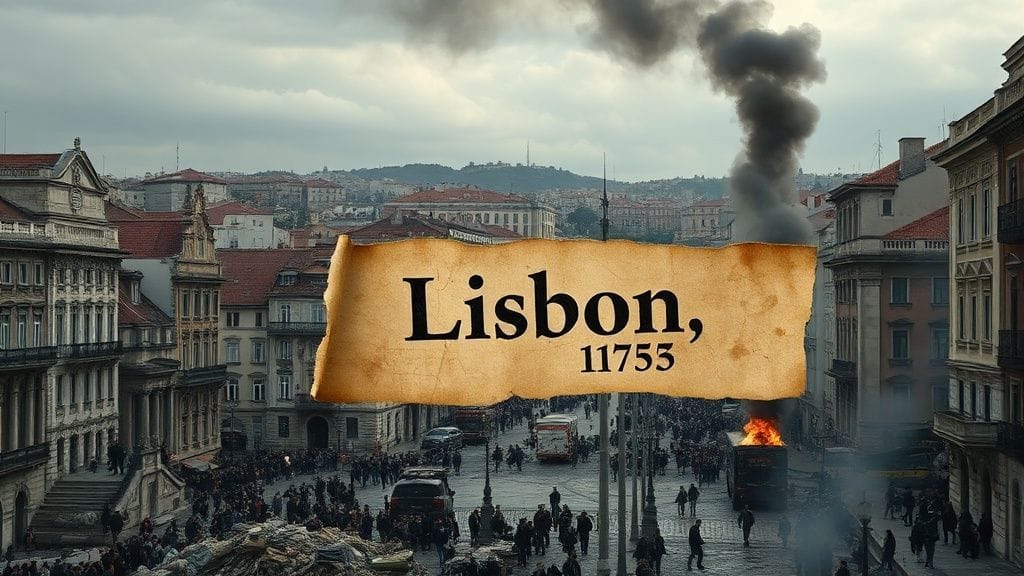
It was a luminous autumn morning in Lisbon. The air was crisp, the sky unusually clear, and the city pulsed with the solemn rhythm of All Saints’ Day. Churches overflowed with worshippers lighting candles and lifting prayers, their chants blending with the soft murmur of the Tagus River and the laughter of children weaving through narrow streets. But beneath this serene facade, the earth was stirring, deep beneath the Iberian Peninsula, preparing to shatter centuries of stability in a violent instant.
At precisely 9:40 a.m., the ground began to tremble—first a subtle quiver, then a shudder that grew monstrous, bending buildings like paper, swallowing the confident footsteps of thousands in a cacophony of collapse and terror. This was no ordinary tremor. It was the 1755 Lisbon earthquake, a catastrophe of such immense force and devastating consequence that it redefined the very understanding of natural disasters and their philosophical implications for Europe and beyond.
The City as a Living Canvas: Lisbon Before the Earthquake
Lisbon, capital of the Portuguese empire, was a jewel of maritime trade and Baroque grandeur. Its streets bore the imprints of centuries of conquest, exploration, and commerce. Palaces and cathedrals soared alongside bustling marketplaces rich with spices from Asia, African gold, and the soft rumble of Atlantic winds carrying news of distant colonies. Life flourished amid narrow alleys, sun-dappled plazas, and monumental public spaces.
By 1755, Lisbon was a canvas of contrasts: thriving commerce shadowed by political intrigue; devout Catholicism interlaced with intellectual stirrings from the Age of Enlightenment. The city was preparing for a grand All Saints’ Day celebration; churches were filled to capacity, their splendid interiors awash in candlelight and reverberating with Gregorian chants.
The Cultural and Religious Reverie of All Saints’ Day
All Saints’ Day, November 1st, was among the most sacred dates in the Portuguese calendar. Hundreds of thousands of residents and visitors had gathered to honor saints and martyrs, light votive candles, and seek divine protection. It was a day of reflection, celebration, and renewed faith.
The religious fervor cloaked the city in a comforting illusion of spiritual permanence, a stark contrast to what nature was about to dispense. In the soft flicker of candle flames and the prayers whispered beneath towering vaults, few anticipated that the earth beneath their feet was preparing to rewrite the narrative of divine providence and mortal frailty.
The First Tremor: The Earth Unleashes Its Fury
The violent shaking began suddenly and with merciless intensity. Buildings groaned, foundations cracked, and the loyal structures of medieval and Renaissance Lisbon began to collapse in clouds of dust and splinters. People fled into the streets, but the earth itself seemed to convulse beneath their feet.
Historical accounts speak of the deafening roar: “It sounded as if the very heavens were being rent apart.” The tremor lasted nearly six minutes—a lifetime when cities fall. Roofs caved in, towers toppled, and thousands were trapped beneath rubble. Nearby, the river’s calm surface suddenly churned, signaling further destruction.
Flames and Ruin: The Inferno that Consumed the City
As if the earthquake were not enough, ruptured oil lamps, ruptured chimneys, and open hearths ignited fires across Lisbon’s tinderbox streets. The blaze quickly spread, fanned by wind and collapsing structures, swallowing entire neighborhoods in waves of flame. The very air filled with acrid smoke that blinded survivors struggling to escape.
For three days, the city burned. Among the ruins, churches, palaces, and houses alike were reduced to blackened skeletons. The inferno erased much of Lisbon’s architectural patrimony, ensuring that the earthquake's physical destruction was compounded by this relentless fire.
The Devouring Waves: The Tsunami’s Deadly March
As survivors sought refuge in open plazas and hills, the earth’s final insult came from the sea. A towering tsunami, estimated to reach 20 meters in height, surged up the Tagus estuary, crashing onto Lisbon’s lower quarters with devastating force.
Entire districts were flooded, homes washed away, and countless lives submerged in salty waters. Eyewitnesses described how the river, once placid, became a furious tempest, overturning ships and drowning thousands. This trio of catastrophe—earthquake, fire, tsunami—ensured Lisbon would never be the same.
Panic and Despair: Survivors in a City of Ruins
For those lucky enough to survive the triple catastrophe, the days and weeks ahead were grim. Food and clean water disappeared, disease loomed, and the psychological scars ran deep. Families were torn asunder; the city’s social fabric unraveled.
But amidst despair, acts of courage and solidarity blossomed. Streets became makeshift hospitals; strangers shared water and shelter. It was, as many chronicles show, a city embattled but not beaten, its spirit flickering amid the ashes.
The Political Landscape Shaken: King José I and the Marquis of Pombal
The earthquake reached even the royal court, dramatically altering the political dynamics of Portugal. King José I, known to be deeply shaken, reportedly took refuge aboard a riverboat, famously remarking that "O Senhor matou o Rei"—The Lord has killed the King.
Enter Sebastião José de Carvalho e Melo, later the Marquis of Pombal, the king’s Prime Minister. His response was swift, decisive, and transformative. Pombal organized relief, restored order, and spearheaded the rebuilding of Lisbon with an unprecedented vision of modern urban planning and earthquake-resistant design.
Science Versus Faith: Philosophical Repercussions Across Europe
The destruction provoked profound existential questions. How could a merciful God allow such devastation, especially on a holy day? Philosophers and theologians grappled with theodicy, fate, and the role of suffering. This disaster cracked the veneer of religious certainty that Europeans had long relied upon.
Voltaire, in his famous Candide, addressed this earthquake indirectly, mocking optimistic philosophies that claimed "all is for the best in the best of all possible worlds." Thinkers like Kant ventured into early seismic science, measuring aftershocks and seeking natural explanations that would eventually shape modern geology.
The Aftershocks of Faith and Philosophy: Responses from Voltaire to Kant
The earthquake became a symbol for Enlightenment critique of blind faith and providentialism. Voltaire’s Poème sur le désastre de Lisbonne confronted the problem of evil with biting sarcasm.
Meanwhile, Immanuel Kant, less a poet and more a scientist, embarked on a meticulous study of the tremors, laying groundwork for seismology. He argued that natural laws explained the earthquake rather than divine punishment, fueling a gradual shift in European thought that reconciled faith with reason.
Urban Rebirth from the Rubble: The Pombaline Reconstruction
Perhaps the most enduring legacy was the reconstruction of Lisbon under Pombal’s direction. He brought together architects, engineers, and planners to reimagine the capital. Wide, straight avenues replaced labyrinthine alleyways; buildings incorporated anti-seismic design techniques—the first known modern “seismos-resistant” structures.
This master plan reused the ashes of Lisbon as a foundation for a new, rational, and resilient city. It was a pioneering model of urban renewal driven by science, pragmatism, and bold leadership.
Architecture Meets Innovation: Engineering Against Future Quakes
The new “Baixa Pombalina” district embodied cutting-edge innovation. Engineers experimented with wooden frameworks—“gaiola” structures—that could flex and absorb shaking. Streets were standardized for quick evacuation, and new laws regulated construction with prevention as a key pillar.
This was revolutionary in an era still dominated by superstition and tradition. Lisbon became a beacon of modern engineering, its urban form a silent monument to human adaptability.
Economic Aftershocks: Lisbon and the Portuguese Empire in Crisis
The earthquake shocked the economic heart of Portugal and its empire. The port city’s destruction disrupted transatlantic trade, colonial administration faltered, and the treasury was strained by reconstruction costs and relief efforts.
Portugal’s standing among European powers wavered, and the disaster accelerated shifts in imperial focus. Rebuilding required fiscal reforms and altered Portugal’s path in complex ways, influencing both metropolitan and colonial destinies.
The Social Fabric Ripped Apart: The Human Toll and Memory
Beyond politics and architecture, the earthquake tore into the city’s social core. The poor suffered disproportionately, with many homeless and destitute. Social hierarchies were questioned as fate indiscriminately claimed lives.
Yet, the disaster also forged new bonds. Survivors shared trauma and hope; charitable networks expanded, and collective memory began to form around the event as a symbol of both loss and resilience.
The Lisbon Earthquake in Global Perspective: A Catalyst for Enlightenment
News of the catastrophe traveled quickly across Europe and beyond. It became a touchstone for debates on natural disasters, scientific inquiry, and the limits of religious explanations.
Indeed, the earthquake helped shift Europe gradually from a worldview dominated by divine providence to one open to empirical science and human agency—a key moment in the Enlightenment story.
Legacy in Literature and Art: Echoes through Time
Artists and writers grappled with the earthquake’s symbolism for centuries. Beyond Voltaire, Romantic poets mourned the sublime destructive power of nature. Painters depicted the ruins and the human agony.
This trauma entered cultural memory, influencing everything from narrative forms to urban philosophy. Lisbon’s destruction and rebirth became a metaphor for the cyclical nature of civilizations.
Lessons Learned: Seismology and Disaster Management Origins
The earthquake prompted early systematic studies of seismic activity. Kant’s measurements and Pombal’s urban reforms marked the dawn of modern seismology and disaster preparedness.
The practices initiated in Lisbon would influence later cities’ responses to catastrophes, forming part of the foundation for contemporary disaster science and urban resilience policies.
Remembering November 1, 1755: Annual Commemorations and Memorials
In Portugal, the memory of the earthquake endures through commemorations and monuments. Each year, the nation reflects on the tragedy, resilience, and lessons learned.
Museums, plaques, and educational programs keep the event alive, educating new generations about the fragility and strength of civilization when faced with nature’s raw power.
The Earthquake in Modern Historical Discourse
Historians today view the Lisbon earthquake as a pivotal moment bridging disaster, politics, philosophy, and science. It remains an essential study case in how societies experience and interpret cataclysms.
Current debates explore its role in shaping modern Portugal, the Enlightenment, and the development of scientific rationalism and urban modernism.
Conclusion
The Lisbon earthquake of November 1, 1755, was not merely a natural disaster but a profound rupture—the planet’s tremor echoing through human history. It dismantled a city, tested the faith of millions, challenged philosophies, and ultimately inspired one of the most remarkable urban rebirths in history.
Yet, beyond bricks and mortar, beyond scientific theories and economic losses, the true legacy lies in the resilience of the human spirit. Faced with infernos and floods, the people of Lisbon found ways to rebuild not only their city but their understanding of the world.
This catastrophe forced Europe to confront uncomfortable truths about nature, God, and human destiny. It marked a turning point, pivoting the continent from blind acceptance toward inquiry, from despair to hope.
It is, perhaps above all, a timeless reminder that while the earth beneath us may shake without warning, our capacity to rebuild, rethink, and endure remains unshakable.
FAQs
Q1: What caused the 1755 Lisbon earthquake?
A1: The earthquake was caused by tectonic activity along the Azores-Gibraltar fault system, related to the complex boundary between the Eurasian and African plates. It registered an estimated magnitude of 8.5–9.0, making it one of the most powerful in European history.
Q2: How many people died in the 1755 Lisbon earthquake?
A2: Estimates vary, but historians generally agree that between 30,000 and 50,000 people perished due to the earthquake, fires, and ensuing tsunami.
Q3: What immediate actions did the Portuguese government take after the earthquake?
A3: King José I delegated authority to the Marquis of Pombal, who organized rescue operations, emergency relief, maintained order, and launched the ambitious reconstruction of Lisbon with innovative urban planning.
Q4: How did the earthquake influence Enlightenment thinkers?
A4: The disaster challenged traditional religious explanations for suffering, inspiring intellectual debate about theodicy, reason, and natural laws. Figures like Voltaire criticized optimistic philosophies, while Kant studied the earthquake scientifically.
Q5: What architectural innovations emerged from Lisbon’s rebuilding?
A5: The Pombaline style introduced anti-seismic wooden frameworks (“gaiola”), standard street layouts for better evacuation, and stringent construction codes, pioneering modern earthquake-resistant urban design.
Q6: Why is the Lisbon earthquake considered a turning point in disaster management?
A6: It was among the first disasters to prompt systematic scientific study and government-led urban planning aimed at mitigating future risks, laying groundwork for modern disaster preparedness.
Q7: How is the Lisbon earthquake remembered today in Portugal?
A7: Through annual commemorations, museums, public monuments, and educational programs, the event is remembered as a moment of national tragedy and resilience.
Q8: Did the earthquake affect Portugal’s colonial empire?
A8: Yes, the damage disrupted administrative centers, strained financial resources, and impacted trade networks, influencing the empire’s evolution during a critical period.