Table of Contents
- Before the Shaking: A Fragile Kingdom at the Edge of Modernity
- Midnight over the Strait: The Final Hours before Catastrophe
- 5:20 a.m.: The Moment the Earth Tore Open
- A City Turned to Dust: Messina in the First Hours
- Across the Water: Reggio Calabria and the Silent Collapse
- The Sea Rises: Tsunami in the Strait of Messina
- Survivors in the Rubble: Voices, Cries, and First Responses
- A Kingdom Overwhelmed: Italy’s Stunned Political Reaction
- Empires at the Ruins: International Aid and Naval Armadas
- Numbers, Bodies, and Names: Counting the Dead and the Missing
- From Stone to Steel: How the Disaster Changed Building and Science
- The Poor, the Forgotten, and the Blamed: Social Fault Lines after the Quake
- Rebuilding Messina: Blueprints for a City of the Future
- Memory, Myths, and Martyrs: How the Quake Lived On
- Messina and Reggio in the Long Twentieth Century
- Echoes in Modern Seismology and Disaster Policy
- Conclusion
- FAQs
- External Resource
- Internal Link
Article Summary: In the early morning of December 28, 1908, the messina earthquake and ensuing tsunami obliterated the twin shores of Sicily and Calabria, in one of the deadliest natural disasters in European history. This article guides the reader from the tense social and political atmosphere that preceded the tragedy through the precise, harrowing minutes when the ground convulsed and the sea turned murderous. It explores the shattered streets of Messina and Reggio Calabria, reconstructing the experience of survivors and rescuers who stumbled through dust, fire, and silence. The narrative follows the belated Italian state response, the arrival of foreign warships, and the international wave of sympathy that met the ruins. It examines how the messina earthquake reshaped architecture, seismology, and the politics of Southern Italy, exposing class divisions and governmental neglect. Over time, memory, myth, and religious devotion fused into a shared civic identity rooted in loss. Finally, the article considers how the lessons of the messina earthquake continue to influence modern earthquake preparedness, urban planning, and our understanding of risk along one of the most dangerous tectonic boundaries in the Mediterranean.
Before the Shaking: A Fragile Kingdom at the Edge of Modernity
On the eve of the twentieth century, the Strait of Messina was both a crossroads and a cul-de-sac, a narrow corridor of water that joined and divided Italy at once. Messina, crouched on Sicily’s sickle-shaped coast, gazed across at Reggio Calabria, its mirror city on the mainland. Steamers smoked their way through the strait, fishermen cast their nets where Homeric monsters Scylla and Charybdis had once menaced sailors, and the newly unified Kingdom of Italy tried to stitch these old worlds into a modern nation. Yet beneath the clatter of trams, the ring of church bells, and the chatter in markets thick with oranges and anchovies, the earth was restless.
By 1908, Italy had been a unified state for less than half a century, and nowhere were the tensions of this hurried unification more visible than in the South. The region was officially part of the same kingdom that boasted the boulevards of Rome and the factories of Turin, but southern cities like Messina and Reggio were marked by poverty, fragile infrastructure, and an uneasy relationship with the distant central government. An old feudal order had collapsed in name, yet land remained concentrated in the hands of a few, and many of the poor lived in cramped, masonry houses that clung to steep hills or clustered in narrow lanes. Buildings were heavy, their walls thick, their roofs piled with tiles—traditional, solid, and catastrophically unsafe when the ground moves.
Earthquakes were no strangers here. Chronicles going back to the Middle Ages spoke of trembling streets and toppled churches; the notorious 1783 Calabrian earthquakes had shattered towns and scarred the land. Local memory carried these stories forward: grandparents recalled nights spent outdoors, tales of churches split down the middle, crucifixes crashing from their altars. Yet as the decades passed without another comparable disaster, these memories softened into distant legends. The messina earthquake of 1908, when it came, would remind the region with brutal clarity that the land had only been sleeping.
At the turn of the century, seismology was emerging as a scientific discipline. Italian scientists like Michele Stefano de Rossi and Giuseppe Mercalli were studying the causes and effects of earthquakes, classifying tremors with careful attention. Mercalli’s own intensity scale, introduced in the late nineteenth century, tried to measure quakes by their observed impact on people and buildings. Small earthquakes were registered from time to time in Calabria and Sicily, but none signaled the imminent horror brewing below. Without modern instruments, and without the concept of plate tectonics—which would only be fully shaped decades later—these tremors were chalked up as proof that the earth was simply “alive.”
The urban fabric of Messina reflected both pride and neglect. The city, a strategic port long coveted by foreign powers, had seen centuries of rebuilding after sackings, wars, and smaller destructions. By 1908, its streets bore the ornate facades of the late nineteenth century: neoclassical public buildings, Baroque churches, uneven rows of residences. Many houses were two or three stories high, with heavy ceilings and inadequately bound walls. Reggio Calabria showed similar patterns, merging aristocratic palaces with modest dwellings loosely stacked along the slopes leading down to the sea. Municipal budgets were tight; funds for reinforcement, urban renewal, or disaster preparation were scarce and often diverted by corruption or sheer bureaucratic inertia.
Politically, Italy suffered from a deep North–South divide. Industrializing cities that lined the Po Valley drew investment and attention, while the Mezzogiorno, the southern region including Sicily and Calabria, was often depicted as backward, superstitious, even dangerous. This stereotyping found practical expression in public policy: infrastructure projects, rail lines, and modern urban planning were prioritized in the North. In the South, narrow-gauge railways and aging roads wound precariously along coasts and through mountains. It meant that when disaster struck, communication and aid would be disastrously delayed.
And yet, life in Messina and Reggio on the last days of December 1908, as remembered by survivors, was not colored by an impending sense of doom. It was the season of religious festivities: Christmas had just been celebrated, and the New Year approached. Households were tidying up after family gatherings; churches were adorned with Nativity scenes; small vendors were still selling winter fruits in the markets. The cities slept under a cold but peaceful winter sky. Nobody imagined that in a few hours, whole streets would disappear, and countless lives would be halted mid-breath.
In this world poised between tradition and modernity, between emerging science and lingering fatalism, the messina earthquake would arrive like a verdict. It would test not merely the strength of buildings, but the resilience of communities, the competence of governments, and the will of an entire nation to embrace its most vulnerable citizens.
Midnight over the Strait: The Final Hours before Catastrophe
The night of December 27–28, 1908, fell quietly over the Strait of Messina. In Messina, the last trams clattered back to their depots; taverns slowly emptied; the gas lamps along the main streets cast a yellowish, unsteady light on cobblestones slick with winter damp. Out at sea, a few late steamers traced dark lines across the water, their lights blinking in the distance like watchful eyes. Reggio Calabria, on the opposite shore, settled into a similar rhythm—dogs barking, a lone carriage rattling past the cathedral, the metallic creak of harbor cranes winding down for the night.
Inside homes, life ebbed into sleep. A dockworker in Messina hurried a final drink, knowing he had an early shift at the port. A seamstress in Reggio put away her needlework by candlelight, whispering a prayer before bed. Families shared beds or crowded into small rooms, bodies seeking warmth as the air grew colder. Children, still excited from Christmas, drifted off amid promises of new games and sweets in the coming year. Somewhere a newborn cried, somewhere an elderly woman fought insomnia with the rosary. The ordinary fragility of life continued, unaware that something far more profound than insomnia or poverty was approaching.
In these final hours, the sky above the strait was said to be unnaturally clear. Some survivors later recalled a strange stillness—dogs whining, birds unusually restless—but memory after catastrophe is a treacherous guide. Scientists today have looked for signs of unusual atmospheric or electromagnetic behavior preceding the quake, but no definitive early-warning phenomena have been identified. The region simply slumbered, with no sirens, no alerts, no seismographs loud enough to wake an entire coastline.
At the port of Messina, ships lay at anchor, their crews drowsing in hammocks or bunks. Foreign vessels occasionally stopped here on their way through the Mediterranean, but on this particular night, there were no great fleets in the harbor, no foreign admirals anticipating a call to rescue. The sea was calm, almost indifferent. Invisible beneath its surface, the tectonic plates that defined the region had been grinding against each other for millennia. Stress had been building along faults beneath the strait, fibers of rock straining closer to their breaking point. The clock of geology ticked on, indifferent to human calendars and holy days.
In the streets of Messina, patrols made their rounds. A few policemen walked along the corso, the main thoroughfare, stamping their feet against the cold. Gas lamps flickered in alleyways where the poor huddled in dilapidated dwellings. In Reggio, a small contingent of soldiers kept watch at the barracks. Some of them wrote letters home; others played cards, yawning between hands. Not far away, priests extinguished candles on church altars, confident that Christmas masses had been successfully delivered and that New Year services would follow as planned. Ritual, routine, and repetition ruled these hours.
In the absence of warning systems, humanity’s last chance of sensing the brewing catastrophe lay in its own intuition. Yet nothing was tangible enough to coalesce into alarm. A shopkeeper closing his shutters might have felt a brief dizziness and blamed it on fatigue. A dog might have howled once more than usual, its cry lost in the labyrinth of city sounds. Whatever signs, if any, the natural world displayed were too subtle. The fate of tens of thousands was sealed in silence.
By 5:00 a.m., most lights were out. The cities were heavy with sleep. Far to the northwest, in Rome, government officials and politicians slept as well, wrapped in the illusion that the kingdom’s greatest problems were political intrigue and budget disputes. In a few minutes, the earth would wrench that illusion away. The messina earthquake would not only devastate two cities; it would awaken a whole country to the price of negligence and the raw force of nature. But at 5:19 a.m., the world along the strait still lay in perfect, terrible ignorance.
5:20 a.m.: The Moment the Earth Tore Open
At 5:20 a.m. on December 28, 1908, time split in two for the people of Messina and Reggio Calabria. Later, seismologists would estimate the magnitude of the messina earthquake at around 7.1–7.2 on the moment magnitude scale, with an epicenter close to the seafloor beneath the strait. But in that instant, no one thought of numbers. They felt only a thunder from below—a roar unlike any storm or cannon—followed by a violent, rolling convulsion of the ground.
Survivors described being hurled from their beds as if flung by an invisible giant. Walls lurched sideways, then snapped. Heavy ceilings cracked like shells. The first shock was so intense that many who had still been half asleep never fully woke; they were crushed before they could sit up, buried beneath beams, tiles, and stone. The shaking lasted less than a minute by most accounts, yet in that minute, the center of both cities dissolved.
One witness in Messina later recalled that the floor “became like the deck of a ship in a storm, only there was no sky, only the ceiling rushing down.” A mother crawling toward her child’s room felt the corridor compress as both walls moved inward and then collapse, releasing a cloud of dust that turned the dark dawn into suffocating twilight. In Reggio Calabria, a priest, thrown against the wall of his small room, heard the bells of the cathedral clanging wildly—not rung by human hands, but by the swaying of the towering structure itself—until suddenly the sound was cut short as the bell tower tore apart.
The messina earthquake struck with what would later be classified as XI or even XII on the Mercalli intensity scale in its most devastated zones: an “extreme” shaking in which very few masonry buildings can survive. Streets groaned open; in some places, the ground visibly cracked. Decorative facades peeled away from structures like masks, crashing into the streets below. Staircases snapped, sending people tumbling. Gas lines fractured, and in scattered places, sparks ignited fires that would smolder amid the ruins.
In Messina’s harbor, ships pitched violently as if seized by an invisible hand. Some ropes tore loose, gangplanks clattered into the water, and sailors ran to decks in alarm. They could see little through the dim and rising dust, only silhouettes of the city lurching and then crumpling. On shore, warehouses folded in on themselves; cranes tipped; barrels and crates rolled uncontrollably. A dockworker who survived remembered the sensation of the cobblestones “running in waves, like rats escaping.”
Reggio Calabria suffered a similar fate. Whole blocks toppled almost in unison, as if some colossal scythe had passed under their foundations. Small one-story homes, particularly those made of poorer materials, sometimes survived better than grand palazzi. But even then, roofs collapsed, and walls caved. The old urban core, with its dense stone constructions and narrow lanes, became a trap, funneling debris and leaving little room for escape.
Amid this maelstrom, human cries interlaced with the roar of destruction. People called the names of loved ones, invoked saints, screamed in wordless terror. Yet the soundscape was as much about what vanished as what arose: bells ceased when towers fell; the accustomed hum of a city died in mere seconds. In its place came the crack of shattering beams, the low rumble of successive collapses, and then, as the shaking eased, an eerie, uncertain quiet broken only by isolated crashes as weakened structures continued to fail.
In the countryside around the strait, villages shook and cracked, but the devastation was often less absolute than in the cities, where heavy masonry and tight clustering amplified the effects. Even so, farmhouses split, wine barrels burst, and animals screamed in panic. Shepherds watched as dust plumes rose like grim pillars over Messina and Reggio. They did not yet know that their markets, their family homes, their familiar churches in those cities had been erased or mutilated beyond recognition.
The messina earthquake had released its energy; the main shock was over. But for the survivors staggering in the dark, tangled in rubble and disorientation, it felt like the end of the world had merely begun.
A City Turned to Dust: Messina in the First Hours
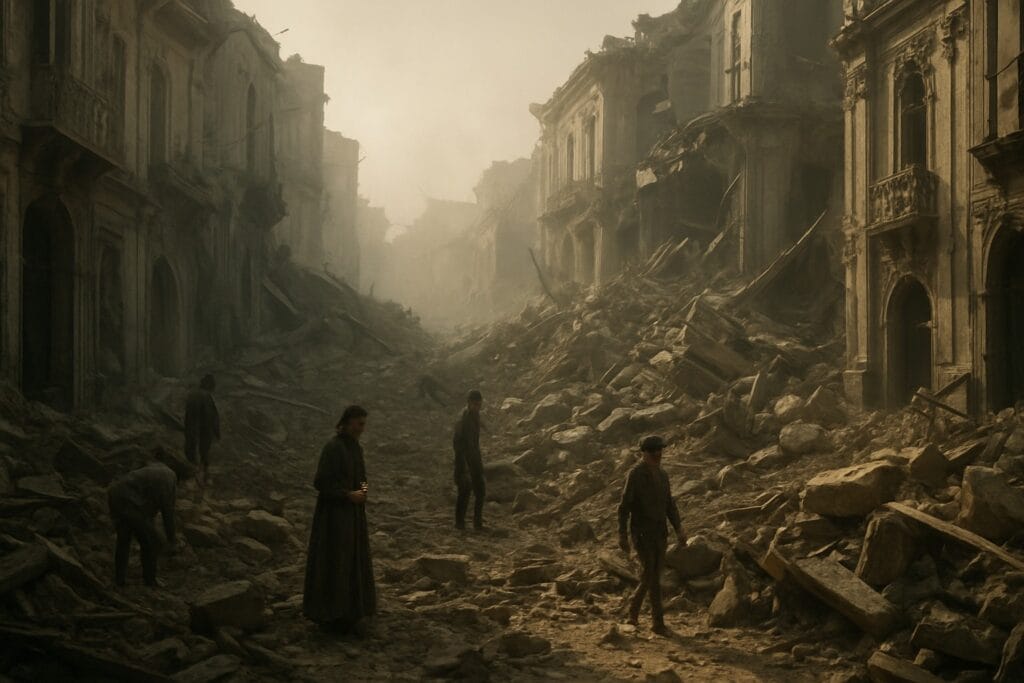
When the first grey light of dawn filtered through the winter sky over Messina, it illuminated not a city, but a broken landscape. Entire districts lay flattened, reduced to jagged heaps of masonry, shattered roof tiles, and splintered wood. Dust still hung in the air, mingling with smoke from nascent fires. The silence that followed the main tremor was short-lived. Soon it was punctuated by groans, sobs, and cries for help rising from beneath the ruins.
Those who had survived the immediate collapse found themselves in a labyrinth of debris. Streets they had known since childhood were unrecognizable, clogged with fallen facades, fragments of balconies, and the twisted remains of carts and tramcars. The cathedral had lost much of its splendor in a heartbeat; churches across the city were cracked open, their icons and statues buried, their altars dislodged. Only a handful of buildings remained standing in recognizable form, and among these, many were dangerously unstable.
Witnesses described people wandering like ghosts—barefoot, half-dressed, faces streaked with blood and dust. Some carried infants wrapped hastily in blankets; others clutched small religious images saved almost by instinct. A man with a broken arm stumbled past a collapsed tenement, calling the names of his wife and two daughters, not knowing they had died instantly. In a small square, a group of survivors huddled around a makeshift fire kindled from broken furniture, shivering in the cold morning air, too shocked to speak.
The port of Messina, once a busy interface between land and sea, had turned into a grim vantage point from which sailors and dockworkers stared in disbelief at the ruined city. When the tremor hit, several large buildings facing the harbor had crumpled, burying anyone who had been sleeping inside. A customs official, emerging with cuts across his face, watched as a row of warehouses slowly sagged and then collapsed entirely in a final, dusty sigh.
Small acts of heroism emerged immediately. Neighbors dug with bare hands through rubble, following faint voices. At one site, a man pried open a small pocket beneath a collapsed stairwell and found a child still breathing, her mother lifeless beside her. In another neighborhood, a priest crawled into a narrow cavity to administer the last rites to those he could reach, then helped pull out survivors. None had training; all acted on instinct and desperation.
But Messina’s ability to rescue its own was sharply limited by the scale of the destruction. Authorities had not prepared for such a calamity; there were no stockpiles of tools, no organized rescue brigades. Many policemen and local officials were dead or trapped themselves. The city hall lay partly ruined, and its remaining staff struggled to coordinate even basic information: How many districts had been hit? Were fires spreading? Did the telegraph lines still function? In most cases, the answers were bleak.
The messina earthquake had also disrupted basic lifelines. Water pipes broke; wells were covered by rubble. People gathered at any visible source of water, sometimes at leaking pipes, wet earth, or broken fountains. Hospitals and clinics, where they still existed at all, were overwhelmed within hours. Makeshift infirmaries sprang up in open spaces—squares, courtyards, even clearings near the shore—where the injured lay on doors used as stretchers, blankets, or directly on the frozen ground.
As aftershocks rattled the city, panic flared again and again. Buildings that had survived the first shock were further weakened; some finally succumbed with the lesser tremors that followed. Each aftershock triggered a wave of terror: people sprinted from the little shelter they had found, fearing a second wave of comprehensive collapse. Mothers screamed, clutching their children. Men yelled warnings that sometimes echoed through quarters already devoid of life.
The smell of dust began to blend with other, more sinister odors. Trapped gas occasionally ignited into small fires. Somewhere, a bakery oven overturned, spilling hot coals that started a blaze among wooden beams. With no organized fire brigade left capable of systematic action, citizens formed bucket lines where water was available, or simply tried to clear away combustibles from near open flames. The disaster was becoming not only an earthquake, but a complex urban emergency without leadership, equipment, or communication.
By mid-morning, the sun’s weak winter light revealed the full panorama: Messina, a proud port city of roughly 150,000 inhabitants, had been practically erased. Contemporary accounts suggest that over 90 percent of its buildings were damaged or destroyed. The human mind resisted such numbers, yet anyone walking a few blocks could see that they were no exaggeration. The messina earthquake had transformed a living city into a monumental grave.
Across the Water: Reggio Calabria and the Silent Collapse
On the mainland, Reggio Calabria awoke to a parallel nightmare. Though smaller than Messina, Reggio bore the brunt of the same violent shaking. Situated on sloping ground that descended towards the sea, the city’s urban fabric funneled destruction much as Messina’s had. Elegant palaces along the waterfront, humble homes in the interior, and public buildings all suffered catastrophic damage.
As day broke, survivors emerged from the ruins in a state of disbelief. The central streets, where shops and cafés once offered color and movement, were clogged with broken masonry and twisted iron. The cathedral was deeply wounded; its walls scarred, its interior piled with debris. The courthouse, municipal buildings, and schools were partly or wholly collapsed. One teacher, later interviewed, recounted how he had gone to check on his school only to find the classrooms reduced to “heaps of desks and stones, as if a giant hand had shaken the building like a toy.”
In many neighborhoods, entire families disappeared. Houses constructed hastily and without regard to seismic risk had simply pancaked, their floors crushing those below. In some rare cases, wooden structures fared better, groaning but remaining upright. Yet these exceptions only highlighted the general rule: Reggio had been built for stability in calm times, not for survival in the chaos of an earthquake.
Communication within the city quickly broke down. Streets that might have served as evacuation routes were blocked. Telephones and telegraphs were disrupted; poles were downed, cables snapped. The local authorities, like their counterparts in Messina, were decimated. Many municipal employees were dead, injured, or unable to reach their offices. Leadership, where it emerged, often came from army officers who still had surviving troops, from priests whose churches were partially intact, or from ordinary citizens who simply stepped into the vacuum.
The messina earthquake was, from the perspective of Reggio’s inhabitants, as much a local disaster as a binational one across the strait. Yet almost immediately, the people of Reggio realized that something terrible had also happened on the Sicilian side. Looking across the water, they saw angry plumes of dust and smoke hovering eerily above the opposite shore. At first, some thought it might be a massive fire or explosion in Messina’s port. Only gradually did it dawn that the entire city might be in ruins, just as their own was.
In the first hours, many survivors in Reggio fled towards open spaces near the waterfront, believing the sea breeze and distance from buildings might offer safety from aftershocks. Unbeknownst to them, the greatest danger from the sea was still approaching. For now, though, their world was the immediate anguish of searching for relatives, treating injuries with whatever bandages they could improvise, and trying to comprehend the scale of the catastrophe.
Doctors who survived found themselves suddenly in war-like conditions. With hospitals damaged or destroyed, they converted any standing structure into a triage area—partially intact churches, courtyards, even sections of the barracks. Patients arrived on carts, doors, or the shoulders of fellow citizens. Limbs were set, wounds stitched, and morphine administered where it was available. Where it was not, pain was endured with teeth clenched, prayers muttered through tears. Many died not only from crushed organs and broken bones, but from exposure, shock, and the absence of prompt care.
The population of Reggio, like that of Messina, was composed largely of poor workers, fishermen, artisans, and small traders. Their homes, often built incrementally, reflected years of slow savings and self-construction rather than engineering guidance. The messina earthquake made visible, in the cruelest possible way, the social geography of risk: those in flimsy housing on unstable ground, with little savings or insurance, were disproportionately killed or left utterly destitute.
As the morning advanced, rumors began to spread. Some said whole villages nearby had disappeared; others claimed that the quake had been felt as far away as Naples or even Rome. No one knew what was true. All they could see was the shattered world in front of them, and the ominous, slowly stirring sea at their feet.
The Sea Rises: Tsunami in the Strait of Messina
The messina earthquake’s horror did not end with the ground’s trembling. Beneath the cold waters of the strait, the violent movement of the seafloor displaced enormous volumes of water. Minutes after the main shock, the sea began to behave strangely along the coasts of Messina, Reggio Calabria, and neighboring communities.
Survivors recounted that the water first seemed to withdraw, exposing parts of the seabed that had rarely, if ever, been visible. Fish flopped helplessly on the exposed shore. Some curious onlookers, dazed by the earthquake and not understanding the danger, reportedly moved closer to see this bizarre sight. In a few harbors, anchored boats were suddenly left leaning on their keels. The withdrawal was brief, however—too brief for most people to recognize it as a classic warning sign of an approaching tsunami.
Then the sea returned. Walls of water between six and thirteen meters high struck segments of the coast, their exact heights varying by location. In some coves, the wave seemed more like a sudden, monstrous surge; in others, it formed a distinct, cresting wall that crashed inland. The force of the tsunami obliterated what the earthquake had merely damaged. Wooden houses, already cracked, were ripped from their foundations and carried inland or out to sea. People who had fled to the shoreline seeking open space were caught in the torrent, swept away along with carts, animals, and debris.
In the port of Messina, ships that had just survived the violent shaking were hammered by the waves. Some vessels snapped their moorings and were thrust against each other or against the quayside. Others were pushed inland, stranded on newly formed, chaotic shorelines of rubble and mud. A small boat filled with survivors hoping to escape the ruined city was capsized by the incoming water, its occupants vanishing amid the chaotic swirl of lumber, stones, and bodies.
Reggio Calabria’s waterfront fared no better. Here, too, the tsunami surged over coastal streets, flooding low-lying neighborhoods and dragging people and materials back into the sea as it receded. The water left behind a hellscape of mud and wreckage, with corpses tangled in fishing nets, livestock wedged among broken beams, and boats stranded in the middle of what had, hours earlier, been safe urban spaces.
Smaller villages along the strait suffered disproportionately. Communities that hugged the shoreline were simply erased. In some places, almost all inhabitants died, crushed by buildings, drowned by the waves, or both. The combination of earthquake and tsunami made the 1908 disaster particularly lethal; where one did not kill, the other often did. Modern estimates suggest that the tsunami accounted for a significant portion of the final death toll.
There was no word “tsunami” in common Italian usage then; people spoke of the “maremoto,” the seaquake, or simply “the great wave.” Without knowledge of the phenomenon’s dynamics, survivors filled the explanatory void with religious or supernatural imagery. Some saw the wave as divine punishment, others as the sea’s own revenge for centuries of human indifference. It’s astonishing, isn’t it, how quickly meaning is sought amid chaos?
Meanwhile, far from the strait, coastal communities reported unusual sea behavior. Gentle waves, minor flooding, and disrupted tides were noted in harbors elsewhere in southern Italy and even beyond. These distant echoes of the tsunami were a faint and indirect testament to the energy unleashed at the epicenter. But for Messina, Reggio, and their neighboring villages, the wave was no echo—it was a second, brutal strike in an already mortal blow.
Survivors in the Rubble: Voices, Cries, and First Responses
As the morning of December 28 advanced, both the Sicilian and Calabrian shores of the strait were dominated by a chorus of human suffering. Under piles of brick and stone, beneath collapsed roofs and staircases, people remained alive—trapped, injured, terrified. Their calls for help echoed weakly from crevices and cavities, sometimes heard, often not. Every rescue was a race against time.
Accounts from the days following the messina earthquake are filled with stories of survivors dug out after hours, sometimes even days, beneath the rubble. One woman in Messina was found on the second day, pinned under a wooden beam that had shielded her from collapsing masonry; she had survived on rainwater seeping through the cracks and the sheer will to see her children again, though she would soon learn they had perished. In Reggio, a young boy was pulled from under a collapsed balcony three days later, dehydrated, delirious, but alive, his small body shielded by his father’s, who had died above him.
Spontaneous rescue efforts formed almost immediately. Sailors from ships in the harbor, including foreign vessels that survived the initial shocks, rowed ashore and joined local men and women in clearing rubble. Soldiers who had survived in the barracks in Reggio organized themselves and tried to establish some order, prioritizing likely survival sites—places where pockets of air might have formed under fallen roofs or in stairwells. They had no heavy machinery, only picks, shovels, and bare hands.
Everywhere, choices had to be made: Which voices to follow? Which piles of rubble to attack first? Rescuers often had to move on when cries faded or when aftershocks threatened to bring down remaining walls. These are the cruel arithmetic of disaster—decisions made in dust and terror, haunting those who survived long after the debris had been cleared.
In the absence of functioning hospitals, churches that still stood became sanctuaries and morgues. Altars served as operating tables; pews became beds. Priests moved among the injured, administering sacraments, offering words of consolation, and sometimes simply providing a human presence amid the incomprehensible devastation. Nuns and laywomen bandaged wounds with torn sheets, boiled water where they could, and tried to nourish the injured with the scant food available.
Yet hunger and thirst soon became serious concerns. With food stocks buried, bakeries destroyed, and supply chains severed, survivors scoured ruins not only for relatives but for something to eat. Broken shops were raided, sometimes in desperation, sometimes in opportunistic looting. Wells and fountains were contested. Such acts were rarely simple: in the dazed days after the earthquake, stealing and survival blurred into each other.
Rumors of looting and banditry spread quickly, especially in Messina. Some accounts, amplified in later official investigations, painted a picture of generalized lawlessness, with gangs marauding through the ruins. More recent historical work, however, suggests that while incidents of theft and violence did occur, they were not as widespread as initially claimed—yet the narrative of chaos would help justify the imposition of harsh military measures later.
From the first hours, the messina earthquake also produced acts of extraordinary solidarity. Fishermen risked the still unsettled sea to ferry the injured to ships offering help. Strangers shared scraps of food, blankets, or even space under makeshift shelters erected from broken beams and cloth. Language and class barriers were blurred when everyone was reduced to the same basic needs: air, water, warmth, and the presence of another human being.
In one striking anecdote cited by later historians, a wealthy merchant from Messina, having lost his home and family, was found helping to carry bodies with a team of laborers. When someone addressed him with a title of respect, he simply shook his head and said, “Here, there are no signori, only living and dead.” It was a rare moment in which the rigid social hierarchies of pre-quake society momentarily collapsed along with the buildings.
But this fragile solidarity existed against a background of profound suffering. As day turned to night on December 28 and 29, thousands of people slept outdoors, some without blankets, huddled around small fires, buffeted by cold sea winds. The cries from beneath the rubble gradually diminished, replaced by the moans of the injured and the quiet weeping of those who understood that their loved ones would not be coming back.
A Kingdom Overwhelmed: Italy’s Stunned Political Reaction
News of the disaster filtered out slowly. The messina earthquake had snapped telegraph lines and severed rail connections, not just locally but across important routes linking southern Italy to the rest of the country. The first fragmentary reports reached authorities through roundabout paths—ships that sailed away from the strait, telegraph stations in outlying areas that managed to send brief messages, and rural officers who rode to functioning lines many kilometers away.
In Rome, the capital, early bulletins on December 28 were confusing and contradictory. Reports spoke of “strong tremors” in Calabria and Sicily, “substantial damage,” and “possible casualties.” Only as additional, more desperate messages arrived did the magnitude of the catastrophe begin to emerge. Whole cities in ruins. Tens of thousands feared dead. A tsunami. The government of Prime Minister Giovanni Giolitti, which had been preoccupied with domestic reforms and colonial affairs, suddenly faced the worst natural disaster in Italy’s modern history.
The response, though not entirely paralyzed, was halting and chaotic. There was no pre-established national emergency management system, no centralized authority with the mandate and tools to coordinate large-scale disaster relief. Responsibility for initial action fell to the Ministry of the Interior, the War Ministry, and the Navy, each acting according to its own procedures and capacities. The king, Vittorio Emanuele III, was informed and reportedly stunned by the early reports. Discussions began about sending him and Queen Elena to the stricken areas, if travel could be arranged.
Orders were issued for army units in southern Italy to mobilize, prepare field hospitals, and march or sail towards Messina and Reggio. Naval vessels were instructed to head for the strait, bearing supplies and medical personnel. But Italy’s transport infrastructure, especially in the South, was itself heavily damaged. Railway tracks were twisted or blocked by landslides; bridges were cracked. Moving troops and materials required improvisation, detours, and often simple brute effort.
Criticism of the state’s response started even as trains were being assembled. Newspapers in the North, relying on rumors and early testimonies, began to ask why communication had failed so completely, why no robust preparedness measures had existed in regions known to be seismic. The image of a disorganized, indifferent state confronting a tragedy in its neglected southern provinces fit into long-standing narratives of the “Southern Question”—the chronic underdevelopment and marginalization of the Mezzogiorno.
In the South, survivors noticed the delays acutely. For crucial hours and even days, they were largely left to fend for themselves, aided only by the first foreign ships and nearby communities. The absence of the Italian state in those early moments would leave a deep mark on local memory. Some people saw it as yet another betrayal, a confirmation that they were citizens only in name. Others, grasping at any sign of help, clung to the appearance of soldiers and officials once they did arrive as proof that Rome had not entirely forgotten them.
The monarchy, sensing both a genuine humanitarian obligation and a political opportunity, leaned into visible gestures of concern. King Vittorio Emanuele III and Queen Elena traveled to the disaster zone in the days that followed, visiting survivors, touring field hospitals, and being photographed amid the ruins. Queen Elena, dressed in white, was reported to have comforted the injured personally, her image becoming part of a modern cult of compassionate monarchy.
Yet behind these images lay a harsher reality. Organizational capability lagged far behind symbolic presence. Supplies arrived haphazardly; distribution was uneven. Some communities received food and blankets while others remained desperately short. The dead, lying in the open or trapped in rubble, posed a growing threat of disease. The government eventually authorized mass burials and even cremations, decisions that clashed with Catholic burial traditions but were deemed necessary for public health.
Politicians and officials in Rome debated not only how to respond in the present, but what the disaster meant for the future. Was it an act of God, beyond human responsibility? Or did the mass casualties reveal negligence in building codes, urban planning, and investment? These questions would not be fully addressed for years. In the immediate term, the Italian state’s reaction to the messina earthquake revealed a kingdom overwhelmed, unevenly compassionate, and still learning, painfully, how to govern in an age of mass catastrophe.
Empires at the Ruins: International Aid and Naval Armadas
Even as Italy grappled with its internal response, help began to appear on the horizon from unexpected quarters. Foreign warships and merchant vessels that happened to be in the eastern Mediterranean received word of the catastrophe and altered course towards the Strait of Messina. Within days, the harbors of Messina and Reggio, themselves in ruins, were crowded not only with Italian ships but with vessels bearing the flags of Russia, Britain, France, the United States, and other nations.
The Russian Baltic Fleet, en route home after its own trials in the Russo-Japanese War, was among the earliest and most notable foreign presences. Its sailors, hardened by years at sea and conflict, were swift to deploy to shore. They dug into the rubble with energy and skill, their dark uniforms soon caked with the same dust that covered every survivor. The British Navy also dispatched ships, and British sailors, together with their Russian, French, and other counterparts, worked side by side with Italian troops and civilians.
Scenes of unlikely cooperation unfolded across the ruins. Russian officers helped coordinate medical evacuations; British doctors assisted in makeshift hospitals; American sailors carried stretchers loaded with Italian children. National rivalries, imperial ambitions, and doctrinal differences were temporarily suspended in the face of overwhelming human need. Diplomatic reports and personal letters from the time highlight the profound emotional impact this scene had on participants and observers alike.
International humanitarian organizations, though still in their infancy compared to today, mobilized as well. The Red Cross played a significant role, sending personnel and supplies. Appeals for aid circulated in newspapers across Europe and the Americas. In Paris, London, New York, and St. Petersburg, citizens collected funds for the victims. One contemporary newspaper in London wrote, “The catastrophe at Messina has shaken Europe’s conscience. We are compelled to act, not merely to pity.” (The quotation, often cited in later histories, captures the moral urgency felt by many.)
Yet behind this solidarity, geopolitics was never entirely absent. Foreign governments saw an opportunity to demonstrate goodwill and gain influence in Italy. Aid became a kind of soft diplomacy. Italian officials, aware of the delicate balance, welcomed help but remained sensitive to the potential appearance of dependency. Some nationalist voices worried that Italy’s disorganized response would undermine its international prestige, even as they expressed gratitude for foreign assistance.
The practical impact of international aid was immense. Foreign ships provided not only manpower but also badly needed resources: tents, blankets, medical supplies, food, and clean water. They evacuated the severely injured to hospitals in other Italian cities or even abroad. They also helped restore basic communication links, using naval wireless systems and dispatch boats to relay messages when land-based telegraphs were down.
In Messina’s devastated port, sailors constructed temporary piers from debris to facilitate landing operations. They set up field kitchens, distributing hot soup and bread to survivors who had gone days with almost nothing to eat. One American officer sent a cable describing “a city where the streets have ceased to exist, the houses are heaps, and the living move like phantoms.” That vivid account later circulated widely, helping to galvanize further donations overseas.
The presence of foreign forces also shaped local experiences of the disaster in more intimate ways. Children remembered being given sweets by sailors; women recalled receiving warm coats from strangers whose language they barely understood. For many survivors, their first direct encounter with Russians, Britons, Americans, or others came not on battlefields or in colonial settings, but in an atmosphere of shared vulnerability amid the rubble of their home towns.
The messina earthquake thus became an early twentieth-century example of what we now call international disaster relief, with navies acting as rapid-response tools. It showcased both the possibilities and limitations of such efforts: the speed and scale at which foreign powers could project aid, but also the dependence on local coordination and the risk of political tensions. The spectacle of empires at the ruins would leave a lasting impression, both in Italian memory and in the evolving global practice of humanitarian intervention.
Numbers, Bodies, and Names: Counting the Dead and the Missing
In the aftermath of any catastrophe, societies try to impose order by counting. How many dead? How many injured? How many homes destroyed? In the case of the 1908 messina earthquake, this effort collided with the sheer magnitude of the destruction and the chaotic conditions on the ground. Yet over weeks, months, and even years, a grim arithmetic took shape.
Most modern estimates place the number of dead between 80,000 and 100,000 people, making the messina earthquake and tsunami one of the deadliest natural disasters in European history. Messina and Reggio Calabria accounted for the majority of these losses, but many smaller towns and villages also suffered devastating casualties. The precise numbers will likely never be known. Countless bodies lay unrecovered under collapsed structures, buried in mass graves, or lost at sea.
Immediate counts were crude. Local authorities, when functioning at all, compiled lists of known dead based on bodies recovered and identified. Churches tried to record burials, but record-keeping fell apart under the pressure of mass interments. As days passed and the threat of disease grew, the priority shifted from identification to mere disposal. Trenches were dug; bodies were placed side by side, sometimes with a small cross or marker, sometimes with nothing at all.
Families, torn between hope and despair, searched for loved ones among lines of corpses laid out in temporary morgues. They lifted sheets, peered at faces rendered nearly unrecognizable by trauma and dust, and sniffed for familiar scents on clothing. Some found closure in these grim rituals; others never did. For many, the missing remained phantoms haunting their lives, neither fully mourned nor fully alive.
Relief committees in Italy and abroad attempted to build more systematic tallies. They collected lists from municipalities, parishes, and hospitals, cross-checked reports, and tried to estimate deaths in zones where records were destroyed. The Italian government, under pressure from the public and Parliament, published figures that reflected both the enormity of the loss and the uncertainty inherent in incomplete data. Disputes over the exact toll emerged, with some insisting that official numbers understated the tragedy.
Lives were also destroyed in less visible ways. Tens of thousands were left homeless, their possessions reduced to fragments. Widows and orphans faced futures with no breadwinner, no inheritance beyond trauma. Shops, workshops, and small businesses that represented entire lifetimes of labor disappeared overnight. The economic losses, though harder to quantify than the dead, were immense.
Yet within this ocean of anonymity, individual stories managed to surface. Newspapers printed names of the dead and missing when they could, attaching brief notes—“a father of four,” “known for his charity,” “a young student recently returned from university.” In some cases, foreign nationals were among the victims: tourists, sailors, or migrants passing through the region. Their deaths drew attention in their home countries, adding an international dimension to the mourning.
One of the few comforts for survivors came from acts of remembrance. Masses were celebrated for the souls of the departed; memorial plaques began to appear, even amid ruins. The attempt to name and honor the victims was not merely a religious duty; it was an assertion that, despite the anonymity imposed by collapsed buildings and mass graves, each life had value. As one contemporary observer wrote, “The earth swallowed them without distinction, but we must remember them as they were—each with a story, a face, a voice.”
Over time, official narratives solidified: lists of the dead, figures inscribed into history books, monuments bearing collective dedications. Yet historians continue to note that behind every rounded number lies a multitude of incomplete fates. The messina earthquake reminds us that counting is necessary but never sufficient; mourning requires stories, and stories depend on memory, which, in turn, is often lost in the dust of collapsed cities.
From Stone to Steel: How the Disaster Changed Building and Science
The ruins of Messina and Reggio Calabria became, unexpectedly, an open-air laboratory for scientists, engineers, and policy makers. The 1908 messina earthquake struck at a moment when seismology and structural engineering were just beginning to emerge as rigorous disciplines. The devastation, so concentrated and so stark, provided a brutal dataset.
Italian and foreign experts traveled to the strait in the months following the quake. They photographed collapsed structures, mapped patterns of destruction, and interviewed survivors about the sequence of events. They noted that certain building types had failed more consistently than others. Heavy, unreinforced masonry buildings, with thick stone or brick walls and rigid, poorly connected floors and roofs, had performed disastrously. Older constructions, lacking even the rudimentary understanding of lateral forces, had simply toppled.
Conversely, some structures displayed surprising resilience. Wooden buildings, where they existed, often fared better. Houses with more flexible frames, lighter roofs, and stronger connections between walls and floors tended to survive shaking that crushed grander edifices. These observations fed into a growing push for “anti-seismic” construction methods—what we would now recognize as earthquake-resistant design.
The Italian government, under intense scrutiny, commissioned studies and began to revise building regulations, at least on paper. New codes for the reconstruction of Messina and Reggio emphasized lighter materials, reinforced masonry, and better structural connections. Engineers recommended wider streets, both to reduce the risk of street blockages from falling facades and to provide evacuation routes. Height limits for buildings were introduced in certain zones, and the use of steel and iron in critical structural elements was promoted.
In scientific circles, the messina earthquake offered clues about the behavior of seismic waves in complex geological settings. Seismographs located far from the epicenter recorded the event, allowing researchers to estimate its magnitude and the directionality of its energy. The distribution of damage, combined with these instrumental records, helped refine models of seismic intensity. Mercalli’s scale, already in use, was applied extensively to eyewitness reports from across southern Italy, providing one of the most detailed early intensity maps for a major European earthquake.
The disaster also spurred renewed interest in understanding the underlying tectonics of the region. Long before the theory of plate tectonics was formalized, scientists suspected that the Strait of Messina lay above a system of faults responsible for repeated large earthquakes. Field studies after 1908 documented ground ruptures, landslides, and changes in coastal elevation. These observations, though sometimes inconsistent or fragmentary, became part of the foundation on which later geophysical research would build.
Internationally, the 1908 earthquake contributed to a broader recognition that urban planning and architecture could not ignore natural hazards. Cities in other seismic regions—Tokyo, San Francisco, Santiago, and beyond—paid attention. Journals published comparative analyses of different earthquakes, using Messina and Reggio as cautionary examples of what happens when dense masonry cities meet high-intensity shaking without preparation.
Italian urban planners themselves were divided. Some argued for a near-total break with the past: a modern, rational grid of reinforced buildings, wider avenues, and clearly zoned neighborhoods. Others, more attached to the traditional urban fabric and constrained by cost, pushed for more conservative rebuilding. The eventual compromise, particularly in Messina, leaned towards rationalization but could never fully erase the city’s old character; fragments of memory remained embedded in the new plan.
Despite these advances, change was uneven. The lessons of the messina earthquake were more readily applied in the rebuilt disaster zone than in other parts of southern Italy, where old construction practices persisted due to poverty, inertia, and lack of enforcement. It is a sad irony that some of the same vulnerabilities exposed in 1908 would resurface in later Italian earthquakes, from Irpinia in 1980 to L’Aquila in 2009. History’s warnings, even when clearly written in stone and dust, are not always heeded consistently.
The Poor, the Forgotten, and the Blamed: Social Fault Lines after the Quake
Natural disasters are often described as “great equalizers,” indifferent to class or status. The messina earthquake, however, revealed as much about social hierarchy as it did about geology. While the ground shook beneath everyone’s feet, the capacity to survive, to recover, and to be heard afterward was deeply influenced by class, gender, and power.
In the densely populated working-class neighborhoods of Messina and Reggio, buildings were most overcrowded and least well built. Families lived in subdivided spaces, sometimes with multiple generations under one roof. When those roofs collapsed, entire kin networks were wiped out in an instant. Survivors from these quarters often emerged with nothing but the clothes on their backs, if even that. They lacked savings, insurance, and influential connections—tools that might have smoothed their path to assistance.
By contrast, some members of the local elite, though not immune to the earthquake’s violence, had better odds. Their homes, while still vulnerable, sometimes had sturdier construction or stood in slightly less exposed locations. They had access to financial reserves, properties in other cities, or family networks elsewhere in Italy or abroad. After the shock passed, these advantages could mean the difference between permanent ruin and the possibility of rebuilding a semblance of their former lives.
In the chaotic days after the quake, rumors about looting and violence often centered on the poor. Newspapers and official reports described scenes of “brigandage,” theft, and moral collapse. But as later scholars have argued, such narratives frequently exaggerated or misrepresented what was happening on the ground. Survival behaviors—taking food from abandoned shops, reclaiming materials from rubble—were framed as criminal in ways that reflected preexisting prejudices against southern populations, especially the urban poor.
Authorities responded by imposing martial law in the stricken areas. Military tribunals were established to deal with alleged crimes swiftly. Some soldiers and officials, convinced that harsh measures were needed to restore order, executed suspected looters or bandits with minimal evidence. Stories circulated of people shot for carrying goods from destroyed stores, even when those goods might have meant the difference between hunger and subsistence.
Women faced particular vulnerabilities. Many lost male relatives who had been primary wage earners, leaving them as heads of households in a context where economic opportunities for women were limited. At the same time, women often played central roles in immediate care work—tending to the injured, caring for children, preparing meager meals from shared resources. Their labor was indispensable yet rarely documented or celebrated in official accounts.
Migrants and seasonal workers, too, were disproportionately affected. Some had arrived in Messina or Reggio only temporarily, hoping to earn enough to support families in the countryside. Their names might not appear in local records; their deaths could easily become invisible to the statisticians writing history. Others had been on the verge of boarding ships for the Americas, part of the great Italian diaspora of the era. For them, the earthquake cut short what had been imagined as a path out of poverty.
Religious interpretations of the disaster also reflected and reinforced social lines. Some preachers described the earthquake as divine punishment for moral failings, implicitly or explicitly blaming the poor for supposed vices. Others framed it as a test of faith and charity, urging the better-off to aid the suffering. The tension between seeing the event as a moral judgment and as an occasion for solidarity ran through sermons, pamphlets, and private conversations alike.
In the years that followed, debates over reconstruction funding, property claims, and compensation often pitted the interests of wealthy landowners and businessmen against those of the dispossessed. Who would receive new housing first? Whose neighborhoods would be prioritized in urban plans? Whose claims to lost property would be recognized? These questions turned the invisible social “fault lines” that had existed before 1908 into visible, bitter disputes.
The messina earthquake thus did more than topple buildings; it exposed the inequities within Italian society. It forced the nation to confront, however reluctantly, the question of who counts most when everything crumbles—and whose suffering can be more easily ignored.
Rebuilding Messina: Blueprints for a City of the Future
In the wake of the catastrophe, the Italian state faced a daunting question: what to do with a city that had been almost completely destroyed. Should Messina be rebuilt where it stood, on its precarious site at the edge of the strait, or should it be relocated to safer ground? Voices on both sides of the debate were passionate.
Some experts argued for relocation, invoking not only seismic risk but the symbolism of starting anew somewhere less haunted. But the majority of Messina’s survivors and local elites insisted on rebuilding in place. The port, the historic role of the city as a gateway to Sicily, and the deep emotional ties to the land weighed heavily. Abandoning Messina’s location would, in their view, be tantamount to surrendering to the earthquake—a second death layered upon the first.
The decision was ultimately made to rebuild Messina on its original site, but with a new urban plan. Engineers and architects set to work drafting a modernist vision: wide, straight streets laid out in a grid where possible, designed to act as firebreaks and evacuation corridors. Building codes called for lower structures—generally no more than three or four stories—and specified forms of reinforced masonry intended to resist lateral shaking.
The new Messina emerged slowly from amid the ruins. Debris had to be cleared first, a process that took years and demanded both manual labor and limited mechanization. Temporary shelters sprouted along the edges of the old city and in nearby camps; some became semi-permanent, shaping the social geography of the reconstruction. Wooden barracks housed not only the poor but also parts of the emerging middle class, equalizing living conditions temporarily in ways that did not always erase underlying inequalities.
Reconstruction funding came from a mixture of state resources, private capital, insurance payouts, and foreign donations. Corruption and mismanagement, unsurprising in such a vast and urgent endeavor, siphoned off some of these funds. Promised projects were delayed or scaled back. Still, brick by brick, Messina reassembled itself, this time with an eye to both modernity and memory.
Architecturally, the new city showed influences from broader European trends: neoclassical facades, rational layouts, and a cautious flirtation with reinforced concrete. But it also carried the imprint of the disaster in more subtle ways. Open squares were left where dense quarters had once stood, partly in the name of safety, partly because full reconstruction was beyond the budget. Regulatory height limits kept the skyline lower, preserving more sky and more potential escape routes than before.
Reggio Calabria underwent a similar, if not identical, process. Its reconstruction plan also favored wider streets and more regular grids, particularly along the seafront. Here, planners took advantage of the disaster to implement long-discussed but previously stalled urban reforms, using the rhetoric of safety and modernization to justify sweeping changes. Not all residents were pleased; for many, the new lines on the map erased familiar patterns of life, displacing communities that had existed for generations.
Culturally, the act of rebuilding became a narrative of resilience. Monuments were erected to commemorate the dead and to honor those who had aided in rescue. In Messina, a monument to the “victims of the earthquake” stood alongside plaques dedicated to foreign sailors and local heroes. The rebuilt city, with its more open plan and reimagined architecture, became a living memorial—a daily reminder of both loss and determination.
Yet behind the rhetoric of rebirth, tensions simmered. Some survivors felt that the new Messina belonged more to planners and external investors than to the communities who had lost everything. Decisions about which neighborhoods to prioritize, which historical buildings to reconstruct, and which to abandon reflected power dynamics as much as technical considerations. The earthquake had leveled much of the old city; the reconstruction process, intentionally or not, stratified the new one.
Still, as decades passed, new generations grew up knowing only the rebuilt Messina and Reggio. For them, the gridded streets and more open vistas were normal. The memories of the pre-1908 city lived on mostly in stories, photographs, and the fading recollections of elders. The messina earthquake had not just broken stone; it had created a temporal dividing line in urban identity: a city “before” and a city “after,” separated by one terrible morning.
Memory, Myths, and Martyrs: How the Quake Lived On
In the years following the 1908 catastrophe, the messina earthquake moved from raw experience into the realm of memory, myth, and public narrative. The process by which societies remember disasters is never simple. It involves official commemorations, religious practices, family stories, literature, and sometimes silence.
Religious interpretations were central in Messina and Reggio, heavily Catholic cities where the line between history and hagiography often blurred. Stories arose of miraculous escapes attributed to the intervention of saints or the Virgin Mary. Some survivors insisted that they had seen protective figures in visions amid the dust and darkness, guiding them to safety. Churches, once rebuilt, incorporated references to the earthquake into their iconography—plaques of thanks for deliverance, altarpieces showing patron saints shielding the city from ruin.
At the same time, the image of the monarchy as compassionate and paternalistic was reinforced through memory. Queen Elena’s visits to the ruins, her presence in hospitals, and her reported acts of personal kindness were amplified in photographs, newspaper stories, and later histories. She became, in some narratives, a quasi-maternal figure for the grieving South, softening the harsher image of a distant Roman state. Whether this image matched the complex political reality or not, it became part of the earthquake’s lasting story.
Literary and journalistic accounts helped shape broader national and international perceptions. Reporters compared the ruins to ancient Pompeii or to battlefields, evoking both classical tragedy and modern industrial warfare. Some writers urged readers to see the disaster as a call to national solidarity and reform; others used it as a lens to critique Italy’s neglect of its southern regions. One scholar later observed that “Messina became a mirror in which Italy saw both its compassion and its failings,” a concise formulation that has been widely quoted.
Within families, more intimate narratives circulated. Grandparents told grandchildren where their houses had stood “before,” pointing at intersections that now hosted different buildings or open squares. They recounted the names of relatives lost, the feel of the ground rolling, the taste of dust in the mouth. Such stories, repeated over decades, preserved details that official histories might overlook: the sound of a specific church bell, the smell of jasmine crushed under rubble, the color of the sky that morning.
But not all memories were shared freely. For some, the trauma was too great, the pain too sharp. They refused to speak of those days, or did so only in fragments. Silence became another form of remembrance, one that shielded both the speaker and the listener from reliving horror. Psychologists today might call this unprocessed trauma, but at the time, it was simply how many coped.
Public commemorations took formal shape as anniversaries approached. On December 28 each year, memorial masses were held, bells tolled, and wreaths laid at monuments. In Messina, the date became a central marker in the city’s calendar, a civic ritual that bound residents together in shared reflection. For those who had not lived through the quake, these events offered a way to connect with a past that still shaped their environment.
Myths also grew around certain figures and places. Stories of heroic rescues—sometimes embellished, sometimes faithfully preserved—became part of local lore. Particular streets acquired reputations for having been “cursed” or “protected.” The sea itself, which had risen in tsunami, remained an ambivalent presence: source of livelihood, but also of remembered terror, its calm surface never entirely trusted.
Over the twentieth century, as new disasters struck other parts of the world and new wars redrew the map of Europe, the messina earthquake slowly receded from global consciousness, but never entirely vanished. For seismologists, it remained a key case study. For Italians, especially in the South, it endured as a symbol of both vulnerability and resilience. For the people of Messina and Reggio, it lingered in the built environment, in annual rituals, and in the names engraved on aging stone.
Messina and Reggio in the Long Twentieth Century
The cities reborn from the ruins of 1908 did not remain frozen in time. Over the course of the twentieth century, Messina and Reggio Calabria navigated the upheavals that reshaped Italy and Europe: two World Wars, Fascism, economic booms and crises, waves of migration, and the slow construction of the modern Italian Republic. The shadow of the messina earthquake, however, never disappeared entirely.
During the Fascist period, the regime of Benito Mussolini sought to harness the memory of the disaster for its own purposes. Official rhetoric emphasized the state’s capacity to rebuild, presenting the new Messina and Reggio as evidence of national strength and discipline. Monuments and public works projects were sometimes framed as gifts of the regime to a once-tragic but now-renewed South. The more uncomfortable questions about pre-1908 neglect and the inadequacies of the early response were pushed into the background.
World War II brought new destruction. Allied bombing raids targeted strategic ports and infrastructure, and both Messina and Reggio suffered damage. For inhabitants, the experience of seeing buildings collapse again, of hearing sirens and explosions, inevitably evoked memories of 1908—even among those born long after the earthquake. Destruction layered upon destruction, and the line between natural and human-made catastrophe blurred.
In the postwar years, both cities participated in Italy’s broader economic transformation. Industrialization, though still concentrated in the North, brought some development to the South. New roads, bridges, and port facilities were built. The Strait of Messina remained a vital transit corridor, and proposals for a permanent bridge—still debated into the twenty-first century—circulated periodically, each time raising questions about engineering, economics, and environmental risk in a seismically active area.
Meanwhile, migration continued to shape the region. Many residents of Messina and Reggio, especially the young and ambitious, left for opportunities elsewhere: Turin, Milan, Rome, or foreign countries. They carried with them family stories of the earthquake, sometimes using their city’s history as a marker of identity in distant lands. At the same time, new internal migrants arrived from even poorer rural areas, filling the urban fabric with fresh energy and need.
Urban sprawl, informal construction, and periodic lapses in enforcement of building codes raised uneasy echoes of 1908. Scholars and activists warned that some of the same vulnerabilities—unsafe housing on unstable slopes, inadequate infrastructure—persisted beneath the veneer of modernity. Smaller earthquakes and landslides in the wider region served as warnings that the land’s restlessness had not abated.
Cultural life, however, flourished in fits and starts. Universities, theaters, and cultural associations helped re-anchor Messina and Reggio in the national imagination as living cities, not just historical tragedies. Commemorations of the earthquake became opportunities not only for mourning but for reflection on identity, development, and justice. Exhibitions of old photographs and documents drew new generations into conversation with the past.
By the late twentieth century, as global awareness of disaster risk and climate change grew, the messina earthquake was increasingly referenced in discussions about resilience and preparedness. Local schools taught about it not merely as a tragic event, but as a lesson: build better, plan ahead, respect the land’s power. Whether these lessons will be fully applied when the next major quake strikes the region remains an open and urgent question.
Echoes in Modern Seismology and Disaster Policy
More than a century after the 1908 catastrophe, the messina earthquake retains a central place in seismological research and disaster policy discussions. Advances in geophysics, geology, and engineering have transformed how scientists interpret the event, even as historians continue to unravel its social and political dimensions.
Modern studies of the region’s tectonics confirm that the Strait of Messina lies within a complex boundary zone where the African and Eurasian plates converge. Fault systems beneath the strait are capable of generating large earthquakes, though their precise behavior remains the subject of active research. By combining historical accounts, geological field evidence, and modern seismic data, researchers have refined models of the 1908 rupture: its approximate length, depth, and slip.
These models have practical implications. They feed into seismic hazard maps that guide building codes and infrastructure planning across Italy. Engineers, armed with better understanding of likely ground motions, can design structures more capable of withstanding future quakes. Critical facilities—hospitals, schools, bridges—can be sited and reinforced with the 1908 scenario (and worse) in mind.
Disaster policy, too, has evolved. Italy today has a national civil protection system, with protocols for early response, coordination between agencies, and communication with the public. Drills, public education campaigns, and building code enforcement—though imperfect—represent an attempt to ensure that no region faces another disaster with the unpreparedness that characterized 1908. When earthquakes have struck other parts of Italy in recent decades, the response, while still criticized at times, has generally been faster and more organized than anything possible in the early twentieth century.
Internationally, the 1908 event is frequently cited in comparative studies of disasters. It appears in global databases of significant earthquakes and tsunamis, used to calibrate risk assessments from the Mediterranean to the Pacific. Scholars reference it when discussing how societies remember and learn from catastrophe. One recent scientific review described the messina earthquake as “a benchmark event for European seismic risk,” underscoring its enduring importance.
Yet the legacy is not solely technical. The 1908 disaster also feeds into contemporary debates about environmental justice and the social dimensions of risk. Who lives in the most vulnerable buildings today? Who has access to information, insurance, and political influence? As climate change and rapid urbanization produce new hazards and magnify old ones, the ghost of Messina hovers over policy discussions worldwide.
Ultimately, the echoes of the messina earthquake in our current century remind us that knowledge, while vital, is not enough. The science of seismic risk must be matched by political will, economic investment, and social solidarity. The ruins of 1908 offer a stark warning of what happens when these elements are lacking—and a challenge to ensure that history does not repeat itself with the same tragic consequences.
Conclusion
In the early dawn of December 28, 1908, the messina earthquake and its accompanying tsunami tore apart two cities, shattered tens of thousands of lives, and inscribed a deep scar into Italian and European history. What unfolded in less than a minute of violent shaking and a few lethal waves became, in the decades that followed, a complex tapestry of stories: of suffering and resilience, of state failure and international solidarity, of scientific progress and stubborn social inequity.
The disaster exposed preexisting vulnerabilities—fragile masonry in crowded neighborhoods, neglected infrastructure, and a profound North–South divide in political attention and resources. It forced Italy to confront the limits of its institutional capacity and, under the gaze of foreign navies and donors, to reckon with its responsibilities to its own citizens. At the same time, the event catalyzed advances in seismology, engineering, and urban planning, contributing to the birth of modern earthquake science and risk-aware city design.
Messina and Reggio Calabria, rebuilt in new forms, carry the memory of 1908 in their streets, monuments, and annual commemorations. Families still tell stories of ancestors lost or saved, and local identity remains intertwined with that terrible morning. The earthquake’s legacy has migrated from raw wound to enduring lesson: that nature’s forces, though beyond human control, interact with human choices in ways that determine who lives, who dies, and who can rebuild.
As we look back more than a century later, the messina earthquake stands as both a historical tragedy and a contemporary warning. In a world where cities continue to expand into hazardous zones and where inequality shapes exposure to risk, its lessons are painfully relevant. Remembering Messina is not merely an act of piety for the dead; it is a call to honor them by building societies that are more just, more prepared, and more attentive to the tremors—literal and metaphorical—that precede catastrophe.
FAQs
- When did the Messina earthquake occur?
The Messina earthquake struck at approximately 5:20 a.m. on December 28, 1908, devastating the cities of Messina in Sicily and Reggio Calabria on the Italian mainland. - How powerful was the Messina earthquake?
Modern estimates place its magnitude at around 7.1–7.2 on the moment magnitude scale, with extreme shaking corresponding to XI–XII on the Mercalli intensity scale in the hardest-hit areas. - How many people were killed by the disaster?
Most historians and seismologists estimate that between 80,000 and 100,000 people died as a result of the earthquake and the subsequent tsunami, making it one of Europe’s deadliest natural disasters. - Did the earthquake trigger a tsunami?
Yes. The seafloor displacement during the quake generated a tsunami that struck the coasts of Sicily and Calabria minutes after the main shock, with waves up to about 6–13 meters high in some locations, greatly adding to the destruction and loss of life. - How did the Messina earthquake change building practices?
The disaster prompted significant reforms in Italian building codes, especially in the affected region. Reconstructed cities adopted wider streets, lower building heights, and structural reinforcements, and the event became an important case study in early earthquake-resistant design. - What role did foreign powers play in the relief effort?
Navies from Russia, Britain, France, the United States, and other countries sent ships, personnel, and supplies. Their sailors helped rescue survivors, treated the injured, and evacuated victims, making the relief effort one of the earliest large-scale examples of international disaster assistance. - Why is the Messina earthquake still studied today?
It is studied for its scientific value in understanding Mediterranean tectonics and tsunamis, for its role in the development of seismology and structural engineering, and for the insights it offers into how societies respond to catastrophic risk. - Could a similar earthquake happen again in the Strait of Messina?
Yes. The region remains seismically active, and geophysical research indicates that faults capable of large earthquakes still exist beneath and around the strait. Modern building codes and disaster planning aim to reduce the impact of any future event, but significant risk remains.
External Resource
Internal Link
Other Resources
- Encyclopaedia Britannica – general search for the exact subject
- Google Scholar – academic search for the exact subject
- Internet Archive – digital library search for the exact subject