Table of Contents
- Dawn Shock: A City Wakes to Shaking
- Faults Beneath the Capital: The Geology of Northern Croatia
- A Compounding Crisis: Earthquake Amid a Pandemic Lockdown
- Minutes That Mattered: Emergency Response in the First Hour
- Stones and Steeples: Damage to Zagreb’s Built Heritage
- Homes, Hospitals, and Schools: Social Infrastructure Under Strain
- Power, Pulpits, and Politics: Decisions from City Hall to the Cabinet
- Counting Losses: Economics of Repair and Insurance
- What Records Reveal: From Seismographs to Parish Books
- Community on the Streets: Volunteers, Neighbors, and the Army
- Aftershocks and Anxiety: The Psychology of a Shaken City
- Building Back Safer: Codes, Retrofits, and Engineering Debates
- Regional Ripples: Croatia, the EU, and Balkan Seismic Memory
- From Memory to Policy: Lessons Archived and Applied
- Conclusion
- FAQs
- External Resource
- Internal Link
Article Summary: In the early hours of March 22, 2020, a strong earthquake struck Zagreb, cracking facades, toppling masonry, and jolting an already anxious city under pandemic restrictions. This article reconstructs the morning’s events and tracks the long arc of recovery. It assesses geologic causes, emergency response, and political choices. It follows families and institutions through months of aftershocks and uncertainty. Drawing on seismological records and policy debates, it explains why the zagreb earthquake 2020 became a test case for urban resilience, heritage protection, and solidarity in crisis.
Why keep reading: A single tremor can rewrite a city’s map, but in 2020 it collided with a lockdown that emptied streets and strained nerves. Follow how stone, policy, memory, and community interacted in real time—and why Zagreb’s choices matter for every historic city sitting quietly above a restless fault.
At a glance:
- Event: Earthquake impacting the city of Zagreb and surrounding counties
- Date: March 22, 2020 (with months of aftershocks)
- Place: Zagreb, Croatia; epicentral area north-northeast of the city
- Main figures: Prime Minister Andrej Plenković, President Zoran Milanović, Mayor Milan Bandić, Croatian Civil Protection, Croatian Seismological Survey
- Why it mattered: First major urban quake in modern independent Croatia; severe heritage losses; recovery under pandemic; catalyst for reconstruction law and seismic risk awareness.
01 – Dawn Shock: A City Wakes to Shaking
Before sunrise on a cold Sunday in March, windows rattled, plaster rained, and a single jolt rolled into a long, unnerving sway. Phones lit up as alarms and messages replaced sleep. For many residents, the zagreb earthquake 2020 turned their quiet apartments into unpredictable rooms of flying books, swinging lamps, and sudden decisions.
People stumbled into courtyards and narrow streets, clutching coats over pajamas, their breath visible in the air. The tremor lasted seconds, but clocks slowed in memory. It was not the worst quake imaginable, but it was the worst many living Zagreb citizens had felt, and the city learned that history can return without warning.
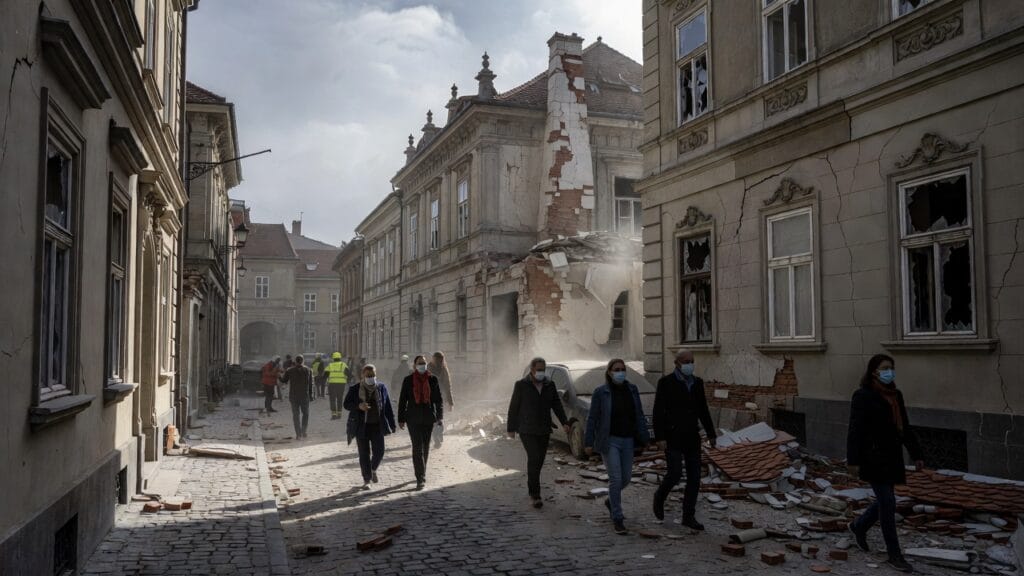
Sirens threaded through the morning as first responders triangulated reports. Residents formed quick clusters at safe distances, scanning old facades for new cracks. The smell of dust mixed with early spring chill. Overhanging cornices and decorative reliefs, once admired, suddenly looked like threats that could fall again with the next aftershock.
02 – Faults Beneath the Capital: The Geology of Northern Croatia
Zagreb sits against Medvednica Mountain, where complex faults link the Alps and Dinarides. The crust is squeezed and sheared, driving shallow earthquakes that can be felt intensely in the dense urban fabric below. Geologists had long mapped these structures, but maps rarely command attention until the ground demonstrates their power.
The mainshock in 2020 struck near neighborhoods like Markuševec and Čučerje, where hillside homes meet forest. Seismologists described a shallow rupture, the kind that throws shaking directly into the city with little warning. The energy was modest by global standards, yet highly efficient at rattling bricks and cornices designed long before modern seismic thinking.
This landscape remembers older shocks, including the 1880 earthquake that helped define Zagreb’s urban history. After that nineteenth-century disaster, the city rebuilt with pride, adopting Central European styles that gave it elegance—and future vulnerability. The 2020 event was not a freak occurrence; it was a return of a long, local conversation between bedrock and buildings.
03 – A Compounding Crisis: Earthquake Amid a Pandemic Lockdown
As the ground heaved, the pandemic’s logic inverted. The rule had been to stay home, keep distance, and minimize contacts. Suddenly, homes felt unsafe, stairwells crowded with neighbors, and the street—a forbidden zone days earlier—became a refuge. It was a cruel test of public messaging: two emergencies, one set of fragile nerves.
Authorities urged people to gather outdoors but avoid large groups, a delicate request that sounded almost contradictory. Residents tried to stand apart while sharing phone chargers, blankets, and rumors. Masks, still new to many, mingled with dust masks scavenged from toolboxes. When aftershocks arrived, the choreography of stepping into open air repeated, a ritual of fear and caution.
04 – Minutes That Mattered: Emergency Response in the First Hour
Dispatchers began routing calls seconds after the strongest shaking faded. Firefighters moved first toward reports of collapsed chimneys, damaged attics, and blocked stairwells. Ambulances checked maternity wards and elder-care homes, alert to fragile patients and improvised evacuations. The first hour set the tone: focused, fast, and complicated by a city waking in fear.
Mobile networks strained under simultaneous messages, while emergency teams relied on radio and established protocols. Logistics officers sent crews to the most vulnerable streets where ornate façades lined narrow lanes. Public squares served as staging areas. With each aftershock, responders stepped back, re-evaluated, then resumed, aware that collapsing brick does not negotiate with urgency.
Mini timeline:
- 06:24 CET, 22 Mar 2020: Mainshock shakes Zagreb; widespread reports of cracked masonry and fallen chimneys.
- ~07:01 CET, 22 Mar 2020: Strong aftershock deepens damage and fear; emergency crews re-check affected zones.
- Late March 2020: Citywide rapid safety inspections begin; priority assigned to hospitals, schools, and heritage sites.
- September 2020: Croatian Parliament adopts a Reconstruction Act focused on Zagreb and neighboring counties.
05 – Stones and Steeples: Damage to Zagreb’s Built Heritage
The city’s beauty became its weakness. Decorative cornices, pilasters, and statues cracked or fell. The cathedral’s spire, a dominant feature of the skyline, suffered notable damage; later months would see controlled dismantling to prevent further collapse. Museums and galleries reported shaken collections and fractured walls, their quiet rooms suddenly unsafe for art and staff alike.
Churches across town lost roof tiles and structural elements, symbolic wounds in a city where Sunday bells usually steady the week’s rhythm. The zagreb earthquake 2020 did not erase the nineteenth-century identity, but it forced painful choices about what to save first. Heritage officials knew that every day exposed to weather compounded long-term loss.
Documentation teams photographed, tagged, and archived damage as quickly as they could, often through dust and unstable scaffolding. The Ministry of Culture and Media coordinated with conservators to triage buildings most at risk. Temporary supports sprouted like splints across facades, a visible acknowledgment that art and engineering would have to share the same vocabulary for months.
06 – Homes, Hospitals, and Schools: Social Infrastructure Under Strain
Beyond monuments, ordinary apartments bore the brunt: cracked walls, shifted chimneys, and fallen interior partitions. Families hauled mattresses into safe rooms or decamped to relatives outside the city, complicating already restricted travel. Leaks and broken heating pipes made spring weather feel wintery again. Repair crews faced a marathon of small emergencies, each case personal and immediate.
Hospitals had to move patients between wards, some already reorganized for pandemic protocols. The maternity hospital became a symbol of resilience as photos showed mothers and infants wrapped in blankets outside. Schools, empty because of public health orders, revealed fissures that would delay in-person learning, deepening the educational disruption already underway for thousands of students.
07 – Power, Pulpits, and Politics: Decisions from City Hall to the Cabinet
City officials and national leaders toured damaged streets, balancing empathy with announcements. Prime Minister Andrej Plenković and President Zoran Milanović addressed the nation, while Mayor Milan Bandić confronted immediate urban logistics. The administrative map of responsibility—municipal, county, national—shaped decisions that would soon be codified in a formal reconstruction framework.
Temporary shelters opened, but many residents preferred to remain near their homes, guarding property and hoping to return quickly. Public communication tried to reconcile compassion with bureaucracy: inspections required forms; aid needed criteria; and relief had to be fair, not merely fast. Meanwhile, clergy addressed congregations shaken spiritually and physically, churches now roped off for safety.
Debate soon focused on a Reconstruction Act to guide funding and technical standards. Supporters argued it would accelerate work and unlock external aid; critics warned of complexity, delays, and inequities among neighborhoods. The law ultimately passed months later, signaling the state’s intent to rebuild, even as implementation details sparked continued public scrutiny.
08 – Counting Losses: Economics of Repair and Insurance
Within weeks, economists and engineers produced early loss estimates. They spoke in ranges, acknowledging uncertainty while tallying cracked masonry, compromised roofs, and ruined interiors. Assessments by Croatian authorities and international partners eventually placed damages and losses in the low tens of billions of euros, a sum daunting for any city, let alone amid a global downturn.
Insurance penetration for residential buildings was relatively low, especially for full seismic coverage on older properties. That left many families reliant on savings, loans, or state programs to finance repairs. Small businesses, already strained by pandemic closures, faced broken storefronts and stockroom damage, their path to reopening strewn with invoices more than debris.
Municipal budgets had to be rewritten. Heritage repairs require specialists and time, neither cheap. The zagreb earthquake 2020 forced a conversation about cost-sharing between owners, insurers, and the state, while the European Union’s solidarity instruments and development banks became potential lifelines. Money would not make walls straight by itself, but without it, scaffolds risked becoming permanent fixtures.
09 – What Records Reveal: From Seismographs to Parish Books
The seismological record is firm where memory can blur. Croatian Seismological Survey stations and the European-Mediterranean Seismological Centre logged magnitudes, depths, and aftershock sequences in near real time. These datasets anchor the chronology, even as eyewitness accounts capture the emotionally true but technically imprecise texture of the morning.
For historians, comparison matters. Parish books and municipal archives from the 1880 quake preserve stories of cracked domes and communal effort, while today’s datasets preserve waveforms, drone photos, and digital maps of damage. The pairing offers a rare longitudinal view: the same city, two centuries, varied technologies, similar human vulnerabilities and choices.
Not every number is final, and some never will be. Property-level data shifts as engineers reclassify damage, legal disputes unfold, and owners choose different repair strategies. What endures is the pattern: older unreinforced masonry fared poorly; structures with partial retrofits did better; and the city’s emergency services prevented a bad morning from becoming a catastrophic day.
10 – Community on the Streets: Volunteers, Neighbors, and the Army
Spontaneous volunteerism filled gaps the first week. Neighbors carried debris, checked attics, and helped elderly residents navigate cracked stairwells. Student groups and civic associations coordinated online, matching tools to addresses and needs to skills. The country’s armed forces supported logistics, moving materials and assisting with dangerous removals in tightly built historic blocks.
Food kitchens and donation drives emerged despite restrictions, improvising safe distribution to minimize contact. Hardware stores became nodal points for tarpaulins, gloves, and rope. These local networks did not replace institutions, but they accelerated small, essential tasks. In disaster narratives, such quiet competence rarely headlines, yet it is the connective tissue of resilience.
Religious and cultural organizations, themselves damaged, offered courtyards for staging and counseling. Psychologists joined hotlines to address fear, particularly among children jolted awake by something no parent could control. The emerging portrait was not of helplessness but of a city leaning into the difficult work of recovery, one conversation and one repaired step at a time.
11 – Aftershocks and Anxiety: The Psychology of a Shaken City
Aftershocks stretched the calendar of fear from hours to weeks. Each small tremor reopened the morning’s alarm, driving families to check doorframes, pets to scratch at doors, and heart rates to spike without warning. Sleep patterns broke. Parents developed new rituals for children: bedtime debriefs, emergency bag rehearsals, and gentle reminders that shaking stops.
It is easy to forget how fragile this world still was, and not just city walls. The pandemic had already eroded routines, layered with economic doubts and isolation. The quake added a kinetic uncertainty. Mental health professionals reported increased anxiety symptoms, while community groups tried to scaffold recovery with simple, repeated acts of reassurance.
Public communication mattered. Transparent updates about aftershock probabilities and visible progress on repairs helped convert dread into a manageable risk. Museums and galleries planned phased reopenings as symbols of cultural persistence. When the cathedral’s damaged elements were stabilized, it sent a powerful message: care could convert damage into determination.
12 – Building Back Safer: Codes, Retrofits, and Engineering Debates
Engineering opinions were not monolithic. Some argued for aggressive retrofitting of unreinforced masonry, including steel ties, shear walls, and diaphragm strengthening. Others emphasized cost, heritage constraints, and the pitfalls of partial measures. The conversation turned on a core question: how to honor architectural character while protecting life safety in the next inevitable tremor.
Modern Croatian building codes reflect lessons from regional earthquakes—Skopje 1963, Friuli 1976, and others—but older buildings predate such frameworks. Engineers explained diaphragms and ductility on evening news, translating jargon into plans residents could weigh. Pilot projects tested methods on emblematic structures, aiming to demonstrate that careful reinforcement could be discreet yet transformative.
The zagreb earthquake 2020 made clear that mitigation is a policy, not just a calculation. Incentives, inspections, and grants shape what owners choose to do. Universities engaged, designing curricula and research focused on historic urban fabrics under seismic loads. A city’s safety is not static; it is built, audited, and rebuilt in cycles that outlast political terms.
13 – Regional Ripples: Croatia, the EU, and Balkan Seismic Memory
Across the region, memories stirred. In December later that year, a stronger quake in Petrinja renewed attention to fault systems threading northern Croatia. European partners took note: urban quakes in historical centers are not rare exceptions. EU solidarity funds and technical missions addressed immediate needs while nudging member states toward broader seismic risk planning.
Croatia’s case joined a long Mediterranean conversation about old cities and new hazards. From Ljubljana to Skopje, municipal leaders compared ordinances and funding models. The zagreb earthquake 2020 offered a cautionary but practical syllabus: know your housing stock, maintain critical infrastructure, and make peace with the slow pace of heritage-safe retrofits.
International agencies published rapid assessments and policy notes, but implementation remained stubbornly local. Zoning boards, property registries, and neighborhood associations mediated decisions that look like engineering but feel like culture. In this, Zagreb became both student and teacher—absorbing advice while demonstrating that trust and persistence are the true currencies of reconstruction.
14 – From Memory to Policy: Lessons Archived and Applied
Months after the tremor, archival work began in earnest. Inspectors’ notes, drone imagery, and repair permits formed a new layer in the city’s record. Legislators refined the Reconstruction Act’s provisions even as contractors hammered. Universities convened roundtables linking seismology, urban planning, and social policy, seeking a template durable beyond one city and one year.
Progress was real but uneven. Some buildings reopened quickly; others languished behind tarps that grew weathered. Funds moved, then met the friction of procurement rules, heritage approvals, and competing priorities. Yet behind the ceremony of ribbon-cuttings lay the steady pressure of civil society groups who tracked promises, published dashboards, and argued for transparency.
Immediate consequence:
Rapid safety inspections, emergency shoring of heritage façades, displacement of residents from unsafe apartments, and an abrupt pivot in pandemic messaging to accommodate outdoor congregation and mutual aid.
Long-term consequence:
A reconstruction law, expanded discourse on seismic retrofits for historic masonry, budget reprioritization toward resilience, and a living archive of practices likely to inform responses across Central and Southeastern Europe.
In this sense, law and memory converged. The 1880 quake had left its architectural and institutional fingerprints on Zagreb; the 2020 event would do the same. What changed was the speed of data and the expectation of accountability, with residents using digital tools to insist that every cracked wall receive more than a sympathetic glance.
15 – Conclusion
In the story of modern Zagreb, March 22, 2020 is a hinge date—where the ground’s brief fury revealed decades of deferred choices. The zagreb earthquake 2020 did not level the city, but it leveled assumptions, showing that culture without upkeep is a promise in search of a budget, and safety without planning is luck misnamed.
What followed—laws, scaffolds, debates, and thousands of quiet repairs—shows a city learning again what its predecessors learned in 1880: resilience is iterative. The legacy will not be counted only in euros or re-opened museums, but in a civic reflex that treats seismic risk as an everyday discipline, braided through architecture, policy, and care.
16 – FAQs
- When did the earthquake occur?
It struck on March 22, 2020, in the early morning, followed by many aftershocks in the hours and months that followed; the mainshock was felt intensely across the Zagreb metropolitan area. - Where was the epicenter?
Seismological readings placed the epicentral area north-northeast of central Zagreb, along faults associated with the Medvednica range, close to hillside neighborhoods such as Markuševec and Čučerje. - Who were the key figures in the response?
Prime Minister Andrej Plenković, President Zoran Milanović, and Mayor Milan Bandić addressed the crisis alongside Croatian Civil Protection, firefighters, medical teams, and the Croatian Seismological Survey. - What caused the earthquake?
Tectonic stresses where the Alps and Dinarides interact drive shallow faulting beneath northern Croatia. A rupture along these faults delivered strong shaking into Zagreb’s dense, historic building stock. - What were the main consequences?
One fatality and dozens injured, widespread damage to unreinforced masonry, significant heritage losses including to the cathedral, disrupted housing and schooling, and the passage of a Reconstruction Act guiding repairs and retrofitting. - What is the legacy of the zagreb earthquake 2020?
It accelerated seismic risk awareness, spurred investment in retrofits, strengthened disaster coordination, and produced a living archive of practices likely to shape policy across Croatia and similar European cities with vulnerable historic cores.
17 – External Resource
18 – Internal Link
Other Resources
- Encyclopaedia Britannica – general search for the exact subject
- Google Scholar – academic search for the exact subject
- Internet Archive – digital library search for the exact subject
Sources and References
-
Government of the Republic of Croatia – Civil Protection Directorate.
“Potres u Zagrebu 22. ožujka 2020. – Službena izvješća i priopćenja.”
(Official bulletins and situation reports, March–April 2020). Available via the Civil Protection Directorate / Ravnateljstvo civilne zaštite, Ministry of the Interior.
Supports: Basic factual data about the earthquake (date, time, magnitude, main affected areas in Zagreb), emergency response measures, evacuation procedures, and the overall coordination of civil protection services on 22 March 2020. -
Seismological Survey of Croatia (Seizmološka služba Republike Hrvatske).
“Serija potresa u Zagrebu 22. ožujka 2020.”
(Technical bulletins and seismic reports, 2020). Faculty of Science, University of Zagreb.
Supports: Seismological characterization of the event (magnitude, epicentre location, focal depth), aftershock sequence, and interpretation of the Zagreb fault system and regional seismicity relevant to the 22 March 2020 earthquake. -
European-Mediterranean Seismological Centre (EMSC) / Euro‑Mediterranean Seismological Centre.
Event page for the 22 March 2020 Zagreb earthquake (Mw 5.3), including moment tensor solutions and felt reports.
Supports: Independent confirmation of magnitude, epicentral coordinates, depth, and macroseismic intensity distribution; provides comparative European context for the Zagreb earthquake within regional seismic monitoring networks. -
Markušić, S., Stanko, D., & Herak, M., et al.
“The Zagreb (Croatia) M5.5 Earthquake on 22 March 2020.”
Geosciences, 10(7), 252 (2020). MDPI.
Supports: Detailed scientific description of the event, including geological background, recorded ground motions, damage patterns across different city districts, and comparison with past earthquakes in the Zagreb area; underpins technical aspects of intensity and building performance mentioned in the article. -
Herak, M., Allegretti, I., & Herak, D.
“Seismicity and Earthquake Hazard in Croatia.” In:
B. L. N. Kennett (ed.), The Adria Microplate: GPS Geodesy, Tectonics and Hazards. Springer, 2013.
Supports: Broader historical and tectonic context of seismic hazard in Croatia and the Dinaric region; explains why Zagreb is seismically active and places the 2020 earthquake within the longer-term seismic history and risk assessments for the country. -
City of Zagreb – Institute for the Protection of Cultural Heritage (Gradski zavod za zaštitu spomenika kulture i prirode).
“Štete na zaštićenim kulturnim dobrima nakon potresa 22. ožujka 2020.”
(Damage assessments for protected cultural monuments, 2020).
Supports: Specific statements about damage to historic buildings and cultural heritage in the city centre (including churches, public buildings, and listed monuments), and the scale of conservation challenges following the earthquake. -
UNESCO Regional Bureau for Science and Culture in Europe.
“Assessment of Damages to Cultural Heritage in Zagreb Following the 22 March 2020 Earthquake.”
Mission and technical assessment reports, 2020–2021.
Supports: International evaluation of the earthquake’s impact on cultural heritage, including the Old Town and major religious and civic landmarks; provides context on restoration priorities and the significance of the affected sites. -
Croatian Parliament (Hrvatski sabor).
“Zakon o obnovi zgrada oštećenih potresom na području Grada Zagreba, Krapinsko‑zagorske županije i Zagrebačke županije.”
(Law on the Reconstruction of Buildings Damaged by the Earthquake in the City of Zagreb, Krapina‑Zagorje County and Zagreb County), Narodne novine, 2020.
Supports: Information on the legal and institutional framework for post‑earthquake reconstruction, including funding mechanisms, eligibility criteria, and the state’s role in long‑term recovery and strengthening of earthquake‑resistant construction standards.