Table of Contents
- On an October Morning in Croatia: When the Earth Turned Against Zagreb
- A Land Between Rivers and Faults: The Kupa Valley Before Disaster
- Echoes of Earlier Tremors: From the 1880 Zagreb Quake to 1909
- The Night of October 8, 1909: Minutes that Shook the Kupa Valley
- Scenes of Ruin at Dawn: Villages, Churches, and Tracks in the Dust
- Witnesses in Their Own Words: Letters, Diaries, and Newspaper Cries
- Measuring the Invisible: Seismographs, Stations, and the Science of Shaking
- Andrija Mohorovičić and the Birth of a Discovery Beneath Our Feet
- From Kupa Valley to the Center of the Earth: How an Earthquake Redrew Geology
- Imperial Borders and Broken Homes: The Austro-Hungarian Context
- Relief Trains, Field Hospitals, and the Slow Politics of Aid
- Faith, Fear, and Resilience: Social and Cultural Reactions
- Rebuilding in Brick and Memory: Urban Change After the Shocks
- A Turning Point for European Seismology: Networks, Debates, and Rivalries
- From Local Tragedy to Global Textbook Case: How 1909 Is Remembered
- The Kupa Valley Today: Heritage, Tourism, and Silent Faults
- Lessons Written in the Crust: Risk, Preparedness, and Human Fragility
- Conclusion
- FAQs
- External Resource
- Internal Link
Article Summary: On 8 October 1909, a tremor rippling through the Kupa Valley south of Zagreb transformed a quiet corner of Croatia into a global landmark in the history of science. Known today as the zagreb kupa valley earthquake, this event tore at villages, cracked churches and rail lines, yet also opened a window into the deep structure of the Earth. It unfolded within the tensions of the Austro-Hungarian Empire, where local suffering collided with imperial bureaucracy and scientific ambition. Through eyewitness accounts, newspaper reports, and the work of the Croatian scientist Andrija Mohorovičić, the earthquake became one of the first quakes to be studied with a modern seismological lens. What emerged was nothing less than the discovery of a boundary within the Earth’s interior, now famously called the Moho. This article traces the human, political, and scientific story of the zagreb kupa valley earthquake from the first ominous rumblings to its long afterlife in geology textbooks. Along the way it explores how devastation pushed authorities to rethink building practices, how faith communities searched for meaning, and how memory clings stubbornly to landscapes that seem peaceful today. In revisiting the zagreb kupa valley earthquake, we uncover both a local tragedy and a global turning point for understanding the planet beneath our feet.
On an October Morning in Croatia: When the Earth Turned Against Zagreb
The morning of 8 October 1909 began like so many others in the hills and lowlands south of Zagreb. Autumn mist hung over the Kupa River, softening the outlines of poplars and church steeples, as farmers in coarse wool coats led their cattle out to the fields. Railway workers at small stations along the line between Zagreb and Karlovac checked signal lamps and swept frost from platforms, glancing up occasionally at a pale sky that promised a clear, cold day. No one had the faintest idea that the ground under their boots, apparently solid and eternal, had been quietly gathering strain for decades.
By then, the people of Zagreb and the Kupa Valley lived with a distant memory of fear. Older residents still remembered the destructive Zagreb earthquake of 1880, which had cracked the cathedral and sent crowds into the streets in panic. Yet nearly thirty years had passed. Children had grown into adults, and the crisis had blended into family stories—something told over winter evenings, a cautionary tale about the caprice of nature. Most houses rebuilt after 1880 still stood, some strengthened with additional buttresses or thicker walls, others only cosmetically repaired. In the minds of many, the danger had retreated into the realm of the abstract.
But deep below the pastures and river stones, something else was happening. The Dinaric Alps, that ragged spine of limestone and dolomite that knits together Croatia, Bosnia, and beyond, were still grinding slowly as the African and Eurasian plates pressed against each other. Faults cut through the crust beneath the Kupa Valley, silent and invisible. Their movements were measured not in human years but in geological ages, yet the stresses they accumulated would, inevitably, demand release. The zagreb kupa valley earthquake was not a random accident; it was the latest expression of a long, patient process, indifferent to the hopes and fears of the people who lived above.
When the release finally came, it would fling the Kupa Valley into the harshest light of modern science. It would summon railway inspectors, army engineers, priests, journalists, and, most memorably, a meticulous Croatian scientist named Andrija Mohorovičić, who would transform chaos into data and data into insight about the very structure of the Earth. But in the opening minutes of that October morning, the story was much simpler. It was, first of all, the story of people going about their lives, unaware that their fields, homes, and churches were perched atop a planet in motion.
A Land Between Rivers and Faults: The Kupa Valley Before Disaster
To understand why the zagreb kupa valley earthquake became so significant, one has to picture the landscape as it was before the disaster—its geography, its economy, and its quiet vulnerability. The Kupa River winds west to east across central Croatia, cutting a gentle corridor between hills and karst plateaus. In the early twentieth century, this was a world of small villages, tiled roofs, fruit orchards, and wooden barns weathered by centuries of use. The rhythms of life were dictated by seasons and harvests, by the markets in Zagreb and Karlovac, and by the timetables of the steam trains that stitched this agrarian world to the wider empire of Vienna and Budapest.
Politically, the region lay within the Kingdom of Croatia-Slavonia, itself an autonomous unit under the Hungarian crown and thus a part of the sprawling Austro-Hungarian Empire. This meant that the people who plowed the fields or tended the river ferries carried imperial banknotes stamped with the double-headed eagle, paid taxes to distant authorities, and sent their sons to serve in imperial regiments. Yet daily life felt intensely local. Parish priests knew every family by name, schoolteachers instructed in Croatian even as official documents were often bilingual, and the dirt roads that connected villages seemed to belong more to ox carts than to bureaucrats.
Geologically, however, the region sat on the frontline of forces as vast as any empire. The Kupa Valley occupies a transitional zone between the steep Dinaric Mountains and the low-lying Pannonian Basin. Beneath the soil, sedimentary rocks, folded and fractured over millions of years, formed a complex mosaic of layers and faults. While the villagers thought in terms of land plots and parish boundaries, geologists and the handful of seismologists who studied the area thought in terms of tectonic lines and seismic zones. Small tremors were not unknown; older farmers sometimes spoke of nights when crockery rattled or of inexplicable ripples in the river. But serious earthquakes were rare enough that each generation hoped not to see one.
In Zagreb itself, just to the north, the memory of 1880 still lingered in bricks and plaster. The neo-Gothic towers of the cathedral were rebuilt with attention to stability, and certain public buildings carried the stamp of more modern engineering. Yet the Kupa Valley, more rural and poorer, could not afford such thorough modernization. Houses were typically of unreinforced masonry—stone and brick walls held together with lime mortar, heavy clay tiles on wooden roofs. Beautiful in their simplicity, they were also, as the coming quake would show, tragically vulnerable to horizontal shaking.
It is astonishing, isn’t it, how a landscape can hold two stories at once? On the surface: peace, fertility, tradition. Beneath: fracture, compression, the quiet creep of tectonic plates. Before October 1909, the villagers of the Kupa Valley mostly lived within the first story. Only a few scientists, reading sparse seismograph traces and compiling regional maps, suspected how violently the second story might erupt into view.
Echoes of Earlier Tremors: From the 1880 Zagreb Quake to 1909
Disasters are rarely entirely new; they arrive trailing echoes of past events and half-learned lessons. The zagreb kupa valley earthquake of 1909 can only be properly understood against the backdrop of an earlier catastrophe: the 1880 Zagreb earthquake. That quake, which struck on 9 November 1880, had left roughly three-quarters of the city’s buildings damaged, cracked the cathedral’s vaults, and killed or injured dozens. It had been strong enough to send people sleeping in makeshift shelters for weeks and to draw attention from engineers and architects across the empire.
In the decades that followed, Zagreb experienced a modest wave of modernization. Some structures were rebuilt with stronger brickwork and iron reinforcements, and authorities encouraged better building practices. Newspapers published simple explanations of earthquakes, often mixing religious reflection with emerging scientific theories. But the Kupa Valley, more distant and less wealthy, did not experience the same intensity of reform. Villagers too far from the capital might have read of the 1880 disaster and shaken their heads sympathetically, while trusting that their own, smaller settlements were somehow safer.
Scientific understanding of earthquakes also changed between 1880 and 1909. In 1880, seismology was still a young field; few places in Europe had permanent seismograph stations, and those that existed were often experimental, run by physicists with a handful of custom-built instruments. By 1909, the situation had improved. Networks of seismographs were being established, data was regularly exchanged across borders, and new mathematical methods were emerging to interpret the traces. The Zagreb observatory, under the direction of Andrija Mohorovičić from 1906, kept careful watch on local seismic activity, recording both distant and nearby tremors.
People living in the Kupa Valley were only dimly aware of this new scientific vigilance. They might hear that “the professor in Zagreb” had measured some distant quake in Italy or Greece. They might even recall small local tremors that rattled glassware in the years leading up to 1909. Yet these experiences rarely translated into concrete changes. The gap between scientific insight and everyday construction practices remained wide, bridged only sporadically by official decrees and the advice of a few forward-looking engineers.
So by the autumn of 1909, Croatia stood in an ambiguous position. It had known disaster and thus could not claim complete innocence. It had, in its capital, a developing seismological institution with instruments sensitive enough to detect the softest vibrations. But the broader society had not yet internalized what those instruments implied: that the Earth beneath them was not fixed but restless, and that preparation was not a luxury but a necessity. The zagreb kupa valley earthquake was about to force this recognition on a new generation.
The Night of October 8, 1909: Minutes that Shook the Kupa Valley
The crucial moments of the zagreb kupa valley earthquake unfolded in less than a minute—sixty seconds that would be dissected and reconstructed over years by survivors, officials, and scientists. Accounts differ slightly in the timing, but by piecing together witness testimony and instrument records, historians and seismologists place the main shock in the early morning hours of 8 October 1909, before dawn had fully broken over the valley.
In a farmhouse near Pokupsko, a woman later recalled waking to a distant, hollow sound, “as if a heavy wagon were rolling underground.” Chickens fluttered in the yard, and the dog began to bark frantically. A second later, the bed seemed to lurch sideways. Crockery slid from shelves, smashing on the floor. The woman’s husband, half asleep, tried to stand but was thrown against the wall as the room swayed. Outside, the stable door banged open, and a horse whinnied in terror. It felt, she would say in a statement collected by local authorities, “as though the whole house had become a ship on a stormy sea.”
Along the railway line closer to Zagreb, a night signalman described the first sensation as a vertical jolt, a sudden thump from below that made the lamp on his desk jump. Then came a slower, sinister rolling motion. He staggered to the door of his small wooden hut just in time to see the telegraph poles shudder like reeds in the wind. Somewhere beyond the dark fields, he heard the crack of bricks splitting, followed by the unmistakable roar of something heavy collapsing. Dogs barked, cattle lowed, and from a village a kilometer away, he caught the thin, panicked cries of people pouring out of their homes.
In Zagreb itself, the shaking was less severe but still startling. Residents in two- and three-story buildings felt their beds rattle and loose plaster fall from ceilings. Many rushed to windows, peering out into courtyards and streets suddenly alive with movement and voices. The city did not descend into the chaos that had accompanied the 1880 quake, but the memory of that earlier disaster rose instantly to the surface. What had it been like in the epicentral zone, if this was only the echo?
At the meteorological and seismological observatory in Zagreb, the earthquake arrived not as fear but as ink. The pens of the seismographs, resting lightly against rotating drums of smoked paper, began to twitch. First came the subtle, high-frequency wiggles of the initial P-waves, traveling fastest through the Earth’s interior. Then, several seconds later, broader, more violent swings marked the arrival of S-waves and surface waves, which do the most damage. To an untrained eye, the traces would have looked like chaos. To Andrija Mohorovičić, who rushed to the instruments as the shaking rattled windows, they were an opportunity.
As the main shock subsided, aftershocks continued—smaller jolts that kept nerves on edge and, in some places, dislodged already weakened walls. Villagers hesitated to return indoors. Families huddled in fields, wrapping shawls and blankets around themselves against the cold autumn air. Children cried from fear and exhaustion. Somewhere under the churned soil and scattered tiles, a different story was beginning: a story in which the disturbance recorded that night would travel, through cables and correspondence, to scientific centers across Europe.
Scenes of Ruin at Dawn: Villages, Churches, and Tracks in the Dust
When dawn finally bled into the eastern sky, the scale of devastation became tragically clear. The zagreb kupa valley earthquake had struck hardest in a zone stretching roughly along the Kupa River and its surrounding settlements. Fields that had seemed level the day before now showed subtle warping—cracks in the soil, small landslides on nearby slopes, dislodged stones along the riverbanks. But the most heartbreaking sights were in the villages.
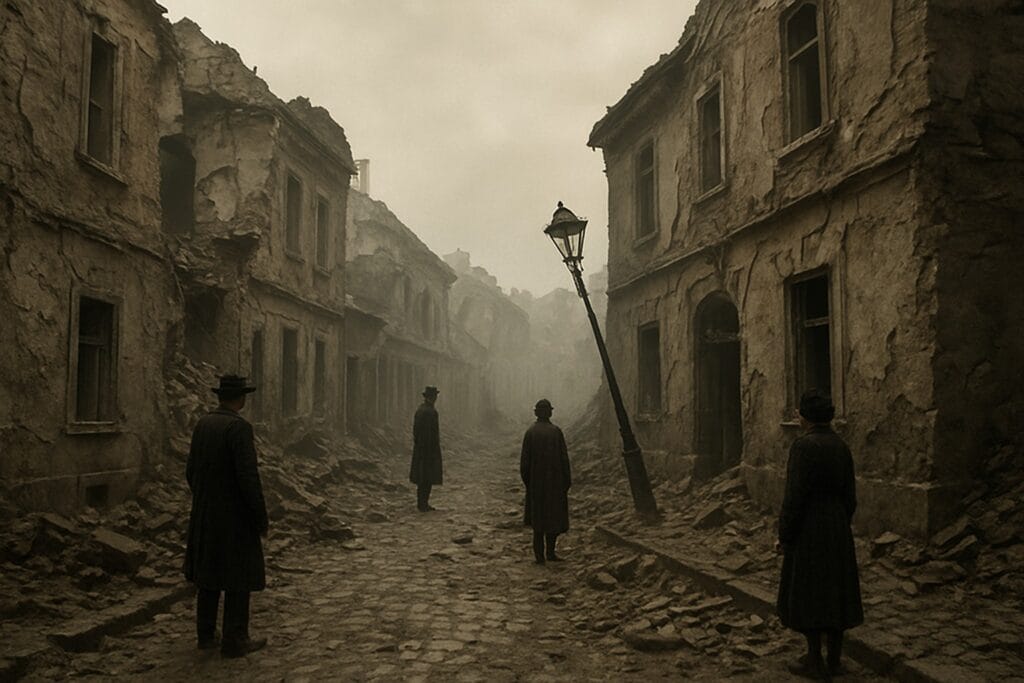
In one hamlet near the epicenter, nearly every dwelling bore scars. Stone chimneys lay in heaps, having toppled through roofs and into kitchens and bedrooms. Gables had collapsed outward, showering courtyards with roof tiles and brick fragments. The thick masonry walls, once a symbol of solidity, revealed their fatal weakness: wide, diagonal cracks running from window corners to foundations, or vertical fissures that split the façade right down the middle. In several houses, entire walls had given way, exposing beds, cupboards, religious icons, and family photographs to the open air.
Churches, the tallest and most cherished buildings in many communities, suffered particularly. A steeple in one parish had lost its upper section, the bell now hanging oddly tilted, its supporting beam splintered. Inside, chunks of plaster lay on the flagstones, and frescoes showed jagged lines where the vault had cracked. Altars were knocked askew, candlesticks strewn across the floor. Parishioners arriving in the morning found their sacred spaces disfigured, and some knelt to pray amid the dust, interpreting the destruction through the dual lenses of divine warning and divine protection.
Rail infrastructure, the steel lifeline of the empire, had not escaped unscathed either. Inspectors sent along the tracks between Zagreb and Karlovac reported misaligned rails, minor embankment subsidence, and damaged station buildings. One small bridge showed a worrying shift in its stone abutments. While no fully loaded passenger train had been on the line at the moment of the quake—a stroke of luck that likely prevented numerous casualties—rail traffic had to be halted or slowed while engineers assessed the damage. In an era when trains carried not just passengers but mail, food, and coal, this disruption had immediate economic and psychological effects.
Casualty figures from the zagreb kupa valley earthquake were, compared to later twentieth-century disasters, relatively modest, but for the communities involved they were shattering. Several people died when roofs or heavy masonry collapsed on them as they tried to flee their homes. Dozens more suffered injuries ranging from broken limbs to head trauma. Makeshift infirmaries sprang up in schools and parish halls, manned by local doctors and volunteers. The injured lay on straw mattresses, tended by relatives and nuns, while rumors about the extent of the disaster spread faster than official reports.
Journalists arriving from Zagreb and other cities in the days after the quake painted vivid pictures. One correspondent described “streets that looked as if a giant hand had grasped each house and shaken it by the shoulders,” capturing in metaphor what engineers would later express in terms of ground acceleration and resonance. The mixture of rubble and personal belongings—mangled bedsteads, children’s toys, cooking pots—lent an almost intimate quality to the devastation. It was not grand monuments alone that had suffered; it was the private architecture of daily life.
Witnesses in Their Own Words: Letters, Diaries, and Newspaper Cries
Events like the zagreb kupa valley earthquake leave not only physical traces but also an emotional archive: letters, diary entries, petitions, and newspaper stories through which the living try to make sense of what they have survived. In the weeks following 8 October 1909, post offices in the Kupa region handled an unusual volume of mail as villagers wrote to relatives in Zagreb, Vienna, and beyond, describing the quake in their own words.
One farmer from a village near the epicenter wrote to his brother in the capital: “It began with a roar, like soldiers marching underground. Then the house shook so that we thought it would leap from its foundations. The children screamed, and we ran outside, but the earth swayed and nearly threw us down. Our neighbor’s chimney fell on their stable and killed a cow. Praise God that no one in our house was taken, but we are afraid to sleep inside now. The walls are cracked like a dried riverbed.” His language mixed rural imagery with a sense of religious gratitude, an attempt to locate the experience within familiar frames.
In the diary of a Zagreb schoolteacher, preserved in a local archive, a different perspective appears. Woken by the tremor, she noted the way the city seemed to hold its breath: “We all rushed to the balcony in our nightclothes. In the courtyard, tenants had gathered, some crying, some laughing nervously. An old woman kept crossing herself, saying, ‘Again, again, like in 1880.’ Yet after a few minutes, the shaking stopped, and the city did not look ruined. Later we learned that the real suffering was to the south, along the Kupa. It is a strange feeling, to stand in safety while knowing that elsewhere, at that same moment, houses were falling.”
Newspapers, eager both to inform and to sell copies, leaned into dramatic descriptions while also providing practical information. The Zagreb daily Obzor, for instance, ran headlines about the “Strong Earthquake in the Kupa Valley” and printed lists of affected villages, damage estimates, and casualty numbers as they became available. Reporters interviewed officials, priests, and ordinary inhabitants. One article quoted a train conductor who had been on a slow freight run when the quake struck: “The wagons jerked as if someone had pulled them sideways. For a moment I feared we would leave the tracks. We stopped, and the silence afterward was worse than the noise. It felt as if the land were deciding whether to shake again.”
Historians today treat such sources with caution—they are colored by personal bias, theological interpretation, or editorial sensationalism. Yet they are indispensable for reconstructing the human texture of the disaster. Official seismological bulletins can tell us the magnitude and the depth; engineering reports can calculate the horizontal forces on a bell tower. But only a villager’s letter can convey what it meant to stand barefoot in a cold field, watching one’s chimney lie in ruins and wondering whether the next shock would bring down the rest of the house.
Some of these voices also reveal an awareness that the earthquake would attract scientific attention. A local priest, in a report sent to a diocesan office, noted almost apologetically that he had paid attention to the “direction of the shaking” and the “duration of the main jolt,” because, as he put it, “the gentlemen in Zagreb may find such details instructive.” In this small remark, we glimpse an emerging relationship between rural eyewitnesses and urban experts—between experience and analysis—that would define the legacy of the zagreb kupa valley earthquake.
Measuring the Invisible: Seismographs, Stations, and the Science of Shaking
While villagers swept rubble from their courtyards, another kind of work was beginning in observatories across Europe: the interrogation of ink. The zagreb kupa valley earthquake was among the first regional events to be captured by a relatively dense network of seismographic stations, and this made it an invaluable case study for the new science of seismology.
At the Zagreb observatory on Grič hill, several types of instruments were in operation by 1909. They included horizontal pendulum seismographs designed to record ground movement in different directions, their heavy masses suspended in such a way that when the ground moved, the mass lagged behind slightly, translating Earth’s motion into the motion of a pen over paper. Vertical seismographs, sensitive to up-and-down movement, complemented these. Each instrument traced continuous lines on rotating drums covered in smoked paper, which was later fixed with varnish to preserve the record.
On the morning of 8 October, when the quake struck, these instruments produced traces that, to a trained eye, contained a wealth of information. The arrival times of the first P-waves and the slower S-waves could be carefully read. The amplitude and frequency of the oscillations could be measured. By comparing the Zagreb records with those from other stations—such as in Graz, Vienna, or even more distant observatories—scientists could triangulate the epicenter’s location and estimate the depth of the source.
This process was not straightforward. Instruments were not yet standardized; each observatory had its own peculiar setups, sensitivities, and calibration methods. Communication was slower than today; data had to be copied by hand or reproduced as photographic plates and mailed between institutions. Yet there was a sense, among the emerging community of seismologists, that they were engaged in a collective project: to coax from wiggly lines on paper a new understanding of the Earth’s interior.
The zagreb kupa valley earthquake offered an especially promising opportunity because it was strong enough to be recorded clearly across a wide area, yet not so destructive as to paralyze the observatories nearest to it. Its intermediate magnitude, shallow depth, and relatively simple waveforms made it, in retrospect, a kind of natural laboratory. In a later analysis, a German researcher (as reported in a 1910 bulletin) would refer to the event as “a fortunate case, where nature has provided us with a clear signal.” Of course, for those who lost homes and loved ones, the word “fortunate” would have sounded painfully ironic.
Still, it was precisely this combination of human tragedy and scientific clarity that fixed the zagreb kupa valley earthquake in the minds of researchers. They cataloged it, shared data about it, and used it to test their emerging theories about wave propagation in the Earth. And at the center of this effort, turning raw seismograms into insight, stood Andrija Mohorovičić, whose name the quake would carry in scientific memory.
Andrija Mohorovičić and the Birth of a Discovery Beneath Our Feet
By 1909, Andrija Mohorovičić was no novice. Born in 1857 in the town of Volosko on the Adriatic coast, he had studied mathematics and physics in Prague, taught in various schools, and gradually shifted his focus to meteorology and seismology. In 1901 he became head of the Zagreb meteorological observatory, and in 1906 he formally took charge of seismological work there as well. He was, by all accounts, a careful, patient observer, with a talent for seeing patterns where others saw noise.
When the zagreb kupa valley earthquake struck, Mohorovičić immediately grasped its importance. The seismograms produced that morning showed unusually clear separations between different types of seismic waves. By precisely timing the arrival of P-waves and S-waves at Zagreb and comparing them with records from other stations, he noticed something that did not fit the then-dominant assumption of a uniformly layered Earth.
Specifically, he observed that some waves, traveling over longer distances within the crust, arrived earlier than would be expected if they had moved through material of constant properties. This suggested that the waves might have been refracted—that is, bent and sped up—at a boundary deeper inside the Earth, where the rocks were denser and more rigid. If correct, this would mean that the Earth’s interior was not a simple, smooth gradation from surface to core but contained distinct layers with sharp transitions.
Over the following months, Mohorovičić plunged into calculations. He plotted travel-time curves, compared observations from multiple stations, and used principles of wave physics to infer the depth and properties of this hypothetical boundary. In a paper published in 1910 in the journal of the Croatian Academy of Sciences and Arts (“O potresu od 8. X. 1909.”), he proposed the existence of a discontinuity between the Earth’s crust and its underlying mantle, at a depth of about 54 kilometers beneath the area of the earthquake. He argued that seismic waves traveling along this boundary could explain the observed arrival times far better than any model that assumed a homogeneous Earth.
This was a bold assertion. At the time, geophysics was still an emerging discipline, and many scientists were cautious about claims that went beyond direct observation. Yet Mohorovičić’s reasoning was rigorous, and his data compelling. Over the following years, as more earthquakes were analyzed around the world, other researchers confirmed the existence of a similar seismic discontinuity at varying depths beneath different regions. The boundary he had inferred became known as the Mohorovičić discontinuity, or simply the “Moho”—a name now familiar to every geology student but rooted in that October morning along the Kupa River.
In one stroke, the zagreb kupa valley earthquake had provided the raw material for a discovery that stretched far beyond Croatia. It had linked the trembling of village houses to the architecture of the planet itself. The paradox is striking: a quake that killed and injured ordinary people also elevated a Croatian scientist into the pantheon of global geophysics. This dual legacy—local pain, global insight—remains one of the most poignant aspects of the event.
From Kupa Valley to the Center of the Earth: How an Earthquake Redrew Geology
The implications of Mohorovičić’s work, built on the zagreb kupa valley earthquake, slowly rippled outward through the scientific world. At first, the recognition was modest and localized; his paper, written in Croatian, was not immediately accessible to all European scientists. But summaries circulated, translations were prepared, and by the 1920s the idea of a crust-mantle boundary had taken firm root in geophysical thinking.
The Moho, as it came to be called, provided a concrete reference point inside the Earth. By studying how its depth varied under continents and oceans, geologists could infer differences in crustal thickness and composition. This, in turn, fed into emerging theories about mountain building, isostasy (the balance of the Earth’s crust on the denser mantle), and eventually plate tectonics. In a sense, the Kupa Valley tremors had helped give the Earth an inner topography, a landscape of layers and boundaries beneath the surface landscape of rivers and hills.
Moreover, the methodological approach pioneered by Mohorovičić—careful analysis of travel times, attention to wave refraction and reflection—became standard practice in seismology. Later scientists would apply similar techniques to study deeper boundaries, such as the core-mantle boundary and the inner core itself. The Earth, which had long been imagined as a murky sphere with a vaguely defined interior, was gradually revealed as a structured body with shells and interfaces, each with its own physical properties.
It is instructive to recall how much of this began not with a global cataclysm but with a regional event: the zagreb kupa valley earthquake. While great quakes like the 1906 San Francisco or the 1908 Messina disasters commanded more public attention, the Kupa Valley event provided a uniquely clear signal for the nascent seismic networks of central Europe. Nature does not rank her earthquakes by human drama; she sends out waves, and it is up to humans to decide which ones to read most closely.
In later historical and scientific overviews—such as those summarized on Wikipedia and in seismology textbooks—the 1909 earthquake is often mentioned less for its direct damage than for its role in this discovery. This skewed emphasis can feel unjust to the communities that suffered. Yet it also underscores a sobering truth: the Earth’s great lessons often arrive wrapped in local tragedies, and scientific memory sometimes outlives human memory of suffering. The task of the historian is to hold both aspects together, ensuring that the term “zagreb kupa valley earthquake” evokes not only a diagram of seismic velocities but also the frightened faces of those who stood in the shaking dawn.
Imperial Borders and Broken Homes: The Austro-Hungarian Context
The zagreb kupa valley earthquake did not occur in a political vacuum. In 1909, Croatia-Slavonia was tightly enmeshed in the political and administrative structures of the Austro-Hungarian Empire, a state already showing signs of strain. Nationalist movements, bureaucratic rivalries, and debates over language and autonomy animated public life. An earthquake, while ostensibly a natural event, immediately intersected with these social and political currents.
From Vienna’s vantage point, the quake was one of many regional crises—floods, epidemics, crop failures—that periodically afflicted different parts of the empire. The central government’s response had to be calibrated: swift enough to demonstrate imperial benevolence, but not so generous as to overstretch finances or create precedents that might be politically inconvenient. Relief funds were allocated, engineers dispatched to assess damage to infrastructure, and official communiqués issued stressing the emperor’s concern for his suffering subjects.
In Zagreb, the quake became a test of local authorities’ capacity and autonomy. The Croatian-Slavonian government in the Banovina had to coordinate aid, mobilize gendarmerie units to maintain order where needed, and liaise with county officials in the affected districts. Newspapers monitored and sometimes criticized the pace of response. Some commentators hinted that the Kupa Valley, being more rural and less politically visible than the capital, risked being neglected.
On the ground in the villages, imperial politics felt distant, yet not irrelevant. People judged the government by whether help arrived in time and in sufficient quantity. A wagon loaded with canvas for temporary shelters, a medical team sent from Zagreb, or a compensation payment for a ruined dwelling all became tangible expressions of imperial power—either benevolent or indifferent. In some cases, relief was channeled through the church, reinforcing the role of parish priests as intermediaries between community and state.
There was also the question of conscription and labor. The army, with its organizational capacity and engineering units, was well suited to disaster relief. Deploying soldiers to help clear rubble or shore up damaged bridges could both speed recovery and showcase the army’s usefulness beyond war. Yet every soldier sent to the Kupa Valley was one less available for maneuvers elsewhere, and the empire’s military planners had to balance humanitarian impulses against strategic priorities in a tense pre-war Europe.
In these ways, the zagreb kupa valley earthquake exposed not only the fractures in the Earth’s crust but also the fissures within an aging empire. The event occurred only five years before the outbreak of the First World War and nine years before the empire’s dissolution. In hindsight, one can see it as part of a series of stresses—economic, political, social, and, in this case, geological—that tested the resilience of a multinational state nearing the end of its life.
Relief Trains, Field Hospitals, and the Slow Politics of Aid
In the immediate aftermath of the quake, improvisation was the rule. Local communities did what they could with what they had: neighbors helped each other retrieve belongings from damaged houses, carpenters and masons shored up dangerously leaning walls with timber braces, and parish halls became makeshift dormitories. But as the scale of destruction became clear, it was obvious that outside assistance was needed.
Relief trains soon began to rattle into stations near the epicentral zone, bringing supplies: canvas tents, blankets, medical equipment, tools, and barrels of lime for disinfection. Doctors and nurses, some from Zagreb and others from nearby towns, established field hospitals. Here, the injured were treated for fractures, lacerations, and, increasingly, respiratory ailments as they slept in cold, damp conditions. For people unused to hospital environments, the experience could be unsettling, but the presence of trained medical staff saved lives that might otherwise have been lost to infection or untreated trauma.
The distribution of aid, however, was uneven. Villages located along the main railway lines were usually helped first, as they were easiest to reach. More remote hamlets, accessible only by poor roads or riverboats, sometimes waited days for substantial assistance. Local officials sent telegrams and petitions, warning that people were living in the open and that rain or further cold could prove deadly. These pleas, preserved in administrative archives, offer a sobering view of how geography and infrastructure shaped survival chances.
Funding posed another challenge. The empire’s coffers were not bottomless, and relief for one region had to be weighed against obligations elsewhere. Local fundraising campaigns sprang up; urban newspapers organized collections, and charitable societies—many with strong religious or nationalist identities—exhorted their members to contribute. One Catholic charity in Zagreb reportedly raised funds specifically marked “for our brothers along the Kupa,” a phrase that emphasized both regional solidarity and a subtle distance between city and country.
Bureaucratic processes, too, could slow recovery. Compensation for damaged houses required inspections, paperwork, and verification of ownership. Tenants without formal title deeds sometimes found themselves in a gray zone, their losses recognized morally but not easily compensated legally. Here, the zagreb kupa valley earthquake highlighted longstanding inequalities in land tenure and legal literacy. Those who could navigate forms and offices often fared better than those who could not.
Yet it would be unfair to portray the state’s response as entirely inadequate. By the standards of the time, the Austrian and Hungarian branches of government mobilized a considerable effort. The mere existence of coordinated relief trains, field hospitals, and engineering inspections marked a departure from the far more haphazard responses to earlier, nineteenth-century disasters. The quake thus became part of a broader European story: the gradual emergence of the modern disaster state, in which authorities are expected not merely to maintain order but to actively assist in recovery.
Faith, Fear, and Resilience: Social and Cultural Reactions
Earthquakes have always stirred spiritual questions. The zagreb kupa valley earthquake was no exception. In the days and weeks after the tremors, churches throughout the region saw increased attendance. Special masses were held, bells rang in remembrance of the dead, and priests delivered sermons that sought to interpret the event in theological terms. Some emphasized divine mercy, pointing out that casualties could have been far higher; others framed the quake as a warning against complacency or moral decline.
Folk beliefs also surfaced. In certain villages, older residents spoke of underground dragons or giants whose movements caused the shaking—a residue of ancient myths that persisted alongside Christian teachings. Children, frightened by aftershocks, asked whether the ground might “open up” and swallow them, echoing biblical imagery. Parents reassured them as best they could, even as their own certainties about the stability of the world had been rattled.
At the same time, the quake accelerated an ongoing shift toward more secular, scientific explanations. Newspapers published interviews with Mohorovičić and other scientists, who explained that earthquakes were caused by movements in the Earth’s crust, not by punishment from above. Diagrams showing wave propagation and fault lines appeared alongside devotional images. For many readers, these scientific narratives did not replace religious ones but coexisted with them, forming a layered understanding of causality: God might be the ultimate author, but the “how” of the event belonged increasingly to physics.
Socially, the disaster revealed and sometimes reshaped community bonds. In villages where losses were shared relatively evenly, a sense of collective fate fostered mutual support. Houses that remained habitable hosted neighbors; food was pooled; work parties formed to repair roofs and clear rubble. In places where damage was more uneven—where some families lost everything and others little—a more complex dynamic emerged. Resentments could surface if aid seemed to favor certain households, and old rivalries might be inflamed by new hardships.
Gender roles, too, came under subtle strain. Women, traditionally confined to domestic spheres, often took on public responsibilities during the crisis: organizing food distribution, caring for the injured at field stations, and petitioning officials when male relatives were absent or incapacitated. Some of these temporary expansions of role would recede once normalcy returned, but for a few women the experience of public action left a lasting impression of their own capabilities.
Children, growing up amid tents and half-ruined houses, internalized the quake in ways that would shape their attitudes toward the world. Oral histories collected decades later include recollections of sleeping fully dressed for months, of flinching at the sound of heavy wagons on cobblestones, of recurring dreams about walls swaying. The zagreb kupa valley earthquake thus became not only a date in the calendar but a formative memory for a generation who would, a few years later, endure the even greater upheavals of war.
Rebuilding in Brick and Memory: Urban Change After the Shocks
As aftershocks diminished and relief operations transitioned into longer-term recovery, attention turned to rebuilding. The zagreb kupa valley earthquake had exposed the vulnerabilities of traditional construction. The question now was whether rebuilding would simply replicate the old or incorporate new ideas about seismic resilience.
Engineers dispatched to the region produced detailed reports. They noted, for example, that buildings with lower, more compact forms and good connections between walls and roofs had fared better than tall, slender structures with poorly tied masonry. They observed that heavy stone chimneys, especially when placed on weak roof beams, posed a particular danger. Some recommended replacing them with lighter materials or redesigning their support systems. These insights, while not entirely new, gained fresh urgency in light of the recent devastation.
In practice, rebuilding was a patchwork process. Wealthier landowners and urban residents could afford to hire engineers and masons familiar with newer techniques, incorporating stronger mortar, iron tie-rods, and in some cases even reinforced concrete, which was then a relatively novel material. Poorer villagers, by contrast, often had to reuse whatever materials they could salvage: cracked bricks, warped beams, tiles chipped but still functional. For them, the choice was not between traditional and modern building science but between a repaired house and none at all.
Still, even modest changes could improve safety. Local carpenters learned, sometimes through informal channels, to anchor roof structures more securely. Some parish churches, when repairing steeples or vaults, consulted engineers to add hidden reinforcements. In Zagreb, the quake spurred discussions about updating building regulations, especially for schools and public institutions. While it would take decades and further disasters for truly robust seismic codes to emerge, the 1909 event nudged the region along this path.
Rebuilding also had a psychological and cultural dimension. Decisions about whether to reconstruct a church tower exactly as before, to simplify it, or to leave it lower were not merely technical; they reflected attitudes toward memory and risk. In one village where the steeple had collapsed, some parishioners argued that it should be rebuilt taller than ever, as a symbol of defiance and faith. Others, more cautious, favored a lower, sturdier design. The eventual compromise—a slightly reduced but better-braced tower—embodied both the desire to remember and the determination not to tempt fate.
Not all scars were erased. In some houses, hairline cracks in plaster were left visible, partly because repairing them would have been costly, partly because they served as quiet reminders of what had happened. Children growing up in such spaces learned to read the walls as archives of the quake. Over time, as new layers of paint were applied and furniture rearranged, the physical traces faded, but the stories attached to them persisted.
Thus the zagreb kupa valley earthquake reshaped the built environment in subtle yet lasting ways. It did not lead to a wholesale reinvention of architecture, but it nudged builders, officials, and homeowners toward a more cautious relationship with the ground. In brick and memory alike, the valley bore the imprint of 1909.
A Turning Point for European Seismology: Networks, Debates, and Rivalries
While villagers rebuilt and remembered, the scientific community continued to mine the zagreb kupa valley earthquake for insight. The event became a frequent reference point in the correspondence between European seismologists, who compared data and interpretations, sometimes amicably, sometimes with a hint of rivalry.
One of the key developments of the early twentieth century was the creation of international seismological associations, which sought to coordinate observations and standardize practices. The 1909 earthquake, with its clear recordings across central Europe, was frequently cited at meetings and in reports as an example of the value of a dense network. It demonstrated that even a moderately strong regional quake could illuminate structures deep beneath the crust if observed widely enough.
Debates arose over how best to model the Earth’s interior. Some scientists favored relatively simple, layered models with a small number of discontinuities; others proposed more complex gradations and anisotropies. Mohorovičić’s interpretation of a sharp crust-mantle boundary added weight to the former view, though it did not settle all questions. As additional earthquakes were analyzed, the picture became more nuanced: the depth of the Moho varied significantly under mountains versus plains, suggesting a dynamic interplay between surface topography and deep structure.
National pride sometimes colored these discussions. For Croatian scholars, the fact that a local scientist and a local event had contributed so centrally to global seismology was a point of quiet satisfaction, especially in an era when cultural autonomy was a sensitive subject. For colleagues in larger states like Germany or Britain, acknowledging this contribution could clash with entrenched hierarchies of scientific prestige. Yet the quality of Mohorovičić’s work made it difficult to ignore or dismiss.
This interplay of collaboration and competition is apparent in published literature of the time. In 1911, for example, a prominent German seismologist cited Mohorovičić’s findings as “notable and worthy of further confirmation,” a phrase that simultaneously recognized their importance and subtly positioned German work as the arbiter of ultimate truth. Over time, as independent analyses corroborated his conclusions, the tone shifted from cautious acknowledgment to routine citation. The name “Mohorovičić discontinuity” appeared in technical papers, gradually losing its national connotations and becoming simply part of the shared vocabulary of the field.
Through this process, the zagreb kupa valley earthquake was woven into a larger tapestry of seismic events—Japanese quakes, Italian quakes, Pacific quakes—that collectively defined the twentieth-century science of the Earth. Its epicenter lay in Croatia, but its waves, both physical and intellectual, washed far beyond those borders.
From Local Tragedy to Global Textbook Case: How 1909 Is Remembered
More than a century later, the zagreb kupa valley earthquake occupies a curious position in memory. Among seismologists and geophysicists, it is famous. The date 8 October 1909 appears in lectures, on slides showing the first plots of travel-time curves that reveal the Moho. Students learn that a regional quake near Zagreb provided the key evidence for a crust-mantle boundary. In technical discussions, the event is often referenced simply as “the 1909 Croatia earthquake,” its human dimension largely abstracted away.
In popular memory within Croatia, however, the quake is less prominent than other disasters. The 1880 Zagreb earthquake, with its dramatic impact on the capital’s cathedral and skyline, looms larger in urban folklore. More recent events—such as the Zagreb and Petrinja earthquakes of 2020—have naturally overshadowed 1909 in the minds of living generations. For many residents of the Kupa Valley today, the 1909 quake is something they may have heard about from grandparents or read about in local chronicles, but it does not dominate the landscape of remembrance.
Nonetheless, traces of commemoration exist. In some villages, anniversary masses have been held on or around 8 October, particularly in major decades like the 50th or 100th year after the quake. Local historians have compiled pamphlets or short books, drawing on parish records and family stories to reconstruct the event. Small exhibitions have been organized in regional museums, displaying photographs of damaged churches, reproductions of seismograms, and portraits of Mohorovičić.
Internationally, the event has been anchored in reference works and educational resources. Scientific encyclopedias and websites, including Wikipedia, include entries summarizing the quake’s basic parameters—magnitude, epicenter, depth—and its role in the discovery of the Moho. These summaries often compress a complex, deeply human event into a few sentences, necessary brevity that nonetheless risks flattening the story. As one historian of science has noted, “To speak of the 1909 Zagreb-Kupa earthquake only as a ‘data point’ is to forget that the data were written in fallen stones and fractured lives.”
The historian’s task, then, is partly restorative: to reinsert lived experience into a narrative that science has, for understandable reasons, simplified. To recall that the term zagreb kupa valley earthquake refers not only to a seismic signal, but to an autumn morning when people ran barefoot from their homes, when priests led prayers amid cracked naves, and when a quiet Croatian scientist saw in jagged ink lines the outline of a hidden world beneath their feet. Memory, like the Earth’s crust, has its own layers; this article has tried to peel back some of them.
The Kupa Valley Today: Heritage, Tourism, and Silent Faults
Walk through the Kupa Valley today and you might never suspect that it was once at the center of a world-changing scientific event. The river still winds lazily between its banks, lined with willows and poplars. Villages cluster along roads and ridges, their roofs repaired and replaced many times since 1909. The fields are carefully parceled, tractors now where horse-drawn plows once carved furrows. Children cycle to school, and commuters drive toward Zagreb along smooth asphalt, scarcely thinking about the ground beneath.
Yet the legacy of the zagreb kupa valley earthquake lingers, sometimes in subtle ways. A plaque on a church wall noting repairs made “after the great earthquake of 1909.” A line in a municipal history pamphlet summarizing “the year when the earth shook and our steeple fell.” A small exhibit in a local museum showing faded black-and-white photographs of toppled chimneys and tents pitched in fields. For those who know to look, these are like outcrops of memory in an otherwise tranquil landscape.
There has been growing interest, in recent decades, in geotourism—travel focused on geological features and histories. In this context, the Kupa Valley and Zagreb’s role in the discovery of the Moho have started to attract attention from geology students and enthusiasts. University groups sometimes visit the region, combining field trips to karst features and river terraces with lectures on the 1909 quake. For them, standing on a hillside near the approximate epicenter can be a humbling experience: to realize that beneath their feet lies the boundary that Mohorovičić helped reveal to the world.
At the same time, modern seismic hazard assessments remind planners that the faults which produced the 1909 quake have not vanished. They remain locked in the crust, accumulating stress at rates much too slow for human senses but all too real for geological time. Building codes in Croatia now take seismic risk into account more systematically, informed not only by the distant memory of 1909 but by more recent events across the Balkans and the Mediterranean. The Kupa Valley, in this sense, lives with a quiet awareness of its tectonic setting—less fearful, perhaps, but more informed.
This coexistence of apparent calm and underlying risk mirrors broader human experience on a restless planet. The zagreb kupa valley earthquake is a reminder that every peaceful field is also a stage upon which deep forces can occasionally erupt. To live here, as anywhere in seismically active regions, is to accept that the solid ground is, in the long run, not entirely solid. Yet people continue to build, to plant, to raise families. They do so not out of ignorance but out of a pragmatic trust that while earthquakes may come, they are rare, and life between them is precious.
Lessons Written in the Crust: Risk, Preparedness, and Human Fragility
What, then, does the zagreb kupa valley earthquake teach us today, more than a century after the ground shook and the seismographs danced? Its lessons fall into at least three intertwined categories: scientific, political, and human.
Scientifically, the quake stands as a classic example of how careful observation of a single event can transform an entire field. Mohorovičić’s insight—that seismic waves from the 1909 event revealed a discontinuity between crust and mantle—remains foundational. It underscores the value of maintaining robust observational networks, of investing in instrumentation and training long before the next big quake arrives. Had the Zagreb observatory not been equipped and staffed as it was, the 1909 quake might have passed into history as just another regional disaster, its deeper message unheard.
Politically and institutionally, the response to the quake illustrates both progress and limitations. The use of relief trains, field hospitals, and engineering inspections marked an important step toward modern disaster management. Yet the uneven distribution of aid, the delays in reaching remote villages, and the bureaucratic hurdles faced by those seeking compensation reveal how vulnerable communities can be to administrative inertia. These themes remain painfully relevant today, as contemporary disasters continue to expose disparities in preparedness and response between urban and rural, rich and poor.
On the human level, the zagreb kupa valley earthquake highlights resilience and fragility in equal measure. People endured fear, loss, and uncertainty, yet they also organized, helped one another, and rebuilt. Children who huddled in fields that night grew up to tell their grandchildren about “the big shaking,” embedding the event into family lore. At the same time, the quake reminds us that no amount of courage can make unreinforced masonry behave like flexible steel. Goodwill is essential but not sufficient; safety also depends on knowledge, technology, and the will to implement them.
Finally, the event poses a more philosophical question about how we relate to the planet we inhabit. The same Earth that provides fertile soil, flowing water, and mineral wealth also stores immense mechanical energy in its shifting plates. The zagreb kupa valley earthquake is one of countless reminders that we live not on a static platform but on the cooled skin of a restless sphere. To honor those who suffered in 1909 is, in part, to take seriously the responsibility to better understand and prepare for such events—so that the next tremor, wherever it strikes, finds societies more ready than the last.
Conclusion
The zagreb kupa valley earthquake of 8 October 1909 began as a local calamity in the dark hours before dawn. It toppled chimneys, cracked churches, and sent families stumbling into cold fields, hearts pounding with fear. Within days, it had drawn responses from parish priests, railway engineers, imperial officials, and journalists. Within months, it had captured the attention of seismologists across Europe. And within a year, it had provided the crucial evidence for Andrija Mohorovičić to propose a boundary deep within the Earth—the Moho—that would forever change our understanding of the planet’s interior.
In following the story from the first jolt to the long arc of scientific recognition, we have seen how a single event can inhabit multiple worlds: the intimate world of farmhouses and family altars, the administrative world of relief budgets and inspection reports, and the abstract world of wave velocities and theoretical models. The zagreb kupa valley earthquake stitched these worlds together in ways that were sometimes harmonious, sometimes painful. Its human cost was borne by villagers who had never heard the word “seismology,” yet whose suffering provided the raw data for one of geophysics’ great advances.
Remembering 1909 means resisting the temptation to view it solely through any one lens—whether as a milestone in Earth science, a footnote in imperial history, or a tragic anecdote in local chronicles. It was all of these at once. Its waves radiated outward not only through rock but through institutions, ideas, and memories. The Kupa Valley’s fields and churches, Zagreb’s observatory, the offices of imperial ministries, and the pages of scientific journals all bore marks of the event.
Today, as we refine seismic networks, improve building codes, and strive for more equitable disaster response, the legacy of the zagreb kupa valley earthquake continues to speak. It urges us to invest in observation and understanding before the ground begins to shake. It reminds us that behind every seismogram lies a community. And it whispers, through the quiet landscape of central Croatia, that the Earth beneath our feet is deeper, more layered, and more dynamic than those who awoke in terror on that October morning could ever have imagined.
FAQs
- What was the zagreb kupa valley earthquake?
The zagreb kupa valley earthquake was a regional earthquake that struck central Croatia on 8 October 1909, affecting the Kupa Valley south of Zagreb. It caused significant damage to villages, churches, and infrastructure, and it became historically important because it provided seismic data that led Andrija Mohorovičić to identify the boundary between the Earth’s crust and mantle, now known as the Moho. - How strong was the 1909 earthquake in the Kupa Valley?
Modern estimates, based on historical records and seismogram analysis, place the zagreb kupa valley earthquake at roughly magnitude 6 on the Richter scale, with a shallow focus. This was strong enough to cause serious damage in the epicentral zone, especially to unreinforced masonry buildings, while producing noticeable but less destructive shaking in Zagreb itself. - Why is this earthquake so important for seismology?
The 1909 event is crucial because Croatian scientist Andrija Mohorovičić used seismograms from the quake to show that seismic waves traveled at different speeds through different layers of the Earth. From this, he inferred the existence of a sharp boundary between the crust and the underlying mantle. This discontinuity, now called the Mohorovičić discontinuity or Moho, is a cornerstone concept in modern Earth science. - Did many people die in the zagreb kupa valley earthquake?
Compared with some catastrophic twentieth-century earthquakes, the number of deaths in 1909 was relatively modest, likely in the tens rather than hundreds or thousands. However, for the affected communities, these losses were devastating, and many more people suffered injuries and the destruction of homes, barns, and places of worship. - How did authorities respond to the earthquake in 1909?
The Austro-Hungarian authorities organized relief trains carrying tents, medical supplies, and food, and they dispatched doctors, nurses, and engineers to the Kupa Valley. Field hospitals were established, and damaged rail lines and bridges were inspected. Aid distribution, however, was uneven, with remote villages sometimes waiting longer for assistance, revealing both the strengths and limits of early twentieth-century disaster response. - What changes did the earthquake bring to building practices in Croatia?
The quake highlighted the vulnerability of unreinforced masonry, especially tall church steeples and heavy chimneys. In the rebuilding phase, some structures incorporated stronger mortar, iron ties, and better connections between walls and roofs. Zagreb authorities discussed improving building regulations, particularly for public buildings, although comprehensive seismic codes would only emerge much later in the century. - Is the Kupa Valley still at risk from earthquakes today?
Yes. The Kupa Valley lies within a seismically active zone associated with the broader tectonic interaction between the African and Eurasian plates. While destructive earthquakes are infrequent on human timescales, the faults that produced the 1909 event remain present. Modern hazard assessments and building codes in Croatia take this ongoing risk into account. - How is the 1909 earthquake remembered today?
Among scientists, the zagreb kupa valley earthquake is widely remembered as the event that led to the recognition of the Moho. Locally, its memory survives in parish records, small museum exhibits, occasional anniversary commemorations, and family stories. It is less prominent in popular memory than the 1880 Zagreb quake or recent twentieth- and twenty-first-century events, but historians and seismologists continue to highlight its significance.
External Resource
Internal Link
Other Resources
- Encyclopaedia Britannica – general search for the exact subject
- Google Scholar – academic search for the exact subject
- Internet Archive – digital library search for the exact subject