Table of Contents
- On the Eve of a Clash: Syria on the Brink in 1281
- From the Steppes to Syria: Mongol Expansion and Mamluk Resistance
- Homs, the City Between Worlds
- Warriors of the Sultan: The Mamluk Military Machine
- Ilkhanid Ambitions: Abaqa Khan, Tekuder, and the Syrian Campaign
- Princes, Emirs, and Lords: The Unlikely Coalition at Homs
- March to Contact: Raids, Scouts, and Rumors of War
- The Morning of 29 October 1281: Forming the Lines
- Steel and Dust: The Battle of Homs Unleashed
- Turning of the Tide: The Mamluk Counterstroke
- Defeat in the Saddle: The Mongol Rout and Its Cost
- Voices from the Battlefield: Chroniclers, Survivors, and Legends
- Aftermath in Blood and Ashes: Homs and Syria Reeling
- Cairo Triumphant: Political Reverberations in the Mamluk Sultanate
- Broken Dreams of Empire: Ilkhanid Setbacks and Shifting Strategies
- Crosses, Crescents, and Crowns: Crusader and Armenian Perspectives
- Borders Stabilized: How Homs Shaped the Map of the Near East
- Memory, Myth, and Identity: The Battle of Homs in Later Centuries
- What the Battle Reveals: Warfare, Culture, and Power in 1281
- Conclusion
- FAQs
- External Resource
- Internal Link
Article Summary: On 29 October 1281, outside the walls of the Syrian city of Homs, a vast Ilkhanid Mongol-led coalition met the hardened warriors of the Mamluk Sultanate in a clash that would echo across centuries. This article follows the unfolding of the battle of homs 1281 from the political tensions that set it in motion to the dust and blood of the battlefield itself. It explores the complex web of allies and enemies—Mongols, Mamluks, Armenians, Georgians, and the remnants of the Crusader polities—that converged in this confrontation. Through narrative storytelling, it reconstructs the formation of the lines, the ferocity of the charges, and the fragile moments when either side might have broken. Beyond the fighting, the article traces the consequences: the consolidation of Mamluk rule in Syria, the fading hopes of Mongol expansion into the Levant, and the cautious recalculations of neighboring powers. It shows how the battle of homs 1281 helped stabilize frontiers, shape religious and political identities, and define the balance of power between steppe empire and sultanate. Drawing on medieval chronicles and modern scholarship, it interrogates how memory transformed this battle into legend. In doing so, it highlights not only who won and lost on that October day, but what the conflict reveals about warfare, faith, and survival in the medieval Middle East.
On the Eve of a Clash: Syria on the Brink in 1281
In the late autumn of 1281, the fields and orchards around the Syrian city of Homs were no longer places of quiet cultivation. Tracks of hooves scarred the soil, campfires speckled the night, and whispers passed from village to village that an army unlike any seen in a generation was descending from the north. The Mongols were coming again, it was said, with their banners of horsehair and their strange allies in gleaming mail. For those who remembered earlier invasions, the name alone—Mongol—carried the taste of ash and the sound of screaming cities. Yet this time, something had changed: waiting for them stood the veterans of a new power, the Mamluk Sultanate, hardened in countless campaigns and determined that Syria would not fall.
By 1281, the region that European travelers still called “Outremer” was a scarred but stubborn mosaic. The Crusader principalities clung to fragments of coastline; local Arab dynasties rummaged for influence between great powers; and above them all two titanic forces strained against one another—the Mamluks of Egypt and Syria, and the Ilkhanid branch of the Mongol Empire in Iran. The battle of homs 1281 was born of this tension, the latest and perhaps most decisive confrontation in a long struggle that began when Mongol horses first splashed through the rivers of Mesopotamia. At stake was not merely a stretch of land but the right to define power, faith, and order in the heart of the Islamic world.
Men and women in Homs could feel the storm gathering long before any banners appeared on the horizon. Caravan merchants reported sightings of vanguards near the Euphrates; Bedouin storytellers embroidered tales of entire villages trampled under hoof. Rumors traveled faster than armies: that Christian kings had joined the Mongols, that Muslim princes had betrayed the sultan, that the invaders planned to raze not only cities but shrines and mosques sacred to Islam. The truth, as is often the case, was more tangled, but the fear was real. Under the minarets and in the markets, people spoke in hushed tones of earlier catastrophes—Baghdad in 1258, Aleppo in 1260—and wondered if Homs would be the next name whispered in dread.
Yet if terror hovered over the city, so too did a strange confidence, born of memory. Two decades earlier, at ‘Ayn Jālūt in 1260, the Mamluks had done what few in the Islamic world dared to hope: they had met a Mongol army in the field and broken it. That victory had saved Egypt and Syria from complete ruination and had given the Mamluk regime a founding myth written in blood and dust. Many of the emirs now sharpening their swords near Homs had cut their teeth in that earlier battle, or had grown up under its shadow. They believed, with a mix of bravado and grim fatalism, that if God had allowed them to defeat the horsemen of the steppe once, He might allow it again.
But this was only the beginning of the story. Behind the assembling armies lay decades of political maneuvering, broken treaties, shifting alliances, and unhealed wounds. To understand why thousands of horsemen converged on the plains of Homs in October 1281, one must first trace the pathways from the frozen rivers of Central Asia to the hot, contested valleys of Syria, and from the training yards of Cairo’s citadel to the distant court of the Ilkhan in Tabriz.
From the Steppes to Syria: Mongol Expansion and Mamluk Resistance
The roots of the confrontation at Homs reach back to the early thirteenth century, when a chieftain named Temüjin, later known to the world as Chinggis (Genghis) Khan, unified the warring tribes of the Mongolian steppe. Under his relentless leadership, a swarm of riders spread outward in all directions, conquering northern China, Central Asia, and the lands around the Caspian Sea with an efficiency that stunned contemporaries. By the time of his successors, the Mongol Empire stretched from Korea to Eastern Europe, held together by a ruthless military hierarchy and the fast-moving hooves of tens of thousands of horsemen.
The Middle East entered Mongol crosshairs in the 1220s and 1230s, but the most devastating blows came later. In 1258, an army under Hülegü Khan, a grandson of Chinggis, stormed Baghdad, the glittering seat of the Abbasid caliphate. What followed was one of the great traumas of Islamic history: libraries burned, scholars slain, the caliph rolled in a carpet and trampled to death. Muslim chroniclers would return to this horror again and again, using it as a reference point for catastrophe. When, only two years later, Mongol and allied forces advanced into Syria and took Aleppo and Damascus, it seemed that the heart of the Islamic world might be torn out entirely.
Yet in 1260, the Mongol tide stalled. As Hülegü withdrew eastward to contest succession disputes, a smaller force under the general Kitbuqa remained in Syria. It was this contingent that the Mamluk sultan Qutuz and his brilliant lieutenant Baybars met at ‘Ayn Jālūt in the Jezreel Valley. There, through a combination of feigned retreat, disciplined cavalry maneuvers, and perhaps Mongol overconfidence, the Mamluks inflicted a stunning defeat. “It was on that day,” wrote one Mamluk-era historian, “that the Muslims tasted again the flavor of victory, after years of bitter defeat.” The psychological effect was enormous. The Mongols, once thought invincible, could bleed.
The victory, however, did not end the conflict. Following Hülegü’s establishment of the Ilkhanate in Iran, conflict with the Mamluks hardened into a long, bitter frontier war. From the 1260s onward, the Ilkhans—Hülegü, then his son Abaqa, and later his successors—sought repeatedly to secure permanent control over northern Mesopotamia and Syria. Their aims were strategic and symbolic: controlling Syria would give them access to the Mediterranean, threaten Egypt, and cement their authority over lands the earlier caliphate once dominated.
Opposing them, the Mamluks forged a fierce identity as defenders of the Dār al-Islām, the abode of Islam, against both Crusaders and Mongols. The ruling sultans were themselves former military slaves—mamlūks—bought or captured as boys, trained as elite horsemen in barracks regiments, and elevated to power by their comrades-in-arms. Their rise to rule in Egypt in the mid-thirteenth century had been dramatic and controversial, but battling external threats, especially the Mongols, gave their regime a sense of legitimacy. The frontier with the Ilkhanate became a proving ground, where military prowess, piety, and political authority intertwined.
Skirmishes, raids, and larger campaigns flared along the Euphrates in the 1260s and 1270s. Neither side could permanently overwhelm the other. The Mongols’ mobility and shock tactics met the Mamluks’ discipline and intimate knowledge of the terrain. Meanwhile, local populations in Syria and northern Iraq suffered the usual fate of people caught between empires: conscription, taxation, pillage, and the constant threat of displacement. By 1281, both sides understood one grim fact: only a major, decisive battle might tilt the balance of power.
Homs, the City Between Worlds
Homs—known in Arabic as Ḥimṣ—had long stood as a city between worlds. Situated on the Orontes River, it occupied a strategic position along the north–south axis that linked Aleppo and northern Syria with Damascus and, further south, with Palestine and Egypt. To those who commanded armies, its geography made it an irresistible node: a place through which roads, caravans, and campaigns naturally passed.
In late antiquity, Homs had been Emesa, a Roman-era city sacred to the cult of the sun and later an important Christian center. By the thirteenth century, it had become a thoroughly Islamic city, its skyline defined by domes and minarets, yet its past lingered in ruins and in the layered memories of its inhabitants. It was a place where Greek, Syriac, and Arabic had once mingled; where Christian and Muslim communities had shared streets and marketplaces; where imperial legions and Arab cavalry had, in earlier ages, marched past the same fields that now awaited Mongol and Mamluk horses.
The city had experienced conquest and reconquest during the Crusades, at times falling under the sway of local dynasties, at others paying tribute to Crusader lords or acknowledging the authority of distant caliphs. By 1281, it was firmly within the Mamluk Sultanate, garrisoned by troops loyal to Cairo but also enmeshed in local Arab and tribal networks. Its citadel loomed over the river plain, a stout symbol of authority but also a refuge in times of peril.
For the Ilkhanid command, the plain near Homs offered an attractive battlefield. It lay within striking distance of the city walls but not so close as to hamper maneuver. The open terrain suited cavalry engagements—precisely the kind of fighting in which Mongol and Turkic horse archers excelled. It was also a psychological target: a significant city whose fall or ruin would send shockwaves through Syria and beyond. For the Mamluks, defending Homs meant defending the northern gate of the Syrian heartland.
Villagers in the surrounding countryside felt the approaching war first. Requisitioning parties from both sides demanded fodder, animals, food, and sometimes labor. Families hid valuables or fled toward what they hoped were safer regions. The orchards for which the region was known—apricots, olives, and figs—stood silent in the autumn air, their fruits mostly harvested, their branches waiting to witness events that would never appear in any harvest ledger.
Through these fields, scouts from both armies skulked in the days and weeks leading up to the battle. Tracks in the dust, a campfire’s ash, or the distant glint of armor might betray the presence of an enemy patrol. Homs’s people watched from walls and rooftops, asking themselves not whether a battle would come, but when.
Warriors of the Sultan: The Mamluk Military Machine
To understand why the Mamluks could stand against, and at times defeat, the Mongols, one must look closely at who the Mamluks were. In origin, they were outsiders—boys purchased as slaves from the steppe regions of Kipchak Turkic lands, the Caucasus, and beyond, or captured in raids. Torn from their birth families, they were converted to Islam, drilled relentlessly in martial skills, and bound to their patrons by oaths of loyalty. What might seem inhuman through a modern lens produced, in its own brutal way, one of the most formidable military elites of the medieval world.
By 1281, the Mamluk Sultanate had refined this system. In barracks in Cairo and major Syrian cities, cohorts of young mamlūks learned not only archery and swordsmanship but also the arts of group maneuver, discipline under fire, and horsemanship at a level that bordered on the theatrical. They could release arrows at full gallop, wheel and reform ranks, and feign retreats with a precision that Mongol tacticians had once thought their own exclusive domain. Heavy lamellar armor protected many of them, and their horses, too, often wore barding to guard against arrows and lances.
The army that would take the field near Homs in October 1281 was composed not only of these core mamlūk regiments but also of auxiliary forces. These included local Arab tribal cavalry, Kurdish units, and contingents raised from Syrian cities. Some were seasoned veterans, others reluctant conscripts. The backbone, however, remained the professionally trained mamlūks, fierce in battle and deeply invested in their collective honor. For them, defeat meant not only personal death or enslavement but the possible unraveling of the political order that had given them power.
Leadership within the Mamluk army was a complicated web of loyalties. At the time of the battle, the sultan was Qalāwūn, himself a former mamlūk of Kipchak origin. He had risen through the ranks under Sultan Baybars, whose military genius and ruthless statecraft had laid much of the foundation for Mamluk power. After Baybars’s death, succession struggles had rocked the regime; Qalāwūn had emerged as sultan in 1279. By 1281, his authority was still in the process of hardening. Victory or defeat at Homs would test not only the strength of his army but the stability of his rule.
Qalāwūn could not be everywhere at once, and so much would depend on the emirs who led wings and divisions. Men like Sunqur al-Ashqar, a powerful emir who had previously rebelled against Qalāwūn and then reconciled, brought their own followings and grievances to the field. Some of them had personal histories with Mongol commanders; others nurtured local ambitions in Syria. Holding this diverse group together required diplomacy and, at times, thinly veiled threats. Yet when facing a Mongol onslaught, old rivalries might be temporarily set aside in the name of survival and religious duty.
From the perspective of Mamluk soldiers, the confrontation ahead was as much spiritual as political. Friday sermons in Cairo and Damascus framed the Mongols as a grave danger to Islam, “enemies who combine the cruelty of the unbeliever with the treachery of the hypocrite,” as one preacher reportedly declared. The army carried not only swords and banners but the weight of expectation from scholars, jurists, and common believers who saw them as a shield raised by God. As they rode toward Homs, some muttered prayers under their breath; others exchanged dark jokes; all knew that the coming clash might define their generation.
Ilkhanid Ambitions: Abaqa Khan, Tekuder, and the Syrian Campaign
On the other side of the frontier, the Ilkhanate was no less complex. Founded by Hülegü, the Ilkhanid state ruled a broad swath of Iran, Iraq, and parts of Anatolia. Its rulers lived in a world of tents and palaces, where Mongol steppe traditions blended with Persian administrative practices and the influence of local religions—Buddhism, Christianity, and, increasingly, Islam. By the late 1270s, the Ilkhan on the throne was Abaqa, Hülegü’s son, a ruler deeply engaged in both internal consolidation and external expansion.
Abaqa’s ambitions in Syria were persistent. He had already overseen earlier campaigns against the Mamluks and had repeatedly sought alliances with European powers, hoping to coordinate joint offensives that would pinch the Mamluks from both east and west. Letters preserved in Latin and French archives show Ilkhanid envoys promising to aid Crusader kings and princes if they would attack the “Saracens” of Egypt in tandem with Mongol advances from the east. These grand designs mostly failed to materialize fully, but they reveal the broader horizon against which the battle of homs 1281 took place.
By the time of the 1281 campaign, Abaqa was not personally present in Syria. He delegated command to his brother Möngke Temür (often identified in sources as a leading prince in the expedition) and to seasoned generals who had fought in previous Levantine campaigns. Alongside the Mongol core rode contingents from vassal or allied states, most notably the Armenian Kingdom of Cilicia and Georgian forces from the Caucasus. There may also have been some participation, at least in logistical or diplomatic terms, from remaining Crusader polities, though their role was more hesitant and constrained.
For the Armenian king Leo II, alliance with the Ilkhanids was a strategic necessity. Hemmed in by powerful neighbors, the Armenian kingdom looked to the Mongols as protection against both Mamluks and rival Christian and Muslim princes. Georgian nobles, too, had learned to navigate the dangerous currents of Mongol domination by offering military service. The Syrian campaign of 1281 thus became a stage on which multiple polities sought to secure their own survival and advantage, even as they marched under Mongol banners.
Ilkhanid armies remained deadly instruments in 1281. Though the era of Chinggis Khan’s original conquests was decades past, the core principles of Mongol warfare endured: speed, flexibility, psychological intimidation, and the devastating use of the composite bow from horseback. The coalition that moved toward Homs was not an improvised raid but a serious attempt to deliver a major blow to the Mamluk position in Syria. Some chronicles speak of tens of thousands of horsemen converging on the region, though medieval figures must always be treated with caution. What matters more is the perception: to the Mamluks and to the civilians in their path, the Ilkhanid host seemed enormous.
At the Ilkhanid court, this campaign was part of a larger strategic calculus. Success at Homs could open the way to deeper incursions into Syria, perhaps even the capture of Damascus. It might also shift the balance in negotiations with both neighboring powers and distant European rulers. Failure, conversely, risked weakening the aura of Mongol invincibility further, especially after the psychological blow of earlier setbacks. With such stakes, the commanders who led the army toward Homs carried not only weapons and banners but the ambitions of a dynasty.
Princes, Emirs, and Lords: The Unlikely Coalition at Homs
One of the most striking features of the battle of homs 1281 is the intricate patchwork of leaders and contingents on both sides. The field did not simply host “Mongols” and “Mamluks,” but a set of overlapping identities: Turkic, Armenian, Georgian, Arab, Kurdish, and more, joined temporarily under two main banners. In an age often framed in simple terms of “East” versus “West” or “Islam” versus “Christendom,” the alliances at Homs tell a more tangled story.
Among the Ilkhanid coalition, Mongol princes occupied the highest positions of command. Their authority derived from bloodline—descent from Chinggis Khan or close kin—and from their proven ability in prior campaigns. Beneath them, generals from Turkic and Persian backgrounds managed logistics and tactical deployments. Armenian lords rode under their own standards but followed Mongol overall direction, their armor and equipment reflecting a blend of Frankish, Byzantine, and local styles: kite shields, chain mail hauberks, and lances echoing those of Western knights.
Georgian forces, armored and often fierce in hand-to-hand combat, brought another flavor of military tradition. Christian chroniclers from the Caucasus later remembered their participation with a mixture of pride and sorrow, for many would not return. For them, as for the Armenians, the campaign against the Mamluks was framed as both service to their Mongol overlords and an opportunity to strike at Muslim powers who had threatened or raided their homelands.
On the Mamluk side, the coalition was no less layered. Elite regiments owed personal loyalty to Qalāwūn or to powerful emirs. Syrian notables brought their own men-at-arms. Arab tribal leaders, whose allegiance could never be fully taken for granted, contributed light cavalry adept at raiding and screening. Some emirates that had flirted with autonomy or even rebellion now found themselves marching in the same direction as the sultan they had once opposed, bound temporarily by the need to confront a greater danger.
Personal rivalries seethed beneath the surface. Qalāwūn’s relationship with Sunqur al-Ashqar, for instance, was fraught; the latter had at one point proclaimed himself ruler in Damascus. Their reconciliation was uneasy, yet at Homs their forces would fight side by side. In the swirl of dust and blood, it would sometimes be difficult to tell where personal ambition ended and collective defense began.
Caught between these coalitions were smaller actors: local lords who tried to hedge their bets, Crusader enclaves calculating how to survive whichever side won, and communities that cared more about the safety of their families and fields than about dynastic rivalries. It is astonishing, isn’t it, how many different hopes and fears can ride into a single battle?
March to Contact: Raids, Scouts, and Rumors of War
In the weeks before 29 October 1281, Syria became an echo chamber of approaching war. From the upper Euphrates to the Orontes valley, scouts reported enemy columns; signal fires on hilltops flared in coded messages; traders diverted caravans to avoid contested routes. Between the main bodies of the two armies, a hidden war of reconnaissance and skirmish unfolded—a prelude to the main symphony of violence.
Mongol scouting parties, lightly armored and riding swift horses, probed deep into Syrian territory to test Mamluk reactions. When they encountered resistance, they melted away, only to reappear kilometers distant. Their task was not only to count enemy standards but to sow doubt. A few villages burned here, a caravan seized there, and soon fear would travel ahead of them like a herald.
The Mamluks were not passive. Experienced emirs knew well the dangers of allowing Mongol vanguards to roam unchecked. They dispatched their own scouts, including Arab tribal riders familiar with every wadi and hill. These men could read the land like a book, recognizing from a patch of trampled grass or a disturbed watering place that enemy horsemen had passed. Intercepted messengers and captured raiders provided fragments of intelligence, which Qalāwūn’s staff tried to piece together into a coherent picture of Ilkhanid strength and intention.
Rumors multiplied faster than reliable reports. In Damascus’s markets, some swore that the Mongols had already taken Aleppo again; others claimed that European crusaders were sailing in support of the Ilkhanids. In Homs, tales shifted with each caravan. For ordinary people, it became almost impossible to distinguish between facts and fear. Chroniclers writing later, like the Damascus historian Ibn al-Furāt, had to sift these contradictory accounts, aware that even they might never fully reconstruct what truly happened day by day.
As the two main armies drew closer, both commanders faced crucial choices: where to seek battle, how to array their forces, and whether to attempt surprise or to accept a set-piece confrontation. The Mamluks, with the advantage of operating in friendly territory, had some say in the choice of ground. The plains north of Homs, with their open expanses and limited obstacles, offered risks and opportunities alike. They could allow the Mamluks to deploy their cavalry effectively—but they also meant that the Mongols, masters of maneuver, would have room to work their deadly patterns.
Slowly, inexorably, the distance between the two armies shrank. Campfires on distant hills became visible from enemy camps. At night, in the stillness, men on both sides could see glimmers on the horizon and imagine that the flickering light was not merely flame but the eyes of their foes. Some, perhaps, whispered final letters to families or entrusted messages to merchants who were fleeing south. Others steeled themselves, sharpening blades, checking bowstrings, and listening for the sound of drums that would signal the march into battle.
The Morning of 29 October 1281: Forming the Lines
The dawn of 29 October 1281 broke cold and gray over the fields near Homs. Autumn in inland Syria could still be warm by day, but at sunrise the air bit at exposed skin, and breath hung briefly as vapor. In both camps, the routine of preparation masked the extraordinary nature of the day ahead. Horses were watered and fed; armor was donned with the help of squires and servants; banners were unfurled, their colors dull in the early light but soon to blaze under the sun.
On the Mamluk side, Qalāwūn and his senior emirs organized their army into the familiar tripartite structure: a center, a right wing, and a left wing. The sultan’s banner likely stood with the central reserve, surrounded by his most trusted mamlūks. Emirs like Sunqur al-Ashqar commanded wings or vanguard elements. Light cavalry, including Arab tribesmen, would fan out ahead and to the flanks, ready to harass or pursue as needed. Drums and trumpets helped keep order as units took their places, each rider aware that a misalignment now could mean disaster later.
Across the field, the Ilkhanid coalition formed its own layered array. Mongol and Turkic horse archers occupied key positions, ready to unleash clouds of arrows. Heavier armored cavalry, including Armenian and Georgian contingents, prepared for shock charges meant to punch holes in the Mamluk lines. Command standards indicated where leading princes took position, signalling to their troops and to allies alike where to look for leadership amid the chaos to come.
For those on the front lines, the moment carried a peculiar mixture of tedium and terror. Hours could pass as commanders finalized dispositions, yet every minute crackled with anticipation. Some soldiers muttered prayers—Muslims reciting verses from the Qur’an, Christians invoking saints, others perhaps clinging to older steppe spirits. The battle of homs 1281, which we now view through the cool lens of history, was for them an immediate, personal gamble with death.
As the sun climbed higher, light spilled fully across the plain, revealing the two armies to one another in all their formidable presence. Accounts differ on the exact numbers, but most agree that both forces were large by the standards of the time, each likely numbering in the tens of thousands if one counts not only fighters but attendants and support staff. From a distance, the glittering of armor and the ripple of banners might have looked almost beautiful—were it not for the knowledge of what they heralded.
Signals were given. Messengers rode back and forth with last-minute instructions. On some level, commanders on both sides knew that once the first volleys were loosed and the first charges initiated, their control would become tenuous. Battles of this scale often began with careful design and then devolved into a series of smaller struggles, where individual bravery, luck, and quick thinking could matter as much as any plan drawn in a commander’s tent.
Then, at a moment remembered differently in each camp but etched forever in survivors’ minds, drums began to thunder, horns to blare. The lines lurched forward. The battle of Homs had begun.
Steel and Dust: The Battle of Homs Unleashed
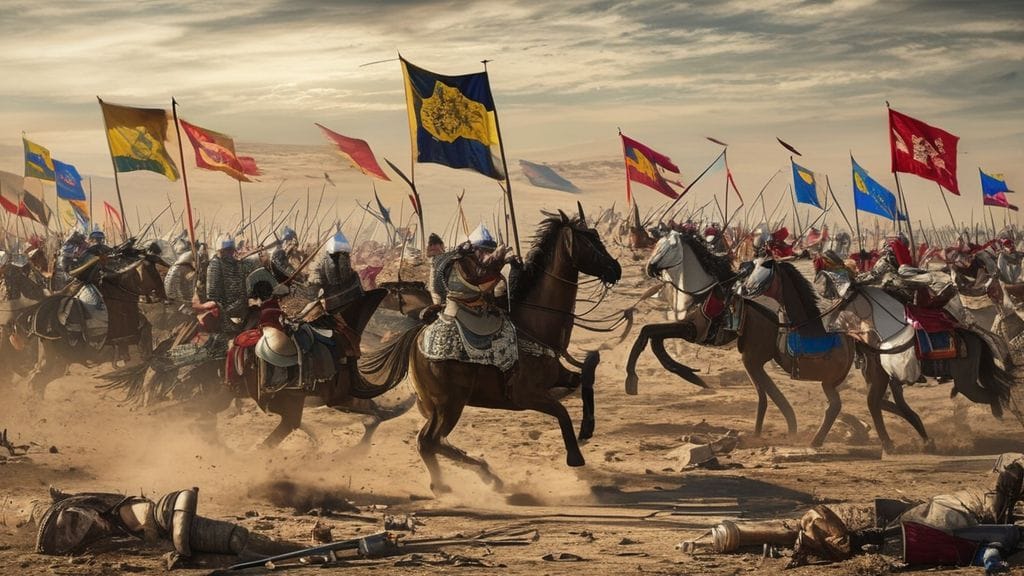
The first phase of the battle of homs 1281 unfolded much as one might expect when two cavalry-heavy armies collide in open terrain. Mongol and Turkic horse archers surged forward, loosing arrows in great arcs that darkened the sky. The Mamluk vanguard responded with their own archery and, when possible, with countercharges meant to disrupt the attackers’ rhythm. Dust rose quickly, turning clear lines into shifting silhouettes.
Mongol tactics emphasized movement, flexibility, and the exploitation of any disorder. Units wheeled, feinted, and retreated, trying to lure Mamluk formations into overextension. When enemy cavalry pursued, Mongol riders would sometimes turn in their saddles and shoot backward at full gallop, a trick that had terrified and shattered many foes in earlier decades. Now, facing the Mamluks, they found an opponent who not only recognized these ruses but had also learned to use some of them.
On the Mamluk side, discipline held—for a time. Years of training and the memory of earlier engagements with Mongols informed their actions. Emirs shouted commands over the clangor; standard-bearers fought to keep their flags visible so their men could orient themselves. When Mongol arrows struck, armor and shields absorbed some of the impact, but horses and exposed limbs were not always so fortunate. Men fell. Riders tumbled. Gaps opened and were hurriedly filled by comrades.
Some chronicles suggest that the Ilkhanid coalition gained an early advantage, especially on one of the Mamluk wings. Armenian and Georgian heavy cavalry, combined with Mongol support, may have driven back segments of the Mamluk line, threatening to roll up their flank. If these reports are accurate, then at that moment the battle hung precariously in the balance. Had the pressure continued unchecked, the Mamluk army might have disintegrated, its units scattered in panicked retreat toward Homs and beyond.
Within the maelstrom, individual acts of courage and desperation unfolded. A Mamluk rider, seeing his emir unhorsed, might wheel around to defend him, cutting down two opponents before falling to a third. An Armenian knight, isolated amid enemy horsemen, could fight back-to-back with his squire until both vanished under blows. Such scenes, repeated hundreds of times across the field, rarely made it into the chronicles in detail, but they formed the living fabric of the battle.
As hours wore on, the noise became almost unbearable: the roar of men shouting battle cries, the drumbeats signaling commands, the screams of wounded horses, the clash of steel on steel. The smell of sweat, blood, and churned earth filled the air. Dust coated tongues and throats, turning shouted orders into hoarse gasps. In this chaos, the ability to maintain formation and morale distinguished armies that held fast from those that crumbled.
The Mongols, for all their skill, were not fighting alone in this campaign; coordination with their Christian allies introduced both strength and complexity. Differences in language, command style, and battlefield doctrine could become liabilities when communication frayed. Conversely, the Mamluks, though riven by internal rivalries, shared a relatively unified system of signals and a long tradition of fighting under a single sultanic banner. As the battle entered its next, decisive phase, these organizational differences would matter.
Turning of the Tide: The Mamluk Counterstroke
Every great battle has a moment—or perhaps a series of moments—when the tide begins to turn. At Homs, this shift seems to have come when Qalāwūn and key emirs recognized both danger and opportunity in the evolving melee. Parts of their line were under severe pressure; yet they also saw signs that the Ilkhanid coalition, having thrown much of its weight into initial attacks, was beginning to show strains of its own.
Mamluk chroniclers describe a critical decision: to launch a powerful counterattack at the right time and place, rather than committing reserves too early or too late. Qalāwūn’s central units, relatively intact despite the storm of arrows, pivoted to support the embattled wing. Emirs rallied their men with appeals to faith and honor. “Remember ‘Ayn Jālūt!” some may have shouted, invoking the earlier, legendary victory over the Mongols. Whether literally spoken or not, that memory hovered over the battlefield like an invisible banner.
The Mamluk counterstroke hit with devastating force. Heavy cavalry surged forward in coordinated charges, lances leveled, aiming not at scattered skirmishers but at the densest clusters of the enemy. Precision mattered: breaking through at a key point could unravel the cohesion of an entire formation. When Mongol and allied horsemen yielded ground, Mamluk riders pressed the advantage, harrying them relentlessly rather than allowing them to regroup and resume feigned retreats.
Some Ilkhanid contingents fought stubbornly. Armenian and Georgian units, committed deeply into the fray, now found themselves exposed as Mamluk attacks shifted the momentum. The very qualities that made them formidable in the charge—their weight, their commitment to close combat—could become weaknesses when lines faltered and withdrawal routes clogged with panicked men and animals.
One can imagine the scene around a collapsing Ilkhanid sector: men shouting in multiple languages, commanders trying to restore order, messengers galloping with urgent orders that arrived too late. A prince, seeing his banner threatened, might attempt to rally his retinue in a last stand, while elsewhere lesser lords chose flight over valor. Dust rising ever thicker blurred distinctions between friend and foe, making it even harder to hold formations together.
Mamluk sources naturally emphasize their own valor and divine favor as keys to this turning point. Later historians like al-Maqrīzī would frame Homs, together with ‘Ayn Jālūt, as clear evidence that God favored the Mamluk state against the “tyranny” of the Mongols. Modern scholars, weighing these accounts against others, point instead to tactical adaptability: the Mamluks had learned how to survive the initial Mongol storm and to respond with disciplined, targeted aggression at moments of enemy vulnerability.
Whatever precise combination of factors tipped the balance, the effect soon became visible across the field: Ilkhanid units, once confident, began to give ground in ways that no longer looked like controlled feints. The battle of homs 1281 was turning in favor of the Mamluk Sultanate.
Defeat in the Saddle: The Mongol Rout and Its Cost
As Mamluk pressure intensified, what had been a hard-fought contest began to tilt into a rout. For a time, Mongol and allied commanders may have believed they could stabilize the situation, regrouping behind fresh lines or rallying around key standards. But battles have their own momentum. Once enough units began to flee in earnest, fear spread like a contagion.
Retreat in steppe warfare, when controlled, could be a deliberate tactic. In the late stages at Homs, however, much of the Ilkhanid coalition’s withdrawal was anything but controlled. Riders jostled and collided as they tried to extricate themselves from the press. Wounded horses stumbled, throwing their riders into the path of oncoming hooves. Banners disappeared in the swirling dust, leaving men unsure of where to rally. In some sectors, Armenian and Georgian survivors hacked their way clear, forming rearguard clusters to cover comrades’ escape.
The Mamluks, sensing victory, did what victorious cavalry often do: they pursued. Pursuit could be as deadly as the battle itself. Now it was the Ilkhanid troops who felt the sting of arrows in their backs and the terror of hoofbeats closing in. Those who managed to keep their wits tried to break off in smaller groups, heading for known routes north and east. Others, disoriented, fled in whatever direction seemed least crowded, sometimes blundering into dead ends or ambushes.
Contemporary Muslim chroniclers, eager to emphasize the scale of the victory, speak of vast numbers of enemy dead. While medieval casualty figures are often inflated, there is little doubt that the Ilkhanid coalition suffered heavily. Losses among Armenian and Georgian contingents were particularly painful for their homelands, where noble lineages could be thinned in a single disastrous campaign. For the Mongols, too, the loss of experienced commanders and veteran troops represented a serious blow.
The Mamluks did not emerge unscathed. Victory on this scale came at a cost. Many emirs and ordinary soldiers fell in the fighting, their bodies later collected or left where they lay, depending on conditions and priorities. Survivors bore scars—physical and psychological—that would remain long after Qalāwūn’s banners had been carried back to Damascus and Cairo in triumph.
Still, for those who rode back under the Mamluk standard, the sense of accomplishment was immense. They had once again met a major Mongol-led invasion in open battle and prevailed. The battle of homs 1281, like ‘Ayn Jālūt before it, would become a cornerstone of their collective identity as an army and as a ruling caste.
Voices from the Battlefield: Chroniclers, Survivors, and Legends
What we know about the battle of Homs comes not from any single authoritative account, but from a chorus of voices—some near-contemporary, others writing decades or even centuries later. Each had their own perspective, agenda, and limitations. Together, they offer a mosaic that is rich yet inevitably incomplete.
Muslim chroniclers from Damascus and Cairo tend to emphasize the piety and bravery of the Mamluk forces, as well as the scale of the Ilkhanid threat. Writers like Ibn al-Furāt and later al-Maqrīzī cast Homs as a divinely favored victory. One such chronicler records, “On that day, the Almighty clothed the infidels in the garments of disgrace and honored the banners of Islam before the eyes of all creation.” Such rhetoric served not only to narrate but to legitimize: victories like Homs bolstered the Mamluk claim to be rightful guardians of the Islamic heartlands.
From the Armenian and Georgian side, sources, when they mention the campaign, often speak more of martyrdom and suffering than of triumph. Lost nobles, shattered regiments, and the bitter realization that alliance with the Ilkhanids did not guarantee success all colored their recollections. In some Armenian chronicles, the Syrian campaign appears almost as a tragic episode in a longer story of survival amid hostile neighbors and domineering overlords.
European observers, though more distant, occasionally referenced Mongol-Mamluk clashes in letters and chronicles. For Western rulers and churchmen, the Ilkhanids represented a tantalizing possibility: a powerful eastern ally against the Mamluks, who by the late thirteenth century had effectively ended the Crusader dream of a stable Christian kingdom in the Levant. Reports of Mongol defeats, therefore, were often received with disappointment. The defeat at Homs underscored the Mamluks’ resilience and complicated European strategic fantasies.
Within Syria itself, oral traditions likely blossomed around the battle. Families in and around Homs may have preserved stories of ancestors who fought or fled, of fields trampled and then replanted, of strange foreigners glimpsed in the chaos. Some of these tales were undoubtedly exaggerated or transformed over time, yet they contributed to the way local identity absorbed and interpreted the conflict. A grandfather’s memory of seeing Mongol riders on the horizon could, in a few generations, become a legend of miraculous deliverance.
Modern historians have tried to disentangle these threads, comparing Arabic, Armenian, Syriac, Latin, and Persian sources against archaeological findings and broader knowledge of medieval warfare. As one contemporary scholar notes, “The battle of Homs in 1281 is best understood not as an isolated event but as a node within intersecting narratives—imperial ambition, confessional conflict, and the adaptation of military cultures across a contested frontier.” That observation—echoing the work of historians like Reuven Amitai—reminds us that any single-document viewpoint is inherently partial.
Yet for all the complexities, a few core truths emerge from the sources: a large Mongol-led coalition advanced into Syria; the Mamluks met them near Homs; a fierce battle ensued; the Mamluks prevailed; and the course of Near Eastern politics shifted accordingly. Around these pillars, memory and legend have woven their own tapestries.
Aftermath in Blood and Ashes: Homs and Syria Reeling
When the dust finally settled over the plain near Homs, the land bore names that no chronicler bothered to record: the hill where horses piled up, the brook where wounded men crawled to drink, the grove whose trees now held arrow shafts lodged in their bark. Local inhabitants emerged cautiously from hiding places, confronted by a landscape transformed. Dead and wounded lay where they had fallen, friend and foe alike indistinguishable beneath grime and blood.
For the people of Homs and its surrounding villages, the immediate aftermath of the battle was a grim labor. Bodies had to be buried, at least those close enough and not too disfigured to retrieve. In Islamic practice, quick burial was not only a matter of hygiene but also of religious duty; yet the sheer number of corpses could overwhelm even the most determined efforts. Some were interred in hastily dug mass graves; others may have been left to the elements and scavengers on more distant stretches of the field.
In the city, relief mingled with grief. The Mongol-led invasion had been repulsed, sparing Homs the horrors that had befallen other cities in earlier decades. Yet many families mourned lost sons, brothers, or fathers. Markets had been disrupted, fields damaged, roads rendered unsafe for weeks or months. Refugees from more exposed areas brought tales of looting and destruction in the path of the invading army, adding to the sense that, even in victory, Syria had paid a high price.
Mamluk authorities moved quickly to assert control and to capitalize on the victory’s political potential. Emissaries carried news to Damascus and Cairo, where sermons of thanksgiving were preached and public celebrations organized. In Homs itself, returning soldiers may have been greeted with both ceremony and a quieter, more personal welcome from their families. The sultan and his leading emirs likely took steps to reward bravery—granting fiefs, distributing spoils, perhaps even promoting particularly distinguished officers.
At the same time, order had to be restored in the countryside. Bands of deserters, looters, and displaced people could easily feed a cycle of banditry and insecurity if left unchecked. The Mamluk state, with its network of governors and garrisons, worked to re-establish the taxation flows and administrative routines that were the lifeblood of any medieval polity. For peasant farmers and urban artisans alike, the resumption of something like normal life was both a relief and a reminder that their world, however shaken, had not collapsed.
Psychologically, the victory at Homs reinforced a narrative that had been building since ‘Ayn Jālūt: that the Mongols, though terrifying, were not unstoppable; that the Mamluks, for all their internal strife, could stand as a bulwark between the Middle East and annihilation. This sense of collective survival would echo in Friday sermons, court poetry, and private conversations for years to come.
Cairo Triumphant: Political Reverberations in the Mamluk Sultanate
For Sultan Qalāwūn, news of the victory at Homs was more than a battlefield report; it was a lifeline for his still-consolidating rule. Ascending the throne in 1279 had not put an end to power struggles within the Mamluk elite. Former supporters of other claimants, ambitious emirs with independent power bases, and factions loyal to the memory of Baybars all eyed Qalāwūn’s regime with a mixture of cooperation and suspicion.
Military triumph is a potent political currency. By delivering a second great victory over a Mongol-led army, Qalāwūn could present himself as the worthy heir to Baybars’s legacy, a savior of Syria, and a champion of Islam. Chroniclers would link his name with ‘Ayn Jālūt in a sequence of providential victories: God had granted success first to Qutuz and Baybars, now to Qalāwūn. In a political culture where divine favor and martial prowess were intertwined, this association was invaluable.
Within the Mamluk elite, the distribution of spoils and honors following Homs helped to cement alliances and, in some cases, to sideline rivals. Emirs who had fought bravely could expect rewards; those whose performance had been lackluster, or whose loyalty seemed wavering, might find themselves reassigned to less critical posts or gently pushed out of central circles of power. The battle, in other words, provided not only security from external foes but also an opportunity for internal housecleaning.
Institutionally, the victory reinforced a trend toward greater centralization of military authority. If the sultan and his top advisors could demonstrate that coordinated, centrally directed campaigns brought success against fearsome enemies, it became harder for regional lords or emirs to argue for greater autonomy. Central treasuries, too, benefited from the plunder and ransoms that followed such battles, even though much wealth flowed directly to the fighting men as part of their due.
For the broader population under Mamluk rule, Homs’s outcome likely strengthened a sense—however begrudging at times—that this regime, for all its taxation and occasional brutality, served a necessary role. The memory of what Mongol conquest had meant for Baghdad and other cities remained vivid. Better, many may have thought, to endure the demands of the sultan’s officers than to face the fire and iron that came with Ilkhanid success.
The battle of homs 1281 thus became part of a political narrative that Qalāwūn and his successors would cultivate carefully: a story of a state forged in adversity, led by soldier-rulers who had saved the lands of Islam from both Crusader and Mongol encroachment. In architectural patronage, in legal decrees, and in carefully curated chronicles, this image would be polished over time into a kind of dynastic myth.
Broken Dreams of Empire: Ilkhanid Setbacks and Shifting Strategies
On the Ilkhanid side, the consequences of the defeat at Homs were sobering. For Abaqa Khan and his advisors, the campaign had represented a serious attempt to shift the balance of power in the Levant; its failure signaled that, at least for the time being, the Mamluk grip on Syria could not be easily broken. The dream of an Ilkhanid-controlled corridor to the Mediterranean—a vision that had animated diplomatic outreach to European powers—grew dimmer.
Strategically, the loss limited Ilkhanid options. Repeatedly launching large-scale invasions into Syria was costly in manpower and resources. Each failure not only weakened military strength but also risked undermining the prestige on which Mongol authority partially rested. When an empire that had once seemed unstoppable began to accumulate conspicuous setbacks, both subjects and rivals took note.
In the years following Homs, internal dynamics within the Ilkhanate also shifted. Abaqa died in 1282, not long after the battle, and succession struggles followed. His brother Tekuder, who converted to Islam and adopted the name Ahmad, briefly ruled, attempting to reposition the Ilkhanate’s religious and diplomatic stance. Later Ilkhans, including the more famous Ghazan (r. 1295–1304), would also embrace Islam and seek new arrangements with neighbors.
The defeat at Homs did not by itself cause these transformations, but it formed part of the backdrop against which Ilkhanid rulers reconsidered their strategies. If direct military conquest of Syria remained elusive, perhaps other tools—diplomacy, religious legitimation, careful management of frontiers—would prove more fruitful. The image of the Ilkhans as relentless conquerors slowly gave way to a more nuanced reality: they were becoming one regional power among several, rather than an unstoppable storm sweeping across continents.
For Ilkhanid Christian allies, especially in Armenia and Georgia, Homs reinforced a lesson they already knew too well: dependence on a powerful patron could be a double-edged sword. When the patron lost, they suffered. Their calculus of survival would increasingly involve careful balancing between Mongol demands, Mamluk pressure, and their own internal politics.
Crosses, Crescents, and Crowns: Crusader and Armenian Perspectives
From the vantage point of the shrinking Crusader polities along the Levantine coast, the battle of Homs was both close and distant. Geographically, it unfolded not so far from their remaining strongholds—Tripoli, Acre, and a few other fortified enclaves. Politically and militarily, however, they were no longer major players in such large-scale clashes. Their ability to shape outcomes had been eroded by decades of defeats and internal divisions.
Over the 1270s, some Crusader leaders had cautiously cooperated with the Ilkhanids against the Mamluks, seeing in the Mongols a potential ally against their most immediate and dangerous foe. Latin chroniclers record episodes of joint operations and mutual understandings. Yet European rulers remained wary, hesitant to commit fully to a partnership with non-Christian, at times brutally anti-Muslim but also unpredictably anti-Christian, conquerors. The failure of major coordinated offensives, combined with internal distractions in Europe, limited what any such alliance could achieve.
The defeat of the Ilkhanid coalition at Homs thus carried mixed implications for the Crusader states. On one hand, it confirmed the Mamluks as the dominant military force in the region, accelerating the sense of encirclement and inevitability that had been gathering in Latin circles. On the other, it reduced the likelihood of large, destabilizing Mongol incursions in the near term, which might have swept away Crusader enclaves as collateral damage.
For the Armenian Kingdom of Cilicia, the consequences were sharper and more personal. Armenian forces had fought and bled under Ilkhanid command. Their losses at Homs weakened the kingdom’s noble families and undermined its capacity to resist future Mamluk pressure. Armenian chroniclers, writing with the hindsight of subsequent Mamluk invasions of Cilicia, sometimes viewed earlier cooperation with the Mongols with a mixture of regret and resignation. Yet at the time, few good options had existed; aligning with the Ilkhanids had seemed the least bad among several dangerous choices.
The interplay of crosses and crescents at Homs—Christian contingents fighting alongside Mongol pagans or newly converted Muslims against a Muslim sultanate that in turn ruled over its own Christian minorities—reminds us that medieval religious and political landscapes were rarely simple. Alliances crossed confessional lines, driven by pragmatism as much as by faith. The battle of homs 1281, often remembered as a Mamluk–Mongol showdown, was also an arena where Christian and Muslim rulers alike tested and redefined their strategic partnerships.
Borders Stabilized: How Homs Shaped the Map of the Near East
When historians speak of “the stabilization of frontiers” in the late thirteenth-century Near East, the battle of Homs looms large in the background. After decades of flux—Mongol advances, Crusader retreats, local rebellions—the failure of the 1281 Ilkhanid campaign helped solidify a rough line of division between the Mamluk Sultanate and the Ilkhanate.
This line, generally following the Euphrates and overlapping with older cultural and administrative boundaries, was not an official demarcation drawn on a map, but a zone of contested yet relatively predictable control. North and east of it, Ilkhanid authority predominated, although always negotiated with local powers. South and west, in Syria and Egypt, the Mamluks held sway. Between them lay buffer regions, fortified towns, and rivers that became as much political symbols as geographic features.
Homs’s role in this process was not solely military. The psychological effect of yet another failed major invasion discouraged Ilkhanid rulers from mounting frequent large-scale expeditions into Syria. They did not cease entirely, but the pattern shifted toward raids, diplomatic maneuvering, and local proxy conflicts rather than direct attempts to seize Damascus or march on Egypt. The Mamluks, in turn, gained confidence in concentrating on consolidating internal control and on dealing with the last Crusader enclaves.
In the broader context of Eurasian geopolitics, this stabilized frontier became one of the many internal boundaries within what had once been a nearly continuous Mongol imperial sphere. Alongside divisions between the Golden Horde in the northwest, the Chaghatayids in Central Asia, and the Yuan dynasty in China, the Ilkhanate’s limits in the west marked the fragmentation of the Chinggisid world. The unifying thunder of the early Mongol advance had given way to a patchwork of successor states, each with its own ambitions and constraints.
For the people living along this frontier, the new equilibrium brought both relief and tension. The risk of catastrophic conquest diminished, but low-level conflict persisted. Fortresses remained garrisoned, and military roads stayed busy. Traders and pilgrims learned which routes were relatively safe and which lay too close to volatile zones. Over time, border communities adapted, developing economic and social strategies suited to life at the edge of empires.
Memory, Myth, and Identity: The Battle of Homs in Later Centuries
As years turned into decades and then centuries, the immediate details of who charged where at Homs faded from living memory. Yet the battle itself did not vanish. Instead, it passed into the realm of story, scripture-tinged sermon, and political exemplum. Like ‘Ayn Jālūt, the battle of homs 1281 became part of the repertoire of moments to which Muslim scholars and rulers could point when speaking of resilience against overwhelming odds.
In Mamluk-era chronicles, Homs is often paired with other key victories to weave a narrative of divine favor. Writers praised Qalāwūn as a just and pious sultan whose faith had been rewarded on the battlefield. The Mongols, once apocalyptic figures in the Islamic imagination, were recast in part as instruments through which God tested and then vindicated the community. This theological framing did not erase the human cost, but it did situate the suffering and triumph within a larger cosmic story.
Later Ottoman and Arab historians inherited these tales and sometimes reinterpreted them in light of their own eras. For Ottomans, who would eventually supplant the Mamluks as rulers of Syria and Egypt, the earlier battles against the Mongols were part of a broader Islamic legacy of struggle and defense—examples to emulate when confronting their own threats, whether from Safavids, European powers, or internal rebels. For Arab nationalists in the nineteenth and twentieth centuries, Mamluk victories occasionally served as symbols of indigenous resistance to foreign domination, even if the Mamluks themselves were of non-Arab origin.
In modern scholarship and popular culture, the Mongol invasions and the Mamluk response continue to fascinate. Books, documentaries, and academic articles revisit the campaigns with new questions: How did military institutions adapt under pressure? What did cross-cultural alliances reveal about medieval political flexibility? How did ordinary people experience and remember such conflicts? Within these broader inquiries, Homs remains a key case study.
At the local level, in and around the present-day Syrian city of Homs, layers of history overlap chaotically. Ancient Roman, early Islamic, Crusader, Mamluk, Ottoman, and modern episodes of conflict and reconstruction all lie atop one another. For those who know where to look, the plain that once hosted thousands of Ilkhanid and Mamluk horsemen can still be imagined beneath contemporary roads and fields. In recent decades, as Homs has endured its own tragedies, memories of older battles may resonate differently, as part of a long, painful continuum of struggle in a city “between worlds.”
What the Battle Reveals: Warfare, Culture, and Power in 1281
Stepping back from the immediate drama, the battle of Homs opens a window onto the broader dynamics of the late thirteenth-century Middle East. It highlights the ways in which warfare, culture, and political authority intersected at a time of profound transformation. The contest between the Mamluk Sultanate and the Ilkhanate was not only about territory; it was about who would define the future of a region shaken by previous conquests and crusades.
Militarily, Homs illustrates the remarkable capacity of the Mamluk system to absorb and counter lessons learned from a fearsome adversary. The same steppe-derived cavalry techniques that had once given the Mongols such an edge were, to a significant degree, replicated and adapted by the Mamluks. The confrontation thus became not just a clash between different styles of war, but between two branches of a shared martial heritage—both rooted in nomadic and semi-nomadic traditions, both harnessing the power of the horse and the composite bow.
Culturally and religiously, the battle underscores the fluidity of identities. The Mongol-led coalition included Christians and Muslims, Turkic and Caucasian peoples, fighting under banners of a dynasty still negotiating its relationship with Islam. The Mamluks, former non-Muslim slaves now transformed into Muslim rulers, presented themselves as guardians of the faith against an enemy whose religious profile was shifting but whose devastating reputation remained. In this sense, Homs was a crucible in which emerging Islamic political identities were forged and tested.
Politically, the battle marks a phase in the long transition from the era of Mongol world conquest to the age of regional post-Mongol states. The inability of the Ilkhans to secure lasting control over Syria, symbolized in part by failures like Homs, contributed to their gradual incorporation into a more typical pattern of Middle Eastern polities—one powerful but not all-powerful state among others. The Mamluks, conversely, emerged as unchallenged masters of the central Islamic lands for more than a century to come.
Finally, the battle of homs 1281 reminds us of the central paradox of war: that events experienced as chaos and terror by participants can, in hindsight, be seen as nodal points where larger historical trajectories bend. For the rider on the field, dust in his eyes and an enemy’s arrow in his shield, the battle’s meaning was immediate and visceral: survive, protect one’s comrades, obey one’s emir, or die trying. For us, centuries later, Homs offers an opportunity to trace how individual courage and suffering, multiplied by thousands, shaped the fate of empires and the stories people tell about them.
Conclusion
On a cold October morning in 1281, the plains outside Homs became the stage for a confrontation that crystallized decades of conflict between steppe empire and sultanate. The Mamluks, former slaves turned elite warriors, faced a Mongol-led coalition that brought with it memories of burnt cities and toppled dynasties. Through disciplined tactics, hard-won experience, and the fragile unity of a diverse army, they held the line and then struck back, turning what might have been catastrophe into victory.
The battle of Homs did not by itself end the Mongol threat to the Middle East, but it helped to fix the frontier between two great powers and to confirm the Mamluks as guardians of the Islamic heartlands. In its wake, the Ilkhanids reconsidered their strategies, while Cairo basked in the glow of a triumph that reinforced Qalāwūn’s authority. Armenians, Georgians, and Crusader remnants read their own fortunes in the outcome, recalibrating alliances and expectations in a landscape where nothing seemed permanent.
Across the centuries, chroniclers, scholars, and ordinary people have revisited Homs, weaving it into narratives of divine favor, national resilience, or imperial decline. The battle has served as a mirror in which different generations see reflections of their own struggles and hopes, from medieval emirs worried about succession to modern readers seeking to understand how violence shapes history. In the overlapping stories of Mongol horsemen, Mamluk lancers, Armenian knights, and Syrian villagers, we glimpse the human complexity behind abstractions like “empire” and “civilization.”
Today, when the name Homs evokes more recent conflicts as well as ancient ones, remembering the events of 1281 is both a caution and a reminder. It cautions us against viewing any era’s upheavals as uniquely unprecedented; others before have faced invasions, sieges, and battles that seemed to threaten the end of their world. It reminds us, too, that out of such crises new forms of political order, cultural identity, and collective memory can emerge. The battle of homs 1281 endures not only as a military episode but as a testament to the enduring interplay of power, belief, and human endurance in a region that has long stood at the crossroads of continents.
FAQs
- What was the Battle of Homs in 1281?
The Battle of Homs in 1281 was a major confrontation between the Mamluk Sultanate of Egypt and Syria and a large Ilkhanid Mongol-led coalition, including Armenian and Georgian forces. Fought on 29 October 1281 near the Syrian city of Homs, it ended in a decisive Mamluk victory that helped secure their control over Syria and limit further large-scale Mongol advances into the region. - Who commanded the armies at the Battle of Homs?
On the Mamluk side, overall leadership rested with Sultan Qalāwūn, supported by senior emirs such as Sunqur al-Ashqar. The Ilkhanid army was commanded by Mongol princes and generals delegated by Abaqa Khan, the Ilkhan ruling in Iran, with Armenian and Georgian leaders directing their respective contingents under overall Mongol command. - Why was the Battle of Homs significant?
The battle was significant because it confirmed the Mamluk Sultanate’s ability to resist and defeat major Mongol-led invasions, following their earlier victory at ‘Ayn Jālūt in 1260. It contributed to the stabilization of a frontier between the Mamluks and the Ilkhanate, secured Mamluk dominance in Syria, and weakened Ilkhanid ambitions in the eastern Mediterranean. - How large were the forces involved?
Medieval sources offer varying and often exaggerated figures, but most historians agree that both sides fielded large armies by the standards of the time, likely in the tens of thousands when including supporting personnel. Exact numbers are impossible to determine, but the scale of the battle was substantial enough to have major political and military repercussions. - Did Crusader states participate in the Battle of Homs?
The remaining Crusader states did not play a direct, decisive role in the battle itself, though they had previously cooperated with the Ilkhanids in some campaigns. By 1281, their power was limited, and while they may have offered logistical or diplomatic support to the Mongols at times, the clash near Homs was primarily between the Mamluks and the Ilkhanid-led coalition. - What were the immediate consequences for Homs and its inhabitants?
In the immediate aftermath, Homs was spared the devastation that would have followed a Mongol victory, but the surrounding countryside suffered from the movement and clash of large armies. Local people faced the tasks of burying the dead, repairing damage, and restoring economic life. The city’s survival under Mamluk protection became a point of local and regional pride. - How did the Battle of Homs affect the Ilkhanate?
The defeat weakened Ilkhanid military prestige and limited further large-scale expeditions into Syria. While the Ilkhanate remained a powerful state, Homs, along with other setbacks, contributed to a gradual shift from expansive conquest toward more regionally focused rule, diplomatic maneuvering, and eventual religious realignment as later Ilkhans embraced Islam. - How do historians study the Battle of Homs today?
Historians study the battle by comparing Arabic, Armenian, Georgian, Persian, and Latin chronicles, analyzing their biases and gaps, and situating the accounts within broader patterns of Mongol and Mamluk warfare. Modern scholarship, including works by historians such as Reuven Amitai, examines Homs not in isolation but as part of the long Mamluk–Mongol struggle that shaped the political map of the medieval Middle East.
External Resource
Internal Link
Other Resources
- Encyclopaedia Britannica – general search for the exact subject
- Google Scholar – academic search for the exact subject
- Internet Archive – digital library search for the exact subject

