Table of Contents
- Whispers Before the Storm: England on the Eve of Losecote Field
- The House of York Divided: King, Kingmaker, and Cousins at War
- Rutland’s Quiet Countryside and the Road to Rebellion
- A March of Fear: How Rumor and Panic Raised an Army
- The Rebel Lords: Sir Robert Welles and the Shadow of His Parents
- Edward IV on the Move: A King Hunts Traitors
- Flags in the Wind: The Morning of the Battle of Losecote Field
- Chaos in the Hedgerows: How the Battle Was Fought and Lost
- “Lose Cote” and Lost Courage: Panic, Flight, and the Naming of a Battlefield
- Blood, Captivity, and Vengeance: The Grim Aftermath
- From Skirmish to Earthquake: The Political Shockwaves of Losecote Field
- Warwick Unmasked: The Kingmaker’s Plot Laid Bare
- Commoners, Gentry, and the Price of Treason in Rutland
- Memory, Chronicle, and Legend: How Losecote Field Was Remembered
- From Losecote to Barnet and Tewkesbury: A Turning Point in the Wars of the Roses
- Landscape of a Forgotten Battlefield: Traces of 1470 in Modern Rutland
- Why a Small Battle Matters: Power, Loyalty, and Fear in Late Medieval England
- Conclusion
- FAQs
- External Resource
- Internal Link
Article Summary: On 12 March 1470, in the rolling fields of Rutland, a seemingly minor clash known as the battle of losecote field became a decisive moment in the Wars of the Roses. This article follows the story from the mounting tensions between King Edward IV and his former ally, Richard Neville, Earl of Warwick, to the panicked rout of rebel forces led by Sir Robert Welles. It explores how fear, rumor, and local grievances fueled a rebellion that collapsed almost as soon as royal banners came into view. Through letters, chronicles, and later traditions, we see how the battle of losecote field both exposed a dangerous conspiracy and briefly strengthened Edward’s grip on power. Yet behind the short-lived royal triumph lay deeper fractures that would soon plunge England back into civil war. The narrative traces the political and personal consequences for nobles and commoners alike, examining what this obscure battlefield reveals about loyalty, ambition, and survival in 15th‑century England. Along the way, it considers how memory reshaped events, how a place-name became a legend, and why the battle of losecote field still matters as a key turning point between Edward IV’s first and second reigns.
Whispers Before the Storm: England on the Eve of Losecote Field
The winter of 1469–1470 settled over England like a damp cloak, heavy with unease. The Wars of the Roses had already scarred a generation: Towton, Hexham, Edgecote Moor—names that meant fathers who never came home, manors burned, fortunes overturned overnight. Yet by early 1470, many believed that King Edward IV, the tall, charismatic Yorkist who had seized the crown in 1461, had finally tamed the tempest. Markets bustled again in London, merchants counted their profits, and the roads—though still dangerous—were at least passable. And still, there were whispers.
Those whispers grew out of grievances, bruised pride, and the shifting alliances of magnates whose private armies could decide a throne. Edward’s choice of bride, Elizabeth Woodville, a Lancastrian widow of modest rank, had offended many high-born lords, especially Richard Neville, Earl of Warwick, the man who had once made and unmade kings. Warwick saw himself sidelined at court, while the Woodville family rose with startling speed. Marriages, wardships, offices—all seemed to fall into the hands of the queen’s kin. At inns, in guildhalls, and in manor houses, men murmured that England was being run by “upstarts.”
Meanwhile, north and south, the wounds of the civil wars had never fully healed. Lancastrian loyalists still skulked abroad or in remote corners of the kingdom, nursing their hopes and their hatreds. While Edward cracked down on a rebellion at Edgecote Moor in July 1469 and briefly fell into Warwick’s power, that victory had not brought lasting stability. Instead, it revealed a kingdom where a powerful earl could still raise armed men against the crown. Rutland, a small and seemingly quiet shire in the East Midlands, lay in the path of these larger forces. Its fields, hedgerows, and narrow lanes did not yet know they would soon host the battle of losecote field.
Somewhere in the corridors of power, letters were being written—carefully worded, sealed with wax, dispatched by trusted riders. Warwick, discontented and increasingly desperate, groped for allies among those who felt similarly betrayed by the king they had helped to enthrone. One such man was George, Duke of Clarence, Edward’s younger brother. Restless, ambitious, and easily influenced, Clarence had married Warwick’s daughter Isabel without his brother’s blessing. A rift had opened within the royal family itself. As the winter of 1470 dragged on, those quiet letters would set in motion a chain of events leading to panic, betrayal, and the sudden flight of men casting off their coats in the fields of Rutland.
The House of York Divided: King, Kingmaker, and Cousins at War
The battle of losecote field cannot be understood without tracing the fracture lines within the House of York. On one side stood Edward IV: in his late twenties, strikingly tall, famed for his charm and his appetite for pleasure, but increasingly determined to rule in his own way. On the other side loomed Warwick, “the Kingmaker,” who had once orchestrated Edward’s rise as if moving a piece across a chessboard. Warwick, from the ancient and powerful Neville family, commanded vast estates and a private military following that spanned several shires. For years, king and earl had acted in concert. Now, their partnership was poisoned.
The chief source of contention was foreign policy and marriage alliances. Warwick had favored a French alliance and sought a royal bride from the Valois court; Edward undermined him by secretly marrying Elizabeth Woodville in 1464. This single act did more than slight Warwick’s ambitions—it shifted the balance of influence at court. The Woodvilles, with their numerous children and shrewd matrimonial strategies, rapidly married into noble families across the realm, often in ways that blocked Warwick’s own kin. Resentment ripened into hostility.
Complicating this rivalry was George, Duke of Clarence. As Edward’s heir presumptive—since the king’s sons were yet unborn—Clarence could imagine himself wearing the crown. Warwick, seeking leverage against his royal master, saw in Clarence an impressionable ally. Their alliance deepened when Clarence married Warwick’s daughter Isabel in 1469 at Calais, an English possession across the Channel where Warwick still held great authority. This marriage, conducted without the king’s consent, was a direct political statement: the duke and the earl would stand together if the king defied them.
The summer rebellion of 1469, culminating at Edgecote Moor, briefly toppled Edward from power. Warwick and Clarence captured the king, and for some weeks England’s ruler was more prisoner than monarch. Yet the two conspirators discovered that holding the crown in chains was far easier than governing a restless kingdom. Disorder spread. Without Edward’s legitimacy and leadership, royal authority faltered. In a striking reversal, Warwick was forced to release Edward, and the king resumed his rule with apparent magnanimity—but also with a sharpened awareness of who his true enemies were.
By early 1470, what had once been a family quarrel had hardened into open treachery. Warwick and Clarence oscillated between reconciliation and conspiracy, appearing to bow before Edward’s authority while secretly seeking other ways to unseat him. It is in this tense climate that Sir Robert Welles, a Lincolnshire noble with his own set of grievances, emerged as a crucial pawn. When rebellion again flared in the Midlands, it was not merely the story of a local uprising. It was the visible tip of an iceberg of Yorkist infighting—infighting that would soon break the surface at Losecote Field.
Rutland’s Quiet Countryside and the Road to Rebellion
Rutland, the smallest of England’s counties, seems an unlikely setting for a momentous clash of dynastic politics. In the 15th century, it was a patchwork of open fields, wooded copses, and small villages tightly clustered around church towers. The local economy revolved around agriculture: sheep grazed on the gentle slopes, and peasants tilled strips of land allocated in the medieval open-field system. Lords collected rents and services, manorial courts settled disputes, and the great affairs of the realm often felt far away.
Yet even in this quiet corner, the tremors of national conflict could be felt. The wars had disrupted trade routes and depleted the labor force. Many village men, once called to serve in their lord’s retinue, never returned. Widows struggled to maintain holdings, and disputes over inheritances grew sharper when bloodlines were thinned by war. Sheriffs and royal commissioners passed through Rutland on the king’s business, assessing taxes or raising troops, reminding everyone that their plough furrows lay beneath a larger sky of royal power.
Located between Lincolnshire to the east and Leicestershire to the west, Rutland lay near regions where discontent was simmering. Lincolnshire, in particular, had seen unrest. The Welles family, prominent landholders there, carried a legacy of grievance. Lionel Welles, 6th Baron Welles, and his son Sir Robert had Lancastrian connections and had suffered under the ascendancy of the Yorkists. The execution of family members and the forfeiture of lands during Edward’s earlier campaigns had left deep scars. For men like Sir Robert, loyalty to the Yorkist king was always conditional, always precarious.
When rumors spread that Edward IV intended to crack down on northern and midland families with suspected Lancastrian sympathies, fear grew rapidly. The specter of attainder—the legal stripping of lands, titles, and rights—haunted noble and gentry households. If the king judged a family disloyal, generations of wealth and honor could vanish with the stroke of a quill. In the taverns of Stamford or Grantham, men weighed the risks: submit and hope for mercy, or rise before the noose tightened.
By early March 1470, rutland’s lanes echoed more frequently with the tramp of armed men. They were not always professional soldiers. Many were local tenants, village lads, or artisans pressed into service by lords who claimed they were defending “the commonweal” or resisting unlawful tyranny. It is astonishing, isn’t it, how easily the language of justice can be harnessed to personal feuds and dynastic schemes? The road to the battle of losecote field was paved with such rhetoric—promises that this time, rebellion would restore order rather than deepen chaos.
A March of Fear: How Rumor and Panic Raised an Army
In February and early March 1470, a tide of rumors swept through Lincolnshire and neighboring shires. According to several contemporary accounts, word spread that the king had summoned Lord Welles, father of Sir Robert Welles, to court under a pretext of justice—but with a darker intention. Many believed Edward IV planned to execute the elder Welles and other suspected ringleaders to break northern resistance once and for all. In an age when news traveled by horse and by gossip, and when royal justice could indeed be brutal, such fears did not require much embellishment to seem plausible.
Sir Robert Welles responded as a dutiful son—and as a man already poised on the edge of rebellion. He began to muster forces in Lincolnshire, presenting the call to arms as a defense of his family’s honor and property. Tenants and neighbors were urged, pressured, or commanded to take up arms. Some came out of loyalty, others out of fear; few could easily ignore the summons of a local magnate. Some later chroniclers, like the author of the Warkworth Chronicle, implied that Warwick and Clarence—then outwardly reconciled with the king—secretly encouraged this uprising, using Welles as their proxy.
The banners that fluttered above Welles’s growing army told a complicated story in cloth and color. Among them, it was reported, were badges associated with Warwick and Clarence, a dangerous signal in the eyes of the king. Whether these emblems were borne at their direct command or merely in anticipation of their support, their presence would prove decisive. Edward, once informed that insurgents marched under the signs of his own brother and his most powerful subject, could not treat the rising as a purely local affair.
As Welles’s men marched southward, plundering or “requisitioning” supplies along the way, fear followed in their wake. The fields along their route, normally busy with the earliest spring labors, saw men leaving ploughs to shoulder bows. Villages offered food and ale reluctantly, knowing refusal could be punished swiftly. Yet the rebels themselves were not a unified, disciplined host. Many were only half trained; few had seen large-scale battle. Some came wearing little more than their everyday clothing, armed with bills, axes, or even improvised weapons.
Still, numbers carry their own kind of confidence. Chroniclers differ on the size of Welles’s army; estimates range from a few thousand to perhaps as many as 10,000. Crowds swell easily in memory and rumor, and medieval writers often exaggerated to emphasize drama. Whatever the true figure, it was enough to alarm local authorities and to demand the king’s personal attention. The die was cast: Edward IV would not delegate this crisis. He would lead his forces north to meet the threat, and the fields of Rutland would be the stage.
The Rebel Lords: Sir Robert Welles and the Shadow of His Parents
Sir Robert Welles did not step onto the historical stage as an isolated hothead. He was the product of a family bruised by years of conflict, and his rebellion must be seen against the backdrop of his parents’ fate. His father, Richard Welles, Baron Welles, had navigated the treacherous currents of the Wars of the Roses with mixed success. Ties to the Lancastrian cause, coupled with shifting allegiances, had left the family exposed under Yorkist rule. For such houses, politics was not an abstract chess game—it was a question of survival.
Robert’s mother, Margaret, Lady Welles, was connected by blood and marriage into a web of noble kinship that stretched across several shires. These networks mattered deeply. In an age when written law existed alongside older customs of feudal loyalty, a family’s security depended on who would answer a call to arms, who would risk their own estates on behalf of a cousin or ally. When Robert rallied men in Lincolnshire, he drew on these bonds, invoking not just anger at the king’s policies but also loyalty to his lineage.
Sources suggest that Robert Welles was not an especially experienced general. He had not made his name on great battlefields like Towton. His leadership rested more on local authority and familial obligation than on military reputation. That limitation would soon become a fatal weakness when confronted by the hardened veterans in Edward IV’s retinue. Yet in early 1470, as Welles’s banner rose over the gathering host, it seemed possible that sheer numbers and righteous anger could compensate for his relative inexperience.
Edward IV, however, understood precisely where to strike. Once informed of the uprising, he summoned Lord Welles to his presence. The elder Welles, trapped between loyalty to his son and submission to his king, faced an impossible choice. Under pressure—likely very intense pressure—he wrote letters commanding his son to disperse his forces and abandon the rebellion. It was a cruel test of familial bonds, and one Edward had no qualms about exploiting.
When Robert refused—or perhaps was unable at that point—to disband his army, Edward acted with cold determination. Lord Welles and another noble captive, Sir Thomas Dymoke, were executed, reportedly in sight of both royal and rebel forces. One can imagine the shock among Welles’s followers when news of these deaths reached them: the king had killed the father to break the son. But this was only the beginning, for instead of cowing the rebels into surrender, the blood spilled intensified the sense that there was no turning back.
Edward IV on the Move: A King Hunts Traitors
Edward IV was not a monarch who shied away from battle. Tall, imposing, and seasoned in war from his youth, he had led armies through snowstorms and across muddy fields, from Mortimer’s Cross to Towton. In March 1470, when confronted with yet another rising in the Midlands, he once more donned armor and took to the road. This was more than a show of royal bravado. By leading his forces personally, Edward affirmed that the crown would not tolerate noble insubordination disguised as local grievance.
The king moved swiftly, drawing men from loyal households and shires that still trusted his rule. Among his following were experienced captains and veteran archers who had survived the bloodiest battles of the past decade. The royal army marched with a discipline and organization that, while not flawless, far outshone the hastily assembled rebel host. Banners bearing the royal arms and the white rose of York fluttered above ranks of spearmen and archers. Drums and trumpets announced their progress.
Edward’s strategy combined speed with psychological warfare. By executing Lord Welles and Sir Thomas Dymoke and ensuring that news of their fate spread, he sent a grim message: rebellion would be met not with negotiation but with death. He also made it known that those who abandoned the uprising now might yet receive mercy—another calculated move to unsettle the cohesion of Welles’s followers. Between fear of the king and fear of their own leaders, many in the rebel ranks must have felt torn.
As the king advanced through the Midlands, he also sought to expose the deeper conspiracy he suspected. The presence of Warwick’s and Clarence’s badges in the rebel camp provided the pretext he needed. Publicly and loudly, Edward denounced the uprising as a treacherous plot masterminded by men who should have been his staunchest allies. This framing was crucial: it transformed a localized revolt into a test of loyalty for the entire political nation. In Edward’s eyes, the battle of losecote field would not merely suppress Lincolnshire malcontents; it would unmask those at the very top who dared to challenge royal authority.
By the second week of March, the two forces were converging on Rutland. The region’s gentle hills and patchwork of enclosed and open land offered no natural fortress. Battle would be decided by discipline and morale more than by terrain. For Edward, the confrontation promised a chance to reassert his dominance. For the rebels, it was a desperate gamble that numbers and fervor could withstand the king’s wrath. Neither side could yet know how swiftly the encounter would unravel.
Flags in the Wind: The Morning of the Battle of Losecote Field
Dawn broke cold and gray over the fields near Empingham in Rutland on 12 March 1470. A thin mist clung to the low ground, and the breath of men and horses steamed in the chill air. This was the morning of the battle of losecote field, though the name itself was still in the future, born of what would happen in the hours to come. For now, it was simply another morning in a troubled kingdom, with two armed hosts facing each other across ploughed earth and hedgerows.
On the rebel side, Sir Robert Welles’s army roused itself with uneven discipline. Men tightened the straps of their gambesons, checked bowstrings for fraying, and muttered quick prayers. Some joked coarsely, masking fear with bravado; others stood silent, gripping their weapons. Among them were yeomen archers, billmen, and assorted retainers who had been dragged from hearth and workshop into a conflict whose true stakes they barely understood. They knew only that they fought for Welles, for the protection of their shire, or against a king they had been told would crush them mercilessly.
Across the field, Edward IV’s encampment stirred with more practiced efficiency. Royal standards were unfurled, catching the light as the sun struggled through the clouds. Trumpeters sounded assembly, and the king’s household knights prepared to mount. Orders ran down the line: ranks were dressed, archers positioned, men-at-arms readied to advance in calculated formation. Edward’s presence alone lent a sense of inevitability to the royal side; this was not some local sheriff’s levy, but the embodiment of the crown in steel and silk.
Between the armies lay the damp, uneven ground of Rutland countryside—furrowed fields, hedge-lined lanes, and scattered copses. Such terrain could break lines and sow confusion, but it offered little defensive advantage to men forced to stand and fight in the open. Both sides knew that longbow fire would likely open the encounter, followed by the brutal push of bill and sword. For those who had survived previous battles, the physical sensations were familiar: the weight of armor, the pinch of boots, the raw edge of dread in the stomach.
Yet something else hung in the air that morning: uncertainty. Welles’s men had heard of their lord’s father’s execution. They knew the king himself commanded the opposing host. They also knew—or believed—that powerful figures like Warwick and Clarence stood behind them, even if they were not physically present. Was help coming? Would their supposed patrons reveal themselves at the crucial moment? Ambiguity erodes courage. And as the light strengthened over Rutland’s fields, that erosion had already begun.
Chaos in the Hedgerows: How the Battle Was Fought and Lost
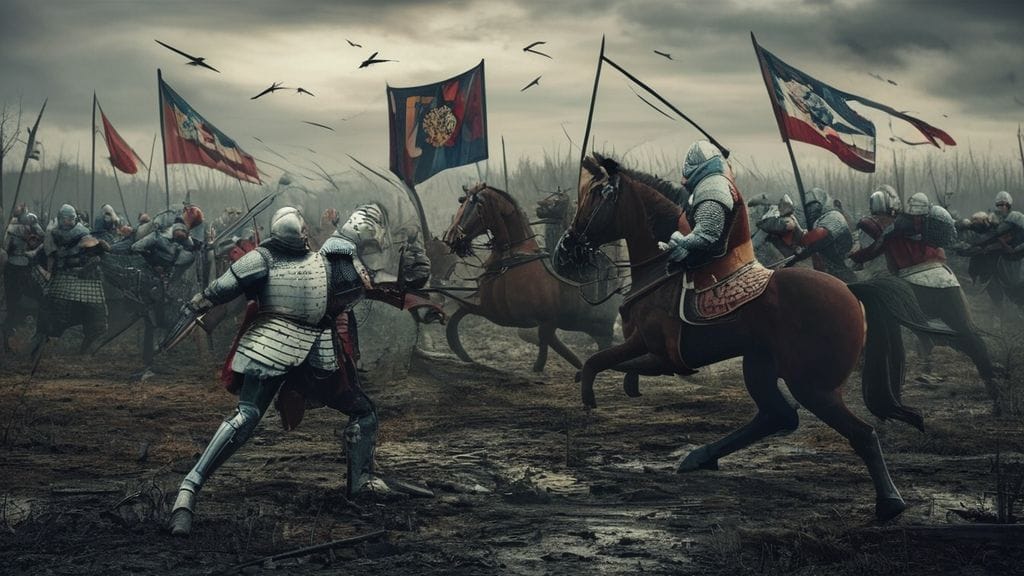
The opening moments of the battle of losecote field unfolded along a familiar script of late medieval warfare. Archers stepped forward, drawing their longbows to the ear, and loosed volleys that hissed through the air like deadly rain. Arrows thudded into shields, armor, flesh, and soil. Men cried out; some fell screaming, others silently, their bodies jolted backward by the impact. Lines wavered but did not yet break. The din rose—shouts of command, the braying of trumpets, the clamor of steel.
Edward IV, seasoned by years of campaigning, wasted little time probing. He pressed his advantage, seeking to turn the engagement into a test of will and organization rather than a prolonged exchange at range. Under his direction, royal men-at-arms advanced, supported by archers who continued to send shafts over their heads into the rebel formation. The king may have ridden along his lines, calling encouragement, reminding his soldiers that they fought not just for wages, but for law, order, and the stability of the realm.
On the rebel side, Sir Robert Welles struggled to impose control. His army had numbers, but numbers can be a curse when fear spreads faster than orders. As the royal advance quickened and the reality of facing the king’s hardened troops sank in, cohesion frayed. Some among Welles’s front lines stepped backward; others looked over their shoulders, calculating the distance to the rear. Once cracks appear in an army’s nerve, they widen with alarming speed.
Contemporary accounts suggest that the battle was remarkably brief. One chronicle claims that the rebels “durst not abide the shot of the king’s ordnance,” though artillery likely played a limited role in this particular clash. More plausibly, it was the sight of the king’s standards bearing down, combined with the news of Lord Welles’s execution, that crushed the rebels’ fragile resolve. Panic rippled through their ranks. A few men began to flee outright, and their flight became contagious.
What should have been a hard-fought contest degenerated quickly into a rout. Welles’s line crumbled as groups of men turned and ran, ignoring the shouted commands of their leaders. Once the sense of collective purpose dissolved, the battlefield became a chaos of individuals seeking only to save their own lives. The royal army, seizing the moment, surged forward. Arrows now found the backs of fleeing men. Royal men-at-arms cut down stragglers and those too encumbered to escape.
Within what seemed like minutes rather than hours, the outcome was clear. The rebel army had disintegrated, and the king’s forces dominated the field. The battle of losecote field, as it would come to be called, was less a conventional engagement than a violent, spectacular collapse of morale. In that collapse, reputations were shattered, conspiracies exposed, and the fate of powerful men sealed.
“Lose Cote” and Lost Courage: Panic, Flight, and the Naming of a Battlefield
What transformed this short, lopsided encounter into a story that would echo through local memory was not just its political consequences, but the manner of the rebels’ flight. According to tradition, as Welles’s men fled before the king’s advance, many cast off their outer garments—doublets, jackets, even mail coats—to run faster. Their fear was so overwhelming that the weight of cloth and armor seemed unbearable. Coats and tunics lay scattered across the fields and hedgerows, mute witnesses to broken courage.
From this image, later generations derived the battlefield’s distinctive name. “Losecote” was popularly explained as meaning “lose coat”—an English phrase that captured both the literal and symbolic shedding of identity in the face of defeat. Whether the name arose immediately after the battle or evolved over time, it encapsulated how villagers and chroniclers understood what had happened there. To lose one’s coat was, in a sense, to lose one’s standing, one’s honor, even one’s claim to loyalty. The men who ran from Edward IV’s banners on that March day were stripped not only of garments but of credibility.
It is always difficult, of course, to disentangle historical fact from later embellishment. Medieval chroniclers delighted in such vivid details, and storytellers in taverns and manor halls would have repeated and embroidered them. Yet the core image rings true. In a panic, men do shed anything that slows them down. A battlefield in the aftermath of a rout often resembled a macabre marketplace of abandoned gear. Even royal troops, scavenging after the fight, would have found no shortage of cloaks, jerkins, belts, and scattered shoes.
The idea of “losing one’s coat” may also have carried a moral lesson. In a society that valued courage and steadfastness, the Rutland rout exemplified disgrace. To stand firm and die in one’s harness of steel was the ideal; to cast aside that harness and flee invited scorn. Local lore likely seized on the story to warn against reckless rebellion and cowardice alike. Children growing up in the villages around Empingham would have heard tales of how their grandfathers or great-grandfathers had watched the rebels run, shedding garments as they went.
Thus a small, swiftly concluded clash was preserved in a single haunting phrase. The battle of losecote field was remembered not for heroic charges or glorious last stands, but for the moment when fear overcame loyalty, and coats littered the countryside like autumn leaves. Names are powerful. They fix complex events into a single, memorable image. “Losecote” did just that, ensuring that the panic of 12 March 1470 would not easily be forgotten.
Blood, Captivity, and Vengeance: The Grim Aftermath
When the running stopped, the dead and the captured remained. The aftermath of the battle of losecote field was as ruthless as its outcome had been swift. Royal soldiers moved through the fields, dispatching wounded rebels who still posed a threat and rounding up prisoners. Those who had thrown away their coats and badges found little protection in anonymity; frightened faces and mud-stained tunics told their own story. Some tried to blend in with local villagers, but in a countryside where everyone knew everyone else, strangers were easily identified.
Edward IV now stood triumphant on the field. His gamble—confronting the rebels directly and using their uprising to expose a wider conspiracy—had paid off. Among the captives was Sir Robert Welles himself, dragged before the king in the immediate aftermath of his defeat. According to later accounts, including those reflected in modern histories, Welles confessed under interrogation that he had been encouraged and supported by Warwick and Clarence. Whether his statements were extracted under threat of torture or promised mercy, their political impact was devastating.
The punishment was swift. Welles and other rebel leaders were condemned to death. Contemporary practice favored public executions not only as retribution but as a grim spectacle of royal justice. In the towns where these sentences were carried out, crowds gathered to watch the grisly finale: heads severed, bodies quartered, traitors’ remains displayed on gates or bridges. Each execution was a message written in blood: this is what awaits those who raise arms against their king.
For the common soldiers captured at Losecote Field, the fate was less clear-cut. Some may have been hanged as an example; others were likely allowed to return home after paying fines, swearing oaths, or suffering lesser penalties. The king had to balance vengeance with the practical need to avoid driving whole communities into despair and further rebellion. Still, the households of Lincolnshire and Rutland felt the impact sharply: fathers, sons, and brothers who had marched under Welles’s banner did not all come back.
In the days following the battle, royal commissioners and clerks got to work. Confiscations of rebel property, inquiries into who had supported the uprising, and the careful compilation of lists of the “disloyal” occupied the machinery of government. The legal instrument of attainder hung over many families like a storm cloud. For the Welleses, the storm broke fully. Their lands and titles were swept away, a once-powerful house reduced and punished to the king’s satisfaction.
The fields around Empingham slowly returned to their ordinary rhythm. Bodies were buried—some perhaps in unmarked pits, others in consecrated ground if families could recover them. The spring crops were sown. Life, as it must, went on. Yet beneath the soil lay more than bones. The battle had planted seeds of resentment and fear that would germinate in the political season to come.
From Skirmish to Earthquake: The Political Shockwaves of Losecote Field
In pure military terms, the battle of losecote field was a small engagement, especially when compared to giants like Towton or, soon after, Barnet and Tewkesbury. But politically, it acted like an earthquake whose epicenter lay not in Rutland’s fields but in the royal court and council chambers of England. Edward IV emerged from the encounter with a powerful narrative: he had put down a treacherous rising that reached up into the highest ranks of the nobility.
Sir Robert Welles’s confessions, whatever the circumstances of their extraction, gave Edward the justification he needed to turn on Warwick and Clarence. The king could now present them not as aggrieved subjects but as traitors plotting his overthrow. Public opinion among the nobility mattered, and many peers watched Warwick’s actions uneasily. To see his alleged involvement in a failed, panic-stricken rebellion made him look less like a statesman seeking reform and more like a reckless gambler willing to risk civil war again.
Edward’s handling of the aftermath also signaled a change in his kingship. During the early years of his reign, he had sometimes shown a tendency toward mercy, seeking reconciliation after victory. In 1470, however, his patience was wearing thin. The repeated defiance of powerful lords had taught him that leniency could be read as weakness. At Losecote Field, he instead demonstrated resolve—a willingness to execute noble captives and strip families of their estates.
This tightening of royal authority did win Edward some support among those weary of chaos. Merchants, many gentry, and even churchmen craved stability. A king who could put down rebellions decisively promised safer roads, more predictable justice, and the protection of property. Yet the same firmness deepened the resolve of his most dangerous opponents. Warwick and Clarence, once their involvement in the Welles rising was exposed, had fewer paths back to grace.
A contemporary chronicler, often attributed to John Warkworth, wrote with grim concision about these events, noting how swiftly Edward struck once the conspiracy was revealed. In modern terms, historians like Charles Ross and Michael Hicks have underlined how crucial Losecote Field was in pushing Warwick into his next, astonishing move: an alliance with his former enemies, the Lancastrians. Thus a small battle in Rutland set the stage for one of the most dramatic political reversals in English history.
Warwick Unmasked: The Kingmaker’s Plot Laid Bare
For Richard Neville, Earl of Warwick, the battle of losecote field was a catastrophe, even if he never stood on its soil. The defeat of Welles’s rebellion robbed him of a useful tool and, worse, stripped away the remaining veil concealing his hostility to Edward IV. Once the king had Welles’s testimony in hand, accusations against Warwick and Clarence were no longer mere suspicions whispered in corridors—they were charges stated openly.
Warwick had long cultivated an image as a defender of the realm, a man who rose against misrule rather than a selfish conspirator. In earlier years, he could argue that he opposed only poor advisors around the king, not the king himself. Losecote Field shattered that distinction. To Edward and his supporters, it was now evident that Warwick would use armed uprisings, stirred up under the banners of lesser men, to bend or break royal authority. His nickname, “the Kingmaker,” took on a darker hue: a man who made kings could also unmake them at will.
Clarence’s position grew even more precarious. As the king’s brother, his alleged complicity in rebellion was a profound betrayal. Edward had indulged George’s youthful restlessness to a point, but the Welles affair made indulgence impossible. While Edward did not move immediately to arrest Clarence—political calculations and the risks of open fratricidal war stayed his hand—the trust between them had been fatally undermined. Every word Clarence spoke and every step he took would henceforth be weighed for signs of treachery.
Under mounting pressure and with few options left within England, Warwick and Clarence fled overseas later in 1470, taking refuge initially in France. It was there that Warwick executed his astonishing pivot, aligning himself with Margaret of Anjou, the indomitable queen of the deposed Henry VI. The man who had once toppled Lancastrian power now planned to restore it. Without the debacle at Losecote Field, such a reversal might have seemed unthinkable. With his position in England crumbling, it became the only path left.
Thus, through a chain of cause and effect, the encounter in Rutland reshaped the entire trajectory of the Wars of the Roses. Warwick’s subsequent invasion of England in alliance with Lancastrian forces, the brief readeption of Henry VI, and the climactic battles of Barnet and Tewkesbury in 1471 all traced their origins, in part, back to the failure of his proxy rising at Losecote Field. A short rout on a March morning had opened a long and bloody chapter.
Commoners, Gentry, and the Price of Treason in Rutland
High politics may have driven the battle of losecote field, but its heaviest burdens fell on shoulders far from the royal court. In Rutland and neighboring shires, the consequences for commoners and gentry were immediate and enduring. Villagers who had watched the two armies converge, who had fed troops under compulsion or welcomed royal officers into their barns, now had to navigate a new landscape of suspicion and reprisal.
For the gentry—the knights, squires, and landholders who formed the backbone of local governance—the battle posed a particular dilemma. Many had been pulled in two directions. On one side lay obligations to their regional magnates, such as the Welles family or the Nevilles, who had long provided protection and patronage. On the other side stood the crown, the ultimate source of legitimacy and law. Men who had sent even a handful of retainers to join Welles’s host now worried: would the king mark their names, strip their lands, or demand crippling fines?
Royal commissions after the battle sought to identify precisely such involvement. Some families found themselves entangled in legal processes that could drag on for months or years. Fines, while less spectacular than executions, could be ruinous. A manor mortgaged to pay the king’s penalty might slip permanently out of a family’s hands. Even those who escaped formal punishment could suffer from damaged reputations and frayed networks of trust. To be whispered about as “one who rode with Welles” was not a safe thing in Edward IV’s England.
Common villagers experienced subtler but no less real consequences. The requisitioning of grain and livestock by both rebel and royal forces in the run-up to the battle left some communities facing shortages. With laborers dead or maimed, fields might go unploughed or harvests be lost. Widows and orphans of men who had joined the rebellion—willingly or under pressure—now struggled not only with grief but with the economic hardship of missing hands in the household economy.
Yet people also adapted. Parish life, with its cycles of Mass, feast days, and church ales, provided a framework for endurance. Local priests preached sermons that interpreted events within a providential scheme: God had punished the proud or vindicated the rightful king, depending on the preacher’s leanings and fears. In manor courts, disputes over land and resources continued to be heard, even as the memory of that March day flickered behind arguments over boundaries and tithes. The price of treason was high, but so too was the human capacity to fold disaster into the long, ongoing story of rural life.
Memory, Chronicle, and Legend: How Losecote Field Was Remembered
History rarely survives in pure form. It passes through the hands of chroniclers, the mouths of storytellers, and the imaginations of generations who seek meaning in the past. The battle of losecote field, though modest in scale, left intriguing traces in this layered memory. Contemporary and near-contemporary chronicles mention it briefly, usually in the context of Warwick’s falling-out with Edward IV. For instance, a chronicle often attributed to John Warkworth notes how rebels in Lincolnshire were defeated and their leaders executed, helping to spark Warwick’s flight abroad.
Later writers, such as the Tudor historian Edward Hall, folded Losecote Field into grander narratives of the Wars of the Roses, emphasizing its role in exposing Warwick’s treachery. Hall’s flowing, moralizing prose turned the battle into a cautionary tale about overmighty subjects and the dangers of divided loyalty. These accounts, while invaluable, must always be read with an awareness of their political agendas. Tudor historians in particular had strong incentives to portray Yorkist dissension as a prelude to the “restorative” Tudor settlement.
Alongside the written sources, oral traditions in Rutland and Lincolnshire preserved more intimate recollections: a story of a grandfather who had watched from a hedgerow, a rumor that a local family’s prosperity originated in the scavenging of abandoned coats and gear, a field-name that referenced the panic of the rebels. Place-names around Empingham and the neighboring countryside evolved, some preserving echoes of the 1470 encounter, others overlaid by subsequent centuries’ ploughing and enclosure. Archaeological traces, though scarce, hint at scattered metalwork, arrowheads, and the odd fragment of harness lost in the rout.
Modern historians, combing these sources with critical eyes, have reconstructed the outline of events while acknowledging gaps and uncertainties. As one modern study notes, “Losecote Field is emblematic of those many late medieval battles that mattered profoundly to contemporaries yet slid into relative obscurity as memory coalesced around a few famous names.” In recent decades, local history societies and battlefield researchers have worked to recover the story, walking the land, comparing contour lines with chronicle descriptions, and seeking to match narrative to terrain.
Legend and scholarship thus intertwine. The image of men throwing off their coats, fleeing over the fields, remains vivid, whether or not every detail can be verified. The story serves as a lens through which to view courage and cowardice, loyalty and betrayal, in an age when all these virtues and vices were tested repeatedly in blood. In remembering Losecote Field, we remember not only a single March day, but the wider fragility of order in a kingdom at war with itself.
From Losecote to Barnet and Tewkesbury: A Turning Point in the Wars of the Roses
Seen in isolation, the battle of losecote field might appear a mere footnote in the long saga of the Wars of the Roses. But when placed on the broader timeline, its significance sharpens. Losecote Field sits at a hinge moment: the end of Edward IV’s first reign and the beginning of the tumultuous interlude that would see Henry VI briefly restored, only to be toppled again. Without Losecote Field, the chain of events leading to Barnet and Tewkesbury in 1471 would look markedly different.
After his victory in Rutland, Edward IV enjoyed a brief surge of stability. He had humbled a rebellious noble house, discredited Warwick and Clarence, and demonstrated that the crown could still act decisively. Yet this stability was built on a perilous foundation. In driving Warwick and Clarence into exile, Edward removed his immediate domestic threat, but he pushed his enemies into the arms of his foreign and dynastic rivals. Warwick’s subsequent alliance with Margaret of Anjou and the Lancastrian cause was made possible, in part, by his loss of room to maneuver within England after Losecote.
By the autumn of 1470, Warwick was back on English soil with French backing and Lancastrian allies. Edward, caught off guard, fled to Burgundy. Henry VI, long a prisoner in the Tower, was led in solemn procession through London streets, briefly restored to a shadowy kingship in what is known as the Readeption. It might have seemed, for a few months, that the Yorkist revolution had been decisively reversed. Yet the very factors that had made Warwick a formidable opponent in the 1460s now made him a dangerous and unstable partner for his new Lancastrian allies.
When Edward returned in early 1471, backed by Burgundian funds and a hardened core of loyal followers, the stage was set for a final showdown. The battles of Barnet (14 April 1471) and Tewkesbury (4 May 1471) would seal the fate of the Lancastrian dynasty and secure Edward’s throne for the remainder of his life. At Barnet, in thick fog, Warwick himself fell in battle, his body later displayed to prove the Kingmaker was no more. At Tewkesbury, the young Edward of Westminster, Prince of Wales, was killed, extinguishing the direct Lancastrian male line.
Losecote Field, then, stands as the opening act in this final drama. By exposing Warwick’s duplicity and destroying his domestic proxy in the Welles rebellion, the battle set forces in motion that could not easily be reversed. It turned simmering resentment into open exile, fractured the already fragile unity among the Yorkist elite, and cleared the way for the last great convulsions of the civil wars. In this sense, the scattered coats in Rutland’s fields were preludes to the blood-soaked banners at Barnet and Tewkesbury.
Landscape of a Forgotten Battlefield: Traces of 1470 in Modern Rutland
Walk today through the countryside near Empingham in Rutland, and it is hard to imagine the cries of battle or the thunder of hooves. The fields are more likely to echo with the lowing of cattle or the distant hum of traffic on modern roads. Hedges line neat property boundaries; tractors have replaced oxen; the seasonal rhythms remain, but in a different key. Yet beneath this pastoral calm lies the ghost of 12 March 1470, inscribed in subtle ways on the land.
Historians and battlefield enthusiasts have worked to identify the probable site of the battle of losecote field using a mix of documentary evidence, topographic analysis, and limited archaeological finds. The descriptions in 15th- and 16th-century sources hint at the proximity to Empingham and to routes used by armies moving between the Midlands and the north. Contour maps reveal how troops might have deployed on slopes offering better fields of fire for longbowmen or firmer ground for advancing men-at-arms.
Metal-detector surveys, carried out with care and appropriate permissions, have occasionally turned up arrowheads, buckles, and other scraps of militaria that may or may not be linked to the 1470 clash. While conclusive proof remains elusive, each small find invites reflection. A twisted piece of iron might once have been part of a harness worn by a rebel who threw off his gear in desperate flight; a corroded arrowhead could have been loosed under the king’s banners as Edward’s archers pressed their advantage.
Landscape changes over five and a half centuries inevitably blur the picture. Enclosure in the early modern period transformed the medieval open-field system into the patchwork of hedged fields we see today. Drainage, road-building, and later agricultural improvements further altered slopes, ditches, and paths. Some features that shaped the battle may have vanished entirely; others survive only as faint ridges or depressions visible in low light or aerial photography.
Yet the act of seeking the battlefield itself becomes a kind of commemoration. Local guides, historical plaques, and trail maps sometimes draw attention to the area’s late-medieval past, inviting walkers to imagine the scene: the sudden panic, the scattering coats, the triumphant royal standard rising over broken ranks. In doing so, the modern landscape becomes palimpsest—a layered text in which contemporary life coexists with the faded ink of historical trauma. The battle of losecote field lives on not only in archives and books but also in the quiet persistence of place.
Why a Small Battle Matters: Power, Loyalty, and Fear in Late Medieval England
At first glance, the battle of losecote field seems too small, too quickly decided, to warrant extended attention. Yet it offers a concentrated glimpse into the dynamics of power, loyalty, and fear that defined late medieval England. In its short, chaotic course, we see how royal authority was asserted, how noble ambition could destabilize a kingdom, and how ordinary people were swept up in struggles far beyond their making.
One lesson of Losecote Field is the fragility of loyalty when fear takes hold. Sir Robert Welles’s men did not enter the field intending to flee. They had been rallied with promises of defending their lord, their shire, or even the “common good.” But under the pressure of facing the king’s own host, their cohesion disintegrated. This reveals the difference between loyalty to a familiar local figure and loyalty to an abstract cause. When the cost of allegiance became immediate and deadly, many chose survival over steadfastness.
The battle also underscores the centrality of information—true, false, and manipulated—in medieval politics. Rumors of Edward’s intentions toward the Welles family helped spark the rebellion; Welles’s later confession about Warwick and Clarence’s involvement gave Edward the leverage he needed to move against them. In a world without printing presses widely in use or mass literacy, letters, proclamations, and word of mouth were the weapons of political warfare as much as swords and bows. The king’s ability to shape the narrative of Losecote Field—to present it as a justified suppression of treason—was as important as his victory in arms.
Moreover, the encounter illustrates the limits of magnate power. Warwick, for all his resources, could not control every outcome once he resorted to proxy uprisings. When Welles’s forces broke, they did more than fail tactically; they exposed the fragility of Warwick’s position and accelerated his downfall. The battle thus warns against overreliance on indirect methods of rebellion: once the mask is torn away, the conspirator stands naked before both king and country.
Finally, Losecote Field reminds us that “small” battles can have profound ripple effects. In human terms, each life lost left a gap in family and community. In political terms, each execution and attainder altered the distribution of land and influence. In strategic terms, the failure of the Welles rising nudged major players toward choices—exile, alliance, renewed war—that reshaped the fate of England. To study this battle is to appreciate how, in history, significance is not measured only in body counts or column inches but in the turning of paths that might otherwise have led elsewhere.
Conclusion
The story of the battle of losecote field begins with whispers in manor halls and ends with scattered coats in muddy fields, but its arc stretches far beyond a single March day in Rutland. In tracing its course, we have seen how a fragile peace under Edward IV unraveled under the weight of personal rivalries, family ambitions, and lingering resentments from earlier phases of the Wars of the Roses. What appeared, at first, as a local rebellion in Lincolnshire became, through the threads connecting Sir Robert Welles to Warwick and Clarence, a decisive test of royal authority.
The battle itself, swift and lopsided, revealed the harsh realities of late medieval warfare: the importance of discipline over numbers, the power of fear to dissolve vows of loyalty, and the brutal efficiency with which a determined king could punish defiance. Its aftermath scattered not only coats but lives and fortunes, as executions and attainders reshaped the noble landscape and imprinted grief on communities in Rutland and beyond. Yet, as fields were replanted and routines resumed, memory worked quietly to preserve the event in chronicles, legends, and place-names.
Politically, Losecote Field marked the moment when Warwick’s opposition to Edward could no longer be disguised as reformist concern. Exposed and cornered, the Kingmaker fled into exile and into the arms of the Lancastrian cause, setting the stage for the climactic battles of Barnet and Tewkesbury. In this sense, the minor rout in Rutland was the spark that helped ignite the final blaze of the Wars of the Roses. It stands as a reminder that turning points in history often unfold not only on grand stages but also in small shires, amid hedgerows and furrows.
To walk the probable battlefield today is to stand at the intersection of past and present, where quiet fields mask a drama of ambition, fear, and sudden collapse. The battle of losecote field matters because it brings into focus the fragile scaffolding of power in 15th-century England, the costs of treason and mistrust, and the enduring human patterns of courage, panic, and survival. In the end, its legacy lies not only in the political consequences it unleashed but also in the insight it offers into how kingdoms are held together—and how quickly they can begin to fall apart.
FAQs
- What was the Battle of Losecote Field?
The battle of losecote field was a short but significant engagement fought on 12 March 1470 near Empingham in Rutland, England. It pitted a rebel army led by Sir Robert Welles against the forces of King Edward IV during the Wars of the Roses. The royal army quickly routed the rebels, exposing a wider conspiracy involving Richard Neville, Earl of Warwick, and George, Duke of Clarence. - Why is it called “Losecote Field”?
The name “Losecote Field” is traditionally explained as deriving from “lose coat,” referring to the rebels who, in panic, reportedly cast off their coats and outer garments to flee more quickly from the king’s forces. Whether or not every detail is literal, the name captures the memory of a rout in which fear and flight dominated. - Who was Sir Robert Welles, and why did he rebel?
Sir Robert Welles was a Lincolnshire nobleman from a family with Lancastrian ties that had suffered under Yorkist rule. Fearing royal retribution against his family—especially after his father, Lord Welles, was summoned by the king—Robert raised an army in Lincolnshire. His rebellion was likely encouraged by Warwick and Clarence, who sought to weaken Edward IV, but it collapsed at Losecote Field. - What role did Warwick and Clarence play in the uprising?
Although Warwick and Clarence were not physically present at the battle, contemporary testimonies, including Welles’s confession, implicated them as instigators or supporters of the rebellion. Their badges reportedly appeared among the rebels, signaling clandestine backing. The failure of the rising and Edward’s subsequent accusations forced Warwick and Clarence into exile and pushed Warwick toward an alliance with the Lancastrians. - How did the Battle of Losecote Field affect the Wars of the Roses?
The battle helped solidify Edward IV’s authority in the short term by crushing a rebellion and justifying harsh action against its noble backers. However, by exposing Warwick’s disloyalty and narrowing his options in England, Losecote Field contributed to Warwick’s decision to join forces with Margaret of Anjou. This alliance led to Edward’s temporary overthrow in 1470 and set the stage for the decisive battles of Barnet and Tewkesbury in 1471. - Where exactly was the battlefield located?
The battle took place near Empingham in the county of Rutland, though the precise location remains a matter of scholarly debate. Historians use contemporary descriptions, landscape analysis, and occasional archaeological finds to approximate the site, but enclosure, farming, and later development have altered the medieval terrain. - Was the Battle of Losecote Field a large battle?
In comparison to major battles like Towton or Tewkesbury, Losecote Field was relatively small. Estimates of the rebel force range from a few thousand to perhaps up to 10,000 men, while the royal army was likely smaller but far better disciplined. The engagement was brief, ending in a rapid rout rather than a prolonged, evenly matched struggle. - What happened to Sir Robert Welles after the battle?
Sir Robert Welles was captured in the aftermath of the battle and brought before Edward IV. Under interrogation, he implicated Warwick and Clarence in the rebellion. He was subsequently executed, and his family’s lands and titles were largely forfeited through attainder, serving as a stark warning to other would-be rebels. - Did common people suffer consequences for taking part in the rebellion?
Yes. While the harshest penalties—execution and full attainder—were usually reserved for leaders and prominent supporters, common soldiers could face hanging, fines, or other punishments. Many communities in Lincolnshire and Rutland lost men in the battle or to subsequent reprisals, and some villagers endured economic hardship from requisitioning of supplies and the loss of laborers. - Why do historians still study the Battle of Losecote Field today?
Historians study the battle of losecote field because it illuminates the internal tensions of Edward IV’s reign, the methods of medieval rebellion and royal repression, and the ways in which seemingly small engagements can have large political consequences. It offers valuable insight into the mechanics of power, loyalty, and fear in the late 15th century, making it an important case study within the broader narrative of the Wars of the Roses.
External Resource
Internal Link
Other Resources
- Encyclopaedia Britannica – general search for the exact subject
- Google Scholar – academic search for the exact subject
- Internet Archive – digital library search for the exact subject

