Table of Contents
- A Kingdom in Ruins: Setting the Stage for Worcester
- From Regicide to Resistance: The Road to the Final Clash
- Charles II in Exile: A Young King Without a Kingdom
- Cromwell Ascendant: The New Order of the English Commonwealth
- The Scottish Gamble: Charles II Crowned at Scone
- Marching South: The Desperate Advance Toward England
- Choosing Worcester: A City Caught Between Hope and Doom
- The Forces Assemble: Numbers, Weapons, and Wavering Loyalties
- The Eve of Battle: Rumors, Prayers, and Quiet Terror
- The Battle of Worcester Unleashed: The Morning Assault
- Storming the Bridges: The Ferocious Struggle for the Severn and Teme
- Collapse Within the Walls: Rout, Panic, and Street-to-Street Fighting
- The King’s Escape: Hiding in Oaks and Houses of Friends
- Prisoners, Plunder, and Purges: The Human Cost of Cromwell’s Victory
- From Worcester to Restoration: How Defeat Shaped a Future King
- Remaking Britain: Political and Religious Consequences of 1651
- Memory and Myth: How Worcester Became “The Crowning Mercy”
- Worcester Today: Landscapes of Remembrance and Silence
- Conclusion
- FAQs
- External Resource
- Internal Link
Article Summary: The battle of worcester, fought on 3 September 1651, marked the violent end of the English Civil Wars and sealed the fate of a young king on the run. This article follows the long road that led to that day: from the execution of Charles I to the rise of Oliver Cromwell and the desperate Scottish-backed campaign of Charles II. It explores how armies converged on the cathedral city of Worcester, why the terrain around the Severn and Teme rivers mattered so much, and how the fighting unfolded hour by bloody hour. Along the way, it reveals the doubts, fears, and ambitions that powered both Parliamentarian and Royalist soldiers, and the fate of those who were captured or forced into exile afterwards. The narrative shows how the battle of worcester crushed the last serious Royalist army in Britain, enabling the Commonwealth to dominate politics for nearly a decade. Yet it also traces how the memory of defeat ultimately shaped Charles II’s character and policies when the monarchy was restored. By weaving eyewitness detail with analysis, it explains how one September day in 1651 transformed the map, the monarchy, and the very idea of authority in England, Scotland, and Ireland.
A Kingdom in Ruins: Setting the Stage for Worcester
By the time the battle of Worcester erupted in early September 1651, the British Isles had already been soaked with nearly a decade of civil war. England, Scotland, and Ireland were not simply three crowns under one ruler; they were three competing visions of order, faith, and power, held together—often uneasily—by the figure of the king. When King Charles I lost his head on a frigid January day in 1649, the executioner’s axe did not just sever a monarch; it struck at centuries of belief about divine right, obedience, and the relationship between God and government. The headsman raised the severed head to the shocked crowd, and what followed was something no English generation had seen before: a kingless state, ruled not by a sovereign but by a Parliament and, increasingly, by its generals.
The wars that led to this moment had been brutal and bewildering. Families across the kingdom had seen sons march off under opposing banners—some for “King and Church,” others for “Parliament and Liberty”—and many never return. Fields that once yielded barley and wheat were churned into mud by horses and cannon wheels. Churches bore the scars of shot and shrapnel, and communities were split by accusations of treason and heresy. In many towns, widows and orphans crowded poorhouses, while taxes and forced loans funded marching armies. In this world of uncertainty and grief, the old idea that the king’s person was sacred and inviolable seemed increasingly fragile.
Yet even with Charles I dead, the conflict did not end. Instead, it entered a new and more radical phase. England was declared a Commonwealth, officially a republic. Parliament dissolved the House of Lords and abolished the monarchy itself, as if ripping out ancient roots and daring the world to see whether the tree of government would wither or thrive. But this moment of revolutionary creativity was shadowed by fear. Royalists had not vanished; they had dispersed—to hiding places, to continental courts, and, crucially, to Scotland, where another Charles waited.
For in exile, the young Charles—Charles II—embodied both a memory and a promise. To Royalists, he was the rightful king, wronged and dispossessed, whose return would heal the kingdom. To Parliamentarians and radical sectarians, he was a potential rallying point for counter-revolution, a figure around whom old hierarchies might reassemble. In the north, Scottish Covenanters, bound by their own religious and political commitments, were rethinking alliances. They had once fought against Charles I to defend their Presbyterian settlement; now some of them were prepared to fight for his son to protect their Kirk and influence. The result was a tangle of loyalties, oaths, and calculations that made the 1650s as dangerous as any battlefield.
It was into this fractured landscape that the events leading to the battle of Worcester took shape. The city of Worcester, with its ancient cathedral overlooking the River Severn, had already known war. It had been besieged and occupied in earlier phases of the conflict, its streets echoing with drums and shouted commands, its citizens forced to feed and house soldiers from both sides in turn. By 1651, however, Worcester was more than just another strategic stronghold; it would become the crucible in which the fate of monarchy and Commonwealth alike was tested.
And so, in that late summer, as leaves just began to turn and harvests ripened in the surrounding countryside, two visions of Britain converged on a single city. One was carried in the person of Charles II and the battered, hopeful army that followed him south from Scotland. The other marched beneath the banners of the English Commonwealth, hardened by years of campaigning and commanded by Oliver Cromwell, the most formidable soldier-statesman of his age. Worcester, unsuspecting as it might have seemed only months before, was about to become the site of the last major battle of the English Civil Wars.
From Regicide to Resistance: The Road to the Final Clash
When Charles I’s blood darkened the scaffold outside the Banqueting House in Whitehall, the shock rippled far beyond London. In the Dutch Republic, in France, and across the German principalities, princes and diplomats watched anxiously. If the English could try and execute their king, what did that say about the supposed inviolability of monarchy everywhere? In Ireland and Scotland, where Charles’s authority had always competed with powerful local institutions, the reaction was even more complex. Some saw a tyrant justly punished; others saw a martyr cut down by rebels.
In England, Royalist resistance was not extinguished by the regicide—it merely changed its shape. Noble families who had supported the crown regrouped in clandestine networks. Smugglers’ coves along the southern coast became channels for messages to and from the exiled court. Former officers of the king’s armies waited for signs of rebellion, for foreign aid, for anything that might crack the armor of the new Commonwealth. They had lost their king, their cause, and often their estates, but they had not yet lost their conviction that England would tire of rule by soldiers and sanctimonious preachers.
Parliament was divided within itself. Moderates hoped for a stable constitutional settlement, while radicals dreamed of a godly commonwealth that would transform society from top to bottom. The army, whose discipline had secured victory, now held substantial political weight. Its senior commanders, including Oliver Cromwell, were hailed as instruments of divine providence by their supporters and as dangerous upstarts by their enemies. The delicate balance between civilian and military power would define the coming years.
Resistance simmered in scattered Royalist risings, clandestine plots, and border raids. Yet none of these were large or coordinated enough to threaten the core of the new regime. What Royalists lacked above all was a viable central figure who could command both domestic loyalty and foreign support. That figure was, in theory, Charles II—but he was young, untested, and isolated on the Continent, moving uneasily among Catholic courts that were willing to offer sympathy but less willing to commit troops and treasure.
Scotland, however, was a different case. It had its own parliament, its own powerful church in the form of the Presbyterian Kirk, and its own recent memory of successful armed resistance. The Scottish Covenanters had entered the wars to defend their religious settlement, not primarily to save or destroy Charles I. When the king was executed without their consent, they were outraged, not only because they disliked regicide but because it seemed to trample on the solemn agreements they had made with the English Parliament. In response, the Scottish authorities declared Charles II their king, on condition that he accept the Covenant and their religious terms.
Thus, resistance to the English Commonwealth found its most serious embodiment not in a secret English conspiracy but in the open, institutional power of Scotland. The stage was set for a new confrontation: not just between two armies, but between two political and religious projects, each claiming to represent the true will of God and the people. As negotiations, intrigues, and ultimatums bounced back and forth across the North Sea and the Anglo-Scottish border, the path to the battle of Worcester became clearer. Sooner or later, the Commonwealth would have to face the uncomfortable fact that its great enemy—the Stuart monarchy—had not been truly destroyed. It had simply migrated north, awaiting its chance to move south again.
Charles II in Exile: A Young King Without a Kingdom
Charles II was not yet thirty when the battle of Worcester transformed his life, but he had already seen more reversals of fortune than most men twice his age. As a boy, he had watched his father wrestle with rebellious parliaments and militant subjects. As a teenager, he had accompanied Royalist armies, sharing in the shock of defeat at Naseby and the long, bitter unraveling of his father’s cause. When Charles I was imprisoned and then executed, his son’s world did not simply fall apart—it inverted. One day he was heir to three kingdoms; the next, he was a fugitive claimant, dependent on foreign hospitality and the shrinking goodwill of exiled courtiers.
His exile was a wandering education in power and its limits. In France, at the court of his cousin Louis XIV, he learned the art of waiting and watching. The French cardinal-minister, Mazarin, weighed the advantages of supporting this dispossessed king against the risks of angering the new English regime. In the United Provinces of the Netherlands, Charles moved among merchants, Calvinist clergy, and seasoned diplomats. Each audience, each dinner, held the possibility of assistance and the sting of disappointment. Envoys spoke in cautious phrases: “in time,” “when circumstances permit,” “if an opportunity presents itself.”
The young king’s household was a microcosm of divided Royalism. Some advisers urged bold action: land in Ireland, rally Highland clans in Scotland, instigate uprisings in England. Others counseled patience, fearing that a failed attempt would leave him with even fewer options. Threads of conspiracy crisscrossed Europe. Royalist agents promised more than they could deliver; foreign courtiers whispered promises they did not intend to keep. Charles listened, sifted, doubted, and occasionally gambled.
One key reality governed them all: without troops, ships, and money, Charles II was a king in name only. He needed a base of support strong enough to withstand the Commonwealth’s armies and compelling enough to draw English Royalists back into the field. That base, it increasingly seemed, would have to be Scotland. There, despite misgivings about his father’s legacy, the Covenanters were prepared—on strict conditions—to recognize him as king. For Charles, this was a painful compromise. He was personally more tolerant in matters of religion than many of his potential allies, and the Covenant demanded that he uphold a rigid Presbyterian system that would marginalize other forms of worship.
Yet what choice did he have? Letters from England made the reality plain: Royalist gentry were impoverished and under surveillance; many had signed oaths to the Commonwealth to preserve their families and estates. Without a legitimate and armed base, any attempt to rise for the Stuarts would be scattered and easily crushed. Scotland offered him an army, a crown, and a platform from which to proclaim his rights over all three kingdoms.
As he sailed north in 1650, Charles II may have felt both hope and foreboding. Hope, because his fortunes seemed at last to be turning. Foreboding, because his fate would now be tied to a fiercely devout political regime whose priorities were not always his own. In their sermons, Scottish ministers spoke of him as a potential “nursing-father” to the Kirk, a ruler whose primary duty was to guard true religion. To the son of Charles I, raised in the cosmopolitan atmosphere of European courts, this was a narrower vision of kingship than he might have desired. Yet circumstances made a hard bargain irresistible. The path to Worcester began with that voyage across the North Sea, as a restless, dispossessed king sailed toward a crown that would prove more a burden than a blessing.
Cromwell Ascendant: The New Order of the English Commonwealth
While Charles II negotiated oaths and titles in the north, Oliver Cromwell consolidated power in the south. The farmer from Huntingdon who had once been dismissed as a minor country gentleman had become, by 1650, the central figure of the English Commonwealth’s military machine. He was more than a general; he was a symbol. To many in the army and among the “godly,” Cromwell was an instrument raised up by Providence to punish tyranny and reform the nation. To Royalists, he was a usurper and a traitor, a man whose ambition had overridden all principle.
Cromwell’s rise was rooted not only in battlefield victories but in a particular religious conviction. He believed that events were guided by God’s will, and that success in war was a sign of divine favor. After the crushing of Royalist forces in England, his attention turned to Ireland and Scotland, where resistance still flared. The campaigns in Ireland were harsh and controversial, marked by sieges at Drogheda and Wexford that left a bitter legacy. In Scotland, he faced a different kind of opponent: disciplined Covenanting armies that saw themselves as defenders of a sacred national church.
The confrontation at Dunbar in September 1650 was a turning point. There, Cromwell’s forces defeated a larger Scottish army, an outcome he famously called “a crowning mercy.” This phrase would echo again later at Worcester, where another decisive victory would, in his eyes, confirm the Commonwealth’s legitimacy. Dunbar opened the way for English occupation of much of southern Scotland, but it did not destroy Scottish resistance entirely. A year of maneuver, siege, and political intrigue followed.
Back in London, the Rump Parliament struggled to translate military success into stable governance. Debates raged over religious toleration, legal reform, and the future of the army’s influence. Radical groups like the Fifth Monarchists saw in the Commonwealth the first glimmer of a new, godly age; more conservative republicans feared that continued reliance on military power would deform any attempt at a free constitution. Cromwell, increasingly, stood at the center of this storm. He wrote letters, consulted with ministers, and tried—sometimes impatiently—to balance the demands of zealots and pragmatists.
News that Charles II had been crowned King of Scots in early 1651, and that he was gathering an army, sharpened the sense of crisis. For Cromwell, the threat was not merely that of a foreign-backed invasion. It was ideological. The reemergence of a Stuart monarch at the head of a Scottish army offered discontented English Royalists a rallying point. If the Scottish and Royalist forces could invade England and raise uprisings along the way, the Commonwealth might face a new multi-front civil war, just when it was trying to consolidate peace.
Cromwell’s response was characteristically direct. He would not wait behind borders; he would pursue and, if possible, annihilate the threat on the move. His strategic aim was to prevent Charles from joining with substantial English support, to intercept and destroy his army before it could gain strength. The stage was thus set for the long pursuit that would end at Worcester, where Cromwell hoped to repeat Dunbar’s “crowning mercy” on an even grander scale.
The Scottish Gamble: Charles II Crowned at Scone
On a cold January day in 1651, in the ancient Scottish town of Scone, Charles II was crowned King of Scots. The ceremony was fraught with symbolism and tension. Gone were the splendid Anglican rites of his father’s coronation; in their place stood a starkly Presbyterian service, saturated in Scripture and admonition. Ministers reminded the young king that his authority came with conditions, that he must uphold the Covenant, protect the Kirk, and rule in a manner consistent with godly discipline. It was a coronation, but also a warning.
For Charles, accepting the Scottish crown was both a triumph and a compromise. He had signed the Covenant, renouncing aspects of his father’s religious policies and pledging to maintain Presbyterianism not just in Scotland but, in theory, across his kingdoms. In practice, he likely hoped to interpret these obligations flexibly if he ever regained full power. But in early 1651, such hopes were distant. His immediate reality was a kingdom under threat, where English garrisons occupied key towns and where internal divisions weakened his support.
The Scottish political elite was far from united behind him. Hardline Covenanters distrusted both Charles’s personal religion and the more Royalist-leaning nobles around him. Moderate “Engagers” and Royalists, in turn, resented the Kirk’s dominance and the moral scrutiny it imposed on the court. Army officers debated strategies in council, while ministers preached fasting and repentance from pulpits. Some saw in their alliance with Charles a necessary evil; others saw it as a providential opportunity to influence a future pan-British monarchy.
Against this backdrop, talk turned to war. The English Commonwealth’s presence in Scotland could not be tolerated indefinitely, nor could the execution of Charles I be left unchallenged. A bold stroke was needed to restore the Stuart cause and to rally English Royalists who still nursed their grievances in silence. The most daring plan was simple in design but perilous in execution: march south into England, present Charles II in person to his English subjects, and rely on local uprisings to swell the Scottish-led army as it advanced.
This was the Scottish gamble. Its advocates argued that waiting longer would only strengthen the Commonwealth. Cromwell’s veterans grew more experienced month by month; English defenses and intelligence networks became ever more organized. Better to strike now, while some English Royalists still had resources, and while news of Charles’s coronation was relatively fresh. Critics warned that the plan relied on uncertain English support and that marching deep into enemy territory would stretch supply lines and expose the army to encirclement.
Yet for a king without a kingdom, opportunity often arrived disguised as risk. Charles listened to his generals and advisers, weighed the dangers, and eventually consented. The decision would lead him inexorably toward the banks of the Severn, toward Worcester, and toward a battlefield that would define the rest of his life.
Marching South: The Desperate Advance Toward England
In the summer of 1651, the Scottish army bearing Charles II’s hopes began its march south. It was a mixed force—Scottish regulars, Highland levies, and a scattering of English Royalist exiles. Estimates of its size vary, but contemporary observers generally place it between 12,000 and 16,000 men. They carried muskets, pikes, swords, and a handful of artillery pieces, but they also carried something less tangible yet equally heavy: the expectation that their advance would spark a broader English rising.
The route chosen was both practical and symbolic. The army moved through the western side of England, avoiding areas heavily garrisoned by Parliamentarian forces and hoping to tap into regions that had shown Royalist sympathy in earlier phases of the war. Towns along the way watched anxiously as banners and standards approached. Some locals offered provisions or quietly cheered; others shut their doors, fearful of reprisals if the Commonwealth regained control. The specter of earlier devastation hung over communities; memories of plunder and quartering were still fresh.
News of the march galloped ahead on horseback and passed from inn to marketplace. In London, the government braced for crisis. Orders were sent out to mobilize militia, secure key crossings, and block likely routes. In the countryside, those inclined toward the Stuarts weighed their options. Was this at last the moment to rise? Or would they again be left vulnerable if the king’s cause collapsed? Many chose caution. Years of defeat and confiscation had taught them how costly a misplaced gamble could be.
Meanwhile, Cromwell moved swiftly to intercept the invaders. Gathering troops from across England and from his garrisons in Scotland, he set out in a determined pursuit. Parliamentary intelligence networks tracked the Scottish movements; local sympathizers provided guides and information. Cromwell’s aim was clear: prevent Charles from gaining significant English reinforcement and corner him before he could retreat safely north.
The march took its toll on the Scottish army. Supplies were often meager; shoes wore thin; sickness spread in the ranks. Soldiers trudged through rain and dust, sleeping rough or in overcrowded billets. Rumors circulated—of large English forces mustering, of Royalist uprisings that never quite materialized, of divisions within their own leadership. Some officers wondered aloud whether they had been too optimistic about English support.
Yet there was also determination. For many Scottish soldiers, this was more than a foreign adventure; it was a campaign to secure their own kingdom’s safety by undermining the power of the English Commonwealth. For English Royalists within the army, it was perhaps the last throw of the dice, a chance to reverse years of loss. As they crossed deeper into England, the question that haunted them all was the same: where would they make their stand?
The answer would soon present itself, in the form of a city perched beside a great river, ringed by fertile fields and crossing-points that offered both opportunity and danger. Worcester, with its ancient cathedral and strategic bridges, lay at a crossroads—in geography, in politics, and in history.
Choosing Worcester: A City Caught Between Hope and Doom
Why Worcester? Of all the towns and cities the Scottish-led army might have chosen as its base, why did they settle on this cathedral city in the west of England? The decision was shaped by a mix of strategy, logistics, and perhaps a measure of desperate improvisation.
Worcester occupied a commanding position on the River Severn, the longest river in Britain, which flowed southward toward the vital port of Bristol. To the west, the smaller River Teme joined the Severn, creating a landscape crisscrossed by fords and bridges. Control of these crossings could open or close entire regions to movement. For an invading army in need of supplies and reinforcements, a city like Worcester offered defensive walls, storehouses, workshops, and a centralized position from which to strike out or defend.
The city also carried emotional and symbolic weight. Early in the civil wars, Worcester had shown Royalist sympathies. King Charles I himself had visited, and the city had been fortified in his name. Though later taken by Parliamentarian forces, its associations with Royalism persisted in memory and rumor. For Charles II and his advisers, entering Worcester might seem like stepping into friendly territory—or at least into a place where old loyalties could be rekindled.
Yet Worcester was no blank slate. Its inhabitants had endured occupation, siege, and shifting allegiances. Some merchants had prospered cautiously under Commonwealth rule; others quietly nursed Royalist sentiments. Guilds, clergy, and civic officials balanced fear of reprisal with the hope of favor, whichever side prevailed. When Charles II entered the city in late August 1651, he was greeted with acclamations, but not all cries of “God save the King!” were equally sincere, nor equally loud.
Inside the city, preparations began at once. Gates were repaired; earthworks strengthened; vantage points identified. The cathedral, with its soaring Gothic nave, became not only a place of worship but a looming symbol over the coming trial. Some citizens took up arms, joining garrison units; others stockpiled what provisions they could, bracing for a siege. Beyond the walls, farms and hamlets found themselves suddenly adjacent to a war zone. Livestock was seized or driven in for safety; fields became potential battlefields.
To Cromwell, Worcester was both a threat and an opportunity. If Charles II was determined to stand and fight there, the Commonwealth could bring its full might to bear on one concentrated target. Worcester could be surrounded, cut off, and crushed. The web of rivers and bridges that made the city so strategically appealing could also become a trap. Cromwell, whose eye for terrain had served him well in previous campaigns, studied maps and reports, considering how best to turn Worcester’s advantages against its defenders.
As August turned to September, the city filled with the sounds of preparation: the tap of hammers repairing palisades, the scrape of carts bringing in munitions, the murmur of anxious prayers in parish churches. The people of Worcester did not know it yet, but they were about to witness—and endure—the last pitched battle of the English Civil Wars, a conflict that had already reshaped their world in ways too deep to measure.
The Forces Assemble: Numbers, Weapons, and Wavering Loyalties
On the eve of the battle of Worcester, two armies faced one another across rivers, fields, and hedgerows, each bearing not only weapons but the political futures of their respective regimes. The disparity between them was stark. Charles II’s force—composed of Scots, some English Royalists, and a sprinkling of foreign volunteers—likely numbered between 12,000 and 16,000. Many were seasoned soldiers, but the campaign south had drained them. Supplies were thin; morale was uneven. Some units had grown weary of marching and uncertain promises of English support that had yet to materialize.
Opposing them, Cromwell commanded a far larger and more varied host. Contemporary estimates suggest his total force around Worcester reached perhaps 28,000 to 31,000 men when all contingents are included. These were not raw levies; many were veterans of multiple campaigns, hardened by battles from Marston Moor to Dunbar. Alongside the New Model Army’s core regiments stood militia units raised from English counties, their loyalty to the Commonwealth buttressed by local fears of renewed Royalist dominance.
Infantry formed the backbone of both armies. Musketeers, armed with matchlock or flintlock muskets, stood in ranks, ready to deliver volleys of shot. Pikemen, carrying long steel-tipped pikes, protected them from cavalry charges and closed in brutal hand-to-hand combat when lines met. Cavalry troopers clanked in buff coats and breastplates, their pistols, swords, and carbines gleaming in the late summer light. Artillery—the “great guns”—rumbled into place, their crews preparing powder charges and round shot.
But numbers and arms tell only part of the story. Equally important were the loyalties and emotions that animated the men who would soon fight. In Charles’s ranks, some soldiers believed passionately in the divine right of kings and the injustice of the regicide. Others were more committed to their Scottish Covenanting leaders than to the Stuart king himself. Distrust lingered between certain Scottish commanders and English Royalist officers, a distrust that had grown during the march south and during arguments over strategy in council.
In Cromwell’s army, the dominant tone was one of grim resolve, framed in religious language. Soldiers read or heard sermons that cast their struggle as a war against tyranny and the vestiges of superstition. Many believed they were instruments of God’s will, charged with completing the work begun in earlier victories. Yet even here, there were variations. Some militiamen fought as much out of fear of Royalist revenge as from ideological zeal. Others resented the burdens of service and the disruption it brought to their livelihoods.
One eyewitness would later recall how, on the night before the battle, the Commonwealth’s camps were alive with prayer meetings, psalm-singing, and exhortations by chaplains and officers. Across the lines, in Worcester, there were also prayers—but their tone was different, laced with anxiety and, in some quarters, a dawning sense of fatalism. Charles II himself moved among his men, showing a composed face, striving to project confidence he may not have fully felt. For a young king who had spent so many years in exile, the sight of thousands of men preparing to fight under his name must have been both inspiring and terrifying.
As darkness fell on 2 September, watchfires dotted the hills, and the murmurs of both camps carried faintly on the night air. The stage was set. The rivers Severn and Teme, silent witnesses of centuries of local life, would at dawn become part of a lethal geometry of attack and defense. The city within its walls prepared to endure whatever the next day would bring.
The Eve of Battle: Rumors, Prayers, and Quiet Terror
Night before a great battle has its own peculiar silence. It is not the silence of peace but the held breath of thousands, each mind circling its private fears. On the eve of the battle of Worcester, 2 September 1651, that tense calm settled over both armies as well as the city caught between them.
Within Worcester’s walls, crowded streets and narrow lanes bore the crush of military and civilian life mingled uneasily together. Inns overflowed with officers; barns and church porches sheltered common soldiers. Fires burned in courtyards where food was hastily cooked. The smell of smoke, sweat, gunpowder, and fear blended into a heavy atmosphere that pressed on the senses. Mothers gathered children indoors, whispering reassurances they barely believed. Merchants quietly hid whatever valuables they could, fearing both plunder by attacking forces and desperate requisition by their supposed defenders.
In the cathedral, that great stone ship of faith riding the currents of English history, prayers rose late into the night. Some came out of conviction in the Stuart cause; others were simply pleas for survival. The echo of voices under the vaulted ceiling, the flicker of candles against chiseled saints and kings, gave the scene a surreal, almost medieval quality. Yet beyond those walls, the reality was starkly modern: disciplined gunpowder armies, centralized states, and printed proclamations had transformed the nature of war since the cathedral’s earliest days.
In the Royalist camp, councils of war considered possible moves. Should Charles attempt to break out before Cromwell could complete his encirclement? Should he hold the city and fight defensively, using the rivers as shields? Reports came in of enemy troop movements, but fog, distance, and rumor distorted the picture. Some officers argued for bold action; others counseled caution. The final decision—to remain and fight from Worcester—reflected both strategic reasoning and the reality that options were rapidly narrowing.
Across the lines, in the Commonwealth’s sprawling encampments, preparations were more methodical. Cromwell and his senior officers had studied the terrain carefully. They planned to cross the River Teme to the southwest, seize key bridges, and then, in coordinated movements, tighten a noose around Worcester from multiple directions. Orders were distributed; units briefed. Chaplains exhorted soldiers to remember God’s past mercies and to trust in His providence for the coming contest.
Ordinary soldiers, however, lived the night not in the language of grand strategy or theology but in the smaller details of human survival. They checked their muskets, caressed the edges of their sword blades, adjusted worn straps, and shared last moments of camaraderie around low fires. Anxious jokes were exchanged; memories of home surfaced unbidden. Some wrote hurried letters, knowing there might be no chance to send them. Others lay awake, staring into the darkness, listening to distant sounds—the creak of wagon wheels, the clink of armor, the muffled cough of a comrade—wondering what dawn would bring.
A chronicler later wrote that the night before Worcester “the sky was thickly overcast, as if the heavens themselves brooded on the issue to be decided.” Whether or not the weather truly matched the metaphor, the sentiment captures something real. Everyone, from the highest commander to the humblest camp follower, sensed that what would happen at Worcester would not be just another battle. It would be, in some as yet undefined way, a verdict on the great experiments and upheavals of the preceding decade.
The Battle of Worcester Unleashed: The Morning Assault
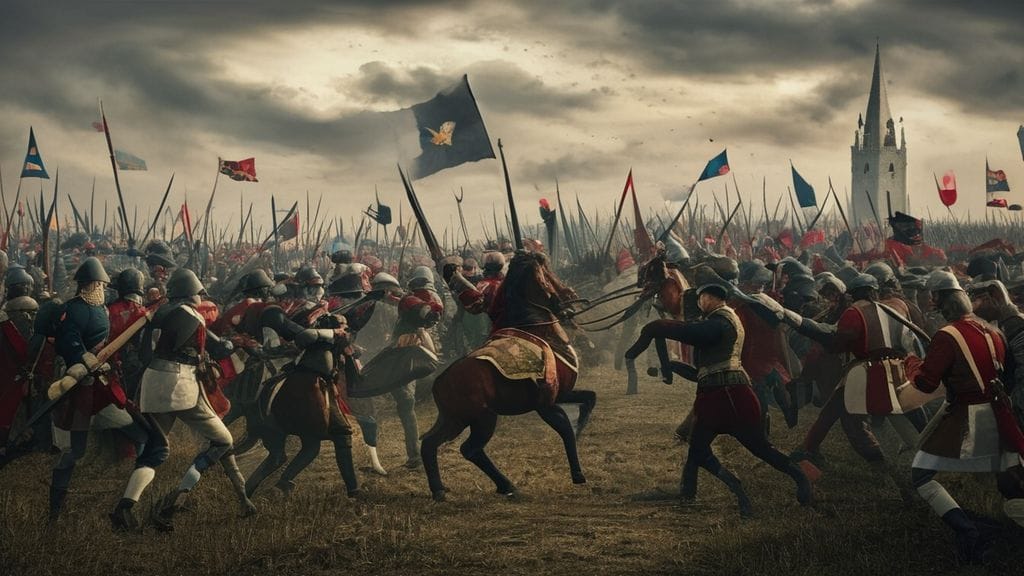
Dawn broke on 3 September 1651 with a pale, uncertain light filtering through clouds. Mist clung to the rivers and low-lying fields, softening outlines and making it difficult, at first, to see the full extent of the forces in motion. Then, gradually, as the sun climbed, the scale of the Commonwealth army around Worcester became clear. Drums rattled, trumpets sounded, and units formed up in ordered ranks. The battle of Worcester was about to begin.
Cromwell’s plan, as later summarized by historians such as S.R. Gardiner, was as intricate as it was aggressive. He intended to divide his forces to strike simultaneously at multiple points. Two main thrusts were aimed at crossings over the River Teme to the southwest of the city, near Powick and Upton. If these could be taken, the Royalists would lose crucial bridges and be threatened from their rear. Meanwhile, other Commonwealth contingents would pressure the city’s eastern defenses, pinning Royalist troops and preventing them from reinforcing threatened sectors.
In the early hours, Commonwealth troops moved toward the Teme. Bridges and fords became the focus of desperate struggle. Royalist outposts, alerted by scouts and the distant rumble of marching men, hastily prepared to defend their positions. Muskets cracked; artillery boomed. Thick smoke began to veil the riverbanks as musket volleys were exchanged at close range. In some places, round shot skipped across the water with lethal effect, cutting down men as they splashed through shallow crossings.
Within Worcester, the noise of battle grew steadily louder, reverberating off walls and steeples. Charles II, observing from vantage points and moving between positions, saw the grim arithmetic of the day unfolding. Each report from the Teme and from the southern approaches carried tidings of intense pressure, of Commonwealth troops forcing their way across or threatening to do so. Orders were sent to reinforce exposed points, but every such move weakened another sector of the defense.
As the morning wore on, it became clear that Cromwell’s numerical and logistical advantages were telling. With more men at his disposal, he could afford to commit reserves to critical points and still maintain pressure elsewhere. Royalist units, once forced back from riverlines or earthworks, struggled to regroup under fire. The Royalist cavalry, potentially a powerful arm, found itself constrained by terrain and by the need to react rapidly to multiple threats.
Yet for all the overarching inevitability that historians can now trace in the pattern of the battle, in the moment the outcome felt anything but certain to those in the thick of it. Local Royalist successes occurred—counterattacks that briefly regained ground, charges that sent Commonwealth troops reeling. One trooper, recalling the day years later, spoke of “a confusion of smoke and shouting, where a man could scarce tell friend from foe until steel met steel.” It was in such swirling confusion that individual acts of bravery, folly, and sheer luck played out, even as the larger tide steadily turned against the king’s forces.
By midday, the situation for Charles II grew increasingly precarious. Bridges over the Teme were contested or slipping from his grasp; Commonwealth units were drawing ever closer to the city’s southern and western outskirts. And fierce fighting at the crossings of the Severn itself still waited to determine whether the Royalists could maneuver freely between the city and the western bank or would find themselves divided and overwhelmed.
Storming the Bridges: The Ferocious Struggle for the Severn and Teme
If one wishes to understand why the battle of Worcester proved so decisively ruinous to Charles II’s cause, one must look closely at the struggle for its rivers. The Severn and the Teme were more than picturesque borders; they were arteries of movement and lines of defense. Control of their crossings—bridges, fords, and causeways—would determine whether the Royalists could reposition their forces, retreat if necessary, or bring timely reinforcements to threatened points.
To the southwest of Worcester, near Powick and along the Teme, fighting reached a savage intensity. Commonwealth troops, some wading through water up to their waists, pushed repeatedly against stout Royalist defenses. Musketeers on the banks fired into close-packed ranks; pike formations attempted to hold firm against assaults across narrow bridgeways. In places, hand-to-hand combat erupted directly on the bridges, men grappling, slipping, and falling into the churning water below, weighed down by armor and gear.
Cromwell, present on this front, saw that a breakthrough here could unravel the entire Royalist position. He threw in reinforcements, directing artillery to batter defensive positions, urging on infantry assaults. The Commonwealth’s superior numbers and coordination began to tell. Slowly, stubbornly, Royalist lines bent under the strain. Several key positions along the Teme were seized or rendered untenable for the defenders.
Meanwhile, attention turned to the Severn and the vital crossing at the city’s western side. A bridge of boats had been constructed to connect Worcester with positions on the opposite bank. Its capture or destruction could cut the Royalist army in two. Commonwealth forces pressed hard against outworks guarding these approaches. Cannon fire shook timbers; splinters and shrapnel flew. Royalist commanders faced agonizing choices: whether to commit scarce reserves to hold these points or pull back to concentrate manpower within the main defensive perimeter.
Within the city, the truth of the situation began to dawn on many. The sounds of battle came not only from one direction but from several, closer with each passing hour. Refugees from outlying farms and hamlets streamed toward the center, bringing chaotic news—“the bridges are taken,” “the enemy is upon us,” “the king is safe,” “the king is lost”—each report contradicting the last. Fear and rumor mixed in dangerous proportions.
For Charles II, the loss or endangerment of the crossings represented more than a tactical setback; it was the erosion of his options. If the bridges fell firmly under Commonwealth control, retreat to the west would become nearly impossible. The Army of Scotland, already fighting at a numerical disadvantage, risked being compressed against the city’s walls. As one later historian observed, Cromwell was “closing a steel trap,” its jaws formed by rivers and regiments alike.
The final phases of the struggle for the bridges saw scenes of extraordinary courage and desperation. Royalist officers led charges to retake positions, rallying men who knew they might not live another hour. Some succeeded, briefly, in pushing back advancing foes. Yet each such local reprieve came at a greater cost in casualties, drawing precious blood from an already outnumbered force. By early afternoon, the pattern was clear: Commonwealth control over key crossings was increasing, and with it, the ability to launch coordinated assaults directly into Worcester itself.
Collapse Within the Walls: Rout, Panic, and Street-to-Street Fighting
As the afternoon of 3 September wore on, the tide of the battle of Worcester shifted decisively from the fields and riverbanks to the city’s very streets. With Commonwealth forces breaching or outflanking outer defenses, Royalist units began falling back toward the walls and gates. What had begun as a fight for strategic positions now threatened to become a desperate struggle for survival in cramped urban spaces.
The first signs of collapse were fragmented. Units that had been ordered to hold specific points under intense pressure began to break. Some soldiers, seeing their officers killed or surrounded, fled toward the city in small groups, often without clear commands. Others, ordered to retire in good order, found themselves swept up in waves of retreating men from neighboring positions. The distinctions between tactical withdrawal and rout blurred amid smoke and confusion.
At the gates, officers and loyal soldiers attempted to impose some semblance of order, shouting for men to form ranks, to rally around colors. In some cases, they succeeded briefly, creating ad hoc defensive lines that slowed the advancing Commonwealth troops. Musketeers fired from behind makeshift barricades; cavalry tried to charge through narrow openings, sabers flashing. But the weight of Cromwell’s larger, more coordinated force bore down relentlessly.
Once Commonwealth contingents began to push into Worcester itself, the character of the fighting changed. Streets that had, only a day before, hosted market stalls and daily commerce now became killing grounds. Musket fire echoed between stone and timbered houses. Doors were barricaded; windows became firing slits. Civilians crouched in cellars or behind shuttered doors, listening in terror as boots thundered past and steel clashed just outside.
Charles II, moving rapidly from point to point, tried to stabilize the situation. He is reported to have personally encouraged defenders and even to have been briefly involved near the front lines of some counterattacks. Such moments of royal exposure to danger carried both symbolic power and personal risk. But courage, even kingly courage, could not reverse the harsh mathematics of the day. Too many enemy troops were surging in; too many of his own soldiers were dead, wounded, scattered, or demoralized.
In some quarters, Royalist defenders fought with a ferocity born of despair. House by house, street by street, they contested the Commonwealth advance. Commonwealth soldiers, for their part, were driven not only by discipline and command but by the conviction, stoked by years of preaching and propaganda, that this was the final blow against a pernicious cause. Amid this lethal intensity, atrocities and acts of mercy both occurred. Prisoners were sometimes spared; in other instances, men were cut down as they tried to surrender, lost in the chaos and fury of close-quarter combat.
As more gateways fell and Commonwealth banners appeared in central squares, the truth became undeniable: Worcester was lost. The king’s forces were no longer an organized army; they were fragments, pockets of resistance, and frightened men seeking escape routes. Smoke rose from damaged buildings; the sounds of organized battle gave way to a more scattered cacophony of shouts, pleas, and isolated shots. The moment had come when Charles II had to choose between martyrdom on the field and flight into uncertain exile once more.
The King’s Escape: Hiding in Oaks and Houses of Friends
Defeat on the field did not mean immediate capture for Charles II, and the story of his escape from Worcester would, in time, become one of the most famous episodes in British royal folklore. As the Royalist position collapsed in the city, a small circle of loyal companions urged the king to save himself. To die in a last stand might seem heroic, they argued, but it would also extinguish the Stuart claim and leave their cause leaderless. To live, even in defeat, was to preserve the possibility of future restoration.
Reluctantly, Charles agreed. Slipping away from the worst of the fighting, likely through lesser-known exits or in the confusion of retreat, he rode out of Worcester with a modest escort. The countryside beyond the city’s battered walls offered little comfort: it was now swarming with victorious Commonwealth troops and patrols intent on hunting down fleeing Royalists. A king on the run was a prize beyond measure.
What followed in the days after the battle of Worcester was a remarkable odyssey of concealment and quick thinking. Charles shed or disguised the signs of his rank, adopting the attire and mannerisms of a commoner. Trusted Royalist sympathizers—gentry families, innkeepers, and servants—risked their lives to shelter him. Any one of them, had they betrayed him to the authorities, might have earned a substantial reward and the favor of the new regime. Instead, they chose loyalty to a fugitive monarch over safety under a triumphant government.
The most famous episode of this escape is, of course, the tale of the royal fugitive hiding in an oak tree. Near Boscobel House, on the Shropshire–Staffordshire border, Charles is said to have climbed into the branches of a great oak with one of his companions, while Commonwealth soldiers scoured the area below. From his leafy refuge, he could supposedly see troopers passing beneath, unaware that their quarry was directly above them. Whether every detail of this story happened precisely as later recounted—or whether it was polished in the retelling—the image of the “Royal Oak” took deep root in popular memory.
Other episodes of the escape were less picturesque but no less fraught. Charles traveled in disguise as a servant, at one point posing as a woodman, at another as a humble attendant to a woman traveling alone. He learned the rough accents and gestures of ordinary folk, practicing until he could pass a casual inspection. Several times, he narrowly avoided detection at inns and on the road, as soldiers questioned travelers and searched lodgings. He later recalled one unnerving moment when a Parliamentarian sympathizer peered closely at him and commented that the servant looked “very like the king”—a remark that might have cost him his liberty or life if taken seriously.
After weeks of such near-misses and tense interludes, Charles eventually made his way to the southern coast. There, with the help of well-placed Royalist agents and sympathetic seafarers, he secured passage across the Channel. The young king who had entered Worcester in hope now left England as a fugitive once more, bound for another stretch of uncertain exile on the Continent.
In later years, Charles II himself would recount his adventures after Worcester with a mixture of humor and nostalgia. The stories of the Royal Oak and of his disguises became part of the Restoration monarchy’s mythology, symbols of a king who had shared in danger and hardship with his subjects. Yet behind the romantic gloss lay the stark reality: the battle of Worcester had destroyed his immediate hopes of reclaiming the throne by force. From now on, his path back to power would depend less on battlefields and more on diplomacy, patience, and the shifting tides of English politics.
Prisoners, Plunder, and Purges: The Human Cost of Cromwell’s Victory
For those who did not escape the collapse at Worcester, the aftermath was grim. The battle of Worcester produced not only dead and wounded on both sides but thousands of prisoners—mostly Royalists—who now fell into Commonwealth hands. Cromwell’s victory was decisive enough that there was no realistic possibility of negotiating favorable terms for the captured; mercy or severity would be determined largely by the new regime’s political calculus and religious conscience.
Contemporary estimates suggest that several thousand Royalist soldiers were taken prisoner. Some were English gentry and officers whose names were already noted by government authorities; others were Scottish rank-and-file, far from home and entirely at the mercy of their captors. While Cromwell issued orders that certain categories of prisoners be spared wholesale executions—if only to avoid international scandal and domestic backlash—this did not mean leniency in practice.
Many Scottish prisoners were marched south in harsh conditions. Exhausted, poorly fed, and often wounded or sick, they were driven along English roads toward makeshift holding sites. Disease ravaged their ranks; dysentery and fever found easy prey among tightly packed, weakened bodies. Some did not survive even the journey to imprisonment.
Those who did survive faced a bleak array of fates. Some were eventually released after swearing not to take up arms again, their return to Scotland or dispersal in England shadowed by poverty and stigma. Others were sentenced to forced labor, both within England and in far-off colonies. A number of Scottish prisoners from Worcester were transported to New England, Virginia, and the West Indies, sold into indentured servitude. There, amid alien landscapes and alongside African slaves and other bound laborers, they lived out years of hard toil—grinding sugarcane, working ironworks, or clearing land.
Within Worcester itself, the immediate aftermath of battle brought plunder and fear. Commonwealth soldiers, though under orders to maintain discipline, could not always resist the temptations of goods abandoned in hurry or poorly guarded homes. Some citizens suffered looting and rough treatment; others managed, through quick submission or existing reputations, to secure protection. The city’s infrastructure, though damaged, was not annihilated in the way some continental towns had been in the Thirty Years’ War. Yet the psychological scars—of occupation, defeat, and uncertainty—ran deep.
Politically, the Commonwealth moved quickly to secure its triumph. Known Royalists in the region were arrested or closely monitored. Confiscations of property continued, especially against those deemed implacable enemies of the regime. Ministers suspected of Stuart sympathies were removed from pulpits; local governance was reshaped to ensure loyalty to London. While there were no mass executions comparable to those seen in some earlier phases of the wars, targeted reprisals sent a clear message: resistance to the Commonwealth would be punished, and the Stuart cause had been decisively broken.
For families of Royalist soldiers—wives, children, parents—the weeks after Worcester were a time of anxious waiting and grief. News traveled slowly; rumors of deaths, imprisonments, and transports to the colonies spread by word of mouth and in occasional printed broadsheets. Some waited in vain for loved ones who would never return. Others endured the cruel mixture of relief and sorrow that came with learning a husband or son was alive, but captive and half a world away.
In victory, Cromwell referred to Worcester, echoing his own language at Dunbar, as another “crowning mercy”—a decisive intervention by providence on behalf of the godly cause. From the perspective of those who suffered in its wake, however, the mercy was hard to perceive. They saw instead the heavy hand of a victorious state, determined to stamp out the last embers of Royalist military resistance and remake the British Isles in a new—if still uncertain—political image.
From Worcester to Restoration: How Defeat Shaped a Future King
Defeats can teach more than victories, and for Charles II, the lessons of Worcester would shape his entire approach to kingship once he finally mounted the throne in 1660. The failed campaign of 1651 showed him both the limits of armed insurrection and the complexities of religious and political loyalties in his kingdoms.
Exiled again after the battle of Worcester, Charles spent the next nine years moving among European courts. He observed, at close quarters, the autocratic splendor of Louis XIV’s France, the fractious republicanism of the Dutch, and the delicate balancing acts of smaller principalities. He continued to court foreign aid, to keep up contacts with English and Scottish Royalists, and to watch for signs that the Commonwealth might fracture from within.
Those signs eventually appeared. After Cromwell’s death in 1658, the regime he had held together with personal authority and military prestige began to unravel. The Protectorate faltered; experiments with parliaments and constitutions failed to create lasting stability. Discontent flared not only among Royalist exiles but within the army and civilian population. By 1659–1660, General George Monck’s intervention, marching his troops from Scotland to London, opened the door to a negotiated restoration of the monarchy.
When Charles II finally returned to England in 1660, he did so not at the head of a conquering army but under terms hammered out with Parliament and key political actors. This mode of return contrasted starkly with the dream that had animated the march to Worcester nine years earlier. No longer would he rely on Scottish Covenanter armies and risky invasions; instead, he would present himself as a monarch ready to reconcile, to forgive, and to rule in partnership with existing institutions.
The Declaration of Breda, issued before his return, reflected this new tone. Charles promised a general pardon for most of those who had opposed his father and himself, subject to parliamentary exceptions; he pledged respect for property rights, even where confiscations had occurred; he offered a measure of religious leniency, though not full toleration. In all these promises, one can sense the imprint of his earlier failure: he knew how many ordinary Englishmen had suffered through cycles of war, confiscation, and reprisal, and he understood that a newly restored monarchy that immediately revived old persecutions would risk plunging the nation back into chaos.
Even his personal demeanor bore traces of Worcester’s influence. Unlike his father, who had often seemed stiff and intransigent, Charles II cultivated an image of affability and flexibility. He laughed at his own misfortunes; he told stories of his escapes with a self-deprecating charm. While such traits were natural to his character, they were also politically useful. A king who had once hidden in trees and farmhouses, one who had depended on humble subjects for his very survival, found it easier to play the role of a monarch close to his people, at least in manner.
Of course, the Restoration was not a simple triumph of moderation. Some regicides were executed; the religious settlement remained contested and often harsh toward nonconformists. Yet compared with what might have been—a bloodbath of retribution and a furious attempt to roll back every change since 1642—the restored monarchy was marked by a degree of pragmatism. In that pragmatism, in that willingness to accommodate new political realities, the shadow of Worcester can be discerned.
Remaking Britain: Political and Religious Consequences of 1651
The immediate military outcome of the battle of Worcester was clear: the last significant Royalist field army had been destroyed, and the English Commonwealth stood unchallenged on the battlefield. But the political and religious consequences of that victory radiated far beyond the city’s walls and far beyond 1651.
Politically, Worcester secured the Commonwealth’s hold over England, but it also accelerated the integration—some would say subjugation—of Scotland. With the Scottish army shattered and Charles II in flight, the English government could impose terms on Scotland with little fear of organized resistance. English garrisons occupied key Scottish towns and fortresses; Scottish institutions found themselves constrained by a regime centered in London. While older Scottish laws and customs were not entirely swept away, the balance of power shifted dramatically southward.
In Ireland, where Cromwell had already waged a brutal campaign before turning north, Worcester’s outcome confirmed that there would be no effective external intervention on behalf of Irish Royalists or Confederate Catholics. The Commonwealth’s land settlements and penal measures could proceed with reduced fear of a Stuart-backed counteroffensive. The three kingdoms that Charles I had once ruled now found themselves under a single republican government—at least in theory—enforced by the strongest standing army Britain had ever seen.
Religiously, the victory at Worcester seemed, to many in the godly camp, a divine endorsement of their cause. Sermons across England interpreted the battle as a sign that God favored the Commonwealth’s attempt to purify church and state. Radical sects, such as Baptists, Fifth Monarchists, and Independents, saw the collapsing of Royalist power as an opening for further reform. They pressed for wider toleration for their own congregations, even as they often showed little sympathy for those—especially Catholics and high Anglicans—whom they saw as enemies of true religion.
Yet the religious landscape remained fractured and volatile. While the old episcopal Church of England had been dismantled in its traditional form, no single alternative settlement commanded universal acceptance. Presbyterians, many of whom had initially allied with Parliament against Charles I, now found themselves uneasy under a regime that favored Independents and sectarians. The Scottish Covenanters’ dream of a pan-British Presbyterian monarchy lay in ruins after Worcester, replaced by a more pluralistic, if unstable, English-centered Protestant republic.
Socially and economically, the end of large-scale warfare offered both relief and ongoing burdens. The cessation of major battles meant fewer new widows and orphans, fewer towns bombarded into rubble. Trade routes gradually recovered; some industries, particularly those supplying military needs, continued to thrive. But war debts loomed, and taxation remained heavy, particularly on those perceived as politically suspect. Former Royalist regions faced not only economic recovery but the long work of social healing, as neighbors who had chosen different sides learned to live alongside each other again.
In the longer run, Worcester’s legacy fed into debates about sovereignty, representation, and the rights of subjects. The very fact that a monarchy had been overthrown, a king executed, and then a republic established—however short-lived that republic proved—left a permanent mark on English political thought. Later generations, including those of the Glorious Revolution in 1688, would look back on the 1640s and 1650s as a cautionary and instructive era. Worcester, as the last pitched contest of that revolutionary period, served as a kind of full stop at the end of a turbulent sentence.
Memory and Myth: How Worcester Became “The Crowning Mercy”
In the decades and centuries after 1651, the battle of Worcester lived on not only in official histories but in sermons, pamphlets, ballads, and family stories. Its meanings shifted with political winds, reflecting the perspectives of those who remembered, recorded, and reinterpreted it.
For Cromwell and his supporters, Worcester was swiftly enshrined as “a crowning mercy”—a phrase that appears in his correspondence and speeches. Just as Dunbar had been hailed as a dramatic proof of divine favor, Worcester was framed as the final, conclusive sign that God had blessed the Commonwealth’s arms. Preachers wove the victory into providential narratives, likening it to Old Testament battles where the righteous triumphed over kings who “did evil in the sight of the Lord.” One sermon of the time declared that Worcester had “cut off the last head of the hydra of malignancy,” a vivid image for the supposedly many-headed Royalist threat.
Royalists, unsurprisingly, told a very different story. For them, Worcester was a tragedy and a test. The figure of Charles II, escaping through hedge and hamlet, became a symbol of unjustly defeated monarchy, sustained by the loyalty of common subjects even in the darkest hour. After the Restoration, royal propagandists eagerly cultivated tales of the king’s adventures. The image of the “Royal Oak” featured in toasts, inn signs, and popular prints. Royalist memoirists, such as Edward Hyde, Earl of Clarendon, incorporated Worcester into sweeping narratives that portrayed the Stuart line as primarily victimized by radical rebels and misguided reformers.
Over time, the political valences of these memories blurred. The romance of Charles’s escape appealed even to some who had little sympathy for his dynastic claims. The notion of a king in disguise, relying on the courage of humble subjects, resonated as a folktale of shared humanity across class lines. Conversely, the Commonwealth’s framing of Worcester as a godly victory fed into later Whig narratives of progress—of arbitrary monarchy curbed and parliamentary government ultimately strengthened, despite the Restoration’s reappearance of kings.
Local memory in Worcester itself developed in distinctive ways. The city’s inhabitants preserved anecdotes of where fighting had been fiercest, which houses had sheltered fugitives, and how their ancestors had coped with occupation and battle. Some families maintained quiet pride in having hidden Royalist officers or even the king; others recalled the tenuous safety that came with early protestations of loyalty to the Commonwealth. Streets and sites associated with the battle acquired layers of meaning that only residents fully grasped.
Historians, from seventeenth-century chroniclers to modern scholars, debated Worcester’s precise military significance. Some, like Clarendon, emphasized the courage and misfortune of the Royalist side; others, including later academic writers, highlighted Cromwell’s superior planning and logistics. The battle has been described as both an inevitable outcome of earlier strategic choices and as a contest whose details still deserve close study. As one modern historian observed, “In Worcester’s fields, the English Revolution won its last battle; in its memory, later generations fought over its meaning.”
It’s astonishing, isn’t it, how one day of fighting can carry such different meanings to different observers? For some, Worcester stands as the Commonwealth’s decisive stamp of authority; for others, it is the crucible from which a more cautious, worldly-wise Stuart monarchy eventually emerged. Both readings, in their own ways, are true.
Worcester Today: Landscapes of Remembrance and Silence
Walk through Worcester today, and it can be hard, at first glance, to imagine the roar of cannon and the cries of charging soldiers. Traffic hums over bridges that, in 1651, were contested with blood. The cathedral rises serenely above the city, its stones weathered by time rather than marked by fresh shot. Yet if one knows where to look—and how to listen—the landscape still whispers of that September day.
On the fields to the south and west, where Commonwealth troops crossed the Teme and pushed toward the city, modern developments sit atop what were once killing grounds. Farmhouses have been rebuilt; hedgerows replanted. Yet archaeologists and local historians can trace alignments, subtle rises in the ground, and archival descriptions that point to where lines were drawn and broken. Commemorative plaques and markers, though modest, invite passersby to pause and consider what happened there.
Within the city, certain streets and buildings retain associations with the battle and its aftermath. Inns that claim—with varying degrees of evidence—to have hosted officers or sheltered fugitives trade on that history. Parish churches hold memorials to those who fought and died, some inscribed in the sober language of Royalist piety, others added later by descendants proud of an ancestor’s role on one side or the other. The cathedral itself, custodian of so much Worcestershire memory, has hosted services of remembrance that subtly shift tone depending on the era.
The story of the battle of Worcester also lives on in education and tourism. Schoolchildren learn of it as the final clash of the English Civil Wars, often in simplified terms: Cromwell vs. Charles, Parliament vs. King. Guided tours and reenactments, when they occur, dramatize key moments—the storming of bridges, the king’s flight, the triumphant entry of Commonwealth forces. Such presentations inevitably condense and interpret, but they also keep alive a connection between present residents and the city’s seventeenth-century ordeal.
Modern sensibilities tend to emphasize the human cost of conflict over its glory. In this, contemporary commemorations of Worcester differ from the triumphalist sermons of Cromwell’s day or the nostalgic tales of Restoration courtiers. Plaques and local histories now more often honor “all who fell” or highlight the suffering of prisoners and civilians. This broader, more empathetic memory reflects changes in how we understand war itself—not just as a contest of leaders and causes, but as a disruptive force in ordinary lives.
And yet, silence remains part of the landscape too. Many who walk past markers or memorials do so without stopping, absorbed in daily concerns. For them, the battle of Worcester is remote, a name in a textbook or not even that. This forgetting is not necessarily a failure; societies cannot carry all of their past equally in mind. But for those who choose to look closer, Worcester offers a rich case study in how a single event can echo through time—reshaping politics, inspiring stories, and leaving traces in stone, soil, and collective imagination.
Conclusion
The battle of Worcester, fought on 3 September 1651, was more than a clash of armies; it was the culminating act of a revolutionary drama that had convulsed England, Scotland, and Ireland for nearly a decade. On that day, the hopes of a young king riding south from Scotland collided with the iron discipline and religious zeal of the Commonwealth’s forces under Oliver Cromwell. The rivers Severn and Teme, the bridges and fields around Worcester, became the stage on which the future of monarchy, parliament, and religious settlement would be violently contested.
In purely military terms, Worcester settled the question of armed resistance to the Commonwealth. Charles II’s army was shattered; thousands of his soldiers were killed, captured, or driven into exile and servitude. The Scottish gamble to restore the Stuarts by force ended in disaster, leaving Scotland open to English occupation and bringing all three kingdoms firmly under republican control. Cromwell’s “crowning mercy” at Worcester enabled the Commonwealth to turn from immediate survival to the more complex task of building a new political order.
Yet the battle’s deeper legacy lies in the ways it reshaped both rulers and ruled. For Charles II, Worcester was a crucible of defeat and humiliation that tempered his approach to power. The king who eventually returned in 1660 was no naive claimant; he understood the limits of armed force and the need to work with, rather than simply dominate, Parliament and public opinion. For ordinary people, the end of large-scale civil war brought relief but also left long shadows—lost relatives, disrupted communities, and a lingering wariness of political extremism from any quarter.
Politically and intellectually, Worcester marked the endpoint of one revolutionary experiment and laid foundations for later debates. The memory of a toppled and then restored monarchy, of regicide and republic, informed later constitutional struggles. The battle’s dual status—as both a decisive victory for a short-lived Commonwealth and a prelude to the Restoration—makes it an especially poignant symbol of how history rarely moves in straight lines.
Standing today in Worcester, it takes an act of imagination to hear once more the drumbeat and gunfire of 1651. But by tracing the story—from the kingdom in ruins that preceded it, through the march south, the furious combat, and the king’s narrow escape, to the long-term consequences and evolving memory—we can see how this single day refracted the hopes and fears of an entire generation. Worcester was, in many ways, the end of the English Civil Wars. Yet behind the celebrations of victory and the laments of defeat, it was also the beginning of a new, uncertain chapter in the history of the British Isles, whose questions about authority, liberty, and faith would echo for centuries to come.
FAQs
- What was the Battle of Worcester and when did it take place?
The Battle of Worcester was the final major engagement of the English Civil Wars, fought on 3 September 1651. It pitted the forces of Charles II, supported mainly by a Scottish army, against the much larger and better supplied army of the English Commonwealth led by Oliver Cromwell. The battle ended in a decisive Parliamentarian victory that effectively destroyed Charles II’s immediate hopes of regaining the throne by force. - Why was the Battle of Worcester so important?
Worcester was crucial because it ended serious Royalist military resistance across the three kingdoms. After this defeat, Charles II fled into exile, and no comparable Royalist field army challenged the Commonwealth again. The victory secured Cromwell’s regime in the short term and allowed the Commonwealth to consolidate control over England, Scotland, and Ireland, shaping the political landscape for the rest of the 1650s. - How large were the armies at Worcester?
Exact numbers vary in the sources, but Charles II’s forces probably numbered between 12,000 and 16,000 men, many of them Scottish. Cromwell’s army, bolstered by English militia and veterans of earlier campaigns, likely fielded between 28,000 and 31,000 soldiers. This numerical superiority, combined with better logistics and coordination, gave the Commonwealth a significant advantage. - What happened to Charles II after the battle?
After his defeat at Worcester, Charles II escaped from the city with a small group of loyal followers. He spent several weeks hiding in safe houses and disguises across the English countryside, including the famous episode in which he concealed himself in an oak tree near Boscobel House to avoid capture. Eventually, he reached the south coast and escaped by ship to the Continent, where he lived in exile until the Restoration of 1660. - What became of the captured Royalist soldiers?
Thousands of Royalist soldiers, particularly Scots, were captured at Worcester. Many were marched south in harsh conditions and held in improvised prisons. Some were released after swearing not to fight again, but many others were transported as indentured servants to colonies in New England, Virginia, and the West Indies, where they endured years of forced labor. Disease and hardship killed a substantial number before they could ever return home. - How did the Battle of Worcester affect Scotland and Ireland?
With the Scottish army crushed at Worcester, Scotland was left vulnerable to English occupation and tighter political control from London. Scottish institutions, especially the Kirk and Parliament, operated under severe constraints. In Ireland, Worcester confirmed that no effective Stuart or foreign intervention was forthcoming, allowing the Commonwealth to press on with land confiscations and settlements that deeply altered Irish society and land ownership patterns. - Did the Battle of Worcester directly lead to the Restoration in 1660?
Not directly, but it was a key part of the story. Worcester destroyed Charles II’s ability to return by armed force, forcing him to rely on diplomacy and patience in exile. The eventual Restoration came not from a Royalist military victory but from internal weaknesses in the Commonwealth and Protectorate, combined with shrewd negotiations. The memory of the civil wars and of battles like Worcester made many in 1660 prefer a negotiated return of the monarchy under certain conditions rather than continued instability. - Why did Cromwell call Worcester a “crowning mercy”?
Cromwell believed that God intervened in human affairs and judged causes through the outcomes of battles. He described earlier victories, like Dunbar, as “mercies” from God. Worcester, which decisively ended the last major Royalist threat, seemed to him the culminating, or “crowning,” mercy—a final confirmation that God favored the Commonwealth’s cause over that of the Stuarts. - Can you visit Battle of Worcester sites today?
Yes. While modern development has changed the landscape, visitors can still explore areas associated with the battle, including fields near the Rivers Severn and Teme and sites within the city itself. Worcester Cathedral and various local markers and plaques commemorate aspects of the events of 1651. Guided tours and local history resources help interpret what would otherwise be an ordinary cityscape as the setting for a pivotal historical moment. - How do historians view the Battle of Worcester now?
Modern historians generally see the Battle of Worcester as a decisive but not unexpected outcome of the strategic situation in 1651. They emphasize Cromwell’s careful planning, the logistical strength of the Commonwealth, and the weaknesses inherent in Charles II’s reliance on a largely Scottish army in England. At the same time, scholars are attentive to the human cost of the battle and its aftermath, as well as to how its memory has been shaped and reshaped over time.
External Resource
Internal Link
Other Resources
- Encyclopaedia Britannica – general search for the exact subject
- Google Scholar – academic search for the exact subject
- Internet Archive – digital library search for the exact subject

