Table of Contents
- A Winter on Lesbos: The Last Days of an Empress
- From Athens to the Purple: Irene’s Astonishing Rise
- An Empire in Turmoil: Byzantium Before the Exile
- The First Reign: Regent, Mother, and Power Broker
- The Eye of God: Iconoclasm, Faith, and Irene’s Council of Nicaea
- Mother Against Son: The Tragedy of Constantine VI
- A Woman Alone on the Throne: Empress and Autocrat
- Courts, Conspiracies, and Coins: The Politics of Irene’s Rule
- Charlemagne, Rome, and the Question of a Roman Emperor
- The Fall in Constantinople: Coup, Deposition, and Exile
- A Rock in the Aegean: Lesbos as Prison and Final Stage
- The Death of Empress Irene on Lesbos: December 803
- Echoes Across the Empire: Political and Social Consequences
- Saint, Usurper, or Tragic Visionary? Later Judgments of Irene
- Gender, Power, and the Memory of a Byzantine Empress
- From Chronicle to Legend: How Historians Reconstruct Irene’s End
- Conclusion
- FAQs
- External Resource
- Internal Link
Article Summary: This article follows the life and death of Empress Irene of Byzantium, culminating in the lonely death of empress irene on the island of Lesbos in 803. It traces her path from an obscure Athenian noblewoman to ruler of the Eastern Roman Empire, the first woman to reign in her own right in Constantinople. It explores her decisive role in ending iconoclasm, her fraught relationship with her son Constantine VI, and the brutal coup that ultimately led to his blinding and her sole rule. The narrative then turns to the palace intrigues, foreign pressures, and shifting loyalties that shaped her downfall and exile. Against the bleak backdrop of Lesbos, we examine how the final months and the death of empress irene reshaped perceptions of imperial legitimacy, female rule, and sanctity. Throughout, the article interweaves political analysis with human drama, showing how Irene’s private tragedies mirrored the struggles of the empire she ruled. By the end, readers will see how the death of empress irene became not just an endpoint, but a powerful symbol in Byzantine memory and later historical imagination.
A Winter on Lesbos: The Last Days of an Empress
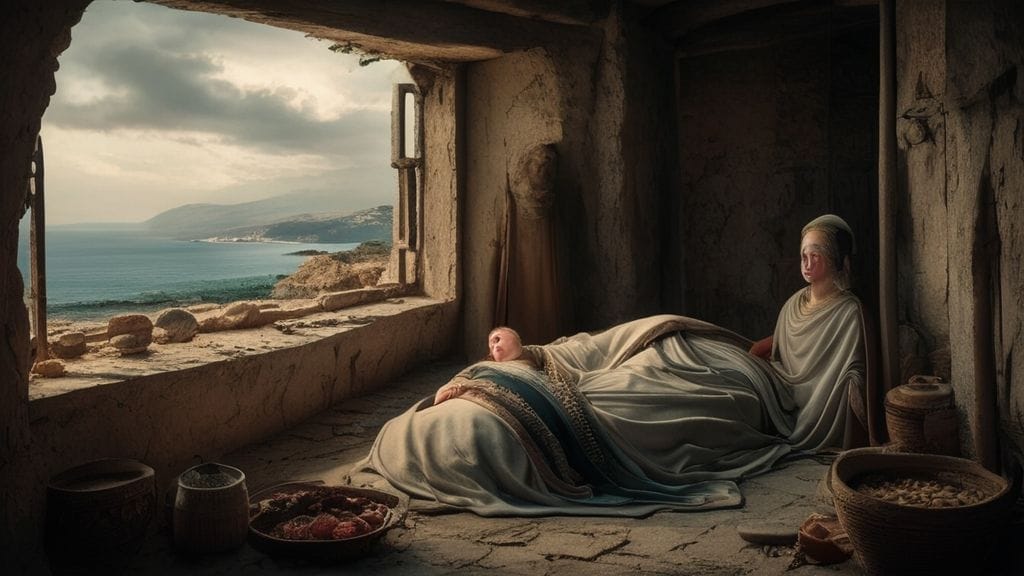
On a cold December day in the year 803, the waves around the island of Lesbos rolled in grey and indifferent, as they had for centuries. The Aegean wind knifed through the narrow streets near the harbor, rattling shutters and lifting the edge of woolen cloaks. In a modest residence overlooking the sea—not a palace, not even a proper villa by Constantinopolitan standards—a woman who had once ruled an empire lay weakened, her life narrowing to a few labored breaths. This was the death of Empress Irene, once mistress of Constantinople, restorer of holy images, and autocrat of the Romans. Here, on a rugged island far from the gilded halls of the Great Palace, the career of one of Byzantium’s most remarkable and controversial figures came to its unceremonious close.
The death of empress irene on Lesbos could easily have gone unnoticed, swallowed by the tides of imperial politics and the daily struggles of islanders concerned more with fishing and trade than the fall of dynasties. There were no triumphal processions, no elaborate funeral in the Hippodrome, no rows of senators dressed in ceremonial robes. Instead, there was perhaps a small group of attendants, a handful of loyalists, and the murmured prayers of clergy who still saw her as the champion who had restored the icons to their rightful place. If there were tears, they were the tears of those who had lived just long enough to remember her days of glory and now watched as history turned its back on her.
But this was only the beginning of the story we must tell. To understand the weight of that final breath on Lesbos, the quiet death of empress irene in exile, we must journey back through the decades—to Athens in the mid-eighth century, to the ceremonial splendor of imperial coronations, to council halls where bishops argued theology under flickering lamplight, and to secret corridors where conspirators whispered in the dark. Irene’s end was shaped by every decision she had made: the alliances she had forged, the enemies she had created, the son she had elevated and then destroyed. In that last winter on Lesbos, the ghosts of a lifetime gathered around her bedside.
It’s astonishing, isn’t it? A woman who once commanded generals, negotiated with emperors in the West, and defied patriarchs died as an exile, her authority stripped away, her name reduced to a cautionary tale or, for some, the memory of a saintly defender of the icons. Yet behind the bare outlines of her fate lies a story of ambition and courage, cruelty and piety, political acumen and personal tragedy. The death of empress irene was a private moment that carried public meaning. It symbolized not only the fall of a ruler but the fragility of power itself in the Byzantine world—a world in which a single misjudged alliance or failed military campaign could send a sovereign from the throne to the monastery, from the crown to the grave.
To follow Irene’s path to Lesbos is to pass through the full panorama of late eighth-century Byzantium. We see an empire squeezed between Arab caliphates to the east and a new imperial rival, Charlemagne, to the west. We glimpse court factions jostling for advantage among mosaic-lined corridors, and we overhear the heated invective of iconoclasts and iconophiles. And at the center of it all stands Irene—at first a young foreign bride at a strange court, then a calculating regent, then a mother torn between duty and domination, and finally an empress alone on the throne, battling not only her enemies but the very idea of what a Roman emperor could be. By the time the waves shuddered against the rocks of Lesbos in 803, the outcome of that struggle had become irrevocably clear.
From Athens to the Purple: Irene’s Astonishing Rise
Irene was not born into the purple. She first opened her eyes, sometime around 752, not in the shadow of Constantinople’s soaring walls but in Athens, then a provincial city within the Byzantine Empire. Athens still carried the echoes of its classical past—ruined temples on the Acropolis, stones polished by centuries of footsteps—but politically it was far from the empire’s center of gravity. Irene’s family appears to have been aristocratic but not of the very highest rank, and much about her early years remains veiled. Chroniclers of the time rarely paused to sketch the childhoods of women, even those destined for greatness.
Yet something about Irene, or perhaps simply the needs of imperial policy, brought her to the attention of Constantinople. In 769 she was summoned to the capital as a candidate to marry the young Leo, son of Emperor Constantine V. The selection of an imperial bride was both political choreography and spiritual theater. Women from elite families across the empire were sometimes presented at court for a kind of “bride show,” where beauty, piety, and family alliances could secure them a place beside the heir to the throne. We cannot say with certainty that Irene participated in such a spectacle, but the later tradition suggests that she did. In any case, she was chosen.
For a young Athenian woman, the move to Constantinople must have been overwhelming. The city was a marvel even then: its skyline punctuated by domes and church towers, its harbor thick with ships carrying silks, grain, spices, and slaves. The Great Palace, with its gilded halls, mosaics, and private chapels, became Irene’s new world. In 769 she married Leo, who would later rule as Leo IV. The ceremony would have been heavy with symbolism—crowns lowered on young heads, prayers intoned by the patriarch, the court watching with a mixture of curiosity and calculating interest. Irene was no longer a provincial noblewoman. She was now within the sacred circle of the imperial family.
Marriage brought Irene into a strange household. Her father-in-law, Constantine V, was a fierce iconoclast, a man whose energetic rule had strengthened the army but unleashed religious turmoil by persecuting the veneration of icons. The court was thick with officers and bureaucrats loyal to the iconoclast cause. Irene herself, as later events make clear, leaned instead toward the veneration of holy images. Whether this was already the case when she first entered the palace or whether her convictions deepened later is impossible to know. But she would have quickly learned to navigate an environment where theological dispute was also political fault line.
In 771 Irene gave birth to a son, Constantine, named after his grandfather. The infant—future Emperor Constantine VI—became the living focal point of imperial continuity. His existence increased Irene’s importance at court; she was now not only the emperor’s wife but the mother of his heir. Still, as long as Constantine V lived, and then as long as Leo IV ruled, Irene’s power was limited by both gender norms and the entrenched networks surrounding the male emperors. Her time would come sooner than anyone expected.
In 775, Constantine V died, leaving Leo IV to rule with Irene as his Augusta. But Leo’s reign was brief. Sickly and perhaps weakened by a lifelong struggle with illness—some sources hint at tuberculosis—Leo died in 780, leaving his nine-year-old son as emperor. Suddenly, with terrifying speed, Irene found herself in a position no one had planned for: she was the mother of a minor emperor in a court still seething with factions and ideologies. The question loomed immediately: who would hold the reins of power until young Constantine VI came of age?
Byzantine politics did not automatically grant women authority, but regencies for child emperors were a familiar feature of imperial life. In the vacuum left by Leo IV’s death, Irene acted swiftly. She secured the support of key officials and had herself proclaimed regent for her son. She was now, in effect, ruler of the empire, though nominally in the name of Constantine VI. This was the first great turning in her fortunes, the first step on a path that would lead, decades later, to her lonely end on Lesbos. The death of empress irene in exile would one day seem as improbable as her sudden rise had been.
An Empire in Turmoil: Byzantium Before the Exile
To appreciate the choices Irene made as regent—and later as sole ruler—we must look at the empire she inherited. The Byzantium of the late eighth century was a state accustomed to crisis and survival in equal measure. Its territories, once stretching from Spain to Syria, had been scoured away by Arab conquests, Slavic migrations, and internal fragmentation. Constantinople remained the jewel at the center, but around it, the map of imperial control had shrunk dramatically.
To the east, the Abbasid Caliphate loomed as a formidable rival, launching raids into Asia Minor and testing Byzantine frontiers. To the north, Bulgars and Slavs pushed and probed the Balkans. To the west, Italy was slipping away, with the papacy in Rome increasingly looking for military support from the rising Frankish power under Charlemagne. Internally, the empire’s themes—its military-administrative provinces—were key to its resilience, but they also provided the base from which ambitious generals could challenge the central authority.
Over these political and military pressures hung a theological storm: the long-running conflict over icons. Iconoclasm, the rejection and destruction of religious images, had been adopted as state policy under earlier emperors. Iconodules, defenders of the images, saw iconoclasm as a dangerous heresy that undermined the incarnation itself. For decades, monasteries had been harassed, icons torn down or whitewashed, and clergy persecuted. Though not every region or bishop supported iconoclasm with equal fervor, the issue divided society from palace to parish.
In this context, Irene’s Athenian background mattered. Greece, including Athens, had been less enthusiastic about iconoclasm than some of the core Anatolian regions that supplied the empire’s military elite. When Irene entered the palace, she carried with her a religious sensibility shaped in part by this provincial environment. As regent, she would discover that religion could be both a personal conviction and a potent political tool. Restoring the icons would give her a solid base of support among monks, urban laity, and segments of the clergy who longed for the old practices.
Yet behind the religious dispute were practical questions of power. Was the emperor—or empress—supreme even in matters of doctrine? How far could the state dictate the forms of worship? And what role would the military, whose ranks contained many loyal iconoclasts, play in enforcing or resisting policy? These questions were not abstractions; they were matters of life and death. The same tensions that shaped the religious landscape would one day help shape the circumstances leading to the death of empress irene, for her policies on icons and her alliances with monastic factions alienated powerful circles in the army.
When Irene assumed the regency in 780, she faced a kingdom fragile but not yet broken. The treasury, while strained, could still fund campaigns. The army was battle-hardened, if restive. The bureaucracy, that intricate web of scribes, fiscal officers, and palace administrators, continued to function. What the empire needed was a steady hand and a careful balancing of interests. Irene, still in her twenties, believed she could provide both—and, crucially, believed that her own reign was sanctioned not only by political necessity but by God’s will.
The First Reign: Regent, Mother, and Power Broker
In the first years of her regency, Irene walked a tightrope. She needed to assert real authority without provoking a backlash from generals or palace officials who might bristle at being ruled by a woman. At the same time, she had to preserve the legitimacy of her son’s future reign. Every act she took was performed formally in the name of Constantine VI, yet increasingly it was understood that the true center of decision-making lay with Irene.
One of her first major tests came in 781, when she arranged a marriage alliance with the West. Charlemagne, king of the Franks, had been amassing power, extending his control across much of Western Europe. Irene negotiated a betrothal between her son Constantine VI and Charlemagne’s daughter Rotrude. For a moment, the prospect of uniting Eastern Roman and Frankish interests seemed imaginable. In Constantinople, Rotrude was given a Greek name, Erythro, and there were plans to educate her as a Byzantine empress.
But politics are never static. Within a few years, Irene changed course, breaking off the engagement and aligning herself more closely with the iconophile faction that regarded Frankish interventions in theology with suspicion. This decision bitterly disappointed Charlemagne and would later color his own imperial ambitions. Still, in the late 780s, Irene’s position remained strong enough to weather the diplomatic fallout. Her greater concern lay closer to home: consolidating control over the army and dealing with the toxic legacy of iconoclasm.
As regent, Irene relied on a circle of trusted advisers and eunuchs—officials who, due to their castrated status, were seen as less likely to claim the throne themselves. Chief among these was Staurakios, a powerful eunuch who became the backbone of her administration. By elevating eunuchs, Irene was not merely following custom; she was crafting a web of loyalties that linked her to palace insiders who owed their positions directly to her favor. At the same time, she replaced certain iconoclast officials with sympathizers of the icons, gradually reshaping the court’s religious climate.
Yet behind the celebrations of her early successes lurked a growing tension with the army. Soldiers and officers, especially from the Anatolian themes, had long supported the iconoclast policies of previous emperors, seeing them as part of a muscular, disciplined vision of the Christian state. Irene’s moves toward reversing iconoclasm threatened not only their beliefs but their place in the imperial hierarchy. The seeds of future resentment—seeds that would later contribute to the vulnerability that made the death of empress irene in exile possible—were already being sown.
Over all these calculations hung one inescapable reality: Constantine VI was growing older. Each year that passed brought him closer to the age at which traditional expectations said he should rule in his own right. The more Irene tightened her grip on power, the more she risked alienating those who thought the emperor’s mother should eventually step aside. The regency that had been justified by the boy’s youth would not last forever. As the 780s turned into the 790s, mother and son moved inexorably toward confrontation.
The Eye of God: Iconoclasm, Faith, and Irene’s Council of Nicaea
If there is one achievement that secured Irene a place of honor in certain religious circles, it was her role in ending the first wave of Byzantine iconoclasm. By 787, after careful maneuvering, she convened a church council to address the controversy—what would become known as the Second Council of Nicaea.
The road to Nicaea was bumpy. In 786, Irene had initially called a council in Constantinople. But as bishops and monks gathered, soldiers loyal to the iconoclast cause stormed the proceedings, breaking up the assembly and forcing the participants to flee. It was a stark reminder that theology in Byzantium was never abstract; it marched in step with the army’s boots. Irene, undeterred, responded by reshuffling forces in the capital, sending suspect troops away under pretext and bringing in units more loyal to her policies from distant themes.
In 787, with the military situation more favorable, Irene reconvened the council, this time in Nicaea, far from the immediate reach of hostile regiments. Bishops from across the empire gathered under imperial protection. Over weeks of intense debate, they affirmed the veneration—not worship—of icons, distinguishing between the reverence due to images and the adoration owed only to God. The decrees of this council restored icons to churches and affirmed the theological principle that the material world could indeed serve as a window to the divine.
For Irene, this was more than doctrine; it was a brilliant political stroke. Aligning herself with the iconophile cause gave her deep support among monastic communities and urban believers. It also helped to mend relations with the papacy in Rome, which had long opposed iconoclasm. However, not everyone approved. Hardline iconoclasts saw the council as a betrayal of previous emperors’ policies. Some officers resented the way soldiers had been sidelined or punished to secure the council’s success.
Later writers, especially hagiographers and church historians, would celebrate Irene as a pious restorer of orthodoxy. The eleventh-century chronicler John Zonaras, for example, described her role at Nicaea with evident sympathy, though he could hardly overlook the darker episodes of her career. For monks in particular, the woman who had risked her throne to restore icons seemed worthy of near-saintly reverence. These same circles would remember with sorrow the death of empress irene on Lesbos, viewing her exile and demise as a tragic end for a ruler who had defended the true faith.
Yet even in this triumph lay the outline of future defeats. By championing the icons, Irene aligned herself against a segment of the military elite. Moreover, her religious policy deepened the perception that she was a “monastic” or “church” empress, more concerned with theology than with war. In a realm perpetually threatened by external enemies, such a reputation could become fatal if campaigns went badly. And some campaigns did.
Nevertheless, in 787, when the council concluded, Irene’s star was still rising. She had survived a regency’s early challenges, reshaped the religious landscape of Byzantium, and projected an image of a ruler guided by both political shrewdness and spiritual conviction. Few looking at her then could have imagined that the woman hailed as restorer of the icons would be forced, years later, to die far from the capital, the death of empress irene occurring in a small corner of the empire she once commanded.
Mother Against Son: The Tragedy of Constantine VI
As Constantine VI moved through adolescence into young manhood, the arrangement that had seemed functional in his childhood grew increasingly unstable. Irene, accustomed to rule, was not eager to surrender real authority. Constantine, who had grown up in the shadow of a powerful mother and a court that revered her, found himself chafing under her guidance.
The first open cracks appeared in the mid-790s. Pressed by factions at court who wanted a more traditionally masculine emperor, Constantine sought to assert his independence. In 790, he attempted to take full control of the government. Officers in the Anatolian themes, hostile to Irene’s circle, proclaimed him sole emperor, attempting to sideline his mother. For a brief moment, it seemed that Constantine might succeed in pushing Irene aside.
But politics are rarely linear. Within a year, Constantine faltered. He allowed his mother back into a share of power, proclaiming her co-emperor in 792. It was a desperate compromise, one that satisfied no one. To conservative aristocrats and soldiers, the sight of a female co-emperor overshadowing her own son was deeply unsettling. To Irene and her supporters, Constantine’s attempts at autonomy betrayed ingratitude and risked the empire’s stability.
Constantine’s own decisions compounded his troubles. A disastrous military campaign against the Bulgars in 792 damaged his reputation. Generals were captured, soldiers slaughtered, and the aura of imperial invincibility dimmed. Byzantine chroniclers did not spare their criticism; they compared him unfavorably with his ancestors, especially the martial emperors who had defended the empire with ruthless efficiency.
On the personal front, Constantine made a fateful choice that would tarnish his image among devout circles. He divorced his first wife, Maria of Amnia, to marry his mistress Theodote, a scandalous act in the eyes of many clergy and believers. The so-called “Moechian Controversy” (from the Greek for “adulterer”) inflamed opposition from monks, some of whom had earlier been staunch supporters of the imperial house after Nicaea II. Irene, ever alert to shifts in public sentiment, carefully positioned herself as the pious alternative to her wayward son.
The tension between mother and son escalated step by step, like a tragic play moving toward its grim climax. In 797, Irene and her allies in the palace made their move. They orchestrated a coup that seized Constantine and imprisoned him. What followed shocked even many of Irene’s supporters: the young emperor was blinded, a punishment that in Byzantine political culture effectively ruled him out as a viable ruler. The blinding was so severe that Constantine is believed to have died shortly afterward, although the exact details are murky.
This act would haunt Irene’s memory forever. It allowed her to rule as sole emperor—she now styled herself “Basileus,” not merely “Basilissa”—but at a terrible moral cost. For some contemporaries, she was a new Athaliah, the biblical queen who slew her own descendants to secure power. For others, particularly among those who revered icons, Irene’s piety and support for the Church softened the horror of the deed. As one later chronicler summarized with bitter concision, “She loved the images of Christ, but not the image of Christ in her son.”
When we think ahead to the death of empress irene on Lesbos, it is impossible not to see in it a dark echo of this earlier death, hidden in the palace’s shadows. Constantine’s fate stained Irene’s reign. Even if some details were softened or spiritualized in later hagiographic traditions, the basic pattern remained: she had seized power through an act of maternal betrayal. Over time, that act eroded the foundation of her legitimacy, making it easier for future conspirators to justify removing her in turn.
A Woman Alone on the Throne: Empress and Autocrat
In 797, with Constantine VI out of the way, Irene became the first woman to rule the Byzantine Empire in her own name. Coins were minted showing her alone, crowned and robed in imperial regalia. Official documents bore her title as “emperor,” not “empress consort.” In the ceremonial life of the capital, she presided over processions, received ambassadors, and sat at the center of the elaborate rituals that defined Roman imperial power.
This was unprecedented and unsettling. Byzantium had known powerful empresses before—Irene herself as regent, Theodora alongside Justinian in the sixth century—but never a woman ruling without either husband or son. Some saw in this a sign of divine favor, a kind of Marian reflection: just as the Mother of God held a central place in Byzantine devotion, now a mother-figure governed the earthly empire. Others regarded it as an ominous inversion of the natural and divine order.
The reaction outside Constantinople was no less complex. In Rome, the papacy, already estranged from the iconoclast emperors, watched with interest. Some Western observers began to argue that with a woman on the throne in Constantinople, the seat of the Roman Empire was effectively vacant—a reasoning that would have enormous consequences when Charlemagne, king of the Franks, received the imperial crown from Pope Leo III in 800.
Inside the empire, Irene had to prove that she could rule as effectively as any man. She sought to stabilize the economy, issuing fiscal reforms and attempting to curb certain abuses by powerful landowners. She continued to cultivate the support of monasteries and iconophile clergy, presenting herself as a protector of Christian orthodoxy. At court, she relied heavily on eunuch officials such as Aetios, whose rise stirred jealousy and rivalry among other power brokers.
Despite these efforts, Irene’s position was constantly under pressure. The blinding of Constantine had alienated segments of the populace. Some whispered that the empire was paying a price for sacrilegious bloodshed within the imperial family. Military officers, already suspicious of a woman at the helm, chafed under the growing influence of eunuch ministers. External challenges did not abate: the Abbasids continued to menace the eastern frontier, and the Bulgars remained a formidable presence in the Balkans.
Nevertheless, there were moments when Irene seemed to hold destiny in her hands. Diplomats from distant courts bowed before her in the Great Palace; religious processions in Constantinople celebrated her as restorer of piety. For a brief, glittering period, the experiment of a female autocrat seemed to work. Only later, as the chill winds of exile lashed the shores of Lesbos, would the death of empress irene force historians to weigh whether those years of unprecedented female rule justified the cost at which they had been bought.
Courts, Conspiracies, and Coins: The Politics of Irene’s Rule
The palace of Constantinople was both a stage and a labyrinth. Under Irene, it hummed with ceremonies, banquets, and elaborate displays of hierarchy—but behind the pomp lay a ceaseless game of intrigue. Eunuchs and generals, bishops and chamberlains, all maneuvered for the empress’s ear and favor.
Irene was acutely aware of the symbolic language of power. She ordered coins minted that depicted her alone, sometimes with a cross or religious image, underscoring her role as God’s chosen ruler. Public buildings were restored or adorned with new mosaics celebrating her piety. These gestures were not just vanity; they were attempts to inscribe her authority into the daily life of her subjects. Every time a merchant in a distant province handled a coin bearing Irene’s image, the fact of female sovereignty was subtly reinforced.
But such symbolism could not hide growing fractures. The court began to split into factions centered around Irene’s leading ministers. Aetios, a eunuch general and close ally of the empress, amassed considerable influence. Some sources accuse him of plotting to place his own brother on the throne, though whether this was genuine ambition or the product of hostile rumor is difficult to say. Other officials resented Aetios, seeing him as a rival for the empress’s trust. The atmosphere thickened with suspicion.
Outside the palace walls, the broader population experienced Irene’s rule in more prosaic ways. Taxation, land tenure, and military service determined their daily realities. Irene sought to balance the budget, but the demands of defense and court maintenance were heavy. When harvests faltered or raids devastated the countryside, resentment could quickly rise—resentment that might find a target in a ruler already considered out of step with traditional gender norms.
In this sense, the same tendencies that had secured Irene’s early power also contributed to her vulnerability. Her reliance on eunuchs and courtly networks, while effective in the sheltered environment of Constantinople, left her more distant from the provincial military elites whose loyalty was crucial for long-term stability. The empire’s fate was still decided, in large part, by the officers who commanded armies along its borders. If they lost faith in the empress, the foundations of her authority would begin to crack.
Time and again, Byzantium had seen how quickly fortunes could reverse. Emperors once acclaimed with thunderous applause in the Hippodrome found themselves tonsured and exiled to monasteries within a year or two. The Aegean’s islands, including Lesbos, were dotted with such fallen figures. The death of empress irene in 803 would, in this sense, follow a grim precedent, even if the path she took to reach that fate was more unusual than most.
Charlemagne, Rome, and the Question of a Roman Emperor
While Irene navigated palace intrigue, events in the West reshaped the very idea of Roman imperial power. Charlemagne, already king of the Franks and Lombards, was emerging as the most powerful ruler in Western Europe. His armies had subdued Saxons, Avars, and others; his court in Aachen shone with a new kind of Christian kingship.
The papacy, increasingly estranged from Byzantine political and military support, found in Charlemagne a necessary protector. In 800, on Christmas Day, Pope Leo III crowned Charlemagne as “Emperor of the Romans” in St. Peter’s Basilica in Rome. For centuries, the title of Roman emperor had been associated exclusively with the Eastern court in Constantinople. Now, the pope had proclaimed a Western rival.
The question immediately arose: could there be two Roman emperors? Some Western thinkers argued that the throne in Constantinople was effectively vacant, since a woman, Irene, sat upon it. Therefore, they reasoned, the imperial dignity had passed legitimately to Charlemagne. Eastern sources, however, did not recognize this logic. To them, the Roman Empire, centered in Constantinople, remained intact under Irene’s rule. The papal coronation of Charlemagne was at best an illegitimate presumption, at worst a direct usurpation.
There are tantalizing hints in some sources that Irene and Charlemagne may have considered a marriage alliance that would unite their realms under a single imperial couple. Later Byzantine historians, like Theophanes the Confessor, preserve whispers of such an idea, though it remains uncertain how close it came to reality. The image of the Athenian-born empress and the Frankish warlord sharing a throne is irresistible to the imagination. Had such a union occurred, the political map of medieval Europe might have looked very different.
In the event, nothing came of it. The obstacles—cultural, political, religious—were formidable. Still, the episode illustrates how Irene’s reign unfolded at a crossroads of world-historical change. Her gender, far from being a mere curiosity, became a key argument in the papacy’s decision to recognize Charlemagne as emperor. And this, in turn, marked a decisive step in the eventual division between “Byzantine” East and “Latin” West.
Ironically, when the cold air swept across Lesbos at the death of empress irene in 803, the empire she had ruled found itself sharing the Roman heritage with a rival in the West. Her downfall did not reverse this new reality; instead, it left her successors with the daunting task of defending Byzantine claims against an established Frankish empire. In this way, the choices and circumstances of her reign echoed far beyond her lifetime, influencing the political landscape of Europe for centuries.
The Fall in Constantinople: Coup, Deposition, and Exile
By the early 800s, the accumulation of grievances against Irene had reached a dangerous pitch. Military officers resented perceived neglect and mismanagement. Court factions seethed with rivalry. The economy, under strain from ongoing military obligations and court expenditures, showed signs of fatigue. Above all, the memory of Constantine VI’s blinding remained a dark stain on Irene’s legitimacy. Many could not forget that she had ascended to sole power by maiming and likely killing her own son.
Into this volatile environment stepped Nikephoros, the empire’s logothete of the genikon—essentially the finance minister. Nikephoros was a capable administrator, known for his fiscal acumen. He had a reputation for severity but also for competence, traits that appealed to those who felt Irene’s regime had become too dependent on eunuchs and too soft on the army’s needs.
In October 802, with careful planning and the support of key officials and military units, Nikephoros orchestrated a palace coup. Irene, then in her early fifties, was caught off guard. The revolution unfolded swiftly, as such events often did in Byzantium. On October 31, Nikephoros was proclaimed emperor. The city, by and large, accepted him. There were no widespread riots in defense of Irene, no mass outpouring of loyalty to the deposed empress. For all her achievements, her ties to ordinary soldiers and citizens had grown thin.
Irene’s fate, at first, was relatively mild by Byzantine standards. Rather than being blinded or executed, she was sent into exile. Initially, she was confined to the island of Prinkipo (Büyükada), one of the Princes’ Islands in the Sea of Marmara, a traditional place of exile for fallen aristocrats and imperial family members. Later, perhaps in 803, she was moved farther away, to the island of Lesbos in the northeastern Aegean.
The decision to spare her life may reflect lingering respect for her role in restoring the icons or a calculation that her presence no longer posed a serious political threat. Still, exile was a profound humiliation. For a woman who had ruled from the heart of the world’s most magnificent city, the move to a provincial island carried a sting that no official courtesy could mask. The same empire whose destiny she had tried to mold now pushed her to its margins.
As Irene departed the capital, perhaps by ship across the Marmara and into the Aegean, she would have seen the city’s skyline recede: the domes of Hagia Sophia, the looming walls of the Great Palace, the bustling harbors where she had once received foreign embassies. She could not know then that she would never return. The death of empress irene would take place far from those familiar shores, on an island whose people had not asked for a dethroned sovereign in their midst.
A Rock in the Aegean: Lesbos as Prison and Final Stage
Lesbos, in the early ninth century, was a place of contrasts. Its inland regions offered fertile lands for agriculture, while its coasts looked out on busy sea lanes connecting Constantinople with the eastern Mediterranean. The island had a long history stretching back to antiquity—home to poets, traders, and, occasionally, political exiles.
For Irene, Lesbos was not a picturesque retreat but a carefully chosen cage. Far enough from the capital to limit her influence, yet still within the empire’s boundaries, it allowed the new regime under Nikephoros to keep an eye on her while symbolically removing her from the center of power. The exact conditions of her exile are not fully recorded, but we can infer from similar cases that she would have been granted a modest household, some attendants, and basic provisions, but stripped of the rich resources and elaborate ceremonial that had once surrounded her.
Imagine the daily rhythms of her life there. Gone were the processions through the Hippodrome, the endless petitions from courtiers, the delicate negotiations with foreign envoys. In their place, there would have been quiet mornings, perhaps broken by the sounds of bells from local churches, the cries of vendors in a small harbor town, the distant calls of fishermen. Irene, long accustomed to crowds, now faced an unwelcome intimacy with her own thoughts.
It is tempting to picture her walking along a rocky shoreline, looking out over the same sea that had once carried fleets bearing her commands. The Aegean, impartial and eternal, offered neither condemnation nor consolation. It simply was. Irene’s mind, however, must have churned with memories: the council of Nicaea, the coronation ceremonies, the conspiracies she had thwarted and the one she had not.
Lesbos was not untouched by the empire’s wider currents. News would still reach the island: reports of Nikephoros’s policies, rumors of tax reforms, tales of clashes with the Bulgars or Arabs. Perhaps some island clergy or local notables visited Irene, curious or respectful, eager to hear stories of life at the center of power. In such conversations, the distance between Constantinople and Lesbos would briefly shrink, and the figure before them—the worn, aging woman in exile—would suddenly align with the legendary empress they remembered from years past.
Yet behind any fleeting glimmers of connection lay the stark reality: Irene’s fate had been sealed. Once an arbiter of destiny for others, she now awaited her own finite end. The death of empress irene would bring no political upheaval, no dynastic crisis. The world that had once spun around her had moved on. Lesbos, in its quiet way, had become the final chapter of a life written in the bold ink of imperial ambition.
The Death of Empress Irene on Lesbos: December 803
In December 803, less than two years after her deposition, Irene’s story reached its last line. We do not have a detailed bedside account. Byzantine chroniclers were often reticent about the intimate details of death, especially of disgraced rulers. But they do tell us enough: that on Lesbos, in exile, Irene fell ill and died.
The death of empress irene has an almost brutal simplicity in the sources. Theophanes the Confessor, a near-contemporary chronicler, records her fall from power and subsequent exile, noting succinctly that she died in poverty. Later writers would embellish the picture with moral commentary, seeing in her end a form of divine justice or, alternatively, a cruel misfortune visited upon a pious benefactor of the Church.
“She who once possessed so great riches,” one later account observes, “spent the last days of her life in poverty, and, lacking even the necessities of life, she died.” The precise accuracy of this statement is debatable—chroniclers often used rhetorical exaggeration to drive home a moral lesson—but it captures the essential contrast: from gold to dust, from power to deprivation. The woman who had once controlled the empire’s treasury, who had overseen tax levies, military payments, and courtly largesse, now reportedly lacked even the basic comforts she had once taken for granted.
Historically, the phrase death of empress irene summons not only the physical cessation of life but a cluster of symbolic meanings. For some iconophile monks and clerics, it marked the passing of a defender of their cause, a ruler who had dared to reverse the policies of iconoclast emperors. Perhaps on Lesbos, local clergy commemorated her with solemn liturgies, emphasizing her council at Nicaea more than the darker episodes of her reign.
For others—particularly those who remembered the blinding of Constantine VI—the death of empress irene was almost a relief, the closing of a morally troubling chapter. They might have seen in her demise the hand of divine retribution, a balancing of the scales for a mother’s complicity in her son’s brutal maiming. The juxtaposition of maternal tenderness and political ruthlessness in her life made her an object of fascination and discomfort for centuries.
We can imagine the small room where she died on Lesbos, perhaps sparsely furnished, a few icons on the wall—images she had fought to defend. Attendents might have stood by, some weeping softly, others simply solemn. A priest or monk would have read the prayers for the dying, invoking the mercy of Christ and the intercession of the saints. Outside, the winter sea continued its restless motion, indifferent to the names of emperors.
In that moment, all the questions that had haunted Irene’s reign—about gender and authority, piety and cruelty, destiny and choice—dissolved into the silence that follows a final breath. Yet, paradoxically, her death did not end those questions. It only transferred them to the realm of memory and interpretation, where historians, theologians, and storytellers would grapple with them for more than a millennium. The death of empress irene on Lesbos, then, was both an end and a beginning: the end of a single life, the beginning of a long and contested afterlife in history.
Echoes Across the Empire: Political and Social Consequences
In immediate political terms, Irene’s passing changed little. Nikephoros I was firmly in control of the throne, and no serious movement seems to have arisen in Constantinople to restore her or champion a posthumous claim. The empire had moved on. Yet the longer-term consequences of her life and death rippled through Byzantine politics and society in subtler ways.
First, her rise and fall set a precedent for how the empire might handle female power. Irene had shown that a woman could rule effectively, conduct diplomatic negotiations, and reshape religious policy. At the same time, the moral stain of her conflict with Constantine VI and her violent methods of retaining power provided ammunition to those who argued that female rulership was inherently dangerous. Later empresses, such as Zoe and Theodora in the eleventh century, would face similar tensions: admired for their strength by some, criticized as unnatural or overreaching by others.
Second, Irene’s religious legacy—particularly the restoration of icons—continued to shape Byzantine identity. Even when a second wave of iconoclasm erupted in the early ninth century under later emperors, the memory of the Second Council of Nicaea provided a powerful precedent for iconophile resistance. When the final restoration of icons came in 843, celebrated as the “Triumph of Orthodoxy,” it did so in a narrative space that Irene had helped create.
Third, the political landscape of East-West relations had been irrevocably altered. The coronation of Charlemagne in 800, prompted in part by the papacy’s perception that Irene’s rule rendered the Eastern imperial throne vacant, established the notion of a distinct Western Roman Empire. This development foreshadowed centuries of rivalry and misunderstanding between Byzantium and the Latin West. As historian Judith Herrin notes, “Irene’s gender played directly into the constitutional innovations of the West,” turning a Byzantine peculiarity into a European turning point.
Socially, Irene’s story circulated as both warning and inspiration. In monastic cells, she might be remembered chiefly as the pious patroness of Nicaea II. In barracks and market stalls, she could be cited as the empress who had betrayed her own son and lost the loyalty of her soldiers. The stark contrast between imperial splendor and her reported poverty in exile reinforced a traditional Byzantine lesson: worldly power is transient, and only spiritual achievements endure.
Thus, while the death of empress irene did not ignite rebellions or dynastic crises, it consolidated a set of narratives that would shape Byzantine self-understanding. The empire could not forget that, for a quarter of a century, a woman had stood at its helm—and had paid dearly for it.
Saint, Usurper, or Tragic Visionary? Later Judgments of Irene
Over the centuries, Irene’s image underwent repeated revisions. Medieval chroniclers, church historians, and later scholars all grappled with the same paradox: how to assess a ruler whose greatest religious achievement was offset by brutal acts of political survival.
Some hagiographical traditions, especially in Greek and Slavic worlds, leaned toward sanctifying her memory. They focused on her role in convening the Second Council of Nicaea, her defense of icons, and her pious benefactions to monasteries and churches. In these texts, the death of empress irene could even be framed as the passing of a righteous sufferer, unjustly cast down by worldly powers but rewarded by God. Certain local calendars and church traditions at times treated her with a reverence approaching that reserved for holy rulers.
More critical voices, however, emphasized her ruthlessness. The Byzantine historian George the Monk (George Hamartolos), writing in the ninth century, castigated her for the blinding of her son, seeing it as a monstrous inversion of natural affection. Later chroniclers echoed this view, presenting her as an object lesson in the dangers of unchecked ambition. For them, her exile and death in relative obscurity became a form of poetic justice.
Modern historians, equipped with a broader comparative perspective, often see Irene as a complex, if deeply flawed, political actor. Scholars like Lynda Garland and Judith Herrin have highlighted how Irene exploited and reshaped gender expectations, operating within a patriarchal system that did not easily accommodate female sovereignty. They point out that many male emperors committed acts equally or more brutal than Irene’s but suffered less moral outrage from contemporary writers—an asymmetry that hints at persistent bias.
At the same time, serious scholars do not shy away from calling Irene’s blinding of Constantine VI what it was: a shocking act of political violence with profound ethical implications. The tension between her religious piety and political cruelty remains unexplained, and perhaps unexplainable. Was she torn inwardly between maternal feeling and imperial necessity, or had the logic of power hardened her beyond such conflicts? The sources are silent on her inner life.
In this multiplicity of judgments, the death of empress irene becomes a kind of blank screen onto which different ages project their values. To some, she is a proto-feminist figure, a woman who seized opportunities and carved out authority in a hostile system. To others, she is an example of how even piety can be warped by the lust for control. The island of Lesbos, which witnessed her final days, becomes in retrospect a stage upon which these interpretations converge, each claiming to reveal the “true” meaning of her fate.
Gender, Power, and the Memory of a Byzantine Empress
Irene’s story forces us to confront the intersection of gender and power in a premodern empire. Byzantium, though theoretically grounded in Roman law and Christian theology, operated in practice through social expectations that sharply limited women’s public roles. Empresses could be influential as consorts, mothers, and regents, but the imperial ideal remained stubbornly male.
By claiming the title of “Basileus” and appearing alone on the coinage after 797, Irene did more than break convention; she challenged the symbolic architecture of Roman authority. The emperor was not only a political figure but also a liturgical presence, appearing in church rituals as a kind of earthly counterpart to the heavenly King. How, many wondered, could a woman fill this role without unsettling fundamental assumptions about divine and human order?
The reactions to Irene’s rule reveal as much about Byzantine society as they do about the empress herself. Some clerics and laypeople accepted her, at least pragmatically, emphasizing her piety and successes. Others balked, pointing to her gender as a sign that the empire had departed from its proper course. These tensions did not vanish with her death; they resurfaced whenever later empresses took on prominent political roles.
Yet Irene also demonstrates how, in a system built on personal charisma and political skill, determined individuals could stretch and sometimes rewrite the rules. She used the regency as a stepping stone, built coalitions around religious causes, and manipulated institutional tools—the council, the coinage, the palace bureaucracy—to consolidate a power base. In doing so, she widened the imaginable boundaries for what an imperial woman could do, even as her own fate cautioned against overreach.
The death of empress irene, then, is not just a biographical endpoint but a lens on broader questions. How does a society remember a woman who fit no easy category—neither a meek consort nor a mere usurper, neither a pure saint nor a simple villain? The uneven, often contradictory answers offered across the centuries remind us that historical memory is as contested as politics itself.
From Chronicle to Legend: How Historians Reconstruct Irene’s End
Reconstructing the last chapter of Irene’s life, including her exile and death on Lesbos, requires historians to move carefully between sparse sources and educated inference. Primary accounts, such as the chronicle of Theophanes the Confessor, offer basic chronological markers but few intimate details. Later writers, from Zonaras to modern scholars, extrapolate from these kernels using knowledge of Byzantine practice and comparative cases.
We know, for example, that exiled emperors and empresses were often sent to islands—places like Prinkipo, Chios, or Lesbos—where monastic communities could both supervise and spiritually “rehabilitate” them. We also know that such figures were typically stripped of their regalia and much of their wealth, though allowed enough resources to maintain a modest household. From this, historians infer the likely contours of Irene’s daily life in exile.
At the same time, scholars must guard against the tendency of moralizing rhetoric in medieval sources. When a chronicler says that Irene “died in poverty,” what exactly does that mean? Absolute destitution, or simply a relative decline from imperial splendor to the level of a minor aristocrat? Modern historians like Warren Treadgold weigh such statements against other evidence about the treatment of fallen rulers, concluding that while Irene’s circumstances were surely reduced, they may not have been as dire as the more polemical passages suggest.
The death of empress irene itself is dated to 803, but the precise day, the nature of her illness, and her final words are lost to us. This silence has invited imaginative expansion. Novelists and dramatists have filled in the gaps with scenes of repentance, bitterness, or serene acceptance, each reflecting the author’s vision of her character. Even some historians, while careful in their official prose, cannot resist occasional speculation about her thoughts gazing over the Aegean in those last days.
What remains firm is the outline: a powerful empress, deposed and exiled, dying far from the seat of her former glory. Within that outline, modern scholarship emphasizes the structural forces at work—patriarchal norms, military politics, doctrinal disputes—while also acknowledging the irreducible individuality of Irene herself. She was both product and shaper of her world.
In the end, the distance between Lesbos in 803 and our own century is bridged by fragile threads: a few lines in chronicles, coins bearing a woman’s stern profile, the minutes of a council at Nicaea, references in later theological and legal debates. Through these, historians continue to revisit and reinterpret Irene’s life and death, reminding us that the past remains, in part, an ongoing negotiation between evidence and imagination.
Conclusion
Empress Irene’s journey—from an Athenian noble girl chosen as an imperial bride, to regent, to sole ruler, and finally to a lonely exile on Lesbos—encapsulates the possibilities and perils of power in the Byzantine Empire. Her story unfolds against a backdrop of military threats, theological disputes, and shifting international alignments, yet at its heart lies a profoundly human drama: ambition tested by circumstance, piety shadowed by violence, maternal ties sundered by the logic of rule.
Her greatest achievement, the restoration of icons at the Second Council of Nicaea, secured her a place of honor in the memory of the Church and helped shape Orthodox identity for centuries. At the same time, the blinding of her son Constantine VI and the ruthless consolidation of her authority left a moral wound that never fully healed in the eyes of many contemporaries and later chroniclers. The death of empress irene on Lesbos in 803 crystallized this ambiguity, allowing different traditions to read into her fate either divine vindication or divine judgment.
Politically, Irene’s reign marked a turning point. Her presence on the throne contributed indirectly to the coronation of Charlemagne, inaugurating a dual imperial structure in Europe that would frame East-West relations for centuries. Internally, her bold assertion of female sovereignty expanded the conceivable roles for women in Byzantium, even as her downfall reinforced anxieties about such experiments.
In the end, Irene resists simple labels. She was neither purely a martyr to patriarchal prejudice nor merely a tyrant draped in religious finery. She governed, decided, and erred within the constraints and opportunities of her time. Her death on a remote island invites us to reflect not only on the fragility of worldly glory but also on the ways in which individuals, however powerful, remain entangled in forces larger than themselves. To stand imaginatively beside her bed on Lesbos is to glimpse both the solitude of a fallen ruler and the enduring echo of a life that forever altered the tapestry of Byzantine history.
FAQs
- Who was Empress Irene?
Empress Irene was a Byzantine ruler born in Athens around 752 who became the wife of Emperor Leo IV, regent for her son Constantine VI, and eventually sole emperor of the Eastern Roman Empire from 797 to 802. She is best known for restoring the veneration of icons at the Second Council of Nicaea in 787 and for being the first woman to rule Byzantium in her own name. - What is meant by the “death of empress irene” in historical sources?
The phrase refers to Irene’s death in exile on the island of Lesbos in December 803, about a year after she was deposed by Nikephoros I. Chroniclers emphasize the contrast between her earlier imperial splendor and the relative poverty and obscurity in which she reportedly died, turning the death of empress irene into a moral example of the transience of worldly power. - Why was Irene exiled to Lesbos?
After Nikephoros I led a successful coup in 802, Irene was removed from power to eliminate her as a potential rival claimant to the throne. Exile to an island like Lesbos was a common Byzantine way of neutralizing deposed rulers while avoiding the political and spiritual risks associated with outright execution. - Did Irene really blind her son Constantine VI?
Most contemporary and near-contemporary sources agree that in 797, Irene’s supporters seized Constantine VI and had him blinded, likely with her approval or direct order. The blinding appears to have been so severe that he soon died from his wounds, although some chronicles are vague about the exact timing of his death. - How did Irene influence the conflict over icons?
Irene played a decisive role in ending the first period of Byzantine iconoclasm by convening the Second Council of Nicaea in 787. This council declared the veneration of icons to be orthodox and condemned iconoclasm, restoring images to churches and strengthening the position of monasteries and iconophile clergy. - Was Irene considered a saint?
Irene has been venerated in some local traditions for her role in restoring icons, and certain hagiographical texts treat her with near-saintly reverence. However, she was never universally canonized, and her legacy remains contested because of her involvement in the blinding of Constantine VI and the political ruthlessness of her rule. - How did Irene’s reign affect Charlemagne’s coronation as emperor?
The presence of a woman on the Byzantine throne led some in the West, particularly around the papacy, to argue that the imperial office in Constantinople was effectively vacant. This reasoning helped justify Pope Leo III’s decision to crown Charlemagne as “Emperor of the Romans” in 800, creating a competing Western empire. - What sources do historians use to study Irene’s life and death?
Key primary sources include the chronicle of Theophanes the Confessor, later Byzantine historians such as Zonaras, conciliar records from Nicaea II, and numismatic evidence like coins bearing Irene’s image. Modern historians also draw on legal texts, liturgical writings, and comparative studies of other exiled rulers to reconstruct the context of the death of empress irene. - Did Irene really die in extreme poverty?
Some medieval chroniclers claim that Irene died in poverty, lacking even basic necessities. While her material circumstances were surely reduced compared to her time as empress, historians caution that such descriptions may be exaggerated for moral effect. She likely retained a modest household on Lesbos, though far removed from imperial luxury. - How is Irene viewed by modern historians?
Modern scholars tend to see Irene as a complex and ambivalent figure: a highly capable political actor and religious reformer who nonetheless committed serious acts of violence and overreach. They emphasize the gendered biases in medieval criticism of her rule while also acknowledging the ethical gravity of actions like the blinding of Constantine VI.
External Resource
Internal Link
Other Resources
- Encyclopaedia Britannica – general search for the exact subject
- Google Scholar – academic search for the exact subject
- Internet Archive – digital library search for the exact subject