Table of Contents
- Rome in 95 CE: An Empire Wrapped in Silence and Fear
- Who Was Flavius Clemens? A Quiet Man at the Heart of Power
- The Flavian Dynasty and the Shadow of Domitian
- Whispers of a New Faith: Christians, “Atheists,” and Superstitio
- The Road to Accusation: Informers, Plots, and Imperial Anxiety
- The Arrest of a Consul: When Privilege Failed to Protect
- Inside the Imperial Palace: The Family Drama Behind the Charges
- The Legal Theater of Treason: How Rome Manufactured Guilt
- The Night Before: Imagining Clemens’s Final Hours
- The Execution of Flavius Clemens: Death on the Imperial Order
- Domitilla in Exile: Survival on the Margins of the Empire
- Echoes in the Senate: How Rome Remembered – and Forgot
- Christians and Jews Under Domitian: Between Law and Terror
- From Tyrant to Monster: How Later Generations Judged Domitian
- The Martyr That Almost Was: Clemens in Christian Memory
- Archaeology and Silence: Traces of Clemens in Stone and Dust
- The Human Cost of Imperial Suspicion: Families, Faith, and Fear
- What the Execution of Flavius Clemens Reveals About Rome
- Conclusion
- FAQs
- External Resource
- Internal Link
Article Summary: In the late summer or autumn of 95 CE, Rome staged a quiet but devastating spectacle: the execution of Flavius Clemens, a sitting consul and cousin of the emperor Domitian, on charges that blended politics, religion, and family betrayal. This article retraces the world that made such a killing possible, from the fragile politics of the Flavian dynasty to the growing unease around Christians and Jews in the capital. It explores how the execution of Flavius Clemens exposed the knife-edge between loyalty and treason, belief and superstition, private conscience and public ritual. Moving through the corridors of the Palatine Palace, the Senate House, and the grim spaces of Roman punishment, it reconstructs the emotional and human cost of imperial fear. The narrative also follows Domitilla, Clemens’s wife, as she is torn from Rome and cast into exile, offering a stark counterpart to her husband’s fate. Throughout, the article examines how later historians and Christian writers reshaped the memory of the execution of Flavius Clemens into a story of martyrdom, tyranny, and the price of dissent. By weaving together ancient texts, modern scholarship, and careful historical imagination, it shows how one man’s death reveals the larger fault lines of an empire at once triumphant and deeply insecure. And in the end, it asks what this moment, seemingly distant, still tells us about power, conscience, and the stories rulers try to bury.
Rome in 95 CE: An Empire Wrapped in Silence and Fear
In the year 95 CE, Rome glittered and trembled at the same time. The streets still bore the marks of earlier catastrophes—the fires of Nero, the civil wars of 69, the eruption of Vesuvius that had buried Pompeii and Herculaneum only sixteen years before. But to a visitor arriving by the Via Appia on a bright autumn morning, the city would have seemed invincible: marble temples gleaming under the Italian sun, the Colosseum looming like a monumental promise of spectacle, processions winding toward the Capitol in carefully choreographed displays of piety and power.
Yet behind this theatrical façade, Rome lived under a thin, brittle crust of fear. The emperor Domitian, last of the Flavian dynasty, ruled a world he had helped to rebuild after fire and civil war. He had restored temples, reformed coinage, strengthened the frontiers, and staged lavish games. Official inscriptions hailed him as dominus et deus—“lord and god”—a title he did not discourage. But beneath the cold eyes of the statues, behind the exultant inscriptions, the capital’s governing class knew another Domitian: watchful, easily offended, quick to suspect conspiracies where there were none, and merciless when he believed treason was in the air.
Into this world walked Flavius Clemens, a man whose very name bound him tightly to the imperial house. He was a cousin of the emperor, a member of the Flavian clan, and—most visibly of all—he had served as consul, the prestigious magistracy that still carried echoes of the Republic’s vanished freedoms. On public occasions, Clemens would have taken his seat in the Senate, wrapped in his white-bordered toga, performing the rituals and speeches that filled Rome’s political calendar. He was visible, respectable, seemingly safe.
But this safety was an illusion. In 95 CE, the execution of Flavius Clemens revealed just how fragile honor and kinship had become in the imperial court. The man who had worn the consular insignia, who shared blood with the ruling house, was suddenly denounced, arrested, and condemned—in all likelihood for a tangled set of reasons that touched on religion, politics, and the deep insecurity of a ruler who saw enemies in every shadow. For those who watched his downfall, the message was unmistakable: if Clemens could die, anyone could.
Rome’s atmosphere that year was tense in ways that could not easily be spoken aloud. Informers—delatores—hovered around the elite, feeding the emperor news of careless remarks, private gatherings, whispered jokes. The Jewish population, long present in the city, lived under the weight of the fiscus Judaicus, the tax imposed after the destruction of the Temple in 70 CE. New, small Christian communities, many of them emerging from synagogues or Jewish households, tried to keep their profile low while they sorted out what it meant to worship Christ in the heart of the empire that had crucified him.
In this wary, listening city, rumors traveled faster than legal decrees. Some spoke of “atheists” who refused to honor the gods, of people who would not pour offerings before the emperor’s statue, of quiet gatherings in private houses where talk turned to a kingdom not of this world. Others muttered about nobles who were “living in a Jewish fashion,” observing strange customs, or rejecting traditional sacrifices. When, at last, the execution of Flavius Clemens was ordered, these rumors suddenly crystallized around a single man—and around the imperial household itself.
It is astonishing, isn’t it, that an empire so sure of its strength could tremble at the religious choices of one quiet aristocrat and his family? Yet to understand why Clemens died, and why his death would echo through Jewish and Christian memory, we must walk backward through his life and forward through the halls of power that sealed his fate.
Who Was Flavius Clemens? A Quiet Man at the Heart of Power
Flavius Clemens was, by all accounts, not the sort of Roman who drew attention to himself—until the day he was condemned. Our surviving sources say little about his personality, his speeches, or his political talents. This silence is itself telling. In a world where ambitious senators clawed for office and prestige, where orators polished their reputations in the law courts and Senate proceedings, Clemens seems to have lived in the subdued orbit of the imperial family, comfortable, dutiful, almost invisible.
He belonged to the Flavian dynasty that had risen from relative obscurity under Vespasian, the tough general who seized power after the chaos of 69 CE. Like many members of the ruling family, Clemens benefitted from the redistribution of wealth and status that followed the civil wars and the destruction of Jerusalem. It is likely that properties in Italy and perhaps in the eastern provinces formed part of his patrimony, along with the social capital that came from being kin to the emperor himself.
What we know for certain is this: in 95 CE, Clemens held the consulship, the highest regular magistracy Rome still possessed. While the real power lay with Domitian, the office of consul retained enormous prestige. Consuls presided over the Senate, gave their names to the year, and represented continuity with a Republican past that was more myth than reality. By raising Clemens to the consulship, Domitian seemed to be honoring his own family, binding the Flavian house together in public view.
But beneath the surface of this honor, something else was happening. Ancient writers hint that Clemens was not a man of sharp intellect or pronounced ambition. The Roman historian Cassius Dio, writing in the third century, would later describe him as a person “of the most contemptible character” (ῥᾳθυμότατος)—a remark that may reflect more on the historian’s scorn for victims of Domitian than on Clemens himself. In Dio’s harsh phrasing, we glimpse an aristocratic disdain for those who seemed passive or politically naive. Yet that very mildness, that lack of visible menace, makes Clemens’s fate all the more striking. He was not, it seems, a schemer in the shadows.
His marriage placed him even closer to the center of power. Clemens’s wife, Flavia Domitilla (often called Domitilla the Younger to distinguish her from other women of the same name), was also part of the imperial clan—niece to Domitian or perhaps adopted into the family. The couple’s household would have moved between townhouses on the Caelian or Palatine hills and luxurious country estates outside the city. They had children—two boys, whom Domitian reportedly designated as his heirs and renamed Vespasian and Domitianus in honor of the dynasty’s founders. For a time, the future of the empire seemed to run through this quiet family.
And still, the execution of Flavius Clemens would come, sweeping this domestic vision aside. This is where our evidence becomes both tantalizing and frustrating. Later Christian writers, reading backward from their own concerns, would insist that Clemens and Domitilla had embraced the new faith or at least sympathized with it. Roman historians, focused on politics, would cast the episode as yet another example of trumped-up treason. Between these interpretations, the man himself remains in half-shadow—neither a clear political conspirator nor a fully documented Christian convert, but something more ambiguous: a noble teetering on a line he may not have entirely understood.
To understand why his life could end so abruptly, we must look not only at Clemens but at the man whose favor and fury determined the fate of Rome: Domitian, last of the Flavians, emperor of marble, law, and terror.
The Flavian Dynasty and the Shadow of Domitian
The Flavian dynasty rose on the ruins of an older world. Vespasian, the founder, had not been born into the long-established aristocracy. He was a soldier, a provincial, the sort of man earlier senatorial families might have dismissed as rough or parvenu. But after Nero’s suicide in 68 CE and the rolling chaos of four emperors in a single year, Rome needed stability more than noble pedigrees. Vespasian won his throne through military support and a shrewd political sense: he paid the army, soothed the Senate, and presented himself as a restorer of order.
His sons Titus and Domitian inherited this project. Titus, the elder, is remembered by later generations as a golden figure: the general who crushed the Jewish revolt and destroyed the Temple in 70, but also the emperor who responded compassionately to disasters, who died too young, mourned by his subjects. Domitian was different. As the younger son, he had grown up half in the shadow, half in the glow of a family that had clawed its way to supreme power. By the time he became emperor in 81 CE, he had already seen the benefits and dangers of imperial rule—the wealth, the honors, the suspicion, the ever-present risk of assassination.
Domitian approached power with a harsh, almost mathematical clarity. He tightened administrative control, took a personal interest in justice, and prided himself on rooting out corruption. He also, increasingly, ruled with an iron hand. The Senate found itself sidelined, its debates more ritual than influence. Trials for treason multiplied. Reputations could be wiped out overnight. As the 80s gave way to the 90s, the emperor’s own fear deepened. Real conspiracies did exist: senators plotted, governors dreamed of rebellion. Yet Domitian’s response was to see menace everywhere.
Under such a regime, the very closeness of family could become dangerous. A cousin, a nephew, a son-in-law—any of these might, in theory, emerge as an alternative emperor in the eyes of discontented soldiers or senators. The Flavian family was meant to embody continuity, but it also provided ready-made rivals. Domitian had no surviving sons. The two boys he had adopted from Flavius Clemens and Domitilla—renamed after his father and brother—offered a solution and a new anxiety: they guaranteed succession, but they also implicitly established Clemens’s household as a royal line in waiting.
It was in this political climate that rumors of religious “deviance” began to matter. In a stable, confident regime, the private beliefs of a quiet cousin might have gone unnoticed or been dismissed as eccentric. In Domitian’s Rome, any divergence from public religious norms could be read as seditious. Traditional Roman religion was not simply about gods; it was a public language of loyalty, a set of shared rituals that bound subjects to their rulers. To avoid sacrifices, to frequent suspicious gatherings, to express hope in a different kingdom—these acts slid easily, in a fearful imagination, from spiritual dissent to political threat.
Later sources, like the Roman historian Suetonius, would portray Domitian’s final years as a catalog of cruelty, listing prominent men and women he condemned on pretexts of astrology, philosophy, or treason. In this list, the execution of Flavius Clemens appears as one episode among many, but its proximity to the emperor, its entanglement with family and succession, gives it a special resonance. When Domitian signed the order that ended Clemens’s life, he was not merely punishing a wayward aristocrat; he was redrawing the map of the future, excising a branch of his own family tree.
Yet behind the political calculations ran another, deeper current: the growing unease in Roman high society about Jews and the new sect called Christians. To see how these threads crossed in 95 CE, we have to turn from the palace to the synagogues, from the Senate House to the rented rooms where small groups met to break bread and whisper prayers to a crucified messiah.
Whispers of a New Faith: Christians, “Atheists,” and Superstitio
By 95 CE, Jews had lived in Rome for generations. They were traders, artisans, freedmen, and a few wealthy patrons, gathered in communities along the Tiber and in various districts of the city. Synagogues provided social and religious cohesion, a place to read the Torah, to observe the Sabbath, to remember the God who had led them out of Egypt. Roman authorities regarded Judaism as an established foreign cult—strange, perhaps, but ancient, and therefore respectable. The destruction of the Temple in 70 had changed the political landscape, but the Jewish presence in Rome endured.
Out of this Jewish world, Christians had begun to emerge. Some were Jews who came to believe that Jesus of Nazareth was the promised Messiah. Others were gentiles who had been drawn to Jewish monotheism but found in Christ a path that did not require full observance of the law. In Rome, as in other cities, this created a complex religious map: synagogues that remained firmly Jewish, house-churches of mixed composition, and ambiguous spaces where lines were still being drawn.
To many Romans, none of this was entirely clear. What they saw were people who worshipped one unseen God, who refused to offer sacrifices to Jupiter or to the divine emperor, who spoke of a future judgment and a kingdom not built by human hands. Some called these people “atheists” because they rejected the gods of the city. Others dismissed them as adherents of a new superstitio—a term that combined religious suspicion with social anxiety, implying something excessive, irrational, and socially dangerous.
In this context, the execution of Flavius Clemens took on a religious hue that would fascinate later Christian writers. Eusebius of Caesarea, writing in the early fourth century, would claim that Clemens’s wife, Domitilla, was a Christian and that both husband and wife suffered because of their adherence to the new faith. In his Ecclesiastical History, Eusebius reports that Domitilla was banished to the island of Pontia for her confession of Christ, linking the family’s downfall directly to Christian belief. Other early Christian texts echo this idea, turning Clemens into a near-martyr, a nobleman who paid with his life for a secret conversion.
But Roman sources describe the charges in different terms. Cassius Dio says that Domitian executed Clemens for atheotēs—impiety or atheism—and banished Domitilla to Pandateria. The Latin tradition speaks of accusations of “Jewish manners” or “living in a Jewish fashion,” suggesting that the couple’s religious behavior was in some way aligned with Judaism or the broader monotheistic milieu from which Christianity emerged. Modern historians debate the exact meaning of these words, but they agree that religion was central to the charges—and that this religion was perceived as socially disruptive, suspiciously foreign, and politically unsettling.
In the Roman imagination, to abandon the public cults and align oneself with an exclusive god who demanded absolute loyalty was more than a private spiritual choice. It was a step away from the shared rituals that made one a proper Roman. It raised troubling questions: If someone would not burn incense to the emperor’s image, was he truly loyal? If he believed in a kingdom of God, could he be trusted to serve the kingdom of Rome? When such questions converged on a man like Clemens—cousin to the emperor, father of would-be heirs—the stakes became very high indeed.
It is in this convergence of religious suspicion and political fear that the execution of Flavius Clemens must be placed. He was not the first noble to be accused under Domitian, nor would he be the last, but the nature of the charges against him—impiety, “atheism,” foreign practices—marked a shift. The regime was beginning to see not only senators but also religious outsiders as potential threats. The line between persecution for treason and persecution for belief was starting to blur.
The Road to Accusation: Informers, Plots, and Imperial Anxiety
How, then, did suspicion settle on Flavius Clemens? The surviving records are fragmentary, but if we listen closely to the patterns of Domitian’s reign, we can sketch the likely path.
Under Domitian, the ranks of informers flourished. These men—and sometimes women—made a profession out of listening, exaggerating, and accusing. They attended dinners, mingled in baths, lingered in corridors. A careless word, a satirical verse, a private joke about the emperor’s pretensions could become, in their hands, material for a charge of maiestas, treason. The Senate resented them, but the emperor rewarded them, paying out a share of confiscated properties when convictions were secured. Fear, greed, and flattery combined to create a culture in which silence became a survival skill.
Clemens and Domitilla, by virtue of their position, would have been under particular scrutiny. Their servants, freedmen, and clients could be pressed for information. If the couple frequented certain circles—Jews, Christian sympathizers, or philosophical salons that questioned the gods—those contacts might be monitored. It would have taken only a few hostile testimonies to build a case that the household was harboring dangerous beliefs.
Meanwhile, Domitian’s own anxieties were sharpening. In the early 90s, several senators and ex-consuls had been executed or forced to commit suicide. Philosophers and astrologers—groups the emperor feared for their capacity to critique or predict—faced expulsions or worse. Beyond Rome, the empire was dealing with military challenges on the German frontier and in Dacia; any suggestion of weakness at the center could embolden enemies at the edges. In this climate, the idea that potential heirs to the throne were being raised in a household rumored to reject the gods and perhaps the divine honors of the emperor must have felt to Domitian like a slow-burning fuse.
Was there an actual conspiracy? Ancient sources are vague. Some later Christian texts hint at circles of believers within the imperial household, people who shared copies of letters from apostles, who prayed quietly for the emperor but not to him. We cannot know how large or organized such a group may have been. What we can say is that, in 95 CE, Domitian seems to have decided that he could no longer tolerate even the possibility that his designated heirs might grow up in an environment colored by Jewish or Christian loyalties.
So an investigation was launched. Informers gathered statements. Perhaps a slave betrayed a private conversation, or a displeased associate exaggerated a household’s religious practices. The young boys, renamed Vespasian and Domitianus, were silent witnesses: children caught in a web that none of the adults fully controlled. Step by step, the case moved forward, tightening like a noose around the dignified figure of Flavius Clemens.
Yet behind the official language of accusation—atheism, impiety, strange customs—lay the more basic, almost primal fear of any autocrat: the fear of replacement. An emperor who insists on being addressed as “lord and god” cannot easily share symbolic space with a cousin who refuses to bend the knee before those titles. In that sense, the execution of Flavius Clemens was both a religious prosecution and a political purge, a preemptive strike by a ruler who could not bear ambiguity at the heart of his own family.
The Arrest of a Consul: When Privilege Failed to Protect
One can imagine the moment of arrest as both theatrical and strangely muted. Flavius Clemens was not seized in a back alley; he moved in the inner ring of Roman politics. The order would have come from Domitian himself, conveyed by officials of the imperial household—perhaps the praetorian prefect or trusted centurions of the guard. Because Clemens was of consular rank and imperial kin, some form of deference would have been shown; there was no need for public manhandling. But no amount of polite phrasing could disguise what the visit meant.
We do not know whether the arrest took place in the Senate House, the imperial palace, or Clemens’s own domus. Ancient writers are silent on the location, perhaps because it was overshadowed by the larger drama of the charges and execution. Yet the symbolism would have been powerful wherever it occurred. If in the Senate, it would have chilled the already timid assembly, reminding every senator that his status offered no shield. If in the palace, it would have been a domestic tragedy, a family confrontation in the emperor’s own domain. If at Clemens’s home, it would have unfolded under the watchful eyes of slaves and freedmen, the household forcibly unmade in front of those who served it.
Whatever the setting, one truth emerged very quickly: the ancient Republican privilege of a senator to appeal to the people, or to expect a public trial, had long since been hollowed out. Under emperors like Domitian, due process was what the ruler said it was. The charge of maiestas—treason—was elastic, easily expanded to cover almost any behavior the emperor disliked. Coupled with religious accusations of “atheism” and foreign customs, it provided a lethal legal mix.
The arrest of Clemens also sent shockwaves through his extended network. Clients and allies who had once flocked to his estate now quietly withdrew. To be associated with a man marked as disloyal to the gods and the emperor was to risk being pulled into the same catastrophe. Informers would have descended on his associates, probing for comments, connections, complicity. The social isolation that comes with being accused in an autocratic system began well before a verdict was pronounced.
For the imperial household, the arrest was a public wound. Domitilla, suddenly balancing fear and defiance, would have watched as her husband was taken away, conscious that her own fate was now entangled with his. The two boys, heirs yesterday and potential orphans today, saw the empire’s power not as a distant abstraction but as a force that could walk into their home and remove their father. The palaces and villas that had once symbolized Flavian success now echoed with whispers—not of triumph, but of betrayal and impending doom.
The execution of Flavius Clemens was not yet carried out, but its shadow was already falling heavily on them all.
Inside the Imperial Palace: The Family Drama Behind the Charges
Behind every official accusation in Rome, there was a personal story, a web of relationships that never made it into the stone inscriptions. The fall of Flavius Clemens was no exception. It unfolded not only in courts and senatorial decrees but in the private spaces of the Palatine Palace, where family members weighed their loyalties, fears, and hopes.
Domitian, by 95 CE, was a man increasingly alone. Many of the senators he trusted earlier in his reign were gone, executed or exiled. His marriage to Domitia Longina had been turbulent; there were rumors of an affair between Domitia and the actor Paris, and of Domitian’s violent response. Though reconciled formally, their relationship was unlikely to have been a source of deep comfort. The emperor’s closest companions were his servants, his guards, and a small circle of favored freedmen.
In this atmosphere, the presence of Clemens and Domitilla could have offered, at least in theory, a different kind of connection: kinship that might have softened the harsh edges of power. The adoption of their sons as heirs suggested a measure of trust, a bet on the future of the dynasty. Yet trust is fragile when it rests on the shoulders of a ruler who sees betrayal in shadows. If Domitian began to suspect that Clemens’s household harbored religious dissidence—if whispers reached him that prayers were being offered for another kingdom, or that the adopted heirs were being raised with loyalties that did not center on the emperor—then the family bond turned from comfort into threat.
One can picture tense conversations in private chambers. Perhaps Domitian summoned Clemens for explanation, questioning the reports that had reached him. Was it true that he avoided certain sacrifices? That his wife associated with Jews or followers of Christ? That certain rituals were being practiced in their household? We have no transcript of such dialogues, but the pattern fits what we know of Domitian’s personality: he liked to test, probe, assert control.
For Domitilla, the situation was even more fraught. If, as Christian sources insist, she had embraced the new faith or leaned toward it, she was being asked to renounce not only religious convictions but the very community that gave them shape. Accepting sacrifices to the emperor’s genius or the public gods would have been, in Roman eyes, a normal demonstration of loyalty. To a convinced Christian, it could feel like a betrayal of Christ himself. Between these rival claims—the emperor, the God of Israel, the crucified Messiah—her conscience would have been torn.
But this was only the beginning. Once imperial suspicion hardened into accusation, family debates gave way to formal procedures. Domitian, in the privacy of his study, would have approved documents that redefined his cousin not as kin but as an enemy of the state. It was in those rooms, far from the crowds, that the decision took shape: Flavius Clemens would be removed. His wife would be banished. Their place in the dynasty would be erased almost as if they had never existed.
The Legal Theater of Treason: How Rome Manufactured Guilt
The machinery of Roman justice in imperial times blended tradition with raw power. In the case of a high-ranking noble like Flavius Clemens, there would be no chaotic street trial or public shouting match; what unfolded instead was a stylized, half-hidden performance, in which conclusion often preceded evidence.
The charge, as reported by Cassius Dio and echoed in later writers, centered on “atheism” and practices associated with Jews. In Roman legal language, this could be folded easily into an accusation of superstitio—a dangerous, unsanctioned cult. For an ordinary subject, such an accusation might lead to local penalties or attempts at suppression. For someone in Clemens’s position, it combined ominously with the flexible and lethal law against treason.
Treason—crimen maiestatis—had originally been a narrow offense, focused on direct threats to the state’s sovereignty. Over the first century of the empire, it expanded dramatically. Insulting the emperor, mocking his image, consulting astrologers about his death, conspiring against his person, refusing acts of loyalty that could be read as symbolic defiance—all these could become, in the hands of a determined prosecutor, evidence of treasonous intent. To be accused of atheism and foreign practices was to be placed morally outside the Roman religious system; from there, it was a short, convenient step to arguing that such a man could not be truly loyal to the emperor.
Proceedings against Clemens would have taken place either before the emperor sitting as judge or before a senatorial court whose verdict was a foregone conclusion. Witnesses—often drawn from the defendant’s own circle—would testify to his religious behavior, his associations, perhaps his comments on imperial cult rituals. The prosecution would present these acts not as private eccentricities but as deliberate rejections of the gods who protected Rome and of the emperor’s divine status.
For the senators watching, the trial of a consular cousin on religious charges was deeply disturbing. It suggested that the old divisions between political and religious offenses were dissolving. If declining participation in certain sacrifices could be framed as treason, then inward dissent—the quiet refusal of heart and conscience—was now a crime. Yet few, if any, would have dared to speak in Clemens’s defense. To question the charges was to cast doubt on the emperor’s judgment; to cast doubt on the emperor’s judgment was to invite suspicion upon oneself.
In this sense, the execution of Flavius Clemens was manufactured in stages. First came the rumors, then the investigation, then the legal framing, then the staged confirmation of guilt. At each step, the emperor’s power shaped reality. Once the accusation of impiety stuck, everything else could be interpreted in its light. Clemens’s mildness became weakness; his quiet faith, if he had one, became dangerous obstinacy; his closeness to the throne became a veiled bid for rival authority. By the time the verdict was pronounced, he was no longer, in official eyes, a cousin and consul, but an enemy of Rome’s gods and Rome’s ruler.
This is how an empire of laws made room for an act that was, in its essence, the expression of one man’s fear.
The Night Before: Imagining Clemens’s Final Hours
Here the documents fall almost entirely silent. We know that Flavius Clemens was executed in 95 CE, likely in Rome or its immediate surroundings, on Domitian’s order. The bare fact stands like a stone in an empty field. Around that stone, we must carefully and honestly reconstruct what we can of his final hours, guided by what we know of Roman practices and the emotional realities of such a moment.
In all probability, Clemens spent the night before his execution confined under guard. As a man of high rank, he may have been held not in a common prison but under house arrest in a secure location, perhaps one of the imperial properties. Iron chains would not have been necessary; the presence of armed guards and the certainty of his fate would have been chain enough. Outside, Rome continued its routines—markets opening, chariots rattling over stones—largely indifferent to the quiet tragedy unfolding in the upper echelons of power.
Did Domitilla see him one last time? The sources do not say. Yet Roman custom, even under harsh rulers, sometimes allowed spouses or close kin a final visit. If they met, that meeting would have been heavy with the knowledge that their lives were being torn apart not by foreign invasion or natural disaster but by a decree signed by a man who had once been simply “family.” They may have spoken of their children, of what would become of them, of the estates and properties that would be seized. If, as Christian tradition insists, faith in Christ bound them, they may have prayed together, entrusting their fates to a higher judgment than Domitian’s.
To face an execution ordered by the emperor was to face two deaths at once: the ending of one’s life, and the erasure of one’s public image. Clemens would have known that his name would be dragged through the mud, his memory painted as that of a traitor and impious man. In a culture where fame and reputation were a kind of immortality, this second death could feel almost worse than the first. Yet if he believed, as some later sources suggest, in a God who vindicated the innocent beyond the grave, then he might have clung to a different kind of memory—the one preserved not on marble, but in the mind of God.
For the guards who watched him, the night may have passed largely in routine. They had seen noblemen rise and fall before. Under Domitian, the spectacle of a senator or equestrian condemned was no rare thing. But the arrest and impending execution of Flavius Clemens carried a peculiar weight, for they knew he was not just any condemned man: he was of the emperor’s blood. If imperial favor could reverse so violently, what did that say about their own safety?
Somewhere in the palace, Domitian himself may have slept uneasily. Autocrats who send their kin to death rarely find complete peace afterward. Did he rationalize the decision as necessary for the security of the state? Did he picture conspiracies that perhaps never existed? Or did a quieter, more human voice murmur that he had gone too far? History does not record his dreams, but a few years later, when Domitian himself was stabbed to death in his own palace, some would remember Clemens’s fate and wonder whether this was a kind of reckoning.
The Execution of Flavius Clemens: Death on the Imperial Order
And then the morning came. The execution of Flavius Clemens, long prepared in legal and psychological terms, now had to be enacted in physical reality. How exactly this occurred is not described in our sources, but we can reconstruct the likely scenario from Roman practices with condemned nobles.
For aristocrats convicted of treason, especially those of consular rank, the standard mode of death was beheading. Crucifixion—reserved for slaves and the lowest classes—would have been considered too degrading even for a supposed traitor of Clemens’s status. Instead, he would have been escorted under guard to a place designated for executions: perhaps a courtyard within a prison complex, a field outside the city walls, or even a secluded area of one of the imperial estates. Privacy, in such a case, was a form of mercy and of control; the emperor did not need a riot or a public outcry.
As the condemned man walked to the place of execution, Roman law allowed him certain dignities. He could arrange his tunic, speak final words if granted permission, compose himself as best he could. There is no record of Clemens’s last statement, but given the charges—impiety, atheism, Jewish customs—one can imagine that any defense he might have offered would have been taken as further proof of obstinacy. Perhaps he chose silence instead, entrusting his reputation to time and to whatever God he believed in.
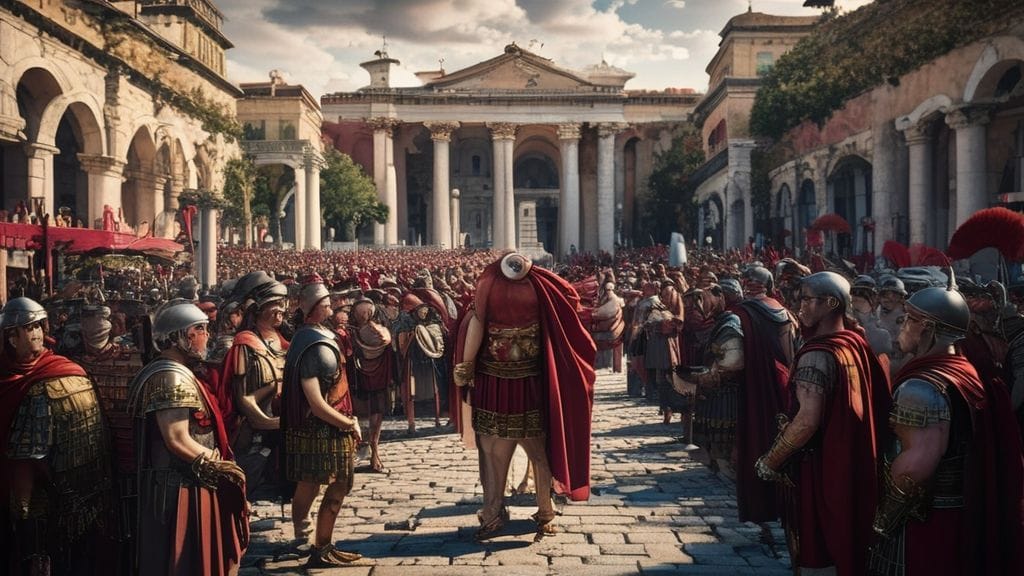
The executioner—a professional, likely drawn from the ranks of soldiers or specialized staff—would have carried out the sentence swiftly. A single, practiced stroke of the sword could sever head from body; in some cases, multiple blows were needed, but Roman authorities preferred an efficient end for high-ranking criminals. Behind this clinical description, however, lies the shattering reality: a life extinguished, a story cut short, a man who once stood at the summit of Roman society reduced, in a moment, to a corpse.
In that instant, the execution of Flavius Clemens became more than an individual tragedy. It was a message. To the Senate: your rank will not save you if I suspect you. To the imperial family: blood ties are conditional, subject to the emperor’s suspicion. To Jews and Christians: your refusal to join our public religious life may one day be read as treason. The sword that fell on Clemens’s neck sliced through layers of social and religious expectation.
Later Christian authors would remember this event in their own idiom. For them, the execution of Flavius Clemens was not only an imperial act but a persecution narrative, a sign that those who followed Christ could expect to suffer, even at the highest social levels. Eusebius hints at Clemens as a martyr in all but name, a nobleman who died because he would not betray his faith. Whether Clemens himself embraced that identity, or whether his beliefs were more fluid, we cannot say. But the fact that later generations claimed him suggests that his death resonated with their experience of imperial hostility.
In the city, life went on. The Senate met; chariots raced in the Circus; sacrifices rose in temples. Rome had practiced the art of continuing after violence. Yet beneath the surface, something had shifted. The execution of Flavius Clemens had shown that even the innermost circle of power was not safe from the emperor’s fear. And that fear, once unleashed, would soon help bring Domitian himself to a bloody end.
Domitilla in Exile: Survival on the Margins of the Empire
While Clemens met his death in Rome, his wife Domitilla faced a different but no less devastating fate: exile. Ancient sources disagree on the exact island—some say Pandateria (modern Ventotene), others Pontia (Ponza)—but in either case the symbolism was clear. These small rocky outcrops off the Italian coast had become, under the early emperors, places where troublesome women of the imperial family were sent to disappear from public life.
To be banished there was to lose almost everything that had defined Domitilla’s existence. She had grown up amid marble colonnades and lush gardens, surrounded by slaves and attendants, her days structured by ceremonies, visits, and the intricate dance of aristocratic life. Now she found herself confined to a narrow island, exposed to winds and waves, with limited company and simple facilities. The glimpses we have of such exiles—from the stories of Julia, Augustus’s disgraced daughter, or of Agrippina the Elder—are stark: isolation, careful surveillance, the constant reminder that one’s identity has been reduced to a problem to be managed.
If Christian tradition is right, and Domitilla held to the new faith, exile may have paradoxically deepened her religious identity. Cut off from the political and social structures of Rome, she would have had time—perhaps too much time—to pray, to reflect, to cling to the conviction that there was a judge above Domitian who saw her plight. Some hagiographical traditions later made much of this, turning her into an exemplary confessor, a noblewoman who accepted disgrace for Christ’s sake. While such embellishments are difficult to verify, they hint at a truth: even on the margins of the empire, faith could flourish in quiet defiance.
Domitilla’s exile also had political implications. By removing her from Rome, Domitian not only punished a suspected dissenter but also erased a link in the chain of succession. Her sons—the boys he had adopted and renamed—fade from the historical record after this point. It is likely that they, too, were marginalized or eliminated, though the sources do not describe their fate in detail. The dynasty that had seemed secure with multiple branches now narrowed perilously around a single, aging ruler who had just demonstrated that he was willing to destroy his own kin.
Life on the island followed a monotonous rhythm. Food and supplies arrived under the watchful eyes of soldiers. Local inhabitants, if any, would have interacted with Domitilla within strictly controlled limits. Letters to Rome, if permitted at all, would be censored or intercepted. The wider world shrank to a strip of sea and rock, to memories that softened and hardened like the changing light on the waves.
And yet Domitilla’s story did not end there. After Domitian’s assassination in 96 CE and the subsequent damnatio memoriae—the official condemnation and erasure of his image—some of his victims were rehabilitated. Exiles were recalled; reputations were posthumously restored. It is possible, though not certain, that Domitilla was among those who regained some measure of freedom under the new emperor, Nerva, or under Trajan. Later Christian traditions associate her with catacombs and properties around Rome that became burial sites for believers, suggesting that her name lived on as a symbol of noble faithfulness.
Whether every detail of these legends is accurate or not, one thing is clear: the exile of Domitilla, like the execution of Flavius Clemens, became more than an isolated punishment. It served as a template, a story pattern, for how early Christians understood the cost of loyalty to their God in the face of imperial power.
Echoes in the Senate: How Rome Remembered – and Forgot
After the execution of Flavius Clemens and the exile of Domitilla, the Senate returned dutifully to its routines. There were debates on provincial matters, ceremonial honors voted to the emperor, discussions—carefully phrased—about finances and public works. The institution knew how to absorb shocks. Yet beneath the formal speeches, the memory of what had happened lingered, like a bruise that no one dared to press.
For senators, the fall of Clemens was doubly unsettling. It showed that even those closest to the emperor could be cut down without warning; and it blurred the line between political loyalty and religious conformity. Some senators, perhaps, reassured themselves that they had nothing to fear: they offered the required sacrifices, they spoke cautiously, they kept their distance from suspect groups. Others, especially those with philosophical leanings or sympathy for foreign cults, realized that their inner lives could now be used against them.
After Domitian’s own assassination in 96 CE—a tightly organized plot involving palace officials and a few senators—the Senate reacted with well-practiced outrage. Suetonius and other later historians preserve the tone of this reaction. The emperor was denounced as a tyrant, his statutes revoked, his name scratched from inscriptions, his memory officially condemned. In this swell of postmortem condemnation, the case of Flavius Clemens became one more piece of evidence in a larger brief: proof that Domitian had abused his power, that he had turned against his own kin, that he had allowed religious suspicion to become a weapon.
Yet the Senate’s embrace of Clemens as a victim was partial and selective. They did not, as far as we know, celebrate him as a hero of conscience or a defender of religious freedom. Their concern was more pragmatic: Domitian’s violence against nobles, whatever its rationale, had humiliated the Senate and destabilized the political order. In rehabilitation, the priority was to restore senatorial dignity, not to explore the deeper issues of religious dissent that had formed the heart of the charges.
Over time, memories shifted and hardened. For some Romans, Clemens was simply one of many casualties of a paranoid regime. For others, he became a cautionary tale about the dangers of aligning too closely with suspect religious movements. Only in Christian circles did his execution continue to burn as a meaningful story—a narrative in which the highborn could suffer alongside the humble for the sake of Christ.
In this selective remembering and forgetting, we find a pattern common to many societies after episodes of persecution. The dominant group reinterprets the event to fit its own political narrative—tyranny corrected, institutional dignity restored—while the persecuted group preserves a different memory, one in which the central themes are faith, conscience, and the price of dissent. The execution of Flavius Clemens thus lives in two parallel histories: one Roman, one Christian, intersecting but never entirely merging.
Christians and Jews Under Domitian: Between Law and Terror
The fate of Flavius Clemens and Domitilla cannot be fully understood without situating it in the broader experience of Jews and Christians under Domitian’s rule. Although the reign did not see a systematic, empire-wide persecution like those of later centuries, the pressure on these communities was real and, at times, intense.
After the destruction of the Temple in 70 CE, Roman authorities had imposed the fiscus Judaicus, a tax on Jews that was, in theory, a transfer of the old Temple tax to the temple of Jupiter Capitolinus. Under Domitian, collection of this tax became harsher and more invasive. Suetonius describes officials inspecting men’s bodies in public to determine whether they were circumcised—an invasive, humiliating procedure—and notes that even those who “lived like Jews” without openly declaring themselves were targeted. This phrase, “living like Jews,” likely encompassed not only ethnic Jews but also gentiles who had adopted Jewish customs or beliefs, and perhaps even some Christians whose practices overlapped with those of synagogues.
For Christians, whose identity was still emerging from Jewish roots, this created a precarious legal situation. In some cases, they may have been lumped together with Jews for tax purposes; in others, they may have been singled out as a distinct, suspicious group. Pliny’s later correspondence with Trajan, around 112 CE, shows that Roman officials were puzzled by Christians: they saw them as stubborn adherents of a “depraved and excessive superstition,” but they lacked clear legal guidelines. Under Domitian, such uncertainty could be dangerous. Local governors, eager to please the emperor or to show zeal in rooting out irregular cults, might push harder against groups that refused to sacrifice.
Within this environment, the execution of Flavius Clemens on charges of atheism and Jewish customs looked, to Christians and Jews alike, like part of a larger pattern. It was not merely a family drama; it was the imperial system flexing its muscles against religious difference. When later Christian writers like Eusebius and Jerome looked back, they saw Domitian’s final years as a foreshadowing of the great persecutions to come—a time when the church learned that its path would run through confrontation with imperial power.
Modern scholars caution against exaggerating this persecution, noting that Domitian’s executions targeted a varied group—nobles, philosophers, administrators—and that religion was only one element in a broader pattern of repression. Yet the combination matters. The fact that religious charges appeared alongside political ones in cases like that of Clemens showed that Rome was beginning to treat certain forms of belief as inherently destabilizing. The boundary between religious nonconformity and treason was fraying.
For ordinary believers in the synagogues and house-churches of Rome, this meant living with a low, constant hum of risk. A neighbor’s denunciation, a tax collector’s suspicion, an official’s desire to please the emperor could, in theory, pull them into the same vortex that claimed a consul. The execution of Flavius Clemens thus functioned as both warning and omen, a sign that even the privileged might share their fate.
From Tyrant to Monster: How Later Generations Judged Domitian
Domitian did not live long after he ordered the death of his cousin. In September 96 CE, less than a year after the execution of Flavius Clemens, he was assassinated in his palace by a group that included court officials and a few senators. The killing was swift and brutal: stabbed repeatedly, Domitian fell in the very place where he had plotted sentences and signed death warrants.
The Senate seized the moment. They proclaimed Nerva, an elderly and respected senator, as the new emperor, and launched what can only be called a campaign of retrospective justice. Domitian was branded a tyrant; his statues were toppled; his name was ordered erased from inscriptions in a classic act of damnatio memoriae. Public memory, always malleable, was reshaped with speed and determination.
In this new narrative, Domitian’s reign became a cautionary tale of excess and cruelty. Suetonius, in his work Lives of the Caesars, paints a vivid picture of an emperor who delighted in others’ suffering, who prowled the palace at night in paranoia, who punished trivial offenses with death. Tacitus, writing with senatorial bitterness, sets Domitian up as a foil to better rulers, a dark figure whose tyranny justified later reforms. In these accounts, the execution of Flavius Clemens appears as one more atrocity, evidence that the emperor would stop at nothing, not even the murder of his own kin.
Christian writers added another layer to this condemnation. For them, Domitian was not only a political tyrant but a persecutor of the saints. The Book of Revelation, traditionally dated by many scholars to Domitian’s reign, speaks of a beastly power that demands worship and is opposed by faithful witnesses who refuse to bow. While the book’s imagery is complex and symbolic, later readers interpreted it as an indictment of Domitian’s demand for divine honors. In this reading, the execution of Flavius Clemens and the exile of Domitilla become tangible instances of what Revelation had described in visionary terms: the clash between an arrogant empire and a humble but defiant faith.
Over centuries, these layered memories turned Domitian into more than a flawed ruler; he became an archetype of the wicked emperor. In Christian homilies and martyrologies, he often appears alongside Nero and Diocletian as one of the great enemies of the church. In secular histories, he stands as a warning about the dangers of concentrated power without accountability. In both traditions, the execution of Flavius Clemens functions as a key episode in the indictment: the moment when Domitian’s fear led him to shed the blood of a man who, by all accounts, posed little real threat.
Of course, historical reality is more nuanced. Domitian was also an able administrator, a builder, a reformer of coinage and law. Some provincial subjects may have experienced his reign primarily as one of order and prosperity. Yet the stories that survive—and the moral judgments they carry—are shaped by those who outlived him and who had reasons, political or theological, to emphasize his darker side. In that constructed memory, Clemens’s execution is not an isolated act; it is a piece of evidence in the case that turned a dead emperor into a symbol of tyranny.
The Martyr That Almost Was: Clemens in Christian Memory
In the centuries after his death, Flavius Clemens occupied a strange space in Christian memory: present, but never fully defined. He was not officially canonized as a saint in the way later martyrs would be, yet his name surfaced in texts and traditions that linked him to the sufferings of the early church.
Eusebius of Caesarea, writing in the early fourth century, mentions Clemens and Domitilla in his Ecclesiastical History, drawing on earlier sources now lost. He reports that Domitian persecuted “many of our people,” including members of his own family, and that Flavia Domitilla, niece of Flavius Clemens, was banished to an island for her testimony to Christ. The lines between different Domitillas—wife, niece, relative—are blurred in his account, but the association is clear: the Flavian household contained Christians, and they suffered for it.
Jerome, in the late fourth century, adds further color, calling Clemens “a man of notable mildness” and emphasizing that he died because of his confession of faith. Later hagiographical collections would sometimes list him informally among those noble Romans who embraced Christianity early and paid with their lives. Catacombs and underground basilicas in Rome would be linked, in popular imagination, to Flavian women who sheltered believers or endowed burial spaces for them.
Yet Clemens never became, in the Christian tradition, a central martyr figure like Peter, Paul, or Lawrence. Perhaps his religious identity in life had been ambiguous; perhaps the memory of his execution was simply overshadowed by more dramatic stories of public martyrdom. Or perhaps the church, wary of overly close association with a man so deeply embedded in imperial structures, allowed his figure to remain half in light, half in shadow.
Even so, the execution of Flavius Clemens served an important narrative function. It offered early Christians a powerful exemplar of what they had long claimed: that the gospel had entered not only the slums and workshops of the empire but also its palaces and senatorial villas. If a consul and imperial cousin could be touched by Christian faith—or by sympathies close enough to be perceived as such—then the faith was not merely a religion of the poor. It was a force capable of unsettling the highest echelons of Rome.
In this sense, Clemens is a martyr that almost was. His death was not accompanied by the fiery speeches or recorded miracles that cluster around later saints. It occurred in relative privacy, documented more by his enemies than by his friends. Yet the church’s willingness to claim him as one of their own, even partially, tells us how strongly his story resonated with their understanding of persecution and fidelity.
Archaeology and Silence: Traces of Clemens in Stone and Dust
When we turn from texts to stones, the figure of Flavius Clemens becomes even more elusive. Unlike some emperors and generals, he left no surviving inscriptions celebrating his deeds, no monumental tomb with bas-reliefs recounting his life. Domitian’s attempt to erase awkward elements of his family, combined with the later churn of urban development, has buried or destroyed whatever direct traces might once have existed.
Archaeologists, however, have uncovered indirect echoes of his world. The Domitilla catacombs outside Rome, one of the oldest Christian burial sites, are associated—at least in tradition—with the Flavian family. Subterranean galleries, frescoed chambers, simple tombs with early Christian symbols suggest a community that valued discreet, shared spaces for remembrance. While we cannot definitively link these catacombs to Domitilla the wife of Clemens, the persistence of her name in connection with them indicates how deeply the idea of a Christian Flavian line took root.
Inscriptions found around Rome preserve the names of lesser-known Flavii and Domitillae, some of whom may have been freedmen or distant relatives connected to the main branch of the family. Their epitaphs speak of ordinary hopes—beloved spouses, dutiful children, piety toward the gods or toward the God of the Christians. Through them, we glimpse a social world in which the boundaries between pagan, Jewish, and Christian identities were permeable, negotiated across generations.
Inside the city, the very absence of monuments to Clemens is itself a kind of archaeological testimony. In a culture that loved to commemorate status, the silence around a man of consular rank suggests deliberate suppression. Domitian’s regime, and perhaps subsequent emperors, had little incentive to preserve memory of a cousin executed on charges that reflected badly on the dynasty. The spaces he might have claimed as his own—statues, dedications, named buildings—were either never erected or quietly repurposed.
Modern excavations on the Palatine Hill and in the Roman Forum have revealed layers of Flavian construction: palaces, audience halls, temples. As scholars piece together the architectural program of the dynasty, they sometimes speculate about which wings might have housed particular family members, where Clemens and Domitilla might have walked, where their children might have played. These reconstructions are necessarily tentative, but they remind us that history unfolds in physical spaces, in rooms that echo with footsteps, in corridors that once carried nervous whispers about imperial displeasure.
In the end, archaeology offers us more context than content for the story of Flavius Clemens. It shows us the world he inhabited—the marble, the frescoes, the urban density of Rome in 95 CE—but it cannot recover his face, his voice, his inner convictions. For those, we remain dependent on texts written long after his death, texts that filtered his life through their own agendas. The stones, in their stubborn silence, underscore how much of his story—like that of so many victims of political violence—has been swallowed by time.
The Human Cost of Imperial Suspicion: Families, Faith, and Fear
Beyond politics and theology, the execution of Flavius Clemens invites us to consider a more fundamental dimension: the human cost of living under a regime where suspicion could be fatal. Rome in 95 CE was not a totalitarian state in the modern sense, but for its elite—and increasingly for marginalized religious groups—it was a place where the wrong association, the wrong practice, the wrong word could end a career or a life.
Families like that of Clemens and Domitilla bore the brunt of this reality. One day they were secure, integrated, hopeful for their children’s future; the next, they were scattered—one executed, one exiled, children likely stripped of inheritance and prospects. Servants and freedmen who had built their lives around the household suddenly found themselves unattached or, worse, tainted by association. The ripples extended outward through circles of patronage, business, and friendship.
For believers, whether Jewish or Christian, the episode underscored a hard truth: conscience could be costly. To refuse participation in certain rituals, to prioritize an invisible God over a visible emperor, was to accept a degree of social and personal risk. Not every Jew or Christian in Rome faced martyrdom or exile, to be sure. Many navigated the boundaries carefully, blending in where they could, drawing the line where they must. But the execution of Flavius Clemens stood as a bloody marker of what the end point of conflict with imperial expectations might look like.
Fear operates in subtle ways. It stifles speech long before it provokes open clashes. It encourages self-censorship, strategic silence, the gradual narrowing of one’s world. In the wake of Clemens’s death, how many conversations in Roman houses ended abruptly when the topic turned to the emperor or to strange new religions? How many potential converts to Christianity hesitated, recalling the fate of a consul who might have shared their sympathies? How many Jews resolved to keep their practices within the walls of the synagogue, avoiding public display?
Yet fear also, paradoxically, can sharpen identity. Communities under pressure often generate stronger internal bonds, clearer boundaries, deeper commitments. For the early church, stories like that of Clemens and Domitilla helped forge a sense of being a pilgrim people within the empire, citizens of a different kingdom whose loyalty to Christ could, at times, clash with the demands of Caesar. For Jews, the tightening of the fiscus Judaicus collection may have reinforced solidarity, a shared awareness of being distinct and targeted.
At the center of all this sits the figure of Clemens himself: a man whose life was shaped by privilege and whose death revealed how quickly that privilege could evaporate under an anxious ruler. His story reminds us that political fear is not an abstract force; it is experienced by particular bodies, particular households, particular children who wake up one morning to find that their world has become unrecognizable.
What the Execution of Flavius Clemens Reveals About Rome
Step back from the details—the dates, the names, the conflicting sources—and the execution of Flavius Clemens offers a lens through which to view the Roman Empire at a critical moment. Several themes stand out.
First, the incident exposes the fragility of imperial dynasties. The Flavians had risen quickly and, by 95 CE, seemed firmly entrenched. Yet within a year of Clemens’s death, the dynasty itself would be extinguished. Domitian’s decision to eliminate a potential line of succession within his own family weakened the very future he was trying to secure. Power, when hoarded too tightly and defended through fear, can undermine itself.
Second, the case highlights the growing tension between traditional Roman religion and emerging forms of monotheism. The charges against Clemens—atheism, Jewish customs—sit at the crossroads of this tension. To Roman authorities, refusal to participate in public cults looked like a denial of the gods and a rejection of shared civic life. To Jews and Christians, loyalty to their God required precisely such refusals. In that clash of perspectives, the seeds of centuries of conflict were sown.
Third, the episode illustrates how legal systems can be bent to serve autocratic ends. The law of treason, originally meant to protect the state, became under Domitian a tool for silencing not only political rivals but also religious nonconformists. Once belief and loyalty were fused in the eyes of the state, dissent of conscience could be criminalized. The execution of Flavius Clemens stands as an early example of this dangerous fusion.
Fourth, the memory of the event shows us how history is constructed. Roman senatorial historians, eager to condemn Domitian, emphasized his cruelty but often ignored the nuances of religious persecution. Christian historians, eager to build a lineage of martyrdom, interpreted Clemens’s death through the lens of faith, sometimes simplifying the complex interplay of politics and religion. Archaeology adds another, quieter voice: the mute witness of stones and catacombs that confirm general patterns but rarely shed light on individual motives.
Finally, on a more universal level, the execution of Flavius Clemens invites reflection on the perennial question of conscience against power. When rulers demand not only obedience but inward assent—when they insist on being “lord and god” in more than a metaphorical sense—those whose deepest loyalties lie elsewhere face agonizing choices. Clemens, whatever his exact beliefs, found himself at that intersection. His death, therefore, is not only a Roman story; it is a human story, echoing across time wherever individuals and communities wrestle with the costs of remaining true to convictions that authorities cannot fully control.
Conclusion
The execution of Flavius Clemens in Rome in 95 CE was a small event in the scale of an empire that stretched from Britain to Syria, from the Rhine to the Sahara. Armies still marched; trade routes still thrummed; the Colosseum still filled with spectators eager for blood and spectacle. Yet in that single act—the beheading of a quiet consul and cousin to the emperor—we catch a concentrated glimpse of Rome’s contradictions at the end of the first century.
We see an emperor, Domitian, torn between his genuine achievements as a ruler and his corrosive fear of rivals, real or imagined. We see a dynasty that had promised stability descending into internal purges that undermined its own future. We see legal norms twisted so that belief itself could be construed as treason. We see the complex position of Jews and Christians, communities negotiating their loyalty to God and their place within an imperial order that tolerated difference only up to a point.
For Flavius Clemens and Domitilla, these grand currents took the form of very personal disasters: death, exile, the likely dispersal of their children and retinues, the erasure of their public memory. Their story reminds us that political and religious systems are always lived out on the level of individual bodies and households. The imperial decree that sent Clemens to the executioner’s sword was, in the end, ink on papyrus; its consequences were flesh and blood.
Later generations would turn this episode into a symbol. Roman historians used it as evidence of Domitian’s tyranny; Christian writers saw in it a foreshadowing of later persecutions and a sign that the gospel had reached the imperial household. Both interpretations contain truth, but both also simplify a complex reality in which political, familial, and religious motives intertwined.
If there is a lesson to draw from the execution of Flavius Clemens, it lies perhaps in the warning it offers about the dangers of fusing political authority with demands for spiritual conformity. When rulers seek to govern not only actions but consciences, when they equate disagreement with disloyalty, the sword is never far away. Rome in 95 CE stands as an early, eloquent witness to this truth. And in the distant, dimly remembered figure of Flavius Clemens—a man who stood at the heart of power and yet was powerless before it—we find a reminder that the stories empires try hardest to suppress are often the ones that speak most clearly to the ages that follow.
FAQs
- Who was Flavius Clemens?
Flavius Clemens was a Roman senator and consul in 95 CE, closely related to the Flavian imperial family as a cousin of Emperor Domitian. He appears in our sources as a relatively quiet figure, not known for great speeches or military exploits, but his proximity to the throne made him significant. Domitian even designated Clemens’s two sons as potential heirs, renaming them Vespasian and Domitianus after the dynasty’s founders. His sudden fall from favor and subsequent execution shocked contemporaries and later writers alike. - Why was Flavius Clemens executed?
Ancient sources state that Clemens was executed on charges of “atheism” and practices associated with Jews, accusations that were folded into the broader crime of treason. This likely meant that he was suspected of adhering to or sympathizing with monotheistic beliefs that refused participation in traditional Roman cults and imperial worship. Some later Christian authors claim he was punished for being a Christian or for harboring Christians in his household. Modern historians see his death as the result of a combination of religious suspicion, political anxiety, and Domitian’s growing paranoia about succession and loyalty. - Was Flavius Clemens a Christian?
The evidence is inconclusive. Christian writers such as Eusebius and Jerome later portrayed Clemens and his wife Domitilla as connected to the early church, suggesting they suffered for their confession of Christ. Roman sources, however, speak more broadly of “atheism” and Jewish customs, without clearly distinguishing Christianity from Judaism. Many scholars think Clemens may have been sympathetic to Christian or Jewish beliefs, or at least part of a household where such ideas circulated, but we cannot definitively prove that he was a baptized Christian in the later doctrinal sense. - What happened to Domitilla after Clemens’s execution?
Domitilla, the wife of Flavius Clemens and a member of the imperial family, was exiled to a small island—ancient sources name Pandateria or Pontia—at the time of her husband’s downfall. Exile meant isolation, close surveillance, and the loss of almost all social and political status. Christian tradition holds that she remained faithful to Christ during this banishment and sometimes associates her with early Christian burial sites around Rome, such as the Domitilla catacombs. It is possible she was later rehabilitated after Domitian’s death, but the historical record is not explicit. - How does the execution of Flavius Clemens relate to persecution of Christians under Domitian?
The execution of Flavius Clemens is often cited by Christian authors as part of a broader pattern of Domitian’s hostility toward Christians. While there is no evidence of a systematic, empire-wide persecution like in later centuries, Domitian’s final years did see increased pressure on Jews and those “living like Jews,” as well as on other religious and philosophical groups he regarded as subversive. The case of Clemens—executed on religiously tinged charges—stands as a vivid example of how Christian or Jewish beliefs could become entangled with accusations of treason under a suspicious emperor. - What does this case reveal about Domitian’s rule?
The fate of Flavius Clemens exposes both the strengths and the dark side of Domitian’s regime. Domitian was an able administrator who strengthened the frontiers and reformed aspects of Roman governance, but he also relied heavily on informers and expanded the use of treason charges. His willingness to execute a close relative on charges of impiety and treason reveals the extent of his paranoia and his insistence on religious and political conformity. Later Roman writers used cases like Clemens’s to bolster their portrayal of Domitian as a tyrant whose reign justified posthumous condemnation. - Did the execution of Flavius Clemens affect the Flavian dynasty’s future?
Indirectly, yes. By eliminating Clemens and exiling Domitilla, Domitian effectively cut off a potential line of succession within his own family, including the two boys he had adopted as heirs. Within a year of Clemens’s death, Domitian himself was assassinated, and with him the Flavian dynasty ended. While multiple factors contributed to this collapse, the removal of relatives who might have provided a smoother transition certainly weakened the dynasty’s long-term prospects. - How reliable are the ancient sources about Flavius Clemens?
Our main sources—Suetonius, Cassius Dio, and Christian authors like Eusebius—wrote long after the events and had their own agendas. Suetonius and Dio, as senatorial or aristocratic writers, were hostile to Domitian and eager to highlight his cruelty; Christian authors wanted to trace a line of persecution and martyrdom back to the first century. As modern historians such as Brian Jones (The Emperor Domitian) have noted, we must read these accounts critically, comparing them, considering their biases, and acknowledging the gaps they cannot fill. - Why is the story of Flavius Clemens still important today?
The story matters because it illustrates enduring themes: the danger of conflating political loyalty with religious conformity, the vulnerability of individuals and families under autocratic regimes, and the ways memory is shaped by those who outlive a crisis. The execution of Flavius Clemens shows how fear at the top of a powerful state can lead to the criminalization of belief and the elimination of perceived rivals, even within the ruler’s own family. It offers a historical case study in the costs of conscience and the fragility of justice under concentrated power.
External Resource
Internal Link
Other Resources
- Encyclopaedia Britannica – general search for the exact subject
- Google Scholar – academic search for the exact subject
- Internet Archive – digital library search for the exact subject