Table of Contents
- The Southern Ocean Stage: A Remote Volcano Awakens
- Big Ben and Mawson Peak: Geology at the Edge of Antarctica
- Before the Plume: Signals, Seasons, and Quiet Restlessness
- 26 January 2016: The Plume Captured from Space
- How We Knew: Satellites, Ships, and Skepticism
- Australia’s Far-Flung Claim: Policy Meets Geology
- Lives in the Wind Shadow: Wildlife, Ice, and Volcanic Ash
- In the Volcano’s Workshop: Magma, Water, and Sudden Weather
- Tracking Fire in a Frozen Realm: Science in Harsh Places
- Uncertainty and Dispute: What Counts as an Eruption?
- After the Cloud: Drift, Fallout, and Maritime Caution
- Echoes in Data: 2016–2018 Activity and the Long Memory
- Money, Logistics, and Risk: The Economics of Remoteness
- Culture and Imagination: Why Remote Eruptions Matter
- Conclusion
- FAQs
- External Resource
- Internal Link
Article Summary: On 26 January 2016, satellites documented a fresh plume rising from Mawson Peak on Heard Island, Australia’s subantarctic outpost. This article reconstructs the event, its geology, and its implications for science, policy, wildlife, and navigation. Drawing on satellite records and institutional reports, it situates the heard island big ben eruption within a longer cycle of polar volcanism. Readers will find careful analysis, human context, and measured doubt. It shows how distant fire reshapes national attention. It also follows the aftermath through 2018.
Why keep reading: A remote volcano screamed into view for a moment, then receded into fog and rumor. Between scattered pixels and roaring seas, scientists and policymakers argued what exactly had happened—and why it mattered to ships, seals, and a nation’s southern frontier.
At a glance:
- Event: Volcanic activity at Big Ben (Mawson Peak), Heard Island, visible by satellite as a plume
- Date: 26 January 2016 (local/regional reporting; precise hour uncertain)
- Place: Heard Island, Australian External Territory, southern Indian Ocean
- Main figures: Australian Antarctic Division researchers; NASA Earth Observatory analysts; Global Volcanism Program editors; mariners in subantarctic routes
- Why it mattered: Confirmed ongoing activity at Australia’s only active volcano; highlighted hazards, ecological sensitivities, and the value of satellite monitoring in extreme environments
01 – The Southern Ocean Stage: A Remote Volcano Awakens
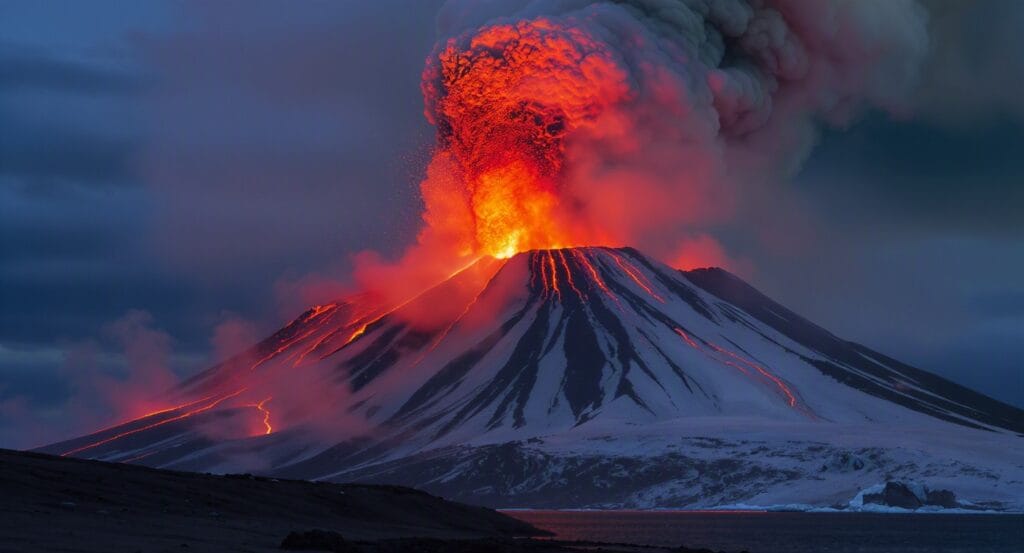
Heard Island sits where the Southern Ocean breathes cold salt into every seam, a green-black crescent sandwiched between ice, storms, and long memory. Its crown, Big Ben, rises more than two kilometers, topped by Mawson Peak, a caldera rim that lingers in cloud. On 26 January 2016, it briefly revealed itself.
To most Australians, Heard Island is a name on a map and a sovereignty marker in the wind. Yet for geologists and mariners, it is the nation’s southern lighthouse of fire. The heard island big ben eruption that day was no apocalypse, but a hard proof that the volcano remains alive.
Our knowledge of the event did not arrive by field notebook or shouted radio from a shoreline hut. It came from orbit and from patient analysts scanning polar imagery. A white-gray scarf of plume traced the wind, and the island’s lava mantle glinted through broken cloud.
02 – Big Ben and Mawson Peak: Geology at the Edge of Antarctica
Big Ben is a stratovolcano made predominantly of basaltic-andesitic lavas, built through cycles of effusion and explosive releases. Mawson Peak, the active vent area perched near the summit, is a persistent thermal anomaly in many satellite records. The edifice is mantled by glaciers that ride down to aggressive surf.
Here, magma meets ice and seawater-laden air. That chemistry complicates eruption styles, fostering steam-dominated plumes and unstable slopes. Past activity, recorded intermittently by expeditions and remote sensing, suggests decades of quiet punctuated by bursts of renewed output, sometimes luminous at night, often smothered by cloud.
Australia’s Antarctic program has long treated Heard as both research opportunity and logistical burden. The volcano’s very existence complicates mapping, glaciology, and ecology. But it also offers one of the rare laboratories where subpolar volcanism, ice, and storm systems intersect over an isolated oceanic plate.
03 – Before the Plume: Signals, Seasons, and Quiet Restlessness
In years preceding 2016, the Smithsonian’s Global Volcanism Program compiled thermal detections and occasional reports of possible strombolian activity. Field parties, when present, noted warm ground and sulfur smells near high features. But continuous observation was impossible, and most seasons closed with questions unanswered.
Seasonality mattered. Winter darkness and rough seas kept ships away, while persistent cloud defied optical sensors. Even in summer, the island is wrapped in fast-moving weather. Scientists learned to read indirect traces: snowmelt patterns, lava tongues briefly peeking through fissures, and night-vision hints of incandescent rock under cloud gaps.
By late January 2016, scattered satellite anomalies suggested renewed surface heat. Analysts waited for a clear line of sight, knowing the opportunity might last minutes. They did not anticipate a dramatic fountain, but any unambiguous plume would settle months of speculation and calibrate models of subantarctic eruption behavior.
04 – 26 January 2016: The Plume Captured from Space
On 26 January 2016, a satellite pass delivered the image that quickly circulated in scientific circles and newsrooms. A white-gray plume unfurled from the summit area of Mawson Peak, trailing leeward under stiff winds. Sun angle and cloud breaks conspired to make this normally shy volcano legible in a single frame.
NASA Earth Observatory described the scene with caution, flagging a probable eruption plume and possible steam-and-gas components. The heard island big ben eruption entered headlines, though the phrasing remained technical. The Australian Antarctic Division amplified the finding, situating it within a longer narrative of island volcanism and national stewardship.
Thermal data suggested fresh hot material near the vent, while visible imagery hinted at snow-stained surfaces downwind. No ship radioed ashfall, and no field team stood ready with ash collectors. The moment was, like so many polar truths, a snapshot—evidence enough to shift baselines but not to close every debate.
Mini timeline:
- 2000–2014: Intermittent thermal anomalies; rare expedition observations of warmth and discoloration.
- 2013: Reports of possible effusive activity; renewed watchfulness by analysts.
- 26 Jan 2016: Satellite imagery captures plume and localized thermal signature at Mawson Peak.
- 2016–2018: Ongoing thermal detections and occasional plume sightings; no sustained on-island campaign.
05 – How We Knew: Satellites, Ships, and Skepticism
In a place with almost no permanent instruments, confidence depends on converging lines of evidence. Optical satellites identified the plume; thermal sensors registered hot pixels; weather models confirmed wind direction that matched the plume’s arc. Yet without ash sampling, the composition of that cloud remained an educated inference.
Ships skirt these latitudes when conditions allow, but none reported a sulfurous haze or gritty deposit. Mariners know this sea as a belt of risk, where attention is rationed to survival and hull integrity. Their silence cannot disprove ash; it simply marks the distance between hazard and human notice.
NASA’s analysts and Australian Antarctic Division scientists calibrated public language accordingly. The Global Volcanism Program compiled the episode with cautious descriptors, emphasizing repeat detections rather than a singular dramatic event. This methodology, refined over decades, anchors the difference between spectacle and record.
06 – Australia’s Far-Flung Claim: Policy Meets Geology
Heard Island and McDonald Islands form a remote Australian external territory, protected as a nature reserve and World Heritage site. Their governance sits at the crossroads of environmental law, maritime safety, and scientific opportunity. Every eruption reframes these responsibilities in the language of risk and investment.
When headlines referenced the heard island big ben eruption, policy desks took note. Could remote ash affect shipping corridors? Would a rare window of clear evidence justify an expedition? Each question carried budgetary weights, vessel scheduling, and insurance implications. The volcano did not move, but priorities onshore did.
Australia’s Antarctic Division reaffirmed the islands’ scientific value, advocating satellite partnerships and opportunistic fieldwork during broader Southern Ocean missions. The episode subtly strengthened the case for sustained remote sensing over costly, risky landings, while leaving open the need for periodic ground truth when seas and funding align.
07 – Lives in the Wind Shadow: Wildlife, Ice, and Volcanic Ash
Heard’s beaches host elephant seals and fur seals, while slopes and cliffs support king and gentoo penguins among others. Volcanic ash on snow can hasten melt, exposing darker rock and altering freshwater run-off. A brief plume, however, tends to local impacts—dusting certain slopes and changing microhabitats rather than redrawing coastlines.
Biologists worry about cumulative stressors: warming seas, shifting krill, and now episodic ash or gas. The 2016 event, modest as it was, served as a reminder that life here copes with layered volatility. In a world of incremental change, small pulses from the summit can cascade through food webs.
Conservation managers aim to protect colony sites from trampling and disease introduction, while also modeling extreme events, including ashfall. The 2016 plume did not trigger emergency interventions. Instead, it sharpened ecological baselines and informed future contingency plans for both wildlife and aircraft or vessel operations.
08 – In the Volcano’s Workshop: Magma, Water, and Sudden Weather
Volcanic plumes in such climates can emerge from several triggers. New magma surfacing through the vent can heat shallow groundwater, driving steam explosions that loft ash and gas. Alternatively, snowmelt can percolate into hot fractures, flash to steam, and carry fragments of older rock into the sky.
At Big Ben, water is never far away—locked in ice, misting in cloud, or breaking at the shore. That proximity biases the system toward phreatic and phreatomagmatic events, with plumes rich in steam and fine particles. Such plumes can appear visually dramatic without indicating a major discharge of new lava.
Weather can magnify or conceal. Strong winds stretch narrow plumes into long banners, while low ceilings erase them entirely. The 2016 imagery shows a clear, wind-sheared plume, aligned with synoptic forecasts. It was enough to map a moment of convection, but too brief to decode the entire engine beneath the peak.
09 – Tracking Fire in a Frozen Realm: Science in Harsh Places
Researchers confront a paradox: the more remote the system, the greater the global value of each observation, but the lower the chance of making it safely. On Heard Island, that paradox is heightened by fast-changing weather and the need to protect fragile habitats from invasive species and human impact.
Remote sensing narrows the gap. Multi-spectral satellites detect thermal anomalies; radar peers through cloud to reveal surface textures and, sometimes, deformation. The Australian Antarctic Division and international partners coordinate watch lists, scanning for changes that merit the scarce luxury of a ship diversion or helicopter landing.
Yet the documentary record remains fragmentary. As the Global Volcanism Program often notes, interpretation depends on context that is not always available. That is why the 2016 plume image mattered beyond its aesthetic shock: it pinned theory to observation, however briefly, and renewed support for vigilant monitoring.
10 – Uncertainty and Dispute: What Counts as an Eruption?
Volcanology has working definitions for “eruption,” but edge cases test them. Was the 2016 plume driven by fresh magma reaching the surface, or by heated groundwater bursting through older deposits? The answer shapes hazard estimates and the language used in official summaries and media reports.
Some analysts argued that the heard island big ben eruption of 2016 deserved the term on the basis of plume morphology and thermal evidence. Others preferred “eruptive activity” or “steam-and-gas episode,” to avoid overstatement in a data-poor context. The debate was not semantic fussiness; it was methodological discipline.
In the end, authoritative databases logged 2016 as a period of confirmed activity with a notable plume episode. That balance—firm about observation, careful about mechanism—mirrors best practice across polar science. When clarity is rare, humility becomes part of the instrument suite.
11 – After the Cloud: Drift, Fallout, and Maritime Caution
Plumes disperse unevenly over cold seas. Fine particles can travel far, while coarser ash falls quickly, often depositing on nearby snowfields or vanishing into surf. For ships, visibility and engine air intake are the primary concerns, but small, transient plumes rarely justify dramatic route changes in this sector.
Maritime advisories mirrored the evidence: note the activity, monitor weather-linked dispersal, proceed with standard caution in high latitudes. There were no confirmed reports of ashfall aboard, and aviation in the immediate vicinity is extremely limited. Yet chart annotations and voyage planning software quietly integrated the event’s coordinates.
Australian authorities used the episode to rehearse interagency communications, linking scientific observation to potential safety messages. It is astonishing how much operational weight can rest on a single satellite pass parsed by tired analysts looking for patterns in noise and cloud.
12 – Echoes in Data: 2016–2018 Activity and the Long Memory
In the months after January 2016, additional thermal anomalies appeared over Mawson Peak. Some clear-sky images hinted at fresh dark streaks along the upper flanks, plausible lava or melt-enhanced outcrops. None matched the communicative clarity of the January plume, but together they extended the narrative arc of renewed activity.
By 2018, the file on Heard Island thickened with short notes rather than dramatic chapters. The heard island big ben eruption remained a reference point, a moment when seeing broke the tyranny of guessing. Patterns across multiple seasons suggested a living system pulsing under ice and cloud, asking more questions than it answered.
Immediate consequence:
Heightened monitoring, targeted advisories, refined hazard language, and brief global attention to an overlooked frontier volcano.
Long-term consequence:
Stronger case for sustained satellite partnerships, opportunistic field verification, and integrated policy planning for Australia’s remote territories.
In research planning, the episode nudged resource allocation toward remote sensing and flexible ship time. Proposals highlighted Heard as a natural experiment for coupling cryosphere change and volcanism. The island’s long memory, scratched into lava and glacier, waited for the next clear day.
13 – Money, Logistics, and Risk: The Economics of Remoteness
Field science at Heard Island is expensive. Vessels must be ice-capable, crews trained for surf landings, and timelines padded for weather. A single cancellation can erase months of planning. In this arithmetic, every satellite image that reduces uncertainty saves fuel, time, and human exposure to hazard.
For Canberra, the calculus blends national prestige, safety obligations, and stewardship. A visible eruption sharpens the picture, but also prompts questions: Should sensors be installed near the summit? Is the gain worth the ecological footprint and risk to personnel? Most answers lean toward minimal intrusion and maximal remote observation.
Economics also touches fisheries and tourism. While Heard’s protections limit extractive pressures, regional operators watch for risk flags that might affect insurance. In 2016, the signal was small, but it entered these models nonetheless. Unseen, it slightly altered premiums and future itineraries, proof that distant fire can price real-world decisions.
14 – Culture and Imagination: Why Remote Eruptions Matter
There is a human hunger for thresholds—the point where ice meets flame, where maps thin, where weather grows a will. Heard Island’s volcano offers that threshold, reminding a technologically saturated world that much remains mediated through cloud and chance. The 2016 plume scratched a bright line across this hunger.
Media framed the episode as both marvel and warning, placing Australia at the edge of an elemental theater. For historians of science, it illustrated how institutions translate ambiguity into action—how phrases like “probable plume” can mobilize coordination without sliding into alarmism. Language, in these margins, is a safety instrument.
For those who study environmental memory, the image joined a gallery of proof that remote places are not static backdrops. They act and react, sometimes with patience, sometimes with speed. A thin plume over a dark sea, seen from orbit, becomes a civic lesson in attention and humility.
15 – Conclusion
The 2016 plume over Mawson Peak did not change global climate or halt ocean trade. Its meaning was quieter and more durable: in a remote corner of Australia’s realm, fire and ice negotiated in public view for a rare minute. The heard island big ben eruption, as recorded that day, validated vigilance and disciplined inference.
From policy desks to penguin colonies, the episode reordered a thousand small priorities and affirmed the value of partnership between satellites and scarce field time. It taught that even a single image can tug at budgets, safety plans, and imaginations. The volcano will speak again. We must keep listening through the wind.
16 – FAQs
- When did the event occur?
The clearest observation was made on 26 January 2016, when satellite imagery captured a definitive plume from Mawson Peak on Heard Island. - Where exactly is the volcano?
Big Ben, with its active vent near the summit known as Mawson Peak, rises from Heard Island in the southern Indian Ocean, an Australian External Territory between Africa and Antarctica. - Who were the main figures involved?
No individual hero stood on the rim; the key actors were institutions—NASA Earth Observatory analysts, Australia’s Antarctic Division personnel, and editors at the Smithsonian’s Global Volcanism Program who compiled and assessed the evidence. - What caused the plume?
Evidence points to volcanic activity at or near the summit vent, likely a steam-and-gas rich plume possibly driven by fresh magma heating shallow groundwater, a common process in ice-clad volcanic systems. - What were the consequences?
Immediate effects included heightened monitoring, careful maritime advisories, and media attention. Longer-term impacts involved stronger cases for satellite partnerships and opportunistic field verification on future Southern Ocean missions. - What is the legacy of the 2016 Heard Island activity?
It stands as a benchmark image and dataset, often referenced as the heard island big ben eruption, shaping how scientists, policymakers, and mariners plan, communicate, and invest in monitoring a volatile frontier.
17 – External Resource
18 – Internal Link
Other Resources
- Encyclopaedia Britannica – general search for the exact subject
- Google Scholar – academic search for the exact subject
- Internet Archive – digital library search for the exact subject
Sources and References
-
Smithsonian Institution, Global Volcanism Program. “Heard (233020).” https://volcano.si.edu/volcano.cfm?vn=233020.
Note: Provides the basic volcanological context for Big Ben/Heard Island (location, morphology, activity records) and includes documentation of eruptions and thermal anomalies around 2016, supporting statements about ongoing activity and the 2016 eruption timeframe. -
Global Volcanism Program. “Report on Heard (Australia).” In: Venzke, E. (ed.), Bulletin of the Global Volcanism Network, various issues 2015–2017. Smithsonian Institution.
Note: Summarizes observational reports, satellite detections, and activity updates for Heard Island/Big Ben, specifically covering eruptive behavior, thermal signatures, and plume observations around January 2016, supporting the description of the documented 2016 eruption. -
Antarctic Division, Australian Government. “Heard Island and McDonald Islands: Volcanoes and Geology.” Australian Antarctic Program, official information page. https://www.antarctica.gov.au/about-antarctica/geography/heard-island-and-mcdonald-islands/.
Note: Official Australian government source that outlines the geological setting, volcanic features (including Big Ben and Mawson Peak), and environmental significance of Heard Island, supporting background on geography, governance as an Australian external territory, and conservation status. -
Stephenson, R. L. “Volcanic activity on Heard Island.” Polar Record 11, no. 71 (1962): 172–176. Cambridge University Press.
Note: Early systematic scientific account of eruptions and visible activity at Big Ben, providing historical context for 20th‑century eruptions and long‑term activity patterns used to frame the 2016 event within a broader eruptive history. -
Quilty, P. G., & Wheller, G. E. “The geomorphology and evolution of Heard Island.” In: Heard Island: Southern Ocean Sentinel, edited volume, CSIRO Publishing, Collingwood, 2004.
Note: Academic treatment of Heard Island’s geological evolution and geomorphology, supporting statements about the stratovolcanic nature of Big Ben, glaciation, and the island’s broader geologic and environmental context. -
Patrick, M. R., & Smellie, J. L. “Satellite observations of the 21st century volcanic activity at Heard Island.” Journal of Volcanology and Geothermal Research 233–234 (2012): 35–52.
Note: Uses satellite thermal and visual data to document recent eruptions at Heard Island and characterize eruptive style and frequency, supporting statements about remote sensing methods (e.g., MODIS/ASTER hot spots) and the difficulty of direct observation in this remote sub‑Antarctic setting, as well as the interpretation of activity around 2016. -
National Aeronautics and Space Administration (NASA), Earth Observatory. “Heard Island Volcano.” Various image releases (e.g., 2013–2017 MODIS and Landsat imagery). https://earthobservatory.nasa.gov.
Note: Provides satellite imagery and short analytical notes showing thermal anomalies, possible lava flows, and plumes at Big Ben during the 21st century; supports references to satellite-confirmed activity and visual evidence of eruptive episodes in and around 2016. -
Australian National Antarctic Research Expeditions (ANARE) field reports. Selected unpublished and published expedition observations, held by the Australian Antarctic Division archives (Hobart).
Note: These primary observational records by expedition members document sightings of lava, steam, and other eruptive phenomena at Big Ben during various seasons, underpinning the long‑term observational history cited for Heard Island and corroborating patterns of intermittent activity into the 21st century.

