Table of Contents
- A Quiet July Morning before the Sea Turned Violent
- Tectonic Fault Lines beneath Paradise: Why the Disaster Was Inevitable
- The Earthquake at 08:19 UTC: Seconds That Changed Java Forever
- Waves on the Horizon: The Tsunami Takes Shape beneath the Indian Ocean
- Impact at Pangandaran: From Holiday Beach to Disaster Zone
- Voices in the Chaos: Survivors, Lost Families, and Split-Second Choices
- Destruction along the Southern Coast: Villages Erased, Boats in the Streets
- Hospitals, Mosques, and Schools: The Social Fabric Torn Apart
- Rescue in the Rubble: Local Heroes, Fishermen, and First Responders
- The State Responds: Government, Politics, and the Weight of Expectation
- Global Echoes: International Aid and the Memory of 2004
- Science after the Waves: Understanding the Java Pangandaran Tsunami 2006
- Warning Systems and Missed Signals: Why So Many Were Caught Unaware
- Rebuilding Pangandaran: Tourism, Trauma, and the Return to the Shore
- Religion, Ritual, and Mourning: How Communities Made Sense of Loss
- Children of the Tsunami: Memory, Education, and the Next Generation
- From Local Tragedy to National Lesson: Policy, Preparedness, and Reform
- Waves in the Historical Record: Java’s Long Relationship with the Sea
- Living with the Next Wave: Ongoing Risk on the Southern Java Coast
- Conclusion
- FAQs
- External Resource
- Internal Link
Article Summary: This article tells the story of the Java (Pangandaran) tsunami of 17 July 2006, a disaster that struck a seemingly ordinary coastal morning and left hundreds dead and thousands displaced. It follows the hidden tectonic tensions beneath the Indian Ocean, the earthquake that triggered the waves, and the terrifying minutes as water surged ashore. Blending survivor testimonies, scientific analysis, and political context, it examines how the java pangandaran tsunami 2006 exposed weaknesses in warning systems despite the world’s recent experience with the 2004 Indian Ocean tsunami. The narrative then explores the social, religious, and economic consequences for Pangandaran and neighboring towns, from shattered tourism to transformed community rituals. It reflects on how local heroes, from fishermen to nurses, acted in the absence of immediate institutional support. Finally, the article situates the event within Indonesia’s longer seismic history and asks how a nation living on the world’s most volatile geological fault lines can prepare for the next wave while still turning to the sea for life and livelihood.
A Quiet July Morning before the Sea Turned Violent
On the southern coast of Java, the morning of 17 July 2006 began with the kind of gentle routine that rarely leaves a mark in history. Pangandaran, a crescent-shaped beach resort embraced by green hills and the restless Indian Ocean, was waking slowly. Fishermen were already returning from the night’s work, their wooden boats dragging faint grooves in the wet sand. Street vendors lit portable stoves and arranged fried bananas, fresh coconuts, and skewers of satay, hoping for a day blessed by tourists and good sales. Children, free from school, chased one another along narrow lanes. The air was damp but calm, the sound of the surf almost comforting.
Tourists—primarily domestic travelers from Bandung, Jakarta, and smaller West Javanese towns—strolled along the shore, taking photographs of the waves that curled in from the vast blue expanse of the Indian Ocean. It was the dry season, when rainclouds usually retreated and the sky sharpened into a clear, intense blue. A gentle wind brushed the palm leaves, and the scent of salt mixed with the smell of grilled fish. For many who had arrived the night before, Pangandaran was a refuge from city traffic and concrete, a place where time stretched a little more slowly.
Yet under this quiet scene lay a kind of unspoken tension, one that had become part of Indonesian consciousness since the cataclysm of 26 December 2004. The Indian Ocean tsunami that year, born from a colossal earthquake off Sumatra, had killed an estimated 230,000 people across multiple countries. In Aceh, on the northern tip of Sumatra, entire communities had been obliterated. Indonesians in Pangandaran had watched the horrifying footage on television, the black water shredding houses and carrying cars like toys. Many had relatives or acquaintances in the affected regions. The words “tsunami” and “Indian Ocean” could no longer be uttered without an electric shiver of fear.
Still, memory has a way of softening its own edges, and distance—geographical and emotional—can convince people that lightning does not strike twice. In local conversations, the 2004 disaster was something that happened “there,” in Aceh, in Thailand, in distant Sri Lanka. The southern coast of Java, while recognized as risky by scientists, in everyday talk was more associated with strong waves and rip currents than with city-destroying walls of water. The java pangandaran tsunami 2006 had not yet entered the lexicon of disaster, not yet become a phrase that made hearts clench.
On that morning, a group of teenagers laughed as they tried to stand on surfboards, tumbling into the shallows. An older couple from Bandung walked hand in hand along the waterline, their feet sinking softly into the sand with each step. Inside small guesthouses, some holidaymakers were still asleep under thin cotton sheets, lulled by the rhythmic crashing of distant waves. Others ate breakfast while discussing nothing more urgent than where to find the best seafood that night.
In the market, a fish seller named Hasan stacked his catch on a makeshift stall: glistening tuna, mackerel, and small reef fish, blues and silvers catching the morning light. He joked with a friend about rising fuel prices and how they were eating into his modest profits. Nearby, a young mother balanced a toddler on her hip while bargaining for vegetables. No one yet thought in terms of evacuation routes, vertical shelters, or tsunami drills. The sea, for all its power, was still a provider, not yet the destroyer it would soon show itself to be.
But this was only the beginning. Far out beyond the horizon, where the ocean floor slopes suddenly into the deep trench formed by the subduction of the Indo-Australian Plate beneath the Sunda Plate, centuries of accumulated strain were about to release. The story of that morning cannot be told only in scenes from the shoreline; it must also be traced along the invisible fractures of the Earth’s crust, where rock would soon snap and water would begin its catastrophic march toward Pangandaran.
Tectonic Fault Lines beneath Paradise: Why the Disaster Was Inevitable
The southern coast of Java lies along one of the most tectonically powerful boundaries on the planet. Just off the shore, deep beneath the Indian Ocean, the Indo-Australian Plate dives under the Sunda Plate at a rate of roughly six to seven centimeters per year. This subduction zone is part of the notorious “Ring of Fire,” a horseshoe-shaped belt of seismic and volcanic instability that arcs around the Pacific and Indian Oceans. To live in Indonesia is to live on the seam of giant geological forces, where the solid ground we trust under our feet is, in reality, in constant slow motion.
For thousands of years, this subduction has built the volcanic spine of Java—majestic cones like Mount Merapi and Mount Slamet—and has periodically unleashed devastating earthquakes. Historical records and oral traditions from coastal communities speak of times when the sea rushed inland without warning, sweeping away houses, rice fields, and lives. Yet these events were often framed in mythic language: punishments of angry spirits, the anger of the legendary Queen of the Southern Sea, Nyai Roro Kidul, or cosmic rebalancings of human and natural domains.
Modern seismology, however, has translated those legends into geophysical histories. Scholars have traced coral uplift, sediment deposits, and written chronicles to piece together a pattern of tsunamis along Java’s southern edge. Though not as frequent as in some subduction zones, when they come, they are often brutal. A 1994 tsunami off East Java killed more than 200 people; smaller events peppered the twentieth century. By 2006, Indonesian geologists knew that the Java trench was capable of producing moderate to large earthquakes that could generate tsunamis, even if these quakes were not colossal by global standards.
Yet knowledge in scientific journals does not automatically translate into preparedness in coastal villages. Funding for public education on tsunami risks remained limited. Infrastructure across much of rural and semi-rural Java was fragile. And the country was still reeling from the 2004 Indian Ocean catastrophe, which had stretched resources and created an enormous focus on Sumatra and the northern Indian Ocean, perhaps at the expense of other vulnerable coastlines. The java pangandaran tsunami 2006 would expose the tragic gap between what had been learned in principle and what had been implemented in practice.
Geophysicists sometimes describe subduction zones as “locked” or “creeping.” When locked, the plates do not slide smoothly; stress accumulates until it is violently released as an earthquake. Along the south of Java in 2006, parts of this boundary were in such a state of tension. Each year, the Indo-Australian Plate pushed under Java, bending the overriding Sunda Plate. The crust strained like a bow being drawn, invisible to the millions of people above who farmed, fished, prayed, and slept in the arc of its influence.
In conference halls in Jakarta and Bandung, scientists had presented models showing what would happen if a shallow undersea quake struck near the southern coast: waves would radiate outward, their speed and height shaped by the seafloor’s contours. Yet even many experts did not anticipate just how dangerous a so-called “tsunami earthquake” could be—an event with relatively modest shaking on land but an unusually efficient transfer of energy into the water column. The 1992 Nicaragua tsunami had shown such a pattern, but the lesson had not been fully operationalized globally.
This is the paradox of living with disaster risk: the more we understand in theory, the more glaring become the human and political choices that allow vulnerability to persist. Poverty, limited coastal zoning enforcement, and the lure of tourist revenue encouraged construction right along the beach in Pangandaran. Many houses and guesthouses hugged the shoreline, some separated from the surf by only a narrow road or a strip of sand. In satellite images taken before July 2006, Pangandaran appears as a thin, low-lying ribbon of settlement exposed to the open ocean.
It is astonishing, isn’t it? The tectonic engine that gives Java its fertile soils and scenic beaches also creates conditions for sudden catastrophe. People had flocked to Pangandaran to enjoy the beauty carved out by those same forces. As the morning of 17 July moved toward late morning, that geological bargain would become tragically clear.
The Earthquake at 08:19 UTC: Seconds That Changed Java Forever
At 15:19 local time (08:19 UTC), as the sun climbed higher over Pangandaran and the market’s bustle swelled, the Earth shook. The epicenter of the earthquake lay roughly 225 kilometers off the southern coast of Java, beneath the seafloor of the Indian Ocean. It was a magnitude 7.7 event: large, but not among the very largest earthquakes recorded in Indonesian history. Many residents who would later describe the moments of shaking emphasized not the intensity but the duration and character of the tremor.
In Pangandaran itself, people felt the ground sway and windows rattle. Hanging lamps swayed gently at first, then more insistently. Dishes clinked, some sliding off tables and shattering on the floor. The shaking lasted for perhaps thirty to sixty seconds in many places—long enough for people to look at one another, to recognize that this was not just a passing tremor, but not so strong as to immediately topple buildings. In Yogyakarta and Bandung, far inland, the quake was felt but mostly prompted brief alarm rather than destruction.
For many on the coast, earthquakes were simply part of life. A young man named Dedi, working in a small hotel reception near the beach, later recalled that the shaking made him stand up and brace himself against a wall. A picture frame fell and cracked. Guests in the lobby grabbed their phones and bags, some rushing outside. But within minutes, as the shaking stopped and no huge damage was visible, nervous laughter crept in. People checked for cracks in their walls, picked up broken objects, and began, tentatively, to return to normal routines.
This was the cruel genius of the event: as a “tsunami earthquake,” its energy distribution was skewed toward longer-period seismic waves and efficient vertical sea-floor displacement rather than intense high-frequency shaking on land. In practical terms, the ocean had been jolted more decisively than the houses. Out at sea, the seabed had lurched and buckled, lifting or dropping large volumes of water. At the surface, the process was almost invisible—no towering wave instantly appeared where the quake occurred. Instead, broad ripples began to form and expand, like the slow-motion shock waves from a stone thrown into a pond.
Within regional seismic monitoring centers, instruments were recording the event and calculating its magnitude. The United States Geological Survey and Indonesian networks flagged a significant undersea quake. But the complexity of determining whether a particular earthquake will generate a dangerous tsunami is compounded by time pressure and incomplete data. Some systems had automated alerts, but in 2006, Indonesia’s national tsunami warning capabilities were still embryonic. The events of 2004 had accelerated planning, but funding, equipment, and coordination remained patchy.
In the crucial minutes after 15:19 local time, the difference between institutional response and lived reality became painfully apparent. There were no sirens in Pangandaran to scream a warning. No standardized loudspeaker messages told people to run inland or seek higher ground. The disaster that would soon be known as the java pangandaran tsunami 2006 was already in motion, but to the people on the beach, the world seemed merely to have wobbled and corrected itself.
Some individuals, however, felt an instinctive dread. Older residents, especially those who had heard stories from their parents or grandparents, associated strong offshore earthquakes with the possibility of tsunamis. A few told their families to move away from the water, just in case. A small number of tourists, remembering images from 2004, felt uneasy. Yet social pressure is powerful: when most people around you stay, it takes courage to run.
Minutes ticked by. Ten, fifteen, twenty. The ocean appeared deceptively normal from the shoreline, though far out to sea, the energy unleashed by the quake was gathering into a set of waves, racing landsward at jet-airliner speeds. The height of these waves in deep water was small, perhaps only tens of centimeters, which is why they often go unnoticed by ships. But as they approached shallower coastal waters, the principles of fluid dynamics would force them upward, compressing their energy into destructive walls of water.
In these intermediate minutes, the disaster might still have become a story of narrow escapes rather than widespread casualties—if effective, trusted warnings had reached the people of Pangandaran and surrounding areas. Instead, the next sign of abnormality many people noticed was not a siren or official instruction, but a subtle change in the sea itself.
Waves on the Horizon: The Tsunami Takes Shape beneath the Indian Ocean
Out beyond the sight of those standing on the beach, the tsunami propagated like a vast, silent pulse. This was not one single wave but a train of waves, their lengths stretching tens of kilometers from crest to crest. In deep water, they sped along at hundreds of kilometers per hour, an invisible bruise spreading across the surface of the Indian Ocean. Although the energy release was smaller than that of the 2004 megathrust quake, the configuration of the seafloor and the particular characteristics of the rupture made this event extraordinarily efficient at generating a devastating surge at specific coastal points.
Oceanographic reconstructions suggest that the tsunami took roughly 30 to 40 minutes to reach the southern coast of Java, including Pangandaran. This is, in theory, enough time for evacuation if people understand the risk and if clear signals reach them. But along much of this coast in 2006, there were no deep-ocean tsunami detection buoys linked to rapid, automated alerts. Nor was there a well-institutionalized culture of “if the earth shakes and you are near the sea, move inland immediately,” the simple yet potentially life-saving rule promoted in some tsunami-prone regions.
Fishermen farther out at sea, whose boats rode atop the long, low swells, barely grasped that anything unusual was underway; tsunamis at sea often feel like nothing more than a long, smooth rise and fall of the ocean. Closer to shore, subtle changes began to occur. In some places, the water drew back slightly, exposing rocks and reef that were normally submerged. In other locations, witnesses later recalled that the sea seemed to grow, the waves drawing higher, the roar deepening into something unfamiliar.
A man named Rudi, who ran a warung—an informal eatery—near the shoreline, said in a later interview that he noticed the sound first. “It was like many trucks coming, but there was no road,” he described. He walked toward the beach, puzzled, then felt a chill as he saw people pointing at the horizon. The line where the ocean met the sky seemed to blur, swell, and then sharpen again, as if a darker band of water was rising and advancing.
In some photographs taken moments before impact, tourists can be seen standing on the beach, staring at the incoming water, some of them with cameras raised. Disaster researchers have since reflected on these images with a kind of haunted frustration: curiosity, the very human urge to look closer, had drawn people toward the danger at the moment when they most needed to flee from it.
The first wave that reached Pangandaran was not the highest, but it was already large enough to break across the beach, surging into ground-floor rooms of houses and shops. People near the shore suddenly found water at their knees, then their waists, then their chests. Tables overturned, stock floated away, and cries of alarm rose above the din. Some tried to run back inland, but the water, thick with sand and debris, pushed against their legs like something alive, determined to hold them back.
Then the second wave came, taller and more violent. Estimates of its height vary by location, but in Pangandaran some measurements later suggested run-up heights of six to seven meters, while in other nearby coastal stretches heights reached ten to twelve meters. From the vantage point of someone standing at street level, it must have looked like a moving wall of brown, churning water, studded with planks of wood, pieces of roofs, furniture, and, tragically, human beings.
As the wave crashed ashore, the java pangandaran tsunami 2006 was no longer a theoretical possibility, no longer seismic data or computer models. It was a roar, a crush of water and matter that turned familiar places into alien landscapes within seconds. The beach vanished; roads disappeared; palm trees bent and snapped. The small details of life—a child’s toy, a pair of sandals, a basket of fruit—were seized and swept into the advancing chaos.
Impact at Pangandaran: From Holiday Beach to Disaster Zone
The transformation of Pangandaran from a holiday destination into a disaster zone happened with terrifying speed. One moment, guests lounged on verandas and vendors arranged their goods; the next, a thunderous surge tore through ground floors, ripped open walls, and carried entire structures off their foundations. Those who survived often described the onslaught not simply as water but as a torrent of “mud and stone” crashing through their lives.
People closest to the beach had almost no time to react once they recognized the danger. Some ran straight away from the ocean, racing down narrow streets choked with stalls and parked motorbikes, shouting to others to follow. A few tried to climb to higher stories of hotels and houses. In the panic, parents grabbed children, sometimes losing their grip as the current slammed into them. Hotel workers unlocked doors and screamed at bewildered tourists. Languages and cries mixed: Indonesian, Sundanese, Javanese, and fragments of English.
One woman, staying with her family in a seaside guesthouse, later recounted how she had been in the bathroom when she heard shrieks and a strange booming noise. When she stepped into the hallway, the floor was already slick with water. Seconds later, a dark torrent smashed through the lobby windows, lifting furniture and people alike. She grasped a railing, feeling her shoulders wrenched as bodies collided with hers. Somewhere in the maelstrom, she lost sight of her two young nephews. By the time the water receded enough for her to stand, the building’s front wall was gone and the beach was a cluttered plain of wreckage and screams.
The force of the java pangandaran tsunami 2006 was enough to hurl cars onto rooftops and push fishing boats hundreds of meters inland. Concrete structures that had been thought solid crumbled under the impact of floating debris battering their pillars. Wooden houses disintegrated; corrugated metal roofs became deadly blades. On the main coastal road, stalls and kiosks were swept away in a single, grinding rush.
Compounding the danger was the pattern of multiple waves. Some survivors who successfully reached higher ground after the first surge made the fatal decision to return too soon, seeking relatives or possessions, only to be caught by a second or third wave. Emergency doctrine now emphasizes that tsunami waves can continue arriving for an hour or more, with fluctuating heights, but in 2006 that knowledge was not widely internalized in Pangandaran’s communities.
Within half an hour, much of Pangandaran’s coastal strip lay in ruins. Mangled motorcycles tangled with uprooted trees; personal belongings hung from power lines. The air smelled of salt, mud, fuel, and dust. In places, stagnant pools formed, trapping people beneath debris or pinning them in awkward, painful positions. The soundscape shifted from the initial roar to a chorus of human voices: calls for help, sobs, prayers, the dazed murmurs of those in shock who repeated the same questions—“Where is my child?” “Where is my mother?”—as if repetition might summon answers.
In numerical terms, more than 600 people were killed across the affected region, with Pangandaran and nearby areas representing a large share of the fatalities. Thousands were injured; tens of thousands were displaced. But numbers, while essential for historical record, can dull the raw immediacy of human experience. In each statistic, there was a name, a story, a set of memories that would never again be updated. The town that had, at dawn, been orientated toward the leisurely rhythms of tourism was, by late afternoon, a place of frantic digging, improvised triage, and desperate searches.
And yet, even as devastation unfolded in Pangandaran, the tsunami’s energy was continuing down the coast, impacting smaller villages and towns whose names would receive less international attention but whose suffering was no less real. The disaster was both local and regional, both a single event and a constellation of personal catastrophes spread along the shoreline.
Voices in the Chaos: Survivors, Lost Families, and Split-Second Choices
Every disaster is, in one sense, a collection of split-second decisions made under conditions of incomplete information and intense fear. The narrative of the java pangandaran tsunami 2006 is interwoven with stories of such moments—choices that separated survival from death, reunion from lifelong mourning.
Take the story of a schoolteacher named Siti. She had brought a group of students from a inland town for a seaside excursion, a modest treat for children who rarely saw the ocean. They had spent the morning playing on the beach and were dining at a modest restaurant when the earthquake hit. Siti felt the shaking and, unlike many, immediately thought of the 2004 tsunami. She had seen the images and had attended a brief teacher-training session that mentioned the link between offshore quakes and tsunami risk. “If the ground shakes and you are near the sea, go up, go in, go away,” the trainer had said.
When the tremor stopped, some of the children laughed nervously and wanted to continue their meal. The restaurant’s owner suggested that everything was fine. But Siti insisted that they pay quickly and move inland. Her insistence was met with mild irritation; in that moment, she shouldered the burden of being the anxious one, the disturber of peace. She managed to gather most of her students and began shepherding them up a hill behind the main road. As they climbed, some protested; their sandals slipped on the dusty path. Then, as they reached higher ground and turned back, they saw the wall of water slam into the beach where they had been only minutes before. Siti’s stubbornness had saved dozens of lives.
Not all such stories have joyous endings. A fisherman named Jajang was repairing his boat near the shoreline when the quake struck. He considered pulling the boat farther up the beach, worried that strong waves might damage it, but then thought of his elderly mother, who lived in a small house a few hundred meters inland. Torn between protecting his livelihood and checking on his only remaining parent, he chose the latter. As he ran toward her house, the first wave hit, knocking him off his feet. The current dragged him through a tangle of debris; he slammed into a tree and lost consciousness. When he awoke hours later at an improvised medical post, he learned that his mother had not survived. For the rest of his life, he would replay his decisions in his mind, knowing that the cause of her death lay in forces far beyond his control but feeling, intimately, the weight of that day’s minutes.
Children, caught in the swirling chaos, experienced the disaster through lenses of confusion and terror. A boy named Arif later told an NGO worker that he remembered his father shouting, “Run, run!” and feeling himself lifted off the ground by the water. “I was flying, but it hurt,” he said. He clung to a floating piece of wood, saw people’s faces—some crying, some strangely calm—flash past. When he finally came to rest in a muddy field, separated from his family, the world seemed stripped of color. Hours later, they would find one another again, huddled in a school building turned temporary shelter, their reunion one bright thread in a sea of loss.
Survivors’ testimonies, collected by journalists, researchers, and humanitarian workers, reveal the intense sensory overload of the moment: the deafening noise of breaking structures, the taste of muddy water, the sting of sand forced into eyes and ears, the physical shock of being thrown against hard objects. Many described time as fragmenting; minutes felt like hours or vanished entirely. Some remembered only shards: a stranger’s hand pulling them to higher ground, the sight of a mosque’s minaret partially submerged, the surreal image of a cow perched in a tree.
In these stories, we see not only tragedy but also resilience and spontaneous solidarity. Neighbors who had rarely spoken before helped one another climb out of collapsed buildings. Young men formed human chains to pull elderly residents from the current. Women tore strips from their own clothes to bandage wounds. In the absence of immediate organized response, social bonds—family ties, neighborly familiarity, shared faith—became lifelines.
Yet behind the celebrations of survival lay another, darker layer: survivor’s guilt. Many who lived through the java pangandaran tsunami 2006 later confessed feeling tormented by questions like “Why me?” and “Why not my child instead?” A teenage girl who lost her younger brother said she avoided the beach for years afterward, feeling that her very presence there was an affront to his memory. Trauma does not end when the waters recede; it seeps into dreams, alters life choices, and reshapes communities’ relationships with their environment.
Destruction along the Southern Coast: Villages Erased, Boats in the Streets
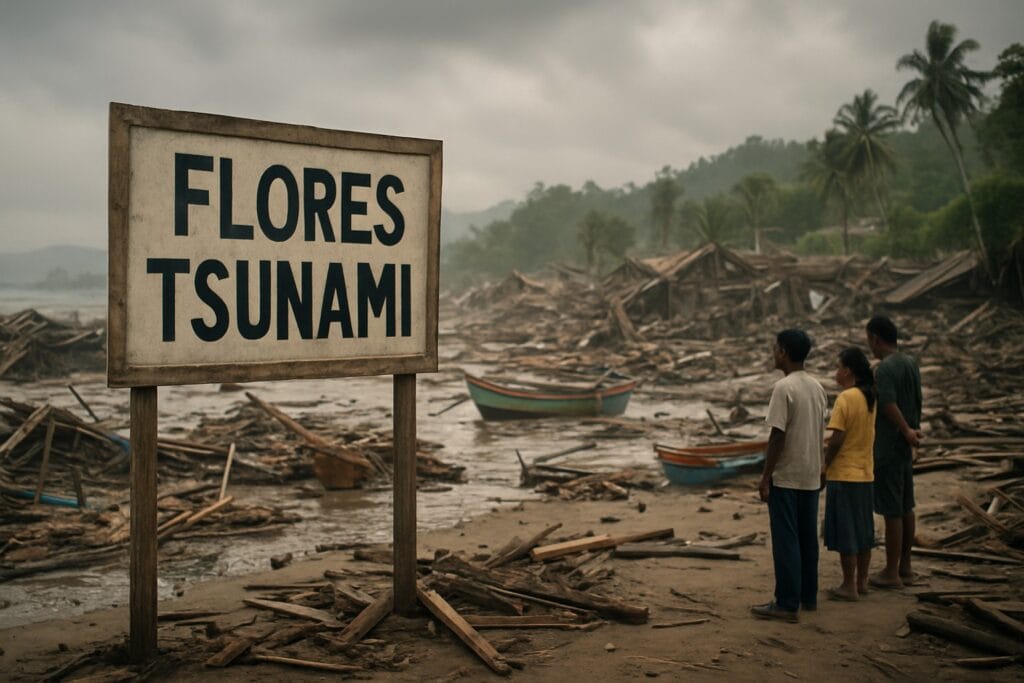
While Pangandaran captured much media attention due to its status as a tourist destination, the tsunami’s path carved a wide swath of destruction along more than 200 kilometers of the southern Java coast. Small fishing villages, where most homes were made of wood and light materials, suffered profound losses. In some places, locals recalled that it seemed as though the ocean had decided to take back a strip of land and everything on it.
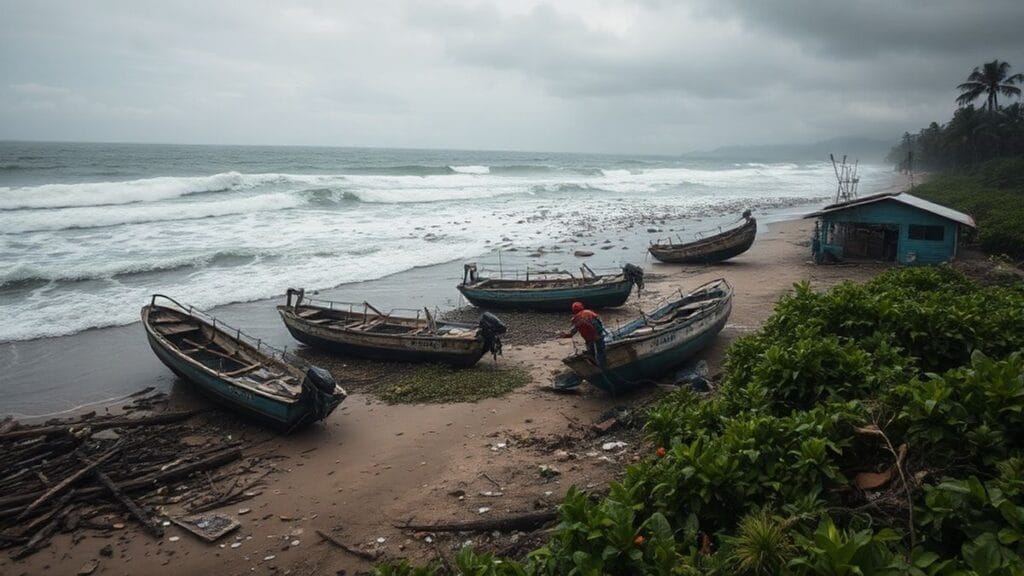
Satellite imagery taken before and after 17 July 2006 shows the visual scale of this theft. Areas once dense with houses, trees, and cultivated plots appear, post-tsunami, as muddy expanses with scattered remnants. Boats, the economic backbone of these communities, ended up marooned in rice fields or lodged into house walls. In one village, a large vessel came to rest atop a cluster of collapsed homes, a surreal monument to the violence of the waves.
Infrastructure was heavily affected. Bridges were washed away, severing road access and complicating rescue efforts. Electricity lines were downed; water systems were contaminated by seawater, mud, and debris. In several locations, tsunamis also triggered small fires when fuel depots and cooking gas tanks were ruptured, adding another layer of danger. The sound of sirens and generators would soon join the natural roar in a discordant post-disaster soundtrack.
A key feature of the java pangandaran tsunami 2006 was the variability of its impact over relatively short distances. Because of seafloor topography and coastal shape, some bays and inlets funneled and amplified the waves. A village lying in the direct path of such focusing might be almost obliterated, while another settlement just a few kilometers away, shielded by a headland or reef, experienced only moderate flooding. This unevenness posed challenges for emergency planners and later for policymakers deciding where and how to rebuild or relocate populations.
Economic damage was immense. For fishermen, boats and nets—often purchased with loans—were lost in minutes. For small business owners in tourist areas, their physical locations and inventories vanished. Rice paddies near the coast were inundated with saltwater, threatening medium-term food security and income. In many families, the tsunami did not merely claim lives; it annihilated livelihoods, creating a dual crisis of mourning and material survival.
Environmental consequences also emerged. The powerful waves uprooted coastal vegetation, including mangroves and protective tree belts. In some places, they excavated new channels and ponds; in others, they deposited thick layers of sand and debris over fertile soil. Coral reefs offshore were damaged by both the turbulence and the debris flows. Over time, some ecosystems would recover or adapt, but in the immediate aftermath, the once-familiar coastal ecology looked torn and exhausted.
Yet, amid this devastation, certain structures remained standing, almost defiantly. Concrete mosques, schools, or larger hotels sometimes resisted the waves better than lighter buildings, providing partial shelter for those who reached them in time. These survivals would later influence reconstruction debates: should communities build more robust structures in place, or move entirely away from the most vulnerable shorelines?
Documentary footage and journalistic photographs from those days—some later curated in academic works and disaster archives—give us a stark visual record. As one researcher wrote, paraphrasing an eyewitness, “It looked like the sea had invaded the land and then left its soldiers behind: pieces of houses, broken trees, ruined boats, and scattered belongings, all shining with a thin skin of mud.” In that strange new landscape, the work of rescue and recovery began.
Hospitals, Mosques, and Schools: The Social Fabric Torn Apart
The tsunami did not strike a blank canvas; it tore through an intricate social fabric woven from religious institutions, educational systems, local governance, and family networks. Mosques, churches, temples, schools, and clinics were not just buildings—they were the nodes around which community life coalesced. When these were damaged or destroyed, the loss reverberated far beyond bricks and mortar.
In Pangandaran and neighboring districts, several mosques near the shore endured heavy damage. For a Muslim-majority population where the call to prayer structures daily rhythm, the sight of collapsed minarets and flooded prayer halls was deeply unsettling. Yet in a striking pattern observed in many disasters, surviving religious spaces quickly transformed into aid hubs and shelters. Even mosques with broken windows and cracked walls hosted displaced families, their prayer rugs repurposed as bedding.
Schools likewise played a paradoxical role. Some coastal schools were badly hit, with classrooms flooded and walls torn open. The destruction of educational materials—books, desks, chalkboards—symbolized a sudden rupture in children’s routine and future prospects. At the same time, less damaged schools located inland became centers for temporary housing, food distribution, and information exchange. Blackboards that had once displayed mathematics problems now bore lists of missing persons and schedules for aid deliveries.
Hospitals and clinics faced immense pressure. In the immediate aftermath, medical staff struggled to cope with a surge of patients suffering from fractures, lacerations, infections, and near-drowning complications. Many health facilities had lost equipment, power, or water supply. Medical workers themselves were victims—some had lost families or homes—but had to compartmentalize their grief to perform triage under grueling conditions. Makeshift operating rooms were set up; volunteer doctors from other regions arrived within days, though access difficulties slowed the initial response.
These institutional strains intersected with class and gender dynamics. Poorer households were more likely to reside in flimsy structures closer to the shore, making them disproportionately vulnerable. Women, who often bore primary responsibility for children and elderly relatives, faced heightened emotional and logistical burdens during evacuation and in crowded shelters. Social scientists who later studied the java pangandaran tsunami 2006 noted that women were central in organizing communal kitchens, childcare circles, and informal counseling networks in displacement camps.
Local governance structures were tested. Village heads and district officials had to coordinate with provincial and national authorities, international NGOs, and local civil society groups. In the confusion of the first days, communication lines faltered. Rumors spread—about the possibility of another wave, about supposed miraculous survivals or prophetic warnings. Religious leaders sought to guide interpretation, often framing the disaster as both a test and a reminder of human humility before divine and natural forces.
The rupture of normalcy also had psychological dimensions. For many, the loss of familiar landmarks made their own identity feel unmoored. The street where they had grown up was gone; the market that had been their social universe was a heap of wreckage. Chronic stress in the weeks and months that followed manifested in insomnia, irritability, and, in some cases, long-term mental health challenges. Yet mental health services were limited, often overshadowed by the more visible needs of shelter, food, and medical care.
Through it all, a fundamental question pulsed beneath practical concerns: what does it mean to be a community when the physical spaces that embodied that community have been shredded? The answer, as it emerged over time, lay not simply in reconstruction of buildings but in the rituals, decisions, and collective narratives that would shape how people remembered and moved beyond 17 July 2006.
Rescue in the Rubble: Local Heroes, Fishermen, and First Responders
When historians reconstruct disasters, there is a temptation to focus on institutions—governments, NGOs, scientific agencies. But in the first hours after the java pangandaran tsunami 2006, the decisive actors were ordinary people thrown suddenly into extraordinary roles. Local fishermen, shopkeepers, teachers, and youth groups became first responders, often before any formal emergency teams arrived.
Fishermen, with their intimate knowledge of tides and currents, quickly grasped the scale of the disaster. Some whose boats had survived or could be repaired ventured back into turbulent waters to search for those swept out to sea. Their missions were perilous; aftershocks and the possibility of further surges loomed. Yet they pulled survivors from floating debris and brought bodies ashore for identification and burial. In makeshift morgues—sometimes just shaded corners of schoolyards—volunteers tried to preserve the dignity of the dead, covering them in cloth and recording features for families.
Youth from local organizations and informal neighborhood groups organized search parties, moving systematically through rubble, calling out, listening for faint responses. They learned quickly to distinguish between the silence of total collapse and the furtive noises that might indicate trapped survivors. In one often-retold incident, a group of young men carefully dismantled a collapsed house after hearing a child’s weak cries; hours of digging revealed a small girl pinned but alive, protected by the triangle formed by a fallen table.
Health workers—nurses, midwives, pharmacists—were another pillar of the ad hoc response. With clinics damaged, they established open-air treatment stations, requisitioning supplies from intact buildings and using what they had. Anesthetics were in short supply; pain was often treated with little more than paracetamol and human reassurance. The fear of infection grew as wounds were exposed to dirty water. Volunteers boiled water, disinfected tools with limited resources, and improvised bandages from clean cloth scavenged from half-destroyed homes.
National and regional authorities did dispatch search-and-rescue teams, soldiers, and police, but geography and damaged infrastructure delayed their full deployment. Helicopters conducted reconnaissance; trucks laden with supplies crept along roads cracked or blocked by debris. Coordination improved with each passing day, but those crucial first golden hours belonged overwhelmingly to people who, on 16 July, had not imagined themselves as rescuers.
Behind these visible acts of heroism lay less-celebrated but equally vital forms of labor. Women organized cooking in shelters, stretching limited rice and canned fish to feed hundreds. Elders calmed children with stories and gentle routines. Religious leaders led collective prayers that offered psychological anchoring in a context where nearly everything else seemed unstable.
One Indonesian journalist, reflecting on the local response, wrote in a feature article later cited by disaster scholars: “Before the uniforms came, it was the sarongs, the flip-flops, the wet T-shirts of ordinary villagers that stood between chaos and something like order.” That sentence, modest in its poetry, captures a truth often overshadowed by top-down narratives: everyday resilience is the first line of defense when catastrophe strikes.
The State Responds: Government, Politics, and the Weight of Expectation
In Jakarta, the news of the tsunami arrived through seismic reports, frantic phone calls, and, soon, televised images. Indonesia’s government, still scarred by criticism of earlier disaster responses, moved to frame its reaction as swift and compassionate. President Susilo Bambang Yudhoyono expressed condolences and promised assistance. Ministers traveled to the affected region, accompanied by media crews documenting their presence among the ruins.
Yet the reality on the ground was inevitably more complex than televised visits. Bureaucratic procedures, damaged roads, and the sheer scale of need created bottlenecks. Local officials had to compile casualty lists, assess infrastructural damage, and coordinate aid distribution. This process was not immune to the frictions of Indonesian politics—competing priorities, uneven capacity among districts, and occasional tensions between central and local authorities.
The java pangandaran tsunami 2006 came at a time when Indonesia was in the midst of reforming its disaster management structures. The National Disaster Management Agency (BNPB) would not be fully established until 2008; in 2006, responsibilities were scattered among various ministries and ad hoc coordinating bodies. Lessons from the 2004 tsunami had prompted the drafting of new laws and plans, but implementation lagged. On the ground in Pangandaran, this translated into a mixture of genuine dedication and bureaucratic improvisation.
Some communities reported frustration with delays in receiving tents, food, and clean water. Others worried that aid would flow preferentially to more visible tourist areas while smaller, poorer villages might be left behind. NGOs—both domestic and international—played a crucial role in filling gaps, but their presence also brought its own politics: competition for visibility, differing approaches to community engagement, and the challenge of aligning short-term relief with long-term development.
Still, it would be inaccurate to portray the state’s role as entirely inadequate. Over the subsequent weeks and months, substantial resources were mobilized for reconstruction, compensation schemes, and infrastructure repair. Government engineers assessed damaged roads and bridges; planners debated the merits of relocating houses farther inland versus building sea walls and designated evacuation routes. These debates were shaped by broader national conversations not just about tsunamis, but about how a populous, archipelagic country should manage its many overlapping hazards—from earthquakes and volcanoes to floods and landslides.
Internationally, the government also had to manage Indonesia’s reputation as a country learning—or failing to learn—from repeated disasters. Donor nations and agencies watched closely, both because they were providing assistance and because Indonesia’s experience held lessons for other coastal states. Was the country building a sustainable, community-centered approach to disaster risk reduction, or merely reacting episodically to each new tragedy?
Politics entered the picture in subtler ways as well. Local elites sometimes sought to shape reconstruction in ways that favored their allies or economic interests, such as promoting tourism-focused rebuilding that might marginalize traditional fishing communities. At the same time, civil society groups advocated for “build back better” principles, arguing that reconstruction must reduce, not reproduce, vulnerability. The java pangandaran tsunami 2006 thus became a battleground over competing visions for the future of the southern Javanese coast.
Global Echoes: International Aid and the Memory of 2004
Beyond Indonesia’s borders, the tsunami triggered a fresh wave of international attention, though never on the scale of the 2004 disaster. The world’s memory of those earlier, apocalyptic images influenced how governments, NGOs, and media outlets framed the 2006 event. Headlines invoked phrases like “Tsunami Strikes Indonesia Again,” linking Pangandaran’s suffering to the broader narrative of the Indian Ocean’s recent torment.
International aid organizations, many of which still had personnel and programs in Indonesia from the 2004 response, mobilized teams, funds, and equipment. Their familiarity with Indonesian partners and contexts allowed for somewhat faster mobilization than if they had been starting from scratch. Yet there was also a sense of fatigue in some donor circles. Having poured unprecedented resources into Aceh and other regions, some governments and publics were less willing to commit large sums to what appeared, by comparison, a smaller disaster.
This disparity in attention and funding raises enduring ethical questions about how the world values lives and losses. For the families on the southern coast of Java, the fact that fewer people died than in 2004 did not diminish the depth of their grief. But media logic often privileges the spectacular, the statistically enormous. The java pangandaran tsunami 2006 occupied a tragic middle ground: devastating locally, overshadowed globally.
Nevertheless, technical assistance flowed in. Experts from Japan, the United States, Germany, and other countries collaborated with Indonesian agencies to study the event’s characteristics. Field surveys measured run-up heights, mapped inundation zones, and documented structural damage. These collaborations were not purely academic; they fed into the design of improved hazard maps, building codes, and warning-system protocols.
International memory politics also played a role. For coastal communities in Sri Lanka, India, and Thailand, the news from Java stirred painful recollections of 2004. Some NGOs with regional mandates framed their support for Indonesia as part of a broader Indian Ocean resilience agenda, emphasizing that the ocean’s rim was a shared risk zone. Conferences and publications used the 2006 tsunami as another case study in how to transform “lessons learned” into “lessons applied.”
Yet behind the jargon of “capacity building” and “resilience,” there were real human relationships. Aid workers reunited with Indonesian colleagues they had met in Aceh. Some returned to Indonesia with a sense of unfinished moral obligation, feeling that their responsibility extended beyond a single, high-profile disaster. In their diaries and reports, they recorded not just technical data but also personal reflections on how communities regenerated social life amid ruins.
Science after the Waves: Understanding the Java Pangandaran Tsunami 2006
In the months following the disaster, scientists scrutinized the event with intense focus. Seismologists, geologists, oceanographers, and social scientists alike recognized that the java pangandaran tsunami 2006 offered crucial insights into a particular type of undersea earthquake and its human consequences. Field teams fanned out along the coast, interviewing survivors and measuring physical traces.
One key scientific finding was that the earthquake was indeed a “tsunami earthquake”—an event in which the tsunami is disproportionately large relative to the felt shaking. Such earthquakes tend to have slower rupture velocities and release energy at longer periods. According to studies published in journals like Geophysical Research Letters, the 17 July 2006 earthquake’s slow rupture contributed to the efficiency of tsunami generation even though many people onshore described the shaking as moderate rather than extreme.
Researchers mapped inundation distances, often using markers such as water stains on walls or debris lines on vegetation. In some low-lying areas, the waves penetrated hundreds of meters inland. Combining these data with numerical models, scientists reconstructed how the tsunami had interacted with local bathymetry and coastal topography. Narrow bays, gently sloping seabeds, and offshore reefs all modulated the waves’ height and speed, sometimes in counterintuitive ways.
Social scientists, meanwhile, focused on knowledge, behavior, and institutional response. They asked why, despite widespread awareness of the 2004 tsunami, many people in Pangandaran did not immediately flee after the earthquake. Interviews revealed a complex mix of factors: the relatively mild shaking, the absence of visible official panic, lingering fatalism, and sheer uncertainty about what to do. Some had never received clear guidance on tsunami evacuation; others had heard about tsunamis only through distant media, not as a locally relevant risk.
These studies contributed to a growing consensus that effective tsunami preparedness requires more than technology. Warning buoys, sirens, and seismic networks are vital, but without community education, regular drills, and trust in authorities, warnings may be ignored or misunderstood. The java pangandaran tsunami 2006 thus spurred a series of recommendations emphasizing “people-centered early warning systems,” a phrase that would echo through United Nations documents and Indonesian policy debates.
Scientists also confronted uncomfortable questions about how their own communication had fallen short. Some geologists had long known that the southern coast of Java was hazardous, but their concerns remained largely within professional circles. The challenge of translating probabilistic risk assessments into compelling, actionable public messaging loomed large. As one researcher ruefully admitted in an interview, “We had the graphs; we did not have the stories that would make people move.”
By integrating field data from 2006 with historical records and paleotsunami evidence, scholars were able to place the event into a longer-term pattern of seismicity along the Sunda trench. This improved understanding, in turn, informed scenario planning for potential future earthquakes and tsunamis that might strike even closer to major population centers. The sea had offered another harsh lesson; science, slowly and imperfectly, tried to learn.
Warning Systems and Missed Signals: Why So Many Were Caught Unaware
One of the most haunting aspects of the java pangandaran tsunami 2006 is the sense that, at least in principle, many of the deaths could have been prevented. Unlike “near-field” tsunamis that strike within minutes, this event offered a window—narrow but real—between the earthquake and the arrival of the waves. So why did so few people evacuate in time?
Part of the answer lies in the state of Indonesia’s tsunami warning infrastructure in 2006. After the 2004 catastrophe, international donors pledged support for a new Indian Ocean Tsunami Warning and Mitigation System. However, designing, installing, and integrating such a system is complex and time-consuming. By July 2006, some seismic monitoring and preliminary alert mechanisms were in place, but a fully functioning network of deep-ocean buoys, real-time data analysis, and coordinated local dissemination had not yet been achieved.
Even where technical alerts existed, the “last mile”—getting information from national centers to coastal populations—was fragile. Many coastal communities lacked sirens, public address systems, or established procedures for relaying warnings through trusted local leaders. In Pangandaran, there were no loudspeaker announcements ordering evacuation, no text-message blasts to mobile phones. The only clear signal most people received was the earthquake itself, and, as noted earlier, its moderate intensity masked the severity of the risk.
Misconceptions about tsunami precursors also played a role. In popular imagery, tsunamis are often associated with a dramatic withdrawal of the sea before the wave arrives. In some locations along the Java coast, such a withdrawal was noticeable; in others, it was not. People who expected this sign may have underestimated the danger when they saw only subtle changes in water level. Additionally, memories of 2004 could, paradoxically, create a kind of false template: if what they were seeing did not match the television images from Aceh or Thailand, some concluded that it could not be a true tsunami.
Institutionally, the event exposed gaps in routine preparedness. Regular evacuation drills were rare; hazard maps were not widely distributed or understood. Schools and hotels lacked clear, practiced procedures for guiding people to higher ground. In some cases, even when individuals wanted to flee, they were unsure which direction offered the safest route, especially in low-lying, flat terrain where vertical shelters were scarce.
After 2006, Indonesian authorities, in cooperation with international partners, accelerated efforts to address these shortcomings. Sirens were installed in more locations; community-based drills increased; tsunami awareness found its way into school curricula and public campaigns. The java pangandaran tsunami 2006, painful as it was, became a catalyst for turning abstract warnings into concrete policy and practice.
Yet the challenge of maintaining vigilance over time remains. As years pass without another major tsunami, memories fade, complacency can creep back, and maintenance of warning infrastructure may be neglected. The lessons of 2006 are thus not a one-time inheritance; they must be continually re-learned, re-taught, and re-embedded in the everyday culture of coastal life.
Rebuilding Pangandaran: Tourism, Trauma, and the Return to the Shore
In the months and years after the tsunami, Pangandaran confronted a delicate paradox: its economy depended on the very shoreline that had nearly destroyed it. Tourism was the town’s lifeblood—hotels, restaurants, surf shops, and beach vendors all relied on visitors drawn by the sea’s beauty. How, then, to rebuild without inviting a repetition of tragedy?
Initially, reconstruction focused on basic needs: clearing debris, restoring electricity and clean water, repairing roads, and providing temporary housing. Tents and barracks-like structures sprouted inland, housing families who had lost their homes. Over time, more permanent housing projects emerged, some funded by government programs, others by NGOs or religious charities. Debates arose about where to situate these new homes. Some planners advocated “no-build zones” along the most vulnerable shoreline areas, urging relocation of residences inland with the beachfront reserved for less vulnerable structures or open space.
However, economic pressures and land ownership patterns complicated such idealized plans. For some families, their only land lay near the shore; moving inland would mean losing both ancestral ties and convenient access to fishing grounds or tourist flows. Land speculation also surged, with outside investors eyeing the opportunity to buy up coastal plots at depressed prices, hoping to profit from future tourism revival. In this tug-of-war between safety and livelihood, compromises were often messy—some new structures rose perilously close to the water, albeit sometimes with slightly strengthened designs.
Psychologically, returning to normal tourism posed its own challenges. For residents who had lost loved ones, the idea of beachgoers sunbathing or jet-skiing near the spots where bodies had once floated could feel jarring, even disrespectful. Yet, over time, many also recognized that a complete rejection of tourism would deepen poverty and hinder recovery. The sea, in all its ambivalence, remained both a grave and a gift.
Initiatives to promote “disaster tourism”—visits that included educational components about the tsunami and local resilience—emerged, echoing similar patterns seen in Aceh and elsewhere. Small museums, memorial plaques, and guided tours sought to honor the dead while ensuring that their stories were not forgotten. These efforts sometimes stirred controversy: should trauma be curated for visitors? Yet for some survivors, telling their stories to outsiders provided a sense of agency and recognition.
Local culture adapted in subtler ways. Some households began keeping emergency bags by the door; children learned to identify escape routes from schools or homes. Drills, once rare, became more common, though participation and enthusiasm varied. The beach, once unambiguously a place of leisure, now carried a shadow of risk in the collective imagination. Still, on weekends and holidays, families gradually returned, spreading mats on the sand, playing in the shallows. The human desire for normalcy, for reclaiming joy in familiar places, proved strong.
Economically, Pangandaran’s recovery was uneven but persistent. Within several years, many hotels reopened or were rebuilt, some with higher floors and reinforced foundations. New businesses sprouted alongside older, resurrected ones. Government marketing campaigns sought to reassure domestic tourists that the town was safe and welcoming. For many Indonesians, choosing to vacation in Pangandaran became, quietly, an act of solidarity as well as leisure.
Yet even as the beachfront lights returned and souvenir stalls multiplied, the memory of 17 July 2006 remained embedded in the town’s identity. Anniversaries of the disaster were marked with prayers, community gatherings, and in some cases, public evacuation drills. The java pangandaran tsunami 2006 had become part of Pangandaran’s story, not an aberration to be forgotten but a chapter to be integrated into an ongoing narrative of living with the sea.
Religion, Ritual, and Mourning: How Communities Made Sense of Loss
In Indonesia, where religious identity is deeply interwoven with daily life, the tsunami’s aftermath quickly took on spiritual dimensions. For many survivors, understanding why such a disaster had occurred—and why it had claimed some lives while sparing others—required more than scientific explanation. It demanded theological and moral reflection, articulated in sermons, communal prayers, and private devotions.
Islamic leaders in West Java framed the tsunami in various ways. Some emphasized it as a test from God, a reminder of human mortality and the need for compassion and solidarity. Others, more cautiously, resisted narratives that portrayed it as punishment, wary of stigmatizing the victims or implying that they were somehow uniquely sinful. Friday sermons in mosques around Pangandaran often combined calls for repentance with exhortations to support the afflicted through charity and volunteerism.
Communal rituals of mourning helped structure the raw chaos of grief. Funerals, sometimes conducted in groups due to the number of dead, created spaces for shared lamentation. Recitations of the Qur’an over mass graves, tahlilan gatherings (collective prayers held several days after a death), and other rites offered both spiritual comfort and social cohesion. In multi-religious districts, Christian and other minority communities likewise held services, sometimes expressing solidarity across faith lines.
Traditional beliefs also resurfaced, particularly around the figure of Nyai Roro Kidul, the mythical Queen of the Southern Sea. For centuries, Javanese folklore has depicted her as a powerful, enigmatic spirit associated with the Indian Ocean, one who can bestow riches or disaster. After 2006, some locals interpreted the tsunami as a sign of her displeasure or as a cosmic rebalancing after perceived human disrespect toward the sea. While such interpretations might seem distant from modern hazard science, for those who held them they provided a culturally resonant framework for making sense of trauma.
These spiritual narratives did not operate in isolation from practical concerns. Religious organizations were among the most active providers of aid, leveraging their networks and moral authority. Islamic charities distributed food and clothing; church-based groups offered counseling; interfaith coalitions organized rebuilding projects. In many shelters, daily prayers punctuated routines, giving structure to days otherwise marked by uncertainty.
At the same time, theology became a quiet site of contestation. Some argued that belief in divine will should not translate into fatalism about disasters. They emphasized scriptural injunctions to seek knowledge and take precautions, interpreting efforts to improve warning systems and evacuation planning as expressions of stewardship rather than distrust of God. Others, more traditionalist, stressed acceptance over activism, wary that too much focus on control might slide into hubris.
Over time, these debates contributed to a richer conversation about “disaster theology” in Indonesia, a field where religious scholars and disaster experts increasingly engaged each other’s perspectives. The java pangandaran tsunami 2006 thus left a legacy not only in physical memorials but also in sermons, books, and quietly transformed beliefs about the proper human response to nature’s violence.
Children of the Tsunami: Memory, Education, and the Next Generation
For the children who lived through the tsunami, 17 July 2006 became a defining hinge in their personal histories—the day when the world before and the world after parted ways. Many lost parents, siblings, or friends; others saw their schools destroyed or their neighborhoods erased. As they grew older, their recollections shifted from raw sensory fragments to more reflective narratives, often colored by the educational messages they later received.
In the immediate aftermath, aid organizations prioritized getting children back into some form of schooling, even if under tents or in damaged buildings. Education was not only about academics; it was a tool for psychological stabilization. Routine, peer support, and engagement with caring adults could help mitigate trauma. Some NGOs introduced “child-friendly spaces” where play, art, and storytelling allowed young survivors to process their experiences in gentler modes.
As formal schools reopened or were rebuilt, tsunami education became part of the curriculum in many coastal areas. Teachers used the java pangandaran tsunami 2006 as a concrete example when explaining natural hazards. Posters showed evacuation routes; drills simulated earthquake and tsunami responses. Children learned to recognize natural warning signs—the combination of strong shaking and proximity to the sea—as triggers for immediate self-evacuation, independent of official announcements.
These lessons sometimes intersected awkwardly with lingering fears. For some children, repeated focus on tsunamis heightened anxiety, making the sea a constant source of dread. Sensitive educators tried to balance realism with reassurance, emphasizing not only the dangers but also the strategies for survival and the improvements in warning systems. They highlighted stories of heroism and community solidarity alongside those of loss.
Longitudinal studies by Indonesian and international researchers have followed some child survivors into adolescence and adulthood. Their findings suggest a spectrum of outcomes. Many displayed remarkable resilience, completing schooling, entering careers in teaching, health, or public service, and becoming informal educators about disaster readiness in their own right. A smaller subset struggled with chronic trauma symptoms, compounded by poverty or continued exposure to other stressors.
In community memory, the children of 2006 became both symbols of vulnerability and agents of change. On anniversaries, they sometimes performed plays or songs about the tsunami, blending personal recollection with didactic messages. These performances, while staged, carried the weight of lived experience. A child who had once clung to a piece of driftwood now stood before an audience, telling others how to run quickly to higher ground.
In this way, the java pangandaran tsunami 2006 seeded a generational shift in how coastal risk was understood. Those who had been young enough to learn from the disaster rather than be crushed by its responsibilities would, as adults, hold key roles in shaping community preparedness for whatever the ocean might bring next.
From Local Tragedy to National Lesson: Policy, Preparedness, and Reform
In the years after 2006, Indonesia’s disaster management landscape changed significantly, shaped in part by the hard lessons of Pangandaran. Laws were revised; agencies were created or strengthened; disaster risk reduction began to appear not only in emergency planning documents but also in development strategies and school textbooks.
The establishment of the National Disaster Management Agency (BNPB) in 2008 marked a pivotal institutional shift. With a clearer mandate and dedicated funding, BNPB could coordinate across sectors and levels of government more effectively than the ad hoc arrangements of the past. Local disaster management agencies (BPBD) were also formed at provincial and district levels, including in West Java. These structures were tasked with everything from hazard mapping and early-warning dissemination to evacuation planning and public education.
Specific to tsunamis, Indonesia invested in the development of the Indonesian Tsunami Early Warning System (InaTEWS), combining seismic data, tide gauges, and, gradually, deep-ocean buoys. While technical and maintenance challenges have persisted, the system represents a substantial upgrade from the patchwork arrangements of 2004 and 2006. Protocols were refined to allow for quicker issuance of alerts, though efforts continue to reduce false alarms and ensure clear messaging.
The java pangandaran tsunami 2006 also influenced land-use and building policies. Some district governments introduced regulations limiting construction within designated coastal setback zones, or at least encouraging the use of stronger materials and elevated designs. Vertical evacuation structures—multi-story buildings designed to withstand shaking and wave impact—were planned in some high-risk areas where inland escape options are limited. Implementation has been uneven, often constrained by budgets, political will, and local resistance, but the principle of designing with tsunamis in mind gained traction.
Importantly, policy discourse shifted from a narrow focus on response to a broader emphasis on risk reduction. This included integrating disaster risk considerations into school curricula, health planning, and even cultural programming. National campaigns promoted simple, memorable rules for earthquake and tsunami behavior. Community-based initiatives, often led by NGOs in partnership with local authorities, trained volunteer brigades in early-warning dissemination and evacuation support.
Critics caution, however, against overly optimistic narratives. They point out that vulnerability remains high in many coastal communities, where poverty, informal settlements, and limited infrastructure persist. Maintenance of warning systems and evacuation routes can wane when political priorities change. Corruption and mismanagement occasionally undercut well-intentioned programs. The java pangandaran tsunami 2006 did not magically solve Indonesia’s disaster challenges; rather, it added another set of scarred lessons to an already complex risk landscape.
Still, there is evidence that these reforms have made a difference. In subsequent tsunami and earthquake events, such as those affecting other parts of the archipelago, improved warning dissemination and community knowledge have in some cases reduced casualties compared to earlier disasters of similar magnitude. The memory of Pangandaran, in this sense, has radiated outward, saving lives in places that never felt its waves.
Waves in the Historical Record: Java’s Long Relationship with the Sea
To fully understand the java pangandaran tsunami 2006, it is helpful to place it within a deeper historical frame. Java’s relationship with the sea has always been marked by both opportunity and threat. Ancient Javanese kingdoms like Mataram and Majapahit relied on maritime trade routes that crossed the same Indian Ocean now associated with tsunamis. Ports along the north coast connected Java to China, India, and the Middle East; the south coast, though rougher and less developed, interfaced with Indian Ocean fisheries and spiritual imaginaries.
Historical chronicles, colonial records, and oral traditions all mention instances where the sea behaved violently. The Dutch, who colonized Indonesia for centuries, kept logs of unusual waves and coastal floods, though not always distinguishing between storm surges, tsunamis, and other phenomena. Indigenous stories often spoke in metaphorical terms—great floods, angry spirits—but their timing and geographic specificity have allowed some modern researchers to correlate them with probable seismic events.
One frequently cited antecedent is the 1921 south Java tsunami, which affected parts of the coast with waves reportedly several meters high. Though less documented than some other events, it left imprints in local memory. The 1994 East Java tsunami, linked to a magnitude 7.8 earthquake, killed over 200 people and provided more systematic data, including tide-gauge records and early scientific surveys. These and other events form a lineage of oceanic violence that contextualizes 2006 as neither freak accident nor entirely predictable repetition.
In traditional Javanese cosmology, the sea often symbolizes the wild, the uncontrolled, in contrast with the ordered world of rice fields and villages. Rituals to appease sea spirits, offerings cast into the waves, and taboos about clothing colors or behavior on certain beaches reflect a deep-seated recognition of marine power. Modern tourists might experience such practices as quaint folklore, but for many locals they encode practical warnings: respect the ocean’s moods, do not turn your back on it entirely.
Colonial and postcolonial development policies sometimes disrupted these old balances. Projects that cleared mangroves, straightened river mouths, or built densely packed settlements near shorelines altered natural buffers. Economic imperatives—export crops, tourism, fisheries—often trumped cautious coastal management. The 2006 tsunami can thus also be seen as a collision between geological time and the recent centuries of accelerated human coastal occupation.
Historians and anthropologists examining the java pangandaran tsunami 2006 have argued that disasters are “not only natural events but social processes unfolding in time.” The tsunami’s waves were a physical shock, but their impacts were magnified by the ways Javanese society had organized its life along the coast, the stories it told about the sea, and the policies that shaped its built environment. In this sense, 2006 stands as both a violent punctuation mark and a continuation of a longer, uneasy dialogue between Java and its southern ocean frontier.
Living with the Next Wave: Ongoing Risk on the Southern Java Coast
Today, if you walk along the beaches of Pangandaran on a calm day, you might see little to remind you of the devastation of 2006. New hotels rise where older ones fell; children build sandcastles near the waterline; fishermen mend nets under the same blue sky that presided over the disaster. Time, commerce, and human adaptability have a way of smoothing over physical scars. Yet the risk has not vanished; the tectonic plates offshore continue their inexorable grind.
Seismologists warn that the Sunda trench remains capable of generating larger earthquakes and tsunamis than the one in 2006. Some models envision scenario events that could send even higher waves into parts of Java’s coast, particularly if rupture segments closer to densely populated areas fail. The precise timing and location of such events are impossible to predict, but their eventual occurrence is almost certain in geological terms.
This raises hard questions about long-term coastal development. How many people should live within the lowest, most exposed strips of land? What level of risk is acceptable for critical infrastructure—power plants, ports, communication hubs—near potential inundation zones? How can evacuation routes and shelters be maintained and upgraded amid competing budgetary demands?
At the community level, efforts to normalize tsunami awareness face the twin challenges of complacency and fatalism. Some younger residents, especially those who were children or not yet born in 2006, may see the event as distant history, its urgency dulled by time. Others, particularly older survivors, may carry such heavy emotional associations with the topic that they prefer not to discuss it. Crafting education and preparedness programs that respect these sensitivities while still fostering readiness is a delicate art.
Climate change adds another layer of complexity. While it does not cause tsunamis—those remain the domain of seismic and volcanic processes—rising sea levels and coastal erosion can exacerbate tsunami impacts by allowing waves to reach farther inland. Changes in storm patterns and rainfall may also interact with tsunami risk in ways not yet fully understood. Forward-thinking planners in Indonesia increasingly advocate an integrated approach that treats tsunamis as one facet of a broader coastal hazard mosaic.
The legacy of the java pangandaran tsunami 2006 thus lives on as a set of unresolved but vital questions: how to balance proximity to the sea’s economic and aesthetic benefits with respect for its destructive capacities; how to translate scientific probability into meaningful everyday practice; how to honor the memory of those lost by ensuring that their deaths contribute to greater safety for others. These are not questions with final answers, but they define the ongoing conversation between Java’s southern communities and the restless ocean beyond.
Conclusion
The story of the Java (Pangandaran) tsunami of 17 July 2006 is, at its core, a story of collision—between deep geological time and the fragile span of human lives, between scientific knowledge and social preparedness, between the irresistible lure of the sea and its sudden transformation into a force of annihilation. On that quiet July morning, few in Pangandaran could have imagined that by late afternoon their town would be synonymous with devastation, that the words “java pangandaran tsunami 2006” would circulate in scientific papers, policy debates, and survivors’ dreams alike.
We have traced the disaster from its tectonic origins beneath the Indian Ocean through the terrifying advance of the waves, the destruction they wrought along the southern Java coast, and the intimate stories of survival and loss that unfolded in seconds and hours. We have seen how institutions—hospitals, mosques, schools, government agencies—struggled and adapted, how local heroes emerged in flip-flops and fishing boats, and how, in the absence of perfect warning systems, human instinct and remembered stories sometimes made the difference between life and death.
In the aftermath, the tsunami became a crucible for change. It exposed gaps in Indonesia’s early-warning infrastructure and disaster governance, accelerating reforms that would reshape the country’s approach to risk. It spurred scientific advances in understanding tsunami earthquakes and highlighted the critical importance of community-based preparedness. It also left enduring marks on religious practice, local culture, and the identities of those who grew up in its shadow.
Yet, for all the policies rewritten and systems improved, the fundamental condition of coastal life along Java’s southern edge remains: to live there is to dwell in a space of beauty braided with danger. The waves that draw tourists and sustain fishermen are the same waves that, under the right seismic push, can rise and roll ashore with lethal force. The challenge—for planners, educators, religious leaders, and ordinary residents—is not to banish this risk, which is impossible, but to weave it into the fabric of daily awareness without succumbing either to paralyzing fear or reckless denial.
As the years pass, memories of the java pangandaran tsunami 2006 will inevitably soften, especially for those who did not stand in its waters. But history, kept alive through stories, rituals, and thoughtful policy, can serve as a second kind of early warning system: a reminder that the ground can shake without much damage and still herald a deadly sea, that quiet mornings can end in catastrophe, and that the choices made in the calm between quake and wave can echo for generations. In honoring those who died and those who rebuilt, we affirm a commitment to making those choices wiser whenever the ocean’s next test arrives.
FAQs
- What caused the Java Pangandaran tsunami in 2006?
The tsunami was triggered by a magnitude 7.7 undersea earthquake along the subduction zone where the Indo-Australian Plate dives beneath the Sunda Plate, south of Java. This event was a so-called “tsunami earthquake,” in which relatively modest shaking on land belied a highly efficient displacement of the seafloor that generated powerful waves. - How many people were killed or affected by the disaster?
Across the southern Java coast, more than 600 people lost their lives, with thousands more injured and tens of thousands displaced. Pangandaran and its surrounding districts accounted for a significant portion of these casualties, as the tsunami struck densely populated and tourist-heavy areas. - Why were there no effective warnings before the waves arrived?
At the time, Indonesia’s tsunami warning system was still in an early stage of development, following the 2004 Indian Ocean tsunami. While seismic networks detected the earthquake, the mechanisms for rapidly translating that detection into clear, local warnings—sirens, public announcements, evacuation protocols—were incomplete or absent along much of the affected coast. - How high were the tsunami waves in Pangandaran?
Wave heights varied along the coast due to local seafloor and shoreline features. In Pangandaran, run-up heights were generally measured at around six to seven meters, while in some nearby stretches they reached ten to twelve meters. Even lower waves were powerful enough to destroy many light structures and sweep people inland. - What changes did Indonesia make after the java pangandaran tsunami 2006?
Indonesia accelerated the creation of a national disaster management agency (BNPB), expanded local disaster offices, and invested in the Indonesian Tsunami Early Warning System (InaTEWS). The government and NGOs also promoted community-based preparedness, evacuation drills, and integration of tsunami education into school curricula, while revising some coastal planning and building regulations. - Is Pangandaran safe to visit today?
Pangandaran has been rebuilt and is once again a popular tourist destination. While the underlying seismic risk remains—as it does for many coastal areas in Indonesia—warning systems, public awareness, and evacuation planning have improved since 2006. Visitors, like residents, should remain attentive to local guidance about earthquake and tsunami procedures. - What is meant by a “tsunami earthquake”?
A tsunami earthquake is an undersea earthquake that, despite having relatively moderate or long-period shaking on land, generates an unusually large tsunami for its magnitude. These events often involve slow rupture and significant vertical seafloor movement, making them especially dangerous because people onshore may underestimate the threat based on how the quake feels. - How does the 2006 Java tsunami compare to the 2004 Indian Ocean tsunami?
The 2004 tsunami was far larger in magnitude and geographic scope, killing around 230,000 people across multiple countries. The 2006 event was smaller but still devastating locally. Importantly, it revealed that even moderate-to-large quakes could produce deadly tsunamis and that lessons from 2004 had not yet been fully translated into preparedness on Java’s southern coast.
External Resource
Internal Link
Other Resources
- Encyclopaedia Britannica – general search for the exact subject
- Google Scholar – academic search for the exact subject
- Internet Archive – digital library search for the exact subject