Table of Contents
- A Remote Volcano Rises from the Blue Pacific
- Ancient Seas and Ancestral Stories of Fire
- From Wartime Charts to Scientific Curiosity
- The 2000s Awakenings: When Kavachi Refused to Sleep
- Witnesses at the Edge of a Boiling Sea
- Science at the Mouth of the Dragon
- Sharks in the Crater: Life Inside an Underwater Inferno
- Islands of Fire: Local Communities and the Unquiet Seafloor
- Warnings, Waves, and the Fragile Security of the Solomon Islands
- The Volcanic Laboratory: Kavachi and Global Climate Questions
- Geopolitics in the Ring of Fire: Mapping a Dangerous Frontier
- Storytellers, Sailors, and the Memory of the Sea
- The Changing Face of the Volcano Through the 2010s and Beyond
- Measuring the Unseen: Satellites, Sensors, and Silent Ash
- A Living Metaphor: Risk, Resilience, and Island Futures
- Conclusion
- FAQs
- External Resource
- Internal Link
Article Summary: In the remote southwest Pacific, the Kavachi eruption Solomon Islands story in the 2000s unfolded as a sequence of restless, underwater convulsions that drew fishermen, scientists, and satellites to a patch of sea that seemed to boil from within. This article traces the long history of Kavachi, from ancestral tales of fire beneath the ocean to its modern reputation as one of the most active submarine volcanoes on Earth. It follows the renewed eruptions of the 2000s, when the volcano repeatedly tried to build a temporary island, only to see its handiwork smashed back below the waves. Along the way, researchers discovered something astonishing inside the crater itself—sharks and other large animals thriving in a realm of acid, heat, and ash. The narrative explores how the kavachi eruption solomon islands sequence affected local communities, influenced disaster planning, and became an open-air laboratory for studying climate-related ocean change. It also delves into the geopolitical and scientific significance of monitoring such hidden giants of the seafloor. Through eyewitness accounts, scientific missions, and cultural memory, the kavachi eruption solomon islands saga becomes a lens on vulnerability and resilience in the Pacific. In the end, Kavachi stands as both a threat and a teacher, reminding the world that the boundary between land and sea, calm and chaos, can shift in a single explosive breath.
A Remote Volcano Rises from the Blue Pacific
The story of the Kavachi eruption Solomon Islands in the 2000s begins far from any capital city, far from highways and skyscrapers, out where the map of the world thins into blue. South of Vangunu Island, a lonely patch of sea in the New Georgia Group hides a mountain that almost never appears on ordinary maps. There is no lighthouse, no harbor, no visible cliff. For most travelers, there is only the endless Pacific stretching away in all directions. Yet below the surface, the seafloor buckles and heaves, sculpted by the collision of tectonic plates that have been grinding together for millions of years. Out of this unseen violence rises Kavachi, a submarine volcano whose summit lies just beneath the waves, perpetually attempting to become an island, perpetually torn apart again.
From a distance, there is often nothing to suggest the presence of a volcano at all. The sea may appear calm, glistening in the tropical sun, dotted with flying fish and the prow of a wooden canoe. But local fishermen know better. They have learned to read the faint discoloration of the water—milky turquoise streaks where superheated, acidic fluids have mixed with seawater. They have learned to listen for the low, muffled booms that carry across still evenings, rumbling like distant thunder from somewhere below. And sometimes, when Kavachi stirs more violently, they can see the sea itself tremble, frothing in great circles, as if something alive is trying to surface.
To most of the world, the kavachi eruption solomon islands episodes of the 2000s were small stories, footnotes in the daily news cycle, overshadowed by great eruptions of ash and lava from better-known volcanoes like Mount Etna or Mount St. Helens. But for those who live in the Solomon Islands—an archipelago already defined by the forces of the Ring of Fire—Kavachi is an intimate presence, a reminder that the ground beneath them does not end where the land meets the sea. It continues downward, unstable and restless, shaped by the same furnace that feeds Kavachi’s crater. When someone in the provincial capital speaks of “the volcano in the sea,” they rarely need to clarify which one. Kavachi is simply there: a quiet menace on the maritime horizon, a name passed between generations like a warning and a myth.
Before the 2000s, Kavachi had erupted again and again, its cycles of growth and destruction recorded in fragments—by passing ships, by local oral histories, by the first scientific expeditions that dared to approach the churning water. But this was only the beginning of its modern story. In the new millennium, as satellite imagery sharpened, as underwater cameras and remote vehicles improved, and as the world’s attention turned more urgently toward climate and ocean change, Kavachi stepped back into the spotlight. Its eruptions became more than a local curiosity; they became a living experiment, a window into how planets reshape themselves from the inside out.
Ancient Seas and Ancestral Stories of Fire
Long before geologists spoke of subduction zones and magma chambers, the people of the Solomon Islands listened to the sea and told stories about what lay beneath. In villages scattered across Vangunu and the neighboring islands, night-time conversations often drifted toward the supernatural—the restless spirits, the ancestral guardians, the places that were taboo. Among these places, the waters above Kavachi had a special weight. Fishermen returned with tales of strange sounds from the deep, of fish that surfaced dead for no visible reason, of sudden patches of hot water that stung the skin.
In these stories, fire and water were not enemies; they were intertwined. Elders spoke of a world in which the sea was not just a place of sustenance but also a realm of immense power. Some believed that the underwater volcano was the work of ancestral beings who had retreated beneath the waves, stirring the earth when angered or neglected. Others saw it as a hole in the world, an opening into a deeper realm where spirits of the dead and the unborn converged. Legends of glowing water at night, of a red light flickering beneath the surface, were passed down in a mixture of awe and fear.
These narratives were not simply folklore in isolation—they served as practical wisdom for survival. If the water changed color, if fish died en masse, if an odd sulfurous smell drifted over the waves, the elders advised staying away. In their own language, they described something very close to what modern volcanologists would later call “hydrothermal activity.” They understood that the sea could suddenly become hostile, that invisible forces could poison the water or generate waves unlike any normal swell. Their stories encoded the accumulated observations of generations who had watched the slow, cyclical drama of the kavachi eruption solomon islands long before it entered scientific literature.
It is astonishing, isn’t it, how these ancestral understandings align with the deep-time history of the region? For millions of years, the Pacific Plate has been sliding beneath the Indo-Australian Plate, dragging down water-enriched ocean crust into the hot mantle. The result is a chain of volcanoes, some towering above the sea as islands, others lurking just below the surface, such as Kavachi. Geologically, Kavachi is a stratovolcano that has repeatedly tried to build itself upward by explosive eruptions and lava flows, only to be demolished by waves and its own unstable slopes.
There is no single, fixed date for Kavachi’s birth. Its roots stretch back into epochs when ice ages came and went, when sea levels rose and fell, when humans had not yet crossed into this part of the Pacific. Sediments on the seafloor carry the record in thin, alternating layers of volcanic ash and oceanic mud, like pages in an ancient book. Each ash layer tells of a past eruption—some explosive, some gentle, some perhaps large enough to send tsunami waves toward nearby coasts. If an ancestor once told a tale about a “year of the hot sea” or “the season the fish vanished,” it may well have corresponded to one of these layers, now buried in darkness.
Thus, when scientific expeditions in the late twentieth century began to talk about cataloguing Kavachi’s behavior, they were entering not a blank space, but a realm already mapped, in another language, by those who had lived under its shadow. The kavachi eruption solomon islands saga is, in this sense, a meeting between two knowledge systems: one bound to seafaring and memory, the other to seismographs and chemical analysis. Both would become essential for understanding what happened in the tumultuous decade to come.
From Wartime Charts to Scientific Curiosity
The modern world first took serious note of Kavachi in the mid-twentieth century, when global conflict and exploration drew more ships into the tropical Pacific. During World War II and the tense decades that followed, navies charted the Solomon Islands region with new intensity. Pilots flying reconnaissance missions, sailors standing watch at dawn, and hydrographic surveyors mapping the seafloor sometimes reported peculiar disturbances south of Vangunu: discolored water, floating pumice, and plumes of steam where no island was supposed to be.
In the 1950s, one such disturbance attracted particular attention. Crew members aboard passing vessels described bursts of dark ash and incandescent fragments breaking the ocean’s surface, rising tens of meters into the air before collapsing back into the sea. The eruption was violent enough that for a brief period, a low, dark island appeared—only to disappear again under the relentless assault of waves and gravity. A British naval vessel reportedly sailed by and gave the feature a provisional note on its charts. The volcano was later named Kavachi, likely after a nearby island or a local designation, though even here, the history is partly obscured by the blending of local and foreign naming practices.
By the 1960s and 1970s, oceanographers and volcanologists began to recognize the importance of submarine volcanoes in the broader picture of Earth’s evolution. Researchers from New Zealand, Australia, and the United States turned their eyes to Kavachi, intrigued by the possibility of watching island-building in real time. Here was a volcano close enough to the surface to be studied with relative ease but active enough to show dramatic changes on human timescales. In scientific papers of the 1970s and 1980s, brief notes about Kavachi’s eruptions began to appear, accompanied by grainy black-and-white photographs of ash columns punching through the sea.
Yet most of these early observations were opportunistic, depending on the luck of a ship happening to pass during an active phase. The volcano would erupt, throw up a temporary cone, and then retreat again beneath the waves, smashing to pieces under its own weight. Volcanologist R. W. Johnson, writing in the 1970s, noted how “the life of this island is measured in weeks, sometimes days,” capturing the tragedy of a mountain forever trying to be born. [Johnson, 1972, cited in regional volcanic bulletins] For all the fascination, however, the technology of the era made it difficult to monitor Kavachi continuously. There were no permanent instruments on the seafloor, no GPS-linked buoys, and satellite imagery was in its infancy.
So, as the twentieth century closed, Kavachi remained something of a mystery: notorious among sailors in the Solomon Islands, periodically documented in scientific bulletins, but seldom studied in depth. The stage was set for change. As the 2000s approached, new tools—higher-resolution satellites, more agile research vessels, remotely operated vehicles—would converge with the volcano’s own cycles. The kavachi eruption solomon islands events of the new century would unfold under a more watchful human gaze than ever before, even as the volcano itself continued to follow rhythms older than any map or instrument.
The 2000s Awakenings: When Kavachi Refused to Sleep
At the turn of the millennium, the Solomon Islands were grappling with political unrest and economic uncertainty, yet the sea, as always, remained a constant presence. Fishermen off Vangunu noticed subtle changes before any scientific agency issued an alert. In the early 2000s, they began to report more frequent patches of “hot water” near the known location of Kavachi, along with a metallic tang on the air on windless days. One boat returned to shore with a story of a strange, whitish foam spreading over the surface, as if soap had been poured into the ocean. To many, it felt like a whisper that the volcano was stirring again.
By the early 2000s, satellites like NASA’s MODIS instruments were routinely scanning the planet’s surface, including the tropical seas. Analysts in distant offices noticed recurring plumes of discolored water in imagery south of Vangunu. At first, these might have been attributed to sediment runoff or algal blooms, but their localization over the known position of Kavachi suggested a volcanic source. Coordinating with local reports, scientists concluded that a new eruptive phase had begun.
The kavachi eruption solomon islands phase that unfolded in the 2000s was not a single cataclysmic blast but a series of episodes—fits and starts, eruptions and lulls, like a sleeper tossing and turning in a fever dream. Some years saw only minor hydrothermal venting, the underwater release of hot fluids and gases that tinted the water and altered its chemistry. In other years, Kavachi produced full-blown surtseyan eruptions, named after the birth of the island Surtsey off Iceland in the 1960s: violent explosions where magma met seawater at shallow depths, fragmenting into ash, steam, and volcanic bombs that were hurled into the air.
Local residents began to speak of “the year of the roaring sea,” when booms from the volcano carried to shore even during daylight, and a faint haze sometimes hovered on the horizon. Wooden canoes stayed farther away from the known coordinates; some fishers refused to cross the area entirely, deviating their routes by hours rather than risk being caught near the volcano during a sudden explosion. When asked, an elder from a village on Vangunu reportedly said, “The sea is talking louder now. We should listen.” It was a sentiment as much spiritual as practical, yet it aligned with volcanological data: the 2000s brought a noticeable uptick in activity.
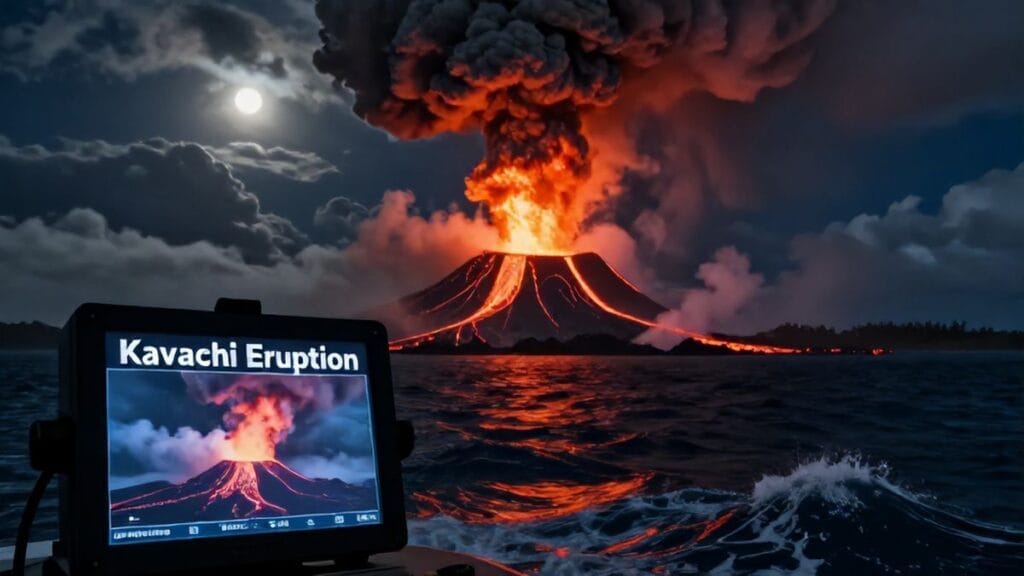
One of the most dramatic episodes occurred mid-decade, when Kavachi constructed yet another ephemeral island. Observers from a passing vessel recorded a low, dark cone breaking the surface, perhaps a few tens of meters across, ringed by vigorous steaming and bubbling water. For days, the island grew, fed by fresh explosions and lava fragments that piled onto the cone. Imagery from above showed a stark circle of pale turquoise water around the black core—a classic sign of hot, acidic fluids mixing with the surrounding sea.
But as in previous decades, the island’s life was short. Waves gnawed at its flanks relentlessly, and the unconsolidated volcanic material slumped back into the sea. Within weeks, sometimes even days, the island had all but vanished, leaving only a shallow, dangerous shoal and a memory. For scientists, however, each brief emergence was a chance to capture data, photographs, and samples, to add another layer of understanding to the evolving portrait of the kavachi eruption solomon islands narrative.
Witnesses at the Edge of a Boiling Sea
To imagine the 2000s eruptions of Kavachi is one thing; to stand at the edge of its activity is another entirely. Consider the experience of a small crew aboard a research vessel, or even a local fisherman nudging his canoe closer than prudence suggests. The first sign is often the smell—sharp, sulphuric, the odor of rotten eggs, but tinged with something metallic, like a hot engine. Then comes the sight: a patch of ocean that doesn’t behave like the rest.
Here, the water boils without boiling. Concentric rings of turbulence spread from an invisible point, their surfaces broken by bubbles of gas and streaks of foam. At the center, a muddy column may rise—a mixture of ash, volcanic glass, and gas-charged water. When the volcano is more active, sudden blasts punch through the surface. Columns of dark ash leap skyward, sheathed in white steam, before collapsing in messy fountains of spray. Chunks of lava, some still glowing red, may be thrown clear of the water, only to hiss and vanish as they fall back into the waves.
An officer aboard a passing cargo ship in the 2000s described sailing past Kavachi at dawn, just as sunlight broke over the eastern horizon. “The sea looked torn open,” he wrote later in his log. “We could see this wound, this place where the ocean seemed to be boiling. A dark column rose maybe a hundred meters, then drifted down as ash. The smell reached us even on the bridge.” His words mirror countless other eyewitness accounts from differently scaled eruptions, a consistency that lends weight to the image of Kavachi as a living, breathing entity, exhaling through the sea.
Local fishermen, meanwhile, experienced the eruptions on a more intimate level. Those who dared approach during quieter phases reported catching fish with odd lesions or discolorations. Some caught dead fish floating on the surface, victims of sudden changes in water temperature or chemistry. “We know when not to cast nets there,” one fisherman is quoted in a regional report. “The fish themselves tell us, when they die like that. It’s not our place.” These lived experiences became a subtle early warning system supplementing any distant satellite observations of the kavachi eruption solomon islands phenomena.
Yet behind the wariness was also a kind of fascination, even pride. In provincial gatherings and school lessons, Kavachi’s eruptions in the 2000s sometimes appeared as a point of identity: proof that the Solomon Islands sat atop one of the most dynamic geological settings on Earth. Children were shown photographs of the erupting sea; teachers spoke of how the same deep forces had built the islands they called home. It was a way of turning danger into story, of weaving risk into the fabric of belonging.
Science at the Mouth of the Dragon
For the scientific community, the 2000s presented both an opportunity and a challenge. Reaching a volcano that erupts underwater, far from major ports, and often without warning is no simple task. Yet the allure was irresistible. Kavachi offered a rare union of accessibility and intensity—a volcano that rose to near sea level, in a climate relatively hospitable to research cruises, yet remained highly active. The kavachi eruption solomon islands events of the decade lured volcanologists, marine biologists, ocean chemists, and even geophysicists into a shared, interdisciplinary experiment.
On several expeditions, research vessels approached the volcano cautiously, guided by real-time satellite data and reports from local fishermen. The closer they drew, the more the instruments aboard came alive. Sonar maps traced the steep, unstable flanks of the cone; water samplers collected bottles of near-crater fluid, hot and acidic, stained with fine ash. Temperature probes revealed pockets where the normally cool tropical ocean shot upward by several degrees, a striking anomaly in such a vast body of water.
Scientists lowered CTD rosettes—clusters of sensors and sampling bottles—through plumes of discolored water, measuring conductivity, temperature, and depth in a fine vertical profile. The data told of sharply stratified layers near the volcano, where hydrothermal fluids rose in buoyant columns before dispersing. Chemical analyses later revealed high concentrations of dissolved metals and gases, including carbon dioxide, hydrogen sulfide, and various trace elements. These findings linked Kavachi to broader questions about how submarine volcanoes contribute to ocean chemistry and, by extension, to climate processes on geological timescales.
At the same time, seafloor mapping campaigns endeavored to capture the volcano’s changing shape. Multibeam sonar surveys conducted a few years apart painted a dynamic picture: steep slopes scarred by landslides, summit depths rising and falling as eruptions added material or gravitational failures removed it. Like sculptors revising a statue over and over, the combined forces of eruption and erosion constantly reshaped Kavachi’s summit, ensuring that any chart of its depth would become outdated within years, if not months.
One of the most ambitious undertakings involved the use of remotely operated vehicles (ROVs) and autonomous underwater vehicles (AUVs). These robotic explorers, tethered to the ship or navigating independently, could approach the volcano more closely than any human diver safely could. Pilot teams watched live video feeds as cameras descended into the green gloom around the crater, revealing cliffs of fresh volcanic rock, sulfur-encrusted boulders, and billowing clouds of black or milky fluid. In one mission, an ROV’s sensors recorded dramatic spikes in temperature and turbidity mere meters from a vent opening, underscoring just how energetic the kavachi eruption solomon islands system could be even between its most photogenic explosive episodes.
These scientific campaigns were not without risk. ROV cables could be snagged on unstable rock; sudden eruptions could damage equipment or force ships to retreat. Planning required close coordination with local authorities in the Solomon Islands, as well as sensitivity to the cultural significance of the area. Yet the shared sense of discovery pushed the expeditions forward. Every new dataset, every sample bottle retrieved from the boiling heart of Kavachi, felt like a conversation with the Earth’s interior—a brief exchange before the sea closed over again.
Sharks in the Crater: Life Inside an Underwater Inferno
Among all the findings that emerged from Kavachi in the 2000s and early 2010s, one image captured the imagination of the world more than any other: sharks, large and unmistakably alive, swimming inside the volcano’s active crater. For decades, marine biologists had wondered what kinds of life could withstand the extreme environment of a shallow submarine volcano—acidic water, elevated temperatures, toxic gases, and periodic explosive eruptions. The assumption, understandably, was that only specialized microbes or perhaps hardy invertebrates could thrive there. When researchers sent an ROV into Kavachi’s crater and saw hammerhead and silky sharks cruising through the hazy water, it seemed almost like a hallucination.
To be precise, the sharks were observed during a phase of relative quiescence, when the volcano was not in full surtseyan eruption but still venting fluids and heat. Nevertheless, the conditions were hostile by any ordinary marine standard. Water samples from near the crater indicated lowered pH levels, elevated turbidity, and chemical signatures of volcanic gases. Yet the video footage—later shared globally—clearly showed multiple species of fish, including the sharks, moving with relative ease through the plume.
The discovery raised intriguing scientific questions. How did these animals avoid damage from the acidic, low-oxygen environment? Did they time their visits to coincide with lulls in the volcano’s most violent behavior? Were they feeding on communities that had adapted to the volcanic conditions, such as chemoautotrophic bacteria or specialized crustaceans? Or were they simply passing through, using the crater as a transient habitat in a broader migratory pattern?
Researchers began to speak of “extreme ecosystems” inside submarine volcanoes, drawing parallels with hydrothermal vents and cold seeps found along the ocean’s mid-ocean ridges and continental margins. In all these cases, life had found ways to exploit energy sources other than sunlight—chemical gradients, heat, and minerals released from the Earth’s interior. Kavachi’s sharks became emblematic of this broader principle: that life is more resilient, more daring, than our categories allow. A scientist involved in the mission remarked in an interview, “It’s as if the sharks didn’t get the memo that this place is supposed to be uninhabitable.”
The kavachi eruption solomon islands narrative thus expanded beyond geology into biology, reminding everyone that the consequences of volcanism are not solely destructive. While eruptions can kill marine life and disrupt ecosystems, they can also create new niches, new chemical landscapes that certain organisms exploit. Over time, volcanic ash and lava break down into mineral-rich sediments that can fertilize the ocean, stimulating phytoplankton growth and cascading up the food chain. It is a cycle of death and renewal, visible even in the eerie silhouette of a shark gliding through a crater that might, at any moment, explode.
This duality fascinated the public and scientists alike. Documentaries and magazine features lingered on the footage of Kavachi’s crater life, framing the volcano as both hellish and strangely hospitable. For the people of the Solomon Islands, the idea that sharks swam inside their undersea volcano added a new layer of story to an already storied place. The kavachi eruption solomon islands saga became not just a tale of risk and instability but also of mystery, adaptation, and the extraordinary tenacity of life at the planet’s edges.
Islands of Fire: Local Communities and the Unquiet Seafloor
While research vessels and international media came and went, the people living in the shadow of Kavachi stayed. For villagers on Vangunu and nearby islands, the eruptions of the 2000s were not isolated scientific events; they formed part of a daily calculus of safety, livelihood, and belief. Fishing grounds had to be chosen not only according to the seasons and the habits of tuna and reef fish, but also with an eye on where the sea might suddenly turn lethal.
During more active periods of the kavachi eruption solomon islands cycle, some communities adjusted their routines. Fishermen avoided the waters south of Vangunu, diverting instead to more distant reefs or coastal shallows. This sometimes increased pressure on already stressed ecosystems closer to shore, or forced longer journeys that consumed more fuel and time. In subsistence-oriented settings where margins were thin, such shifts could have real economic and nutritional consequences. A week of heightened volcanic unrest might mean fewer fish on the table, less protein for children, more worry for parents.
On the other hand, certain eruptions brought short-term benefits. The death of fish near the volcano, while a sign of danger, also created opportunistic harvesting scenarios when currents carried carcasses toward safer waters. Some villagers recalled particular days when the tide seemed to deliver free bounty, though such gifts were tinged with unease. Should they eat fish killed by the volcano’s toxic breath? Was this a blessing from the ancestors or a warning? Decisions were made around communal fires and church gatherings, blending Christian doctrine with older cosmologies.
Education and disaster awareness programs in the 2000s began to integrate more scientific understandings of Kavachi into local knowledge. Teachers used diagrams to show how magma rose from deep within the Earth, how it interacted with seawater, and how tsunamis could be generated by undersea landslides or explosions. These lessons were not abstract. Children could step outside their classrooms and see the faint plume of steam on the horizon, a living illustration of what they had just learned. In some schools, students were asked to draw pictures of the volcano, resulting in a fusion of scientific and symbolic imagery—cross-sections of magma chambers beside personified depictions of the volcano as a spirit or giant.
Church leaders sometimes spoke of Kavachi in sermons, linking the volcano’s power to themes of humility and stewardship. The Earth, they said, was not entirely under human control; it was shared with forces beyond comprehension. This message resonated especially in the wake of other regional disasters, such as the 2007 Solomon Islands earthquake and tsunami, which killed dozens and displaced thousands. Although that tragedy was not directly caused by Kavachi, it underscored a broader sense of vulnerability within the Ring of Fire. The undersea volcano south of Vangunu was just one piece in a larger puzzle of tectonic danger.
In village conversations, the kavachi eruption solomon islands events of the 2000s sometimes blended with political concerns. People asked whether the national government in Honiara was doing enough to support remote communities facing natural hazards. They wondered how international partnerships and aid could help establish better early warning systems, evacuation plans, and resilient infrastructure. For residents who might never appear in global news stories, Kavachi served as a symbol of their precarious position—caught between an unruly Earth below and distant centers of power above.
Warnings, Waves, and the Fragile Security of the Solomon Islands
Any discussion of a submarine volcano in the southwest Pacific must grapple with the threat of tsunamis. While not every eruption generates waves, the potential is real—especially when explosive activity or flank collapse displaces large volumes of water. The kavachi eruption solomon islands activity of the 2000s unfolded in a region already haunted by memories of destructive tsunamis. The 2007 event, caused by a magnitude 8.1 earthquake in the New Georgia Islands, sent waves up to 10 meters high crashing into coastal communities, a stark demonstration of how quickly the sea could turn deadly.
In this context, Kavachi became part of broader disaster planning conversations. Could an explosive eruption or submarine landslide at the volcano generate a significant tsunami for nearby islands? How much warning would residents have? Scientists studying Kavachi collaborated with regional agencies and international organizations to model possible scenarios. Using bathymetric data and simulated eruptions of varying intensities, they estimated potential wave heights and travel times. Preliminary studies suggested that while small eruptions were unlikely to pose a major tsunami threat, larger flank collapses could produce hazardous waves for communities within tens of kilometers.
These assessments fed into emerging Pacific-wide warning systems. After the devastating Indian Ocean tsunami of 2004, global efforts to improve tsunami detection and communication accelerated. The Pacific Tsunami Warning Center refined its protocols, and the Solomon Islands linked more closely into networks of seismic stations, tide gauges, and emergency communication channels. In theory, an unusually large event at Kavachi—if accompanied by detectable seismic signals—could trigger alerts within minutes.
But on the ground, or rather on the coast, the reality remained uneven. Remote villages often lacked reliable telecommunications, road access, or formal evacuation infrastructure. In such places, the first warning of a wave might still be the sight of the ocean withdrawing unexpectedly from the shore or an ominous rumble from seaward. As one disaster coordinator in the Solomon Islands observed, “Technology helps, but local knowledge saves lives.” The kavachi eruption solomon islands story, therefore, intersected with broader efforts to teach natural warning signs, evacuation routes, and the importance of vertical escape—climbing to higher ground as quickly as possible.
Politically, these challenges highlighted the difficulties faced by small island developing states in coping with multi-hazard environments. Volcanic risks overlapped with earthquakes, cyclones, sea-level rise, and economic fragility. International aid often arrived in bursts after disasters but was harder to secure steadily for long-term resilience projects. Kavachi, mostly submerged and rarely front-page news, struggled to command the same attention as more dramatic land eruptions elsewhere, even though it posed real, if localized, dangers.
Yet, in meetings between Solomon Islands officials and regional partners, Kavachi was not forgotten. It appeared in hazard maps, contingency plans, and scientific briefings. The volcano’s restlessness served as a constant reminder that the country’s security could never be separated from its geology. In a sense, the kavachi eruption solomon islands episodes of the 2000s were part of an ongoing negotiation between the state, its citizens, and an unruly Earth—a negotiation that had to account for both immediate threats and long, slow processes like climate change.
The Volcanic Laboratory: Kavachi and Global Climate Questions
As the twenty-first century advanced, the scientific lens on Kavachi widened beyond immediate hazards. Researchers began to view the volcano as one node in a global network of submarine eruptions that collectively influence ocean chemistry and, indirectly, climate. Every time Kavachi erupted—whether visibly at the surface or quietly beneath it—it released gases and particles into the water. Carbon dioxide, sulfur compounds, trace metals: these ingredients entered complex pathways of reaction and transport, some local, some far-reaching.
One key question concerned the scale of submarine volcanic carbon emissions compared to human-caused emissions. At first glance, the contribution from a single volcano like Kavachi is tiny next to the billions of tons of CO₂ released annually by fossil fuel burning. But scientists sought to understand the cumulative effect of all undersea volcanoes, many of which remain poorly monitored. To do so, they studied places like Kavachi in detail, measuring gas fluxes, assessing how much CO₂ dissolved into the ocean versus reached the atmosphere, and analyzing how volcanic inputs might buffer or exacerbate ocean acidification.
The kavachi eruption solomon islands events of the 2000s provided valuable case studies. Water column profiles taken during and after eruptions showed transient spikes in dissolved inorganic carbon, as well as drops in pH near the volcano. Over time, mixing with surrounding seawater diluted these anomalies, but the data allowed modelers to refine their understanding of small-scale acidification events. They asked: could repeated eruptions in a confined area, over decades or centuries, leave a lasting imprint on marine ecosystems? Might such hotspots serve as “natural experiments” for how life responds to changing ocean chemistry?
Parallel to the carbon story was the question of nutrient fertilization. Volcanic ash and hydrothermal fluids often carry iron and other micronutrients that can stimulate phytoplankton growth when dispersed through the ocean. In satellite images, discolored plumes from Kavachi sometimes appeared alongside subtle boosts in surface chlorophyll concentration, a proxy for phytoplankton biomass. Determining causation, however, required careful analysis—were these blooms truly linked to volcanic inputs, or coincidental overlaps with favorable light and temperature conditions?
Collaborative studies cited Kavachi alongside other sites like the Tonga-Kermadec arc and Icelandic submarine systems, painting a picture of volcanism as both a hazard and a contributor to biogeochemical cycles. In a sense, Kavachi became a small but vivid thread in the larger tapestry of Earth system science. As one paper phrased it, “Submarine volcanoes such as Kavachi act as intermittent, localized reactors where mantle-derived materials are transformed and redistributed through the ocean” [Cantner et al., 2014, in a regional context]. This language might seem abstract, but it touches on a fundamental truth: the separation between geology and oceanography is an illusion. The ocean is not merely a passive receiver; it is continually reshaped by what wells up from below.
In public discourse, climate change is often framed in terms of atmospheric processes, melting ice, and rising seas. The kavachi eruption solomon islands narrative invites a more three-dimensional perspective. It asks us to remember that the climate system includes the deep ocean, the seafloor, and the molten rock beneath. Even as humanity alters the atmosphere at unprecedented speed, the planet’s internal heat continues its own rhythms, occasionally manifesting in places like a boiling patch of ocean south of Vangunu, where sharks swim through an acidic mist and ash drifts like undersea snow.
Geopolitics in the Ring of Fire: Mapping a Dangerous Frontier
The South Pacific, with its scattered islands and vast stretches of open water, has long been a stage for geopolitical competition, from the colonial carve-ups of the nineteenth century to the strategic rivalries of the Cold War and the resource politics of the twenty-first century. In this theater, the kavachi eruption solomon islands phenomenon might seem, at first glance, a marginal curiosity. Yet even here, geology and geopolitics intersect in subtle ways.
Maritime boundaries, for instance, sometimes hinge on the existence of islands or rocks that protrude above sea level. Under the United Nations Convention on the Law of the Sea (UNCLOS), a country’s exclusive economic zone (EEZ) extends 200 nautical miles from its baseline, but small outlying features can complicate or extend these claims. An island that is permanently above water can bolster a state’s maritime reach; a shoal that appears only briefly before sinking again generally cannot. Kavachi’s ephemeral islands thus raised intriguing legal and political questions: what if the volcano one day built a more stable island? Would that alter the configuration of maritime space in the region?
For now, these questions remain hypothetical. Kavachi’s islands have thus far been short-lived, and the surrounding waters are already well within the Solomon Islands’ EEZ. Still, the volcano’s restlessness underscores the fluid nature of maritime geography in a tectonically active region. Coastlines shift due to uplift or subsidence; coral atolls grow or erode; and submarine features like Kavachi occasionally breach the surface, if only for a moment. In a world where seabed mining, fisheries, and undersea cables matter more than ever, such changes can have real-world consequences.
International scientific collaboration at Kavachi also carried diplomatic significance. Joint expeditions involving researchers from multiple countries required coordination, permits, and often negotiation. These activities, while technical on the surface, fostered relationships and trust that could spill over into other arenas—disaster aid, sustainable development, marine conservation. For the Solomon Islands, hosting or facilitating such research strengthened its role as a custodian of a unique and globally relevant environment.
Some policymakers began to frame Kavachi within a narrative of “blue diplomacy”—using the ocean and its features as a platform for cooperation rather than conflict. The volcano became a shared object of curiosity, a reminder that the Earth’s deep processes are indifferent to national borders. Lava and ash pay no heed to lines on a map; plumes of discolored water drift according to currents, not treaties. In this sense, studying the kavachi eruption solomon islands dynamics was also an exercise in humility, a recognition that human political designs overlay but do not control the planet’s more fundamental architectures.
At the same time, the reality of limited resources meant that long-term monitoring of Kavachi remained challenging. Installing permanent instruments on or near the summit was risky; funding for repeated cruises was never guaranteed. Thus, the volcano continued to erupt, often unobserved, in a kind of parallel time to the human schedules of budget cycles and election calendars. Its persistent activity was a quiet rebuke to the short horizons of politics: while governments changed and alliances shifted, the magma beneath the Solomon Islands continued to rise and fall, heedless and patient.
Storytellers, Sailors, and the Memory of the Sea
Amid the graphs, satellite images, and hazard models, there is another archive of Kavachi’s 2000s eruptions: stories. Sailors recount moments when the ocean seemed to come alive beneath them; children remember school days punctuated by distant booms; scientists tell of the first time they saw the volcano erupt from the deck of a pitching ship. Each story fixes a small piece of the kavachi eruption solomon islands experience in human memory.
One local fisherman, interviewed by a visiting journalist, described how he once strayed closer to the volcano than intended while chasing a school of tuna. “The water became different,” he said. “It was like we crossed a line that we could not see.” He and his companion noticed bubbles rising everywhere, and patches of white foam that did not break like normal waves. Then a low sound came from below, a kind of groan. “We turned the boat around,” he recalled. “We did not run, but we did not stay.” Back in the village, the elders nodded at his story, adding it to their own internal catalogue of near-misses with the undersea fire.
Scientists, too, found themselves drawn into narrative. A volcanologist might have begun the decade thinking only in terms of eruption columns and magma composition, but after a week near Kavachi, they started to speak differently. They talked about the volcano as if it had moods—“lively” one day, “sullen” the next; “sleepy” for months, then suddenly “angry.” These were metaphors, of course, yet they revealed how difficult it is to encounter such raw planetary energy and remain entirely clinical. Even the most rigorous field report sometimes contained a sentence that slipped into poetry.
For the wider Solomon Islands public, radio and word of mouth carried news of Kavachi’s activity. When plumes were visible or eruptions particularly loud, reports spread quickly. In church gatherings and market stalls, people speculated about what the volcano might mean—was it a sign of coming change, a test, or simply part of the world’s ordinary turbulence? The coexistence of scientific explanations and spiritual interpretations did not always create conflict. Many islanders held both views simultaneously, finding no contradiction in believing that magma rose due to plate subduction while also seeing Kavachi as an expression of divine or ancestral will.
Writers and artists began to incorporate Kavachi into their work. Poems likened the submarine volcano to a heart beating under the ocean, or to a drum whose sound only some could hear. Paintings showed waves lit from beneath, or fish fleeing a luminous wound in the sea. In classrooms, students wrote essays about what they would say if they could speak to the volcano. The answers varied: some would beg it to be gentle; others would thank it for reminding humans of their place; a few would ask it what the world looked like from the inside.
These stories and images do more than decorate the scientific record. They preserve the emotional truth of living with a restless neighbor beneath the waves. When future historians look back on the kavachi eruption solomon islands episodes of the 2000s, they will have access not only to seismic logs and satellite tracks, but also to these intimate testimonies. Together, they form a composite picture of an era when humanity’s understanding of the deep Earth grew more precise, yet remained, in many ways, humbled by what it still could not fully know.
The Changing Face of the Volcano Through the 2010s and Beyond
As the 2000s gave way to the 2010s, Kavachi did not fall silent. Instead, it settled into the pattern that has characterized much of its known history: alternating between quiescence, hydrothermal venting, and more spectacular explosive episodes. Satellite images from 2012, 2014, and later years show recurring discolored water plumes in the familiar location. Occasionally, regional pilots and sailors reported seeing low steam plumes or even small jets of ash breaking the surface.
In May 2014 and again in 2019, for instance, satellite imagery clearly revealed an active eruption at Kavachi. Visible plumes shaped like wisps of smoke trailed from the surface disturbance, while the surrounding water glowed a surreal turquoise. These images circulated online, briefly capturing global attention. The kavachi eruption solomon islands story entered social media feeds, where it was sometimes mischaracterized as a “new island” or “sudden volcano,” despite its long, documented history. Still, the renewed focus served as a reminder that Earth’s restless processes continued regardless of our shifting attention spans.
Scientific missions in the 2010s built on the groundwork laid in the previous decade. Improved ROVs, more sensitive sensors, and refined sampling protocols allowed for better mapping of the volcano’s hydrothermal plume and biological communities. The discovery of sharks in the crater, first noted around the mid-2010s, became a touchstone for discussions about extreme environments. Documentaries airing on global networks narrated the kavachi eruption solomon islands saga with cinematic flair, pairing drone footage of the boiling sea with interviews of scientists and local residents.
At the same time, efforts to install longer-term monitoring systems faced persistent challenges. The corrosive, unstable conditions near the summit made it difficult to anchor instruments securely. Attempts to deploy temporary seafloor stations met with varying success, sometimes retrieving invaluable data, other times losing equipment to landslides or eruptions. Budget constraints and the logistical difficulty of mounting repeated expeditions in a remote region further limited continuity.
Despite these obstacles, the composite picture of Kavachi grew clearer. Geophysical studies suggested that the volcano tapped a relatively volatile-rich magma source, predisposing it to explosive behavior in shallow water. Geochemical analyses compared its lavas and gases to those from other volcanoes along the Solomon Islands arc, helping to trace patterns in how the mantle melts and evolves beneath this restless corner of the Pacific. Biological surveys continued to catalog the species able to withstand the volcano’s harsh conditions, contributing to a broader appreciation of life’s adaptability.
In local communities, Kavachi remained both familiar and mysterious. Children who had grown up hearing about its eruptions in the 2000s now became young adults, some leaving for education or work in Honiara or overseas, others staying to fish the same waters their grandparents had. The volcano’s activity no longer made headlines unless particularly dramatic, but it persisted as an unspoken element of place—like the knowledge that typhoon season would return each year, or that certain reefs were best fished only at specific tides.
Looking beyond the 2010s, there is no reason to think Kavachi will cease its cycles. Like many submarine volcanoes, its life span likely stretches far beyond any human chronology. The kavachi eruption solomon islands episodes of the early twenty-first century are, from the volcano’s perspective, merely a brief flutter of activity in a continuum of building and eroding that may last tens or hundreds of thousands of years. Yet for the generations who live through them, they are defining experiences, shaping how they understand risk, resilience, and the deep connections between land, sea, and fire.
Measuring the Unseen: Satellites, Sensors, and Silent Ash
One of the paradoxes of Kavachi is that it is both visible and invisible. Its most dramatic eruptions in the 2000s sent clear, photogenic plumes into the sky, but much of its life unfolds in obscurity, hidden beneath tens of meters of opaque seawater. To bridge this gap, scientists turned increasingly to remote sensing and indirect measurement—ways of listening to the volcano without being physically present.
Satellite imagery became a crucial tool. Instruments like MODIS, Landsat, and later Sentinel sensors scanned the region regularly, detecting changes in sea surface color and temperature. Algorithms were developed to flag anomalies consistent with volcanic discharges: elongated plumes of lower reflectance, often shaped by currents, anchored at the known coordinates of the volcano. By compiling these detections over months and years, researchers built time series of Kavachi’s activity, identifying periods of heightened unrest and relative calm.
Beyond optical data, radar satellites could sense subtle changes in the sea surface during eruptions, while altimetry missions provided information about ocean height variations that, in theory, could reveal large-scale disturbances such as landslides or waves. Though the spatial resolution of these data was often coarse relative to the scale of a single volcano, they contributed to the overall picture of how energetic the kavachi eruption solomon islands episodes might be.
In parallel, regional seismic networks picked up earthquakes associated with tectonic activity in the Solomon Islands arc. Discriminating volcano-specific signals from broader tectonic noise was challenging, especially for a submarine edifice like Kavachi, which might produce smaller, subtler tremors than a towering stratovolcano on land. Nonetheless, in some cases, clusters of small quakes could be correlated with known eruptive periods, hinting at magma movement or structural adjustments within the volcano.
Oceanographic sensors, such as drifting buoys and gliders, offered another window. Though not always deployed specifically for Kavachi, they occasionally passed through its influence, recording anomalies in temperature, salinity, or chemical composition. These incidental measurements complemented targeted campaigns, filling in blanks in space and time. Over the 2000s and 2010s, the sheer volume of such data—a product of the global expansion of environmental monitoring—meant that reconstructing the kavachi eruption solomon islands history became increasingly feasible, even when direct human observation was scarce.
Still, significant uncertainties remain. How often does Kavachi erupt in a way that fails to breach the surface or discolor the water enough for satellites to detect? How many ash and gas pulses rise into the upper water column, altering local conditions for hours or days before dissipating unrecorded? The answers to these questions matter not only for understanding this single volcano but also for estimating the cumulative impact of submarine volcanism worldwide.
In a way, Kavachi stands at the frontier of our ability to sense the Earth. It challenges our instruments to pierce opaque water, our algorithms to distinguish signal from noise, and our imaginations to picture what is happening in the darkness below. The kavachi eruption solomon islands narrative, therefore, is not just about a volcano; it is about the evolving human capacity to detect and interpret the planet’s most secret actions.
A Living Metaphor: Risk, Resilience, and Island Futures
Viewed from a certain angle, Kavachi is more than a geological feature; it is a metaphor made of rock and fire. An island that keeps trying to exist but is always destroyed could be read as a symbol of fragility in an era of rising seas. A volcano that shapes ecosystems even as it threatens them mirrors the double-edged nature of many natural processes. For the Solomon Islands, a nation facing both immediate natural hazards and long-term climate risks, the kavachi eruption solomon islands saga offers a concentrated lesson in living with uncertainty.
On one level, the volcano teaches about risk. It shows that danger is not always where we expect it to be—not only on towering peaks or in obvious fault lines, but also in seemingly placid stretches of ocean. It underscores the importance of layered knowledge: the interplay of local observation, oral tradition, scientific measurement, and global communication. In communities near Kavachi, safety depends on listening to elders as much as to satellites, on reading the sea and heeding official advisories.
On another level, Kavachi illuminates resilience. Despite eruptions, shifting fish stocks, and occasional disruptions, coastal communities have adapted. They alter routes, change techniques, integrate new information into old frameworks. Scientists, too, persist in the face of logistical and financial obstacles, slowly accumulating insight about a world that resists easy access. The volcano itself, endlessly rebuilding and collapsing, embodies a kind of stubborn persistence that resonates with human efforts to cope with a changing planet.
More broadly, the kavachi eruption solomon islands narrative troubles simple distinctions between natural and human-made crises. While submarine eruptions are not caused by human activity, their impacts intersect with vulnerabilities shaped by history, politics, and economics. A village with robust infrastructure, diversified livelihoods, and strong emergency networks will fare differently than one without. Thus, understanding Kavachi fully requires attention not only to magma chemistry but also to colonial legacies, development paths, and global inequities.
There is also a moral dimension. Kavachi and other undersea volcanoes remind us that the Earth is not a passive backdrop to human drama but an active participant. Our actions—burning fossil fuels, altering land cover, overfishing—interact with deep Earth processes in intricate ways, sometimes amplifying risks, sometimes obscuring them. A warming world may not stop volcanoes from erupting, but it does influence how societies experience and respond to eruptions, from disaster recovery to migration patterns.
In this sense, standing at the rail of a ship near Kavachi in the 2000s, watching the sea boil, could feel like looking into a mirror. The turbulence below, the clouds of ash and steam, the sharks undeterred by danger—all of it reflects our own age of upheaval, in which boundaries dissolve and old certainties crumble. The kavachi eruption solomon islands story, with its mix of fear, curiosity, loss, and wonder, captures something essential about being human on an ever-changing planet: we are always, in some way, living on the edge of a volcano.
Conclusion
The Kavachi eruption Solomon Islands episodes of the 2000s brought a remote submarine volcano into sharper human focus. What had long been an intermittent curiosity for passing sailors and a powerful presence in local lore became, in this decade, a subject of concentrated scientific scrutiny and global curiosity. Through satellite eyes, ROV lenses, and the testimonies of fishermen and villagers, the volcano emerged as a complex character: dangerous yet generative, hidden yet spectacular, alien yet strangely familiar.
We have traced Kavachi’s story from ancestral tales of fire beneath the sea to modern models of magma ascent and plume chemistry. Along the way, we have seen how the volcano’s eruptions disrupted fishing patterns, fed into disaster planning, and provided a natural laboratory for studying ocean acidification, nutrient cycling, and extremophile ecosystems. The sight of sharks swimming in its crater challenged preconceptions about where life can thrive, just as the ephemeral islands that rose and fell from its summit challenged our notions of permanence and territory.
For the Solomon Islands, Kavachi is not a spectacle viewed from afar but a neighbor—distant yet influential, silently reminding communities of their position within the Ring of Fire. Its restlessness mirrors the broader vulnerabilities of island societies facing earthquakes, cyclones, economic pressures, and rising seas. Yet it also testifies to their resilience, their ability to integrate new knowledge without losing older wisdom, to adapt fishing routes and narratives alike to a changing landscape of risk.
Globally, the kavachi eruption solomon islands narrative expands our understanding of how Earth’s interior interacts with the ocean and atmosphere. It underscores that climate, chemistry, and biology are deeply entangled with geologic forces that operate over immense spans of time. Even in an age when human activity dominates many global trends, the planet’s own dynamics—expressed in a patch of boiling sea south of Vangunu—retain their power to surprise, to humble, and to teach.
In the end, Kavachi’s story is unfinished. The volcano will continue to erupt, to build and lose islands, to host improbable life forms in its crater, long after the specific expeditions and policy debates of the 2000s have faded from memory. What remains is a set of lessons: about attentiveness to subtle signs, respect for the sea’s volatility, the importance of tying local experience to global science, and the need to see the world as a living, changing whole. Beneath the tranquil surface of the Pacific, beneath the hulls of passing boats, Kavachi waits—an undersea reminder that the ground beneath our feet is, in the grand scheme of things, always in motion.
FAQs
- Where is the Kavachi volcano located?
Kavachi is a submarine volcano situated in the southwest Pacific Ocean, south of Vangunu Island in the New Georgia Group of the Solomon Islands. Its summit lies just below sea level, and it is part of the broader tectonically active arc created by the subduction of the Pacific Plate beneath the Indo-Australian Plate. - What makes the Kavachi eruption Solomon Islands events of the 2000s significant?
The 2000s saw a series of renewed eruptive episodes at Kavachi, including surtseyan eruptions and the brief emergence of temporary islands. These events occurred at a time when satellite monitoring and underwater technology were advancing rapidly, allowing for unprecedented observation of a highly active submarine volcano and its impacts on local communities and marine ecosystems. - Can Kavachi’s eruptions cause tsunamis?
In principle, explosive eruptions or flank collapses at Kavachi could generate localized tsunamis, especially for nearby islands. Modeling studies suggest that small to moderate eruptions are unlikely to produce large waves, but significant mass movements of volcanic material could pose a hazard. Regional tsunami warning systems and local knowledge together form the basis of preparedness. - Why are sharks found inside Kavachi’s crater?
Sharks and other large fish have been observed inside the volcano’s crater during relatively quiet phases, when it is venting heat and chemicals but not undergoing major explosions. The exact reasons are still being studied, but possibilities include exploiting unique food sources or using the crater as a transient habitat. Their presence highlights the surprising adaptability of marine life to extreme environments. - How often does Kavachi erupt?
Kavachi is considered one of the most active submarine volcanoes in the southwest Pacific, with frequent periods of hydrothermal activity and intermittent explosive eruptions. Exact frequencies vary, and many events go unobserved, but satellite detections and eyewitness reports indicate that notable activity has occurred repeatedly across the late twentieth and early twenty-first centuries. - Does Kavachi contribute significantly to global climate change?
While Kavachi emits volcanic gases, including carbon dioxide, its contribution is small compared to human-caused emissions from fossil fuel use. However, studying the volcano helps scientists understand the cumulative impact of submarine volcanism on ocean chemistry and carbon cycles, which is important for building accurate long-term climate models. - Can new permanent land form from Kavachi’s eruptions?
So far, Kavachi’s efforts to build an island have produced only temporary cones that are quickly eroded by waves and gravity. In theory, a sufficiently large and sustained eruptive phase could create a more stable island, but the volcano’s loose materials and exposed location make this challenging. Any such development would be closely watched for its geological and legal implications. - How do local communities in the Solomon Islands relate to Kavachi?
For nearby communities, Kavachi is both a practical concern and a cultural symbol. Fishermen adjust routes based on its activity, while elders maintain oral histories and warnings about the volcano. Schools and churches incorporate both scientific and spiritual interpretations, reflecting a blended understanding of the undersea volcano’s power and significance. - What technologies are used to study the kavachi eruption solomon islands system?
Researchers employ a combination of satellite remote sensing, ship-based sonar mapping, water and gas sampling, and remotely operated or autonomous underwater vehicles. These tools help map the volcano’s shape, monitor its activity, analyze fluid chemistry, and document the extraordinary ecosystems in and around its crater. - Is it safe to visit the area around Kavachi?
Approaching Kavachi carries inherent risks due to unpredictable eruptions, toxic gases, and rough seas. Scientific expeditions follow strict safety protocols and typically maintain cautious distances based on real-time observations. For non-specialists, visiting the immediate area is generally not advised; viewing the volcano from a safe distance or through documentary media is far safer.
External Resource
Internal Link
Other Resources
- Encyclopaedia Britannica – general search for the exact subject
- Google Scholar – academic search for the exact subject
- Internet Archive – digital library search for the exact subject