Table of Contents
- A Volcano Awakens: The Initial Roar of Ol Doinyo Lengai
- The Unique Heart of Ol Doinyo Lengai: Earth’s Only Carbonatite Volcano
- Tanzania’s Rift Valley and the Fires Within: Geological Context
- Early Signs: Seismic Tremors and Smoke Columns
- January 2007: The Volcano Breaks Its Silence
- Lava Like No Other: The Signature Natrocarbonatite Flows
- Community at the Edge: Local Maasai Tribes and Their Relationship to the Volcano
- Scientific Expeditions Mobilize: Understanding the Rare Phenomenon
- The Eruption’s Fury: Lava Lakes, Fountains, and Ash Clouds
- Environmental Impact: The Eruption’s Effect on Flora and Fauna
- Global Attention: Media, Scientists, and the World’s Eye on Lengai
- The Human Experience: Stories of Courage, Adaptation, and Awe
- 2008 and The Volcano’s Gradual Calm: What Next?
- The Legacy of the 2007-2008 Eruption: Lessons in Volcanology
- Ol Doinyo Lengai in the Culture and Mythology of the Maasai
- Volcanic Monitoring and Risk Management Post-Eruption
- Insights into Earth’s Mantle from Ol Doinyo Lengai’s Unique Activity
- The Future of Ol Doinyo Lengai: Potential for New Eruptions
- Tourism and Scientific Interest: A Double-Edged Sword
- The 2007-2008 Eruption in Retrospect: Science, Society, and Spectacle
1. A Volcano Awakens: The Initial Roar of Ol Doinyo Lengai
On a warm night in late 2006, the serene silhouette of Ol Doinyo Lengai, the famed “Mountain of God,” began to hum with a growing intensity beneath the vast Tanzanian sky. For years, the Maasai herders had observed subtle changes in the land — faint tremors, a distant glow on the horizon. But nothing prepared the nearby villages for the earth’s dramatic awakening in January 2007. What followed was a spectacle of nature’s raw power and profound mystery, as Africa’s only active natrocarbonatite volcano erupted, illuminating the Rift Valley with molten flows unlike any other on Earth.
The eruption of Ol Doinyo Lengai between 2007 and 2008 was no ordinary volcanic event. Its unique lava, vivid black and syrupy, flowed with a curious fluidity and cooled rapidly to dark ash, reshaping landscapes and challenging scientific understanding. But beyond the geology, this eruption was steeped in cultural resonance and human drama — striking a balance between awe and fear, destruction and rebirth.
2. The Unique Heart of Ol Doinyo Lengai: Earth’s Only Carbonatite Volcano
Ol Doinyo Lengai stands apart not only in the rugged terrain of Tanzania’s Gregory Rift but in the entire volcanic world. Unlike the silicate lavas typical of volcanoes everywhere else, Lengai erupts natrocarbonatite lava—a rare, sodium and potassium-rich carbonatite that flows at remarkably low temperatures (around 500-600°C), cooler than typical basaltic lava, which can reach over 1,000°C.
This uncommon volcanic chemistry produces lava of unusual fluidity and color, often black when fresh but turning white after exposure to the atmosphere as it rapidly weathers. Its incredible uniqueness made the 2007-2008 eruption a scientific landmark and an unparalleled natural show, illuminating questions of Earth’s mantle processes and raising curiosity worldwide.
3. Tanzania’s Rift Valley and the Fires Within: Geological Context
Ol Doinyo Lengai straddles the tectonic boundary between the African and Somali plates, along the East African Rift system—a slowly splitting scar in the continental crust drawing Tanzania’s dramatic landscapes into being. Here, the Earth’s interior peeks closer to the surface, enabling volcanic manifestations that sculpt mountains and valleys.
The geological context of this region is fundamental to understanding why Ol Doinyo Lengai behaves so distinctively. Volcanism here is the product of mantle upwellings and lithospheric tension, pumping magma that is chemically unique as it ascends through layers enriched in carbonates and alkalis. The result? A volcano unlike any other—singular, enigmatic, and alive.
4. Early Signs: Seismic Tremors and Smoke Columns
As the new millennium advanced into the first decade, subtle tremblings beneath the volcano began escalating. Local eyewitnesses reported rumbling sounds, small landslides, and columns of dark smoke rising unexpectedly. Scientists noted increasing seismicity—low-frequency quakes hinting at magma movement within the volcano’s chambers.
In late 2006, the signs grew impossible to ignore: thermal anomalies were detected via satellite imagery, smoke plumes hinted at gas accumulation, and seismic networks positioned around the Rift Valley registered intensifying volcanic unrest. The mountain was preparing to unleash what would become nearly two years of intermittent eruptive activity.
5. January 2007: The Volcano Breaks Its Silence
On a crisp evening of January 27, 2007, Ol Doinyo Lengai’s summit crater lit up with a fiery glow that pierced the night. It was a moment villagers and volcanologists had long awaited and feared.
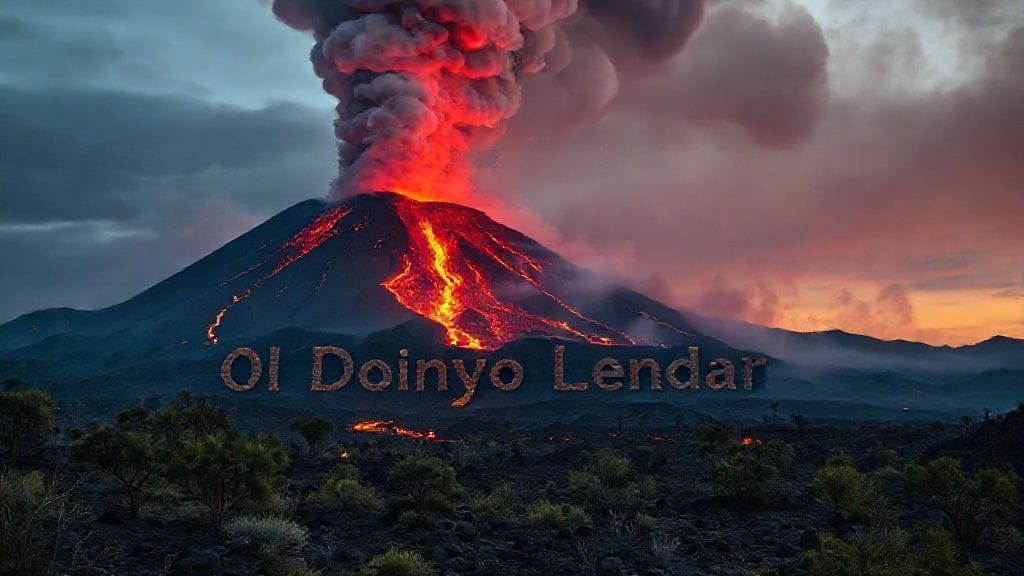
The eruption began with spectacular lava fountains, columns of molten natrocarbonatite bursting tens of meters into the air, cascading down the slopes in thick, fast-moving flows. Unlike most volcanic eruptions that produce heavy ash clouds and pyroclastic flows, Lengai’s activity was gentler yet mesmerizing—its lava gently reshaping the landscape in waves of ink-black rivers.
Over days and weeks, this new volcanic phase asserted itself, alternating between explosive emissions and oozing flows, disrupting ecosystems but also inviting scientists eager to study the carbonatite phenomenon in real-time.
6. Lava Like No Other: The Signature Natrocarbonatite Flows
The 2007 eruption showcased a prodigious outpouring of natrocarbonatite lava, a fluid so rare it was almost mythical. Unlike typical basaltic or andesitic lava, Lengai’s flows were silky, running swiftly across the volcanic flanks, with temperatures barely above water’s boiling point.
As the lava cooled, it hardened quickly into black or occasionally white ash, with a unique composition of sodium and potassium carbonate salts. This rapid cooling and chemical transformation gave the area an eerie lunar appearance, with “spiky” black slag fields contrasting against the green Rift Valley below.
7. Community at the Edge: Local Maasai Tribes and Their Relationship to the Volcano
For the Maasai people, Ol Doinyo Lengai has always been a sacred place, their traditional “Mountain of God.” The volcano represents both a spiritual entity and a literal landmark guiding their nomadic pastoral lifestyle.
During the 2007 eruption, many Maasai communities faced immense challenges—disrupted grazing lands, air dense with ashes, and the psychological strain of a sleeping god now visibly furious. Yet their connection to the mountain remained profound, blending ancient rituals for appeasement with contemporary resilience amid uncertainty.
Interviews with elders reveal that the eruption rejuvenated traditional narratives, reinforcing the sacred status of the mountain and challenging modern approaches to disaster management with deeply rooted cultural respect.
8. Scientific Expeditions Mobilize: Understanding the Rare Phenomenon
The eruption immediately galvanized international volcanologists and geochemists. Specialized teams from the United States, Europe, and Tanzania descended on Lengai to conduct fieldwork, sample the lava, and deploy monitoring equipment.
These efforts brought unprecedented insight into natrocarbonatite volcanism—its chemistry, eruption mechanisms, and environmental impact. Instrumentation recorded real-time data on gas emissions rich in carbon dioxide and sulfur dioxide, seismic tremors mapped magma movement, and thermal sensors tracked the changing lava lakes.
The 2007-2008 eruption became a living laboratory, expanding human knowledge of volcanic diversity and influencing theories on mantle heterogeneity and geochemical cycles.
9. The Eruption’s Fury: Lava Lakes, Fountains, and Ash Clouds
Though less explosively violent than many volcanoes, Ol Doinyo Lengai’s eruption was no less awe-inspiring. The summit crater hosted vibrant lava lakes shimmering with carbonatite flows, feeding intermittent fountains that erupted with fiery jets of lava.
Ash clouds, while not as dense or far-reaching as in typical silicic eruptions, occasionally blanketed the lower slopes, affecting vegetation and air quality. The volcanic landscape was reshaped visibly—new craters formed, lava fields extended, and fractures appeared in the mountain’s flanks.
This dynamic geology unfolded against the backdrop of Tanzania’s vast wilderness, a persistent reminder of nature’s power and unpredictability.
10. Environmental Impact: The Eruption’s Effect on Flora and Fauna
The eruption's environmental footprint was significant but complex. Lava and ash temporarily destroyed grazing grounds and altered watercourses, threatening wildlife and pastoral livelihoods.
Yet, paradoxically, volcanic soils eventually promised renewed fertility, offering hope for long-term ecological renewal. Species ranging from endemic birds to large mammals displayed resilience, often retreating during peak activity and returning as the landscape stabilized.
Conservationists also monitored air quality and water sources, noting how volcanic gases subtly influenced local microclimates and ecosystem dynamics.
11. Global Attention: Media, Scientists, and the World’s Eye on Lengai
Unlike many remote volcanic events, the Ol Doinyo Lengai eruption attracted worldwide media coverage due to its rarity and picturesque flows. Images of glowing black lava running through lush green plains captivated audiences globally.
Documentaries, scientific papers, and news stories brought the eruption into public consciousness, blending fascination with concern for local communities. Discussions about volcanic risk, climate impact, and geological oddities made Lengai a headline feature for many months.
This global gaze also raised questions about how remote natural hazards are communicated and managed in the era of instant information.
12. The Human Experience: Stories of Courage, Adaptation, and Awe
Amid scientific data and geological analysis lie deeply human stories. Maasai herders recount nights under smoky skies, families adapting their migration routes, and schoolchildren watching volcanic glow outside classroom windows.
One poignant tale tells of a herder who, despite lava flows nearby, refused to abandon precious cattle, believing in spiritual protection from the mountain god. Another describes volunteer scientists sleeping in tents amid ash fall, driven by curiosity and commitment.
These personal narratives enrich the eruption's history, reminding us that natural events are felt viscerally by those who live alongside them.
13. 2008 and The Volcano’s Gradual Calm: What Next?
By mid-2008, Ol Doinyo Lengai’s activity waned into intermittent bursts and minor emissions. The lava lakes cooled, flows slowed, and tremor frequencies decreased.
Scientists declared the active phase over but cautioned about future unrest, as rift volcanism rarely ceases permanently. The eruption’s gradual calm allowed communities to begin rebuilding lives and ecosystems to recover.
Yet the mountain’s restless nature remained a constant reminder—when and how would it roar again?
14. The Legacy of the 2007-2008 Eruption: Lessons in Volcanology
The 2007-2008 eruption will be remembered as a milestone in understanding atypical volcanism. It provided invaluable data on carbonatite magma dynamics, geochemical evolution, and eruption styles.
Volcanologists refined monitoring techniques, integrated indigenous knowledge into risk communication, and highlighted the need for preparing communities living in volcanic shadow.
More broadly, the eruption underscored Earth’s variety in volcanic activity, challenging assumptions that all lava behaves the same and inspiring further research into rare magmas worldwide.
15. Ol Doinyo Lengai in the Culture and Mythology of the Maasai
For centuries, Ol Doinyo Lengai has loomed large in Maasai cosmology—not just as a physical landmark but as a spiritual presence. The eruption rekindled oral traditions about divine wrath and blessing, with elders interpreting volcanic activity as messages from the ancestors.
Ceremonies were held to honor the mountain god, seeking protection or forgiveness. The eruption reanimated these ancient beliefs, blending modern scientific explanations with enduring cultural meaning, illustrating the dialogue between nature, faith, and identity.
16. Volcanic Monitoring and Risk Management Post-Eruption
Post-eruption, Tanzania’s geological agencies bolstered surveillance around Ol Doinyo Lengai with new seismic stations, gas analyzers, and remote sensing.
Risk management efforts incorporated Maasai community participation, building early warning systems sensitive to local needs and customs. Educational programs emerged, empowering residents with knowledge about signs of volcanic unrest and preparedness strategies.
This integrated approach exemplifies how science and society can collaborate effectively in disaster-prone regions.
17. Insights into Earth’s Mantle from Ol Doinyo Lengai’s Unique Activity
The natrocarbonatite magmas erupting from Ol Doinyo Lengai provide rare windows into deep Earth chemistry. Their formation implies mantle sources unusually enriched in carbonates and alkalis, challenging traditional views of mantle composition.
Studies of the 2007-2008 eruption’s lava chemistry helped decode mantle heterogeneities and carbon cycling between Earth’s interior and surface. These findings contribute to broader geological debates about how continents rift and how volatile elements influence magmatic processes.
18. The Future of Ol Doinyo Lengai: Potential for New Eruptions
Given its restless nature, Ol Doinyo Lengai is expected to erupt again, though predicting magnitude and timing remains challenging.
Scientists emphasize continuous monitoring, acknowledging the volcano’s history of intermittent activity with decades-long dormancies punctuated by sudden eruptive episodes.
Understanding its rhythms is crucial for safeguarding local populations and unraveling the enigmatic processes fueling Earth’s sole carbonatite volcano.
19. Tourism and Scientific Interest: A Double-Edged Sword
The eruption and its aftermath attracted tourists and researchers eager to witness Lengai’s unique volcanic landscapes firsthand.
While this interest brings economic benefits and educational opportunities, it also poses challenges of environmental degradation and cultural sensitivity. Balancing preservation with access remains an ongoing conversation among Tanzanian authorities, Maasai leaders, and the scientific community.
Responsible tourism initiatives aim to foster respect for both natural wonders and indigenous heritage.
20. The 2007-2008 Eruption in Retrospect: Science, Society, and Spectacle
Looking back, the eruption of Ol Doinyo Lengai in 2007-2008 stands as a compelling intersection of natural violence and human perseverance. It illuminated mysteries of Earth’s interior, shaped local cultures anew, and captured the imagination of a global audience.
More than a geological event, it was a vivid narrative of earth and people entwined—of a sacred mountain’s fiery pulse echoing through time, reminding us that beneath the calm surface of our planet lies a dynamic, living world waiting to reveal its wonders and warn of its power.
Conclusion
The odyssey of Ol Doinyo Lengai’s 2007-2008 eruption is a saga of nature’s singular rhythms and humanity’s enduring responses. This “Mountain of God,” long revered by the Maasai and studied by scientists worldwide, revealed once more the earth’s capacity to astonish and humble.
The eruption was not merely a geophysical event but a story carried in the voices of local herders, the pens of avid volcanologists, and the lenses of global media. It taught us about the rarest volcanic magmas, the subtle interplay of earth forces beneath a tectonic fracture, and the profound meanings inscribed onto landscapes by culture and creed.
As the volcanic fires died down, the legacy of Lengai’s eruption illuminated paths for future exploration, understanding, and coexistence with a planet that is at once volatile and vital.
FAQs
Q1: What makes Ol Doinyo Lengai’s lava unique compared to other volcanoes?
A1: Ol Doinyo Lengai erupts natrocarbonatite lava, the only known active volcano to do so. This lava is rich in sodium and potassium carbonates, making it much cooler and more fluid than typical basaltic lava, with distinctive black coloration that quickly weathers to white.
Q2: How did the 2007-2008 eruption affect local Maasai communities?
A2: The eruption disrupted grazing lands and air quality, creating challenges for the nomadic Maasai herders. However, it also reinforced cultural narratives and spiritual connections, with rituals conducted to appease the volcano’s deity and adapt to changing conditions.
Q3: Why is Ol Doinyo Lengai important for volcanic science?
A3: The volcano offers rare insight into carbonatite magmatism, deep mantle chemistry, and eruption dynamics different from typical silicate volcanism. Data from the 2007-2008 eruption advanced understanding of geochemical cycles and volcanic monitoring methods.
Q4: What risks does Ol Doinyo Lengai pose for future eruptions?
A4: Although usually less explosively violent, future eruptions can disrupt local populations via lava flows, ash emissions, and gas release. Continuous monitoring is essential to provide timely warnings.
Q5: How do local beliefs influence volcanic risk management around Ol Doinyo Lengai?
A5: The Maasai regard the volcano as sacred, which influences acceptance of evacuation and disaster preparedness measures. Integrating traditional knowledge with scientific approaches enhances effective community engagement.
Q6: Did the eruption have significant ecological impacts?
A6: Yes, the eruption temporarily damaged vegetation and affected wildlife habitats. However, volcanic ash also enriched soils, allowing ecological recovery and increased fertility over time.
Q7: How did the global scientific community respond to the eruption?
A7: Researchers launched expeditions, deploying monitoring equipment and collecting samples, making the event a milestone for volcanology and geochemistry.
Q8: What is the future outlook for Ol Doinyo Lengai?
A8: The volcano remains active and unpredictable, necessitating ongoing observation. Its unique activity continues to intrigue scientists and demands respect from local communities and visitors alike.

