Table of Contents
- A Fiery Awakening in the Pacific: The Tinakula Eruption of 2017
- The Lonely Sentinel: Understanding Tinakula’s Volcanic Identity
- Geographical and Cultural Context: The Solomon Islands Amidst the Pacific Ring of Fire
- Precursors to Disaster: Signs Leading to the 2017 Eruption
- The Day the Island Roared: Chronology of the 2017 Event
- First Witnesses: Local Observations and Emergency Responses
- Scientific Eyes on the Volcano: Monitoring Tinakula from Afar
- Nature’s Fury: The Mechanics Behind the Eruption
- Explosive Power: Pyroclastic Flows, Ash Clouds, and Lava Rivers
- The Human Dimension: Impact on Nearby Communities and Indigenous Populations
- Communication Breakdown: Challenges in Disaster Response in Remote Island Settings
- Regional Repercussions: Social and Economic Ripples Across the Solomon Archipelago
- The Environmental Toll: Ecological Disruptions and Regrowth Prospects
- Global Reflections: Volcanoes in a Warming World
- Resilience and Recovery: Rebuilding Lives After the Ashes
- The Legacy of Tinakula: Lessons for Volcano Preparedness
- Memory Carved in Stone: Cultural Narratives and Oral Histories Around the Eruption
- Scientific Advances Sparked by the Event
- Philosophical Contemplations: Man’s Place Amidst Earth’s Fury
- Looking Forward: The Future of Volcanic Monitoring in the Pacific
- Conclusion: The Unyielding Dialogue Between Humanity and Nature
- FAQs About the Tinakula Eruption
- External Resource
- Internal Link
1. A Fiery Awakening in the Pacific: The Tinakula Eruption of 2017
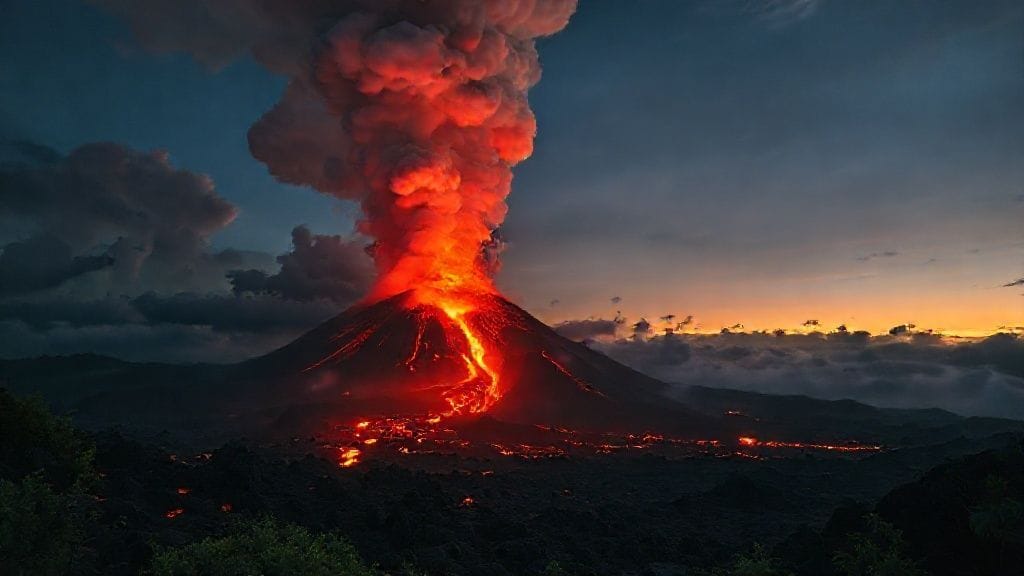
In the stillness of the South Pacific, far from the bustle of global capitals, a small island suddenly surged to life with a roar that tore through the tropical skies. On an otherwise unremarkable evening in 2017, Tinakula—a remote volcanic island in the Solomon Islands chain—erupted with spectacular ferocity, sending towering ash plumes skyward and casting molten rivers across its ancient slopes. The event was as sudden as it was dramatic, a powerful reminder that beneath the tranquil beauty of this oceanic landscape, the forces of Earth’s molten heart pulse alive and untamed.
For locals scattered across neighboring islands and for the global scientific community alike, the eruption of Tinakula was a moment charged with awe, fear, and urgency. The silent sentinel had spoken, unleashing an elemental fury that would leave traces far beyond the borders of this solitary volcanic outcrop.
2. The Lonely Sentinel: Understanding Tinakula’s Volcanic Identity
Tinakula has long been a geographical enigma wrapped in volcanic mystery. Rising starkly from the Pacific Ocean, this volcanic island is part of the Solomon Islands’ vast archipelago—an area that rests precariously on the Pacific Ring of Fire, where tectonic plates collide and reshape the Earth’s surface.
Volcanologists have known Tinakula for its periodic eruptions, documented sporadically over the centuries. Yet despite its volatility, the island remains uninhabited, a forbidding landscape of jagged rock and blackened ash. This lethal solitude has preserved it as a natural laboratory for studying the anatomy of volcanoes and the rhythms of Earth’s fiery core.
3. Geographical and Cultural Context: The Solomon Islands Amidst the Pacific Ring of Fire
The Solomon Islands archipelago lies at the intersection of the Australian and Pacific tectonic plates, a seething seam of geological turmoil. This region is perennially vulnerable to earthquakes, tsunamis, and volcanic eruptions — elements of a volatile Earth that shaped not only the physical landscape but also the cultural and historical narratives of its inhabitants.
Among the dozens of islands, some are densely populated with vibrant communities who have lived in symbiosis with this volatile environment for millennia. Their oral histories brim with tales of fire, earth, and sea morphing together in catastrophic and awe-inspiring ways. Tinakula, while largely uninhabited, figures prominently in local legends as a powerful and unpredictable force.
4. Precursors to Disaster: Signs Leading to the 2017 Eruption
Before metal instruments and satellites recorded it, the volcanic rumblings of Tinakula were whispered early by the trembling earth and intermittent gas emissions. Seismic tremors, subtle ground swelling, and increased sulfur dioxide emissions were quietly documented by scientists, heralding a buildup deep beneath the island’s core.
Local fishermen and sailors, whose professions depend on a profound reading of nature’s moods, also sensed unease. Unusual animal behavior, darkened skies from distant plumes, and changes in sea temperature around Tinakula all painted a silent but portentous picture.
For the scientists monitoring the region, these signals were warnings that Tinakula’s slumber was ending—a ticking geological clock counting down to eruption.
5. The Day the Island Roared: Chronology of the 2017 Event
On a humid morning in late 2017, the stillness over the serene blue waters was abruptly shattered. Observers noted a violent upheaval as a dense, billowing column of black volcanic ash pierced the atmosphere, climbing miles into the sky. Tremors shook the surrounding waters as molten rock fractured the island’s surface.
The eruption unfolded in phases: initial explosive bursts catapulting ash and volcanic gases high above; pyroclastic flows racing down the flanks; lava oozing through new fissures and reshaping the island’s coastline. The spectacle was at once fearsome and mesmerizing—a raw, chaotic demonstration of Earth’s internal energies.
6. First Witnesses: Local Observations and Emergency Responses
Though Tinakula itself was devoid of permanent inhabitants, nearby island communities in the Solomon chain were rattled by the eruption. Fishermen spotted the ash plume from miles away, sending urgent word to coastal villages. The South Pacific’s sparse communication infrastructure struggled to relay warnings quickly, but some alerts reached local authorities by radio.
Emergency teams were hastily mobilized, although their efforts were complicated by the geographical remoteness and limited resources. Evacuations were a priority, especially in areas lying downwind of the ash fall. Many residents feared potential tsunami waves triggered by volcanic landslides; precautionary measures were swiftly enacted.
7. Scientific Eyes on the Volcano: Monitoring Tinakula from Afar
Lacking continuous onsite monitoring, volcanologists relied heavily on satellite imagery and remote sensing to track the eruption’s development. NASA satellites captured high-resolution thermal images revealing the spread of lava flows, while atmospheric sensors quantified emitted gases.
International observatories feeding data into volcanic early-warning systems worked overtime, piecing together patterns and predicting potential future eruptions. Though the eruption was sudden, advances in technology allowed for a rapid assessment of its scale and duration—a revolution in how modern science confronts natural disasters on remote terrains.
8. Nature’s Fury: The Mechanics Behind the Eruption
Tinakula’s eruption was a textbook example of subduction zone volcanism. Here, the Pacific plate plunges beneath the Australian plate, melting rock under high pressure and temperature. This molten material, buoyed by gas buildup, eventually breaches the surface with explosive force.
The 2017 eruption was driven primarily by volatile-rich magma, causing violent explosive activity mixed with slow lava effusion. The surge of ash and gas formed towering plumes that affected atmospheric chemistry and regional climate temporarily.
9. Explosive Power: Pyroclastic Flows, Ash Clouds, and Lava Rivers
One of the most terrifying aspects of the eruption was the deadly pyroclastic flows—fast-moving currents of hot gas, ash, and volcanic debris that scorched everything in their path. These incandescent avalanches reshaped the island’s surface almost overnight.
The ash ejected reached an estimated altitude of 10 kilometers in the atmosphere, blanketing nearby islands with fine volcanic dust. Lava flows, though slower, carved new landforms, their rivers of fire altering the coastline with blackened rock.
10. The Human Dimension: Impact on Nearby Communities and Indigenous Populations
While Tinakula itself had no permanent residents, the eruption had immediate and lasting effects on communities nearby. Ash fall contaminated crops and water supplies, dusting roofs and fields with deadly particles. Respiratory illnesses surged in vulnerable populations as clean air became a scarce commodity.
Fisherfolk saw their livelihoods threatened as marine ecosystems near the island faced temperature rises and changes in water chemistry due to volcanic activity. Although the Solomon Islanders are deeply familiar with their environment’s caprices, the eruption tested their resilience to its limits.
11. Communication Breakdown: Challenges in Disaster Response in Remote Island Settings
The event starkly highlighted how geography complicates disaster relief and communication in the South Pacific. Many villages rely on radio or infrequent transport to receive information—a bottleneck in the early stages of the eruption.
Delays increased risks, as early warnings about ash fall and possible tsunamis could not reach all affected populations immediately. The eruption served as a wake-up call for governments and aid organizations to improve infrastructure and preparedness in isolated island regions.
12. Regional Repercussions: Social and Economic Ripples Across the Solomon Archipelago
Beyond immediate health hazards, ash contamination affected agriculture and fisheries, sources of food security and income. The Solomon Islands economy, largely dependent on subsistence farming and fishing, felt the eruption’s reverberations.
Trade disruptions ensued due to airspace closures over regional airports affected by ash clouds. Tourism, a growing sector for more accessible islands, also saw setbacks amidst safety concerns.
13. The Environmental Toll: Ecological Disruptions and Regrowth Prospects
Volcanic eruptions are paradoxical acts of destruction and creation. While the immediate impact on flora and fauna was catastrophic—burned trees, sterilized soil, displaced wildlife—the eruption also laid the groundwork for ecological renewal.
Nutrient-rich volcanic sediments eventually foster plant regrowth, and pioneer species colonize new land. Over decades, Tinakula’s scorched landscape would evolve, a living testament to nature’s regenerative powers.
14. Global Reflections: Volcanoes in a Warming World
Though volcanic eruptions are natural phenomena, the Tinakula event prompts questions regarding volcanic activity in a changing climate. Some scientists ponder whether global warming may influence magma chamber temperatures or glacial melting on volcano flanks, altering eruption frequency or intensity.
At a minimum, the eruption brings into focus humanity’s vulnerability to sudden natural catastrophes amid broader environmental uncertainty.
15. Resilience and Recovery: Rebuilding Lives After the Ashes
Following the eruption’s subsiding violence, affected communities in the Solomon Islands showed remarkable resilience. Local and international aid efforts collaborated to restore clean water access, health services, and food supplies.
Traditional knowledge, such as recognizing animal behavior and natural signs, complemented scientific advisories to rebuild safer livelihoods. Recovery was arduous but underscored human tenacity when confronting nature’s extremes.
16. The Legacy of Tinakula: Lessons for Volcano Preparedness
The 2017 eruption reaffirmed the urgency of establishing more robust volcano monitoring networks across the Pacific. Investment in real-time seismic stations, satellite data integration, and community education emerged as frontline strategies.
Emergency response plans were revised, emphasizing rapid communication and evacuation protocols tailored to the region’s unique geography. Tinakula became a case study, inspiring preparation for future volcanic crises globally.
17. Memory Carved in Stone: Cultural Narratives and Oral Histories Around the Eruption
While modern instruments captured data, indigenous narratives contextualized the eruption within millennia-old traditions. For many Solomon Islanders, volcanic eruptions are spiritual events—moments when the earth voices ancestral power and demands respect.
Storytellers wove the 2017 eruption into legends, reinforcing cultural identity and providing collective meaning to trauma and recovery—a human response mirroring the eruption’s lasting imprint on collective memory.
18. Scientific Advances Sparked by the Event
The Tinakula eruption contributed valuable scientific insights into subduction zone volcanism in remote island contexts. Researchers refined satellite-based eruption monitoring techniques and improved atmospheric ash dispersal models.
Cross-disciplinary collaborations between volcanologists, meteorologists, and social scientists grew stronger, highlighting the integrated nature of disaster studies.
19. Philosophical Contemplations: Man’s Place Amidst Earth’s Fury
Tinakula’s blistering awakening invites reflection on humanity’s fragile but enduring place on this restless planet. In the face of geologic time scales and elemental forces, our civilizations seem transient — yet alive with determination and hope.
Such events remind us of the intimate, sometimes precarious relationship between human life and Earth’s fiery heart, imbued with respect, humility, and vigilance.
20. Looking Forward: The Future of Volcanic Monitoring in the Pacific
The Pacific Ring of Fire remains a high-risk zone, where communities live in constant dialogue with volcanic activity. The Tinakula eruption has accelerated efforts to employ satellite constellations, unmanned aerial vehicles, and AI-driven predictive models.
International cooperation, involving regional governments and scientific bodies, aims to build resilience networks—equipping island nations with tools and knowledge to face their volcanic giants.
21. Conclusion: The Unyielding Dialogue Between Humanity and Nature
The 2017 eruption of Tinakula was more than a geological event; it was a dramatic spectacle signaling nature’s persistent power to surprise, challenge, and transform. In its explosive fury, it etched a story of destruction and renewal, fear and hope.
For the peoples of the Solomon Islands and the global community, Tinakula’s awakening reaffirms a timeless truth: Earth’s forces are both our genesis and our reckoning, calling humanity to balance curiosity with respect, knowledge with humility. As the island’s volcanic breath fades into history, its lessons burn bright—guiding us toward a future where preparedness and coexistence with nature’s primal rhythms are not optional, but vital.
FAQs About the Tinakula Eruption
Q1: What caused the Tinakula eruption in 2017?
A1: The eruption resulted from tectonic activity at the subduction zone where the Pacific Plate dives beneath the Australian Plate, causing magma to rise and erupt explosively.
Q2: Were there any casualties from the eruption?
A2: There were no direct casualties on Tinakula since it is uninhabited, but nearby communities faced health issues due to ash fall and environmental disruption.
Q3: How did local communities respond to the eruption?
A3: Communities relied on traditional knowledge and communicated warnings through radio alerts; emergency responses were hampered by geographic isolation but focused on evacuations and health interventions.
Q4: What role did satellite technology play in monitoring the eruption?
A4: Satellite imagery and remote sensing were crucial in tracking ash plumes, lava flows, and gas emissions, providing data where on-site monitoring was not possible.
Q5: How has the eruption influenced volcanic preparedness in the region?
A5: It spurred investment in monitoring infrastructure, regional cooperation on warning systems, and improved disaster management protocols tailored for remote island settings.
Q6: What environmental impacts did the eruption cause?
A6: Immediate destruction of vegetation and marine ecosystems occurred, but volcanic deposits also enriched the soil, promoting ecological regeneration in the longer term.
Q7: Is Tinakula still considered active?
A7: Yes, Tinakula remains an active volcano with potential for future eruptions, warranting continuous monitoring.
Q8: How is the eruption remembered in local culture?
A8: The event has been incorporated into oral histories and spiritual narratives, reinforcing cultural bonds and respect for nature’s power.

