Table of Contents
- The Chamber and the Vote: October 25, 1971
- Two Chinas, One Seat: The Long Contest since 1949
- Cold War Realignments: Sino-Soviet Split and US Calculus
- Credentials Battles of the 1950s and 1960s
- The Albanian Resolution and the Representation Question
- Washington’s Pivot: From Isolation to Rapprochement
- Taipei’s Dilemma: Exit, Voice, or Compromise
- The Night of Votes: Roll Calls, Applause, and Walkouts
- What Resolution 2758 Did—and Did Not Do
- Aftermath in New York: Flags, Protocol, and the Security Council Seat
- Human and Diplomatic Ripples Across Asia and Africa
- Global Institutions and Development Agencies Recalibrated
- Interpreting the Sources: Myths, Numbers, and Memory
- Legacies for Taiwan, Cross-Strait Relations, and International Law
- Conclusion
- FAQs
- External Resource
- Internal Link
Article Summary: On October 25, 1971, the United Nations General Assembly passed Resolution 2758, restoring the People’s Republic of China’s representation and expelling the delegation of the Republic of China. The decision capped decades of diplomatic maneuvering, Cold War calculations, and annual bruising votes. It changed the composition of the Security Council and the geopolitics of global governance. This narrative explains the timeline, arguments, and aftermath. It examines what changed, what did not, and why “china admitted to united nations” became a global shorthand for a far more complex realignment. It also reassesses the human and institutional consequences that followed.
Why keep reading: A single vote reconfigured the map of international legitimacy, transferring a permanent Security Council seat and stranding millions in a diplomatic gray zone. Follow the pressure points—Washington’s turn, Taipei’s choice, Beijing’s terms—and see how a procedural fight became a geopolitical reckoning.
At a glance:
- Event: UN General Assembly Resolution 2758 on Chinese representation
- Date: October 25, 1971
- Place: United Nations Headquarters, New York City, USA
- Main figures: PRC leadership under Zhou Enlai; ROC leadership under Chiang Kai-shek; U.S. President Richard Nixon and Henry Kissinger; U.S. Ambassador George H. W. Bush; delegates from newly independent Asian and African states
- Why it mattered: Shifted global recognition of “China” to Beijing, transferred a permanent UN Security Council seat, and reshaped Cold War alignments and international institutions.
01 – The Chamber and the Vote: October 25, 1971
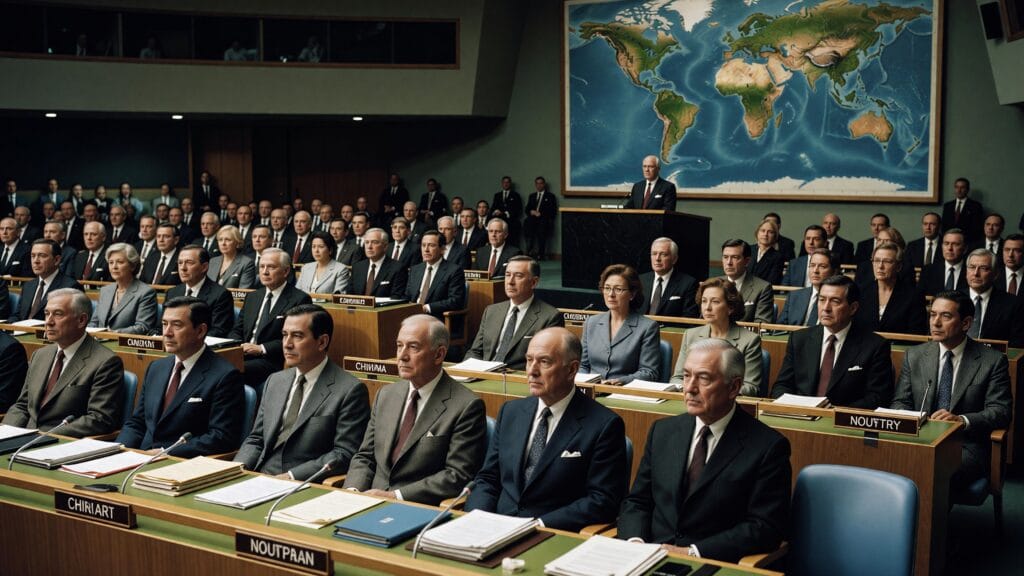
The General Assembly hall in New York hummed with tension as delegates prepared for a vote that would decide who spoke for “China.” Flags barely stirred, translators poised over microphones, and diplomats weighed alliances and futures. When the tallies appeared, applause rolled through the chamber: Resolution 2758 passed, sealing a transformative moment.
The resolution “restored” the People’s Republic of China to its place and expelled “the representatives of Chiang Kai-shek.” Behind the headline—china admitted to united nations—lay years of debate over legitimacy and representation, intensified by the Cold War, decolonization, and the arithmetic of a changing General Assembly.
Some delegations celebrated a long-sought correction; others lamented the loss of Taiwan’s voice. The ROC representatives gathered their papers and left, their departure both symbolic and final. Yet this was the end of one struggle and the beginning of another, as institutions, treaties, and relationships had to be reconfigured with care.
Few votes had carried such visible geopolitical weight. What had been a credentials quarrel deepened into a decision about the world’s most populous country and a permanent seat on the Security Council. The chamber’s choreography concealed hard calculations, domestic constraints, and the precise wording that would echo for decades.
02 – Two Chinas, One Seat: The Long Contest since 1949
The origins reach back to 1949, when the Chinese Civil War concluded with the Communist leadership proclaiming the People’s Republic of China in Beijing, and the Nationalist government withdrawing to Taiwan. At the United Nations, however, the Republic of China retained the China seat, a Cold War presumption that fused recognition with containment.
Across the 1950s, Washington’s strategic imperative in Asia—hardened by the Korean War—sustained Taiwan’s position, while many countries declined to recognize the PRC. Yet decolonization changed the General Assembly’s electorate, and every new independent state adjusted the vote calculus. The question of who represented “China” kept returning, more contentious each year.
03 – Cold War Realignments: Sino-Soviet Split and US Calculus
By the early 1960s, the Sino-Soviet split fractured the Communist bloc, creating space for nonaligned diplomacy and for Western reassessment. France recognized the PRC in 1964, signaling that some allies could diverge from Washington on China policy while remaining within the Western orbit. Recognition patterns, however, did not immediately decide UN representation.
American strategy evolved slowly. Vietnam, détente with the Soviet Union, and concern about Soviet influence in Asia pushed Washington toward a triangular diplomacy. The calculus was simple but explosive: if Beijing was a counterweight to Moscow, then excluding it from the UN distorted the global architecture and hindered crisis management.
Still, domestic politics mattered. For U.S. administrations from Truman to Johnson, backing Taiwan at the UN was part principle, part electoral constraint. As the 1960s waned, growing numbers in the General Assembly—especially from Africa and Asia—argued that the UN could not credibly ignore the government controlling the mainland and its hundreds of millions of citizens.
04 – Credentials Battles of the 1950s and 1960s
Throughout the 1950s and 1960s, Chinese representation returned as an annual ritual with procedural twists. The United States and allies framed it as an “Important Question,” requiring a two‑thirds majority to change representation. This tactic, adopted in 1961, was designed to preserve the status quo as the Assembly’s composition shifted.
Each year, margins narrowed. New states from Africa and Asia joined the UN, many sympathetic to Beijing’s anti-imperial narrative and skeptical of dual representation formulas. Some countries recognized both claims morally but could not translate that ambivalence into a single vote under rigid UN procedures.
Mini timeline:
- 1949: PRC proclaimed; ROC government relocates to Taiwan.
- 1950: Korean War entrenches U.S.–ROC alignment at the UN.
- 1961: “Important Question” procedure requires two‑thirds to alter representation.
- 1970: Support for Beijing rises; margins tighten but status quo holds.
05 – The Albanian Resolution and the Representation Question
In the late 1960s, a group of states led by Albania championed a bluntly worded draft: “restore” to the PRC “all its rights” and expel “the representatives of Chiang Kai-shek.” It rejected any “two Chinas” or “one China, one Taiwan” solutions. The effect was to tie Chinese representation to a single, indivisible seat.
For supporters, the Albanian resolution was a moral and demographic correction, aligning the UN with political reality on the mainland. For opponents, it closed off creative compromises that might have kept Taiwan within the UN system while acknowledging Beijing’s authority over “China” as a UN member state.
This text gathered momentum because it was unambiguous, not because it was universally loved. Ambiguity had preserved the status quo; clarity promised a decision. By 1971, co-sponsorships multiplied, and delegates understood the vote would be more than procedural—an emblem of where the postcolonial and Cold War currents were flowing.
06 – Washington’s Pivot: From Isolation to Rapprochement
Richard Nixon had signaled openness to an eventual opening with Beijing even before the White House, but the details emerged in 1969–1971. Henry Kissinger’s secret trip to Beijing in July 1971 created strategic shockwaves, suggesting a new architecture in which Washington and Beijing could coordinate, even as ideological chasms remained.
At the UN, the United States tried to reconcile principles with pragmatism. The goal became dual representation: seat Beijing while retaining Taiwan in the General Assembly, though not necessarily on the Security Council. The approach hinged on redefining the issue from identity to participation, a move Beijing flatly rejected.
In October 1971, Washington pushed to keep the “Important Question” requirement, hoping to force a two‑thirds threshold. It also floated a resolution to ensure Taiwan’s continued representation alongside Beijing’s admission. Both maneuvers faltered as diplomats counted votes and sensed the momentum behind the Albanian text.
The United States found itself arguing process to guard a diminishing position. Domestic audiences watched closely, but abroad the scene was clearer. The PRC would only accept the China seat as an exclusive claim; any formula implying two states undercut the core message it had repeated since 1949.
07 – Taipei’s Dilemma: Exit, Voice, or Compromise
For Taipei, the 1971 session posed an existential diplomatic test. Could it accept a downgrade, perhaps retaining a General Assembly seat as “Taiwan,” while Beijing took the China seat? The leadership in Taipei, shaped by wartime experience and claims to represent all China, judged that concession more dangerous than departure.
Internal debates in the Republic of China government wrestled with prestige, survival, and the risk of setting precedents. Contemporary accounts suggest that Taipei sought support for dual representation but would not accept formulations implying a separate Taiwanese state. If the Assembly endorsed the expulsion clause, departure seemed unavoidable.
When the Albanian resolution passed, the ROC delegation, led by Liu Chieh, walked out. It was a theatrical end to a quarter-century of UN presence. For supporters of Taiwan abroad, the walkout symbolized moral injury; for critics, it acknowledged political reality. Either way, the decision closed one door and complicated every subsequent path.
08 – The Night of Votes: Roll Calls, Applause, and Walkouts
The sequence mattered. First, the Assembly considered whether the question should be treated as “important,” requiring a two‑thirds majority. That motion failed to secure the needed threshold, clearing the way for a simple majority on the substantive resolution. Delegations understood instantly that the arithmetic now favored Beijing’s backers.
Then came the decisive roll call. Seventy-six voted in favor, thirty-five opposed, and seventeen abstained, according to the UN record. Applause followed, mingled with the scrape of chairs as some delegations shifted positions or prepared statements for domestic consumption. The gallery sensed a hinge moment in postwar history.
Some observers later minimized the drama, saying the outcome had been foreordained by demographic and diplomatic shifts. But this was only the beginning of the story. A vote can redraw seating charts in a night; the deeper work—revising practices, treaties, and expectations—takes years and reverberates through people’s lives.
09 – What Resolution 2758 Did—and Did Not Do
Resolution 2758 settled a question of representation: the PRC, not the ROC, would hold China’s seat at the UN and in the Security Council. It directed the expulsion of “the representatives of Chiang Kai-shek.” The UN thus recognized Beijing as speaking for “China” in the organization and its principal organs.
What it did not do is equally important. The text did not opine on Taiwan’s sovereignty or declare Taiwan a province of the PRC; it addressed representation within the UN system. Modern historians emphasize this distinction because later political arguments sometimes stretch the resolution’s meaning beyond its carefully crafted scope.
In practice, the resolution narrowed options for Taiwan’s direct participation in UN bodies, while leaving legal debates to states and scholars. The victory solved one problem and created another: how to include Taiwan’s 23 million people in global health, aviation, and development discussions without crossing Beijing’s red lines or contradicting UN precedent.
10 – Aftermath in New York: Flags, Protocol, and the Security Council Seat
Within weeks, the PRC delegation arrived in New York to assume the seat, with Qiao Guanhua among the most visible figures and Huang Hua becoming Beijing’s first permanent representative. Protocol officers adjusted plaques, interpreters acclimated to a new cadence, and the Secretariat implemented logistical changes that signaled a realigned diplomatic landscape.
The Security Council’s permanent membership, unchanged since 1945, now included Beijing’s representative. This altered veto dynamics and the optics of Cold War debates. The PRC used its first veto in 1972, showing that presence was not merely symbolic; it could shape outcomes on decolonization cases, peacekeeping mandates, and membership admissions.
For Washington, Ambassador George H. W. Bush navigated a bruising week, balancing public disappointment with a forward-leaning tone on future U.S.–PRC relations. The path to Nixon’s 1972 visit to China was now framed by a UN decision that both reflected and accelerated rapprochement. Diplomacy moved on, though not evenly for all parties.
11 – Human and Diplomatic Ripples Across Asia and Africa
Across Asia and Africa, the vote resonated as a postcolonial correction. Many governments had viewed Beijing as an anti-imperial partner, even when wary of ideology. Recognizing the PRC in the UN simplified bilateral decisions; embassies opened, state visits multiplied, and development agreements gained momentum, especially where infrastructure and commodity trade aligned interests.
For Taiwan, the consequences were intimate and administrative. International travel documents, participation in specialized agencies, and the visibility of its civil society faced new hurdles. States continued to trade with and visit Taiwan, but official diplomatic ties dwindled over the 1970s and 1980s as capitals synchronized with the UN decision.
12 – Global Institutions and Development Agencies Recalibrated
Specialized agencies adapted on their own timelines. The World Health Organization aligned with the UN decision in 1972, and the World Bank and International Monetary Fund transferred China’s seats to Beijing by 1980. These moves redirected votes, loans, and influence across global development, trade policy, and standards-setting bodies.
UNCTAD conferences, UNESCO debates, and food security programs absorbed a new great-power participant whose priorities blended sovereignty defenses with development advocacy. Beijing often supported newly independent states on economic issues, even while contesting narratives on human rights or intervention, creating a sometimes counterintuitive pattern of alignments.
Business and aid followed. China’s presence altered procurement, trade finance, and project diplomacy, even before its later economic boom. For Taiwan, workarounds emerged: technical missions, quasi-official institutes, and collaboration through partner states. Such creative diplomacy sustained real relationships, but it could not undo the structural shift created by Resolution 2758.
13 – Interpreting the Sources: Myths, Numbers, and Memory
Accounts of the 1971 vote sometimes inflate or flatten the drama. The surviving evidence points toward a steady build-up rather than a surprise reversal. The UN General Assembly’s official records and contemporary press describe careful whip counts, while later memoirs add color, sometimes sharpening self-justifying narratives among the principal actors.
Some myths linger: that the decision automatically made Taiwan a UN nonentity in all domains, or that the vote settled a legal status question it never attempted to touch. Modern historians remain cautious because the surviving record is fragmentary in places and layered with political intent, especially in speeches crafted for domestic audiences.
Useful correctives come from the UN Yearbook, primary UN documents, and scholarly syntheses. They reveal that representation and sovereignty are distinct, that abstentions and absences mattered tactically, and that the “Important Question” strategy bought time but could not outpace demographic change. Memory simplifies; the record restores complexity.
14 – Legacies for Taiwan, Cross-Strait Relations, and International Law
In the decades since 1971, Resolution 2758 has been invoked by all sides. Beijing cites it to oppose any Taiwan participation implying statehood, while many governments interpret it narrowly as a representation ruling. Cross-Strait dynamics have shifted with politics in Taipei and Beijing, but the UN’s institutional pathways remain shaped by that autumn vote.
Taiwan’s quest for meaningful participation has focused on functional arenas—aviation safety, health security, and technical standards—where exclusion can impose costs on everyone. The COVID-19 era revived debates over public-health coordination, underscoring how representation rules crafted for a Cold War moment ripple into practical cooperation—or its absence—half a century later.
For international law, the case is frequently taught to distinguish representation at intergovernmental organizations from sovereignty determinations. The lesson is durable: institutions choose representatives based on political recognition and rules of procedure, not by adjudicating territorial disputes. Yet behind that neat principle lie lives, economies, and security dilemmas that refuse to stay tidy.
Immediate consequence:
Beijing took China’s UN and Security Council seats, and Taipei’s representatives departed. Agencies and committees adjusted procedures within months, and bilateral recognitions shifted rapidly in the early 1970s.
Long-term consequence:
Global governance incorporated a rising China, reshaping development policy and great‑power bargaining. Taiwan navigated an innovative but constrained international space, while 2758 became a touchstone in legal and diplomatic arguments about participation and representation.
15 – Conclusion
What happened in New York on October 25, 1971 was a recalibration of legitimacy within the world’s central forum. The shorthand—china admitted to united nations—misses the precise truth: the UN recognized Beijing as the representative of “China,” expelling Taipei’s delegation without judging sovereignty. That careful distinction still frames debate, diplomacy, and daily coordination.
Resolution 2758 did not end the story; it set its parameters. It revealed how arithmetic, decolonization, and Cold War triangulation combine to bend institutions. And it left a legacy visible in every roll call where Beijing votes, and in every workaround Taiwan builds. The decision’s deeper meaning endures wherever representation collides with identity and law.
16 – FAQs
- When did the UN make its decision on Chinese representation?
The General Assembly adopted Resolution 2758 on October 25, 1971, after failing to classify the issue as an “Important Question” requiring a two‑thirds majority. - Where did the vote take place?
The vote occurred at United Nations Headquarters in New York City, in the General Assembly hall, with delegations from around the world present. - Who were the main figures involved?
On the PRC side, senior diplomacy involved Zhou Enlai’s leadership, with Qiao Guanhua and later Huang Hua prominent at the UN. On the U.S. side, President Richard Nixon, Henry Kissinger, and Ambassador George H. W. Bush were central. The ROC delegation was led by Liu Chieh. - What caused the shift toward Beijing’s representation?
Decolonization expanded the General Assembly, the Sino‑Soviet split changed Cold War geometry, and key states recalibrated recognition. Over time, the arithmetic favored a resolution that “restored” the PRC’s rights and expelled the ROC delegation. - What were the consequences of the vote?
Beijing assumed China’s UN and Security Council seats, influencing debates and veto dynamics. Taiwan lost UN representation, facing constraints in specialized agencies. Many states adjusted recognition policies, and global institutions recalibrated procedures and seats. - What is the legacy of the decision today?
It remains a touchstone in arguments about participation and sovereignty. While often reduced to “china admitted to united nations,” experts note the resolution addressed representation, not Taiwan’s legal status, shaping cross‑Strait diplomacy and UN practices to this day.
17 – External Resource
18 – Internal Link
Other Resources
- Encyclopaedia Britannica – general search for the exact subject
- Google Scholar – academic search for the exact subject
- Internet Archive – digital library search for the exact subject
Sources and References
-
United Nations General Assembly. Resolution 2758 (XXVI), “Restoration of the lawful rights of the People’s Republic of China in the United Nations.” 25 October 1971. Official Records of the General Assembly, Twenty-Sixth Session.
Note: Primary document that records the exact decision by which the PRC was seated in the UN and the representatives of the Republic of China (Taiwan) were expelled, including wording, vote tally, and date of adoption (25 October 1971 in New York). -
United Nations Yearbook 1971. New York: United Nations, 1973.
Note: Provides an official narrative of the diplomatic process inside the UN leading to Resolution 2758, including debates in the General Assembly, the “Important Question” procedural issue, and the broader context of membership and representation questions in 1971. -
Luard, Evan. A History of the United Nations: Volume 2, The Age of Decolonization, 1955–1965 (with Epilogue on Later Developments). New York: St. Martin’s Press, 1989.
Note: Offers historical background on the UN’s evolving membership, Cold War alignments, and the long-running dispute over China’s representation, helping to contextualize why the 1971 vote marked a major turning point in UN politics. -
Kissinger, Henry. White House Years. Boston: Little, Brown, 1979.
Note: Memoir by the U.S. National Security Adviser/Secretary of State that details U.S. policy toward the PRC and Taiwan, including the secret diplomacy leading up to the early 1970s rapprochement with Beijing, which strongly influenced the climate in which the 1971 UN decision was taken. -
Garver, John W. China’s Decision for Rapprochement with the United States, 1968–1971. Boulder, CO: Westview Press, 1982.
Note: Academic study that analyzes Chinese foreign policy calculations in the late 1960s and early 1970s, explaining why Beijing sought improved international standing and how this fed into the campaign to obtain China’s UN seat. -
United Nations Dag Hammarskjöld Library. “UN Documentation: Research Guide – China and the United Nations.” United Nations, New York.
Note: Curated research guide that traces the documentary history of the “China question” in the UN, including earlier resolutions, voting patterns, and the transition from ROC to PRC representation, supporting statements about the length and complexity of the recognition dispute. -
Office of the Historian, U.S. Department of State. Foreign Relations of the United States (FRUS), 1969–1976, Volume XVII: China, 1969–1972. Washington, D.C.
Note: Edition of declassified U.S. diplomatic documents that provides primary-source insight into American strategy on the PRC, Taiwan, and the UN seat in the run-up to October 1971, corroborating the interplay of Cold War politics and the UN vote. -
Scobell, Andrew, and Maryanne Kivlehan-Wise. “China’s Evolving Role in Peacekeeping and International Security.” US Army War College Strategic Studies Institute, 2005.
Note: Analyzes how China’s participation in UN peacekeeping and security institutions developed after gaining the UN seat and Security Council position, supporting interpretations of the long-term impact of the 1971 admission on China’s role in global governance.