Table of Contents
- The Edge of Empires: Dura-Europos Before the Storm
- Rome and Persia on a Collision Course
- Shapur I’s Early Reign and Strategic Vision
- The Road to the Euphrates: 252–255
- Walls of Painted Faith: Inside Dura-Europos
- Siegecraft and Strategy: How the Sasanians Attacked
- Tunnels and Poisoned Air: The Battle Underground
- Breach and Sack: The Fall of a Frontier City
- Prisoners, Plunder, and Deportation
- Aftermath in Rome and Persia
- Memory in Fresco and Dust: Archaeology of a Lost City
- Interpreting the Sources: Caution and Debate
- Conclusion
- FAQs
- External Resource
- Internal Link
Article Summary: In 256 CE, the frontier city of Dura-Europos on the Euphrates fell to the Sasanian king Shapur I, a shock that reshaped Rome’s eastern defense and proclaimed Persian military mastery. This article traces the city’s cosmopolitan life, the siege’s brutal mechanics, and the political reverberations that followed. Drawing on inscriptions, archaeology, and debated chronicles, it reconstructs the event with care. The phrase shapur i sacks dura-europos appears in scattered sources and modern summaries, but the human story lies in the dust-choked tunnels and abandoned shrines. We examine why the city was targeted, how it was taken, and what its loss meant for empires and ordinary families. The result is a narrative of strategy, faith, and survival at the very edge of empire.
Why keep reading: Because a forgotten city on the Euphrates became the test site for new siegecraft, the gallery of vanished religions, and a message to Rome that the balance of power had shifted. Follow the clues—from a Persian royal inscription to a tunnel filled with bodies—to watch an empire learn, adapt, and bleed.
At a glance:
- Event: Sack of Dura-Europos by Sasanian forces under Shapur I
- Date: 256 CE (some scholars allow 257 CE)
- Place: Dura-Europos, on the Euphrates in Roman Syria (modern Qal‘at es-Salihiyeh, Syria)
- Main figures: Shapur I; Roman garrison and Palmyrene auxiliaries; local civilian population
- Why it mattered: Demonstrated Sasanian siege superiority, destabilized Rome’s eastern frontier, and—through emergency earthworks—preserved unparalleled archaeological evidence of ancient religion and warfare.
01 – The Edge of Empires: Dura-Europos Before the Storm
On a high bluff overlooking the Euphrates, Dura-Europos watched caravans glide along the river’s bright ribbon, a midway station between the Mediterranean and Mesopotamia. Founded in the Hellenistic age and taken by Rome in the second century, it was a palimpsest of languages, coins, and cults. This was the city that would later be reduced to a cautionary tale: shapur i sacks dura-europos.
Dura was more than a garrison. It was a trading post where market scales and temple incense shared the same air, where Greek inscriptions haunted Parthian walls and Aramaic prayers crossed Latin orders. A Palmyrene presence connected it to desert trade, while Roman administrators pinned it to an imperial map. Yet the city’s strength made it conspicuous to enemies studying Rome’s arteries.
In quiet courtyards, paintings flickered with stories—Esther and Mordecai in a synagogue, an early Christian baptistry adorned with figures, and Mithra slaying the bull in a cave-like temple. The variety was not a weakness, but a record of life at the edge. Still, history has a way of finding the edges and pressing hard.
02 – Rome and Persia on a Collision Course
By the mid-third century, two empires stared across the Euphrates with competing dreams. The Romans defended a stretched frontier, distracted by internal challenges and the logistics of distant war. The Sasanians, newly ascendant in Iran, claimed Achaemenid legacies and sought to redraw the map inherited from Parthian predecessors.
Rome had long treated the East as negotiable territory, where legions and client kings bought time. But the Sasanian court looked west with a program, not a patch. Control of crossing points, cities like Dura-Europos, and messaging through victories would announce that a different opponent had arrived. What mattered was not only territory, but reputation forged in siegecraft.
It is easy to forget how fragile this world still was. A single breached wall—not even a capital, just a hinge-town—could reroute trade, erode local loyalties, and tempt rivals. The Euphrates here was not only a river, but a measure of power and imagination.
03 – Shapur I’s Early Reign and Strategic Vision
Shapur I, son of Ardashir I, inherited a throne sharpened by ambition and reform. Where his father had broken the Parthian order, Shapur aimed to refine a system of rule projecting central authority across long distances. That meant sieges, deportations, and a political theater built on carefully chosen conquests.
At court, claims of universal kingship mingled with practical military preparation. Reliefs at Naqsh-e Rustam showed kings triumphing over Roman foes, but behind carved stone stood an army learning how to unmake Roman forts brick by brick. Shapur’s “Res Gestae,” carved near the Ka‘ba-ye Zartosht, recorded cities subdued and provinces shaken.
Modern historians debate the exact motives for each campaign, but the pattern is clear: fortresses along the Roman edge were both targets and messages. In later retellings and in modern shorthand, the story compresses to a headline—shapur i sacks dura-europos—yet the decision was the product of method, not impulse.
04 – The Road to the Euphrates: 252–255
Years before the final assault, scouts and raiders felt out the Roman line. Campaigns against Antioch and other Syrian cities revealed that the eastern provinces could be reached, tested, and taught to fear. Surviving texts are uneven, but they speak of thrusts designed to shake garrisons loose and identify weak stones.
Palmyrene forces, allies and sometime guardians of the Roman East, passed through Dura-Europos, leaving inscriptions and economic fingerprints. Their presence underlined the city’s networked life, balancing desert routes and river lanes. Yet allied passage could not substitute for strategic certainty when a siege-minded enemy gathered farther east.
Mini timeline:
- c. 165 CE: Rome takes Dura-Europos under Lucius Verus.
- 240–241 CE: Shapur I becomes king of kings of the Sasanian Empire.
- 252–253 CE: Persian advances into Syria; Antioch threatened and possibly taken.
- 256–257 CE: Siege and sack of Dura-Europos; frontier shaken.
It is astonishing how much political weight could rest on a single river crossing. Control a stretch of the Euphrates, and you tax caravans, position armies, and influence local elites. Dura-Europos, perched high, was a door handle. Shapur’s hand was reaching for it.
05 – Walls of Painted Faith: Inside Dura-Europos
Before the siege, the city’s diversity had already written its own history. Archaeologists later uncovered a synagogue with vibrant biblical scenes and a Christian house-church with a painted baptistry—rare survivals that only exist because of war. A Mithraeum, shrines to local gods, and Greek inscriptions crowded the alleys with competing heavens.
The Roman military stamped its presence in orderly barracks and inscriptions, while merchants measured margins in warehouse shadows. Palmyrene names marked contracts and offerings, reminding us that Dura was tied to trade beyond imperial boundaries. Households stitched empire, desert, and river into a common fabric of everyday gestures.
Yet behind the ceremony of worship and market custom, the garrison knew that war was near. News traveled upriver, rumors collected in arches, and commanders inspected walls with harder eyes. The life captured in fresco and tablet would soon be interrupted by shouts from siege mounds and the terrifying thud of engines.
06 – Siegecraft and Strategy: How the Sasanians Attacked
Sasanian armies approached Dura-Europos with practiced patience. They built siege ramps and dug mines, used battering rams and artillery, and pressed the city’s defenders into reactive engineering. The Romans responded by thickening walls from within, creating a great earthen embankment that, ironically, preserved the city’s paintings for posterity.
The Sasanian method reflected lessons learned along Rome’s line: isolate, demoralize, and open a breach where discipline meets panic. Artillery duels were only a prelude to the quieter, crueler struggle beneath the ground. There, in darkness and heat, soldiers met in galleries of dust where sound carried like rumor.
Engineers mattered more than heroes. In the third century’s wars of edges, the victor was often the side that best managed wood, earth, fire, and air. Dura-Europos would be decided not by a single clash in the sun, but by planning that forced the defenders to choose the least-worst option at every hour.
07 – Tunnels and Poisoned Air: The Battle Underground
Archaeology revealed a mine and counter-mine where combatants met with picks, shields, and desperation. In one space, a tangle of bodies suggests a deadly reversal. Later forensic work proposed that burning sulfur and bitumen created choking gases, an improvised chemical weapon unleashed in the confined world below the wall.
Not all scholars agree on the details, but the evidence points toward ingenuity sharpened by necessity. In those tunnels, victory depended on whose air ran out first, whose torch blinded more effectively, or whose fire ate the oxygen. The past here is painfully intimate: burned residues, scorched walls, and equipment dropped at the instant of panic.
Above ground, the siege ramp loomed; below, the tunnels fed terror toward the wall’s foundations. It is the sort of struggle that rarely survives in documents, yet here the soil itself acts as witness, filling the silence left by absent chroniclers.
08 – Breach and Sack: The Fall of a Frontier City
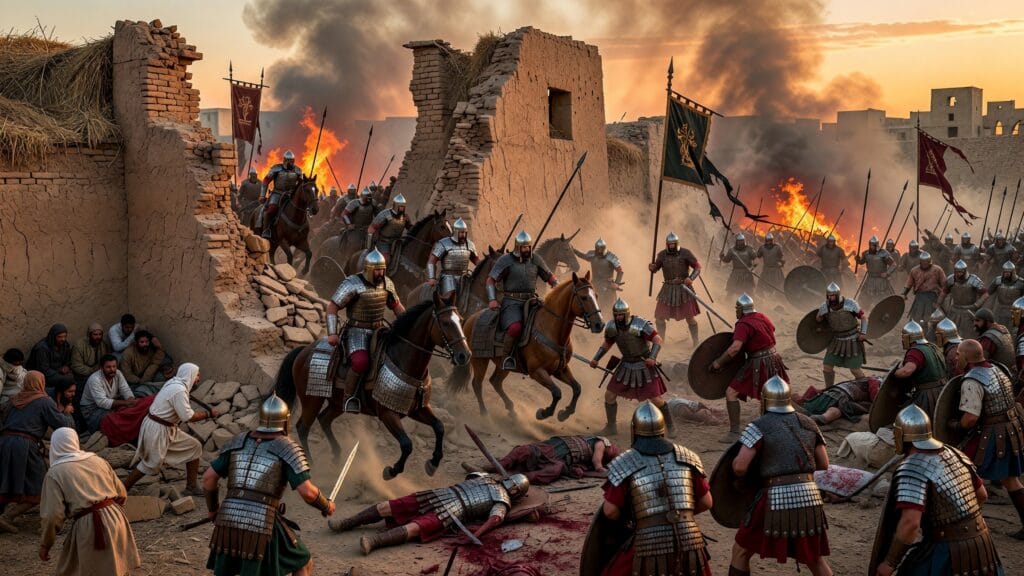
At some point late in 256—some allow 257—the defense snapped. The breach, whether by undermining or combined pressure from engines and mines, opened the way. Soldiers poured through a gap embedded in smoke and fear, and the defenders fell back from streets they had long patrolled and prayed in.
What does “sack” mean here? Likely a sequence of quick seizures, searches for valuables, targeted destruction of military installations, and the taking of prisoners of value—artisans, officials, and those whose skills could be redeployed. Later abandonment suggests that the city never recovered its population or protective infrastructure.
Contemporary narrative sources are thin, so we avoid invented heroics. Yet the archaeology carries voices: doors fortified in haste, rooms filled with rubble against walls, and rich houses emptied of their movable life. The victory solved one problem and created another—the need for the conqueror to integrate the gain into a durable strategy.
09 – Prisoners, Plunder, and Deportation
Shapur’s regime often deported populations, moving skilled captives into Iran’s interior to serve imperial projects. After Dura-Europos, the pattern likely held: artisans, clerks, and families were uprooted, dismantling the city’s social network at its core. The practice turned conquest into capital—a human reservoir for royal cities and workshops.
Plunder served both treasury and theater. War spoils paid soldiers and financed monumental statements elsewhere, reinforcing a sense that Persian power could translate shock into stone. Roman loss, conversely, rippled into local economies that depended on secure caravans and stable garrisons. A frontier without people is a line without stories.
Tradition remembers great kings and cities, but here the aftermath lingers in smaller traces: a name inked on a potsherd with no household to return to, a tool packed and forgotten, a painted eye peering from a buried wall. The sum of many silent endings is what we call a sack.
10 – Aftermath in Rome and Persia
For Rome, the loss of Dura-Europos was a symptom of deeper strain. Within years, the emperor Valerian would be captured at Edessa, an unprecedented humiliation. In the East, local leaders like Odaenathus of Palmyra emerged as crucial buffers, rallying forces that could answer quickly where imperial legions lagged.
For Shapur, the sack announced that his empire could breach walls and reorder frontiers. Yet victories produced workloads: holding ground, administering populations, and facing new coalitions. The Sasanian court leveraged captures as diplomatic pressure and ideological proof, carving images and inscriptions to make the wins echo beyond the riverbanks.
Immediate consequence:
Roman evacuation and abandonment of Dura-Europos, loss of a bridgehead on the Euphrates, and psychological shock to provincial defenses. Persian prestige surged, reinforcing the credibility of Shapur’s campaigns in Syria and Mesopotamia.
Long-term consequence:
Rome’s eastern strategy tilted toward flexible, regional responses and reliance on allied powers. The Sasanian use of deported labor accelerated development in Iran’s royal centers, while the buried city became an accidental time capsule for modern archaeology.
The victory altered rhythms of movement more than lines on a map. Caravans recalculated hazards; officials revised marching tables; and both empires learned that frontier wars would reward engineering as much as valor. It was a lesson that would repeat in embattled cities for centuries.
11 – Memory in Fresco and Dust: Archaeology of a Lost City
Dura-Europos disappeared from the political record, but the earth remembered. In the twentieth century, Franco-American excavations pulled back the desert’s cover to reveal walls, inscriptions, and paintings unmatched for their preservation. The Roman embankment that braced a failing defense had entombed homes, shrines, and barracks alike.
The synagogue’s paintings stunned scholars, offering a window into Jewish visual culture otherwise lost for this era. The house-church’s baptistry gave one of the earliest Christian pictorial programs, while the Mithraeum’s images deepened understanding of a cult that rarely left such vivid traces. War had become archivist, cruel and efficient.
Archaeological field notes, pottery logs, and architectural plans now tell more of Dura’s last days than the literary record. Institutions like Yale University and European museums stewarded the finds, though practices reflect their own time’s assumptions. Modern conservators, revisiting the material, weigh new questions about daily life, trade, and the precise choreography of the siege.
12 – Interpreting the Sources: Caution and Debate
The documentary record is fragmentary. Shapur’s inscription celebrates victories in general terms, not the granular narrative historians crave. Roman writers like the Historia Augusta and Zosimus offer partial, sometimes suspect, perspectives shaped by later politics. Archaeology, therefore, carries unusual weight in reconstructing the event.
Modern scholars debate the exact year, with 256 CE widely accepted and 257 still proposed. They also differ on the role and extent of chemical agents in the mines. The surviving evidence points toward tactical innovation underground, but absolute certainty remains elusive, reminding us that the past resists tidy summaries.
In this context, even the phrase “Shapur I’s sack of Dura-Europos” is an interpretive label, not a single primary account. The Liber Pontificalis does not speak to this frontier, the annalists are quiet, and the royal rolls are administrative, not narrative. We stitch a coherent line from scattered threads and the soil’s own testimony.
13 – Conclusion
Dura-Europos fell because two empires met with different energies and tools, and one used engineering to pry open a hinge on the Euphrates. The city’s religious murals and military routines were buried by decisions made in distant courts, then by defensive earth hastily piled against a wall. In scholarly shorthand, shapur i sacks dura-europos, but the reality was a methodical rebalancing of power and a lived catastrophe.
Yet from catastrophe came memory. The siege’s remnants preserved a uniquely textured picture of third-century life, while its lessons on logistics and adaptability outlived both empires. Shapur’s victory announced a new normal in the East; Rome’s adjustments foreshadowed later frontier strategies. And in the painted figures staring from a buried room, we meet the human cost behind every triumphant inscription.
14 – FAQs
- When did the sack occur?
Most scholars date the event to 256 CE, though some allow for 257 CE based on interpretive differences in archaeological layers and campaign sequences mentioned in royal inscriptions. - Where did it happen?
At Dura-Europos, a Roman-held city on a bluff above the Euphrates in Roman Syria, today near Qal‘at es-Salihiyeh in eastern Syria. Its position controlled movement along the river and tied desert trade to imperial networks. - Who were the main figures?
The Sasanian king Shapur I led the offensive, while Roman and Palmyrene soldiers defended the city. Civilians, artisans, and officials formed the vulnerable middle, later reflected in evidence for deportations and abandonment. - Why was the city targeted?
Dura-Europos guarded a strategic segment of the Euphrates corridor, serving as a military post and commercial node. Capturing it fit Shapur’s broader aim to demonstrate siege dominance, disrupt Roman logistics, and project Sasanian power deep into Syria. - What were the consequences?
Immediately: Dura’s abandonment, Roman shock, and a prestige boost for Shapur. Longer term: altered Roman frontier doctrine, strengthened reliance on regional allies like Palmyra, and the redeployment of skilled captives within the Sasanian realm. - What is the legacy today?
Archaeological discoveries—synagogue frescoes, a painted house-church, a Mithraeum, and siege tunnels—offer an unparalleled window into ancient religion and warfare. In concise terms, shapur i sacks dura-europos became a case study in how a single siege can illuminate an entire era.
15 – External Resource
16 – Internal Link
Other Resources
- Encyclopaedia Britannica – general search for the exact subject
- Google Scholar – academic search for the exact subject
- Internet Archive – digital library search for the exact subject
Sources and References
-
Rostovtzeff, M. I. et al. The Excavations at Dura-Europos (Multiple Vols.). New Haven: Yale University Press, 1929–1952.
Note: Foundational publication of the major Yale–French excavations at Dura-Europos. Provides archaeological evidence for the city’s final destruction layer, the siege works, the Sasanian attack, and the mid-3rd-century abandonment of the site. -
James, Simon. Excavations at Dura-Europos 1928–1937: Final Report VII, The Arms and Armour and Other Military Equipment. London: British Museum Press, 2004.
Note: Uses military finds and stratigraphy to reconstruct the Sasanian siege of Dura-Europos, including the mined walls, gas-warfare interpretation, and the context of the city’s fall under Shapur I. -
Greatrex, Geoffrey, and Samuel N. C. Lieu. The Roman Eastern Frontier and the Persian Wars (Part II, AD 363–630). London–New York: Routledge, 2002.
Note: Although focused on a slightly later period, this volume provides essential background on Roman–Sasanian relations, frontier policy, and patterns of warfare that help contextualize Shapur I’s campaigns in Syria and Mesopotamia. -
Rubin, Ze’ev. “The Reforms of Shapur I.” In: La Persia e l’Asia Centrale da Alessandro al X secolo, ed. by G. Gnoli and L. Lanciotti, Rome: Accademia Nazionale dei Lincei, 1988, pp. 177–196.
Note: Discusses Shapur I’s imperial policy, administrative and military reforms, and his western campaigns, supporting statements about his broader strategy, imperial ideology, and the geopolitical aims behind the sack of cities like Dura-Europos. -
“Res Gestae Divi Saporis” (Kaʿba-ye Zartošt Inscription of Shapur I).
In: N. Sims-Williams, “The Sasanian Inscription of Paikuli,” and translations collected in: Richard N. Frye (ed.), The History of Ancient Iran. Munich: C.H. Beck, 1984.
Note: Primary source royal inscription of Shapur I listing his victories over Rome and campaigns in Roman territory. While Dura-Europos is not named, this text is crucial evidence for Shapur’s own account of his conquests in Syria and Mesopotamia and his self-presentation as victor over the Romans. -
Frantz Grenet, et al. “Dura-Europos.” In: Encyclopaedia Iranica, online edition, Columbia University / Brill.
Note: Scholarly encyclopedia entry summarizing the history of Dura-Europos under Parthian, Roman, and Sasanian pressure, including the circumstances and approximate date of the city’s destruction by Shapur I’s forces. -
“Dura-Europos.” Yale University Art Gallery – Dura-Europos Collection (official site).
Note: Museum collection and academic overview of the site, with emphasis on finds from the final siege (military equipment, fortification remains, religious buildings). Supports discussion of the city’s multicultural character and the archaeological evidence for its violent end in the mid-3rd century. -
Potts, Daniel T. Iran in the Ancient and Medieval World (550 BC–AD 1500). In: The Oxford History of Iran. Oxford: Oxford University Press, 2013.
Note: Provides broader narrative of Sasanian Iran under Ardashir I and Shapur I, including their conflicts with Rome, frontier strategy, and the importance of Roman Syria within Sasanian foreign policy.