Table of Contents
- From Hiroshima to Vienna: A World on Edge
- Eisenhower’s “Atoms for Peace”: Vision and Strategy
- Negotiating an Unusual Agency, 1954–1956
- Vienna Chosen: A Neutral Capital for a Nuclear Age
- Statute and Structure: What the IAEA Was Meant to Be
- July 29, 1957: Inauguration and Early Mandate
- Inventing Safeguards: Watching the Atoms Without Stopping Them
- Selling the Peaceful Atom: Medicine, Agriculture, Power
- Suez, Sputnik, and the Cold War Shadow
- Early Tests of Credibility: Israel, India, and Beyond
- The NPT Nexus: 1968 and the New Bargain
- Inspectors’ Boots on the Ground: Protocols and Dilemmas
- Accidents and Public Trust: Three Mile Island to Chernobyl
- From Iraq to Iran: The Agency in a World of Secrets
- Conclusion
- FAQs
- External Resource
- Internal Link
Article Summary: In July 1957, amid Cold War anxiety and scientific hope, an international institution took shape to discipline the atom and democratize its benefits. This article traces how the International Atomic Energy Agency emerged from a diplomatic maze and why its promise drew intense scrutiny. We follow negotiations, statutes, early safeguards, and crises that repeatedly tested its credibility. We explore Vienna’s symbolic neutrality, Eisenhower’s political gamble, and the Agency’s human consequences. By journey’s end, we see why the phrase “international atomic energy agency established” marks not an end, but a beginning.
Why keep reading: Because the IAEA’s birth captured the world’s fear that atoms could end civilization and its faith that they might feed, heal, and electrify it. This is the story of a delicate institution built to referee that contradiction—one inspection, one treaty, and one crisis at a time.
At a glance:
- Event: Establishment of the International Atomic Energy Agency (IAEA)
- Date: July 29, 1957 (Statute enters into force; first General Conference convenes in October 1957)
- Place: Vienna, Austria (headquarters; later housed at the Vienna International Centre from 1979)
- Main figures: Dwight D. Eisenhower; W. Sterling Cole (first Director General); Andrei Gromyko; Sigvard Eklund (successor)
- Why it mattered: It created a global referee to promote peaceful nuclear uses while attempting to prevent their conversion into weapons.
01 – From Hiroshima to Vienna: A World on Edge
In 1945, two mushroom clouds redefined global politics, fusing science to existential dread. Within a decade, nuclear knowledge had diffused far beyond the wartime alliance that created the bomb. Governments realized the technology could light cities or erase them. The international debate hardened around a paradox: how to share atomic benefits without unleashing catastrophe.
Initial attempts to internationalize control—like the Baruch Plan of 1946—collapsed against early Cold War mistrust. States clung to sovereignty and secrets, even as civilian reactors and medical isotopes hinted at a constructive nuclear future. Scientists, diplomats, and newly independent countries all clamored for access, forcing great powers to consider a new compromise.
By the mid-1950s, pressure grew for a body that could embody reassurance and authority simultaneously. It needed legitimacy within the United Nations family, technical competence, and a global mandate—yet without becoming a supranational police force. The path to Vienna would be paved with speeches, drafts, and uneasy bargains.
02 – Eisenhower’s “Atoms for Peace”: Vision and Strategy
On December 8, 1953, U.S. President Dwight D. Eisenhower addressed the UN General Assembly with his “Atoms for Peace” proposal. He offered a dramatic gesture: funnel fissile material and expertise into a multilateral agency that would promote peaceful uses. It was visionary, strategic, and tinged with anxiety about unchecked proliferation.
Washington’s initiative recognized a stubborn truth: the genie of nuclear science was already out. U.S. officials saw a chance to steer the narrative from fear to utility, building alliances with countries hungry for electricity and medicine. But the Soviet Union and many non-aligned states would demand safeguards for equity and respect for sovereignty.
Eisenhower’s team, as the U.S. National Archives and FRUS volumes suggest, framed the proposal to outmaneuver propaganda while acknowledging real risks. Publicly, it was a humanitarian project. Privately, it was also a bid to shape rules before alternative blocs did. The eventual agency would have to live inside this dual purpose.
03 – Negotiating an Unusual Agency, 1954–1956
From 1954 onward, intense drafting sessions tried to turn rhetoric into workable law. Delegations wrestled with a deceptively simple task: design an institution strong enough to give confidence but flexible enough to be accepted by sovereign states. The Statute’s language became the battlefield for these competing priorities.
Producer states wanted influence reflecting their uranium output and reactor technology. Developing countries pressed for access and training without political strings. The Soviet bloc insisted on protections against Western dominance. The UN Secretariat facilitated, but the eventual Agency would be autonomous, linked to—yet not owned by—the UN framework.
According to David Fischer’s authoritative “History of the IAEA,” the compromises intertwined governance with geography and timing. The Board of Governors would have permanent seats reflecting nuclear capability, alongside elected seats for regional balance. The General Conference would embody universality. It was not a perfect democracy, but it was deliberately representative.
04 – Vienna Chosen: A Neutral Capital for a Nuclear Age
Choosing Vienna signaled the kind of future the Agency imagined for itself: impartial, accessible, and symbolically central. Austria’s postwar neutrality placed it between blocs without belonging to either. The city’s diplomatic tradition and location made the choice pragmatic and evocative at once.
Vienna offered something else—stability for a technical institution that needed to be close to Europe’s laboratories while welcoming delegations from Latin America, Africa, and Asia. It aspired to be a clearinghouse where cutting-edge science met careful diplomacy, more laboratory than lectern, yet dependent on both.
Temporary offices housed the early staff until the Vienna International Centre opened in 1979. The expanding Secretariat reflected a widening mission: engineers, health physicists, agricultural experts, lawyers, and translators. Each hire embedded the idea that safe atom-sharing required a multilingual, multidisciplinary civil service with unusually steady nerves.
05 – Statute and Structure: What the IAEA Was Meant to Be
The IAEA Statute, finalized in 1956 and entering into force in 1957, set the Agency’s DNA. It promised to accelerate and enlarge the peaceful uses of atomic energy while ensuring, so far as possible, that assistance was not misused for weapons. To do both, it married cooperative development with verification powers.
Two pillars defined operations. The Board of Governors, a technocratic core with political edges, would make key decisions on safeguards and assistance. The General Conference, a broader assembly of member states, would set overall direction and elect Board members. Between them stood a Director General, guardian of continuity and custodian of credibility.
Mini timeline:
- 1945: Atomic bombings intensify calls for international control.
- 1953: Eisenhower’s “Atoms for Peace” speech at the UN.
- 1956: IAEA Statute approved and opened for signature.
- 1957: Statute enters into force; headquarters established in Vienna.
Yet the Statute’s language—“so far as it is able”—also revealed boundaries. The Agency could apply safeguards only where states accepted them. It could not compel membership, nor pry open military programs by fiat. Its authority would grow through consent, habit, and performance rather than through coercion.
06 – July 29, 1957: Inauguration and Early Mandate
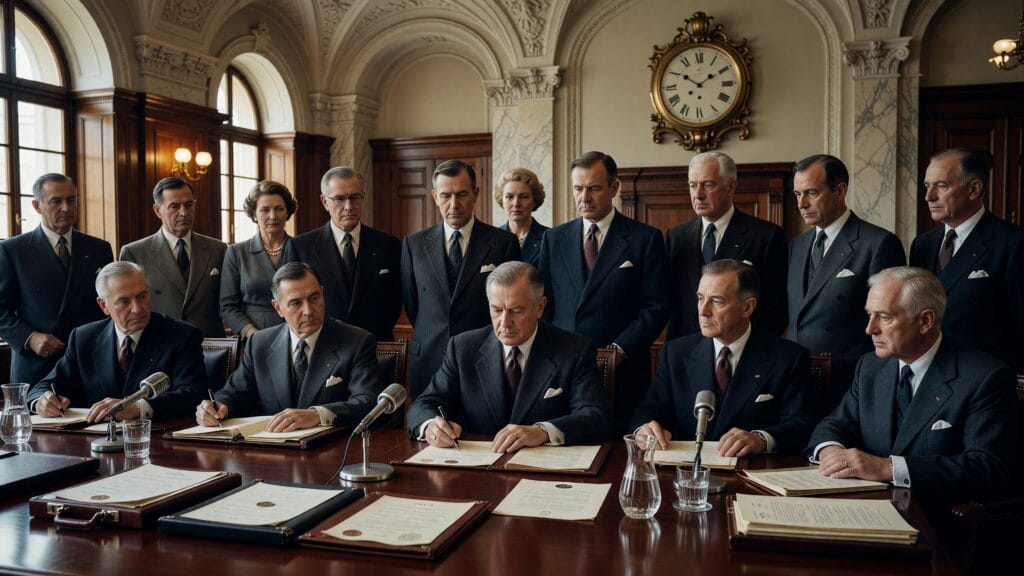
On July 29, 1957, the Statute entered into force, and the Agency began to exist not on paper but in practice. In the months that followed, the first General Conference convened in Vienna, and the Board of Governors met to decide priorities, personnel, and how to translate hope into procedures.
W. Sterling Cole, a U.S. congressman turned international civil servant, became the first Director General. The Secretariat’s earliest tasks were tangible: assemble scientific advisory groups, design training programs, and outline safeguards. The phrase international atomic energy agency established, repeated in newspapers and communiqués, carried an unmistakable sense of new responsibility.
There was celebration, but also skepticism. Critics feared a fig leaf for superpower interests. Supporters emphasized technical assistance and standards for reactor safety. The new Agency set out to prove that it could improve agriculture and medicine on Monday, then reassure a nervous world about enriched uranium on Tuesday.
07 – Inventing Safeguards: Watching the Atoms Without Stopping Them
Safeguards were the Agency’s most delicate invention. Early systems, codified in the 1960s under documents like INFCIRC/26 and later INFCIRC/66, focused on accounting for declared nuclear materials in specific facilities. Inspectors would measure inputs and outputs, verify records, and look for discrepancies large enough to indicate diversion.
This was bookkeeping with geopolitical stakes. States wanted predictable, non-intrusive routines; inspectors needed enough access to detect tricks. Every instrument—a seal, a camera, an assay—had political weight. The system accepted a risk: that undeclared facilities might escape notice. Nevertheless, it created a baseline discipline where none had existed.
Over time, practice shaped doctrine. Technical advances introduced tamper-indicating devices, neutron monitors, and environmental sampling. Yet the philosophy remained humble: provide confidence, not absolute guarantees. The difference mattered when the world discovered how much could hide behind a small loophole and a locked door.
08 – Selling the Peaceful Atom: Medicine, Agriculture, Power
While safeguards drew headlines, technical cooperation won hearts. The Agency helped train radiologists, cancer nurses, and veterinary specialists. It sponsored isotope hydrology to trace groundwater and improve irrigation. In agriculture, nuclear techniques induced mutations and tracked pests, quietly boosting crop yields far from the drama of international summits.
Power reactors, dazzling on brochures, appealed to leaders seeking modernity. The Agency organized expert missions, standardized safety norms, and published guidance for siting, operation, and waste management. For many countries, the IAEA became synonymous with scientific mentorship rather than intrusive checks—an identity essential to political survival.
By building clinics and labs, the Agency bought trust that inspection regimes alone could never earn. The peaceful atom was not just propaganda; it was an x-ray machine in a provincial hospital, a harvest saved from weevils, and a scientist trained to international standards. Utility became the Agency’s quiet diplomacy.
09 – Suez, Sputnik, and the Cold War Shadow
Global politics shoved the Agency into the spotlight more than it chose. The Suez Crisis of 1956 had already underscored how colonial legacies and superpower postures could collide. Then Sputnik in 1957 declared the Soviet Union’s technological prowess, intensifying competition over prestige projects, including reactors and research centers.
In this atmosphere, the Agency offered a rare venue where scientists from rival blocs could share standards and sometimes data. It did not transform the Cold War, but it carved a narrow channel of cooperation through it. Conferences crackled with disputes, yet they also diffused practical know-how safely, if imperfectly.
Arms control remained outside its mandate, but adjacent. When superpowers tested weapons, public fear washed over civilian nuclear projects, heightening demands for safety and transparency. The Agency learned a hard lesson: legitimacy depended not only on its own conduct but on the behavior of states it could not control.
10 – Early Tests of Credibility: Israel, India, and Beyond
Controversies in the 1960s tested the young institution’s mettle. Israel’s facility at Dimona, a focus of U.S. concern, illustrated the Agency’s limits when states resisted comprehensive scrutiny. The most fateful case came in 1974, when India conducted a “peaceful nuclear explosion,” harnessing knowledge from assistance but outside IAEA safeguards.
The Indian test jolted confidence in the global nuclear bargain. It proved that “peaceful” technology and knowledge could be partitioned strategically to achieve military goals. The Agency responded by tightening facility-specific safeguards, yet the fundamental gap remained: without a universal treaty, protections were patchwork.
These episodes did not destroy the Agency, but they marked a turn. Members realized inspections needed broader reach, and supplier states reconsidered export controls. The delicate balance between openness and oversight began to tilt toward more precise conditions, anticipating a landmark pact that would redefine the Agency’s authority.
11 – The NPT Nexus: 1968 and the New Bargain
The Treaty on the Non-Proliferation of Nuclear Weapons, opened for signature in 1968, changed the IAEA’s world. Non-nuclear-weapon states accepted comprehensive safeguards on all peaceful nuclear activities, administered by the Agency, in exchange for access to technology and a promise—however contested—of disarmament by nuclear powers.
For the IAEA, the NPT produced a systemic mandate. Model agreements like INFCIRC/153 in 1971 standardized procedures and expanded inspector access. The Agency was still a creature of consent, but consent now came bundled with treaty obligations. Verification shifted from site-by-site auditing to national system evaluation.
This was the moment when “international atomic energy agency established” became an anchor in international law rather than just a headline. The Agency’s identity matured, no longer simply a facilitator of assistance but a guardian of a global bargain, surrounded by expectations it had not chosen but had to meet.
12 – Inspectors’ Boots on the Ground: Protocols and Dilemmas
Inspections require choreography. Inspectors plan visits, notify states, and verify declared inventories with independent measurements. They install cameras, apply seals, and sample the environment for microscopic signatures of nuclear activity. Each step is standardized yet context-specific, woven into confidential reports that feed Board deliberations.
The dilemmas are structural. Too little access invites evasion; too much risks backlash or politicization. After the 1991 discovery of Iraq’s clandestine program, member states strengthened the toolkit with the Additional Protocol in 1997, enabling short-notice inspections and broader environmental sampling to detect undeclared work.
Yet the art remains in relationships. Inspectors must be rigorous and calm, knowledgeable and discreet. A misused word can sour months of cooperation; an overlooked anomaly can mortally wound credibility. In the field, geopolitics collapses into small acts—checking a logbook, weighing a cylinder, verifying a camera’s timestamp.
13 – Accidents and Public Trust: Three Mile Island to Chernobyl
Even as proliferation fears persisted, nuclear accidents reshaped the Agency’s agenda. The 1979 Three Mile Island incident in the United States rattled confidence, prompting a wave of safety reviews and peer exchanges. Then, in 1986, Chernobyl transformed skepticism into trauma. Fallout drifted across borders; secrecy met satellite images.
The IAEA convened emergency meetings, dispatched experts, and helped codify new norms. The Early Notification and Assistance Conventions of 1986 aimed to accelerate transparency and mobilize international help. Safety standards expanded, culminating in the Convention on Nuclear Safety in 1994 and a culture of peer review that prized candor.
Chernobyl’s legacy endures in drills, design upgrades, and a presumption of openness under stress. It taught the Agency that accidents could sabotage nonproliferation by eroding acceptance of peaceful programs. Safety and safeguards, once partly separate, now moved together, each reinforcing the other’s claim to necessity.
14 – From Iraq to Iran: The Agency in a World of Secrets
The 1991 Gulf War uncovered Iraq’s clandestine nuclear program, stunning diplomats who had assumed existing safeguards were adequate. Under special UN Security Council mandates, the IAEA’s “Action Team” dismantled facilities, mapped procurement networks, and pioneered investigative techniques that informed later verification worldwide.
In the 2000s, attention shifted to Iran. After undeclared activities were revealed in 2002, years of inspections, resolutions, and negotiations followed. The 2015 Joint Comprehensive Plan of Action tasked the IAEA with detailed monitoring. Political storms swirled around technical judgments, yet the Agency’s quiet reporting cadence acted as an anchor.
Meanwhile, North Korea’s path—joining the NPT, expelling inspectors, and testing weapons—showed the limits of consent-based systems. The lesson was sobering: verification can document noncompliance and build coalitions, but it cannot enforce political will. Still, each inspection refined methods, reinforcing why the Agency mattered at moments of crisis.
Immediate consequence:
The IAEA evolved from a developmental broker into a central verifier of treaties and ad hoc Security Council mandates, with stronger tools like the Additional Protocol and environmental sampling.
Long-term consequence:
The world normalized the expectation that nuclear programs be inspected, reported, and internationally intelligible—a cultural shift that empowers diplomacy even when it cannot compel outcomes.
15 – Conclusion
The IAEA’s creation was an act of disciplined optimism. It took a technology born in secrecy and horror and attempted to place it under rules, inspections, and shared benefits. The phrase international atomic energy agency established marks the moment an aspiration acquired an address, a statute, and, slowly, a tradition.
That tradition is neither triumphant nor toothless. It is procedural, cumulative, and human—a chain of reports, site visits, assistance projects, and emergency responses. From cancer clinics to cascade halls, from Vienna corridors to far-flung laboratories, the Agency gave the nuclear age a grammar. In learning to speak it, the world learned to breathe.
16 – FAQs
- When was the IAEA established?
The Statute entered into force on July 29, 1957, the date widely marked as when the international atomic energy agency established its legal existence. The first General Conference met in Vienna in October 1957. - Where is the IAEA headquartered?
Vienna, Austria. The Agency began work in Vienna in 1957 and moved into the Vienna International Centre in 1979, consolidating its growing Secretariat and laboratories. - Who were the key figures at the beginning?
U.S. President Dwight D. Eisenhower catalyzed the idea with his 1953 “Atoms for Peace” speech. W. Sterling Cole served as the first Director General, followed by Sigvard Eklund, who led major expansions in safeguards and technical cooperation. - What caused the IAEA to be created?
In the wake of Hiroshima and Nagasaki, and as nuclear knowledge spread, states needed a way to share peaceful applications without fueling weapons programs. Eisenhower’s proposal, UN diplomacy, and years of negotiations converged in the 1956 Statute and its 1957 entry into force. - What were the main consequences of its establishment?
The IAEA standardized nuclear safety and verification, built training networks, and became the verifying arm of the NPT. It also created expectations: responsible nuclear programs would be inspected, reported, and technically legible to the international community. - What is the IAEA’s legacy today?
It remains the central institution for peaceful nuclear cooperation and verification, mediating crises from Iraq to Iran and coordinating safety norms after accidents. “International atomic energy agency established” was a milestone; its enduring legacy is a culture of accountability in nuclear affairs.
17 – External Resource
18 – Internal Link
Other Resources
- Encyclopaedia Britannica – general search for the exact subject
- Google Scholar – academic search for the exact subject
- Internet Archive – digital library search for the exact subject
Sources and References
-
Statute of the International Atomic Energy Agency (Approved on 23 October 1956, entered into force 29 July 1957), United Nations Treaty Series, Vol. 276, No. 3840.
Note: Primary legal document establishing the IAEA, used to confirm the founding date, legal basis, objectives (“to accelerate and enlarge the contribution of atomic energy to peace, health and prosperity”) and organizational structure. -
International Atomic Energy Agency (IAEA). “History.” In: About Us, official IAEA website, Vienna.
Available at: https://www.iaea.org/about/overview/history
Note: Official institutional overview used for the narrative of the agency’s origins, early development, and its location and role in Vienna as an international nuclear watchdog. -
International Atomic Energy Agency (IAEA). “The IAEA and the Non‑Proliferation Treaty.”
Available at: https://www.iaea.org/resources/non-proliferation-treaty-npt
Note: Used to support discussion of the IAEA’s safeguards system, its verification role under the NPT, and the evolution of its non‑proliferation mandate after its establishment. -
Krige, John & Barth, Kai‑Henrik (eds.). Global Power: Science and Technology in International Affairs. Chicago: The University of Chicago Press, 2006.
Note: Contains chapters on Cold War science diplomacy and the politics of peaceful nuclear energy, used to situate the creation of the IAEA within broader Cold War and “Atoms for Peace” context. -
Fischer, David. History of the International Atomic Energy Agency: The First Forty Years. Vienna: International Atomic Energy Agency, 1997.
Note: Authoritative institutional history by a senior IAEA official; used for details about early negotiations, member‑state debates over the Statute, and the agency’s initial programs and challenges. -
Hewlett, Richard G. & Holl, Jack M. Atoms for Peace and War, 1953–1961: Eisenhower and the Atomic Energy Commission. Berkeley: University of California Press, 1989.
Note: Provides context on U.S. nuclear policy and President Eisenhower’s “Atoms for Peace” initiative, which directly influenced the proposal and political support for establishing the IAEA. -
Eisenhower, Dwight D. “Atoms for Peace.” Address to the United Nations General Assembly, New York, 8 December 1953. In: Public Papers of the Presidents of the United States: Dwight D. Eisenhower, 1953. Washington, D.C.: U.S. Government Printing Office, 1960.
Note: Primary source speech outlining the concept of an international atomic energy agency and peaceful nuclear cooperation, used to support statements about the intellectual and political origins of the IAEA. -
United Nations Office at Vienna. “Vienna as a Hub for International Organizations.”
Available at: https://www.unov.org/
Note: Used to confirm the role of Vienna as a major center for international organizations, including the IAEA, and to support references to the city’s significance in post‑war multilateral diplomacy.