Table of Contents
- Rome in Winter 1564: The Final Studio
- The Artist and the Age: Michelangelo at Ninety
- The Project Unfinished: St. Peter’s and the Late Pietàs
- 18 February in Rome: The Last Hours
- Papal Court Response: Mourning and Politics
- Family, Heirs, and the Florentine Claim
- The Secret Journey North: Moving the Body
- Florence on Stage: The State Funeral and Mythmaking
- The Studio Afterlife: Assistants, Drawings, and Dispersal
- Reputation in Print: Condivi, Vasari, and the Sources
- Faith, Reform, and Art: Michelangelo’s Spiritual Testament
- Patronage and Money: The Market After 1564
- Europe Responds: Echoes Across Courts and Workshops
- Unfinished Visions: The Dome and the Final Sculptures
- Conclusion
- FAQs
- External Resource
- Internal Link
Article Summary: In February 1564, Rome stood witness to the last breath of Michelangelo Buonarroti, the aging architect of St. Peter’s and towering sculptor of the Renaissance. This article reconstructs the days surrounding his death, the ceremonies that followed, and the political theater that transformed mourning into strategy. We track the covert transfer of his body to Florence, the Medici state funeral, and the contested authorship of his legacy. Drawing on contemporary testimony and later retellings, we examine how the death of Michelangelo became a European news event. Finally, we interpret the human, spiritual, and architectural consequences left in the wake of his passing.
Why keep reading: A single death opened a struggle between Rome and Florence, church and state, memory and myth. Follow how a quiet passing in a modest Roman house became a diplomatic operation, a publishing campaign, and a blueprint for how Europe would remember artistic genius.
At a glance:
- Event: Death of Michelangelo Buonarroti
- Date: 18 February 1564 (Old Style), late evening
- Place: Macel de’ Corvi district, Rome, Papal States
- Main figures: Michelangelo; Pope Pius IV; Giorgio Vasari; Lionardo Buonarroti; Cosimo I de’ Medici; Daniele da Volterra; Giacomo della Porta
- Why it mattered: The passing of the most celebrated artist of his age catalyzed political rituals, transformed artistic reputations, and shaped the trajectory of St. Peter’s and European art after the Council of Trent.
01 – Rome in Winter 1564: The Final Studio
Rome in February felt more gray than golden, the marble city shivering along muddy streets and shuttered workshops. In a house near Macel de’ Corvi, within earshot of Trajan’s Forum, Michelangelo sat surrounded by chalked plans and a wounded block of marble. The death of michelangelo would turn this quiet, book-lined refuge into a site of pilgrimage and dispute.
He was almost ninety, his handwriting smaller, his authority undiminished. The studio smelled of paper and dusty travertine, not oil paint; his days no longer belonged to fresco but to architecture, letters, and the stubborn stone of a final Pietà. Rome’s winters tend to level noise, but his name still echoed through the palaces.
News about him moved quickly between clerics, envoys, and artisans who watched St. Peter’s rise above the skyline. Michelangelo’s house stood modestly against that ambition, a world of drafts and recollection rather than spectacle. Yet people knew that within, a conversation with time itself was nearing its last exchange.
02 – The Artist and the Age: Michelangelo at Ninety
Michelangelo’s old age coincided with an unsettled Rome. The Council of Trent had only just concluded in December 1563, and ecclesiastical politics shaped everything from decoration to doctrine. He lived with the authority of a man who had painted the Sistine and defied patrons, but with the fragility of years counted carefully by friends and anxious nephews.
Contemporary letters suggest pain in his hands and legs, a body thinned by fasting and work. Still, petitions arrived at his door, and visitors sought a word about the dome or a glance at the stone that he continued to carve. He seemed at once retreating and central, a paradox the city itself produced.
He had weathered papal displeasures and shifting fashions, surviving long enough to become his own memorial. It is easy to forget how fragile this world still was: reputations traveled by rumor and manuscript, and a single illness could silence a voice that had defined an epoch.
03 – The Project Unfinished: St. Peter’s and the Late Pietàs
Michelangelo’s principal duty in his final years was St. Peter’s Basilica, where he revised and simplified earlier schemes. The shell of the great church advanced under his eye, though he warned repeatedly against changes by committee. Beside those architectural labors lay a broken, tender sculpture: the Rondanini Pietà, slim and ascetic, emerging from exhaustion.
The late Pietàs do not deliver beauty comfortably. They show figures attenuated, a Christ almost weightless, a Mary whose sorrow is chiselled into persistence. Modern historians debate how much is intentional and how much unfinished experiment, but the surviving evidence points toward deeply personal carving, worked and reworked to the threshold of his strength.
Meanwhile he signed letters for the Fabbrica of St. Peter’s and consulted with trusted collaborators. Jacopo del Duca and other assistants executed instructions while he hovered between correction and contemplation. The victory solved one problem and created another: who would guard these intentions if his hand fell still?
04 – 18 February in Rome: The Last Hours
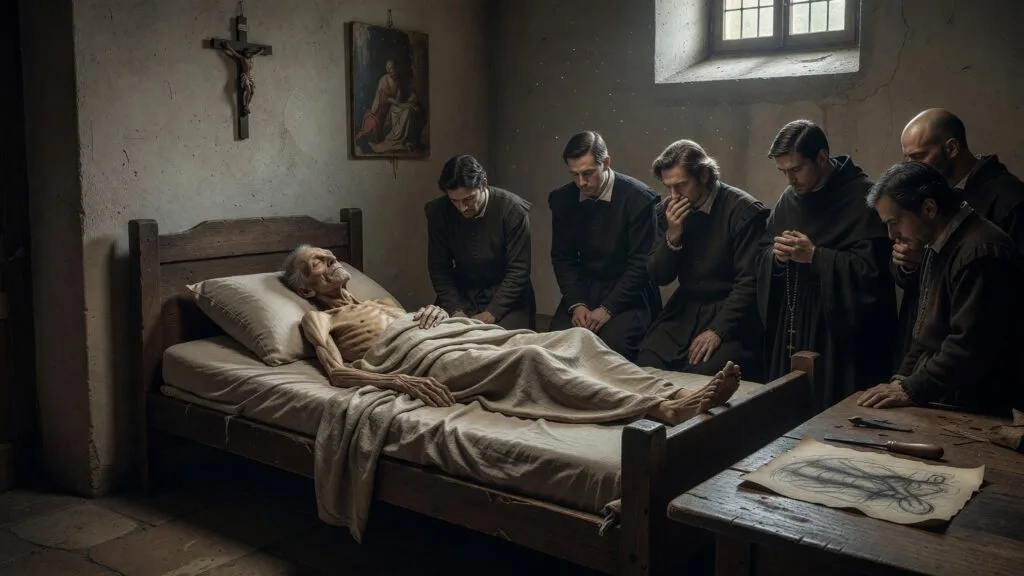
On the evening of 18 February 1564, the vigil of his final illness closed. Accounts vary in detail; later chroniclers claimed prayers, visitors, and a brief release from pain. What is consistent is the location—his house near Macel de’ Corvi—and the sense of quiet endurance that had defined his last decade.
His physician and a small circle of friends and servants reportedly attended. Daniele da Volterra, remembered for other reasons, appears in some retellings as a near presence. A nephew’s interests hovered through correspondence, already turning affection into administrative duty. The passing itself was unadorned, appropriate to a man who had sought simplicity late in life.
News moved across Rome faster than carts. Before midnight, papal officials, patrons, and colleagues had heard, and by morning the city understood that a chapter had closed. Yet behind the ceremony to come, a knot of inheritance and city pride began to pull tight.
Mini timeline:
- 1475: Birth in Caprese, in the Florentine countryside.
- 1534: Michelangelo relocates to Rome, leaving Florence behind.
- 1546: Appointed chief architect of St. Peter’s Basilica.
- 1564: Death in Rome; body transferred to Florence within weeks.
05 – Papal Court Response: Mourning and Politics
Pope Pius IV presided over a city just freed from the storm of council and reform. His court moved quickly to acknowledge the loss while preserving papal prerogatives over a servant of St. Peter’s. Condolences were public, but practical questions surfaced almost immediately: burial, guardianship of designs, and the message Rome should project.
Funerals in Rome were instruments as much as devotions. A celebrated artist’s rites might signal a city’s cultural supremacy, an argument played out in candles and catafalques. The Curia’s instinct was to honor the architect where he had served, consolidating Rome’s claim over his reputation just as the basilica neared irreversible stages.
Yet this was only the beginning. Florence, under Cosimo I de’ Medici, regarded Michelangelo not simply as a son but as a resource for dynastic legitimacy. The desire for his remains—silent and potent—met the papal intention to mourn him in place, and compromise would prove as delicate as liturgy.
06 – Family, Heirs, and the Florentine Claim
Michelangelo had long acknowledged his nephew, Lionardo Buonarroti, as heir. Letters from the Casa Buonarroti archive reveal decades of careful instruction about property and reputation. The death crystallized those threads into immediate decisions: arrange papers, secure the studio, and, if possible, fulfill the family’s dream of bringing him home.
Florence had courted Michelangelo for years, alternately praising and pressuring him. Now Cosimo I could transform fidelity into spectacle by returning the master to San Lorenzo, near the Medici tombs and underneath fresher layers of ducal magnificence. The nephew’s duty and the duke’s ambition briefly became the same road.
But permission was not simply a family affair. Contemporary sources suggest papal consent was required, and negotiations unfolded quietly. The documentary record is fragmentary, yet most historians agree that an understanding—formal or tacit—cleared the way for a discreet departure from Rome.
07 – The Secret Journey North: Moving the Body
Accounts of the transfer read like a minor heist in a world of prayers and permits. Later narratives describe the body concealed in a crate of merchandise, escorted by allies of the Buonarroti household along the road to Florence. Whether every detail is exact, the secrecy speaks to the stakes: no city wanted to be seen as losing him.
The route wound across a winter landscape, muddy and watchful. Couriers traveled faster than coaches, carrying news that outran the procession. By the time the convoy crossed into Tuscan territory, the destination city was readying its altars and its rhetoric, preparing to turn grief into architecture.
Sources differ on dates, but by late March the remains were in Florence, and by mid-summer the full civic and ducal machinery would escort them to San Lorenzo. What began as a quiet Roman death became a Florentine triumph, engineered through kinship, timing, and the politics of memory.
08 – Florence on Stage: The State Funeral and Mythmaking
Florence staged the funeral at San Lorenzo with theatrical precision. A towering catafalque, attributed to Vasari’s designs, transformed the church into a visual argument about Tuscan supremacy. Paintings, verses, and temporary decorations narrated Michelangelo’s life as a journey that properly ended under Medici protection, a story as political as it was pious.
Poets read tributes; delegations processed beneath allegorical banners that framed him as a miracle of nature and custodian of divine form. The ceremony elevated grief into statecraft, aligning the Buonarroti lineage with Medici power, and the city with a universal artistic calling. Florence, like Rome, understood how to manage the afterlife of fame.
Giorgio Vasari was everywhere in this theater: as organizer, court artist, and biographer in waiting. If mourning requires narrative, he was prepared to supply it, weaving the man he knew into the legend he needed. The death of michelangelo thus began a life on paper that would accompany every later viewing of the Sistine or the Pietàs.
09 – The Studio Afterlife: Assistants, Drawings, and Dispersal
Back in Rome, the practical work of closure pressed on. Assistants and friends secured the studio, allocating drawings, models, and fragmentary sculptures according to instructions and circumstance. Some sheets were destroyed at the master’s behest in earlier years; others survived by chance or discretion, sown across collections that would become the modern canon.
The Rondanini Pietà, later found in his Roman rooms, traveled a different path before arriving in Milan centuries afterward. Models for St. Peter’s passed into institutional custody, where committees, jealousies, and new ideas would bruise their integrity. In the wake of his absence, every scrap became both artifact and argument.
Dispersal created value. Dealers, princes, and scholars hunted for proof of touch; apprentices defended their place in a lineage that suddenly lacked a living measure. The studio had always been a court in miniature; now it became an archive—and a battlefield over authenticity and intention.
10 – Reputation in Print: Condivi, Vasari, and the Sources
Michelangelo’s reputation relied on more than marble; it depended on words. Ascanio Condivi’s 1553 Vita di Michelagnolo offered a portrait shaped with the artist’s consent, pushing back against misreadings in Vasari’s first edition. After 1564, Vasari returned with a revised Life that enshrined the master as the summit of artistic history.
These texts do not agree in everything, and modern historians remain cautious because the surviving record is fragmentary. The Buonarroti family papers, long housed in Florence, give texture to finance and sentiment; Vatican correspondence anchors the story of St. Peter’s in institutional reality. Yet there is room for debate about daily details and motives.
The printing press multiplied grief into opinion, and opinion into doctrine. Europe read about his serenity and struggle, about a saintly artist who mastered bodies and believed in reform. The death of michelangelo thus became a publishing event, shaping canons as securely as any column of travertine.
11 – Faith, Reform, and Art: Michelangelo’s Spiritual Testament
Michelangelo’s later poetry, addressed to friends like Vittoria Colonna, reveals a man wrestling with grace and form. He spoke of sculpture as a way of releasing the image God had placed in stone, a metaphor that turned craft into confession. The Counter-Reformation demanded clarity; his lines asked for mercy.
After the Council of Trent, the debates over sacred images intensified. He had already weathered criticism of the Last Judgment’s nudes; after his death, Daniele da Volterra’s draperies softened the scene under papal direction. Even that edit became part of the legend, a proof that the master’s vision could still unsettle official comfort.
In this climate, the thin, sorrowing bodies of the late Pietàs feel prophetic. They do not defy doctrine; they gravitate toward it, stripping spectacle until only the wound remains. His spiritual testament lies less in any single verse than in the turn toward austerity, a refusal to flatter flesh or fashion.
12 – Patronage and Money: The Market After 1564
Michelangelo had navigated money with a stubborn independence. He accepted payments and stipends, yet he famously rejected salaries that bound him too tightly, including, some sources suggest, compensation as chief architect of St. Peter’s. Account books complicate the boast, but the impression mattered: he belonged to work, not payroll.
After his death, his name itself became currency. Drawings attributed to his hand fetched influence as well as price; sculptural fragments found patrons quicker than apprentices could carve. The market built a hierarchy of touch, with proximity to his studio becoming a certificate that amplified careers or ruined them if falsified.
Princes and prelates commissioned “in the manner of” rather than “by” him, stabilizing demand for a style that combined monumentality with psychological charge. The economy of genius is always speculative; in 1564, speculation turned toward the void he left, and the winners were those who could supply echoes convincingly.
13 – Europe Responds: Echoes Across Courts and Workshops
News of his passing crossed the Alps with merchants and manuscripts. In Spain, where royal taste leaned toward intense devotion, the idea of Michelangelo—stern, sublime, exacting—reinforced aspirations for buildings like El Escorial. In France, where wars of religion soon raged, court artists weighed grandeur against fracture, seeking authority in an Italian lineage.
North of the Alps, engravers circulated his inventions more widely than any messenger could. Prints of the Sistine, of muscular prophets and tangled limbs, offered academies a training ground long after the master’s voice fell silent. The death of michelangelo became a syllabus, a set of images to climb and arguments to rehearse.
Reactions were not uniform. Some communities distrusted his heroic nudes; others embraced the architecture and turned away from the flesh. But everywhere, his absence sharpened questions: could greatness be taught, or only imitated? Could a city own a memory as Rome and Florence claimed to?
14 – Unfinished Visions: The Dome and the Final Sculptures
Michelangelo never saw St. Peter’s dome completed. He left a model and a mandate, warning against tampering. After his death, Giacomo della Porta and Domenico Fontana carried the work forward, altering details while respecting the core profile. From certain angles, the dome reads like his signature; from others, like a compromise signed in committee.
The Rondanini Pietà, with its attenuated forms, resists easy closure. It asks viewers to accept fracture as meaning, an almost modern invitation startling for a sixteenth-century hand. Meanwhile, the Florentine Pietà he once attacked with a hammer—frustrated by a fracture, perhaps by grief—stood as a troubling relic of his late uncertainties.
Unfinished work unsettles inheritances. It is astonishing how much political weight could rest on a seal, a signature, or a hostage; in art, authority can rest on a chisel left beside an indeterminate plane. In this ambiguity, later centuries found room to claim him anew, both classic and restless.
Immediate consequence:
Rome lost its living architect for St. Peter’s; Florence gained a state funeral. Workshops reorganized, and collections competed for drawings and fragments linked to the master’s final years.
Long-term consequence:
His death fixed a model of artistic genius filtered through Vasari and court ritual, shaping academies, markets, and devotional art across Europe for centuries.
15 – Conclusion
The winter passing in a modest Roman house mobilized a continent’s ambitions. The death of michelangelo was more than an end; it was a hinge between Renaissance confidence and Counter-Reformation discipline, between solitary invention and institutional stewardship. Rome mourned its architect; Florence made him a monument; Europe made him a curriculum.
In the contest over remains and remembrance, we glimpse how art becomes history. Plans became buildings, fragments became relics, and grief became narrative. What he left—dome, drawings, poems, and wounded marble—continues to fix our eyes on the hard path between vision and obedience, where unfinished stone still asks what form we are brave enough to free.
16 – FAQs
- When did Michelangelo die?
He died on 18 February 1564, in the evening, as contemporary notices from Rome record. The date falls just weeks after the close of the Council of Trent, placing his final hours amid a broader climate of reform. - Where did Michelangelo die?
He died in his house in the Macel de’ Corvi district of Rome, near Trajan’s Forum. The neighborhood no longer survives in its original form, but its location anchored him within walking distance of the major works that defined his last decades. - Who were the key figures involved after his death?
Pope Pius IV guided the papal response; his nephew Lionardo Buonarroti handled family affairs; Giorgio Vasari shaped the Florentine funeral and the biography; and collaborators such as Daniele da Volterra and Giacomo della Porta helped manage works and legacy. - Why did his body move from Rome to Florence?
Florence, under Cosimo I de’ Medici, sought to claim Michelangelo as its greatest son, aligning civic pride with dynastic prestige. With family advocacy and, sources suggest, papal consent, the transfer allowed a grand public funeral that served political and cultural goals. - What changed in art and architecture because of his death?
Immediately, Rome lost its guiding hand for St. Peter’s, while Florence gained symbolic capital. Over time, academies across Europe codified his style; markets prized his drawings; and debates over sacred images, now without his voice, leaned more heavily on committees and biographers. - What is his enduring legacy today?
Beyond masterworks like the Sistine frescoes and monumental sculptures, his legacy includes a model of solitary artistic authority and moral seriousness. The death of michelangelo helped consolidate this image, amplified by Vasari and others, making him a touchstone for how cultures define genius.
17 – External Resource
18 – Internal Link
Other Resources
- Encyclopaedia Britannica – general search for the exact subject
- Google Scholar – academic search for the exact subject
- Internet Archive – digital library search for the exact subject
Sources and References
-
Vasari, Giorgio. Le Vite de’ più eccellenti pittori, scultori e architettori, expanded edition, 1568. Various modern critical editions (e.g., ed. Rosanna Bettarini and Paola Barocchi, Florence: Sansoni, 1966–1987).
Note: Primary biographical source for Michelangelo’s life, reputation during his own century, and early reactions to his death; supports statements on his stature in 16th‑century Italy and contemporary assessments of his artistic achievements. -
Buonarroti, Michelangelo. The Letters of Michelangelo, translated and edited by E. H. Ramsden. Stanford: Stanford University Press, 1963.
Note: Collection of Michelangelo’s correspondence, providing primary evidence for his late life in Rome, relations with popes and patrons, and personal concerns in the years leading up to his death. -
Condivi, Ascanio. Vita di Michelagnolo Buonarroti. Rome, 1553. Critical edition in: Ascanio Condivi, Vita di Michelangelo, ed. Giovanni Nencioni. Florence: Sansoni, 1998.
Note: Near‑contemporary authorized biography supervised by Michelangelo himself; supports details about his Roman period, his own view of his career, and aspects of his character and working habits close to the time of his death. -
Wallace, William E. Michelangelo: The Artist, the Man and his Times. Cambridge: Cambridge University Press, 2010.
Note: Modern scholarly synthesis of Michelangelo’s life and historical context; supports information on his final years in Rome, his work on late architectural and sculptural projects, and the circumstances and dating of his death in 1564. -
Hirst, Michael. Michelangelo: The Achievement of Fame, 1475–1534 and Michelangelo: The Artist and the Man, 1534–1564. New Haven and London: Yale University Press, 2011.
Note: Detailed, document‑based biography; the second volume in particular supports discussion of Michelangelo’s Roman residence in his final decades, his health and workload, and documented records of his death and burial. -
Hall, Marcia. “Michelangelo Buonarroti.” In Grove Art Online. Oxford University Press. (Access via institutional subscription.)
Note: Authoritative encyclopedia entry summarizing Michelangelo’s career, with reliable dates and contextual information; supports chronological framing of his life, his major commissions in Rome, and his posthumous reputation in art history. -
Musei Vaticani (Vatican Museums). Official pages on Michelangelo and the Sistine Chapel. Vatican City State: Musei Vaticani.
Note: Institutional resource providing historically grounded information on Michelangelo’s Roman commissions under the papacy, his ongoing relationship with the Papal court, and his status in Rome at the time of his death. -
Casa Buonarroti, Florence. Archival and museum documentation on Michelangelo Buonarroti. Florence: Fondazione Casa Buonarroti.
Note: Museum and archival holdings related to Michelangelo and his family; supports details about posthumous treatment of his remains and legacy, as well as documentary evidence surrounding the transfer of his body to Florence after his death.