Table of Contents
- Carthage in the Severan Age
- A Young Mother under Arrest
- The Prison Journal and Voice of Perpetua
- Felicity’s Labor and Resolve
- The Arena as a Roman Stage
- The Day of the Games: March 7, 203
- Spectacle, Animals, and the Crowd
- The Final Act with the Sword
- Roman Law, Religion, and Identity
- Christian Communities and Gender
- Memory, Text, and Transmission
- From Local Story to Global Icon
- Debates among Historians
- Legacies in Liturgy and Art
- Conclusion
- FAQs
- External Resource
- Internal Link
Article Summary: On March 7, 203, in Roman Carthage, a small group of Christian catechumens, including Vibia Perpetua and the enslaved woman Felicity, entered the amphitheater and refused to renounce their faith. Their deaths were recorded in an extraordinary text, part memoir and part editorial narrative, that gave early Christianity one of its most intimate portraits. This article reconstructs the political climate, legal pressures, and social hierarchies framing the martyrdom of Perpetua and Felicity. It follows the prisoners from arrest to arena, traces how their memory traveled, and examines scholarly debates. The result is a sober, human reading of courage under empire and of a story that never stopped moving. Along the way, we ask why this episode mattered, and how it still shapes conversations about gender, authority, and faith.
Why keep reading: In a world where empire demanded conformity, a young mother and an enslaved woman refused. Their courage unfolded step by step, not as myth, but within law courts, prison cells, and a roaring amphitheater. Follow the evidence, hear their voices, and see how a local execution became a global inheritance.
At a glance:
- Event: Martyrdom of Perpetua and Felicity and their companions
- Date: March 7, 203 CE (traditional date, derived from the Passio)
- Place: Carthage, Africa Proconsularis, Roman Empire
- Main figures: Vibia Perpetua, Felicity, Saturus, Revocatus, Saturninus, Secundulus (died in prison), and the governor Hilarianus
- Why it mattered: Their testimony preserved one of the earliest female-authored Christian texts, shaped martyr ideology, and became central to North African Christian identity and later global Christian memory.
01 – Carthage in the Severan Age
At the turn of the third century, Carthage was a prosperous metropolis, the Roman crown of North Africa. Colonnaded streets, bustling markets of grain and olives, and a grand amphitheater signaled imperial confidence. Beneath the marble shimmer, religious diversity and social stratification knit and frayed in equal measure.
Emperor Septimius Severus, himself African-born, stabilized a once-fractured empire. Yet the harmony was incomplete. Contemporary sources suggest that around 202, imperial policy hardened against conversion to Judaism and Christianity, even if everyday enforcement varied by governor, city, and crowd.
This was the world that framed the martyrdom of perpetua and felicity. A provincial capital that celebrated spectacles, honored the emperor’s household, and prized public order now became the stage where a small religious minority pressed the limits of conscience and law.
It is easy to forget how fragile this world still was. Political legitimacy rested on theatrical loyalty, oaths, and sacrifice, while new religious identities asked adherents to refuse such rites. The victory of imperial reunification created a new problem: what to do with dissent that was spiritual more than seditious.
02 – A Young Mother under Arrest
Vibia Perpetua was young, likely in her early twenties, a freeborn woman from a respectable family. She was also a recent Christian catechumen, mother to an infant son, and daughter to a father who pleaded for her to recant. The Passio names her companions, including the enslaved woman Felicity, Revocatus, Saturninus, and their teacher Saturus.
Arrest placed Perpetua where many provincial cases began: a crowded prison, rough with heat and smell, where family and fellow believers negotiated access with guards. The law did not target belief as belief, but the refusal to sacrifice and the obstinate confession of a proscribed identity could trigger deadly charges.
The friction was intimate. A father’s pleas clashed with a daughter’s conviction, and within that conflict lay the empire’s dilemma. Could public harmony be secured if some citizens denied the gods that underwrote it, and would they bend if the law applied pressure at the point of family obligation?
03 – The Prison Journal and Voice of Perpetua
The surviving account claims that Perpetua herself wrote part of the narrative. If authentic, it is one of the earliest Christian texts by a woman. The voice inside speaks clearly of fear, resolve, and a profound sense that the impending trial was also a spiritual contest.
She describes visits from her father, the pain of separation from her infant, and visions that gave her interpretive frames for suffering. One vision shows a perilous ladder guarded by a dragon, another her deceased brother Dinocrates, once tormented by thirst, now refreshed through her intercession.
Modern historians debate exact authorship, but the text’s intimacy is unmistakable. It breathes daily details that ring provincial and plausible: negotiations for better prison conditions, the relief when her baby was allowed to nurse, and the odd calm that settled as the hearing approached.
The editorial hand that frames her words offers interpretations and structure, but something personal still pierces the screen of rhetoric. It is not only a tale of death; it is a diary of conversion hardened into witness, line by line and choice by choice.
04 – Felicity’s Labor and Resolve
Felicity’s situation was even more precarious. As an enslaved woman and pregnant, she carried double vulnerability within the Roman legal and social order. The Passio reports that she prayed to give birth before the spectacle, since pregnant women could not be executed according to local custom.
She went into labor in prison, days before the games. The story remembers guards who mocked her groans, incredulous that she hoped to face beasts with composure. The text answers with a hard distinction: childbirth pain is involuntary; martyrdom is an offering freely chosen, suffered with aid from God.
A child was born and quickly taken in by a community whose survival depended on informal networks. The pairing of Perpetua and Felicity—free and enslaved, both mothers—would become a powerful symbol of Christian solidarity that did not erase social difference but challenged its boundaries in the arena.
Mini timeline:
- c. 202: Policy shift against conversions attributed to Severus, though enforcement varies.
- Early 203: Arrest of Perpetua, Felicity, and companions; initial imprisonment in Carthage.
- Shortly before March 7: Felicity gives birth in prison; Secundulus dies in custody.
- March 7, 203: Public spectacle in the amphitheater; executions of the group.
05 – The Arena as a Roman Stage
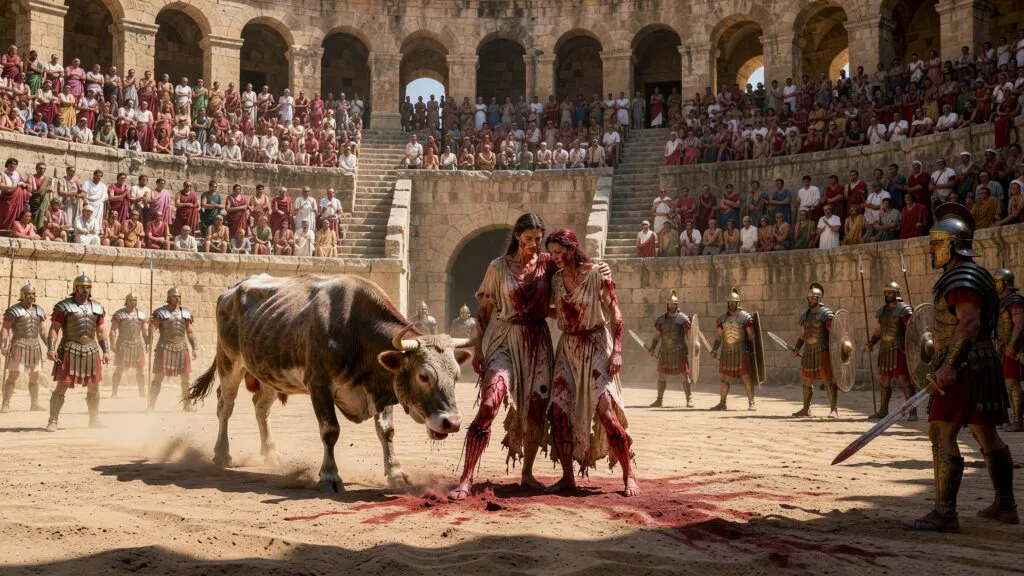
The Carthaginian amphitheater could marshal thousands. There, civic life performed itself through games, hunts, and judicial executions woven into celebratory calendars. The editor of the Passio claims the spectacle honored the birthday of the emperor’s son Geta, linking local ritual to imperial family prestige.
To enter that space as a condemned criminal was to become a prop in Rome’s theater of power. The garments, the animals, the choreography of entrances and exits, even the music, all reinforced the moral of order restored. A refusal to play the assigned role challenged more than a judge; it defied a civic catechism.
Perpetua and her companions were asked to don ritual costumes—priests’ robes to align the display with the gods. They refused, at risk of angering the organizers, for to wear them would be to concede a liturgy they did not accept. This was not stubborn spectacle; it was conscience embodied.
But this was only the beginning. The sequence of events—exposure to beasts, injuries, reprieves, and final sword—would turn the amphitheater’s grammar against itself, as the condemned asserted agency in the very moment designed to strip it away.
06 – The Day of the Games: March 7, 203
On the morning of March 7, 203, the prisoners were led into daylight. The editor of the Passio narrates how Saturus, the catechist, entered confident yet humble, while Perpetua walked with the poise of someone who had already settled her answer. By then, her father’s pleas had not moved her.
The crowd did not come for them alone. Hunters, performers, and animal keepers worked to make the day’s program memorable. Executions were inserted into this sequence as punctuation marks, moments when the city declared loyalty to the gods and the emperor, and when troublemakers met the empire’s teeth.
Secundulus, one of the group, had died in prison, spared the amphitheater’s choreography by an earlier weakness. The rest faced staged ordeals that juxtaposed humiliation and courage. Far from the cool silence of a law court, here emotion and spectacle roared over every judgment.
The Passio records gestures of care even then: sharing a final kiss of peace, adjusting torn garments for modesty, and encouraging one another. In these small acts, the group knitted a different community amid an audience that sought another lesson entirely.
07 – Spectacle, Animals, and the Crowd
The editor says Perpetua and Felicity were exposed to a wild heifer, a choice that invoked fertility and provocation. The animal tossed them, injuring and disorienting them, while the arena’s dust swallowed cries that mixed awe, mockery, and pity. Attendants retrieved and clothed them again, a gesture the narrative reads as grudging respect.
For the men, various beasts were brought forth, from leopards to bears, playing their part in a grim zoological theater. Saturus endured grievous wounds, and a tradition in the text recalls his final gift of a blood-soaked token to a sympathetic guard named Pudens, a counter-ritual of intimacy in a place of display.
These details are not tidy morality plays. They carry the texture of provincial spectacle, where trained animals did not always behave and crowds shifted between cruelty and admiration. The condemned, too, acted on a script of their own, complicating attempts to reduce them to passive symbols.
08 – The Final Act with the Sword
When animals failed to complete the sentence, the sword followed. The Passio reports that Perpetua stood steady as a nervous gladiator approached. The text famously claims she guided his hand to her throat, asserting control at the last instant and recasting her death as willing testimony rather than mere victimhood.
Felicity, too, is remembered as serene, her ordeal of labor now joined to the final wound that Roman justice demanded. The editor notes the group’s unity as they died, a choreography of conviction that inverted the arena’s didactic message and offered a rival reading to anyone willing to see it.
Martyr legends later polished such scenes, but the core detail—composure amid chaos—aligns with other accounts from the era. Even allowing for rhetoric, the story’s force lies in the textured ordinariness of fear and choice, not in invulnerable heroes or easy miracles.
It is astonishing how much political weight could rest on a blade’s tremble. One executioner’s hesitation became, in memory, a symbol that the empire’s hand could falter where a believer’s resolve did not.
09 – Roman Law, Religion, and Identity
What, legally, was their crime? Earlier correspondence between Pliny and Trajan had established a practice: Christians were not hunted, but if accused, they must sacrifice or face punishment. By the Severan period, practice varied, and governors retained discretion to protect public order.
Contemporary sources suggest a policy shift against conversion around 202, though concrete edicts are scant and unevenly preserved. In Carthage, the governor Hilarianus appears in the Passio as the magistrate who pressed them to sacrifice for the emperor’s welfare, a ritual pledge embedded in civic virtue.
Refusal, then, was not mere insolence. It contested Rome’s understanding of loyalty, which fused political allegiance with participation in public cult. To say “no” was to tear at the fabric tying household to city and city to gods, which is why punishment was staged before a crowd.
Yet behind the ceremony lurked practical anxiety. The empire needed compliance, not theological clarity. The spectacle asserted that dissent could be contained. The persistence of Christian communities suggested otherwise, and memory of cases like this exposed the limits of fear as policy.
10 – Christian Communities and Gender
Perpetua and Felicity complicate assumptions about who held authority in early Christianity. A freeborn woman and an enslaved woman stand at the center, their courage recorded and recited in assemblies led primarily by men. The text itself became part of catechesis, shaping how later believers imagined faithful agency.
It also reveals household dynamics. Perpetua’s father represents the older order, trained to guard family honor through religious conformity, while Perpetua stakes a different claim: identity anchored in baptismal allegiance. That she nursed an infant underscores the radicalness of her decision in a deeply familial society.
Felicity’s presence presses another issue. Her enslavement makes her courage doubly abrasive to Roman sensibilities, for bravery was a virtue elite men claimed as their own. In pairing Perpetua and Felicity, the narrative suggests a solidarity that did not erase status but reframed worth under a different lordship.
Such stories also circulated among women, offering models of piety and endurance. That influence likely exceeded what official records show, surfacing instead in naming traditions, household devotions, and local shrines, where memory is often more stubborn than law.
11 – Memory, Text, and Transmission
The “Passion of Saint Perpetua, Saint Felicitas, and their Companions” survives in Latin with a parallel Greek translation, indicating early circulation beyond Africa. The text begins with an editor’s preface, includes sections that claim Perpetua’s own words, and concludes with an account of the executions.
Augustine of Hippo, preaching two centuries later, referred to public readings of their acts in Carthage, even cautioning hearers not to place private visions above Scripture. His sermons attest that their cult and story were well-known and actively curated in North Africa.
Modern editors, including compilers of the Acts of the Christian Martyrs, underline how unusual the Passio is for its autobiographical core. While redaction is clear, and some stylization likely, the blend of administrative detail and raw prison experience resists reduction to literary invention alone.
12 – From Local Story to Global Icon
Initially, their memory was anchored in Carthage. Tradition remembers a burial place venerated by local Christians, and the city marked their feast annually. Pilgrims, merchants, and clerics carried the story along Mediterranean routes, translating it into new tongues and contexts.
By late antiquity, Perpetua and Felicity appeared in martyrologies and calendars across the Latin West, their names recited in Eucharistic prayers. In the East, translations diffused a condensed memory that still stressed courage, solidarity, and the transformative power of witness under pressure.
Art added another channel. Frescoes, ivories, and later manuscript illuminations depicted the two women, often together, sometimes with the heifer that marked their ordeal. Their paired image traveled more easily than fuller narratives, a visual shorthand for friendship in adversity across status lines.
With the spread of Christianity to sub-Saharan Africa and the global South, their story gained new resonances. Communities read in them a precedent for female leadership in suffering and a reminder that African Christianity had deep roots long before modern missions.
13 – Debates among Historians
Scholars disagree on several points. Was there a concrete Severan edict against conversions, or do later narratives retrospectively sharpen a vaguer policy environment? The exact legal trigger in Carthage remains contested, complicated by provincial discretion and archival losses.
The authorship of the journal portion continues to animate discussion. Most accept that a woman’s voice lies near the core, but the degree of editorial revision is disputed. Stylistic features hint at redaction, while the immediacy of domestic detail argues for authentic proximity to events.
Interpretation also varies. Some read the narrative as dramatized catechesis crafted to form communities under pressure, while others highlight its ethnographic value for Roman Africa—offering glimpses of prisons, patronage, and courtroom etiquette. Both readings are compatible if handled with methodological care.
What endures, despite debate, is the text’s capacity to make a provincial prosecution morally legible. Even skeptics of particular details acknowledge its power to preserve unheard voices—women, the enslaved, the young—at the edges of empire, speaking into posterity with rare clarity.
14 – Legacies in Liturgy and Art
In North Africa, their feast on March 7 anchored a cycle of remembrance linking martyrs to the living. Augustine’s homilies show pastors shaping that memory carefully, celebrating courage while resisting sensationalism. The community negotiated how to remember without turning visions into private revelation that outran shared doctrine.
Throughout the Middle Ages, their names populated calendars, and their likenesses appeared in churches where women sought intercession during pregnancy and childbirth. Artistic motifs shifted with local tastes, but the pairing remained constant: a friendship sanctified by ordeal, an image of equality amid structural inequality.
Modern readers find additional layers. The narrative raises questions about conscience in relation to state power and about how communities remember those who choose death over dissimulation. In an era anxious about authenticity, the Passio’s composite voice still feels unsettlingly direct.
The martyrdom of perpetua and felicity also functions as an African Christian memory reclaimed by contemporary scholars and believers. It resists Eurocentric timelines by foregrounding a cosmopolitan Carthage where bold women spoke, wrote, and suffered at the crossroads of empire and church.
Immediate consequence:
The executions affirmed civic authority before a crowd and warned Christian communities to keep silent, yet eyewitness recollection and the Passio’s circulation ensured the opposite—wider attention and bolder imitation.
Long-term consequence:
The pair became liturgical fixtures, influenced ideals of female piety, and served as a transhistorical touchstone for debates on conscience, gender, and empire, shaping Christian identity far beyond Roman Africa.
15 – Conclusion
Across the centuries, the arena’s dust has settled, but the questions raised there persist. Who commands allegiance when public order and private conscience collide, and what does courage look like when the price is everything? The martyrdom of perpetua and felicity answers not with abstractions, but with lives weighed under law, family, and fear.
They did not topple the empire that killed them, yet they endured in memory that outlived emperors. Their story reminds us that texts can carry voices across ruptured time and torn communities, translating a local tragedy into a universal probe of loyalty, dignity, and the stubborn eloquence of witness.
16 – FAQs
- When did the martyrdom occur?
The traditional date is March 7, 203 CE, derived from the Passio’s internal chronology and later commemorations in North African and Western liturgical calendars. - Where did it take place?
In the amphitheater of Roman Carthage, capital of Africa Proconsularis, a major provincial city that staged public games and judicial executions as civic rites. - Who were the main figures?
Vibia Perpetua, a young freeborn mother; Felicity, an enslaved woman who gave birth shortly before execution; and companions Saturus, Revocatus, Saturninus, with Secundulus dying in prison. - What caused their prosecution?
They were catechumens who refused to sacrifice to the Roman gods and the emperor’s welfare, a defiance treated as dangerous to civic order under the governor Hilarianus’s authority. - What were the consequences?
Immediately, execution and public warning; long-term, the martyrdom of perpetua and felicity became a foundational narrative shaping Christian devotion, gendered ideals of witness, and African Christian identity. - What is their legacy today?
Their feast on March 7 remains in many Christian calendars; their Passio is studied as early Christian literature, a rare woman’s voice, and a lens on conscience, empire, and community.
17 – External Resource
18 – Internal Link
Other Resources
- Encyclopaedia Britannica – general search for the exact subject
- Google Scholar – academic search for the exact subject
- Internet Archive – digital library search for the exact subject
Sources and References
-
“The Passion of Saints Perpetua and Felicitas”, in The Acts of the Christian Martyrs, ed. and trans. Herbert Musurillo, Oxford: Clarendon Press, 1972, pp. 106–131.
Note: Primary source for the martyrdom itself. Contains Perpetua’s own prison diary (in first person), the account of Saturus, and the narrative framing of their arrest, trial, and execution in Carthage in 203. Supports details about the date, location, visions, arena deaths, and early cult of Perpetua and Felicity. -
Salisbury, Joyce E., Perpetua’s Passion: The Death and Memory of a Young Roman Woman, New York: Routledge, 1997.
Note: Modern scholarly monograph that analyzes Perpetua’s social background, gender, family relations, and the construction of her memory in late antique and medieval Christianity. Supports interpretations of Perpetua as a Roman noblewoman, the role of motherhood, and the development of her cult. -
Bremmer, Jan N., and Marco Formisano (eds.), Perpetua’s Passions: Multidisciplinary Approaches to the Passio Perpetuae et Felicitatis, Oxford: Oxford University Press, 2012.
Note: Collection of academic essays on the text, historical context, authorship, rhetoric, and reception of the Passio. Supports discussion of the literary character of the account, debates about redaction and authorship, and the North African Christian milieu of early 3rd‑century Carthage. -
Tertullian, Apologeticus and Ad Scapulam, in Tertullian: Apologetical Works, trans. T.R. Glover, Loeb Classical Library, Cambridge, MA: Harvard University Press, 1931.
Note: Early 3rd‑century North African Christian writer from Carthage. These works are primary evidence for the legal and social treatment of Christians in Roman North Africa and for the atmosphere of persecution under Septimius Severus. Helps contextualize the legal framework and provincial administration surrounding the martyrdom of Perpetua and Felicity. -
Barnes, Timothy D., Tertullian: A Historical and Literary Study, Oxford: Clarendon Press, 1971.
Note: Academic study of Tertullian and Carthaginian Christianity that also deals with persecution and the Severan period. Supports statements about the development of the African church, the intellectual climate in Carthage, and the relationship between Roman authority and local Christian communities. -
“Perpetua and Felicity”, in The Oxford Dictionary of the Christian Church, 3rd ed. rev., ed. F. L. Cross and E. A. Livingstone, Oxford: Oxford University Press, 2005.
Note: Concise scholarly reference entry summarizing the lives, martyrdom, and cult of Perpetua and Felicity. Supports basic factual elements such as the date (7 March 203), place (Carthage), key persons involved, and later veneration in liturgical calendars. -
Frend, W. H. C., Martyrdom and Persecution in the Early Church: A Study of a Conflict from the Maccabees to Donatus, Oxford: Basil Blackwell, 1965.
Note: Classic scholarly work on early Christian martyrdom. Provides larger historical and sociopolitical context for persecutions under Septimius Severus and the theological meaning of martyrdom in North Africa, reinforcing the wider background in which Perpetua and Felicity’s deaths occurred. -
University of Notre Dame, Medieval Institute, “The Passion of Perpetua and Felicity,” digital facsimile and translation (part of early Christian texts resources), University of Notre Dame.
Note: Academic online resource that presents the Latin text and English translation of the Passio with scholarly apparatus. Supports the specific wording of key passages, including Perpetua’s visions, interactions with her family, and the description of the executions in the arena.