Table of Contents
- Anatolia After the First Crusade: A Fragile Map in 1101
- Who Marched North: Pilgrims, Princes, and a Captive Hero
- Byzantium’s Tightrope: Hospitality and Control
- Marching into Paphlagonia: Toward Mersivan
- The Battlefield: Ground, Weather, and Formations
- First Contact: Feints, Arrows, and a Thinning Line
- Encirclement: The Four-Day Unraveling
- Breakout and Capture: Leaders’ Fates and Fractured Survivals
- Power Rebalanced in Anatolia: Seljuks and Danishmends
- Imperial Calculus: Alexios I and the Aftermath
- The Crusade of 1101 in Full: A Chain of Defeats
- What the Sources Say: Building a Battle from Fragments
- Lives in the Wake: Captivity, Ransom, and Communities
- Strategic Lessons: Roads Closed, Minds Changed
- Conclusion
- FAQs
- External Resource
- Internal Link
Article Summary: The Battle of Mersivan in early August 1101 marked the collapse of an overconfident crusading wave attempting to retrace the First Crusade’s triumph. In northern Anatolia, Seljuk and Danishmendid forces exploited terrain, mobility, and intelligence to isolate and destroy a fractured coalition. The campaign exposed deep rifts among Latin leaders, frictions with Byzantium, and the limits of Western logistical reach. By closing crucial overland corridors, it reshaped crusader strategy for a decade. This narrative reconstructs the road to disaster, the battle’s four-day arc, and its human costs. The focus is the battle of mersivan, but the consequences extend far beyond one field.
Why keep reading: Two worlds collided at Mersivan—pilgrim zeal against steppe warfare—on a landscape that chose winners long before swords met. Follow the brief rise of hope, the gradual tightening of a noose, and the moment when a crusading reinvigoration turned into a warning etched across Anatolia.
At a glance:
- Event: Defeat of a 1101 crusader army by Seljuk and Danishmendid forces near Mersivan (Merzifon)
- Date: Early August 1101 (often cited as 5 August; exact day disputed in sources)
- Place: Plains and low hills near Mersivan/Merzifon, Paphlagonia, northern Anatolia
- Main figures: Kilij Arslan I, Malik of the Seljuk Sultanate of Rum; Danishmendid Emir (often identified as Danishmend Gazi); Count Raymond of Toulouse; Archbishop Anselm IV of Milan; Stephen of Blois; William of Nevers
- Why it mattered: It shattered the Crusade of 1101, closed overland routes for Western armies, and consolidated Turkish control in inland Anatolia.
01 – Anatolia After the First Crusade: A Fragile Map in 1101
In 1101, Anatolia was a patchwork of rivalries stitched by roads and river valleys. The Seljuk Sultanate of Rum, battered in 1097–1099, was rebuilding under Kilij Arslan I, while the Danishmends guarded the north-central highlands. Byzantine authority stretched like a net along the coast, its knots secure but its strands dangerously thin inland.
Yet pilgrims kept pouring east. Memory of the First Crusade’s success still glowed, lighting a path that had grown more perilous. The battle of mersivan would prove that the landscape had learned from 1097, and that Turkish leaders had, too. The fragile post-1099 balance was about to be violently redrawn.
The First Crusade had succeeded by improvisation and unlikely endurance, but those virtues could not be copied on schedule. Fresh contingents believed numbers would compensate for inexperience and supply shortfalls. In northern Anatolia, the cost of that miscalculation would be paid with men, horses, and the last confidence of a road once thought open.
02 – Who Marched North: Pilgrims, Princes, and a Captive Hero
The 1101 movement was never a single army. A vast Lombard host, inspired by preachers and led in part by Archbishop Anselm IV of Milan, surged into Byzantine territory, undisciplined yet fervent. French nobles, among them Stephen of Blois and William of Nevers, assembled as well. Count Raymond of Toulouse, a veteran of 1097–1099, emerged as a reluctant coordinator.
Many aimed not just for Jerusalem but for a nearer cause: the liberation of Bohemond of Antioch, captured by the Danishmends in 1100. That vow redirected momentum north into Paphlagonia. Rescue blended with reputation-seeking, drawing the coalition toward unfamiliar country and an enemy better organized than in 1097.
The movement’s size became a liability. Peasant-heavy columns strained supply trails and angered Byzantine towns. Coordination with later-arriving contingents proved fragile. The expedition carried the glamor of a crusade, but not the hard-won lessons that had kept earlier columns alive through a harsher Anatolian gauntlet.
03 – Byzantium’s Tightrope: Hospitality and Control
Emperor Alexios I Komnenos had seen this before. He ferried groups across the Bosporus, provisioned them when possible, and urged adherence to safer southern corridors. But the Lombards were insistent and unpredictable, sometimes plundering friendly lands, sometimes bargaining, always moving faster than imperial caution.
Alexios sought to turn raw zeal into a manageable spearhead that could be recalled if broken. He furnished guides and pressed for discipline, knowing northern routes made resupply nearly impossible. When the coalition veered toward Paphlagonia against advice, imperial strategy shifted quietly toward damage control and maritime contingency.
The trust built in 1097 was fraying. Byzantium wanted reliable allies who could hand back reconquered towns, not masses demanding autonomy and glory. The battle of mersivan would be fought far from Constantinople’s walls, but its outcome would ricochet into the empire’s diplomacy, finances, and faith in Latin promises.
04 – Marching into Paphlagonia: Toward Mersivan
In late spring and early summer 1101, the crusader coalition left the safer arteries around Nicomedia and Nicaea and climbed into Paphlagonia’s rougher geography. Trails were narrower, villages poorer, and Turkish scouts more confident. The Danube grain and Aegean fish of Byzantine depots were suddenly very far behind.
Kilij Arslan and the Danishmends watched. Where the First Crusade had surged past Nicaea and Dorylaeum before Turkish alliances gelled, this time coordination took root. The coalition’s bannered mass drew attention but not submission. It telegraphed a route, and the enemy adjusted, concentrating speed and patience rather than brute force.
Mini timeline:
- Spring 1101: Lombards arrive in Constantinople; friction with Byzantine authorities grows.
- Early Summer 1101: Coalition forms near Nicomedia; decision to aim north toward Danishmend territory.
- Late July 1101: Turkish forces consolidate along approaches to Mersivan.
- Early August 1101: Battle near Mersivan; crusader coalition shattered.
Modern historians emphasize that Turkish mobility transformed the theater. The broader the crusader footprint, the easier it was to isolate foraging parties and engineer thirst. The coalition’s insistence on rescuing Bohemond, however admirable, meant entering a trap baited with fame and closed by ground they barely knew.
05 – The Battlefield: Ground, Weather, and Formations
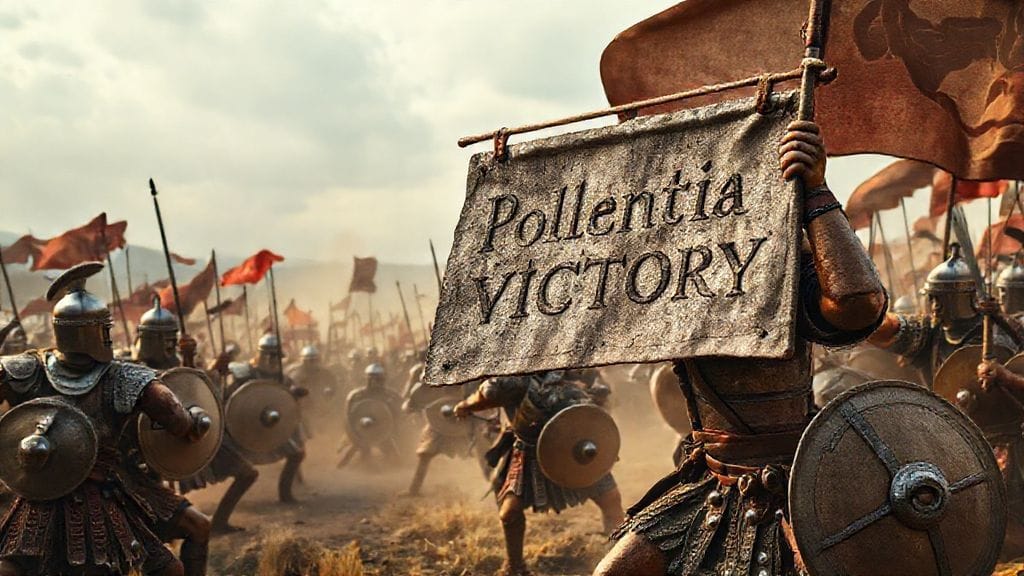
Mersivan lay on a gently rolling tableland, ringed by low ridges and sliced by shallow streams that could fail in summer. It was cavalry country. Shrubs and dust offered cover to swarming horse archers, while the crusaders’ carts and noncombatants slowed any disciplined pivot or feigned retreat.
Surviving accounts suggest the coalition formed five divisions, with Lombards prominent in the center and experienced knights under Raymond forming a more mobile wing. What looked orderly on a map frayed under harassment. Intervals widened, signaling opportunity to any general familiar with steppe-inflected tactics.
Heat dragged at men and animals. Armor rubbed raw shoulders, and quivers emptied quickly on both sides. The opening curtain was not a charge but an attritional theater of scouting feints, arrow storms, and water denied. The shape of the battle of mersivan was already sketched before steel rang at close quarters.
06 – First Contact: Feints, Arrows, and a Thinning Line
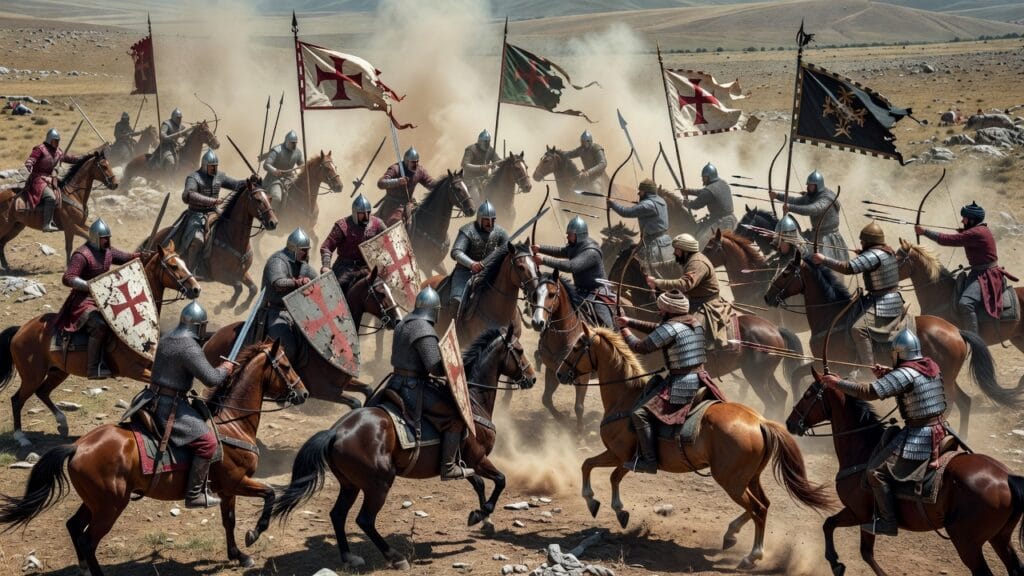
Turkish horse archers opened the day as they preferred, probing flanks and pelting the baggage. Crusader knights, conditioned to rescue threatened points, chased shadows. When they rode back breathless, gaps greeted them. Each sally consumed momentum, and every return found less water and more fear.
Some chronicles say Lombard eagerness broke formation; others blame the terrain. Blame rarely captures how stress accumulates. Wagons jammed where streams pinched the road, animals stumbled, and noncombatants screamed at the sound of hooves beyond the brush. Small panics, multiplied, can fuse into a single logic: retreat or risk annihilation.
Raymond’s veterans tried to anchor a counterpunch, even staging short, desperate charges that forced Seljuk detachments to yield. But every success pushed them farther from the center. The more bravely they stabilized the edge, the more the middle starved of rescue. A net tightens best when the fish fights.
07 – Encirclement: The Four-Day Unraveling
Accounts speak of several days of fighting, with pressure increasing in phases. Day by day, Turkish forces tightened a semicircle into a ring. By the climactic phase, the coalition faced missiles from every direction and could no longer coordinate across dust, fear, and the dead weight of a starving baggage train.
The battle of mersivan reached its awful clarity when the coalition’s five parts operated like separate little armies. Some defended wagons as if they were walls; others tried to break out in wedges aimed at the nearest ridge line. Turkish cavalry let each wedge run, then bled it on the flanks.
Modern analysis often stresses intelligence work behind the scenes. Kilij Arslan, chastened by 1097’s setbacks, had studied crusader habits. He learned to avoid direct shock and to prefer hours of distance killing to minutes of collision. Mersivan is less a heroic charge than a case study in tactics outliving bravery.
08 – Breakout and Capture: Leaders’ Fates and Fractured Survivals
Near the end, Raymond of Toulouse reportedly led a breakout attempt with a cadre of mounted men, punching through to the north with losses. A scattering reached Sinope and other ports, where Byzantine ships—alert to the danger—took on shivering refugees. Survival was measured in finding a sailor who still had room on deck.
Others were not so fortunate. Anselm IV of Milan appears in several traditions as captured and later ransomed, though details vary. William of Nevers and Stephen of Blois would continue campaigning afterward, their reputations dented but not erased. Many lesser-known captains vanish from the record, their end lost to a field without graves marked.
Civilians were swept up in the chaos. The battle’s last hours dissolved boundaries between combatant and pilgrim, knight and carter. The victors took horses, gear, prisoners, and stories. The defeated carried only reasons—God’s testing, luck’s desertion, or the simple verdict that they had insisted on a road the land would not permit.
09 – Power Rebalanced in Anatolia: Seljuks and Danishmends
Mersivan was not just a military victory; it was a political endorsement. Kilij Arslan’s authority, challenged since 1097, gained solidity. Coordination with the Danishmends yielded dividends, though their partnership remained a marriage of convenience. After the battle, control of routes, fortresses, and taxation lanes in north-central Anatolia tilted decisively.
Turkish morale surged, and with it, confidence to confront later incursions. The notion that crusaders could march where they pleased was broken. Every river crossing and hill pass now marked entry into a defended geometry. The countryside surrounding Mersivan became less a neutral transit zone and more an interior, guarded and watched.
Internal rivalries did not disappear; they matured. Emirs still balanced enemies and allies in a shifting game. But Mersivan proved that, under pressure, coalition warfare could trump Latin weight. The political imagination of the region—its expectations of how invasions would be met—changed in a matter of days.
10 – Imperial Calculus: Alexios I and the Aftermath
For Alexios I, the defeat confirmed hard lessons. The empire could guide crusaders but not compel obedience once they marched inland. Maritime power proved its worth as survivors were plucked from Black Sea ports. The emperor’s ledger would count ships and silver as higher returns than promises from northern pilgrims.
Relations with Latin leaders cooled but did not collapse. Byzantium still needed Western aid against Normans and Turks, and Westerners still needed imperial grain and ferries. But Mersivan shifted the tone from grand alliance to careful transaction. The empire would prefer small, negotiated advances over mass pilgrim armies beyond its logistical umbrella.
The battle of mersivan also influenced imperial mapping. Garrison plans, scouting networks, and diplomatic outreach to Turkish rivals all evolved. The empire could not magic a safe inland highway into existence, so it doubled down on the seas, the coasts, and the cities that bent trade to its advantage.
11 – The Crusade of 1101 in Full: A Chain of Defeats
Mersivan was the most dramatic disaster, but it was not alone. Other contingents pressing deeper into central Anatolia met ruin near Heraclea and elsewhere in late 1101. Leaders like Hugh of Vermandois perished from wounds soon after, and German magnates such as Welf IV faded from the picture in the campaign’s shadow.
What emerged was a European sense that Anatolia was no longer passable by large overland crusades without meticulous imperial partnership. The memory of 1097’s Dorylaeum victory no longer applied. The geography had not changed, but Turkish preparation had, and the Latins’ assumption of repeatable miracles had withered.
Had the 1101 campaign succeeded, Mediterranean politics might have pivoted. Instead, failure preserved a status quo in which newly founded crusader states looked south and west for support, not overland through the Anatolian interior. Sea lanes and piecemeal reinforcements would define the next decade of warfare.
12 – What the Sources Say: Building a Battle from Fragments
The documentary record for 1101 is uneven. Anna Komnene’s Alexiad, composed within the Byzantine court, frames events through imperial strategy, highlighting Alexios’s caution and the perils of undisciplined allies. Western narratives such as Albert of Aachen’s Historia Ierosolimitana gather reports from pilgrims and envoys, giving a Latin sense of confusion and loss.
Muslim chroniclers, including Ibn al-Athir writing in the early thirteenth century, preserve traditions of Turkish coordination and valor. Each tradition carries its own emphases, and precise dating—often given as 5 August—rests on later harmonization rather than a single contemporary logbook. Modern historians remain cautious because the surviving record is fragmentary.
Even so, the broad picture is consistent across traditions: a large, poorly coordinated Latin coalition entered northern Anatolia; Turks chose ground and tempo; and the result shaped policy in Constantinople and strategy in the Levant. The battle of mersivan survives not as a single voice but as a choir of wounded memories.
13 – Lives in the Wake: Captivity, Ransom, and Communities
Defeat ripples outward long after trumpets fall silent. Captives became currency in complex negotiations. Ransoms strained diocesan treasuries and magnates’ purses, while families waited without word. Some prisoners were absorbed as labor or converted under pressure; others found freedom months or years later, changed more than any chronicler could capture.
Border communities bore the weight. Villages near Mersivan scavenged fields that had been stripped twice, once by crusaders, then by victors. Byzantine coastal towns received survivors—the wounded, the bereft, and those whose vows had found a cruel fulfillment. Charity records hint at flows of alms and food as winter closed on the Black Sea.
Religious meaning was contested. Some preached that God had punished pride; others insisted endurance was holiness itself. Within monastic houses, scribes copied letters that tried to make suffering legible. In the silence between lines, we glimpse people who had set out singing and who returned, if at all, with smaller voices.
14 – Strategic Lessons: Roads Closed, Minds Changed
Mersivan’s most durable lesson was strategic humility. Crusader planners learned that large columns across Anatolia required Byzantine partnership at every mile, and even then might fail. Smaller, better-mounted bands or sea-borne expeditions promised more. The battle of mersivan thus redirected the traffic of faith from the dusty plateaus to the harbors.
For the Seljuks of Rum and their allies, the victory sanctioned a defensive doctrine: drain strength, refuse set-piece battles until the enemy is already beaten by need, and strike where baggage buckles. It became a template for meeting Latin cavalry without surrendering the skies of space and time a horse archer needs.
Immediate consequence:
Crusader reinforcements shattered; survivors evacuated by sea; Bohemond remained in captivity; Turkish control reasserted over Paphlagonian routes and hill passes.
Long-term consequence:
Overland crusades through central Anatolia fell from favor; Byzantine strategy emphasized naval logistics; Turkish polities entrenched; the memory of 1101 shadowed later crusading rhetoric and planning.
It is easy to forget how fragile this world still was. A single defeat could redraw mental maps as much as physical ones. Kings and counts would still dream of great marches, but quartermasters and emperors remembered Mersivan when they tallied ships, fodder, and the speed of the enemy’s bow.
15 – Conclusion
The Battle of Mersivan did not merely end a campaign; it ended an illusion. The belief that the triumphs of 1097–1099 could be replicated by assembling numbers and piety alone died in the dust of northern Anatolia. In its place grew a pragmatic calculus that preferred hulls to hooves and patience to bravado.
By forcing crusader strategists to abandon the overland artery, Mersivan preserved Turkish control of the interior and recalibrated Byzantine diplomacy. The battle of mersivan thus stands as a hinge event: a tactical victory with strategic consequences that shaped routes, alliances, and imaginations. It reminds us how geography, when married to learning adversaries, writes history in permanent ink.
16 – FAQs
- When did the battle occur?
Early August 1101, commonly cited as 5 August, though precise day and sequence vary by source. - Where was it fought?
Near Mersivan (modern Merzifon) in Paphlagonia, northern Anatolia, across rolling ground well-suited to Turkish horse archers. - Who were the main leaders?
On the Turkish side, Kilij Arslan I of the Seljuk Sultanate of Rum with Danishmendid allies; among the crusaders, Count Raymond of Toulouse, Archbishop Anselm IV of Milan, Stephen of Blois, and William of Nevers featured prominently. - What caused the battle of mersivan?
Crusader reinforcements in 1101 chose a northern route to rescue Bohemond of Antioch and press inland, provoking a coordinated Turkish response that sought to trap them on unfavorable ground. - What were the consequences?
A crushing crusader defeat, mass casualties and captives, and consolidation of Turkish control in central and northern Anatolia. Overland routes for future crusades fell out of favor, and Byzantine strategy leaned more heavily on maritime logistics. - What is the legacy of the battle?
The battle of mersivan became a strategic cautionary tale, shaping crusader planning for a decade. It redirected Western aid via sea, heightened Byzantine caution with Latin armies, and affirmed Turkish doctrines of mobility and attrition in the Anatolian interior.
17 – External Resource
18 – Internal Link
Other Resources
- Encyclopaedia Britannica – general search for the exact subject
- Google Scholar – academic search for the exact subject
- Internet Archive – digital library search for the exact subject
Sources and References
-
Albert of Aachen (Albertus Aquensis), Historia Ierosolimitana, ed. and trans. Susan B. Edgington, Oxford University Press, 2007.
Note: Contemporary Latin narrative history of the First Crusade and its aftermath. Used here primarily for information on the broader context of early 12th‑century crusading, the routes through Anatolia, and the perception of Asia Minor campaigns in Western Europe, which frames the setting and motivations surrounding the Battle of Mersivan. -
Anna Komnene, The Alexiad, trans. E. R. A. Sewter, revised by Peter Frankopan, Penguin Classics, 2009.
Note: A key Byzantine primary source written by the daughter of Emperor Alexios I Komnenos. While focused on the First Crusade and Byzantine–Seljuk relations, it provides essential background on imperial strategy in Anatolia, the military situation in north‑central Anatolia, and the complex alliances and rivalries that shaped conditions leading up to later battles such as Mersivan. -
Ibn al‑Athīr, The Chronicle of Ibn al‑Athir for the Crusading Period from al‑Kamil fi’l‑Ta’rikh, Part 1 (The Years 491–541/1097–1146), trans. D. S. Richards, Ashgate, 2006.
Note: A major Arabic chronicle by a 12th–13th‑century historian, providing a Near Eastern and Muslim perspective on the early crusading period and campaigns in Anatolia. Relevant for corroborating the role of Seljuk and Danishmendid forces in central Anatolia and for contextualizing the balance of power in the region around 1101. -
Alan V. Murray (ed.), The Crusades: An Encyclopedia, 4 vols., ABC‑CLIO, 2006.
Note: Comprehensive reference work used for cross‑checking details on the Crusade of 1101, the routes across Anatolia, the role of northern Anatolian towns (including the region of Mersivan/Merzifon), and the interaction between crusading armies and Turkish principalities in Asia Minor. -
Jonathan Phillips, The Crusades, 1095–1204, 2nd ed., Routledge, 2014.
Note: Modern scholarly synthesis that situates the Battle of Mersivan within the failed Crusade of 1101, explaining why Western forces re‑entered Anatolia, how they were organized, and how defeats in northern and central Anatolia affected subsequent crusading policy and the security of routes between Constantinople and the Levant. -
Thomas Asbridge, The First Crusade: A New History, Oxford University Press, 2004.
Note: Although centered on the First Crusade, Asbridge’s analysis of logistical problems, regional politics in Anatolia, and early encounters between crusaders and Turkish forces helps interpret the military geography and recurring vulnerabilities that also characterized the campaigns that culminated in the battle at Mersivan in 1101. -
Claude Cahen, Pre-Ottoman Turkey: A General Survey of the Material and Spiritual Culture and History c. 1071–1330, trans. J. Jones‑Williams, Taplinger, 1968.
Note: Scholarly study of Seljuk and Danishmendid Anatolia. Used for understanding the political fragmentation of central and northern Anatolia, the rise of Turkish emirates in the region around Merzifon/Mersivan, and the strategic importance of these territories during the early 12th century. -
“Merzifon,” in Türkiye Diyanet Vakfı İslâm Ansiklopedisi (TDV İA), Türkiye Diyanet Vakfı, Istanbul (online edition).
Note: Scholarly encyclopedic entry on the town of Merzifon (historically Mersivan), providing historical and geographical background on the settlement in northern Anatolia, its medieval significance, and its position on key routes, which underpins identification of the battle’s approximate location and local context.