Table of Contents
- A Frontier River in Revolt, April 1524
- The Italian War of 1521–1526: Stakes Across the Alps
- Commanders and Armies: Bonnivet, Lannoy, and Pescara
- The Road to Gattinara: Retreat from Lombardy
- Eve of Battle: Rain, Bridges, and the River Sesia
- The Skirmish Ignites: Arquebus and Pike in Motion
- The Death of Bonnivet and the French Collapse
- Swiss, Gascons, and Landsknechts: Mercenary Realities
- Weapons and Tactics: Why Firearms Spoke Louder
- Aftermath in Italy: From Milan to Marseille
- Finance, Supply, and the Price of Campaigning
- Faith, Propaganda, and Reputation
- Sources and Silences: Reconstructing the River Fight
- Legacies to Pavia: A Prelude to Disaster
- Conclusion
- FAQs
- External Resource
- Internal Link
Article Summary: On 30 April 1524, near Gattinara in Piedmont, French and Imperial-Spanish forces clashed along the Sesia River in a sharp engagement that previewed the era’s changing warfare. The battle of the sesia marked the lethal rise of Spanish arquebusiers against armored cavalry and pike blocks. French commander Guillaume Gouffier, seigneur de Bonnivet, was killed, and the retreat became a rout. In victory, Charles V’s commanders reclaimed momentum in Lombardy. The fight’s tactics anticipated Pavia, where France would meet catastrophe the following year. This article traces the setting, combat, sources, and long-term consequences.
Why keep reading: A river skirmish turned into a turning point when gunpowder and discipline broke tradition. Follow how a single day along the Sesia rippled outward to reshape Italy’s politics, the financing of war, and the reputation of commanders who would soon decide the fate of a king.
At a glance:
- Event: Battle along the Sesia River during the Italian War of 1521–1526
- Date: 30 April 1524 (contemporary sources agree on late April, most specify the 30th)
- Place: Near Gattinara, Piedmont, along the Sesia River’s banks
- Main figures: Guillaume Gouffier de Bonnivet; Charles de Lannoy; Fernando d’Avalos, Marquis of Pescara; Georg von Frundsberg
- Why it mattered: Demonstrated the battlefield ascendancy of arquebusiers over gendarmes and pike, killed France’s commander, and opened the road to Imperial advances that set the stage for Pavia.
01 – A Frontier River in Revolt, April 1524
At dawn, mist clung to the Sesia’s sandbars and willow thickets, and the French columns moved with the wary discipline of an army in retreat. What followed, remembered as the battle of the sesia, was swift, disorienting, and decisive. It unfolded along a corridor of water and gravel where armor clashed with smoke and shot.
Gattinara, a small Piedmontese town, found itself transformed into a hinge between empires. The French had failed to secure Lombardy and now threaded westward, hoping the river would slow pursuit. Across from them, Imperial scouts watched the ford lines, reading the current like seasoned hunters.
It is easy to forget how fragile this world still was, even with banners and cannon. A misjudged crossing or a volley of timely fire could rewire a campaign. On that April day, a century of tactical habits collided with new realities as men with firearms waded and ran where cavalry once ruled.
But this was only the beginning of the story, and the water itself would become a weapon. The Sesia’s shifting channels offered cover to those who could move lightly and shoot straight, while turning heavy cavalry into lumbering silhouettes against dust and glare.
02 – The Italian War of 1521–1526: Stakes Across the Alps
France, Spain, the Holy Roman Empire, and their allies fought over northern Italy’s duchies as if they were pressure points to control Europe. Milan, especially, was more than prestige; it was the financial and strategic anchor of Lombardy’s roads, revenue, and alliances. Whoever held it could project force across the Alps and into the peninsula.
By 1524, Francis I sought to recover influence after setbacks in Lombardy. Charles V’s lieutenants—Lannoy and Pescara—understood that attrition, money, and mobility could break French resolve. The Italian War became a contest of sieges, payments, and fast-moving strikes, where exhausted treasuries mattered as much as bold charges.
In this climate, commanders gambled on tempo. They watched quartermasters as closely as enemy vanguards, and cities changed hands under the pressure of credit. Gattinara’s riverbank would become the fulcrum where mobility and firepower tilted the war’s balance, if only for a season.
03 – Commanders and Armies: Bonnivet, Lannoy, and Pescara
Guillaume Gouffier, seigneur de Bonnivet, was a court favorite of Francis I—an admiral by title and a captain by ambition. He had led French fortunes in Lombardy with mixed results, admired for nerve yet criticized for misjudgments. At the Sesia, he bore the burden of escorting a large force away from danger without inviting catastrophe.
Charles de Lannoy, viceroy of Naples, moved with a statesman’s patience, coordinating Imperial elements often suspicious of each other. Alongside him was Fernando d’Avalos, Marquis of Pescara, whose Spanish infantry doctrine stressed discipline and the arquebus’s cunning reach. They read terrain as carefully as accounts ledgers.
Behind these figures stood the mercenary world of the era. Swiss pikemen served France at high wages, gascon shot and Italian light cavalry flanked, and German Landsknechts marched to Imperial drums. Their loyalties were contractual, yet their reputations—for steadiness or dash—carried strategic weight.
Leadership in 1524 meant more than ferocity. It meant placing the right men in the right ground before hunger or pay arrears unraveled cohesion. The Sesia tested whether Bonnivet’s prestige could overcome a shrinking margin of operational freedom against adversaries adept at unconventional pressure.
04 – The Road to Gattinara: Retreat from Lombardy
The French withdrawal from Lombardy was not a panicked flight but a strained calculation. They could not hold exposed positions without money and secure depots. Winter skirmishes and spring alarms drained morale, and the safest road west threaded through fords and ferries on the Sesia’s fickle course.
Imperial scouts shadowed the march, probing for weak rear guards, broken wagons, or a contested crossing. Bonnivet sought to avoid a set-piece battle, hoping his columns could reach safer ground in Piedmont and reconstitute. But the enemy pressed hard enough to force a stand along the river’s edge.
When the French vanguard touched the Sesia’s banks near Gattinara, engineers and pioneers searched for practicable crossings. Time mattered as much as courage. A few hours of calm would let baggage pass and infantry reform; a few sudden volleys would turn order into crisis.
Mini timeline:
- 1523: French pressure on Lombardy falters amid counterstrokes and financial strain.
- Early 1524: Imperial pursuit intensifies; French begin retreat toward Piedmont.
- 30 April 1524: Contact along the Sesia near Gattinara; running fight and French collapse.
- Summer–Autumn 1524: Imperial momentum carries into Provence; the war’s center of gravity shifts.
05 – Eve of Battle: Rain, Bridges, and the River Sesia
The Sesia was no placid moat. Seasonal rains fattened its channels, while gravel bars split the current into quicksilver paths. For officers, every choice seemed provisional. Bridges creaked under wagons, and fords changed depth between morning and noon, turning routine crossings into tactical gambles.
French rear guards tried to mask the retreat with scattered horse, screening the movement of Swiss pike and critical baggage. Imperial shot and light cavalry tested the veil, firing from thickets and sliding back into cover. Each exchanged volley chipped at cohesion and delayed the passage of precious carts.
Contemporary reports suggest that Bonnivet intended to maintain a defensive line only as long as necessary. But harassment grew into a sustained, coordinated pressure. In the half-seen spaces between willow stands, an action took shape that would break the rhythm of a retreat and reshape a campaign.
06 – The Skirmish Ignites: Arquebus and Pike in Motion
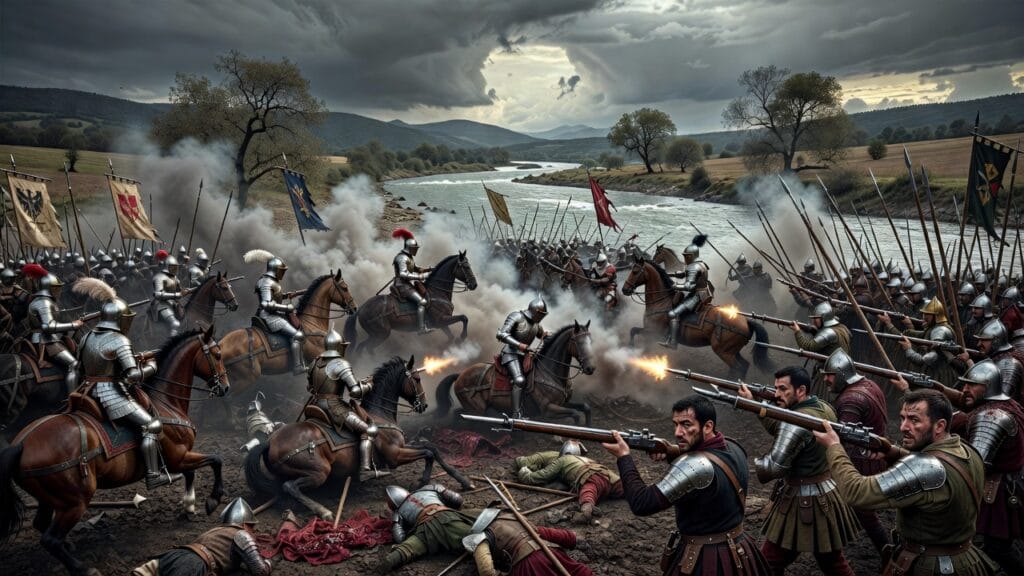
The first clear wave of fire came not from grand batteries but from bands of arquebusiers advancing in loose files. Pescara’s doctrine favored this swarm of shot, slipping between obstacles, wading across shallow cuts, and firing into the densest silhouettes of horse and pike before melting away.
French gendarmes, superb in shock, struggled to close. On uncertain ground, with water and gravel clinging to hooves, their charges bled momentum. Each time they pressed forward, shot rippled from the river fringes, and the return path became a gauntlet through which wounded men and riderless horses recoiled.
In places, Swiss squares held their nerve, bristling against approach. Yet the arquebus’s rhythm—prime, fire, withdraw—proved corrosive. When Imperial pike and Landsknechts advanced in concert, pressure compounded. What began as a screen for crossing turned into an urgent fight for survival along a narrowing corridor.
Later chroniclers claimed that the French tried to reconstitute a line on higher ground, but the tempo outran them. Here, the battle of the sesia announced its lesson: speed and firearms, in the hands of trained infantry, could unmake heavier formations before they found purchase.
07 – The Death of Bonnivet and the French Collapse
Amid this churn of smoke and splashing firelines, Bonnivet was struck. Accounts differ on the exact moment, but agreement centers on his death by wounds sustained in the action. With the commander fallen, orders frayed, and rival captains focused on saving their own cohorts, the line unraveled.
Retreat paths jammed with wagons and wounded. Some French horse tried to reverse the tide with desperate countercharges, but each attempt met the same ragged curtain of arquebus fire and pike thrusts. What defense remained became a series of local last stands, quickly outflanked and erased by nimble pursuers.
There is a stark humanity to this collapse. Men carried friends as far as they could before throwing down pikes to swim for safety, and standard-bearers buried colors in the mud rather than surrender them. Behind the numbers lies a mosaic of losses that no roll call could fully capture.
08 – Swiss, Gascons, and Landsknechts: Mercenary Realities
Swiss pikemen formed the spine of French infantry power, but even their fearsome squares could not dictate terms in every landscape. On the Sesia, their virtues—steadiness and shock—met a foe who refused the frontal duel and instead gnawed at flanks and backs with smoke and lead.
Gascon skirmishers, often underrated in grand narratives, fought stubbornly among the willows. Yet their counterfire could not reverse the operational pattern set by better-drilled Imperial shot. Meanwhile, German Landsknechts, marching under Imperial pay, pressed forward in coordination with arquebusiers, adding weight where needed.
Mercenaries measured risk through the lens of pay and reputation. When commanders died and formations buckled, decisions to stand or slip away were also calculations of credit, survival, and future contracts. The Sesia revealed how professionalized violence was becoming—and how finance and morale intertwined under fire.
Modern historians debate exact numbers, but the pattern feels clear. Cohesion mattered more than raw bravery, and discipline in reloading and dispersal outran the prestige of armor. The field at Gattinara became a proving ground for the tactical future unfolding in northern Italy.
09 – Weapons and Tactics: Why Firearms Spoke Louder
Arquebuses were not merely new; they were system-shaping. Their psychological force at short range, amplified by smoke and sound, could scatter horse and fray pike order. When combined with light-footed maneuver across channels and thickets, they multiplied effect while exposing few targets to decisive counterattack.
French cavalry doctrine relied on closing compressed distances, delivering impact with mass and plate. On a braided riverbed, water, silt, and brush denied that geometry. Imperial commanders exploited this mismatch, teaching their shot to live in the folds of the ground and to attack by rhythm rather than line.
Geoffrey Parker and others have later pointed to the Sesia, alongside Pavia, as evidence that gunpowder infantry and flexible command practices transformed outcomes. Charles Oman, writing earlier, emphasized how even small arms in the right hands could overturn the ceremonial primacy of the charge. The surviving evidence points toward both insights.
10 – Aftermath in Italy: From Milan to Marseille
Victory along the Sesia handed Charles V’s lieutenants precious momentum. With French resistance broken at the river and Bonnivet dead, Imperial commanders secured Lombardy’s routes and reasserted pressure on Milan. The French position in northern Italy, already compromised, became untenable without fresh resources and leadership.
Flush with success, the Imperial coalition carried the war west. In the months that followed, they crossed into Provence, hoping to break French power at its doorstep. They reached Marseille, and though the siege ultimately failed, the broader effect was to keep pressure high and to shape French strategic choices for 1525.
The victory solved one problem and created another. Rapid advances lengthened supply lines and increased dependence on credit and local support. Yet the psychological shock weighed more heavily: French allies recalculated, and neutral cities considered the wisdom of opening gates to Imperial garrisons rather than gambling on French return.
From the Sesia’s banks, one can trace a line to the catastrophe awaiting Francis I at Pavia the next year. There, many of the same commanders and doctrines would meet again, only with a king at the center of the storm.
11 – Finance, Supply, and the Price of Campaigning
War in 1524 moved at the pace of money. Pay chests, pledges, and promises fed mercenary contracts, mended bridges, and bought bread. When the French retreat stalled at rivers, it was as much a ledger’s verdict as a tactical mishap. Lannoy and Pescara, by contrast, had the wind of recent receipts in their sails.
Each day of marching strained wagons and animals. For the French, the cost of escorting heavy baggage while protecting key infantry blocks created slow-motion dilemmas. On the Sesia, time became currency, and Imperial shot spent it to best effect, inflicting delays that matured into defeat.
After the battle, Imperial paymasters sought to convert success into more loans and levies. The strategy worked unevenly, but the optics mattered. A string of tactical wins signaled solvency, and in the political economy of Renaissance war, solvency meant more soldiers willing to sign on for the next push.
12 – Faith, Propaganda, and Reputation
Victories demanded narratives. Imperial letters, circulated quickly, framed the Sesia as proof of divine favor and Spanish military excellence. Captains praised the discipline of their arquebusiers, and medals or promises gilded reputations. In courts from Valladolid to Naples, the story hardened into a template for future campaigns.
French memorials, by necessity, were elegiac. Bonnivet’s fall gave chroniclers a focal point for grief and for criticism. In the literary culture of Francis I’s court, martial failure rubbed against ideals of chivalry and patronage, and the tension stung. Reputation, after all, was its own kind of logistics.
Religious language framed losses and gains as providential tests. Yet behind the rhetoric, a more practical catechism took hold: train your shot, move lightly, and pick ground that denies the enemy’s strengths. The Sesia became a sermon in strategy, repeated in barracks and chancelleries alike.
13 – Sources and Silences: Reconstructing the River Fight
Reconstructing the action near Gattinara means balancing partisan chronicles with fragments of administrative record. Francesco Guicciardini’s Storia d’Italia offers a Florentine lens on politics and war, while Paolo Giovio’s accounts, close to power, foreground commanders’ deeds. Both supply texture, but neither captures every angle of a fluid river battle.
The royal rolls and correspondence hint at pay levels, unit compositions, and the timing of musters, giving an administrative skeleton to the narrative. Modern historians remain cautious because the surviving record is fragmentary, and tactical details often come filtered through apologetics or victory reports polished for patrons.
Despite gaps, the pattern of combat described by later analysts like Geoffrey Parker aligns with contemporary claims of mobile shot and constricted heavy cavalry. When narratives converge across bias lines, they point toward a genuine shift in tactical balance on the Sesia’s banks.
14 – Legacies to Pavia: A Prelude to Disaster
The Sesia did not end the war, but it set its tempo. In 1525 at Pavia, many of the same Imperial commanders would concentrate their doctrines in a decisive field. The habits learned in river skirmishes—dispersed fire, sudden concentration, relentless harassment—scaled up into a battle that captured Francis I himself.
For France, the loss of Bonnivet meant more than mourning. It removed a champion of bold offensives and left the army to renegotiate its command chemistry under pressure. The battle of the sesia thus became a hinge moment, foreshadowing how leadership vacuums could prove as deadly as enemy volleys.
Military culture, too, shifted. Captains boasted less about armor and more about drill, powder, and terrain reading. Training manuals and whispered counsel increasingly pointed to the primacy of coordinated shot and pike, carrying the Sesia’s lessons far beyond Piedmont’s riverbeds into Europe’s evolving art of war.
Immediate consequence:
French retreat turned into rout, Bonnivet was killed, and Imperial forces secured momentum and initiative in Lombardy heading into the summer of 1524.
Long-term consequence:
Tactical confidence in Spanish arquebusiers shaped operations that culminated at Pavia, while France’s command and coalition politics suffered a shock felt across subsequent campaigns.
15 – Conclusion
On 30 April 1524, the Sesia’s channels became corridors for a new kind of fighting. Light-footed arquebusiers, paired with disciplined pike, denied the old grammar of cavalry shock. In that crucible, the death of Bonnivet turned a guarded retreat into a reckoning, and the battle of the sesia echoed well beyond Gattinara’s banks.
Its deeper meaning lies in the maturation of combined-arms warfare and the fusion of finance, leadership, and terrain into a single decision engine. What happened in the water and willows prefigured Pavia and reshaped Renaissance campaigning. The river taught a hard lesson: the age favored those who moved fastest, shot straightest, and spent wisely.
16 – FAQs
- When did the battle take place?
The clash occurred on 30 April 1524, during the Italian War of 1521–1526. Contemporary sources center firmly on the final days of April, with the 30th most commonly cited. - Where was the battlefield?
Along the Sesia River near Gattinara in Piedmont. The fighting spread across braided channels, fords, and thickets that favored nimble infantry over heavy cavalry. - Who were the main commanders?
On the French side, Guillaume Gouffier, seigneur de Bonnivet. On the Imperial side, Charles de Lannoy and Fernando d’Avalos, Marquis of Pescara, with German Landsknechts under figures like Georg von Frundsberg. - What caused the battle?
The French were retreating from Lombardy under pressure, seeking to cross the Sesia. Imperial pursuit escalated a rear-guard screen into a sustained engagement that exploited terrain and mobility. - What were the consequences?
The French retreat collapsed, Bonnivet was killed, and Imperial forces gained momentum in northern Italy. The outcome foreshadowed Pavia, where similar tactics and leadership would decide a far greater contest. - What is the battle’s legacy?
It signaled the ascendancy of disciplined arquebusiers in open combat, influenced operational choices through 1525, and remains a case study in how terrain and training can overturn prestige arms. Many scholars reference the battle of the sesia when tracing the era’s tactical evolution.
17 – External Resource
18 – Internal Link
Other Resources
- Encyclopaedia Britannica – general search for the exact subject
- Google Scholar – academic search for the exact subject
- Internet Archive – digital library search for the exact subject
Sources and References
-
Hall, Bert S. “The Battle of the Sesia (30 April 1524): Firearms, Tactics, and the End of the Swiss Infantry.” In Weapons and Warfare in Renaissance Europe: Gunpowder, Technology, and Tactics, Johns Hopkins University Press, 1997, pp. 187–195.
Note: Provides a detailed modern military analysis of the Battle of the Sesia, including the role of firearms, troop composition (French, Imperial, and Swiss contingents), and tactical developments in the Italian Wars. -
Oman, Charles. A History of the Art of War in the Sixteenth Century. London: Methuen, 1937, pp. 72–78.
Note: Discusses the broader context of the Italian Wars and includes a narrative of the 1524 campaign in northern Italy, with specific coverage of the Sesia engagement, commanders involved, and its significance in the transition from pike-dominated infantry to combined-arms formations. -
Letters and Papers, Foreign and Domestic, of the Reign of Henry VIII, vol. 4, ed. J. Gairdner. London: Her Majesty’s Stationery Office, 1875, entries for April–May 1524.
Note: Primary diplomatic and political source that contains English reports and correspondence about the progress of the Italian Wars in 1524, including references to French and Imperial operations in Piedmont and reactions to the fighting near the Sesia. -
“Italian Wars (1494–1559).” In Encyclopaedia Britannica Online.
Note: Offers reliable background on the sequence of Italian Wars, the major powers (France, the Habsburg Empire, and their allies), and situates the 1524 Sesia campaign within the larger conflict between Francis I of France and Charles V. -
Mallett, Michael, and Shaw, Christine. The Italian Wars 1494–1559: War, State and Society in Early Modern Europe. 2nd ed., Routledge, 2012, pp. 156–170.
Note: Provides scholarly context for the 1520s phase of the Italian Wars, including French strategy in northern Italy, Imperial responses in Lombardy and Piedmont, and the lead‑up to the campaigns that included the Battle of the Sesia and the later Battle of Pavia. -
Contamine, Philippe. “Infantry and Firearms in the Sixteenth Century.” In War in the Middle Ages, Blackwell, 1984, pp. 292–304.
Note: While not focused exclusively on the Sesia, this academic study explains the evolution of infantry tactics and the growing importance of gunpowder weapons, directly relevant to understanding why the Sesia engagement is often cited as a turning point in early modern European warfare. -
Archivio di Stato di Torino (State Archive of Turin). Fondi: Carteggio Ducale e Ducale Savoia, corrispondenza militare 1523–1525 (Piemont).
Note: Collection of contemporary administrative and military correspondence from the Duchy of Savoy concerning operations in Piedmont, including references to troop movements and clashes along the Sesia in 1524; used by historians to reconstruct the local and regional context of the battle near Gattinara. -
Museo Storico Nazionale d’Artiglieria, Torino. Catalog entries and exhibition materials on early 16th‑century firearms and artillery in northern Italy.
Note: Provides material culture evidence and technical data on the types of firearms and artillery deployed in Piedmont and Lombardy during the 1520s, supporting descriptions of weaponry and battlefield technology associated with the Battle of the Sesia.

