Table of Contents
- England on a Knife-Edge: Late 1380s
- From the Wonderful Parliament to Open Defiance
- Robert de Vere and the Making of a Favorite
- Mustering in Cheshire: Archers, Pay, and Loyalty
- The Race to the Thames Crossings
- Clash at Radcot Bridge: A Winter Engagement
- Rout, Swimming, and Surrender
- Reading the Record: Chronicles, Rolls, and Bias
- Shock in Westminster: Opening the Merciless Parliament
- Regions at Odds: Cheshire, London, and the Shires
- Money and War: The Fiscal Squeeze Behind the Crisis
- The Idea of Kingship Tested
- Henry Bolingbroke Learns to Rule
- Memory on the River: Landscapes of Rebellion
- Conclusion
- FAQs
- External Resource
- Internal Link
Article Summary: On 19 December 1387, a brief winter clash beside the Thames changed the course of Richard II’s reign. The battle of radcot bridge pitted the king’s favorite Robert de Vere against a coalition of nobles later known as the Lords Appellant. Their victory led directly to the harsh “Merciless Parliament” and the purge of royal ministers. This article reconstructs the march, the fighting, and the fallout. It draws on chronicle and administrative sources to capture motives, uncertainties, and consequences. The battle’s human drama foreshadowed Henry Bolingbroke’s rise and England’s shifting ideas about kingship and accountability.
Why keep reading: A king’s honor, a favorite’s gamble, and a river crossing blocked at the last moment—Radcot Bridge compressed a national crisis into a single winter’s day. Follow the stakes, the split-second decisions, and the political aftershocks that redrew the map of English power.
At a glance:
- Event: Battle at Radcot Bridge between royalist forces and the Lords Appellant
- Date: 19 December 1387 (contemporary sources agree on the month and year)
- Place: Radcot Bridge, crossing of the Thames near Faringdon, Oxfordshire
- Main figures: Robert de Vere (Duke of Ireland), Thomas of Woodstock (Duke of Gloucester), Richard FitzAlan (Earl of Arundel), Henry Bolingbroke (Earl of Derby), Thomas Beauchamp (Earl of Warwick), King Richard II
- Why it mattered: It precipitated the Merciless Parliament of 1388, reshaped Richard II’s government, and prepared the ground for Henry Bolingbroke’s later seizure of the crown.
01 – England on a Knife-Edge: Late 1380s
England in the late 1380s was weary of war costs, anxious about authority, and haunted by the memory of the 1381 rising. Richard II, crowned young, claimed the sacral gravitas of kingship, yet his circle of trusted favorites angered many magnates. The battle of radcot bridge would grow from this volatile mix of ideals and grievances.
French raids along the Channel coasts, the stagnation of the Hundred Years’ War, and fiscal experiments eroded public patience. Parliament became a theater where barons and commons questioned royal officers and spending. The king’s insistence on personal loyalty collided with aristocratic expectations of counsel, restraint, and shared responsibility.
It is easy to forget how fragile this world still was. Authority hinged on oaths, commissions, and the credible movement of armed retinues. A single blocked bridge, a rumor of treachery, or a missed payment could tilt the balance between royal dignity and noble defiance.
02 – From the Wonderful Parliament to Open Defiance
In 1386 the so-called “Wonderful Parliament” forced a new accountability on the crown. Michael de la Pole, the chancellor, was impeached, and a commission of government was imposed to audit royal administration. Richard II chafed at this incursion, brooding over affronts to his prerogative.
By 1387 tensions hardened into open confrontation. Thomas of Woodstock, Richard FitzAlan, and Thomas Beauchamp styled themselves guardians of the realm’s laws and finances. Their coalition gained strength as the king’s efforts to protect indicted favorites appeared to many as contempt for parliamentary judgment and fiscal restraint.
When Henry Bolingbroke and Thomas Mowbray joined the coalition late that year, the quarrel ceased to be only about policy. It became a struggle for control of the roads to London, the levers of government, and the king’s immediate person.
03 – Robert de Vere and the Making of a Favorite
Robert de Vere, Earl of Oxford and newly titled Duke of Ireland, embodied the courtly loyalty Richard II prized. He had the king’s affection and command, but little patience from his critics. Elevated titles and rapid advancement fed the image of favoritism as policy, and of policy as a shield against scrutiny.
De Vere’s household and affinities linked court to shire through patronage and promise. To admirers he was the courageous point of the royal spear; to adversaries he was a sign that intimacy, not merit, determined the realm’s fate. The disjunction sharpened with each parliamentary censure.
As indictments approached, de Vere became not merely a counselor but a symbol of the royal cause. Saving him meant saving the king’s capacity to choose friends; defeating him meant restoring a constitutional balance the Appellants claimed was slipping away.
04 – Mustering in Cheshire: Archers, Pay, and Loyalty
The royalist counterstroke formed in the northwest. De Vere gathered men in Cheshire, a region with its own traditions of affinity to the crown and a reputation for skilled archers. Contemporary reports emphasize their numbers and confidence, but also hint at uneven discipline and uncertain pay.
Contemporary sources suggest that cash, badges, and promises flowed, binding free companions to de Vere’s banner for a swift march south. Whether out of loyalty to Richard II or to wages and honor, the Cheshire host became the king’s most immediate tool to break the Appellants’ encirclement.
Time mattered. The longer the royalist column tarried, the more likely Appellant forces would entrench around river crossings. The very roads and bridges of the Thames valley became political instruments, where engineering choices offered decisive answers to constitutional questions.
05 – The Race to the Thames Crossings
To reach the king in the southeast, de Vere needed a safe passage over the Thames. The obvious crossings—New Bridge, Radcot Bridge, and others between Lechlade and Oxford—became choke points. The Appellants understood that halting one column at a bridge could halt a royal recovery in London.
Accounts credit Henry Bolingbroke with swift movement and tactical patience. Lords Appellant spread detachments to watch the river, deny crossings, and stage ambushes. The battle of radcot bridge would speak less of pitched lines and more of outmaneuvering, obstruction, and archery from prepared ground.
Mini timeline:
- 1386: “Wonderful Parliament” impeaches Michael de la Pole; reform commission created.
- Mid–1387: Royal favorites threatened with prosecution; polarization intensifies.
- December 1387: De Vere marches from Cheshire; intercepted near the Thames.
- Early 1388: “Merciless Parliament” condemns royalists; government reshaped.
Bridges were not neutral features. They were fortified with earthworks, guarded by archers, and, when necessary, deliberately damaged. A broken arch turned a road into a trap, converting a column’s momentum into vulnerability within a few desperate minutes.
06 – Clash at Radcot Bridge: A Winter Engagement
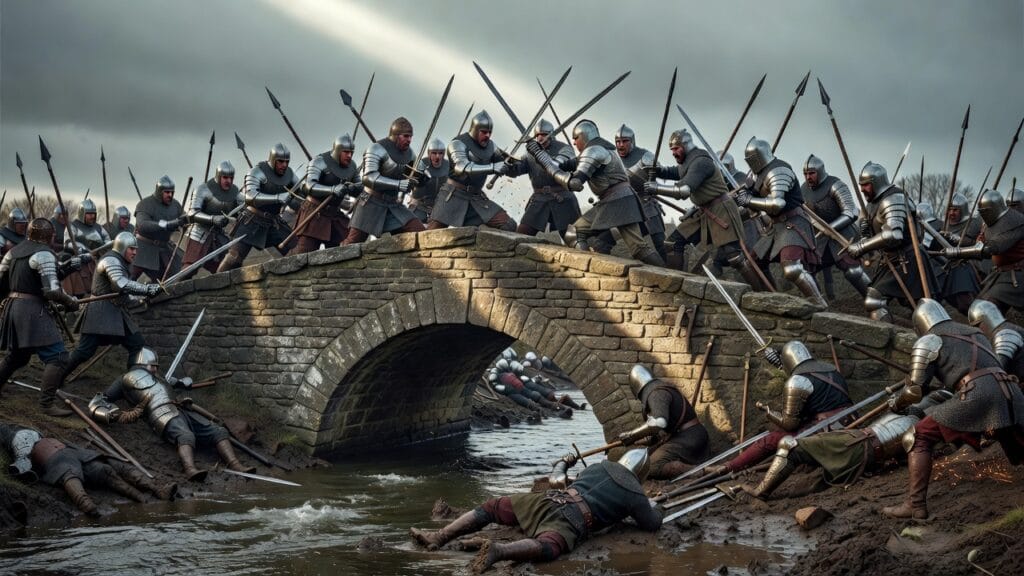
On 19 December 1387, de Vere’s column encountered Appellant forces at Radcot Bridge. Later chroniclers claimed that the bridge had been partly dismantled in advance, forcing the royalists into a bottleneck under heavy arrow fire. In this version, boldness met obstruction and faltered in an icy haze.
Fighting near a river in winter compresses options. Horses stumble, marshy banks limit movement, and archers dominate a narrowed field. The surviving evidence points toward a brief, sharp engagement rather than a prolonged melee, with the initiative firmly in Appellant hands.
Modern historians debate exact numbers, but the qualitative picture is consistent: confidence gave way to confusion. De Vere found his advance contested, his rear threatened, and the promise of joining the king fading with every volley. The swords mattered, but the bridge decided.
07 – Rout, Swimming, and Surrender
Tradition remembers de Vere’s desperate escape, described as a swim for safety with armor discarded. Whether the Thames or a nearby channel carried him away, the image endured: a duke in flight, chilled and alone, while his retinue scattered or yielded. It symbolized the shattering of royalist morale.
Several captains were captured; some were slain amid the press at the bridgehead. Chroniclers such as Thomas Walsingham present the rout as providential, a judgment against overreaching favorites. Even allowing for bias, the outcome was stark—Appellants secured the field and the narrative.
By dusk, the political horizon had changed. The king’s path to a loyal army was blocked, and his closest allies were fugitives or prisoners. The battle of radcot bridge lasted hours; its consequences would consume the next year.
08 – Reading the Record: Chronicles, Rolls, and Bias
Our understanding of Radcot Bridge emerges from a mosaic of sources. The Westminster Chronicle, close to court yet often critical, and Walsingham’s St Albans tradition offer vivid, sometimes moralizing accounts. The Anonimalle Chronicle provides additional color from the north, with its own emphases and silences.
The royal rolls and later the Parliament Rolls of Medieval England reveal the legal and administrative aftermath more than battlefield detail. They record charges, forfeitures, and the reconstitution of councils. Modern historians remain cautious because the surviving record is fragmentary and shaped by victors’ voices.
When sources turn theatrical—imagining speeches, penning moral lessons—they reveal contemporary anxieties as much as facts. Reading across these layers, a consistent line emerges: logistics, terrain, and cohesion mattered more than bravery alone.
09 – Shock in Westminster: Opening the Merciless Parliament
The Appellants’ victory cleared the road to legislative reckoning. In early 1388, the “Merciless Parliament” assembled, driven by outrage at royal misgovernment and emboldened by battlefield success. Indictments turned into convictions, and mercy—long the king’s prerogative—gave way to exemplary punishment.
Royal ministers and judges associated with Richard’s cause faced the full theater of parliamentary justice. Alexander Neville, Archbishop of York, fled; Robert Tresilian, chief justice, was executed; others followed. De Vere and Michael de la Pole were condemned in absentia, stripped and exiled in the legal sense.
The victory solved one problem and created another. By asserting control through the severest penalties, the Appellants stabilized governance for a season but deepened the king’s resentment. Memory, once weaponized, rarely returns to its scabbard.
10 – Regions at Odds: Cheshire, London, and the Shires
Radcot Bridge exposed regional rifts. Cheshire armed men backed a royal favorite, while London’s political class largely sympathized with reform and constraint. County levies and urban guilds watched carefully, measuring how the wind blew in Westminster and on the river roads.
Local grievances—tax burdens, purveyance abuses, and unpaid wages—amplified the conflict’s stakes. In the shires, rumors of confiscations or pardons affected daily livelihoods. The battle at a rural crossing became a story retold in markets and manors as a judgment on fairness in high places.
It is astonishing how much political weight could rest on a seal, a signature, or a hostage. Regional loyalties conditioned who held those instruments at any hour, and Radcot skewed the balance toward the Appellants’ networks for months to come.
11 – Money and War: The Fiscal Squeeze Behind the Crisis
Beneath banners and oaths lay ledger books. England’s war with France demanded funds, while campaigns delivered minimal returns. Extraordinary levies stung; ordinary revenues lagged. Parliament pressed for audits, and royalists pressed for freedom to act without constant scrutiny.
In this climate, accusations against ministers were not only about corruption but about failures of strategy. The royal court’s spending, patronage, and alienations of revenue looked reckless to critics. The Appellants redirected flows of income and lands, asserting that solvency was the first condition of national defense.
The battle of radcot bridge, for all its drama, solved no fiscal question. It merely decided who would sign the orders, collect the dues, and face the consequences when the next fleet had to be paid. Power and accounting traveled together to Westminster in 1388.
12 – The Idea of Kingship Tested
Richard II believed deeply in the dignity of crown and person, a late medieval fusion of sacred charisma and inherited right. His policy of favor signaled trust over faction. To adversaries, it looked like insulation from advice and law. At Radcot, these visions struck one another across ruined masonry.
The Appellants couched their actions not as rebellion but as lawful correction under the realm’s customs. By presenting themselves as guardians, they both justified force and limited it. The rhetoric mattered, because legitimacy—not merely victory—would be judged in Parliament and remembered in chronicles.
Yet behind the ceremony, fear lingered. If a council could compel a consecrated monarch today, what custom would protect great lords tomorrow? Radcot Bridge forced every magnate to recalibrate how hard to push a king without breaking the frame of monarchy itself.
13 – Henry Bolingbroke Learns to Rule
Henry Bolingbroke, Earl of Derby, stood at Radcot Bridge as a commander shaped by war, exile, and pedigree. His conduct against de Vere won him credit for decisiveness and self-control. Years later, those who remembered the river crossing also remembered Bolingbroke’s steady hand in a crisis.
Participation among the five Lords Appellant gave Henry invaluable lessons: coordinate fast, secure supply lines, seize bridges, and negotiate from strength. When he returned from exile in 1399 to claim lands—and then the crown—these skills translated from fieldcraft to statecraft with alarming ease.
The battle of radcot bridge did not make a king in a day, but it trained one. It showed how legitimacy could accumulate around planning, restraint, and a sense that the road ahead belonged to the man who controlled the crossings.
14 – Memory on the River: Landscapes of Rebellion
Radcot Bridge remained a place rather than a monument, its stones repaired and weathered by trade and time. Yet for contemporaries and later generations, the site marked a fault line where royal favor met noble resolve. Landscape preserved what parchment and sermon amplified.
Later chroniclers embellished the scene with moral purpose: icy waters as purgation, a shattered arch as divine commentary. Modern visitors see a quiet reach of the Thames, but the memory of men in harness, banners snapping in cold air, and archers behind makeshift works lingers in regional lore.
Immediate consequence:
Royalist momentum collapsed, de Vere fled abroad, and the Appellants controlled the political process that produced the Merciless Parliament.
Long-term consequence:
Richard II’s distrust hardened, leading to his 1397 reprisals and, ultimately, to the chain of events enabling Bolingbroke’s seizure of the throne in 1399.
In the end, Radcot’s meaning lies in its ordinariness. A small bridge, a short fight, and a large reckoning remind us that English politics often turned on bottlenecks in the landscape as surely as on speeches in Westminster Hall.
15 – Conclusion
What happened at Radcot Bridge was neither the grand set-piece of a chivalric epic nor a trivial skirmish. It was a precise answer to a precise problem: who would reach the king first and on whose terms. The battle of radcot bridge resolved, for a season, the struggle between royal preference and aristocratic correction.
Its legacy unfolded in statutes and executions, in reshaped councils and hardened memories. Richard II never forgot the humiliation, and Henry Bolingbroke never forgot the lesson. A winter fight over a damaged crossing rippled forward to 1399, proving that in late medieval England, the control of bridges often foreshadowed the control of crowns.
16 – FAQs
- When did the Battle of Radcot Bridge occur?
It took place on 19 December 1387, during a winter campaign that capped months of political escalation between Richard II’s favorites and the Lords Appellant. - Where exactly was the battle fought?
At Radcot Bridge on the River Thames near Faringdon in Oxfordshire, a strategic crossing controlling access between the northwest approaches and the road to London. - Who were the main figures involved?
On the royalist side, Robert de Vere, Duke of Ireland, led a force drawn largely from Cheshire. Opposing him were the Lords Appellant, notably Thomas of Woodstock, Richard FitzAlan, Thomas Beauchamp, Henry Bolingbroke, and Thomas Mowbray. - What caused the confrontation?
The battle grew from disputes over governance and finance after the 1386 “Wonderful Parliament.” Indictments against royal ministers and Richard II’s defense of his favorites pushed nobles to mobilize, leading de Vere to march south and the Appellants to block the Thames crossings. - What were the immediate consequences?
The Appellants’ victory ensured their dominance in the early 1388 “Merciless Parliament,” resulting in executions, forfeitures, and the exile or condemnation of key royalists, including de Vere and Michael de la Pole. - How did the battle influence later English history?
It sharpened Richard II’s distrust and primed the political culture for later confrontations. For Henry Bolingbroke, the battle of radcot bridge confirmed his capacity for command, a reputation that mattered when he deposed Richard in 1399 to become Henry IV.
17 – External Resource
18 – Internal Link
Other Resources
- Encyclopaedia Britannica – general search for the exact subject
- Google Scholar – academic search for the exact subject
- Internet Archive – digital library search for the exact subject
Sources and References
-
Thomas Walsingham, Chronica Maiora (late 14th century)
Primary source. A near-contemporary monastic chronicle that describes the political crisis of 1386–1388, the rise of the Lords Appellant, and the confrontation with Richard II’s favorites, including the campaign that culminated in the Battle of Radcot Bridge. Supports details on the factions involved and the broader context of aristocratic opposition to Richard II. -
Anonimalle Chronicle, 1307–1381; continued in later compilations (e.g. V. H. Galbraith, ed., Manchester University Press, 1970)
Primary/near-contemporary source (via modern scholarly edition). Although focused mainly on earlier 14th-century events, the continuation in related chronicle traditions is frequently cited for the political narrative leading to the Merciless Parliament and the suppression of royal favorites. Used by historians to reconstruct the background to Radcot Bridge and the actions of the Lords Appellant. -
Saul, Nigel. Richard II. New Haven & London: Yale University Press, 1997.
Modern scholarly monograph. A leading academic study of Richard II’s reign, with detailed analysis of the 1380s crisis, including the formation of the Lords Appellant, the military movements of 1387, and the political fallout after Radcot Bridge. Supports interpretations of the battle’s significance for royal authority and the road to the Merciless Parliament. -
Horrox, Rosemary. “Richard II (1367–1400), King of England and Lord of Ireland.” In Oxford Dictionary of National Biography (online edition, Oxford University Press).
Modern scholarly reference article. Provides an authoritative overview of Richard II’s reign, with concise coverage of the events of 1387–1388 and the clash between the king’s circle and the Lords Appellant. Supports dating, key personalities, and the political context into which the Battle of Radcot Bridge fits. -
Ormrod, W. M. “The Reign of Richard II.” In The New Cambridge Medieval History, Vol. VI, c.1300–c.1415, edited by Michael Jones. Cambridge: Cambridge University Press, 2000.
Modern academic chapter. Places Radcot Bridge within the constitutional and military developments of late 14th-century England, explaining the structural tensions between crown and nobility and the way the 1387 confrontation shifted the balance of power. Supports the broader historical framing of the battle and its consequences. -
Goodman, Anthony. The Loyal Conspiracy: The Lords Appellant under Richard II. London: Routledge & Kegan Paul, 1971.
Modern scholarly monograph. A focused study of the Lords Appellant, their motivations, military actions, and political program. Contains detailed discussion of the 1387 campaign against the king’s favorites, the maneuvering that led to Radcot Bridge, and its aftermath. Supports specific points about the composition, aims, and strategy of the Lords Appellant at the battle. -
“Radcot Bridge and the 1387 Battle.” Historic England, National Heritage List for England (NHLE) entry for Radcot Bridge and surrounding scheduled area.
Authoritative heritage listing. Describes the physical bridge, its medieval fabric, and its association with the 1387 battle. Supports the identification of the site, its location in Oxfordshire, and the continued recognition of Radcot Bridge as a place of historical significance. -
“Richard II and the Lords Appellant, 1387–1388.” The National Archives (UK), education and research resources on late medieval government and politics.
Archival/educational resource from a national archive. Summarizes key documents from the period—including records of treason proceedings and parliamentary actions—illustrating the breakdown of relations between Richard II and the Lords Appellant. Supports statements about the legal and political consequences of the battle and the subsequent Merciless Parliament.