Table of Contents
- Sicily Between Byzantium and Ifriqiya
- The Invitation: Euphemius’s Revolt and Aghlabid Opportunity
- Landing in the West: 827 at Mazara and First Campaigns
- Siege and Disease: Asad ibn al-Furat before Syracuse
- Turning West: Toward Palermo’s Walls
- The City of Palermo: Geography, Harbor, and Promise
- The Siege of Palermo: 830–831
- Breakthrough and Fall: Summer 831 and its Uncertainties
- After the Gates Opened: Garrison, Governance, and Faith
- Ripple Effects: Byzantium, Sicily, and the Mediterranean
- Palermo Ascendant: From Balarm to Nerve Center
- War, Tax, and the Sea: The New Economy
- Memory and Sources: Reading a Fragmentary Record
- Legacies across the Mediterranean: Culture, Language, Faith
- Conclusion
- FAQs
- External Resource
- Internal Link
Article Summary: In 831, Palermo fell to Aghlabid forces from Ifriqiya, a pivotal episode in the protracted Muslim conquest of Sicily. The capture reshaped Mediterranean trade routes and remapped political loyalties from Byzantium to North Africa. It began with internal Byzantine dissent, was forged through siege, and led to a hybrid society. This article traces causes, the siege itself, and the long consequences. It weighs contested dates and sources carefully. It also places the fall of palermo 831 within centuries of cultural exchange and conflict.
Why keep reading: Because a city’s fall rarely ends a story; it starts new ones that bind empires, merchants, monks, and sailors into a single sea. Palermo’s capture in 831 changed faiths, languages, and markets, and its legacy ripples outward through medieval Europe and North Africa.
At a glance:
- Event: The capture of Palermo (Balarm) by Aghlabid forces during the Muslim conquest of Sicily
- Date: 831 CE (exact month debated in the sources, often placed in summer or early autumn)
- Place: Palermo, northwestern Sicily, a natural harbor on the Tyrrhenian Sea
- Main figures: Aghlabid emir Ziyādat Allāh I; commanders active in Sicily including Asad ibn al-Furāt and later generals; the Byzantine rebel Euphemius
- Why it mattered: It transformed Palermo into a Mediterranean hub and accelerated the centuries-long shift of Sicily from Byzantine to Islamic rule.
01 – Sicily Between Byzantium and Ifriqiya
At the start of the ninth century, Sicily stood as a Byzantine outpost facing North Africa, a wealthy island straddling trade lanes between Alexandria, Ifriqiya, and the Latin West. Its fields supported grain exports; its cities gathered merchants drawn by safe harbors and imperial administration. Yet the island’s prosperity masked internal tensions and shifting loyalties.
The Aghlabid emirate in Ifriqiya, nominally under Abbasid suzerainty, surveyed the sea with interest. Pirates, traders, and diplomats blurred boundaries across the straits. When later chroniclers narrate the fall of palermo 831, they are recounting not an isolated coup but the culmination of currents already surging between Kairouan and Syracuse.
Byzantine authority in Sicily was real yet often distant. Taxation and ecclesiastical politics could stir resentment, and imperial military resources were stretched by wars elsewhere. It is easy to forget how fragile this world still was, dependent on a few fortified harbors and the loyalty of provincial elites.
02 – The Invitation: Euphemius’s Revolt and Aghlabid Opportunity
In 826–827, a Byzantine naval commander named Euphemius rebelled after clashing with imperial authority, a dispute later embroidered by romance in medieval accounts. Seeking allies, he crossed to Ifriqiya and appealed to the Aghlabids with a simple bargain: help me seize Sicily, and you gain a foothold in the island.
To the Aghlabids, opportunity met calculation. Emir Ziyādat Allāh I approved an expedition under the jurist-general Asad ibn al-Furāt, whose reputation united legal rigor and martial resolve. Contemporary sources suggest motives were mixed: piety, glory, revenue, and leverage against Byzantium all mattered, while Euphemius’s plea provided a convenient legal and political frame.
Yet behind the promise of quick victory lay a stubborn reality. Byzantine fortresses ringed the coast, and the interior could feed large garrisons under siege. The expedition sailed into a chessboard crowded with small pieces—local militias, monks, merchants, and pirates—each capable of tilting a campaign.
03 – Landing in the West: 827 at Mazara and First Campaigns
The Aghlabid-led force landed near Mazara in 827, a beachhead on Sicily’s southwestern coast. Initial victories encouraged the invaders and their Sicilian allies. But the hoped-for rapid collapse of Byzantine control did not materialize. The army pivoted toward Syracuse, the old metropolis, calculating that one decisive siege could deliver the island.
As the campaign unfolded, alliances frayed. Euphemius’s influence waned, and the expedition’s goals broadened beyond restoring a client to power. The invaders realized they were not merely kingmakers; they were potential founders of a new provincial order, if only they could secure a durable base.
Mini timeline:
- 827: Landing near Mazara; early clashes; march toward Syracuse
- 828: Prolonged siege operations near Syracuse; plague strikes; death of Asad ibn al-Furāt
- 830–831: Operations pivot westward; pressure mounts on Palermo
- 831: Capture of Palermo; consolidation of Aghlabid authority in northwestern Sicily
But this was only the beginning. Terrain, disease, and the Byzantine fleet conspired against a quick end. The invaders needed a different target: a harbor rich enough to sustain them and strategically placed to interdict imperial relief.
04 – Siege and Disease: Asad ibn al-Furat before Syracuse
The heavy gamble on Syracuse met stiff resistance. The city’s walls, provisioning, and the Byzantine navy’s ability to disrupt blockades turned the field against the attackers. The siege dragged on, testing the endurance of troops and allies alike, while the political understanding with Euphemius eroded in the strain.
Plague compounded failure. Asad ibn al-Furāt died in 828, a loss recorded with sadness by later Arabic historians who emphasize his scholarly stature as much as his generalship. Morale faltered. The expedition persisted under new commanders, but hope of taking Syracuse for now slipped from reach.
Modern historians remain cautious because the surviving record is fragmentary, with later narratives smoothing over the confusion of these years. Still, the broad outline is clear: the army could not take Syracuse, but it could survive elsewhere on the island if it seized a harbor for resupply and fresh recruits.
05 – Turning West: Toward Palermo’s Walls
By 830, the invaders had learned their lesson. A direct blow at Syracuse had failed; a western pivot promised a base with softer hinterlands and political fissures to exploit. Palermo, with its natural harbor and defenses, beckoned as both prize and lifeline.
Palermo had been an important Byzantine center, but not impregnable. The surrounding countryside offered supplies, and the coastal approaches favored a sustained naval presence. If the Aghlabids could fix their fleet there, they could lock in a logistical chain from Ifriqiya and invite more troops and settlers.
Word of the shift traveled across Sicily. Some communities hedged; others, sensing a new balance of power, opened negotiations or withheld support from imperial garrisons. It is astonishing how much political weight could rest on a seal, a signature, or a hostage offered during these uncertain exchanges.
06 – The City of Palermo: Geography, Harbor, and Promise
Palermo sat on a gentle arc of coast, its harbor—a shallow inlet later known as La Cala—curving into a defensible basin. Hills ringed the plain beyond, while roads funneled produce and trade from the hinterland. A Byzantine fortification crowned a defensible core, and ecclesiastical buildings anchored its civic life.
Merchants valued the city’s position astride routes to Sardinia, the Tyrrhenian ports, and North Africa. For the Aghlabids, a foothold here promised customs revenues, shipyards, and a place to mint authority as much as coin. The city’s geography made it a natural candidate for a new administrative hub.
Yet geography alone would not surrender walls. The coming siege required both naval pressure and patient attrition, aided by local intelligence and, perhaps, a faction within the city persuaded by survival over loyalty. Contemporary sources suggest that supplies became tight, morale frayed, and command decisions grew harder.
07 – The Siege of Palermo: 830–831
Accounts disagree on whether Palermo endured a single continuous siege or a sequence of blockades and assaults. What emerges is a picture of multi-front pressure: the Aghlabid fleet choking maritime resupply while land forces harried the approaches, severing lines of communication to other Byzantine strongholds.
Archaeology hints at layers of repair and later rebuilding, signs of a city battered yet viable. Chroniclers describe night sorties, fires, and the grinding toll of scarcity. However embellished, these narratives capture the attritional nature of warfare on an island where every sack of grain could decide a season.
As months wore on, politics worked alongside battering rams. Negotiations may have played a role, whether to secure terms for elites or to protect religious property. The sources do not give us a single dramatic breach, but they converge on a simple outcome: by 831, Palermo fell to the Aghlabids.
08 – Breakthrough and Fall: Summer 831 and its Uncertainties
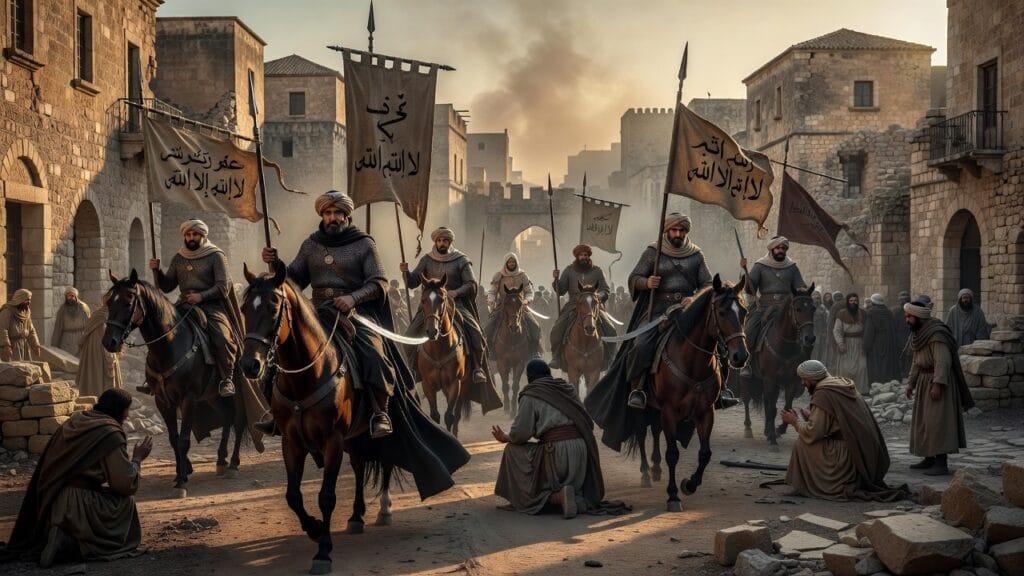
Some Arabic chronicles and later Italian histories place the city’s capitulation in the summer or early autumn of 831, with September often cited. Exact dates are elusive, but the thrust of testimony holds: the walls were yielded, the garrison overmatched, and the new masters installed amid a tense, negotiated transition.
Later tradition remembers churches repurposed and offices reorganized, with the cathedral’s status a particular focus of memory and debate. Modern scholars urge caution: transformation was real, but it unfolded unevenly. Administrative and religious change overlapped with efforts to stabilize food supplies and security for merchants and artisans.
To contemporaries, the fall of palermo 831 was not an end but a beginning filled with risk. Some residents adapted, protecting property and kin; others departed or awaited imperial counterstrokes. Yet the city’s strategic logic—harbor, hinterland, sea lanes—made the Aghlabid victory unusually durable.
09 – After the Gates Opened: Garrison, Governance, and Faith
With Palermo secured, the Aghlabids installed a garrison and administrative apparatus that linked the city to Ifriqiya. Governors supervised taxation, defense, and judicial matters, blending Arabic and local practices. Over time, a new social fabric took shape as soldiers, merchants, and craftsmen settled and intermarried with Sicilian communities.
Religious life shifted as mosques were established and the call to prayer joined the city’s soundscape. Yet Christian communities persisted, paying taxes and negotiating privileges. The Liber Pontificalis, though distant and polemical, preserves hints of how Rome viewed such changes: as both loss and a summons to charitable relief for displaced faithful.
Conversion proceeded neither quickly nor uniformly. Some families converted for opportunity; others maintained beliefs under new rulers. The city’s calendars now included both Christian and Islamic feasts, sometimes overlapping in marketplaces where practical needs trumped doctrinal boundaries.
10 – Ripple Effects: Byzantium, Sicily, and the Mediterranean
Byzantium could not immediately reverse Palermo’s fall. Its fleets had to defend other frontiers, and the logistics of a sustained Sicilian campaign were punishing. Palermo’s new status multiplied the island’s strategic complexity, offering the Aghlabids a staging point for both raids and diplomacy across southern Italy.
For Sicilian society, the consequences were layered. Taxation patterns shifted, military service obligations changed, and urban life gained new institutions and languages. Estates might be confirmed or redistributed, reshaping local hierarchies. Trade benefited from new connections to Ifriqiya and al-Andalus, even as war intermittently threatened shipping.
Immediate consequence:
Palermo became an Aghlabid stronghold, anchoring resupply, recruitment, and coastal control in northwestern Sicily, which enabled further campaigns inland and along the Tyrrhenian coast.
Long-term consequence:
The city evolved into a leading Mediterranean center whose institutions, languages, and markets blended Islamic, Greek, Latin, and later Norman elements, transforming Sicily’s identity and economy.
The victory solved one problem and created another. Holding Palermo demanded naval vigilance, stable taxation, and pragmatic rule over diverse communities. Yet from this demanding balance grew a durable urban vitality that even future conquerors would prize and preserve.
11 – Palermo Ascendant: From Balarm to Nerve Center
Under Aghlabid authority, Palermo—Balarm in Arabic sources—rose swiftly. Administration crystallized around the harbor and fortified core, while markets attracted traders from Ifriqiya, Sicily’s interior, and the Italian mainland. The city’s scribes, judges, and artisans signaled confidence in a future tied to the southern Mediterranean.
Within decades, Palermo outstripped other Sicilian centers in political influence. Its mosques, workshops, and warehouses multiplied, and shipwrights serviced fleets that policed sea lanes and carried envoys. The fall of palermo 831 thus seeded an urban growth curve that made Balarm the unquestioned hinge of Sicilian affairs.
This ascendance was not uninterrupted. Rivalries within Ifriqiya and changing fortunes at sea periodically threatened the city’s supply lines. Yet Palermo’s adaptable elites navigated these pressures, forging habits of governance that later rulers, including the Kalbids and the Normans, would refine rather than discard.
12 – War, Tax, and the Sea: The New Economy
War brought taxes, but also opportunities. Palermo’s rulers levied duties on trade and property while extending protection to caravan and maritime networks. Letters of safe conduct, standardized measures, and judicial oversight made markets reliable enough that merchants preferred Balarm’s docks despite ongoing conflict elsewhere.
The sea carried more than commerce. Corsairing—raids for ransom and goods—punctuated the economy, unsettling coastal communities yet also integrating Palermo into a wider system of exchange that spanned Ifriqiya, Provence, and southern Italy. Revenue from captives and prizes mingled with earnings from grain, textiles, timber, and artisanal goods.
Over time, new crops and techniques spread, encouraged by investors with contacts across North Africa and al-Andalus. Citrus and sugarcane would become notable in later centuries, but the foundations of irrigation and market integration took shape in the decades after 831, when Palermo’s rulers sought steady supplies and taxable surpluses.
13 – Memory and Sources: Reading a Fragmentary Record
The story of Palermo’s fall emerges from voices written long after the event, stitched from Arabic narratives, Byzantine continuations, and Latin annals from southern Italy. Ibn al-Athir and Ibn Idhārī preserve strands of the Aghlabid perspective, while the Chronicon Salernitanum offers a peninsular echo of how the conquest touched Italy’s south.
Modern historians, including Michele Amari in the nineteenth century and more recent scholars like Alex Metcalfe, have pressed these sources against archaeology and numismatics. They warn that precise dates, casualty figures, and tactical details are often lost, while later writers projected their own priorities onto earlier struggles.
In this light, the fall of palermo 831 is best understood as a process: a siege and surrender embedded in years of campaigning, deal-making, and reconstruction. Rather than a single climactic day, it was a tipping point in a war that would continue, sporadically, until the close of the tenth century.
14 – Legacies across the Mediterranean: Culture, Language, Faith
Palermo’s capture accelerated encounters that reshaped identities across the sea. Arabic and Greek coexisted in chancery and market; Sicilian dialects absorbed loanwords for irrigation, commerce, and craft. Religious life diversified under Islamic governance, while Christian monasteries adapted through new patronage networks and cautious engagement with rulers in Balarm.
The city became an intellectual waypoint. Jurists and scholars traveled between Kairouan and Palermo, carrying texts and techniques. Even after the island shifted to Norman rule in the eleventh century, the administrative and cultural systems rooted after 831 proved resilient, enabling a famed tri-lingual court culture that astonished visitors from Latin Europe.
It is easy to forget how much of this flowed from pragmatic decisions taken after the walls yielded. Governors who secured grain, ensured fair weights, and mediated between faiths laid foundations deeper than any battle plan. The legacy of the fall of palermo 831 thus lived on in contracts, canals, and calendars as much as in chronicles.
15 – Conclusion
Viewed from a distance, 831 looks like a single turning point. Up close, it is a braided process: rebellion, invasion, siege, and settlement converging on a harbor city that became a Mediterranean hinge. The fall of palermo 831 did not close a chapter; it inaugurated a long negotiation between peoples, institutions, and seas.
From that negotiation, Palermo emerged as Balarm, a center whose influence outlived its conquerors. Markets stabilized, languages intertwined, and faiths coexisted under changing banners. The city’s capacity to absorb and redirect power, born of 831, shaped Sicily’s path through Aghlabid, Kalbid, and Norman centuries, leaving a legacy that still frames the island’s story.
16 – FAQs
- When did Palermo fall during the Muslim conquest of Sicily?
Most sources place the city’s capitulation in 831 CE, often in summer or early autumn, though exact dating remains debated among historians. - Where did the decisive shift occur on the island?
In Palermo, on Sicily’s northwestern coast, where a natural harbor enabled Aghlabid fleets to sustain a prolonged campaign and then consolidate power after the surrender. - Who were the main figures behind the campaign?
Aghlabid emir Ziyādat Allāh I authorized the expedition; Asad ibn al-Furāt led early operations until his death in 828; the Byzantine rebel Euphemius catalyzed the invasion by inviting Ifriqiyan support. - What caused the fall—military force or negotiation?
A combination: naval blockade, attrition, and shifting alliances pressured the garrison, while negotiations likely shaped terms of surrender. The fall of palermo 831 thus blended siegecraft with political calculus. - What were the immediate consequences for Sicily?
Palermo became an Aghlabid stronghold, anchoring further campaigns, reshaping taxation, and redirecting trade toward Ifriqiya, while Christian communities adapted under new governance. - What is the long-term legacy of Palermo’s capture?
Over centuries, Palermo evolved into a cosmopolitan capital where Arabic, Greek, and Latin cultures interacted, influencing administration, agriculture, and learning, and laying foundations for the later Norman synthesis.
17 – External Resource
18 – Internal Link
Other Resources
- Encyclopaedia Britannica – general search for the exact subject
- Google Scholar – academic search for the exact subject
- Internet Archive – digital library search for the exact subject
Sources and References
-
Al-Balādhurī, Aḥmad ibn Yaḥyā. Futūḥ al-Buldān (The Conquests of the Lands). Edited and translated by Philip K. Hitti. London: Palestine Exploration Fund, 1916.
Note: A key early Arabic chronicle for the Muslim conquests in Sicily, including references to Aghlabid campaigns and the broader context of the island’s gradual takeover in the 9th century. -
Ibn al-Athīr, ʿAlī ibn Abī al-Karam. Al-Kāmil fī al-Tārīkh (The Complete History). Various editions; English selections in D.S. Richards (trans.), The Chronicle of Ibn al-Athir for the Crusading Period from al-Kamil fi’l-Ta’rikh. Aldershot: Ashgate, 2006–2008.
Note: A later medieval Arabic universal chronicle that preserves earlier traditions about the Aghlabids and the sequence of events surrounding the Muslim conquest of Sicily, including Palermo’s fall. -
Metcalfe, Alex. Muslims and Christians in Norman Sicily: Arabic Speakers and the End of Islam. London: Routledge, 2003.
Note: Provides modern scholarly analysis of Islamic Sicily from the Aghlabid conquest onward, including the significance of Palermo as a Muslim capital and the long-term political, social, and religious changes initiated by the 831 conquest. -
Johns, Jeremy (ed.). Arabic Administration in Norman Sicily: The Royal Diwan. Cambridge: Cambridge University Press, 2002.
Note: While focused on the later Norman period, this monograph reconstructs the institutional and administrative legacy of Islamic rule in Sicily, much of which originated in the Aghlabid and subsequent Muslim governance established after the capture of Palermo. -
Houben, Hubert. Sicily: A Short History, 826–1200. Translated by G. A. Loud and Diane Milburn. Cambridge: Cambridge University Press, 2002.
Note: Offers a concise scholarly overview of Sicilian history from the beginning of the Muslim conquest in 826 through the Norman period, including a detailed narrative of the Aghlabid campaigns, the siege of Palermo, and the island’s transformation under Islamic rule. -
Abulafia, David. The Great Sea: A Human History of the Mediterranean. London: Allen Lane, 2011.
Note: Places the fall of Palermo in 831 within the wider Mediterranean context of shifting power between Byzantium, the Latin West, and Islamic polities, highlighting Palermo’s role in maritime trade and regional geopolitics. -
“Sicily under Arab Rule (827–1091).” Encyclopaedia Britannica, Encyclopaedia Britannica, Inc. (Online edition, regularly updated).
Note: Summarises the chronology of the Arab conquest of Sicily, including the key dates of the initial landings, the capture of Palermo, and the consolidation of Aghlabid control, supporting the basic timeline and political framework. -
Biblioteca della Regione Siciliana / Archivio di Stato di Palermo. Selected medieval charters and notarial documents (Latin and Arabic), as discussed in:
Jeremy Johns, “The Arabic Documents of Norman Sicily: Context, Language, and Script,” in Script and Scripturality in the Middle Ages, ed. P. Binski & S. Panayotova. London: Harvey Miller, 2015.
Note: Although later in date, these documentary materials and their analysis shed light on the continuity of institutions, landholding patterns, and urban structures established under Muslim rule that originated with the Aghlabid conquest of Palermo.