Table of Contents
- Europe on Edge: The War of the Spanish Succession
- A Treasure Fleet Cornered in Galicia
- Plans on Both Sides: Rooke, Ormonde, and Château-Renault
- The Boom at Rande: Engineering a Trap
- Into the Bay: The Allied Approach
- Cutting the Barrier: The Assault Opens
- Battle in the Inner Waters: Fire, Smoke, and Splinters
- The Land Offensive: Forts and Batteries Fall
- Prizes, Silver, and Scorched Holds
- News, Propaganda, and the Making of a Victory
- Ripples Through Markets: Silver, Credit, and Insurance
- Political and Strategic Aftermath in Madrid, Versailles, and London
- Ships, Tactics, and Lessons for Naval War
- Memory, Coinage, and the Long Echo of Vigo
- Conclusion
- FAQs
- External Resource
- Internal Link
Article Summary: On 23 October 1702, an Anglo-Dutch fleet struck at Vigo Bay in Galicia, trapping a Franco-Spanish convoy that had carried treasure from the Americas. The battle of vigo bay unfolded in a narrow inlet blocked by a heavy boom and guarded by shore batteries. The Allies broke in, seized or destroyed much of the enemy fleet, and captured a portion of the silver. The victory, coming after a failed raid on Cádiz, rebalanced early war morale. It also rattled Atlantic finance, insurance, and convoy practice. This article follows the planning, the combat, the propaganda, and the long legacy of the action.
Why keep reading: This was not just a fight over ships; it was a collision of empires at the bottleneck of a Galician inlet. Inside that smoke lay bullion, strategy, and reputations on the line—an audacious strike that redefined a young war’s tempo and echoed across Europe’s markets and ministries.
At a glance:
- Event: Naval attack on a Franco-Spanish convoy in Vigo Bay during the War of the Spanish Succession
- Date: 23 October 1702 (Julian/Gregorian differences occasionally confuse reporting)
- Place: Vigo Bay and the inner San Simón inlet, Galicia, Spain
- Main figures: Admiral Sir George Rooke; James Butler, Duke of Ormonde; Admiral Château-Renault; Don Manuel de Velasco (Spanish convoy)
- Why it mattered: It restored Allied prestige, disrupted bullion flows, and reshaped convoy and blockade strategy early in the war.
01 – Europe on Edge: The War of the Spanish Succession
By the autumn of 1702, Europe was reorganizing around a single question: who would control the Spanish inheritance after the death of Charles II. The conflict pulled England, the Dutch Republic, and the Holy Roman Empire against France and Bourbon-ruled Spain, and the battle of vigo bay would become one of its earliest maritime flashpoints.
Ports from Brest to Cadiz bristled, insurance tables in London and Amsterdam trembled, and colonial routes carried not only goods but insecurity. Sea power could swing credit, diplomacy, and even dynastic confidence, and the allies knew that a sharp naval gesture might realign the mood after their missteps at Cádiz.
Early war strategy mixed blockade with opportunism. Fleets probed weak points, couriers flew to court with rumors, and commanders searched for a prize that could be reached quickly and explained elegantly. Vigo Bay—quiet, provincial, but suddenly full of treasure-laden hulls—became the theater no one had planned for and everyone would remember.
02 – A Treasure Fleet Cornered in Galicia
In September and October, the Spanish America convoy, protected by Château-Renault’s French escort, edged toward the Iberian coast. Cádiz and other principal ports looked perilous under Allied attention, so the convoy turned north and sought the shelter of Vigo’s deep ría, a long Atlantic estuary dividing pine-dark ridges.
Local authorities and engineers labored to transform sanctuary into fortress. A boom—an armored barrier of masts, chains, and spars—was drawn across the bottleneck at Rande, sealing the entrance to the inner San Simón inlet. Muskets and cannon were lifted into improvised works along both banks to discourage any bold intrusion.
Theoretically, this put the convoy beyond immediate assault while silver was unloaded to safe inland routes. But time was a dangerous ally. Allied scouts traced the trail, and the plain fact of so much bullion crowded into a cul-de-sac invited a strike that could overturn the mood of a campaign—and a continent.
03 – Plans on Both Sides: Rooke, Ormonde, and Château-Renault
Admiral Sir George Rooke, bearing the weight of the Cádiz failure, needed a decisive stroke. He convened war councils that balanced prudence with momentum, while the Duke of Ormonde, commanding troops aboard, urged a joint operation: naval penetration of the boom aligned with a sharp land attack at the narrows.
Across the water, Château-Renault’s calculus differed. He aimed to hold as long as possible, scatter valuable cargo inland, and then, if cornered, deny the enemy their glory by scuttling or scorching prized hulls. This was a defense of time, environment, and controlled destruction.
Both strategies were fragile. Rooke’s demanded exact timing and sheer nerve in confined waters; Château-Renault’s presumed that Iberian terrain, engineers, and coastal militia could stretch the clock. The balance would depend on wind, gunpowder, and whether the boom at Rande yielded to iron and fire.
04 – The Boom at Rande: Engineering a Trap
Rande’s narrows pinch the ría into a hard channel. There, carpenters, sailors, and soldiers fused a defensive chain of masts, cables, and hulls. The barrier was backed by shore batteries and by men ready with grapnels and fire, a three-dimensional net meant to throttle any intrusion.
Booms had a long ancestry in harbor defense, but they were never perfect. Strong tides, gunfire, and collision could strain the joints. The Allies studied the problem like engineers, plotting which ships should strike first, how fireships might harass the defenders, and where a gap would open under pressure.
From the defenders’ view, the objective was delay. Even if the boom were breached, the inner waters—tight and crowded—could become a killing ground. Fireship captains rehearsed their desperate art, and the convoy’s commanders debated the line between preservation and honorable sacrifice.
05 – Into the Bay: The Allied Approach
On the morning of 23 October, sails gathered like white hills at the mouth of Vigo Bay. Rooke’s lines moved deliberately up the estuary, guns run out, crews rehearsed. Dutch captains alongside English admirals signaled with crisp economy; the channel ahead narrowed, dark with anchored masts beyond Rande.
The battle of vigo bay began as geometry: angles of approach, arcs of fire, and the measured closing of distance. The wind cooperated enough to form columns. Allied vanguard ships aimed at the boom, while a secondary group stood ready to exploit any fracture, and land forces prepared boats for a lateral strike.
It is easy to forget how fragile this world still was. Orders traveled in flags and drumbeats, fortunes in chests, and the difference between a clean breach and a ruinous entanglement could be a few yards of current or the nerve of a pilot who knew the Rande channel’s teeth.
Mini timeline:
- Early Oct 1702: Convoy diverts from Cádiz to Vigo Bay for safety.
- Mid Oct 1702: Boom completed across Rande; shore batteries strengthened.
- 22 Oct 1702: Allied fleet sights the bay and finalizes the attack plan.
- 23 Oct 1702: Breach of the boom; fighting spreads into the inner inlet.
06 – Cutting the Barrier: The Assault Opens
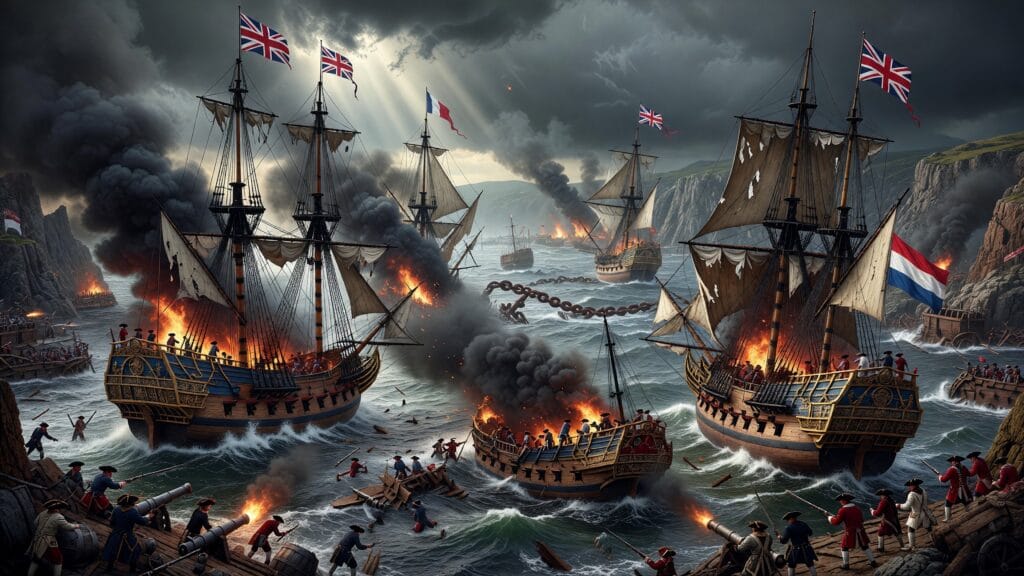
The lead ships crashed against the boom, cannon spitting at near point-blank range. Allied mariners hauled with axes and hooks, while gunners pounded the timbers at the joints. Defenders returned with heavy shot and musketry from the flanking works, splinters and smoke making reference points vanish.
One breach—small at first—spread under pressure. A fireship drifted, flaring like a floating forge and forcing defenders to shift their aim. The next Allied ship widened the gap, battered through, and slewed into the still water beyond, presenting fresh broadsides against the convoy’s guard line.
Momentum now favored the attackers, but organization frayed in the choke point. Not all captains could see the signals. The art of battle shifted from plan to improvisation, from charts to nerve, and this is where commanders either write dispatches in triumph or explain absence with smoke and ash.
07 – Battle in the Inner Waters: Fire, Smoke, and Splinters
Inside the boom, space shrank to chaos. French escorts and Spanish galleons fired, maneuvering as room allowed, while some began the grim work of denying prize: holes bored, fuses set, cargo shifted. Frigates curled into angles to rake their enemies; the air turned into sawdust and salt.
Allied ships pressed relentlessly, sails blackened, rigging torn. Boarding actions flared, men leaped across narrowing gaps, and marines on fighting tops picked at commanders and helmsmen. In several cases, fire decided the question faster than shot; a blaze leapt to powder, and a hull groaned astern before capsizing.
Later chroniclers claimed the destruction was absolute, but contemporary letters are more cautious. Many ships were taken intact; others burned. Some treasure went up in fire, some sank in shallow mud, and some had already been carted inland. The panorama defies a simple tally, and that is part of its historical gravity.
08 – The Land Offensive: Forts and Batteries Fall
While the ships clawed at the boom, Ormonde’s troops rowed toward the embattled shores of Rande. Assault parties clambered up rocks, exchanging volleys with batteries that guarded the narrows. The moment the gunners wavered, naval pressure redoubled, and defenders found shot striking them from rearward angles.
Once the shore positions buckled, the geometry of defense collapsed. Those guns had anchored the barrier; without them, the boom’s purpose drained away. Ormonde’s men moved along the banks, rolling captured guns to face inward, hastening the convoy’s confusion and clearing the approach for more Allied ships to surge through.
It is astonishing how much political weight could rest on a seal, a signature, or a hostage—but in this hour, it rested on the tilt of a gun carriage captured on a rocky ledge. Naval victory often requires unglamorous infantry work, and Vigo’s inner ring proved that with brutal clarity.
09 – Prizes, Silver, and Scorched Holds
When the gunfire thinned, commanders turned to arithmetic. How many ships were taken, how many destroyed, and how much treasure had survived the flames? The answer mattered not only for prize money but for the war’s story in Europe’s newspapers, gazettes, and coffeehouses.
Contemporary reporting suggests numerous French men-of-war were captured, with several Spanish galleons also seized, while others were scuttled or burned. As for bullion, a share was won; another share had been hurried ashore earlier; and a third share slipped away by ruin or confusion. The Allied reward was important, if not total.
The surviving evidence points toward deliberate self-denial by the defenders once defeat seemed certain. Bulkheads were pierced, chests hidden, powder trains lit. For the victors, divers and boatmen worked amid floating debris to recover what they could, while officers calculated prize rolls that would later shape careers and reputations.
10 – News, Propaganda, and the Making of a Victory
After the smoke cleared, the story began. Rooke’s dispatches traveled quickly to London, where the Cádiz embarrassment still stung. The London Gazette carried jubilant accounts in November, shaped by the need to reassure allies and investors that Britain and the Dutch Republic could force outcomes at sea.
Across the Channel, French and Spanish reports emphasized delay, denial of treasure, and honorable resistance behind the boom. Versailles favored narratives that preserved naval dignity and stressed the convoy’s partial success in offloading bullion. Madrid sought to contain the morale damage while pointing to long coastal lines that no blockade could seal entirely.
Modern historians remain cautious because the surviving record is fragmentary. Numbers vary, and the treasure’s final disposition resists neat totals. Yet the publicity was real: medals were struck, sermons preached, and in London a new phrase circulated—“Vigo coin”—as silver taken at the ría found its way to the Mint and into public pockets.
In the Dutch Republic, broadsheets paired sober enumeration of ships with woodcuts of broken booms and drifting fireships. Pamphleteers explained how a bottleneck engagement could redeem a season. The battle of vigo bay became the moral of a tract: maritime coalition, correctly handled, could reverse bad weather, bad luck, and bad judgment.
11 – Ripples Through Markets: Silver, Credit, and Insurance
Silver was Europe’s bloodstream, and Vigo tampered with its flow. Even a partial Allied capture raised questions about exchange rates, remittances to armies, and underwriting for Spain’s Atlantic trade. Insurers recalculated premiums on convoyed treasure, and merchants adjusted letters of credit linked to the timing of American bullion.
In London, the war’s financial machinery—taxes, lotteries, and exchequer bills—fed on confidence. A fresh naval success steadied that confidence. In Amsterdam, the news was parsed with customary care: one battle would not make a war, but convoy interdiction on this scale implied that Bourbon logistics across the ocean would demand new caution and expense.
The victory solved one problem and created another. It reassured investors that Allied fleets could strike, yet it also warned them that volatility would rattle transatlantic schedules. Markets do not mind risk as much as uncertainty, and Vigo radiated both to every countinghouse with Spanish claims on the New World.
12 – Political and Strategic Aftermath in Madrid, Versailles, and London
For Madrid, the loss at Vigo was humiliating but not fatal. The court of Philip V argued that the essential lifeline from America could not be permanently severed and set about revisiting port choices, escorts, and the timing of future convoys. Regional authorities in Galicia were reminded how quickly a quiet ría could become strategic.
Versailles weighed naval prestige against continental priorities. The convoy system needed reinforcement, yet the French crown balanced resources between Flanders, Italy, and the sea. Vigo’s lesson was awkward: a defensive posture in a narrow harbor may tempt a concentrated enemy into a devastating raid at just the worst moment.
In London, ministries and admirals extracted political credit. The fleet’s reputation recovered, recruitment was easier to justify, and the alliance with the Dutch gained a happy example of cooperation under fire. Still, strategists admitted that storms, intelligence, and improvisation had all mattered as much as doctrine in the Ría de Vigo.
Immediate consequence:
Allied morale lifted after Cádiz; several French ships of the line and Spanish galleons were lost; a portion of the treasure bolstered British coinage and prize funds; convoy planning for Spain and France grew more defensive and complex.
Long-term consequence:
Vigo shaped Allied confidence in amphibious cooperation, pushed Bourbon planners toward tighter escort doctrine, and fed an enduring public memory through medals, sermons, and the “VIGO” mark in British currency under Newton’s Mint.
Diplomatically, the victory stiffened the Grand Alliance’s bargaining posture in the winter councils. Yet behind the ceremony, logistics still ruled. The next campaigning season would test whether such dramatic strikes could be repeated or whether home waters and continental sieges would reclaim the war’s attention.
13 – Ships, Tactics, and Lessons for Naval War
Naval officers studied Vigo for its choreography in confined waters. The use of a boom forced a ramming-and-cutting phase followed by sudden close-quarter brawling among anchored or half-maneuvering ships. That sequence rewarded bold vanguards, reliable signal systems, and practiced boarding parties.
Fireships played their ambiguous role—terror more than tonnage—disrupting defenders and opening seams in a tight defense. Yet Vigo also warned that fireships could feed confusion for both sides if mismanaged. The more prized lesson lay in combined operations: the near-simultaneous seizure of shore batteries made the boom’s collapse inevitable once attackers reached it.
For convoy designers, Vigo was a case against static entrapment. Defending a treasure fleet behind a single choke point invited a decisive enemy strike timed to the convoy’s awkwardest moment—when cargo and crews were mid-transfer. Mobility, dispersion, and exit options gained new weight in Bourbon planning memoranda afterward.
14 – Memory, Coinage, and the Long Echo of Vigo
The name “Vigo” left the water and entered the mint. Under Isaac Newton at the Royal Mint, silver seized from the convoy was coined into English currency stamped with “VIGO” beneath Queen Anne’s bust. Owning such a coin turned newsprint into a tangible reminder of naval reach translated into public wealth.
Spanish and French memories were more somber. Galician chronicles counted burnt hulks and praised local courage. French memoirists defended Château-Renault’s timing and emphasized the salvage of bullion already landed, while critics asked whether a different harbor—or an earlier break for sea—might have spared the fleet a trap.
Centuries later, historians revisit the ría with a careful eye. Archaeological dives, regional archives, and cross-checked admiralty papers have refined, but not erased, uncertainty over treasure totals. The battle of vigo bay endures less as a figure in an account book than as a lesson in how geography and timing can humiliate powerful states.
15 – Conclusion
Vigo Bay was a brief eruption that altered a war’s psychology. In a single day, the battle of vigo bay restored Allied maritime confidence, shook Bourbon assumptions, jolted markets, and etched a name onto coins and into sermons. It emphasized how choke points, shore guns, and hurried decisions can amplify fortune or failure.
Its deeper meaning lies in the fusion of material and symbolic power. Ships and silver mattered, but so did the narrative forged in dispatches and minted in currency. Long after the smoke cleared, Vigo shaped convoy doctrine, public finance, and Europe’s understanding that mastery at sea could reconfigure a conflict’s very rhythm.
16 – FAQs
- When did the battle occur?
The action took place on 23 October 1702, early in the War of the Spanish Succession, with some reports reflecting calendar differences between regions when publicizing the victory. - Where exactly was it fought?
In Galicia, Spain, within Vigo Bay’s long estuary. The decisive fighting happened at the Rande narrows and in the inner San Simón inlet, after attackers broke through a defensive boom stretched across the bottleneck. - Who were the main commanders and fleets?
An Anglo-Dutch fleet under Admiral Sir George Rooke, with land forces led by the Duke of Ormonde, attacked a Franco-Spanish force commanded by Admiral Château-Renault and guarding the Spanish America convoy led by Don Manuel de Velasco. - What caused the confrontation?
Spain’s treasure convoy diverted to Vigo for safety amid Allied pressure on major ports. The Allies, seeking to reverse the failure at Cádiz and to strike at Bourbon finances, discovered the convoy’s location and chose a rapid assault on the inlet’s defenses. - What were the main consequences?
The Allied victory captured or destroyed many enemy ships and seized a share of bullion, buoyed morale, entered British coinage as “VIGO” silver, disrupted Atlantic finance, and forced France and Spain to rethink convoy routes, escorts, and harbor defenses. - What is the legacy of the battle of vigo bay?
It became a template for combined naval-land operations in confined waters, a cautionary tale against trapping convoys behind single barriers, and a cultural emblem—memorialized in coinage and propaganda—of early Allied naval assertiveness during the war.
17 – External Resource
18 – Internal Link
Other Resources
- Encyclopaedia Britannica – general search for the exact subject
- Google Scholar – academic search for the exact subject
- Internet Archive – digital library search for the exact subject
Sources and References
-
Primary Source – British Admiralty Dispatches
“Letters and Papers Relating to the War with France and Spain, 1702–1713,” in: Calendar of State Papers, Domestic Series, ed. by the Public Record Office, London: HMSO (various vols., early 18th-c. correspondence).
This collection includes official dispatches and correspondence from Admiral Sir George Rooke and other naval officers, providing first‑hand accounts of the Battle of Vigo Bay, details of the Anglo‑Dutch fleet’s composition, the assault on the boom, and reports on the capture and destruction of the Franco‑Spanish treasure fleet. -
Primary Source – Contemporary French Account
Sébastien Le Prestre de Vauban, “Mémoire sur l’état de la marine et des ports de France au début de la guerre de Succession d’Espagne” (early 18th c.), in: Oisivetés de M. de Vauban, ed. Georges Duby, Paris: Éditions du CNRS, 1968 (critical edition).
Vauban’s memoranda, while broader in scope, describe French naval preparedness and strategic concerns at the outset of the War of the Spanish Succession, providing contemporary context for France’s use of Vigo Bay as a protected harbor and the vulnerabilities that made the 1702 attack possible. -
Academic Monograph – Naval and Strategic Context
Rodger, N. A. M. The Command of the Ocean: A Naval History of Britain 1649–1815. London: Penguin, 2005.
Rodger offers a detailed scholarly synthesis of British naval power, including a discussion of the War of the Spanish Succession and the Battle of Vigo Bay as a key early engagement; this supports the article’s treatment of the battle’s strategic importance for Anglo‑Dutch naval supremacy and maritime finance. -
Academic Monograph – War of the Spanish Succession
Lynn, John A. The Wars of Louis XIV, 1667–1714. Longman, 1999.
Lynn situates Vigo Bay within the broader military and diplomatic history of Louis XIV’s later wars, explaining how the loss of the treasure fleet affected French and Spanish war finances and contributed to the early balance of power in the War of the Spanish Succession. -
Specialist Study – Treasure Fleet and Economic Impact
Lane, Kris E. Pillaging the Empire: Global Piracy on the High Seas, 1500–1750. 2nd ed., New York: Routledge, 2016.
Lane examines Iberian treasure fleets and state finances; his analysis underpins the explanation of why the silver and goods in Vigo Bay were so critical to the Spanish monarchy and how their loss influenced imperial revenue and European credit markets. -
Encyclopedic Reference – Concise Overview
Black, Jeremy. “Vigo Bay, battle of (1702).” In: The Oxford Companion to Military History, ed. Richard Holmes. Oxford: Oxford University Press, 2001.
This entry provides a concise, peer‑reviewed summary of the Battle of Vigo Bay, including key dates, commanders, casualty figures, and the outcome, supporting the article’s basic factual framework and chronology. -
Museum / Library Resource – Visual and Material Evidence
National Maritime Museum (Royal Museums Greenwich). “The Battle of Vigo Bay, 1702” (online collection notes and paintings). Royal Museums Greenwich, UK. Accessed via: https://www.rmg.co.uk.
The National Maritime Museum’s collection includes period paintings, ship models, and curatorial notes relating to Vigo Bay and the War of the Spanish Succession, corroborating details on ship types, battle formations, and public memory of the engagement. -
University Resource – War of the Spanish Succession Background
University of Portsmouth, History Department. “The War of the Spanish Succession (1701–1714)” – part of the British Maritime History teaching resources. University of Portsmouth, UK. Accessed via: https://www.port.ac.uk.
This academic teaching resource contextualizes Vigo Bay within the early phase of the war, supporting the article’s discussion of alliance politics, strategic goals of the Grand Alliance, and the maritime dimension of the conflict.

