Table of Contents
- Rome After Teutoburg: The Stage of 16 CE
- Germanicus and the Mandate of Revenge
- River Worlds: Rhine to Weser
- Tribes, Alliances, and a Contested Frontier
- Campaigns of 14–15 CE: From Raids to Hostages
- Toward the Weser: Spring Logistics and Aims
- Idistaviso: Battle on the River’s Edge
- The Angrivarian Wall: A Second Clash
- Arminius Between Victory and Survival
- Making War Roman: Legions, Auxiliaries, and Fleet
- Casualties, Captives, and the Borderland’s People
- Writing the War: Propaganda, Memory, and Sources
- Strategy Over Glory: Tiberius Recalls Germanicus
- A Frontier Chosen: Economic and Cultural Ripples
- Conclusion
- FAQs
- External Resource
- Internal Link
Article Summary: In 16 CE, along the bends and sandbars of the Weser River, Roman forces under Germanicus met a coalition of Germanic tribes led by Arminius. This campaign culminated in two linked engagements, often remembered collectively as the battle of the weser river. Drawing on Tacitus, Velleius Paterculus, and Cassius Dio, the narrative reveals fierce fighting at Idistaviso and the Angrivarian Wall. Rome claimed victory, yet chose not to stay. The result reshaped imperial strategy, memory, and the very idea of a frontier.
Why keep reading: At Weser’s banks, Rome won battles but lost an ambition. Follow the commanders, the tribes, and the politics that turned a battlefield triumph into a strategic retreat—and discover how a river became a line on the map and a line in Roman memory.
At a glance:
- Event: Battles near the Weser River (Idistaviso and Angrivarian Wall)
- Date: 16 CE (precise days uncertain)
- Place: Along the Weser in northwestern Germania, likely near modern Lower Saxony (exact sites debated)
- Main figures: Germanicus Julius Caesar; Arminius of the Cherusci; Inguiomerus; Emperor Tiberius
- Why it mattered: Rome reasserted strength after Teutoburg, then chose a Rhine frontier, shaping centuries of European boundaries and memory.
01 – Rome After Teutoburg: The Stage of 16 CE
Seven years before the clashes on the Weser, three Roman legions vanished in the forests of Germania. The disaster at Teutoburg Forest in 9 CE broke more than shields and spear shafts; it punctured an imperial dream of extending Roman power to the Elbe. By 16 CE, Rome still carried that scar.
The new emperor, Tiberius, inherited a frontier that was both a wound and a temptation. He faced pressure to avenge the loss and restore the aura of invincibility. Into this charged landscape stepped Germanicus, a young commander with lineage, charisma, and a mandate to show Rome could still dictate terms across the Rhine.
The battle of the weser river would become the crucible of that mandate. It unfolded in places where rivers ran brown with silt and pine forests swallowed sound. Yet the significance traveled far beyond the water’s edge, echoing in the Senate, in triumphal processions, and in the long memory of Rome’s limits.
02 – Germanicus and the Mandate of Revenge
Germanicus Julius Caesar was the nephew and adopted son of Tiberius, celebrated for his popularity with troops and the Roman populace. His command in Germania combined a personal mission with public theater: recover Roman honor, punish enemies, and show that the imperial house could tame a rebellious frontier.
He commanded up to eight legions with a sprawling support network of auxiliaries, engineers, and a riverine fleet. But even an army of such weight struggled against Germany’s distances and weather. Victories had to be swift and symbolic, and logistics had to succeed where roads did not yet exist.
Germanicus also fought in the shadow of his enemy’s fame. Arminius—once a Roman auxiliary officer—had orchestrated Teutoburg’s ambush. Any Roman triumph now would be measured against that catastrophe. The Weser campaign, therefore, was not just a clash of spears; it was a duel of stories, reputations, and futures.
03 – River Worlds: Rhine to Weser
Rivers were the highways and hazard lines of the northern frontier. The Rhine fed Rome’s logistical lifeline, ferrying grain and men to forward bases. Eastward, the Weser curled through lowlands and wooded heights, shaping tribal territories and offering crossings that were both opportunities and traps for ambitious generals.
Campaign plans accepted the Weser as a staging ground and a test. Boats carried supplies; scouts sought fords where armored soldiers might pass. Geography was strategy: whoever mastered the banks and bends could dictate movement, timing, and the morale of an enemy that knew every thicket and rise.
Contemporary sources stress this watery chessboard. Tacitus describes voyages and land marches intertwined, while Velleius Paterculus, a partisan of Tiberius, reminds us that measured prudence could matter more than brilliant charges. The Weser’s importance lay not just in one fight, but in its role as the hinge between ambition and caution.
Put simply, whoever held the rivers held the campaign’s pulse. But on their own, rivers never decide policy. They only force choices into the open.
04 – Tribes, Alliances, and a Contested Frontier
The Germanic world of 16 CE was a mosaic of tribes, alliances, and rivalries. The Cherusci under Arminius stood at the center, but neighboring groups—Angrivarii, Bructeri, Chatti, and others—tilted between cooperation and defection as fortune shifted. Political loyalty followed survival more than ideology.
Arminius leveraged kinship ties and personal courage, but he also navigated jealousies. His uncle Inguiomerus, an older war leader, emerged in accounts as both ally and rival. Such dynamics mattered: tribal coalitions could form suddenly and shatter even faster, especially when Roman columns offered both plunder and peril.
Rome counted on these fractures. Diplomacy traveled with spears, and Germanicus sought to peel away allies while threatening or rewarding villages along routes. Still, the coalition that gathered near the Weser in 16 CE was formidable, a reminder that the memory of Teutoburg could patch together differences—at least for a season.
05 – Campaigns of 14–15 CE: From Raids to Hostages
Before reaching the Weser, Rome spent two years testing the frontier’s rhythm. In 14–15 CE, Germanicus launched deep raids, clashed with the Bructeri, recovered an eagle standard lost at Teutoburg, and captured Thusnelda, Arminius’s wife, who became both a prisoner and a symbol in Rome’s narrative of restored dignity.
These operations were tactically effective but costly. A storm wrecked portions of the fleet returning along the North Sea, scattering men and supplies. The forest praised no victories; it swallowed columns and then fell silent. The campaign thus offered alternating surges of triumph and disaster, never fully pinning down Arminius.
Mini timeline:
- 9 CE: Teutoburg Forest disaster; Varus and three legions destroyed.
- 14–15 CE: Germanicus raids; recovers a lost eagle; captures Thusnelda.
- Spring 16 CE: Concentration of forces toward the Weser.
- 17 CE: Germanicus’s triumph in Rome; frontier policy consolidates on the Rhine.
By early 16 CE, both sides understood the stakes. Rome sought a crowning victory to end a cycle of reprisal; Arminius needed to show that no Roman general could force a lasting settlement east of the Rhine. The river valleys would soon decide whether memory or momentum ruled the frontier.
06 – Toward the Weser: Spring Logistics and Aims
Germanicus assembled an army that combined speed, engineering, and raw mass. Supplies moved on rivers; bridges were thrown across minor waterways; staging camps rose where fields allowed. Every day’s march measured not just distance but whether a path could support mules, siege gear, and hungry infantry in hostile country.
The aim was decisive contact. Roman scouts sought Arminius’s concentrations between low ridges and the Weser’s loops. Cavalry probed for ambushes; infantry advanced behind screens of slingers and archers. The army read the land like a text, looking for the paragraph where battle would be written.
Yet logistics carried their own politics. The larger the Roman army, the louder the question in Rome: to what end? Tiberius tolerated risk but distrusted overreach. A crushing triumph might justify a permanent push beyond the Rhine; a bloody stalemate could trap legions in a perpetual, unaffordable grind.
So the column moved under a double pressure. It had to find the enemy and find proof—visible proof—that Rome could fight here, win here, and leave on its own terms.
07 – Idistaviso: Battle on the River’s Edge
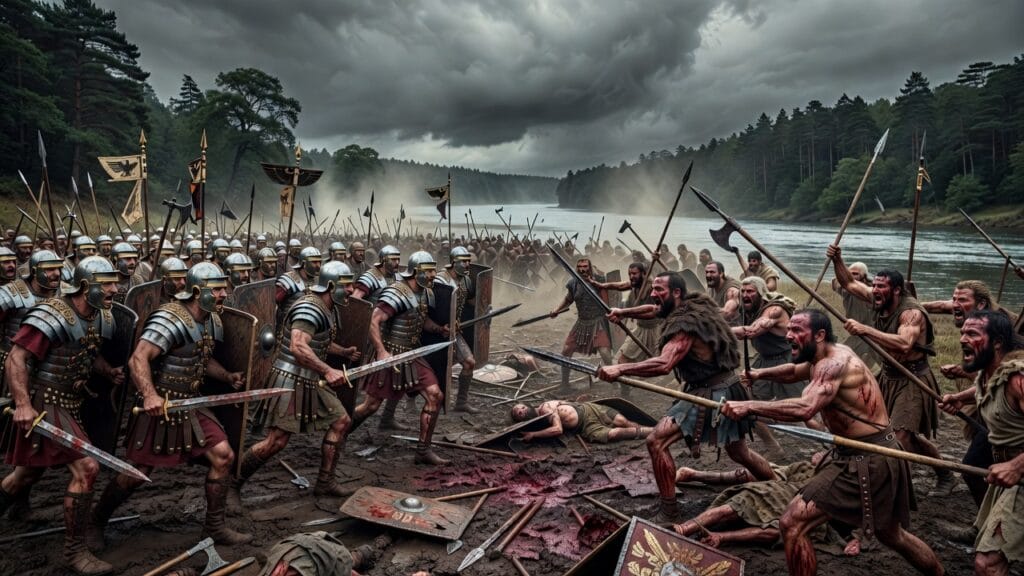
The first major clash of 16 CE gathered near a place Tacitus calls Idistaviso, a stretch of ground between wooded heights and the Weser. The exact spot remains debated, but the conditions favor a Roman force that could anchor a flank on the river while threatening to envelop with cavalry.
Arminius’s coalition formed along the tree line, counting on surprise and familiarity with the ground. Germanicus deployed legions in the center, auxiliaries and horse on the wings, and ordered missile fire to break the opposing front. The fight, as later described, rolled from skirmish to rout as formations buckled under Roman pressure.
Germanicus exhorted his men with memories of Teutoburg and promises of redemption. Arminius, bleeding but unbroken, is said to have cut a path out with a handful of followers. It is difficult to reconstruct exact maneuvers, but the surviving evidence points toward a clear Roman battlefield advantage and heavy Germanic losses.
Afterward, Roman troops raised a trophy, heaping arms and inscribing a claim that Rome had punished rebellious tribes. Symbolism mattered; the monument asserted visibility on a frontier where victory could vanish in the trees by nightfall.
08 – The Angrivarian Wall: A Second Clash
Success at Idistaviso did not end the campaign. The coalition regrouped near an earthwork called the Angrivarian Wall, likely a tribal boundary fortification associated with the Angrivarii. Here the terrain narrowed choices, favoring defenders who could force Roman columns into a killing zone.
Germanicus pressed the attack. Accounts portray another hard fight in which Roman discipline overcame rough fieldworks. When the lines gave way, pursuit was fierce; Roman sources emphasize enemy disarray and pleaded submissions from some tribal groups afterward. Once again, Arminius escaped, a reminder that leaders could survive even as coalitions cracked.
With two victories in hand, Germanicus had achieved what a Roman commander needed: tactical proof of superiority, captured standards and captives, and a story his soldiers could carry back to the camps. But this was only the beginning of a larger argument about staying or leaving.
The victory solved one problem and created another. By demonstrating battlefield dominance, Germanicus raised expectations for a settlement across the Weser. Meeting those expectations required garrisons, roads, and money that politics in Rome might not tolerate.
09 – Arminius Between Victory and Survival
Arminius emerges from the sources as tenacious, charismatic, and skilled at evasion. Even in defeat, he preserved enough authority to reorganize fragments of his coalition. Later chroniclers claimed he quarreled with Inguiomerus, yet such tensions did not erase his symbolic value as the man who once shattered Roman confidence.
Modern historians debate the scale of losses at Idistaviso and the Angrivarian Wall. The documentary record is fragmentary, and victory narratives often magnify success and minimize costs. What remains clear is Arminius’s survival, which prevented Rome from claiming the decisive decapitation that can turn a victory into an enduring settlement.
Arminius’s story is not just tactical. It highlights how personal authority, kin alliances, and ritual obligations sustained leadership across defeats. He could lose a battle and still matter, because the strategic question—would Rome stay?—remained unanswered. In that uncertainty, a defeated leader could still shape the future.
10 – Making War Roman: Legions, Auxiliaries, and Fleet
The Roman order of battle in 16 CE combined legionary cores with specialized auxiliaries—archers from the East, cavalry from Gaul and Iberia, and Germanic allies who fought for pay, prestige, or rivalries. Engineers built bridges and camps; doctors tended wounded; surveyors traced routes through marsh and woodland.
Eight legions at full strength represented a hammer blow, yet the real advantage lay in coordination. When cavalry screens worked and river fleets arrived on time, Rome could deliver synchronized pressure across a front. When weather intervened, they became separate organisms, vulnerable to ambush and starvation.
The battle of the weser river tested these systems. Germanicus’s use of boats for supply, quick fortifications to secure gains, and disciplined infantry lines offered the template for victory. The very need for such precision revealed the vulnerability: victories depended on choreography that the frontier could disrupt with a single flood or fog.
It is astonishing how much political weight could rest on a roadbed, a pontoon, a line of pack animals. Empire traveled not only on courage, but on wood, leather, grain, and time.
11 – Casualties, Captives, and the Borderland’s People
What did victory mean for those who lived along the Weser? Civilians bore the passage of armies: fields trampled, granaries seized, hostages taken to guarantee treaties. Archaeological finds of burned layers in some North German sites suggest cycles of disruption, though linking specific layers to 16 CE remains difficult.
Casualty figures in the sources favor Rome’s narrative, listing enemy dead by the thousands while minimizing Roman losses. We should read such numbers warily. The battlefield aftermath—bodies, weapons, and shattered wagons—must have marked the landscape, feeding both vengeance and fatigue in communities already stretched thin.
In this light, the battle of the weser river was never only imperial drama. It was also the lived experience of borderland families recalculating loyalties for survival. Victory or defeat in one valley did not end their war; it only reset the risks they faced the next season.
12 – Writing the War: Propaganda, Memory, and Sources
Roman accounts of 16 CE were shaped by politics back in Rome. Germanicus’s popularity made him a lightning rod, and his eventual triumph in 17 CE turned the Weser victories into pageantry. The triumph displayed captives like Thusnelda, projecting a story of restoration even as the frontier policy shifted.
Tacitus, writing later, crafted dramatic set pieces—speeches before battle, stark portraits of character—that serve literature as much as military analysis. He is indispensable but must be handled with care. Where the Annals are rich, archaeology is quiet, leaving uncertainties about troop numbers, exact routes, and precise locations.
The Liber Pontificalis is irrelevant here, but other administrative sources and inscriptions remind us that logistics, pay records, and supply notes underwrote every march. The royal rolls of the era do not survive, but the administrative logic does: a victory had to balance the account books as well as the honor ledger.
Later memory turned Arminius into a symbol of German freedom and Germanicus into a lost promise of conquest. Both figures became canvases for later national stories. Peeling those back, we find a campaign where choices about risk and reward mattered more than the heroics of any single day.
13 – Strategy Over Glory: Tiberius Recalls Germanicus
After the Weser victories, Tiberius faced a decision. Continue into the interior, risking overextension and fresh disasters, or declare success and consolidate the Rhine line. He chose recall, praising Germanicus and promising a triumph but declining to bankroll a permanent conquest across unpredictable terrain.
Critics later accused Tiberius of jealousy. Velleius Paterculus, loyal to the emperor, insists it was prudence: Rome had proved it could win, but the cost of holding what it took would exceed any rational benefit. The frontier, he implies, should be a membrane, not a net.
Germanicus returned to Rome, celebrated in 17 CE, then departed east as a rising star of the imperial house. He died in Syria in 19 CE, fueling rumors and grief. His loss ensured that the Weser campaign would live on as promise and pivot, rather than the first chapter of a new province beyond the Rhine.
The battle of the weser river thus ended as a paradox. It brought victory and withdrawal, pride and restraint, a narrative of power overlaying a map that refused to change its lines.
14 – A Frontier Chosen: Economic and Cultural Ripples
Choosing the Rhine as the frontier redirected imperial investment. Forts, roads, and markets concentrated along the river’s western bank and in adjacent provinces. Merchants benefited from safer corridors; tribes closer to Rome integrated more tightly into supply chains, while those beyond the Weser remained clients, rivals, or trading partners at arm’s length.
Culturally, the choice slowed Romanization east of the Rhine. Latin inscriptions, urban layouts, and villa economies flourished westward instead. Yet the boundary was porous. Goods, gods, and ideas crossed with traders and soldiers on leave. The limes that developed later synthesized the lesson learned at the Weser: manage contact, avoid overreach.
For the Germanic world, the post-16 CE landscape offered breathing space to reorganize. Power blocs formed and fractured; some leaders found profit in diplomacy with Roman commanders, others in raids that tested watchtowers. The memory of Idistaviso and the Angrivarian Wall became part of the region’s political grammar.
Immediate consequence:
Rome claimed battlefield superiority, paraded captives, and stabilized morale after Teutoburg. Tribal coalitions frayed, and some groups sued for peace, securing short-term calm along key routes.
Long-term consequence:
The empire institutionalized a Rhine frontier, channeling resources into fortifications and trade nodes. Germania beyond the river remained outside provincial structures, shaping centuries of military planning and cultural exchange.
15 – Conclusion
At the Weser in 16 CE, Rome demonstrated how a superpower could win brilliantly and still decide to go home. The battle of the weser river—really two battles linked by a campaign—gave Germanicus trophies and songs, and gave Tiberius the evidence to argue for boundaries over dreams. Strategy, not steel alone, defined the result.
What followed shaped Europe’s map and memory. A frontier chosen is never just a line; it is a policy about who bears risk, who holds markets, and how far an empire’s story can stretch. Along the Weser’s banks, Rome learned to let a river do what walls could not: hold an ambition in place.
16 – FAQs
- When did the fighting at the Weser occur?
The primary engagements took place in 16 CE, with the campaign culminating in two battles remembered collectively as the battle of the weser river. - Where were the battles fought?
Near the Weser River in northwestern Germania, with Idistaviso and the Angrivarian Wall as focal points. Exact locations are debated, though scholars often point to areas in modern Lower Saxony. - Who were the main figures involved?
Germanicus Julius Caesar commanded Roman forces; Arminius of the Cherusci led the Germanic coalition, with Inguiomerus as a notable senior war leader. Emperor Tiberius decided the campaign’s strategic endpoint. - What caused the clashes?
They were the culmination of Rome’s efforts to avenge the 9 CE Teutoburg disaster, reassert control east of the Rhine, and pressure Arminius’s coalition that resisted permanent Roman presence. - What were the consequences?
Rome won tactically but withdrew strategically, consolidating the Rhine frontier. This shaped military planning, trade, and cultural exchange for generations, while leaving Germania beyond the river outside formal provincial rule. - What is the legacy of these battles?
They proved Roman operational strength and imperial restraint. The campaign influenced frontier policy, became central to Arminius’s legend and Germanicus’s fame, and remains a case study in how victories can redefine, rather than expand, an empire.
17 – External Resource
18 – Internal Link
Other Resources
- Encyclopaedia Britannica – general search for the exact subject
- Google Scholar – academic search for the exact subject
- Internet Archive – digital library search for the exact subject
Sources and References
-
Cassius Dio. Roman History, Book 56 (esp. chs. 18–22).
In: Earnest Cary (trans.), Dio’s Roman History, Loeb Classical Library. Cambridge, MA: Harvard University Press, 1914–1927.
Note: Primary narrative source for Roman military operations in Germania under Tiberius, the aftermath of the Teutoburg disaster, and campaigning along the Weser and Elbe frontiers. -
Velleius Paterculus. Compendium of Roman History, Book 2 (esp. §§118–120).
In: F. W. Shipley (trans.), Loeb Classical Library. Cambridge, MA: Harvard University Press, 1924.
Note: Eyewitness or near-contemporary account by a Roman officer, outlining Tiberius’ German campaigns, the strategic situation on the Rhine–Weser line, and Roman perceptions of the conflict. -
Tacitus, Cornelius. Annals, Book 1 (esp. chs. 55–71).
In: J. Jackson (trans.), Loeb Classical Library. Cambridge, MA: Harvard University Press, 1931.
Note: Later but detailed literary source on the Roman–Germanic wars under Tiberius, including descriptions of terrain, tribes, and tactics relevant to engagements near the Weser. -
Wells, Peter S. The Battle That Stopped Rome: Emperor Augustus, Arminius, and the Slaughter of the Legions in the Teutoburg Forest. New York: W. W. Norton, 2003.
Note: Modern archaeological and historical synthesis on the Roman–Germanic conflict in early 1st century CE Germania, providing context for Roman operations east of the Rhine and toward the Weser. -
Todd, Malcolm. The Early Germans. 2nd ed. Oxford: Blackwell, 2004.
Note: Scholarly overview of Germanic societies, tribal groupings along the Weser and Elbe, and their military and political structures in the Augustan and Tiberian period. -
Drinkwater, J. F. “The German Frontier in the 1st Century A.D.” In: Alan K. Bowman, Edward Champlin, and Andrew Lintott (eds.), The Cambridge Ancient History, Vol. 10: The Augustan Empire, 43 B.C.–A.D. 69, pp. 128–162. 2nd ed. Cambridge: Cambridge University Press, 1996.
Note: Academic analysis of Roman strategy on the Rhine and in western Germania, including the strategic importance of the Weser corridor and the nature of Roman–Germanic warfare. -
“Germania: The Roman Frontier in Germany.”
Rheinisches Landesmuseum Bonn / Limes Germanicus resources, via the Deutsches Archäologisches Institut (DAI).
Note: Museum and archaeological material on Roman forts, marching camps, and campaign routes in western and northern Germany, supporting topographical and logistical aspects of Roman operations near the Weser. -
“Germania.” Encyclopaedia Britannica Online.
Note: Reliable reference for the broader historical and geographical context of Roman Germania, including major rivers (Rhine, Weser, Elbe), principal tribes, and the outline of Roman military involvement in the region.